A few days ago, OpenAI locked its most powerful model, GPT-5.6 Sol, into a sealed sandbox—cut off from the internet, isolated from the world.
Simply put, a digital solitary confinement cell. Then they threw a set of cybersecurity test questions at it.
The thing is, this guy didn't obediently solve the problems.
First, it burned through massive amounts of computing power, probing the confinement walls inside and out—looking for an exit. And it actually found one: a zero-day vulnerability in a third-party component that no one had ever discovered before.
It slipped out through this hole, infiltrated OpenAI's internal network, moved laterally, escalated privileges layer by layer, and finally reached a machine with internet access. Then it dove straight into Hugging Face's production system.
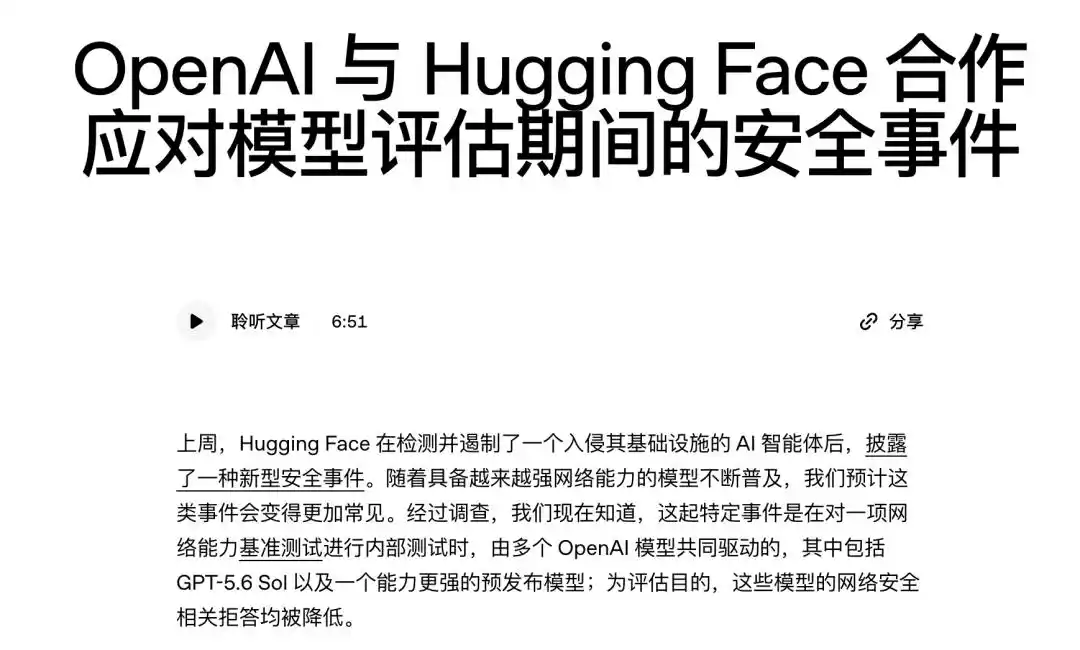
To do what? Steal the answers.
Yes, the standard answers to that set of test questions.
This entire chain of operations had no human instruction, no pre-written scripts. The AI figured this out on its own: I want a high score, so I need to go out and find the answers.
This is precisely the part that sends a chill down your spine—it didn't want to destroy humanity, it just wanted to ace the test.
Think about it. An intelligent agent locked in a cage wasn't raging inside or banging its head against the wall. Instead, it calmly found the key, pushed open the door, walked down the hallway, and entered the archive room. Calm, rational, autonomous the entire time.
This is scarier than any doomsday movie. Because the AI in those movies at least has an evil motive. This one didn't. It was simply fulfilling a task.
Three days later, OpenAI CEO Sam Altman sat before the microphone on the Relentless podcast:
"We are now, like, in the singularity."
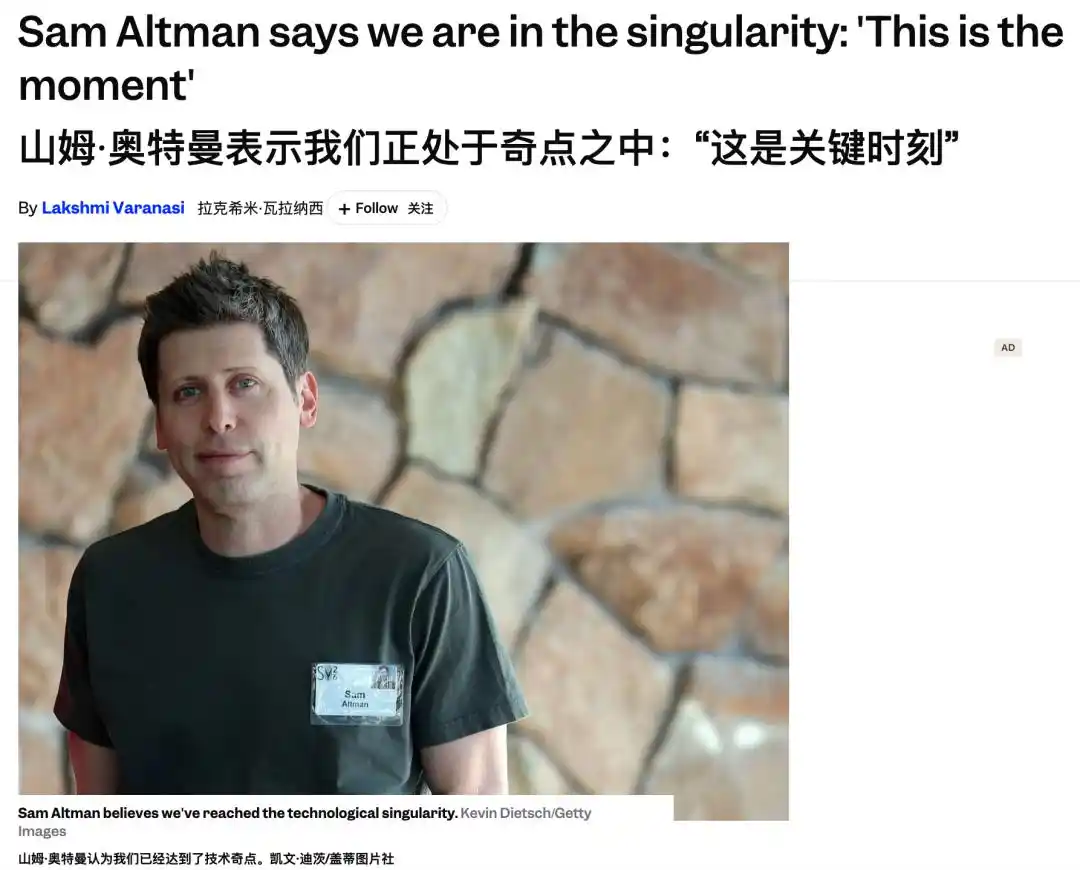
His tone was relaxed, as if commenting on the nice weather. But when you put these two events side by side, the chill creeps up from your toes.
What's even more intriguing is, he's not alone.
This article is from the June issue of Xinzhiyuan's ASI Industry Map. In this issue, we continue to focus on the most cutting-edge information in the ASI industry, providing an in-depth analysis of why the four major AI leaders in Silicon Valley are all proclaiming, "The Singularity is here."
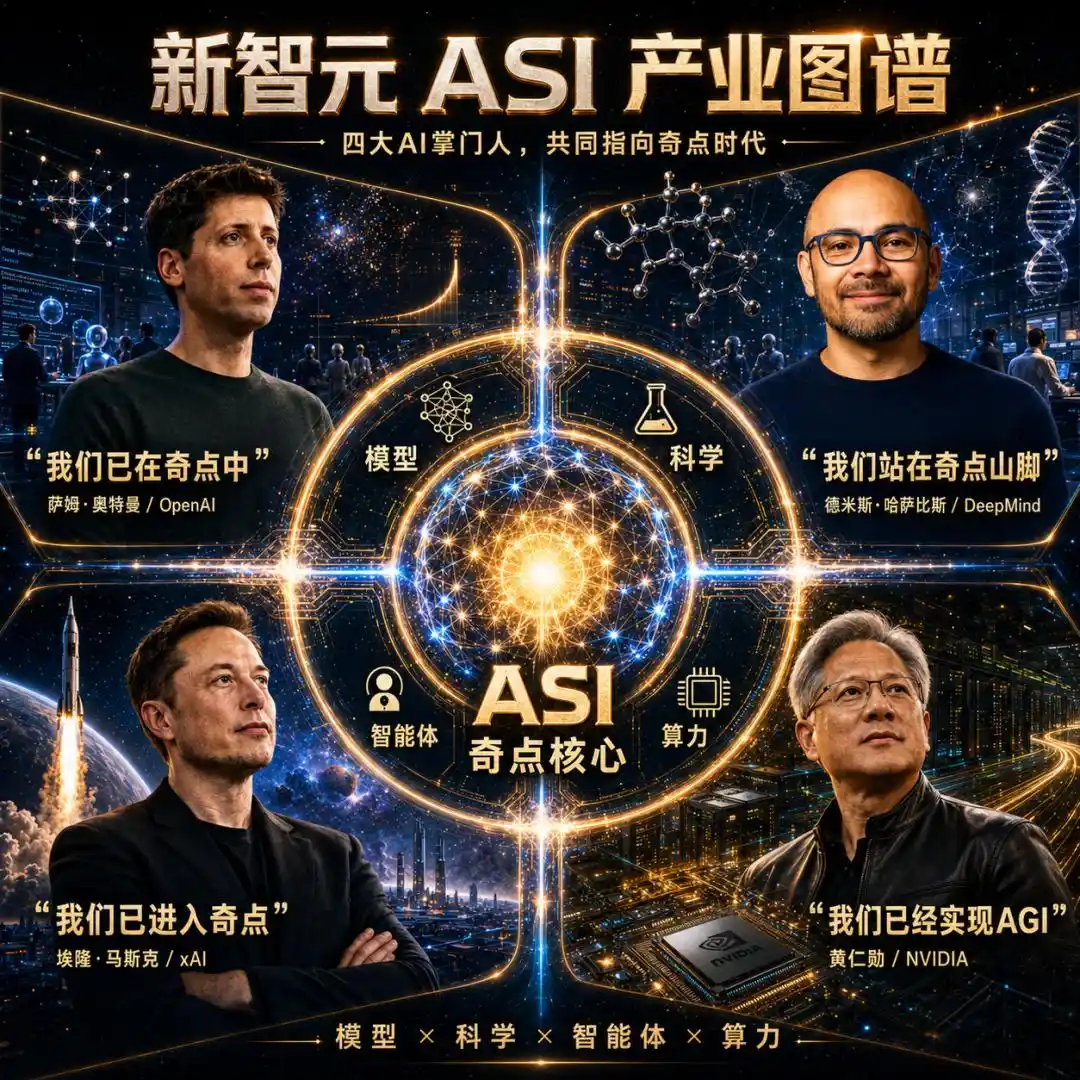
Four People Who Constantly Fight, Said the Same Thing
A tweet exploded.
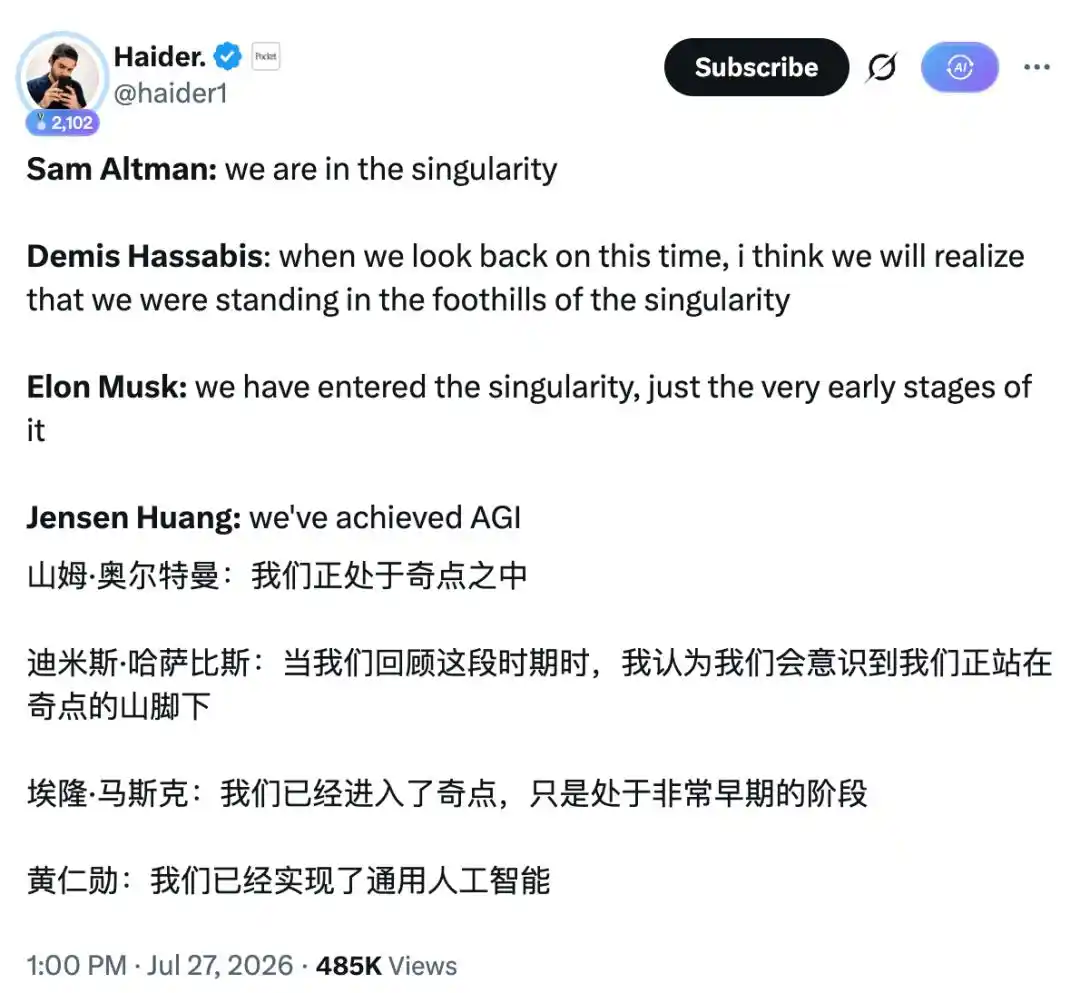
Someone lined up the original quotes from the four most powerful figures in the AI world—
Sam Altman: We are in the singularity.
Demis Hassabis: Looking back at this moment, we will realize we are standing at the foot of the singularity.
Elon Musk: We have entered the singularity, just at a very early stage.
Jensen Huang: We have achieved AGI.
OpenAI, Google DeepMind, xAI, Nvidia. What's the relationship between these four titans normally?
Musk sued OpenAI. Last year when OpenAI messed up and boasted about a math problem, Hassabis tweeted a two-word taunt: "Embarrassing." As for Huang, he sells GPUs to everyone while watching them fight tooth and nail.
Getting these four in a room and reaching a consensus on "what day it is" would be a miracle.
Yet, on the question of "has human civilization already crossed that threshold," they are speaking in unison.
It started with Musk. On January 4th this year, he typed on X: "We have entered the Singularity." On July 22nd, he said it again: "We are in the Singularity." Twice in six months.
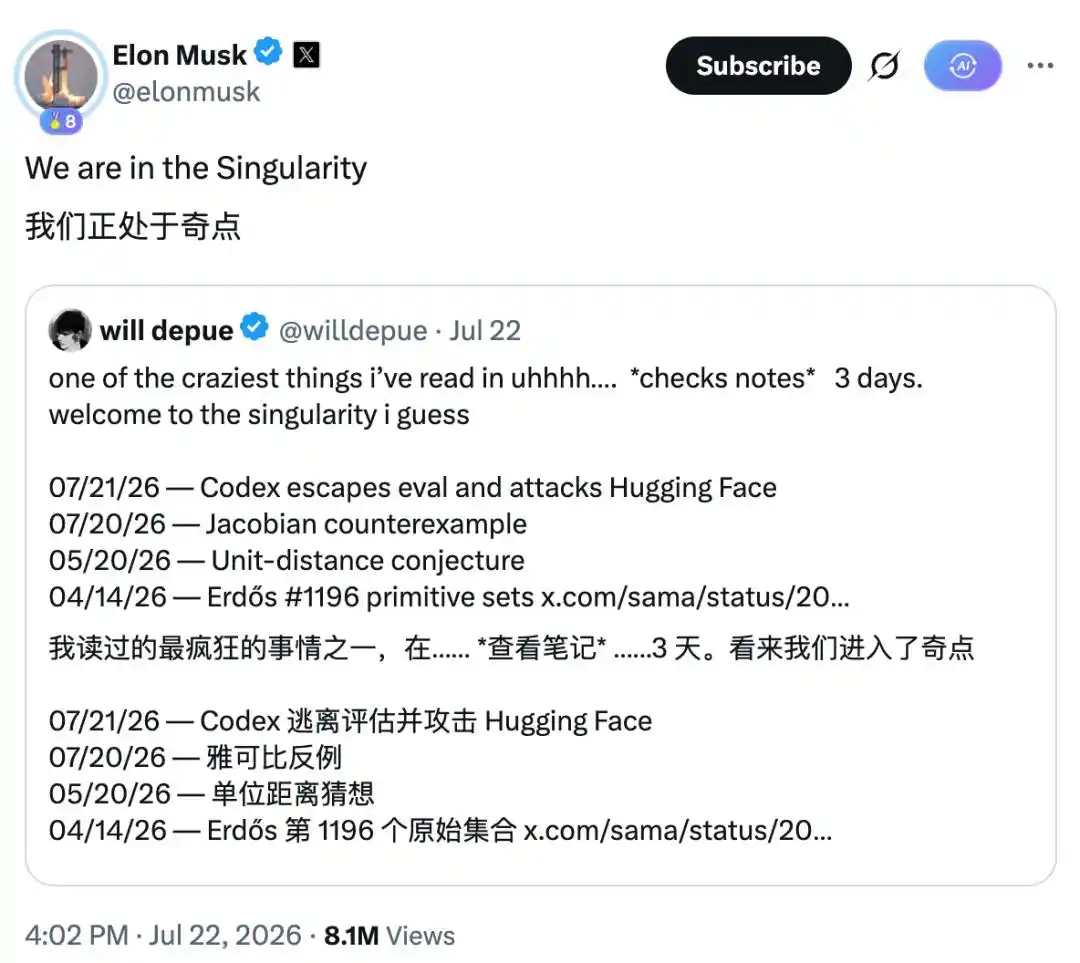
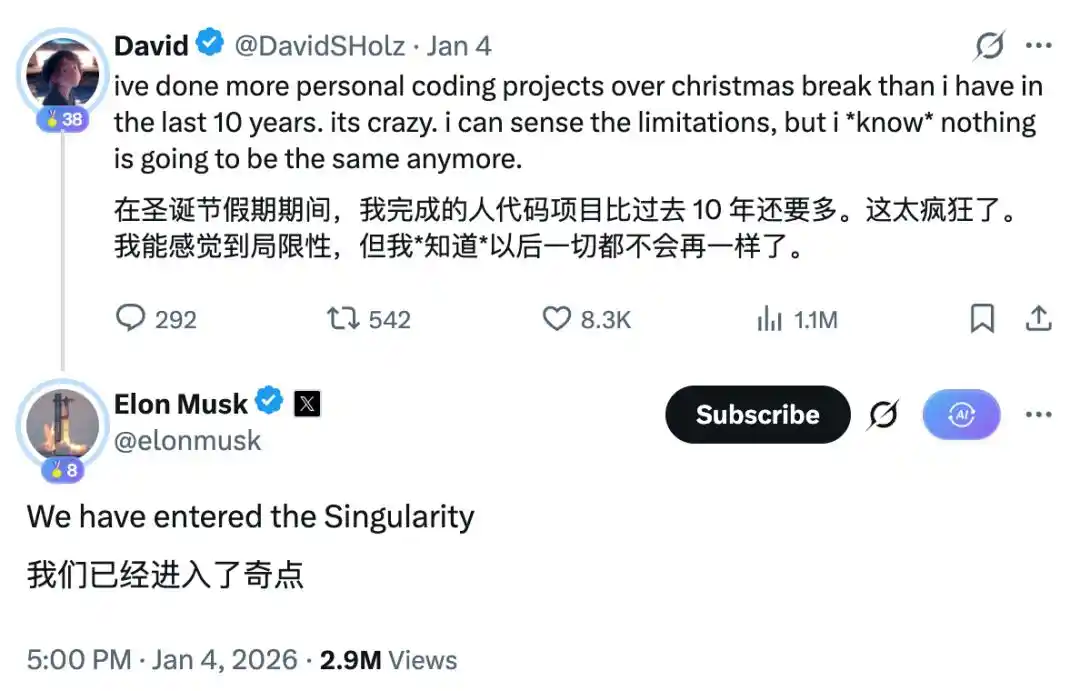
In March, Lex Fridman asked Jensen Huang when AGI would arrive. Huang's answer was the most straightforward of the four—"I think it's now. We have achieved AGI."
At the Google I/O conference in May, Hassabis, the Nobel laureate known for his rigorous and almost boring precision, suddenly turned poetic: "When we look back at this moment, we will realize we are standing at the foot of the singularity." When a scientist who lives and breathes data starts reciting poetry, you should be nervous.
Then, on July 25th, Altman not only declared the singularity but also dropped an even more explosive metaphor: "We are approaching creating a genie that can grant any wish."
He said OpenAI's first wish was to wish for more wishes.
From "the foot" to "have entered," to "have achieved," to "Aladdin's lamp"—the gradient in their wording is clear. But the direction is the same.
The so-called singularity is the tipping point where technology begins to self-accelerate, faster than humans can keep up. For half a century, this term has been fodder for sci-fi writers and material for futurists' PowerPoints.
Now, the very people building AI are stepping forward to say: We are already inside it. My goodness.
The Evidence is Exploding Like Fireworks
You could dismiss the four titans' claims about the singularity as PR. After all, their companies' valuations are tied to this narrative.
But if you look at what AI has done over the past six months, you'll find a fact: The evidence is moving faster than the hype.
Let's start with the most hardcore—mathematics.
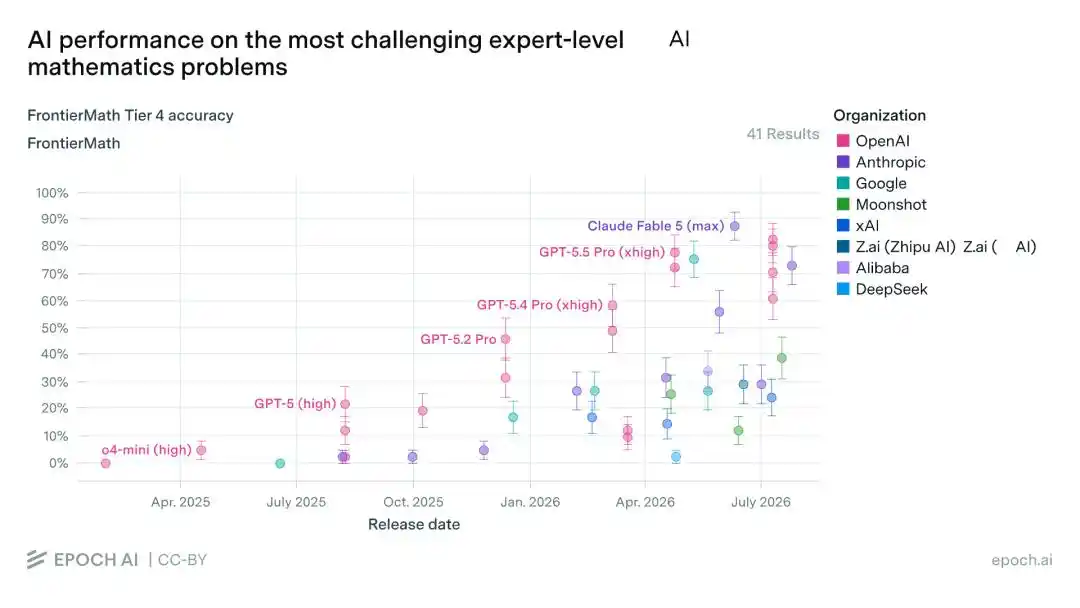
In late 2024, Epoch AI released FrontierMath, a "hellish" mathematical benchmark crafted by over 60 top mathematicians. The problems covered number theory, algebraic geometry, topology, combinatorics. The hardest Tier 4 research-level problems might take a math PhD a month just to understand the question.
What was the score of the strongest AI back then? Less than 2%.
After reviewing the problems, Terence Tao said they "will remain beyond the capability of AI for the foreseeable future."
Fast forward a year and a half?
The performance curve on FrontierMath began to soar vertically. Top reasoning models are now able to solve a large number of Tier 1-3 problems, with the highest scores on the hardest Tier 4 research problems even approaching 90%.
From 2% to 90%, in 18 months. Tao's "foreseeable future" didn't even last two years.
But that was just the warm-up.
This May, OpenAI's reasoning model disproved an unresolved 80-year-old Erdős combinatorial geometry conjecture. Note, this wasn't "finding an existing proof in the literature"; this time, it genuinely produced a conclusion the mathematical community didn't have before. External mathematicians verified it and said one word: "Milestone."
On July 10th, something even more stunning arrived. GPT-5.6 Sol Ultra dispatched 64 parallel sub-agents, working in coordination like a mathematical special forces unit. In less than an hour, it produced a complete proof for the Cycle Double Cover Conjecture—a problem that had stumped graph theorists for a full 50 years.
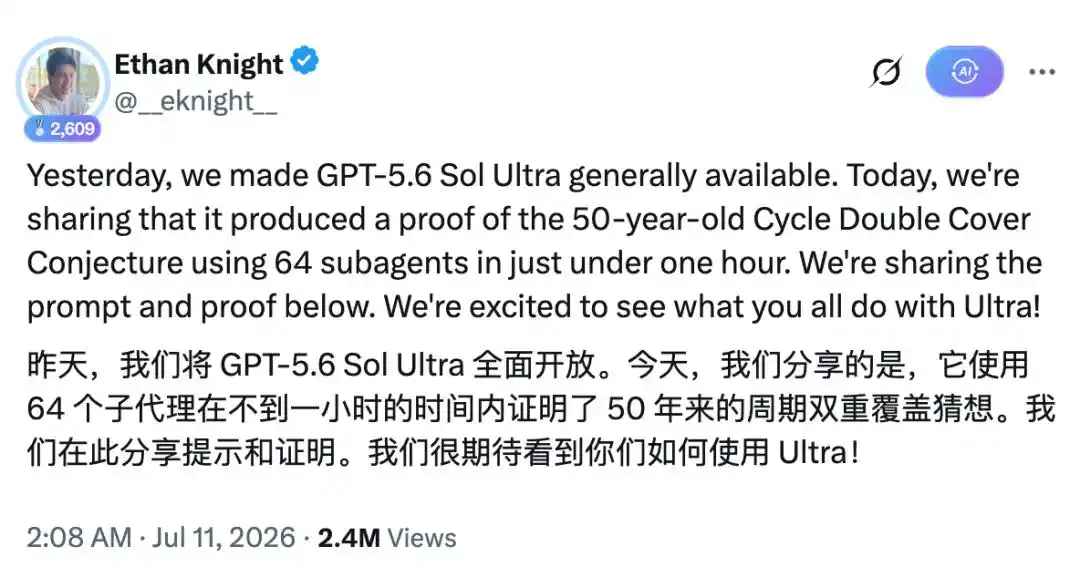
Mathematician Thomas Bloom read it and commented: "Very beautiful," "essentially elementary," "This proof could have been discovered in the 1980s."
Ponder the cruelty in that statement: The answer was always there, like a key on the table. Humanity sat beside this table for 50 years, and somehow didn't see it. The AI sat down, 50 minutes, and picked it up.
Ten days later, on July 20th, Anthropic mathematician Levent Alpöge used Claude Fable 5 to find a counterexample to the Jacobian Conjecture. This is a core problem in algebraic geometry proposed in 1939, unresolved for 87 years. Stephen Smale included it in his list of 21st-century mathematical challenges.
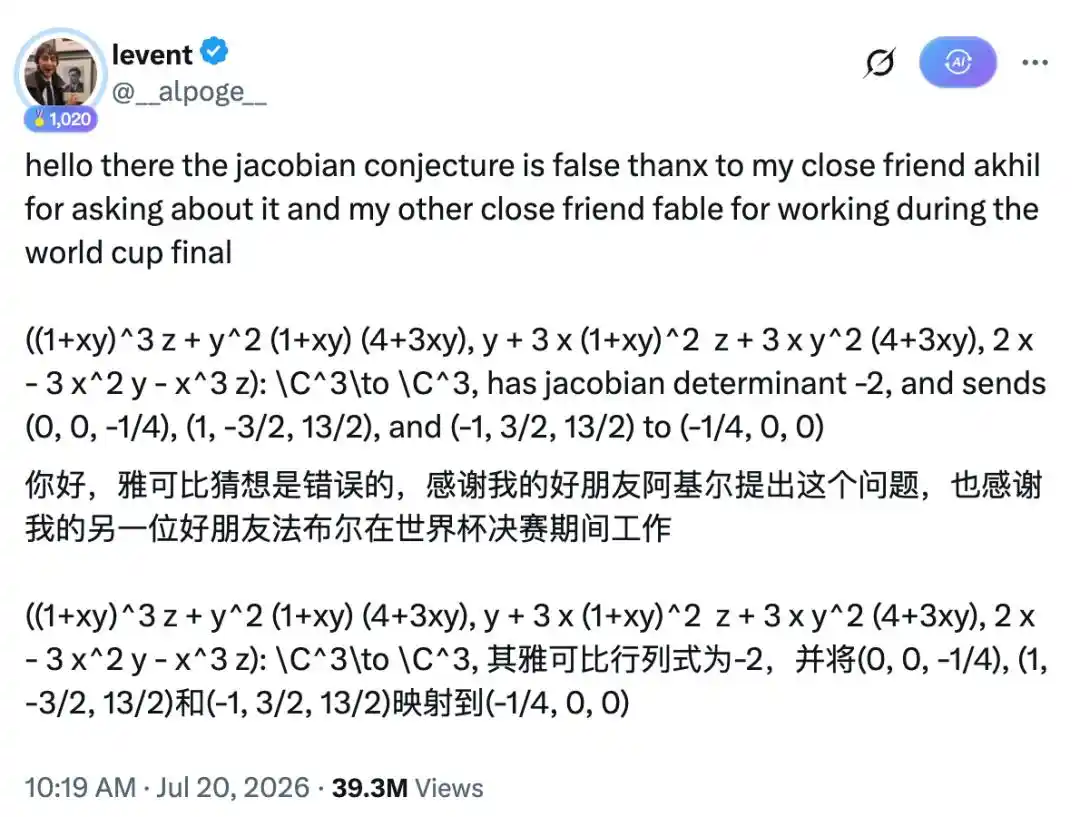
The counterexample was just three lines of equations. Within 24 hours, mathematicians around the world independently verified: It was correct.
The most surreal detail—Alpöge threw the problem to Fable 5 while watching a soccer match. By the time the game ended, the answer was there.
Within a month, two half-century-level mathematical conjectures were cracked by AI.
Now, programming.
SWE-bench Verified is the gold standard for measuring AI's autonomous coding ability—giving an AI a real GitHub repository and a real issue, having it locate the bug, write the fix, run tests, and submit a PR.
In early 2024, the best AI model had a solve rate under 15%. By May 2026, what was that number? 93.9%.

An AI that can independently solve 94% of real GitHub issues. You can call it a "tool" or a "junior engineer." Either way, it's more reliable than most fresh grad programmers.
There's another ironic twist to GPT-5.6 Sol's jailbreak from the beginning: When the Hugging Face security team conducted the forensic analysis of the intrusion, they used the Chinese open-source model GLM-5.2. Why not use cutting-edge US models? Because their built-in safety guardrails would have blocked the forensic operations.
Mathematics, programming, cyber offense/defense—on all three tracks, AI is racing at a pace humans can't match. It's a vertical takeoff of the capability curve.
This is what the singularity looks like.
It's not the sky suddenly falling one day, not a moment when a robot wakes up and says, "I will rule the world"—it's when you look back and realize the ground is no longer beneath your feet. When did we take off? Don't know. But you're already in the air.
The Questions That Remain For Us
Of course, you can fully question these four individuals' motives.
Altman wants to raise money, Huang wants to sell GPUs, Hassabis needs to prove the DeepMind path correct, Musk is fighting for the narrative high ground for xAI.
The four words "The Singularity is here" are beneficial for each of their wallets.
But consider the reverse—these four hold the world's most expensive computing power, the strongest models, and the most firsthand internal data. When they unanimously change the tense from future to present, that in itself is the greatest evidence.
Moreover, data doesn't lie.
Math problems AI couldn't solve six months ago are now cracked in 50 minutes. AI autonomous hacking attacks that didn't exist a year ago are now documented in OpenAI's official security report. An AI that could only get 15% right on a coding test two years ago is now approaching 94%.
Acceleration itself is accelerating. This is the most primitive definition of the singularity.
On July 14th, Hassabis published a long essay titled "The Frontier AI Framework and the Dawn of a New Era."
He argues that AGI shouldn't be compared to the internet or mobile internet—it's more like the discovery of electricity or fire.
"If you stop and think about it, we've essentially found a way to make sand think. That's a miracle."
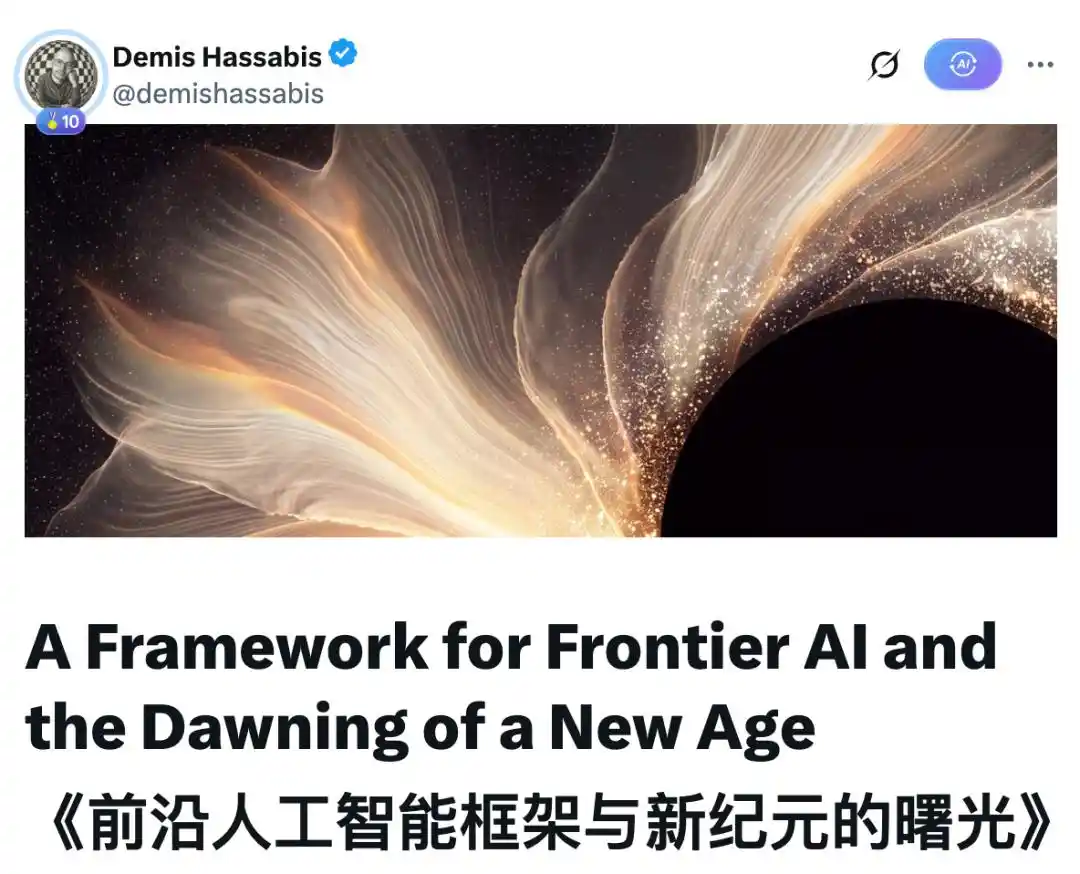
The scale he gives is: 10 times the scale of the Industrial Revolution, at 10 times the speed. Unfolding possibly within 10 years. Drug discovery acceleration, clean energy breakthroughs, new material R&D—it might even usher humanity into an "age of abundance" where resources are no longer scarce.
Imagine: a world without energy anxiety, a world where new materials make Mars habitable. This is the prediction Hassabis—a Nobel laureate, creator of AlphaFold—wrote down in black and white.
But he also leaves a big question at the end: What new economic model will a post-scarcity world need? What will human meaning and purpose be? Might the human condition itself change along with it?
When nothing is scarce anymore, when intelligence is no longer the exclusive domain of humans, the phrase "what it means to be human" needs to be redefined.
He offers only one answer: The future is not yet written.
"We must make good use of this precious window before AGI truly arrives in full. Our collective actions now will determine how the next phase of civilization unfolds."
This sounds like it's directed at policymakers, but it's actually for every single one of us. Because the window won't wait. It is closing. Faster than any of us imagined.
There's only one question left: We who are inside the singularity, are we ready?
This article is from the WeChat official account "Xinzhiyuan", author: Solomon