Bitcoin Shifts Towards Consolidation, Long-Term Holder Selling Pressure Significantly Eases

marsbitPublished on 2026-07-17Last updated on 2026-07-17

Abstract

Bitcoin's Bottoming Process Shows Signs of Shifting Dynamics Bitcoin's bottom formation is ongoing, but key characteristics are changing. The capitulation selling by long-term holders (LTHs), a primary source of selling pressure this cycle, has begun to cool from its recent peak. Buyers successfully absorbed the selling at the June lows, and price is now recovering to challenge overhead resistance. The market is testing higher resistance levels. Bitcoin reacted more strongly to soft inflation data than major equity indices, signaling sellers may be exhausted and buyers are waiting for a catalyst. Its correlation with stocks is weakening while its inverse relationship with the USD is deepening, suggesting liquidity dynamics are now more influential than risk sentiment. On-chain, price sits between the network's Realized Price (a historical bear market floor) and the Short-Term Holder (STH) cost basis near $69k, a key resistance level where recent buyers break even. LTH profit-taking has largely dried up, and losses now dominate realized on-chain volume—a typical late bear market signal. Crucially, the pace of LTH capitulation has started to decline. Derivatives markets show bearish positions are being unwound, with put/call ratios falling and crash protection costs moderating. However, this derisking hasn't been accompanied by significant spot buying, a missing link for sustained recovery. US spot ETF outflows have slowed but not reversed. In conclusion, foundational elem...

Author: Glassnode

Compiled by: AididiaoJP, Foresight News

Bitcoin's bottom is still being built, but its characteristics are quietly shifting. The capitulation selling by long-term holders is cooling off, buy-side demand has successfully absorbed the June lows, and the price is gradually recovering, challenging the zone that previously suppressed it.

Executive Summary

  • The market has begun testing resistance levels above.
  • Bitcoin's reaction to weak inflation data was much stronger than that of any major stock index, marking the most positive response to good news in weeks.
  • Correlations with equities are loosening, while the inverse linkage with the dollar is deepening further – the current driver is liquidity, not risk appetite.
  • Long-term holder selling – the primary source of selling pressure this year – has retreated from its peak.
  • Profit-taking has drastically reduced. Buyers have fully absorbed the selling pressure at the June lows, diminishing the supply pressure faced on each subsequent rally.
  • The Short-Term Holder cost basis is near $69,000, the break-even line for recent buyers, which will become the next significant resistance; a strong reaction is expected there.
  • Derivative traders are unwinding bearish positions, but spot buying has not yet followed, which is the missing link in the current recovery.

Macro Insights

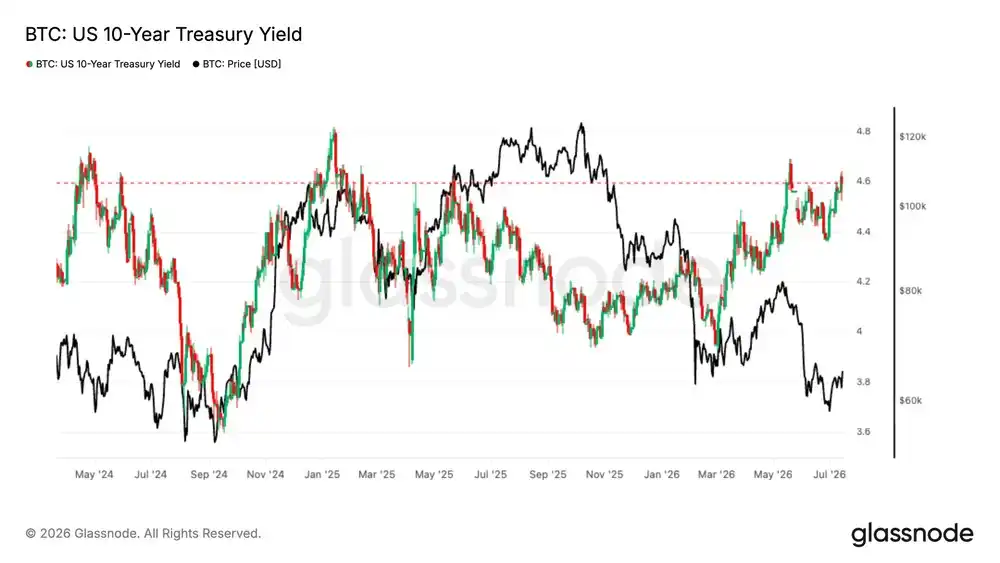
The pressure faced by Bitcoin this quarter is essentially a story of real rates, not risk-off. The 10-year real yield has climbed to around 2.4%, near the 2026 highs, and the dollar has held above its 200-day moving average since May. However, broader risk assets show no signs of strain: equities are near highs, credit spreads are low, and volatility remains moderate.
Bitcoin Leads the Rally

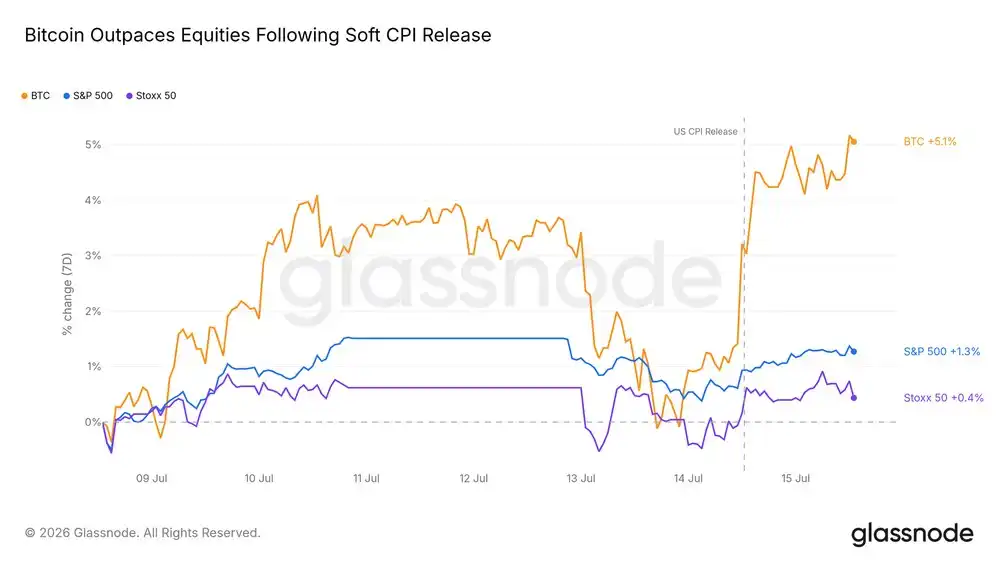
Following Tuesday's soft inflation data, Bitcoin posted larger gains than any other major asset. It jumped swiftly after the release, significantly outperforming US and European stocks for the week. After a month of sideways movement near lows, the market is once again reacting positively to good news.

This sensitivity is itself a signal: a market eager to rally on a single inflation report often indicates that sellers are exhausted, and buyers are just waiting for a reason.
Shift in Macro Drivers

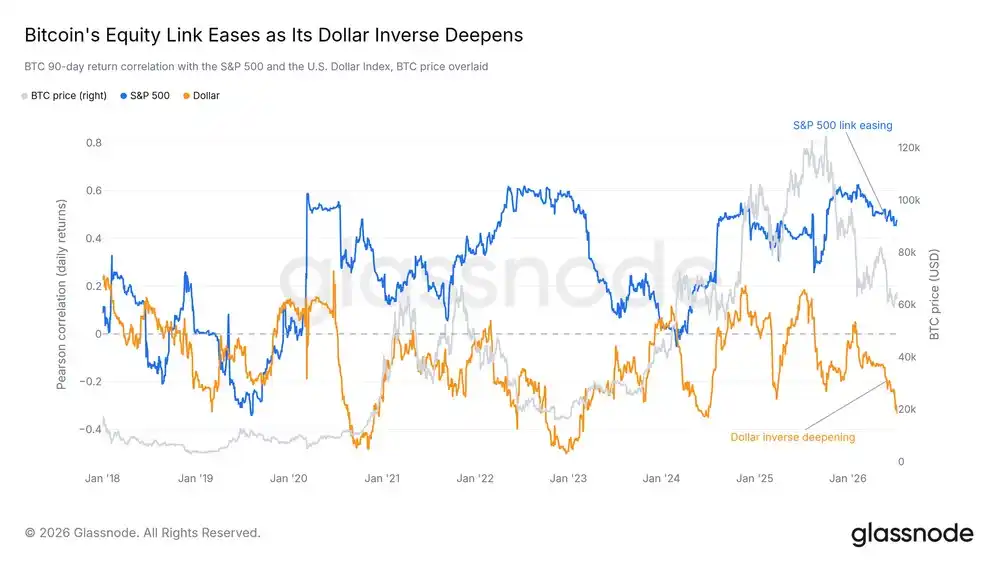
Underneath the rally, Bitcoin's driving factors are changing. Its correlation with US stocks has been weakening since winter, while its inverse relationship with the dollar has deepened. Bitcoin is looking less like a proxy for stocks and more like an asset that strengthens when the dollar weakens.

It has not decoupled from the risk asset universe, but the dollar and liquidity channels now hold more sway than stock market sentiment. This is the channel most likely to transmit first if the macro environment loosens from here.
On-Chain Insights

Between Floor and Ceiling

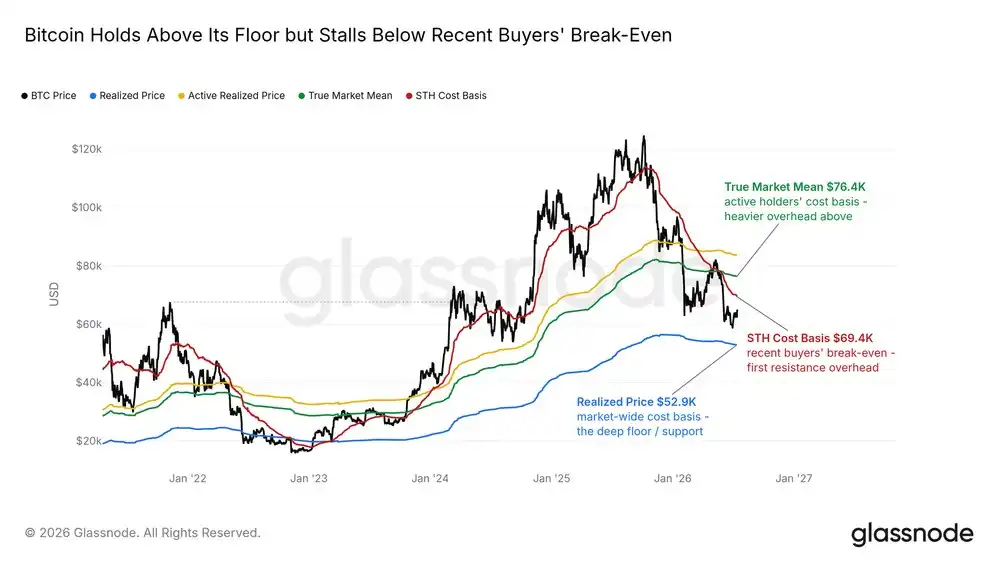
The cost basis map precisely illustrates the current position. The Bitcoin price is above the network's average realized price – a natural floor in bear markets; yet it is below the Short-Term Holder cost basis (near $69,000) – the average entry price for buyers over the past five months. The current recovery is climbing towards this break-even resistance level, with a large number of trapped buyers waiting above.

The first touch of this level is likely to trigger a strong reaction, as those most inclined to sell are the ones about to break even. Successfully reclaiming it would open space for the recovery; rejection would reinforce the range-bound pattern.
Sellers Stop Taking Profits

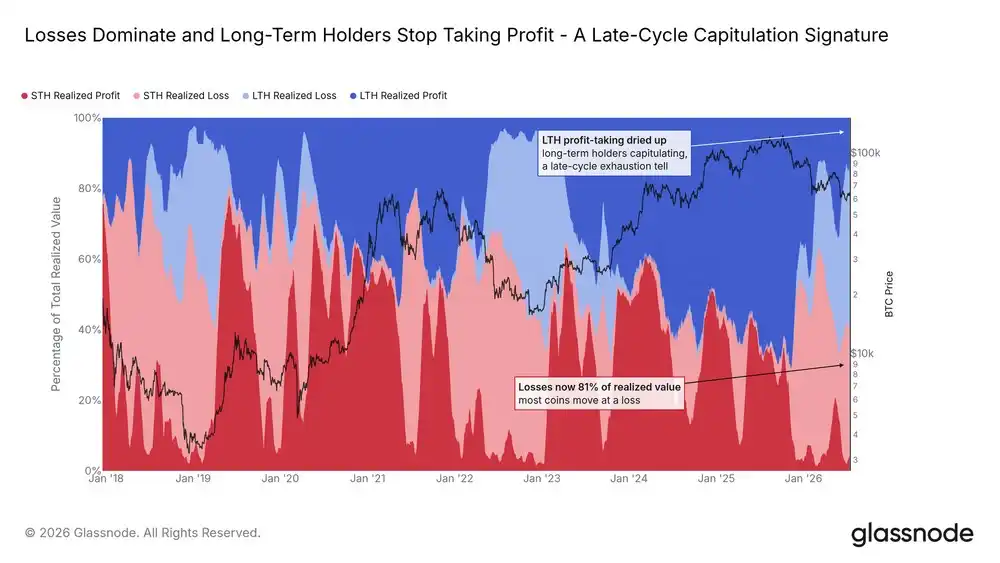
The Long-Term/Short-Term Holder Realized Profit/Loss ratio indicator categorizes all on-chain selling into four types: veterans and newcomers, each selling at a profit or loss. For most of this cycle, selling by long-term holders at a profit dominated the selling flow. This flow has now nearly dried up completely; veterans are primarily selling at a loss.

Loss-selling by both cohorts now constitutes the main transactional signature on-chain, a typical late-bear signal. The crucial change is that the share of selling by long-term holders has stopped growing. The wave of selling pressure that has capped every rally this year is no longer expanding.
Capitulation Selling Begins to Cool

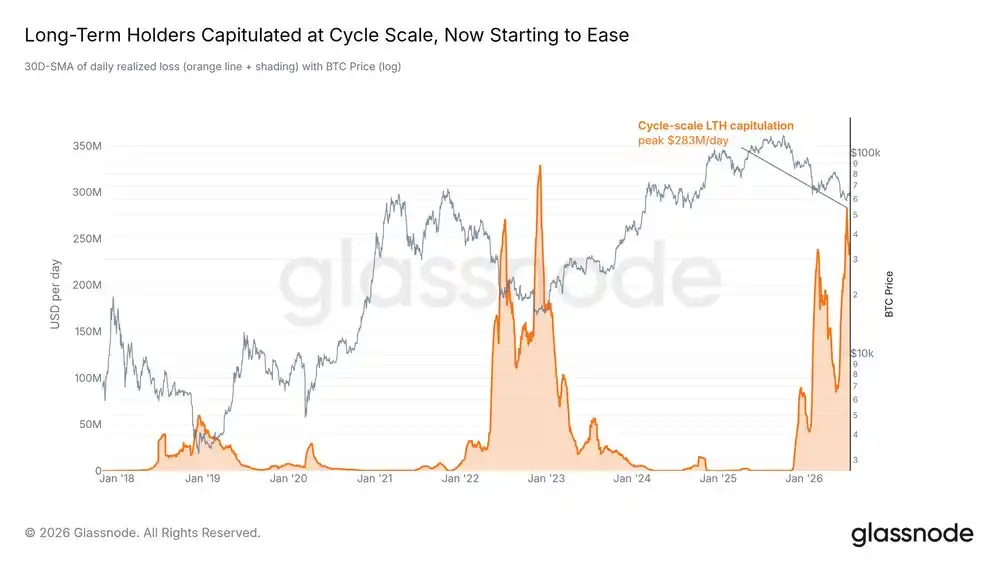
The rhythm of this capitulation is the most important current metric. The Entity-Adjusted Long-Term Holder Realized Loss metric filters out internal transfers, reflecting the actual volume that veterans are giving up each day. This metric hit a cycle peak two weeks ago; last week's report highlighted that its cooling was a prerequisite for any lasting recovery.

Now it has begun to recede. A single pullback doesn't prove exhaustion, and new shocks could restart selling. But in this cycle, it's the first time this core metric defining the bottoming process has shifted from rising to falling. The primary sellers driving this bear market are, at the margin, drying up.
Demand Absorbs Lows Selling

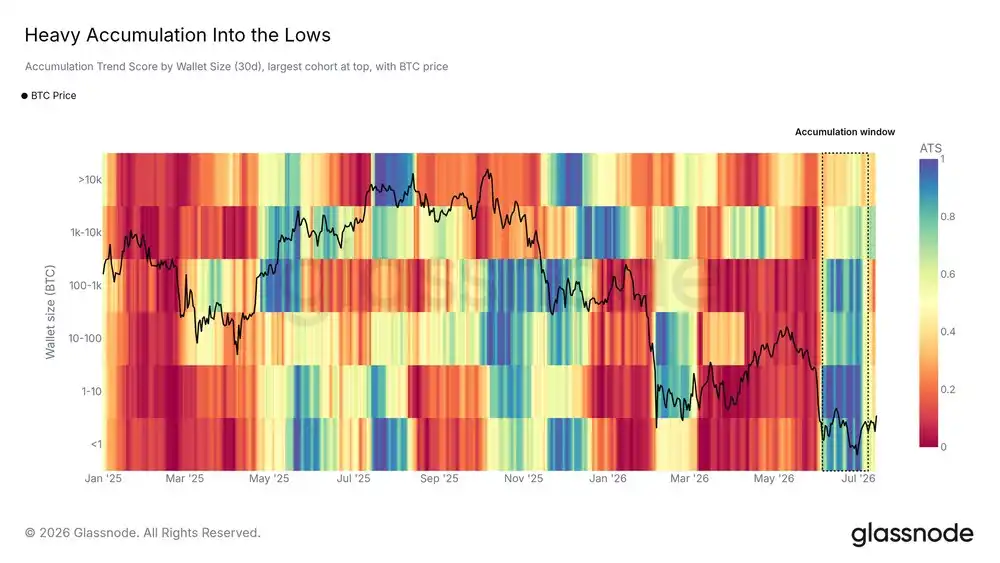
As veterans capitulated, buyers stepped in promptly. The Accumulation Trend Score, segmented by wallet size, shows a broad and strong wave of buying during the June lows, covering wallets from small to large. After prices stabilized, this intensity weakened, and the market entered a waiting mode.

The coins sold at the lows found buyers. Whether these buyers return with similar force in the next move will determine whether this bottom holds.
Off-Chain / Derivatives Insights

ETF Outflows Slow

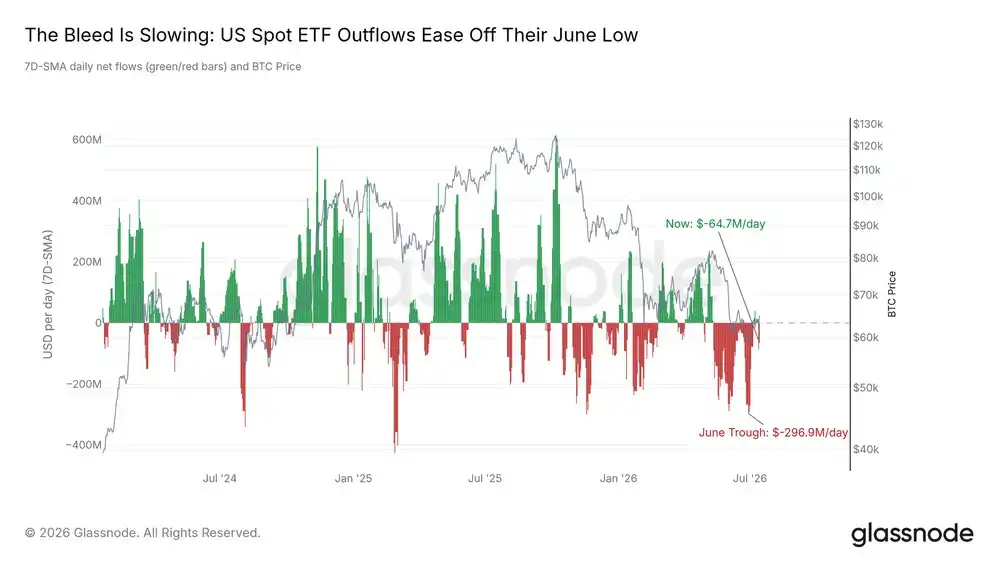
US Spot ETFs tell a similar story of easing but unresolved pressure. Redemption pressure has significantly retreated from June's extreme levels, trending towards stabilization. However, the channel is not fully repaired: this week still saw one of the largest single-day outflows in several weeks, followed by a partial inflow the next day.

Until inflows truly return and hold steady, this remains a market where institutions have stopped fleeing but have not yet started buying.
Bears Throw in the Towel

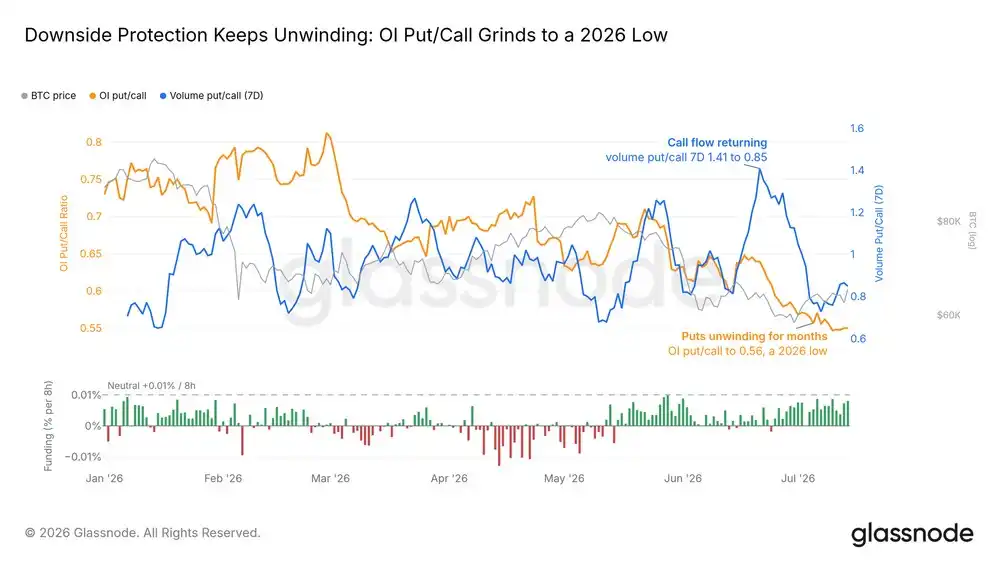
Derivative markets have been moving in the opposite direction for weeks. The options put/call ratio has fallen to its lowest level this year, with traders letting bearish protection expire; perpetual funding rates are only slightly above neutral, far from crowded long levels. Bearish bets are quietly and steadily unwinding.

But this unwinding hasn't translated into actual buying. Position adjustments by futures and options traders do not equate to capital entering the spot market, which is the clearest warning sign in the current recovery.
Panic Premium Eases

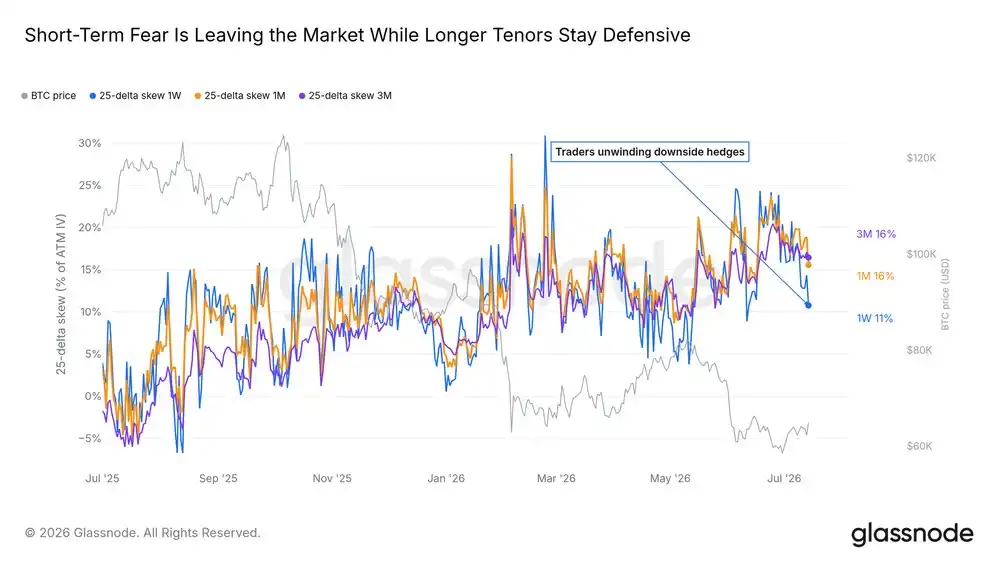
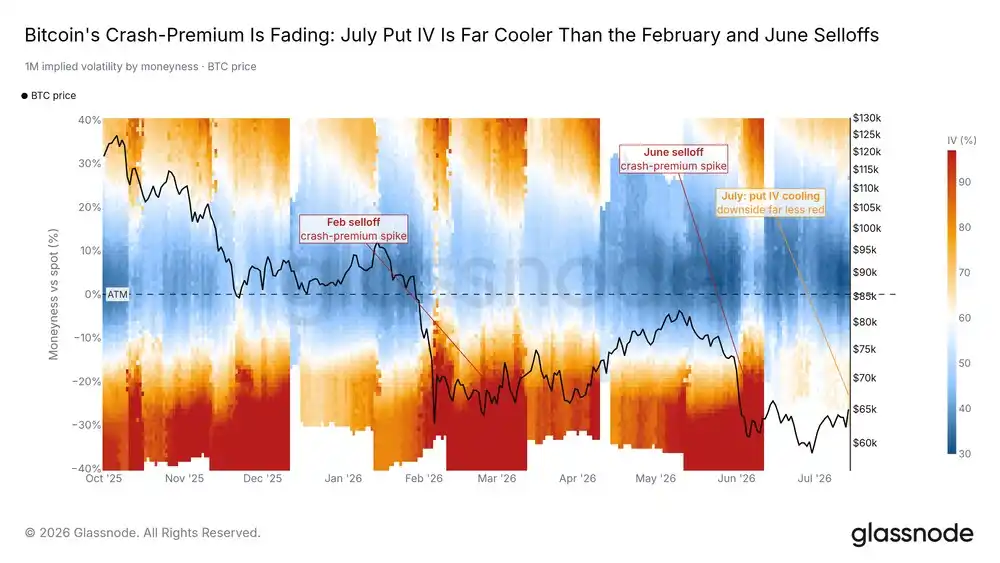
The premium for crash protection in the options market (measured via 25-Delta Skew) spiked during the June sell-off but has since consistently receded, now well below February's extreme levels. The cost of hedging each pullback is noticeably lower than a month ago.

Demand for protection still exists – as it should with unconfirmed lows – but the overall direction is normalizing.
Approaching Max Pain

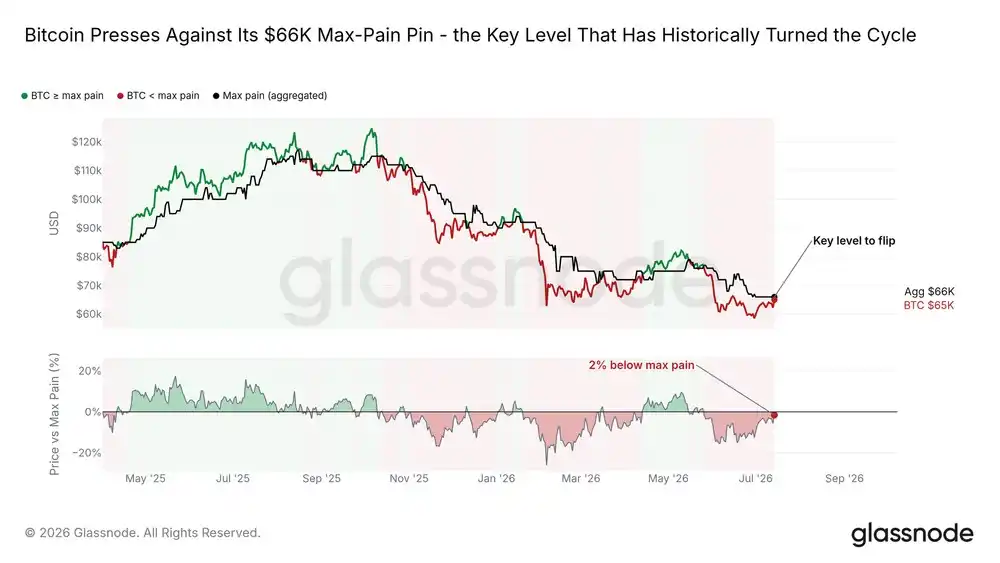
Max Pain is the price at which the largest volume of open options expires worthless, and spot price has oscillated around it this year. Bitcoin is currently just below this level and challenging it for the first time in weeks.

Historically, reclaiming Max Pain often coincides with a shift to a more market-friendly environment, though the transition takes time. A clean break above this level would be the first structural signal of an upside breakout from the range; rejection would confirm the cautious sentiment still priced into the options market.
Crash Protection Costs Decline

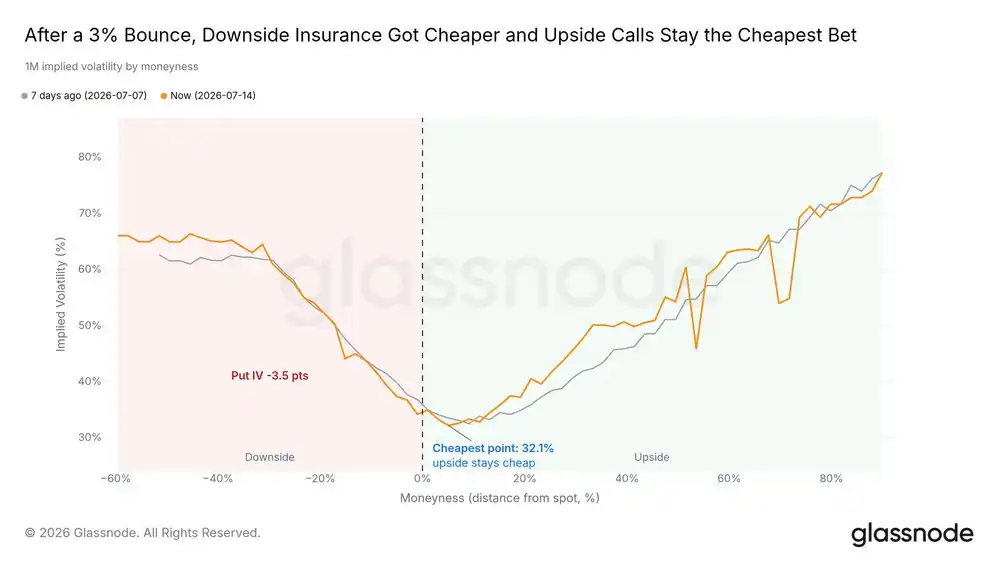
Absolute protection costs also confirm the easing trend. During the recovery, the price for one-month crash protection has steadily declined, indicating waning hedging demand. The market still pays a premium for downside protection, but significantly less than at the lows.
Volatility Enters a Calm Period

A longer-term view shows how calm the market has become. The Bitcoin Volatility Index (DVOL) is near one-year lows, and the deep put pressure that erupted in February and June has faded from the volatility surface. Such compression rarely lasts; it's often the backdrop before the next decisive move begins.
Conclusion

A bottom is still being built, and this week it began to respond. Long-term holder capitulation has retreated from its peak, profit-taking has dried up, and the June lows were absorbed by broad-based buying. Bitcoin reacted more strongly to macro-positive news than other assets, is approaching Max Pain from below, and nearing the Short-Term Holder cost basis above – where the recovery will face its first real test.

Confirmation signals are still absent: ETF outflows have slowed but not reversed, derivative unwinding lacks spot follow-through, and compressed volatility awaits a catalyst. The key signal to change the view would be spot-driven buying that pushes price to effectively break through and hold above the Short-Term Holder cost basis. If long-term holder losses accelerate again, or if price is pushed back near the Realized Price, the market will return to range-bound trading.

The foundation is laid, but the follow-through has not yet arrived.

Trending Cryptos

Related Questions

QWhat is the key change in the behavior of long-term Bitcoin holders according to the article?

AThe key change is that the selling pressure from long-term holders, which was the primary source of sell pressure this year, has peaked and is now declining. Specifically, profit-taking sales by long-term holders have almost completely dried up, and their realized loss selling has started to cool off from its recent peak.

QWhat are the two key price levels that define Bitcoin's current trading range, as mentioned in the article?

AThe two key levels are the Realized Price (the network-wide average cost basis), which acts as a floor, and the Short-Term Holder Cost Basis (around $69,000), which acts as a ceiling. Bitcoin is currently trading between these two levels.

QHow did Bitcoin react to the soft inflation data mentioned in the article compared to other assets?

ABitcoin reacted more strongly to the soft inflation data than any other major asset class. It rallied immediately after the data release and significantly outperformed major stock indices (US and European) over the week, marking its most positive response to good news in weeks.

QWhat does the article identify as the missing element in the current Bitcoin market recovery?

AThe missing element is spot-driven buying. While derivatives traders are unwinding bearish bets (reducing shorts and letting puts expire), this adjustment in positions has not been accompanied by significant capital flowing into the spot market to buy Bitcoin directly.

QWhat is the 'Max Pain' price level, and what significance does the article attach to Bitcoin's price action relative to it?

AThe 'Max Pain' price is the strike price at which the largest number of open option contracts would expire worthless. The article states that Bitcoin's price has oscillated around this level all year and is now challenging it from below for the first time in weeks. A clean break and hold above Max Pain would be the first structural signal of an upward breakout from the range, while a rejection would confirm the cautious sentiment still priced in by options markets.

Related Reads

Li Shanyou: The World Is Getting More Competitive, But We Can Choose to Be Slower, Go Deeper, and Turn Inward

**Title:** Li Shanyou: The World Is Moving Faster and More Chaotically; We Can Choose to Be Slower, Deeper, and More Inward **Summary:** In an era where AI evolves weekly and past experiences often fail, the article argues for returning to First Principles. It shifts focus from "cognition" (knowledge/content), which AI has disrupted, to "consciousness" or "the capacity to know"—the foundational ability that enables cognition and determines its scope and depth. The piece uses Zhang Yiming (founder of ByteDance) as a case study for the "second-order consciousness" of the mobile internet era: success through rational logic, modeling, and deduction, which allowed him to surpass earlier "first-order" entrepreneurs reliant on copying experiences. However, the author suggests that the AI era demands a further leap to "third-order consciousness"—operating from a place of inner inspiration, vision, or "ideas," beyond pure rationality. Figures like Elon Musk and Steve Jobs are cited as examples, with DeepSeek's Liang Wenfeng presented as a potential representative of this new, AI-native wave of entrepreneurs driven by curiosity and innovation rather than just commercial logic. For the majority who may not become such visionary leaders, the author proposes an alternative path: the "Path of Quality" or "Work as Art." This involves turning inward, focusing on the immediate task at hand, and imbuing one's work with care and dedication—creating a "quality" product not as a means to an end, but as an end in itself. This process refines both the work and the individual's own consciousness. In a hyper-competitive, fast-paced world, this path offers a counterpoint: to be slower, go deeper, and focus inward, finding meaning by creating quality in everyday endeavors, regardless of scale.

marsbit1h ago

Li Shanyou: The World Is Getting More Competitive, But We Can Choose to Be Slower, Go Deeper, and Turn Inward

marsbit1h ago

1inch Co-founder Anton Bukov Leaves, Launches New Project Second Tier

Anton Bukov, co-founder of the decentralized exchange aggregator protocol 1inch, has announced his departure from the company's daily operations. Bukov, who was instrumental in designing core 1inch architectures like the Router, Fusion, and cross-chain Swap, ceased involvement in November 2025 due to strategic and leadership disagreements, though he retains his co-founder title and 50% equity stake. Concurrently, Bukov unveiled his new venture, Second Tier (tier.xyz), describing it as infrastructure to "shorten the distance between economic intent and on-chain execution." He explicitly stated it is not a DEX or aggregator. The project's public-facing material is currently a manifesto criticizing systemic financial friction and advocating for building new architectural categories rather than competing within existing ones. No product details, team, or funding have been disclosed. The split highlights a strategic divergence within 1inch. While CEO Sergej Kunz has steered the company toward traditional finance integration—evidenced by a 2025 brand refresh and a major Coinbase partnership—Bukov emphasized a commitment to decentralized, permissionless DeFi principles. Bukov's exit coincides with a challenging period for 1inch. Q1 2026 data shows a 60.3% quarterly drop in its daily average trading volume to $97.1 million, underperforming the broader DEX aggregator market decline. Its market share fell from 25.2% to 17.0%, dropping it to fourth place among competitors. Key questions remain regarding Bukov's future role as a major 1inch shareholder, the timeline for Second Tier's product development, and whether 1inch's institutional-focused strategy can reverse its declining trading metrics.

Foresight News1h ago

1inch Co-founder Anton Bukov Leaves, Launches New Project Second Tier

Foresight News1h ago

Meituan Leads Investment, New Unicorn in Dexterous Hands Born

Xynova, a full-stack provider of dexterous hand solutions for embodied intelligence, has officially become a unicorn after securing a 500 million yuan Series A+ round led by Meituan. This marks the company's third major funding in 2024, bringing the total raised in four months to approximately 1.5 billion yuan. The investment lineup features a prominent group of industrial and internet giants, including repeat investors like Xiaomi and new backers such as NIO Capital and China Merchants Capital. With total market capitalization of its industrial shareholders exceeding 5 trillion yuan, the backing represents a strategic positioning across the new energy manufacturing, smart logistics, and last-mile delivery sectors. Founded in 2024 by CEO Xia Yuxuan, Xynova focuses on the critical "last centimeter" of robot interaction—the dexterous hand. Moving beyond traditional technical debates, the company adopts a full-stack, self-developed approach, integrating hardware and algorithms. Its flagship product, the Flex 2, is a hybrid tendon-and-direct-drive hand with 23 degrees of freedom, weighing under 400 grams and boasting a key component lifespan of over 1.5 million cycles. The industry narrative is shifting from robot mobility to practical utility, making reliable, mass-producible components crucial. Xynova has established a 5,400-square-meter factory in Hangzhou, with annual capacity expected to reach 10,000 units by year-end. The company believes embodied robots will see large-scale real-world adoption within three years, potentially as soon as 18 months.

marsbit1h ago

Meituan Leads Investment, New Unicorn in Dexterous Hands Born

marsbit1h ago

Trading

Spot

Hot Articles

What is $BITCOIN

DIGITAL GOLD ($BITCOIN): A Comprehensive Analysis Introduction to DIGITAL GOLD ($BITCOIN) DIGITAL GOLD ($BITCOIN) is a blockchain-based project operating on the Solana network, which aims to combine the characteristics of traditional precious metals with the innovation of decentralized technologies. While it shares a name with Bitcoin, often referred to as “digital gold” due to its perception as a store of value, DIGITAL GOLD is a separate token designed to create a unique ecosystem within the Web3 landscape. Its goal is to position itself as a viable alternative digital asset, although specifics regarding its applications and functionalities are still developing. What is DIGITAL GOLD ($BITCOIN)? DIGITAL GOLD ($BITCOIN) is a cryptocurrency token explicitly designed for use on the Solana blockchain. In contrast to Bitcoin, which provides a widely recognized value storage role, this token appears to focus on broader applications and characteristics. Notable aspects include: Blockchain Infrastructure: The token is built on the Solana blockchain, known for its capacity to handle high-speed and low-cost transactions. Supply Dynamics: DIGITAL GOLD has a maximum supply capped at 100 quadrillion tokens (100P $BITCOIN), although details regarding its circulating supply are currently undisclosed. Utility: While precise functionalities are not explicitly outlined, there are indications that the token could be utilized for various applications, potentially involving decentralized applications (dApps) or asset tokenization strategies. Who is the Creator of DIGITAL GOLD ($BITCOIN)? At present, the identity of the creators and development team behind DIGITAL GOLD ($BITCOIN) remains unknown. This situation is typical among many innovative projects within the blockchain space, particularly those aligning with decentralized finance and meme coin phenomena. While such anonymity may foster a community-driven culture, it intensifies concerns about governance and accountability. Who are the Investors of DIGITAL GOLD ($BITCOIN)? The available information indicates that DIGITAL GOLD ($BITCOIN) does not have any known institutional backers or prominent venture capital investments. The project seems to operate on a peer-to-peer model focused on community support and adoption rather than traditional funding routes. Its activity and liquidity are primarily situated on decentralized exchanges (DEXs), such as PumpSwap, rather than established centralized trading platforms, further highlighting its grassroots approach. How DIGITAL GOLD ($BITCOIN) Works The operational mechanics of DIGITAL GOLD ($BITCOIN) can be elaborated on based on its blockchain design and network attributes: Consensus Mechanism: By leveraging Solana’s unique proof-of-history (PoH) combined with a proof-of-stake (PoS) model, the project ensures efficient transaction validation contributing to the network's high performance. Tokenomics: While specific deflationary mechanisms have not been extensively detailed, the vast maximum token supply implies that it may cater to microtransactions or niche use cases that are still to be defined. Interoperability: There exists the potential for integration with Solana’s broader ecosystem, including various decentralized finance (DeFi) platforms. However, the details regarding specific integrations remain unspecified. Timeline of Key Events Here is a timeline that highlights significant milestones concerning DIGITAL GOLD ($BITCOIN): 2023: The initial deployment of the token occurs on the Solana blockchain, marked by its contract address. 2024: DIGITAL GOLD gains visibility as it becomes available for trading on decentralized exchanges like PumpSwap, allowing users to trade it against SOL. 2025: The project witnesses sporadic trading activity and potential interest in community-led engagements, although no noteworthy partnerships or technical advancements have been documented as of yet. Critical Analysis Strengths Scalability: The underlying Solana infrastructure supports high transaction volumes, which could enhance the utility of $BITCOIN in various transaction scenarios. Accessibility: The potential low trading price per token could attract retail investors, facilitating wider participation due to fractional ownership opportunities. Risks Lack of Transparency: The absence of publicly known backers, developers, or an audit process may yield skepticism regarding the project's sustainability and trustworthiness. Market Volatility: The trading activity is heavily reliant on speculative behavior, which can result in significant price volatility and uncertainty for investors. Conclusion DIGITAL GOLD ($BITCOIN) emerges as an intriguing yet ambiguous project within the rapidly evolving Solana ecosystem. While it attempts to leverage the “digital gold” narrative, its departure from Bitcoin's established role as a store of value underscores the need for a clearer differentiation of its intended utility and governance structure. Future acceptance and adoption will likely depend on addressing the current opacity and defining its operational and economic strategies more explicitly. Note: This report encompasses synthesised information available as of October 2023, and developments may have transpired beyond the research period.

848 Total ViewsPublished 2025.05.13Updated 2025.05.13

What is $BITCOIN

Discussions

Welcome to the HTX Community. Here, you can stay informed about the latest platform developments and gain access to professional market insights. Users' opinions on the price of BTC (BTC) are presented below.

活动图片