Olympus DAO Myth Reappears? A "Sovereign On-Chain Central Bank" Written with 4000 Lines of Immutable Code

marsbitPublished on 2026-08-24Last updated on 2026-08-24

Abstract

A new project called The Standard Reserve has emerged, branding itself as a "sovereign on-chain central bank." It aims to replicate core central bank functions—currency issuance, money supply adjustment, and reserve accumulation—entirely through 4,000 lines of immutable code, with no human governance. Its core mechanism is a "reflexive monetary policy" based on a single signal: the net ETH flow into or out of the system's sole Uniswap v4 ETH/$STANDARD pool. Sustained net ETH inflows trigger an "expansion" phase, increasing $STANDARD issuance and using protocol fees to buy tokenized gold as a permanent hard reserve. Net outflows (or zero flow) trigger an immediate "contraction" phase, reducing issuance and using fees to buy back and burn $STANDARD. The system involves six key entities: the $STANDARD token (hard-capped at 1 billion), the central Uniswap pool, the Central Bank contract, Charter NFTs (acting as "banking licenses"), Branch units under each Charter (which earn a share of newly minted $STANDARD), and separate Vaults for expansion (buying gold) and contraction (buying back $STANDARD). To participate, users ideally acquire a Founding Charter NFT (initially 1,000 are free via allowlist/public mint). Each Charter comes with one Branch; more can be opened by burning $STANDARD for "expansion permits," increasing revenue share. Retiring a Branch lets users claim accumulated $STANDARD but imposes a dynamic exit fee (higher if many exit simultaneously), with half the fee ...

Crypto friends who see the symbol (3,3) know the power of Olympus DAO $OHM @OlympusDAO in 2021.

IDO price $4, peak at $1,415, a rise of over 300 times—and that's just the price increase, not counting the additional tokens from rebases. If you held, starting with $500 could truly have a chance to become $5 million.

Since then, any project waving the flag of being an OHM copycat could garner attention or support from a group of followers.

But those days are gone!

Back to the topic.

A very interesting new project recently appeared on-chain: The Standard Reserve. It doesn't call itself a stablecoin, nor a governance token, but directly proclaims itself as "The sovereign onchain central bank."

一、 What does it actually want to do?

Traditional central banks have three core functions:

— Issue currency

— Regulate money supply

— Accumulate reserve assets

The Standard Reserve implements these three things entirely with code, with no committee, no board, no human intervention. The whitepaper sums it up in one sentence:

“It answers to no board, committee, or government. Because it’s 4,000 lines of immutable code. The bank is code.”

The entire system is a closed monetary economy with only four core elements:

One currency: $STANDARD

One market: The ETH/$STANDARD pool on Uniswap v4 (with a custom hook)

One signal: The net ETH flow of this pool

One authority: The code itself

二、 Core Mechanism: Reflexive Monetary Policy

This is the most essential part of the entire project.

The system only looks at one signal

—— Net ETH Flow: Net inflow > 0 (someone continuously buys $STANDARD with ETH) → Expansion period increases the issuance rate of $STANDARD, then uses the fees mainly to purchase tokenized gold, held permanently as hard reserves

—— Net inflow ≤ 0 (someone continuously sells $STANDARD) → Contraction period immediately reduces issuance rate, uses the fees mainly to repurchase and burn $STANDARD

Moreover, the adjustment is asymmetric:

Rate cuts (contraction) take effect immediately

Rate hikes (expansion) must be gradually increased through sustained net inflow

Simply put: if a lot of capital flows in and the price rises consistently, the system issues more tokens + hoards gold; if capital flows out, the system issues fewer tokens + repurchases and burns. This is what it calls "reflexive monetary policy."

三、 Six Core Entities

1、$STANDARD

ERC-20, hard cap of 1 billion

—— The only currency, minted only upon withdrawal, continuously burned

2、The Pool

Uniswap v4 ETH/$STANDARD pool

—— The only market, all trading fees go to the bank, net flow is the policy signal

3、Central Bank

4000 lines of code

—— Reads net flow, decides issuance rate, allocates fees

4、Charter

Soulbound NFT (transfer may be opened later)

—— The banker's "business license," genesis only has 1000 free spots

5、Branch

"Storefronts" under a Charter

—— The units that actually earn issuance revenue, maximum of 10 per Charter

6、Vaults

Expansion Vault + Contraction Vault

—— Responsible for hoarding gold and repurchasing/burning respectively

补充: A Charter is a company, a Branch is its storefront. The company makes money through storefronts, expands by opening new storefronts (burns tokens), and pays dividends to the owner by closing storefronts. Closing the last storefront dissolves the company.

四、 How does one interact with the project?

1、 Acquire a Genesis Charter

1000 free Founding Charters (allowlist + public, 1 per wallet max) After that: Daily ETH Dutch auctions for new ones

2、 Open Branches to Earn

Each Charter comes with 1 Branch Can open up to 10 maximum Additional Branches require purchasing "Expansion Licenses" with $STANDARD (100% burned)

3、 Withdraw and Retire

Branch → Receive proportional accumulated $STANDARD But must pay a dynamic exit fee (higher fee with greater system exit pressure) Half of the exit fee is burned, half is distributed to remaining bankers Closing the last Branch burns the Charter

The design is interesting: to earn more, you must burn tokens to expand; to withdraw, you must permanently give up future profit share and possibly subsidize those who stay.

五、 Where does the money come from and go?

All protocol revenue (trading fees + Charter auction ETH) is pooled and then distributed:

70% → Current active vault Expansion period → Expansion Vault → Converted to tokenized gold, held permanently Contraction period → Contraction Vault → Rate-limited repurchase of $STANDARD and burn

15% → Protocol-owned liquidity (permanently added to the pool)

15% → Team

Repurchases during contraction also have rate-limiting protection:

Formula: spendtick=min⁡(0.10×V, 0.002×R) V is the Contraction Vault reserve, R is the V4 pool reserve. Meaning each hour, at most min(10% of vault balance, 0.2% of pool reserve) can be spent, preventing manipulation or one-time sell-offs.

六、 Summary

1、 Mechanism

The entire mechanism is quite intricate. Total token supply is 1 billion, initial 100 million plus the pool. The first 1000 Charters require allowlist. Acquire a Charter, get one built-in Branch. Holding a Branch allows you to share in the newly issued tokens. Want more Branches? Burn $STANDARD tokens. If you withdraw (retire), you can receive the accumulated platform tokens but must pay an exit fee. The exit fee is dynamic; the more people exit, the higher the fee. Upon exit, the corresponding Branch is destroyed. We can think of Charter as the parent NFT and Branch as the child NFT. The parent NFT is purchased with ETH (first 1000 are free), child NFTs are acquired by burning $STANDARD.

More child NFTs, more money shared.

2、 Expansion Vault and Contraction Vault

This is a point easily confused. First, money is collected uniformly, primarily from subsequent Charter auctions and $STANDARD transaction taxes (rate currently unknown).

After collection, based on the current epoch's state, it flows to either the Expansion Vault or the Contraction Vault.

If net ETH inflow > 0 (which essentially means the token price is rising, assuming ETH price is constant), then 70% of the collected money goes to the Expansion Vault to buy tokenized gold, held as permanent reserves.

If net ETH inflow ≤ 0, then 70% goes to the Contraction Vault to buy $STANDARD according to the formula and burn it continuously.

3、 How to get an Allowlist spot for Charter?

Getting a Genesis Charter is undoubtedly the most profitable way to participate.

1000 pieces, free mint, with allowlist and public spots. Three types of roles have a chance to get on the allowlist:

The most active on-chain participants / Educators in this field / Content creators / High-quality community contributors

4、 Risks

The Standard Reserve attempts to use pure code to create an on-chain central bank that regulates its own money supply, hoards its own gold, and repurchases and burns its own tokens during declines. It also gamifies the "banker" role into NFT + branch earnings, aligning participants' self-interested actions directly with the system's deflation and reserve accumulation.

The mechanism, narrative, and gameplay have some innovation. However, the project is completely anonymous, many key parameters (epoch length, base issuance rate, multiplier range, transaction fee rate, etc.) are still blank, and code security is unknown. DYOR.

@standard_rsv

Trending Cryptos

Related Questions

QWhat is The Standard Reserve, and how does it describe itself?

AThe Standard Reserve describes itself as a 'sovereign on-chain central bank'. It aims to replicate the core functions of a traditional central bank—issuing currency, regulating money supply, and accumulating reserve assets—through 4,000 lines of immutable code, operating without a board, committee, or government intervention.

QWhat is the core mechanism of The Standard Reserve's monetary policy?

AThe core mechanism is a 'reflexive monetary policy' governed by the Net ETH Flow into its primary Uniswap v4 ETH/$STANDARD pool. If net ETH inflow is positive, the system enters an expansion phase, increasing $STANDARD issuance and using fees to buy tokenized gold as hard reserves. If net inflow is zero or negative, it enters a contraction phase, immediately reducing issuance and using fees to repurchase and burn $STANDARD.

QWhat are the six core entities within The Standard Reserve system?

AThe six core entities are: 1. $STANDARD (the currency, 1 billion hard cap), 2. The Pool (Uniswap v4 ETH/$STANDARD pool), 3. Central Bank (the 4,000 lines of code), 4. Charter (soulbound NFT, the 'license'), 5. Branch (revenue-generating units under a Charter), and 6. Vaults (Expansion Vault for buying gold, Contraction Vault for repurchasing/burning $STANDARD).

QHow does a participant (banker) generate income within The Standard Reserve?

AA participant must first acquire a Charter NFT. Each Charter comes with one Branch. Holding a Branch allows the participant to receive a share of newly issued $STANDARD tokens. To increase earnings, participants can purchase additional Branches (up to 10 per Charter) by burning $STANDARD tokens for 'Expansion Licenses'.

QWhat are the primary risks mentioned regarding The Standard Reserve?

AThe primary risks mentioned are that the project is completely anonymous, several key parameters (like epoch length, base issuance rate, transaction fee rate) are still undefined, and the security of its unaudited, immutable code is unknown.

Related Reads

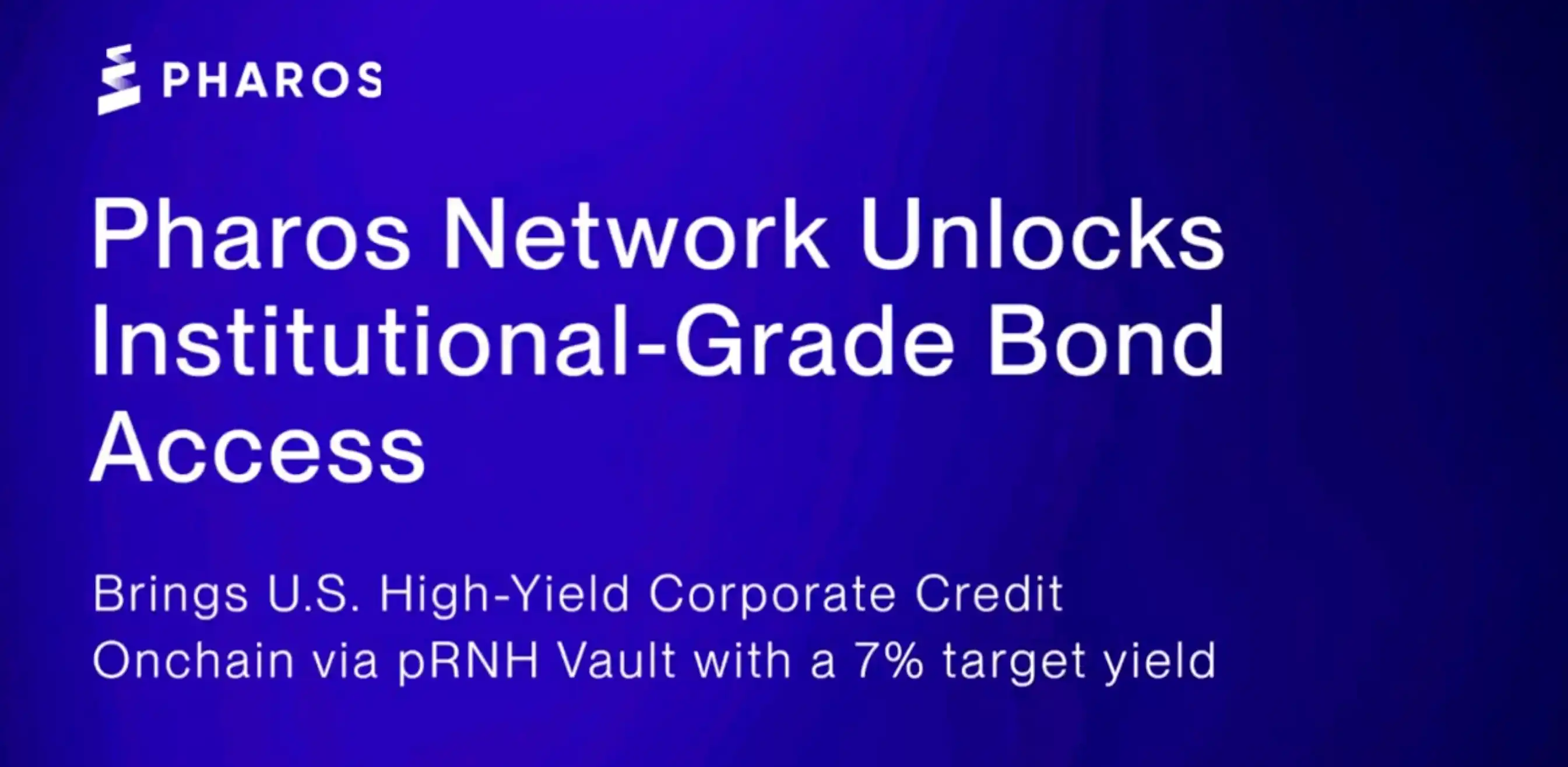
Pharos Introduces On-Chain Institutional-Grade U.S. Corporate Bond Credit, Expanding Its RealFi Asset Portfolio

Pharos Network has launched the pRNH Vault, introducing institutional-grade US corporate high-yield bond exposure to its on-chain RealFi (Real World Finance) ecosystem. Developed by the R25 protocol, the vault provides qualified users access to a tokenized portfolio of high-yield corporate debt, broadening Pharos's asset offerings beyond stablecoins and cash-equivalents. The vault's underlying asset is the NYLIM Anemoy US High Yield Corporate Bond separate account (HYB), managed by New York Life Investment Management (NYLIM) and tokenized in collaboration with Anemoy and Centrifuge. Users can deposit USDC into the vault to receive pRNH tokens, representing indirect ownership of the HYB portfolio, which targets an annualized yield of approximately 7%. The structure offers programmability and composability for on-chain financial applications. Pharos views this move as a key evolution from basic asset tokenization towards building a dynamic marketplace where institutional assets can be actively discovered, evaluated, and utilized programmatically. The pRNH Vault architecture incorporates agent-assisted functionalities for credit screening, liquidity monitoring, and on-chain operations, signaling tighter integration between real-world finance and intelligent on-chain systems. To support this vision, Pharos employs a technical stack including the SALI engine for parallel execution, modular SPNs, protocol-level compliance, ZK-KYC/AML, and native AI agent support. The network positions itself as the "value discovery layer" for the agent economy, aiming to make real-world value, smart agents, and institutional assets widely accessible. The pRNH launch adds a core credit asset to this ecosystem and serves as a practical test case for its infrastructure.

marsbit4m ago

Pharos Introduces On-Chain Institutional-Grade U.S. Corporate Bond Credit, Expanding Its RealFi Asset Portfolio

marsbit4m ago

Deposits in RWA Tripled — Traditional Finance Chooses Blockchain

The decentralized finance (DeFi) sector is undergoing a structural shift, with tokenized real-world assets (RWA) taking center stage. According to a joint report by CoinShares and Token Terminal, deposits in RWA lending and trading platforms tripled year-over-year, reaching $7.4 billion in Q2 2026. This explosive growth starkly contrasts with a 15% decline in overall DeFi deposits and a nearly 70% drop in DEX trading volumes over the same period. Analysts highlight this divergence as evidence of a fundamental shift: demand is driven not by speculation but by the genuine utility of blockchain for traditional finance. The primary drivers are tokenized U.S. Treasury bonds and multi-strategy funds, like BlackRock's BUIDL, which investors use as reliable collateral to secure stablecoin loans while earning yield. The Ethereum network hosts about 70% of all RWA collateral. Beyond government bonds, the tokenization of equities and commodity derivatives is advancing. The tokenized equity market is estimated at $2.2 billion, while perpetual futures on assets like oil and the S&P 500 have seen explosive growth on platforms like TradeXYZ. Standard Chartered projects the total tokenized asset market could reach $4 trillion by 2028. This growth signals that RWA has moved beyond crypto market cycles, offering tangible value, deep liquidity, and 24/7 global access, marking a new phase of institutional scaling for blockchain-based finance.

cryptonews.ru39m ago

Deposits in RWA Tripled — Traditional Finance Chooses Blockchain

cryptonews.ru39m ago

Trading

Spot

Hot Articles

How to Buy DAO

Welcome to HTX.com! We've made purchasing DAO Maker (DAO) simple and convenient. Follow our step-by-step guide to embark on your crypto journey.Step 1: Create Your HTX AccountUse your email or phone number to sign up for a free account on HTX. Experience a hassle-free registration journey and unlock all features.Get My AccountStep 2: Go to Buy Crypto and Choose Your Payment MethodCredit/Debit Card: Use your Visa or Mastercard to buy DAO Maker (DAO) instantly.Balance: Use funds from your HTX account balance to trade seamlessly.Third Parties: We've added popular payment methods such as Google Pay and Apple Pay to enhance convenience.P2P: Trade directly with other users on HTX.Over-the-Counter (OTC): We offer tailor-made services and competitive exchange rates for traders.Step 3: Store Your DAO Maker (DAO)After purchasing your DAO Maker (DAO), store it in your HTX account. Alternatively, you can send it elsewhere via blockchain transfer or use it to trade other cryptocurrencies.Step 4: Trade DAO Maker (DAO)Easily trade DAO Maker (DAO) on HTX's spot market. Simply access your account, select your trading pair, execute your trades, and monitor in real-time. We offer a user-friendly experience for both beginners and seasoned traders.

3.1k Total ViewsPublished 2024.03.29Updated 2026.06.02

How to Buy DAO

Discussions

Welcome to the HTX Community. Here, you can stay informed about the latest platform developments and gain access to professional market insights. Users' opinions on the price of DAO (DAO) are presented below.

活动图片