Author: Nancy, PANews
After a prolonged period of stagnation, SOL has finally experienced a strong rebound.
Since August, SOL has been trending upwards, not only reversing the consecutive monthly negative returns recorded since October 2025 but also achieving its strongest single-month performance since March 2024.
This rally was not driven solely by market sentiment. In addition to sustained capital inflows, improvements in on-chain fundamentals, and technical upgrades, the reform of its token economic model has become a crucial factor influencing SOL's long-term value.
Strongest Single-Month Performance in 10 Months, Institutional Buying Emerges as Key Driver
SOL has surged strongly this month, once breaking through $110 to reach a new high since the end of January this year.
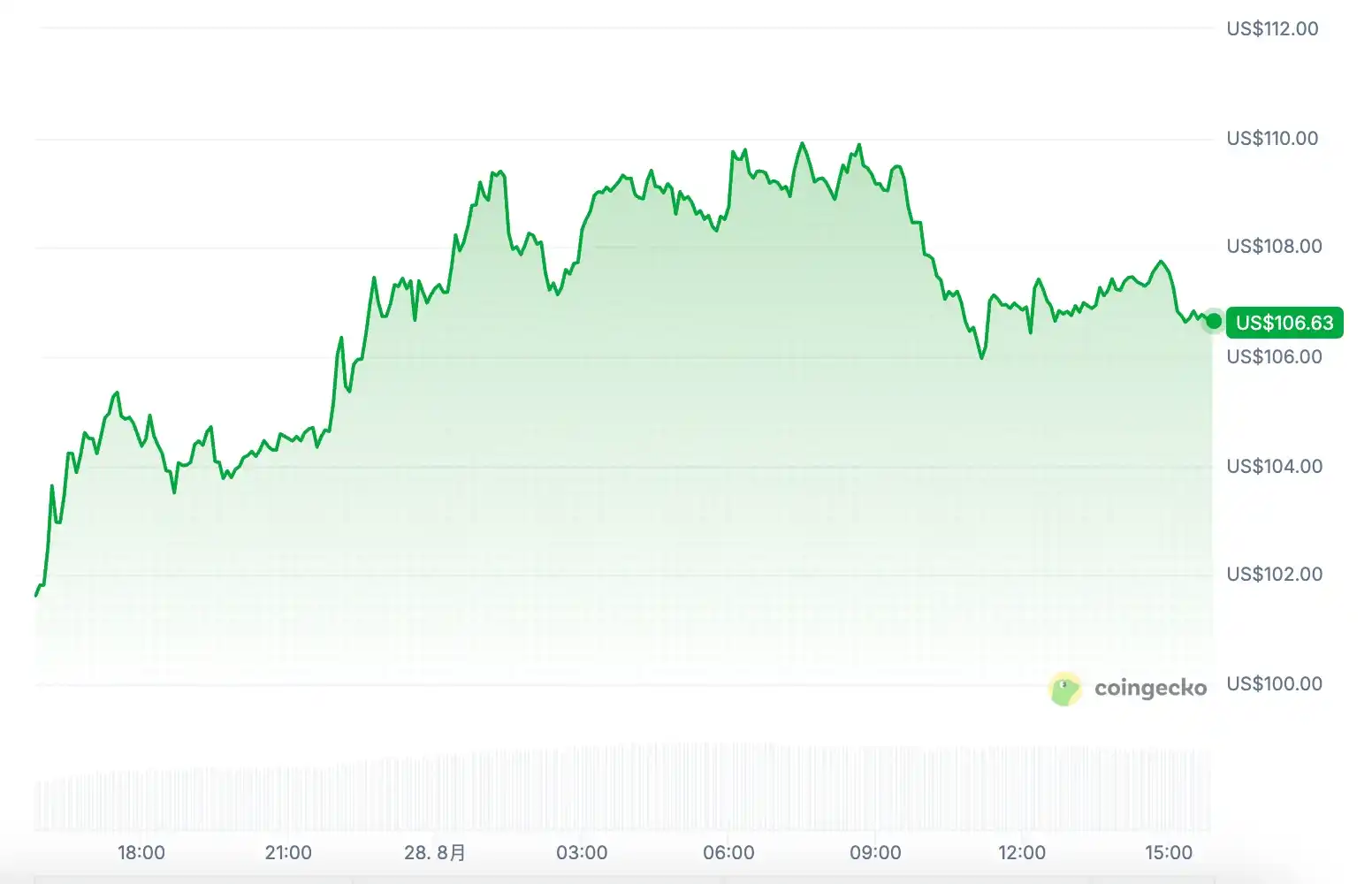
In terms of monthly performance, SOL accumulated a gain of 46.9% in August, ending a streak of 10 consecutive months of monthly losses and marking its most robust month in nearly a year. With the strong price rebound, SOL's year-to-date loss has narrowed significantly to about 13%, compared to its 34.1% annual decline for the entirety of 2025.
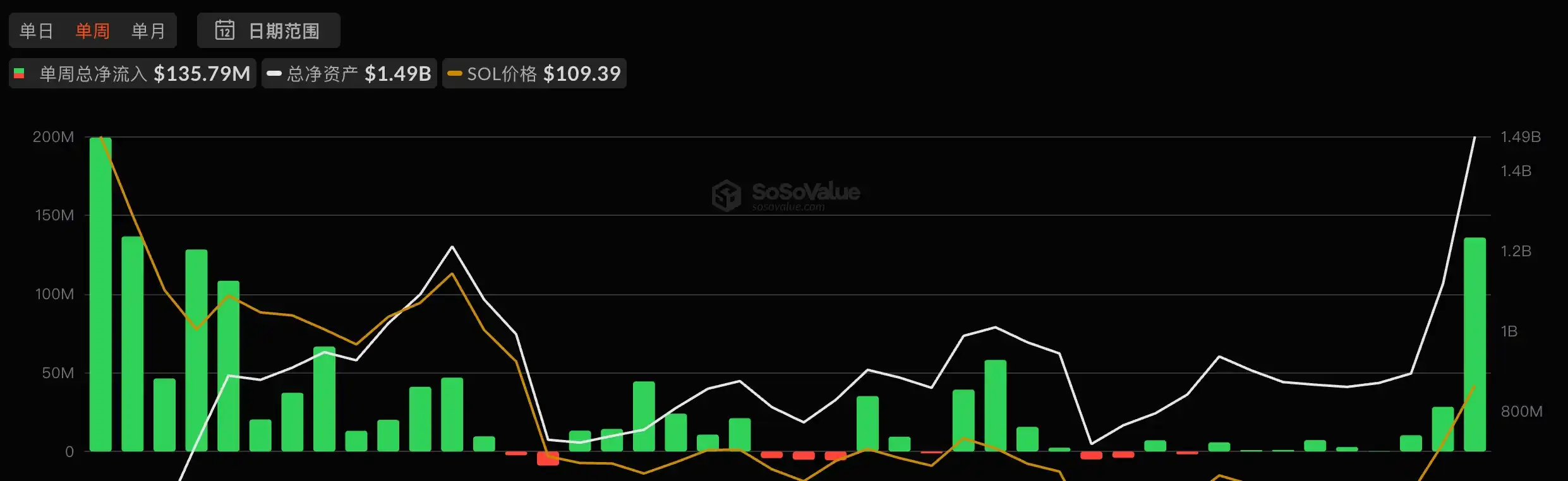
Institutional capital and continued ETF inflows have been important buying forces driving SOL's current upswing. Recently, Solana spot ETFs have seen consistent daily inflows. Data from SoSoValue shows that ETF net inflows over the past week accumulated to approximately $13.6 billion, marking the highest weekly inflow since November of last year. On a monthly basis, the inflow scale for Solana spot ETFs in August also reached the second-highest level since their listing.
Simultaneously, Solana Treasury companies (DAT) have recently begun increasing their SOL holdings. For instance, DeFi Development Corp. recently announced the resumption of SOL purchases, acquiring approximately 19,000 SOL with an investment of about $1.86 million, bringing its total SOL holdings to about 2.33 million, valued at approximately $180 million. Solmate Infrastructure also disclosed an increase of 1,000 SOL, pushing its total holding value past the $100 million mark.
Institutional access channels are also broadening further. Schwab, with assets under management of $12.6 trillion, recently announced that its crypto platform will enable direct trading of SOL, significantly lowering the barrier for traditional institutions to purchase SOL.
Beyond improvements in capital flows, Solana's on-chain fundamentals continue to strengthen, with several key metrics reaching all-time highs.
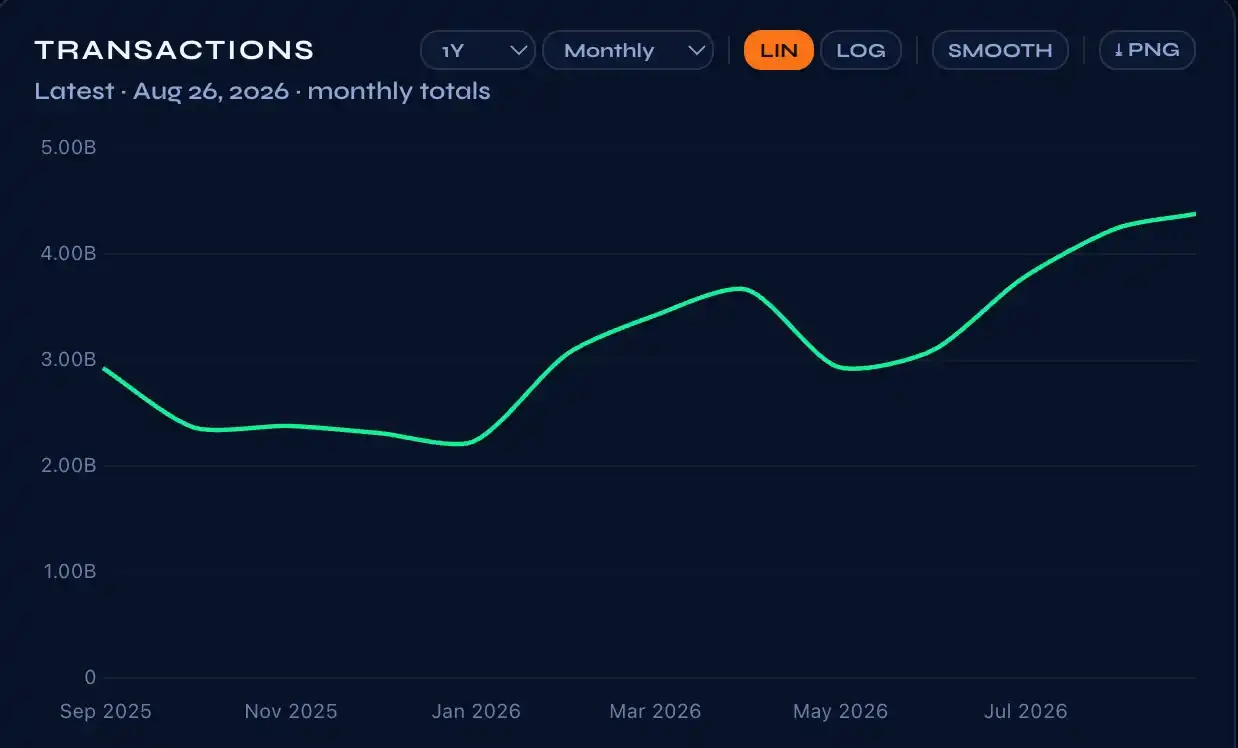
Data from State of Solana indicates that Solana processed a record 44.8 billion transactions in August. Since the end of December last year, monthly transaction volume has increased by approximately 2.25 billion, a growth of 100.9%. Meanwhile, RWA.xyz data shows that the total value of Real World Assets (RWA) on Solana has exceeded $4.04 billion, and the number of RWA holders has increased to over 355,000, also setting new network highs.
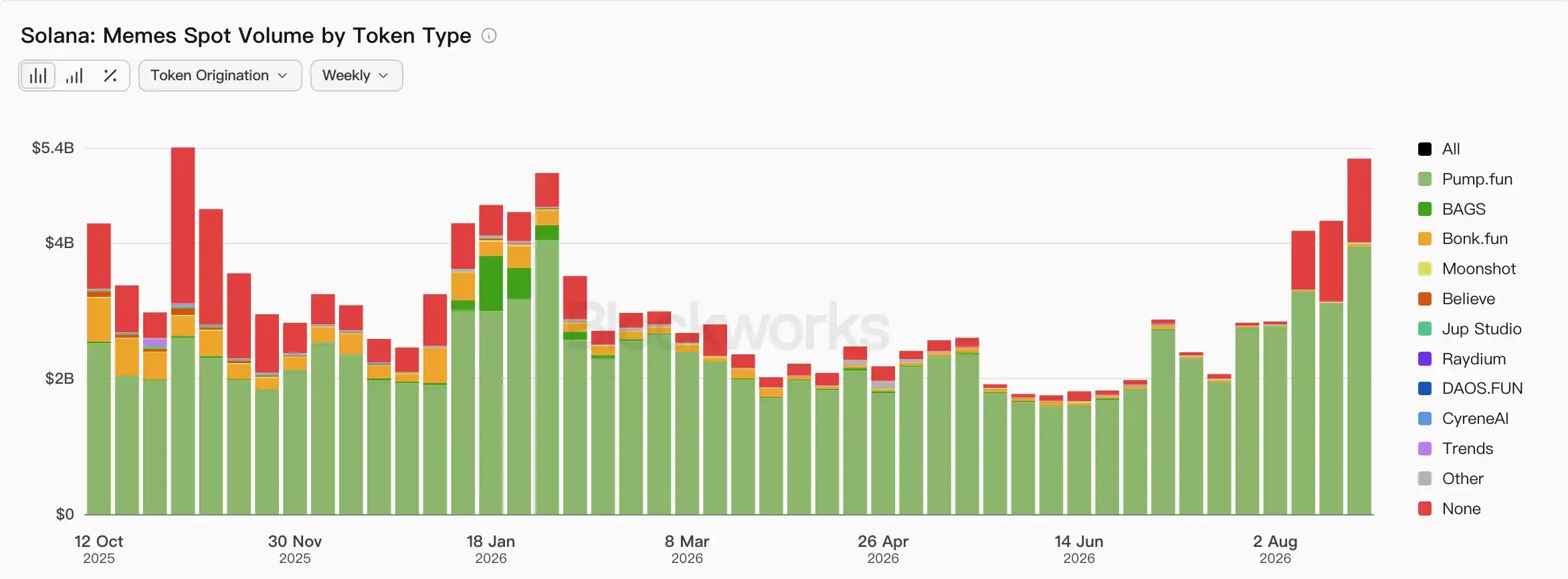
Meme coin trading activity has also shown a noticeable recovery. Data from Blockworks indicates that the latest weekly spot trading volume for Meme coins on Solana surpassed $5.24 billion, reaching a new high since the end of November 2025.
The stablecoin market continues its expansion. Artemis data shows that the supply of stablecoins on Solana has grown to $16.5 billion, an increase of approximately $4.1 billion compared to $12.4 billion a year ago, representing a growth of about 33%.
Furthermore, recent technical upgrades have also provided support for network performance improvements. For example, the recent activation of SIMD-0286 on the mainnet increased the block compute unit limit from 60 million to 100 million, a 66% capacity increase. The Agave 4.2 client also rolled out multiple phased upgrades on the mainnet in August, including a 90% reduction in rent, a 3.3x increase in maximum transaction size, and a phased reduction of block time from 400ms to 200ms.
The more critical consensus-layer change, Alpenglow, is planned to launch on the mainnet around October this year with Agave 4.3. Its goals are to compress finality from about 12.8 seconds to around 150 milliseconds and to move a large portion of the votes that previously occupied block space to off-chain aggregation, thereby freeing up more space for real user transactions. If these upgrades proceed as planned, Solana's confirmation speed, block space utilization, and overall network efficiency are expected to improve further.
SOL Proposes Emission Reduction, Tokenomics Reform Nearing Implementation
A more direct, and potentially long-term impactful, potential catalyst comes from improvements to its token economic model.
As the market is no longer willing to buy into tokenomics characterized by "high emissions, high unlocks, and weak value capture," an increasing number of crypto projects are re-evaluating the supply-demand dynamics of their tokens.
In recent months, several projects including Ethena, Polygon, Aptos, Sushiswap, Venice, and Near have been planning or advancing tokenomics reforms. The main directions include reducing unlock pressure, using protocol revenue to buy back or burn tokens, adjusting inflation and emission mechanisms, and optimizing staking incentives.
Solana is now entering this wave of tokenomics reform.
Currently, there is considerable controversy in the market regarding SOL's economic model. Main points of contention include that SOL's emission rate is still relatively high, staking rewards create significant continuous selling pressure, transaction fees hardly vary with actual compute resource usage, user habits of over-reporting compute units lead to scheduler inefficiency, and the amount of SOL burned remains low compared to its issuance.
To address these issues, the Solana community has proposed two key proposals, SIMD-550 and SIMD-553, aiming to adjust SOL's supply mechanism from the angles of "reducing issuance" and "increasing burns," respectively. The goal is to make the tokenomics more closely reflect actual network usage.
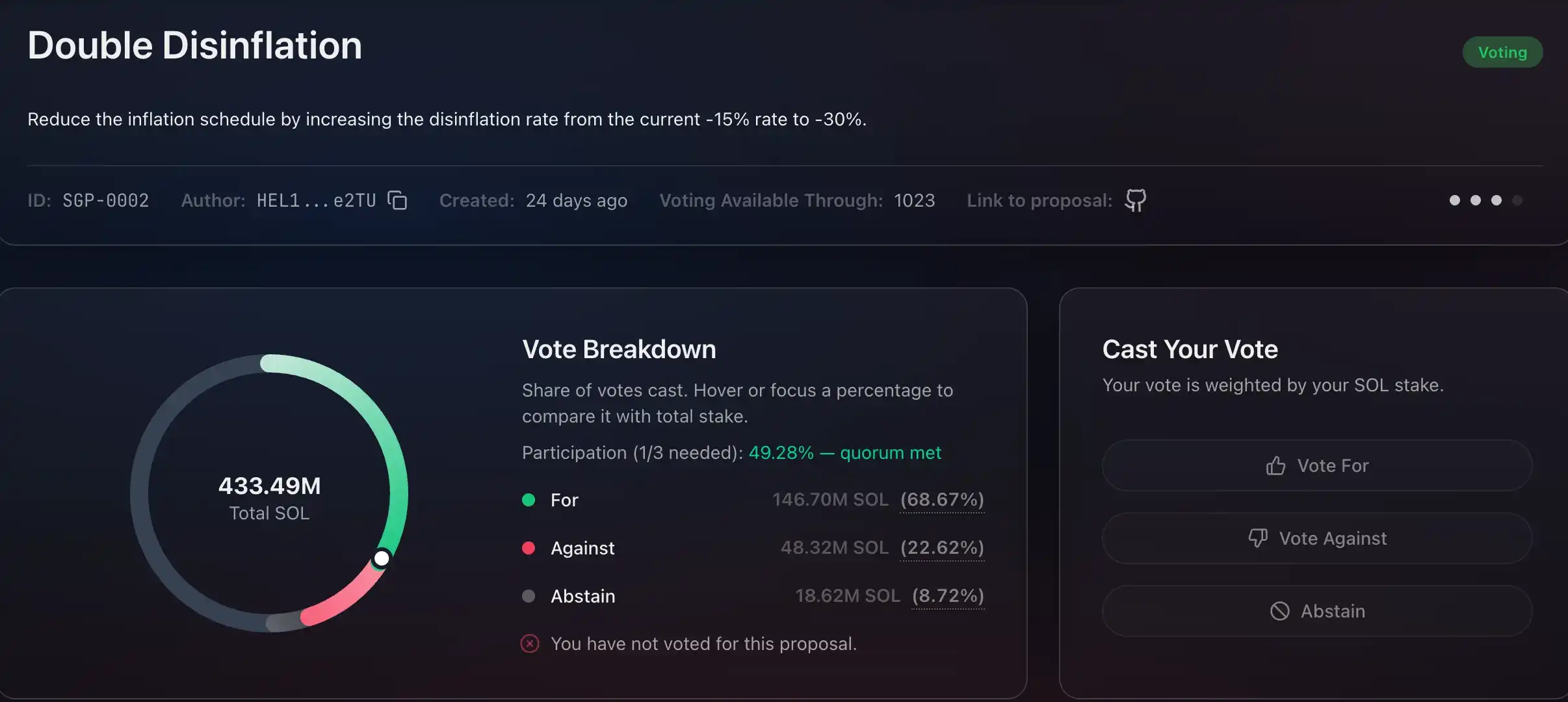
SIMD-550 primarily tackles the problem of excessively fast new SOL supply. This proposal intends to increase the annual inflation rate decay from 15% to 30%, thereby advancing the timeline for SOL to reach its base inflation rate of 1.5% from around 2032 to 2029. According to the proposal's calculations, the nominal staking yield is projected to gradually decrease from about 5% to around 2.25% over the next three years.
SIMD-550, proposed by Helius engineers, is a simplified version of the earlier SIMD-0411 plan. Compared to the earlier, more complex SIMD-228, which ultimately failed to reach quorum due to controversy, SIMD-550 reduces the complexity for community understanding, voting, and implementation.
Currently, the voting for this proposal is nearing its end, with a participation rate of approximately 49.15%, already exceeding the 1/3 quorum requirement. Among the votes, 68.58% are in favor.
SIMD-553 addresses the issue of insufficient burns. SIMD-553 introduces a resource fee charged based on the compute units declared for a transaction, with all such fees being burned. This proposal was approved in July and aims to increase the daily burn rate of SOL from the current approximately 600-800 SOL to about 7,500-9,000 SOL.
Its core logic is to better align resource fees with the network capacity declared and reserved by transactions. Currently, users engage in "over-reporting compute units," meaning they declare a resource limit significantly higher than actual usage. The scheduler still reserves block space based on the declared amount, reducing packing efficiency and preventing the existing fixed fees from fully reflecting actual resource consumption. This proposal therefore charges fees based on declared compute units and burns them entirely, increasing the cost of arbitrarily declaring high limits, reducing this incentive misalignment, and ensuring that more active network usage leads to increased SOL burns.
From a tokenomics perspective, SIMD-550 reduces new supply, while SIMD-553 increases the burn rate on the supply side. According to a report from 21Shares, these two proposals are expected to collectively reduce net SOL issuance worth approximately $1.4–1.5 billion over six years. This may compress staking yields while enhancing SOL scarcity and potentially redirecting capital from staking towards the on-chain DeFi and application ecosystem.
It is important to note that tokenomics reform itself does not equate to value capture and does not guarantee SOL price appreciation. The true determinant of a token's long-term value is its ability to consistently attract real users and capital, and for actual network demand to outpace new supply over a longer cycle.