Robinhood Chain Sees Another Billion-Dollar Meme Hit, 'Token-Stock Pairing' Memes Nurture RWA Sector

marsbitPublished on 2026-08-28Last updated on 2026-08-28

Abstract

Another high-value meme coin has emerged on Robinhood Chain, with the AI token reaching a peak market cap of $100 million after a nearly 10x gain in one week. Unlike typical pump-and-dump tokens, AI has been actively developed. It is paired with NVDA, Robinhood Chain's tokenized NVIDIA stock, and its community treasury uses fees to buy back and burn tokens. AI's success is partly fueled by LONG, a leading meme launchpad on Robinhood Chain. LONG pioneered a "coin-stock pairing" model, where new meme coins are paired with tokenized stocks (like NVDA, TSLA) instead of traditional crypto assets like ETH. This changes the pricing dynamic, linking meme coin value to both crypto sentiment and the underlying stock's performance, creating a dual bet for traders. This innovation has unexpectedly boosted Robinhood Chain's Real World Asset (RWA) sector. Approximately 34% of the chain's RWA trading volume now comes from these coin-stock paired meme transactions. Specifically, LONG's platform accounts for a significant portion of NVDA trading, with 23% of Robinhood Chain's NVDA reportedly locked in AI's treasury. Robinhood CEO Vlad Tenev acknowledged the unanticipated growth of meme trading and its positive spillover effect on RWA liquidity and utility, noting the creative combinations of assets that have emerged. The trend highlights new potential use cases for tokenized stocks beyond simple trading.

Original | Odaily Planet Daily (@OdailyChina)

Author | Golem (@web3_golem)
Today, another major meme coin has emerged on Robinhood Chain. The meme token AI saw its market cap peak at $100 million, surging nearly 10x over the past week.

Clearly, this meme coin isn't a typical pump-and-dump scheme but has undergone a period of operation and community development. AI is the leading meme coin in the current "token-stock pairing" sector. It is paired with the NVIDIA stock token (NVDA) on Robinhood Chain. Over the past month of community growth, it has established an AI community treasury, which uses creator fees and 50% of transaction fees to buy back and burn the token supply. Currently, 0.82% of the token supply has been burned.

The explosive popularity of the meme coin AI also benefits from the empowerment of its underlying token launch platform, LONG. In its early stages, LONG even airdropped NVDA stock tokens to AI holders. LONG is a meme coin launch platform within the Robinhood Chain ecosystem. With its innovative "token-stock pairing" meme issuance model, LONG has become a top meme launch platform on Robinhood Chain.

According to Dune data, although the daily new tokens on LONG lag significantly behind platforms like Flap and Pons, the total daily trading volume of meme coins launched on LONG ranks third on Robinhood Chain, trailing only Pons and noxa, and surpassing platforms like Uniswap's pools and Flap. The trading volume of meme coins issued by LONG accounts for 8.5% of the total meme trading volume on Robinhood Chain, securing the third position.
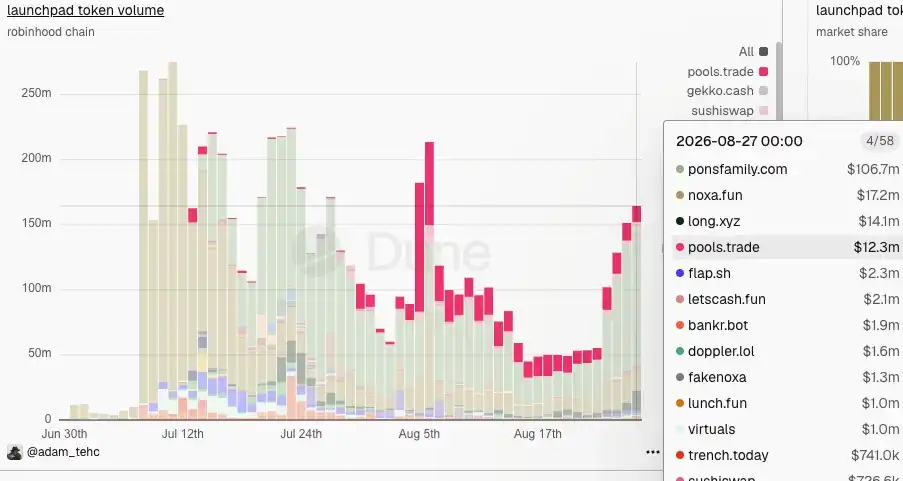
Robinhood Chain Launchpad Meme Daily Trading Volume Ranking

Token-Stock Pairing: Changing the Unit of Account for Meme Coins

The so-called "token-stock pairing" model means that when users issue a meme coin, they can autonomously choose a specific stock token as the unit of account and the paired trading asset. The other side of the meme coin's liquidity pool is no longer native blockchain assets like SOL, BNB, or ETH, but tokenized stocks on Robinhood Chain, such as NVDA, TSLA, AAPL, SPCX, MSFT, TSM, etc.

While it may seem like just a change in the paired asset for the liquidity pool and the on-chain unit of account, the impact is significant. The relative price of the meme coin is no longer measured by how many ETH it can be exchanged for, but by how many shares of the tokenized stock it can buy. This means the meme coin's price is influenced not only by market sentiment but also by the price fluctuations of the traditional stock market, directly bridging the "dimensional wall" between the meme coin market and the stock market.

Therefore, buying a token-stock paired meme coin is essentially a double bet: wagering that the meme coin will outperform the stock, while also betting on the dollar price movement of that stock. There is no 1:1 redemption relationship between the meme coin and the anchored stock token. The stock token merely serves as the quote asset in the liquidity pool, not as collateral for the meme coin. The token-stock pairing does not provide any value backing for the issued meme coin.

In actual trading, users still use ETH to buy and sell token-stock paired meme coins on the front end of meme trading platforms. However, on the backend, the ETH is first converted into the stock token, which then enters the token-stock pool to be exchanged for the meme coin. Simultaneously, the fees creators receive are not in ETH but in the underlying anchored stock token. If one views stocks like NVDA or SPCX as more valuable than cryptocurrencies like ETH, then in a sense, token-stock paired meme coins are also helping communities accumulate value investments.

Recently, LONG also announced the upcoming launch of LongX, which will support users issuing tokens using leveraged stock tokens as the underlying asset. Users won't need to actively manage perpetual positions; they simply hold them as standard ERC20 tokens, while rebalancing and position management are automatically handled at the protocol level, with Lighter serving as the underlying execution and liquidity layer. Compared to token-stock pairing, this model of packaging leveraged stock assets into tokens is not LONG's innovation. A similar model was introduced in May by alt.fun, a meme launch platform on the Hyperliquid ecosystem, but that platform has since lost its heat and users. (Related reading:Meme Wrapped Contracts: Is alt.fun True Innovation or Pseudo-Demand?)

Boosting RWA Trading on Robinhood Chain

For the Robinhood Chain ecosystem, the true significance of token-stock paired meme coins lies in boosting the trading volume of the RWA (Real World Assets) sector and expanding the utility of stock tokens.

Robinhood Chain's initial primary vision was to become an RWA-focused chain, but meme trading unexpectedly took off. In a recent interview, Robinhood CEO Vlad Tenev stated this was unforeseen by their team. What surprised him even more was that meme trading also stimulated demand for trading and liquidity of related stock tokens.

According to Dune data, the current total circulating value of RWAs on Robinhood Chain is approximately $45.4 million, with 202 RWA assets. In terms of trading volume, besides direct stock token trading, the stock token trading volume driven by token-stock paired meme coins accounts for about 34% of total RWA trading, making it the second-largest contributor to RWA trading volume.
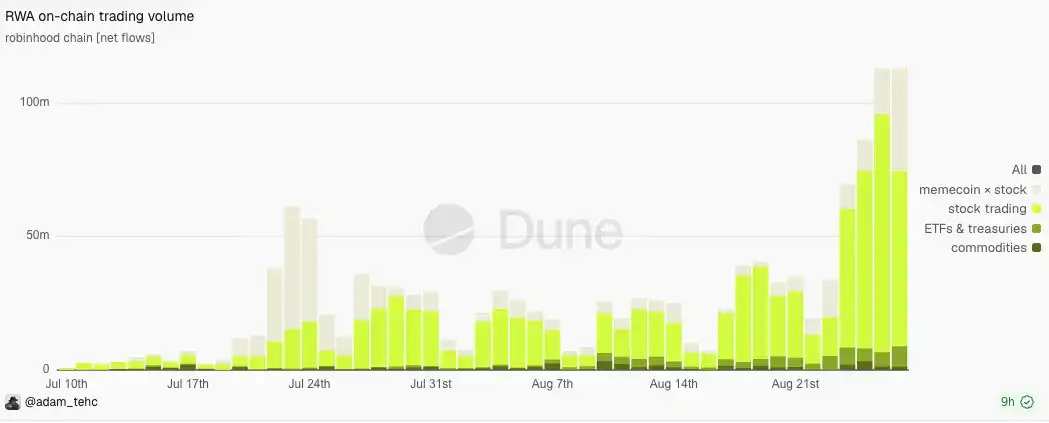
Composition of Robinhood Chain RWA Daily Trading Volume

Given LONG's leading position in the token-stock pairing Launchpad sector, this essentially reflects LONG platform's contribution to Robinhood Chain's RWA trading volume. Specifically, as of now, NVDA trading volume completed through LONG exceeds $94 million, accounting for over 53% of the total stock token trading volume on the LONG platform. According to LONG's official announcement, 23% of NVDA on Robinhood Chain is locked in the community treasury of meme coin AI.
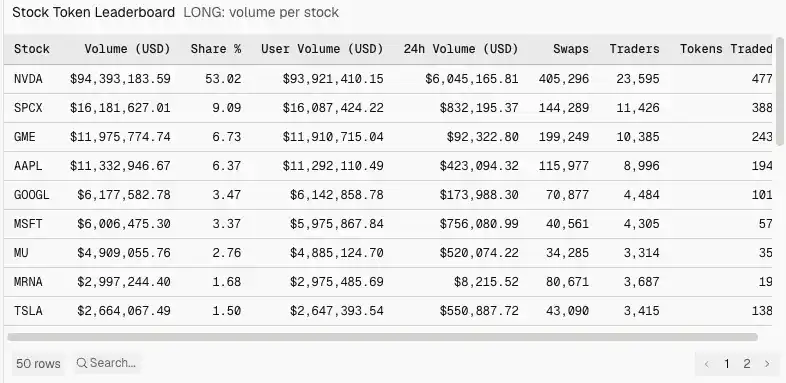
LONG Platform Stock Token Trading Volume and Platform Share

Meme trading driving stock token transactions is a development Robinhood welcomes. Vlad Tenev even implicitly praised token-stock paired memes in a recent interview, stating, "They've connected meme coins, major cryptocurrencies, and stock tokens to create some unique products we never anticipated would be built. It's unlikely we would have thought to build them ourselves." (Related reading:Robinhood CEO Interview: Meme Coin Boom Was Unexpected, My Portfolio Is Quite Diverse)

Another significant meaning of token-stock paired meme coins is expanding the utility of stock tokens, showing users and entrepreneurs the innovative possibilities for traditional assets like stocks on-chain. Beyond meme coins, more mature and protocolized innovations involving stock tokens are certain to emerge in the future.


Trending Cryptos

Related Questions

QWhat is the 'stock-pairing' meme coin phenomenon mentioned in the article, and how does it work?

AThe 'stock-pairing' meme coin phenomenon refers to a new method of launching meme coins on the Robinhood Chain, where a meme coin is paired with a tokenized stock (like NVDA or TSLA) in its liquidity pool instead of a native cryptocurrency like ETH. This means the meme coin's price is quoted in terms of shares of the stock. When users buy the meme coin with ETH, the protocol first converts the ETH into the paired stock token, which is then used to purchase the meme coin from the liquidity pool.

QWhich platform is the leading meme coin launchpad for 'stock-pairing' coins on Robinhood Chain, and what data supports this claim?

AThe leading platform for 'stock-pairing' meme coins on Robinhood Chain is LONG. Data from Dune Analytics shows that while LONG does not have the highest number of new daily tokens, the total daily trading volume of meme coins launched on its platform ranks third on Robinhood Chain, behind only Pons and noxa. Meme coins from LONG account for 8.5% of the total meme trading volume on the chain.

QAccording to the article, what was a significant unexpected benefit of the meme coin trading frenzy on Robinhood Chain?

AA significant unexpected benefit was that the surge in meme coin trading, particularly through the 'stock-pairing' mechanism, substantially boosted the trading volume and liquidity for the Real World Asset (RWA) sector, specifically for tokenized stocks. It created a new, high-demand use case for these stock tokens, contributing to about 34% of the total RWA transaction volume on the chain.

QHow does the meme coin AI benefit its community, and what is its connection to NVDA?

AThe meme coin AI benefits its community through a community treasury. It allocates creator fees and 50% of transaction taxes to buy back and burn (permanently remove) its own tokens from circulation. As of the article, 0.82% of the token supply had been burned. AI is paired with the tokenized NVIDIA stock (NVDA) on the LONG platform. Early AI holders were even airdropped NVDA tokens, strengthening the connection between the meme coin and the stock.

QWhat did Robinhood CEO Vlad Tenev say about the development of 'stock-pairing' meme coins?

AVlad Tenev stated in an interview that the meme coin explosion was unexpected. He praised the innovation behind 'stock-pairing' meme coins, saying that users have created unique products by combining meme coins, major cryptocurrencies, and stock tokens in ways his team had not anticipated and likely would not have thought to build themselves.

Related Reads

Two AI Giants Devour One-Third of Global New Computing Power, Nearing Half Next Year

Two AI giants, Anthropic and OpenAI, are projected to consume one-third of the world's new computing power this year, a share that could rise to nearly half by next year. By 2028, they may command the majority of the world's effective available AI compute, according to analysis by Dylan Patel of SemiAnalysis. This rapid growth is driven by soaring revenue per megawatt—Anthropic reportedly reaching up to $50 million per MW—which far exceeds the estimated $10-15 million cost. This creates a self-reinforcing cycle: higher earnings enable purchasing more advanced compute, leading to more powerful models and further revenue gains. While about 71% of AI compute is owned by major cloud providers, its usage is increasingly concentrated with these two labs. A significant portion of their compute (around 50%) is dedicated to research and experimentation rather than direct model training or inference. Looking ahead, Dylan suggests an increasing share of compute will be diverted from revenue-generating inference towards AGI research, despite potential investor pressure for returns. The massive capital expenditure—cumulatively around $11 trillion from 2024-2029—risks tightening global credit markets. Furthermore, government regulations, like withholding top-tier model releases or pausing data center tax exemptions, could disrupt the growth cycle by capping revenue-per-MW gains. The conversation highlights a concerning trend toward extreme centralization. As compute efficiency improves and costs drop, the "effective AI labor" controlled by a single leader could theoretically surpass the global human population within years. The core challenge is shifting from a race for AGI itself to a question of who will control it.

marsbit19m ago

Two AI Giants Devour One-Third of Global New Computing Power, Nearing Half Next Year

marsbit19m ago

QCP Capital: Bitcoin's Rally to $80,000 is Supported by Spot ETFs, Not Leverage

QCP Capital's report "Trial of Trust" analyzes Bitcoin's surge towards $80,000 ahead of the Jackson Hole Symposium, attributing it primarily to spot ETF inflows rather than leverage. The rally coincides with markets assessing the Federal Reserve's balancing act between persistent inflation and broader financial conditions, especially amid new pressure on the long end of the US Treasury yield curve. This pressure followed the US Treasury's August 19 announcement to at least double its buyback operations for 10-30 year bonds starting September 9, which lowered long-term yields and boosted assets like Bitcoin and gold. Meanwhile, inflation remains sticky, with July's core PCE at 3.3% year-on-year, keeping the Fed's September rate decision uncertain. The risk-on environment is also supported by the AI investment cycle, highlighted by Nvidia's strong earnings. However, this capital-intensive cycle contributes to demand for funding, influencing long-term bond yields. Crucially, Bitcoin's price increase from ~$63,5K to ~$80K occurred alongside eight consecutive days of net inflows (~$2.8B) into spot Bitcoin ETFs. Simultaneously, futures open interest declined and funding rates remained subdued, indicating the rally was driven by spot demand and short covering, not new leveraged long positions. The options market is now showing increased demand for calls. Bitcoin is approaching a supply zone of $81K-$86K. The key question is whether the uptrend remains supported by organic spot demand or becomes increasingly reliant on leverage. The market awaits Fed Chair Kevin Warsh's Jackson Hole speech for clues on the Fed's inflation framework and its view on long-term yield dynamics.

cryptonews.ru19m ago

QCP Capital: Bitcoin's Rally to $80,000 is Supported by Spot ETFs, Not Leverage

cryptonews.ru19m ago

Trading

Spot

Hot Articles

Discussions

Welcome to the HTX Community. Here, you can stay informed about the latest platform developments and gain access to professional market insights. Users' opinions on the price of MEME (MEME) are presented below.

活动图片