Prediction Markets Turn Bearish As Kalshi Traders Price 69% Odds Of Bitcoin Dropping To $50,000 First

bitcoinistPublished on 2026-06-18Last updated on 2026-06-18

Abstract

Prediction market traders on Kalshi are pricing in a 69% probability that Bitcoin will fall to $50,000 before it reaches $100,000. This reflects a bearish sentiment snapshot among participants on the platform, contrasting with more optimistic cycle-bottom calls from some investors. The odds are not a guaranteed forecast but a live market gauge that can shift quickly with price action and trader positioning. The setup captures a key market debate: whether Bitcoin faces another significant downside leg or is poised for a major bullish breakout driven by institutional demand. The article cautions against over-interpreting the number, noting prediction markets are best used as a sentiment indicator alongside factors like ETF flows and macroeconomic policy.

Bitcoin bulls may be looking for the next breakout, but prediction-market traders on Kalshi are pricing a much more defensive path, with one market showing odds tilted toward BTC hitting $50,000 before $100,000.

TL;DR

  • Kalshi Crypto highlighted a market pricing 69% odds that Bitcoin hits $50,000 before $100,000.
  • The odds reflect trader sentiment on a prediction platform, not a guaranteed forecast.
  • The setup shows a sharp contrast with bullish cycle-bottom calls from investors such as Anthony Scaramucci.
  • Kalshi markets can move quickly as spot price and trader positioning change.

Kalshi Traders Lean Bearish On Bitcoin

The Kalshi Crypto post points to a market where traders were pricing a 69% chance of Bitcoin hitting $50,000 before $100,000. The live market is available through Kalshi’s Bitcoin price contracts, though the exact probability can change as traders buy and sell positions.

That caveat is important. Prediction-market odds are not the same thing as an analyst forecast, a model output, or a guaranteed outcome. They reflect the price at which participants are willing to take the other side of a defined event. In simple terms, they show what the market on that platform currently believes is more likely.

Why $50,000 Versus $100,000 Matters

The framing is powerful because it captures the current split in Bitcoin sentiment. A move to $50,000 would represent another major downside leg from current levels, likely tied to tighter macro conditions, weaker ETF demand, or renewed risk-off pressure. A move to $100,000 would signal the opposite: stronger liquidity, renewed institutional demand, and a return to the kind of reflexive upside that crypto bulls have been waiting for.

Markets like this are useful because they compress a complicated debate into one tradable question. Is Bitcoin more likely to flush lower before it doubles into six figures? Kalshi traders, at least in the referenced market snapshot, leaned toward the bearish answer.

A Sentiment Gauge, Not A Certainty

The danger is over-reading the number. Prediction markets can be thin, emotional, or heavily influenced by short-term price action. If Bitcoin sells off for a few days, downside contracts can become more expensive. If Bitcoin rallies, those same odds can reset quickly.

That makes the Kalshi signal useful as a sentiment snapshot rather than a standalone trading system. It tells traders that the market mood is not unanimously bullish, even while some high-profile investors argue that low retail interest and weak momentum could mark a cycle-bottom zone.

The split itself may be the story. Bulls see apathy as accumulation fuel. Prediction-market traders see downside risk as more immediate. Bitcoin often moves hardest when one side becomes too comfortable, and the current debate suggests neither side has fully won the narrative yet.

For traders, the next major clues are still likely to come from ETF flows, macro policy, and whether BTC can reclaim stronger technical levels. Until then, Kalshi’s bearish pricing is a reminder that the path to $100,000, if it comes, may not be a straight line.

This article was written by the News Desk and edited by Samuel Rae.

Originally reoprted on Kalshi Crypto X post at Kalshi Crypto X post

Trending Cryptos

Related Questions

QAccording to the Kalshi market snapshot mentioned in the article, what are the odds that Bitcoin reaches $50,000 before $100,000?

AThe odds are 69%.

QWhat is the key distinction made between prediction-market odds and a traditional analyst forecast in the article?

APrediction-market odds reflect the current price participants are willing to trade a defined event at, showing market sentiment on that platform, not a guaranteed forecast or model output.

QHow does the article suggest the market sentiment from the Kalshi traders contrasts with views from some high-profile investors?

AIt contrasts sharply, as the Kalshi traders lean bearish by pricing in downside risk, while some investors like Anthony Scaramucci are making bullish cycle-bottom calls.

QWhat two general scenarios does the $50,000 vs. $100,000 debate represent for Bitcoin, according to the article?

AA move to $50,000 would represent a major downside leg tied to tighter macro conditions, weaker ETF demand, or risk-off pressure. A move to $100,000 would signal stronger liquidity, renewed institutional demand, and a return to strong upside momentum.

QWhat does the article caution against when interpreting the prediction market data from Kalshi?

AIt cautions against over-reading the number, noting that these markets can be thin, emotional, influenced by short-term price action, and that the odds can reset quickly.

Related Reads

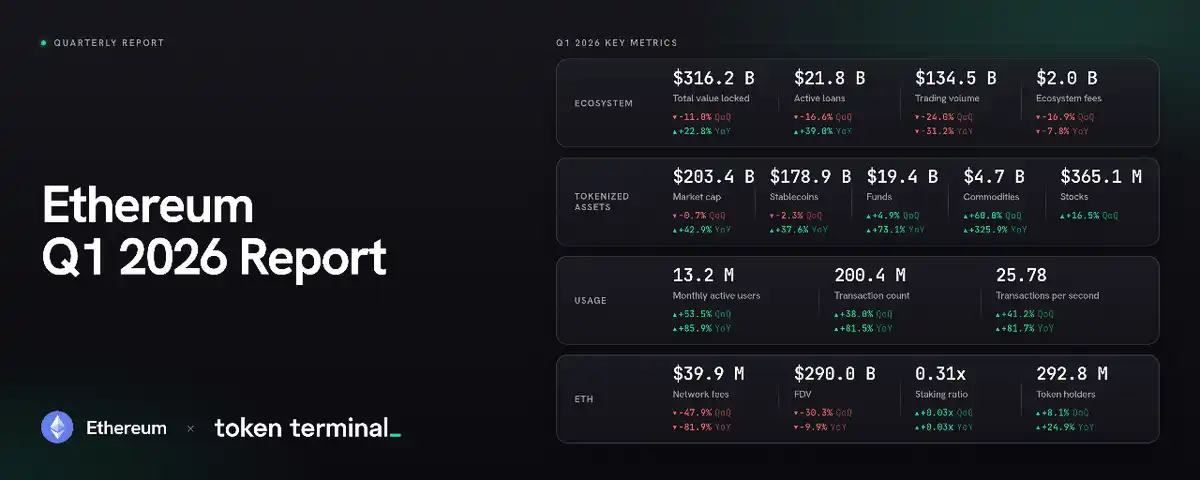
Ethereum 2026 Q1 Review: On-Chain Activity Hits Record Highs, Tokenized Assets Lead the Industry

Ethereum Q1 2026 Review: Record On-Chain Activity, Tokenized Assets Lead the Industry. Despite a price correction impacting USD-denominated metrics, Ethereum's on-chain usage hit all-time highs in Q1 2026. Monthly active addresses surged 85.9% year-over-year to 13.2 million, while L1 transactions and throughput also set new records. This growth occurred alongside a significant 47.9% quarterly drop in L1 transaction fees, demonstrating the impact of network scaling via upgrades like the Blob Parameter Fork. The ecosystem maintained its dominance in decentralized finance (DeFi), holding 71% of the total value locked among top chains and 79.2% of active borrowing. Ethereum solidified its position as the primary platform for tokenized real-world assets (RWAs), with a total market cap of $203.4B. It holds leading shares in stablecoins (61.8%), tokenized funds (73%), and tokenized commodities (84%) across major chains. Key developments included the ERC-8004 standard for AI agents and heightened institutional engagement at forums. Major financial institutions like BlackRock, JPMorgan, and a European banking consortium announced new tokenized products on Ethereum throughout the period. The report draws parallels to the early internet, suggesting Ethereum is sacrificing short-term fee revenue for long-term network expansion and adoption. Its strategy focuses on becoming a neutral, open settlement layer for global finance, with scaling roadmaps aiming for tens of thousands of TPS by 2029.

marsbit19m ago

Ethereum 2026 Q1 Review: On-Chain Activity Hits Record Highs, Tokenized Assets Lead the Industry

marsbit19m ago

Matrixdock Featured Again in SBMA’s 《Crucible》: Discussing How Tokenisation Enhances Efficiency in the Precious Metals Market

Matrixdock's research article, titled "Why Tokenisation Matters for the Bullion Industry and How Carrying Costs Fit In," has been featured again in the SBMA's industry publication *Crucible*. Authored by Matrixdock lead Eva Meng, the piece examines how tokenisation enhances the efficiency and utility of the precious metals market. The article argues that tokenisation builds upon the accessibility improvements brought by gold ETFs, not by redefining gold's value but by enabling it to function within digital finance. It extends gold's role beyond a portfolio holding, potentially facilitating instant settlement, digital collateral, and operation in 24/7 markets. A key focus is transparently handling the unavoidable carrying costs (storage, insurance) of physical assets like gold and silver. Matrixdock introduces the Fungible Reserve Standard (FRS) framework, based on an "Economic Purity Principle," which aims to reflect these real-world economic costs clearly within the token mechanism, rather than bundling them opaquely. The platform's practical applications are highlighted, including its gold token XAUm and its silver token XAGm, the first built on the FRS framework. As the tokenised gold market surpassed $6 billion in February 2026, the industry's focus is shifting from initial proofs of reserves to broader concerns of market efficiency and capital utilization. Tokenisation is positioning gold and other precious metals to become active components within the evolving digital financial system.

marsbit51m ago

Matrixdock Featured Again in SBMA’s 《Crucible》: Discussing How Tokenisation Enhances Efficiency in the Precious Metals Market

marsbit51m ago

New Huo Research: Dense Bottom Fishing in the $60K BTC Range, a 'High Value-for-Money Zone' Sees a Handover Surge

Bitcoin has shown a significant oversold rebound this week, with extreme panic in the crypto market easing. Multiple data points indicate a notable market bottom is forming. On the market front, the net outflow from Bitcoin spot ETFs has continued to shrink, and the negative premium between Coinbase and USDT is steadily correcting. Industry fundamentals suggest the shutdown cost for mainstream miners is concentrated between $30,000 and $50,000, potentially solidifying a阶段性 industry cost floor—a classic signal of market bottoms in previous cycles. Institutional capital is notably positioning against the trend. For instance, Sinohope Group's weekly OTC trading volume surged over 8 times环比, with active platform users doubling, both reaching record highs. This confirms a sharp increase in large capital transaction activity and a spike in off-exchange funding demand. Sinohope Research also observed on-chain data showing that funds from entities with public company attributes and long-term "whale" wallets are actively accumulating Bitcoin around the key $60,000 price level. The research institute has maintained since mid-May that a high-value investment window has reopened, and the market is now undergoing a shift from panic selling to long-term holding. Looking ahead, the core drivers for an upward market move will be liquidity release and macro policy developments. The successful and strong performance of SpaceX's IPO has reignited market optimism, and the massive liquidity frozen during its subscription period is now being unlocked. This substantial capital is expected to seek new value opportunities, potentially flowing into currently undervalued assets like Bitcoin. On the macro and policy front, the tone set in Kevin Warsh's upcoming speech at the FOMC meeting is crucial for near-term monetary policy expectations. Furthermore, the potential passage of the CLARITY Act by late July could significantly boost institutional confidence for capital entry. Considering these bottoming signals alongside favorable liquidity and policy factors, Sinohope Research remains optimistic about the market's subsequent trajectory.

marsbit55m ago

New Huo Research: Dense Bottom Fishing in the $60K BTC Range, a 'High Value-for-Money Zone' Sees a Handover Surge

marsbit55m ago

Trading

Spot
Futures

Hot Articles

What is $BITCOIN

DIGITAL GOLD ($BITCOIN): A Comprehensive Analysis Introduction to DIGITAL GOLD ($BITCOIN) DIGITAL GOLD ($BITCOIN) is a blockchain-based project operating on the Solana network, which aims to combine the characteristics of traditional precious metals with the innovation of decentralized technologies. While it shares a name with Bitcoin, often referred to as “digital gold” due to its perception as a store of value, DIGITAL GOLD is a separate token designed to create a unique ecosystem within the Web3 landscape. Its goal is to position itself as a viable alternative digital asset, although specifics regarding its applications and functionalities are still developing. What is DIGITAL GOLD ($BITCOIN)? DIGITAL GOLD ($BITCOIN) is a cryptocurrency token explicitly designed for use on the Solana blockchain. In contrast to Bitcoin, which provides a widely recognized value storage role, this token appears to focus on broader applications and characteristics. Notable aspects include: Blockchain Infrastructure: The token is built on the Solana blockchain, known for its capacity to handle high-speed and low-cost transactions. Supply Dynamics: DIGITAL GOLD has a maximum supply capped at 100 quadrillion tokens (100P $BITCOIN), although details regarding its circulating supply are currently undisclosed. Utility: While precise functionalities are not explicitly outlined, there are indications that the token could be utilized for various applications, potentially involving decentralized applications (dApps) or asset tokenization strategies. Who is the Creator of DIGITAL GOLD ($BITCOIN)? At present, the identity of the creators and development team behind DIGITAL GOLD ($BITCOIN) remains unknown. This situation is typical among many innovative projects within the blockchain space, particularly those aligning with decentralized finance and meme coin phenomena. While such anonymity may foster a community-driven culture, it intensifies concerns about governance and accountability. Who are the Investors of DIGITAL GOLD ($BITCOIN)? The available information indicates that DIGITAL GOLD ($BITCOIN) does not have any known institutional backers or prominent venture capital investments. The project seems to operate on a peer-to-peer model focused on community support and adoption rather than traditional funding routes. Its activity and liquidity are primarily situated on decentralized exchanges (DEXs), such as PumpSwap, rather than established centralized trading platforms, further highlighting its grassroots approach. How DIGITAL GOLD ($BITCOIN) Works The operational mechanics of DIGITAL GOLD ($BITCOIN) can be elaborated on based on its blockchain design and network attributes: Consensus Mechanism: By leveraging Solana’s unique proof-of-history (PoH) combined with a proof-of-stake (PoS) model, the project ensures efficient transaction validation contributing to the network's high performance. Tokenomics: While specific deflationary mechanisms have not been extensively detailed, the vast maximum token supply implies that it may cater to microtransactions or niche use cases that are still to be defined. Interoperability: There exists the potential for integration with Solana’s broader ecosystem, including various decentralized finance (DeFi) platforms. However, the details regarding specific integrations remain unspecified. Timeline of Key Events Here is a timeline that highlights significant milestones concerning DIGITAL GOLD ($BITCOIN): 2023: The initial deployment of the token occurs on the Solana blockchain, marked by its contract address. 2024: DIGITAL GOLD gains visibility as it becomes available for trading on decentralized exchanges like PumpSwap, allowing users to trade it against SOL. 2025: The project witnesses sporadic trading activity and potential interest in community-led engagements, although no noteworthy partnerships or technical advancements have been documented as of yet. Critical Analysis Strengths Scalability: The underlying Solana infrastructure supports high transaction volumes, which could enhance the utility of $BITCOIN in various transaction scenarios. Accessibility: The potential low trading price per token could attract retail investors, facilitating wider participation due to fractional ownership opportunities. Risks Lack of Transparency: The absence of publicly known backers, developers, or an audit process may yield skepticism regarding the project's sustainability and trustworthiness. Market Volatility: The trading activity is heavily reliant on speculative behavior, which can result in significant price volatility and uncertainty for investors. Conclusion DIGITAL GOLD ($BITCOIN) emerges as an intriguing yet ambiguous project within the rapidly evolving Solana ecosystem. While it attempts to leverage the “digital gold” narrative, its departure from Bitcoin's established role as a store of value underscores the need for a clearer differentiation of its intended utility and governance structure. Future acceptance and adoption will likely depend on addressing the current opacity and defining its operational and economic strategies more explicitly. Note: This report encompasses synthesised information available as of October 2023, and developments may have transpired beyond the research period.

388 Total ViewsPublished 2025.05.13Updated 2025.05.13

What is $BITCOIN

Discussions

Welcome to the HTX Community. Here, you can stay informed about the latest platform developments and gain access to professional market insights. Users' opinions on the price of BTC (BTC) are presented below.

活动图片