This article is from:David Lin
Compiled by|Odaily Planet Daily(@OdailyChina);Translator|Azuma(@azuma_eth)
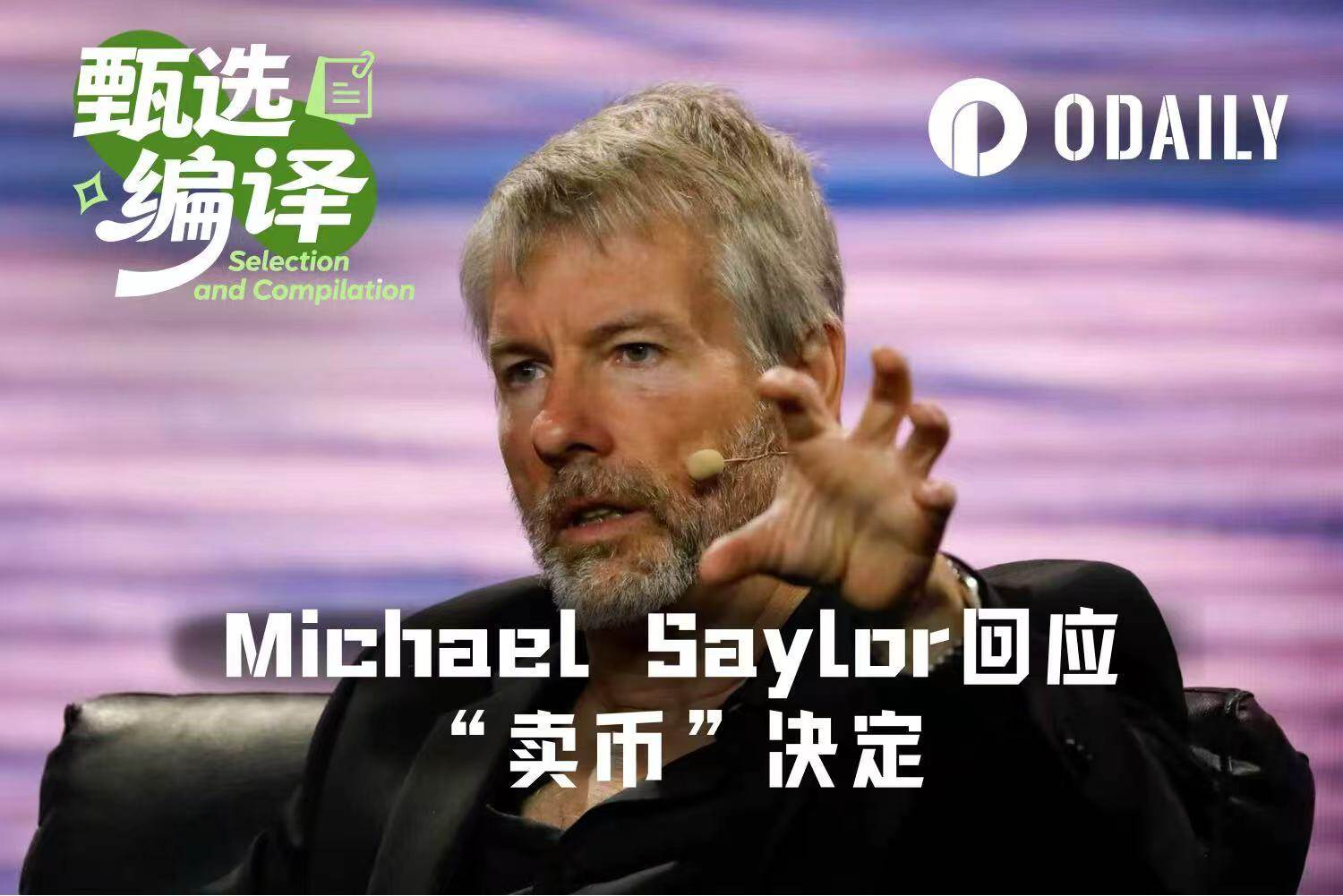
Editor's Note: During last Monday's earnings call, MicroStrategy first mentioned "preparing to sell Bitcoin if necessary to pay dividends," a statement that immediately sparked intense market debate about its "betrayal of faith."
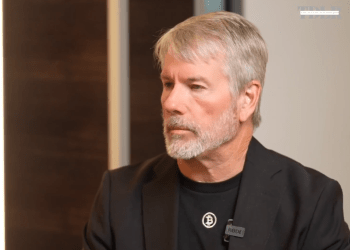
In response, MicroStrategy's Executive Chairman Michael Saylor recently provided a deep dive into the underlying logic behind this decision during an interview on David Lin's podcast. He emphasized that he only said he "would sell," not that he would be a "net seller." Saylor also mentioned that MicroStrategy is leveraging Bitcoin's extremely high appreciation properties as "digital capital" to achieve arbitrage by issuing digital credit instruments (like STRC), thereby ensuring the continuous net growth of its holdings. The following is the full content of the podcast (edited) as compiled by Odaily Planet Daily.
Podcast Interview
David Lin (Host A): It's an immense honor to co-host this exciting interview with MicroStrategy's Executive Chairman, Michael Saylor, alongside my co-host, Bonnie Chang. We'll start with MicroStrategy's recent announcement and the posts Michael Saylor has made on social media. Bonnie, let's begin.
Bonnie Chang (Host B): You announced something last week that sent shockwaves through the entire space.
Michael Saylor: Um, you're probably referring to our statement during the earnings call — that we are prepared to sell Bitcoin if necessary to pay STRC dividends.
Bonnie Chang: I believe that was a carefully considered decision. What was the thinking behind it?
Michael Saylor: The most important point is that we want the market to understand that Bitcoin's capital gains can be used to fund credit dividends. When we sell $1 million worth of STRC credit products, we turn around and buy $1 million worth of Bitcoin. Our expectation for Bitcoin is an annual appreciation of about 30%, and in reality, its appreciation is closer to 40% per year. We can strip out the initial 11% of that capital appreciation and pay it as a dividend.
The market has been confused about what we would use to pay dividends. For most of history, we've paid dividends by selling common stock (MSTR equity). MSTR equity is a derivative of Bitcoin and typically trades at a premium to Bitcoin. So, we were selling a Bitcoin derivative, but some people worried that we might not be able to sell equity in the future.
Then came some bearish talk saying we had to sell equity; other talk said the company would never sell its Bitcoin. This morphed into — "Well, if they aren't planning to sell Bitcoin, then Bitcoin must be worthless, they can never sell it. And if they can't sell it, then we can't count Bitcoin as an asset on the balance sheet."
If you own $65 billion worth of something and people want to value it at zero, that's not good, right? We don't want credit rating agencies to think the company's assets are zero. We want them to believe we have $65 billion in assets. Additionally, there were some online "haters" constantly complaining it was a Ponzi scheme because we funded preferred stock dividends by selling equity.
What we wanted to do was reinforce this business model — sell credit to invest in Bitcoin; over time, that investment appreciates faster than the dividends accrue; then we realize the capital gains and pay dividends.
We thought the best way to clarify this was to make it clear that "the company never needs to sell common stock," we can simply sell the substantially appreciated Bitcoin to pay dividends, which is essentially using capital gains to fund credit dividends.
I think this is like a real estate development company. They raise capital by issuing credit instruments to buy land at $10,000 per acre, develop it so it's worth $100,000 per acre, then realize that capital appreciation. You can sell the land at $100,000 per acre, lease it after full development, or remortgage it. No one questions a real estate development company that uses credit proceeds for capital investment, and we're doing the same thing with Bitcoin. We want to make sure the market understands this.
I became famous for saying "never sell your Bitcoin," which is why the internet exploded when they heard we might sell. But if I were more precise, it would be "never be a net seller of Bitcoin." It's just that "never be a net seller" isn't as catchy or easy to spread.
I think during these times, even if we were to sell 1 Bitcoin, we would buy 10 to 20 back. So, you're really talking about a "buy 10, sell 1, net buy 9" situation. Once people understand that, it shouldn't be an issue anymore, though it's a controversial topic right now.
Bonnie Chang: Could you explain how you can sell 1 Bitcoin while buying 10?
Michael Saylor: Sure. MicroStrategy's primary Bitcoin accumulation engine is STRC. In April, we sold $3.2 billion worth of STRC, so we bought $3.2 billion worth of Bitcoin. The dividend is about $80 to $90 million. So, in this month where we raised $3 billion, we only need to come up with $80 or $90 million to pay the dividend — essentially, you're buying 30 Bitcoin while selling 1.
Our "break-even rate" is about 2.3%. This means that if we issue credit debt equal to 2.3% of our Bitcoin holdings, then even if we sell Bitcoin to pay dividends, we will always be a net buyer of Bitcoin. Another point is that if Bitcoin appreciates 2.3% annually, we can pay dividends forever and continue creating value without selling any common stock.
In the first four months of this year, we've already sold about $5 billion worth of STRC. At this pace, the issuance rate this year will be 15% to 20%. As long as the company is growing, it will buy more Bitcoin than it sells. I expect that in every future month and quarter, we will be a net buyer of Bitcoin.
Bonnie Chang: I have another question. Many investors religiously believe in "never selling Bitcoin." Do you think they should still follow that advice?
Michael Saylor: Yes, I think you should be a "net accumulator" of Bitcoin. When I said "never sell your Bitcoin," I meant that if you're going to spend it on something, make sure you replenish it after spending.
Many crypto or Bitcoin believers say they want to buy things with Bitcoin. I'd say, then fill the gap after spending. Don't be a net seller of Bitcoin because Bitcoin is capital. At the end of every year, you should have more Bitcoin than you started with.
For analogy, if Google invests $1 billion in building a data center and earns $10 billion from it, they net $9 billion. That doesn't crash the dollar market, right? No one gasps, "Google sold dollars to buy a data center." The dollar will be fine, and it doesn't shake Google's business model. They spent $1 billion investing in their business; that's normal, rational. Sometimes you spend money to make more money.
So, if you spend 1 Bitcoin to earn 10 Bitcoins, I think that's beneficial for Bitcoin and good for the company... When the equity capital market is less liquid than the Bitcoin market, we want to be able to utilize that market.
Whenever a company takes away its options, saying "we will never ever do something," whatever that is, the result is usually regret. For example, if we said we "will never, ever buy back our own stock, we will only sell stock," then shorts would short our stock like crazy, pushing it down to $1. When the stock price has a huge discount to Net Asset Value (NAV), if we could buy it back, those shorts would be in trouble. By exploiting their irrationality, we could make a lot of money.
So, what we really expressed on the earnings call was — we'll trade STRC for MSTR, we'll trade BTC for MSTR, we'll use BTC or MSTR to pay dividends, we'll do whatever is in the best interest of the company. But over time, we expect to be a net accumulator of Bitcoin. This doesn't change how we trade assets day-to-day. Whether we sell credit debt, sell equity, or sell Bitcoin capital will depend on market conditions and mispricing.
Another thing we said yesterday was that we are prepared to buy back our bonds. Our corporate debt is currently trading cheap, undervalued, so it makes sense to buy it back, and it doesn't make sense to sell it. We won't sell undervalued assets; we'll buy undervalued assets and arbitrage any opaque inefficiencies. If the market knows we'll do this, the market will give all these assets a fair valuation. This benefits investors in all these instruments, and ultimately, it's our fiduciary duty.
David Lin: One of your biggest critics, Peter Schiff, wrote this morning: "Yesterday, Saylor admitted MSTR (MicroStrategy) would sell Bitcoin to pay STRC dividends if needed. I think this pledge is to keep the so-called Ponzi scheme going longer. But I suspect when the moment comes, he'll opt to suspend dividends and let STRC crash rather than let Bitcoin crash." What is your response to that?
Michael Saylor: Peter thinks Bitcoin is a Ponzi scheme. Peter doesn't really like anything in this space. Bitcoin is "digital capital," and we've built a digital finance company by selling equity and credit instruments to buy this capital. I believe Bitcoin will endure because it represents global economic wealth with full property rights in a tokenized form.
On top of that, we've built a credit instrument, STRC, which simply strips out volatility, reduces risk, and extracts or 'distills' yield from the digital capital. If you don't acknowledge Bitcoin as legitimate, you'll never acknowledge any derivative built on it as legitimate. But for those who believe Bitcoin can store economic wealth in a tokenized form, what we're doing is very straightforward.
STRC uses an overcollateralized model: for every $5 of Bitcoin, sell $1 of credit debt, and that $1 of credit debt has a defined yield. There are many people who believe Bitcoin is a legitimate asset; they just can't stomach its volatility. They don't want to put money for their child's tuition due in the fall into Bitcoin because they have to pay the bill in 12 weeks. So for them, digital credit makes a lot of sense because the principal is protected, it's more stable. Plus, with STRC they can get 3 to 4 times the yield of money markets. This is precisely Bitcoin's superior trait over other capital assets, allowing us to pay this high dividend yield.
David Lin: Here's a theory I'd like your thoughts on, and then I'll hand it back to Bonnie. Some traders have noticed that whenever STRC pays a dividend, the ex-dividend price trades below par for a period (maybe a day or two). Once it reaches par, that's when MicroStrategy goes to buy Bitcoin. So, they've started 'front-running' by buying Bitcoin before STRC reaches par, betting that you and MicroStrategy will buy Bitcoin at par. Can you comment on this?
Michael Saylor: What happens near the dividend date is that demand for STRC is enormous because there's about 90 cents of dividend after that record date. So, there are billions, hundreds of billions of dollars worth of STRC traded before the record date, and on the day after the record date, it trades down 60 or 70 cents, then gradually recovers to par over the next week or two.
So that's normal. Those are arbitrageurs. Their idea is that by tying up capital for about 12 days a year, they can capture roughly a 42% annualized yield. They have their calculations. That's fine, and it's good for us because it creates liquidity and engagement. This situation will continue.
As for the second idea, can you front-run the Bitcoin market? The Bitcoin derivatives market has $50 billion in daily volume. So, I don't think anyone has enough capital to move that market.
My view is that Bitcoin is a bit like "the square of tech capital." What drives the Bitcoin market are trade wars, hot wars, foreign policy, national situations, and the Iran situation in the Strait of Hormuz, then currency wars — like whether we expect SOFR to drop to 200 basis points, or whether the yield curve is being distorted. You can see we're in a fairly tight monetary environment now, so these macro factors are the main drivers of Bitcoin.
I can tell you one fact: we've bought $100 million worth of Bitcoin in an hour, and it didn't move the price; we've bought $200 million in an hour, and it didn't move the price; we've bought $200 or $300 million and then stopped, and the price went up.
So, no one has enough power to move Bitcoin's price... Well, maybe if you plan to throw $30 billion into the market in an afternoon. But I've spent a lot of money; we've bought more Bitcoin than anyone I know, we've probably bought $62 billion worth. I believe it's a global market with its own momentum.
So, talk about us being able to move the price is flattering, but I don't think so.
Bonnie Chang: Why, after you bought so much Bitcoin, did you say the price didn't move a bit?
Michael Saylor: Because the market liquidity is extremely deep. Suppose I were to buy $1 billion today; even that is only 1/50th of $50 billion in volume.
If you ask traders, they'll say spot market volume is sometimes $20 billion a day, derivatives sometimes up to $80 billion. In a market with such deep liquidity, what's $100 million? That's what's special about it. On the weekend, if you want to put on a $1 billion position with 20x leverage, you can do it in the Bitcoin market; if you want a $1 billion credit line within an hour, you can do it in the Bitcoin market.
I do think macro factors drive Bitcoin, and sometimes Bitcoin has its own life force. Micro factors drive it too — I mean industry factors like the formation of digital credit, bank credit, and investor sentiment towards Bitcoin assets — these drive the market. But I think Bitcoin is more powerful than all of us, and that's why we have confidence in it — because no single participant can prop it up or hold it back.
David Lin: If the Strait of Hormuz remains closed for the foreseeable future, several forces will intertwine. First, some say inflationary pressures will persist; second, the Fed might eventually need to cut rates because they're stuck with high inflation. So, what ultimately happens to liquidity? If the Fed remains trapped, what happens to Bitcoin?
Michael Saylor: I think when you have tight monetary policy, high global trade tensions, and high geopolitical tensions due to foreign policy or war (whether in Ukraine or Iran), all of these are somewhat binding; they are headwinds. I think when these factors reverse, they become tailwinds.
But regardless, Bitcoin will grind up. This is because the organic supply from miners is only about $10 to $12 billion per year, only 450 Bitcoins per day. You can do the math. Then, every time we raise another $10 billion in capital, we've bought up the entire year's supply. So, if a bank creates $10 billion in credit, that's "one turn of the axle"; if we sell $10 billion in STRC digital credit, that's "the second turn"; when $10 billion flows into IBIT (BlackRock's Bitcoin spot ETF), that's "the third turn."
So, capital flows, digital credit, digital capital wrapper vehicles, and bank credit — all of these are driving the market's fundamentals, and they're all positive. Regardless of macro factors, you'll see continuous adoption. The role of macro winds is just that when we should be grinding up 30%, a tailwind might make us surge to 50%, while a headwind will somewhat slow us down.
David Lin: Has your logic for Bitcoin changed?
Michael Saylor: No change. But I will say, it's now clear Bitcoin is "digital capital," and over the past 12 months, one thing has become very clear — one of Bitcoin's killer apps is digital credit.
Many people wonder, what is the killer app for a $1.5 trillion asset class with hundreds of billions in daily volume? The answer is as collateral for credit. Since digital capital is the best-performing capital asset (and it is), outperforming the S&P 500 by two to three times, it logically follows that we can create the best-performing credit asset on top of this capital asset.
What we've seen over the past year is that STRC is the most liquid credit instrument; it's the most liquid preferred stock in the entire market, also the largest preferred stock by size in the market. It has the highest Sharpe ratio. We've successfully created an instrument with a Sharpe ratio of 3, paying 11% to 12%.
The highest Sharpe ratio in stocks is Nvidia, around 1.7; the S&P 500 is about 0.9... nothing beats 1. Even the top hedge funds you can find can't exceed a Sharpe ratio of 2.2.
So, digital credit actually has better risk-adjusted returns than all other financial strategies and all publicly traded instruments in the public capital markets. I couldn't have told you this 12 months ago. But now the logic holds — if Bitcoin is the best-performing capital, then a convertible bond backed by Bitcoin becomes the best-performing convertible bond, and a credit instrument like STRC becomes the best-performing preferred stock.
By the way, do you know what percentage of the preferred stock market we accounted for this year?
Bonnie Chang: I'd guess over 70%?
Michael Saylor: 60% of all preferred stock in the United States this year was issued by us. Last year and this year, we were the largest credit issuer in the country. We revitalized the preferred stock market; STRC has exploded in growth.
So, I think the novelty is the idea that "digital capital drives digital credit." As you see on the show, digital credit is a stepping stone to digital currency. Because now there's a whole crop of stable coins/tokens pegged to the dollar paying 8% or 9% yields. Apex created one, growing from 0 to $300 million in 8 weeks; Saturn created another, growing from 0 to $110 million in 6 weeks.
In digital assets, crypto, and traditional finance, there's been an explosion of innovation driven by digital credit. And Bitcoin is the foundation that makes digital credit possible. This is probably the most exciting thing this year.
Bonnie Chang: Last question. Was it "Have Space Suit—Will Travel" that inspired you to go to MIT? Let's go back to before MIT, before this book and Bitcoin. Say something to your younger self.
Michael Saylor: You know, when I was in first grade, my parents wanted to motivate me. They told me they'd give me 10 cents for every book I read. I had a comic book addiction at the time. I remember comic books were 25 cents each. So the math was, I had to read two and a half "real books" to get one comic book. I was highly motivated.
That summer I read about 100 books. I'd go to the library and take out 10 at a time. Then I discovered science fiction, discovered Heinlein, Clark, and Asimov. I read "The Moon is a Harsh Mistress" and "Have Space Suit—Will Travel" before third grade; by third or fourth grade, I'd gone through them all.
I would say reading those science fiction books drove my intellectual development. Boys in elementary school are highly impressionable. I remember in "Have Space Suit—Will Travel," the protagonist is an alpha male. He fixes a space suit, gets picked up by a ship, travels the universe, and saves humanity from "worm-eyed monsters." What's the reward for saving humanity? He gets a full scholarship to MIT. I thought, if MIT is good enough for that hero who saved humanity, it's probably good enough for me. So, come hell or high water, I'm going there.
David Lin: If Elon Musk invited you to Mars, would you accept?
Michael Saylor: That depends on what kind of vehicle he's offering to take me there.