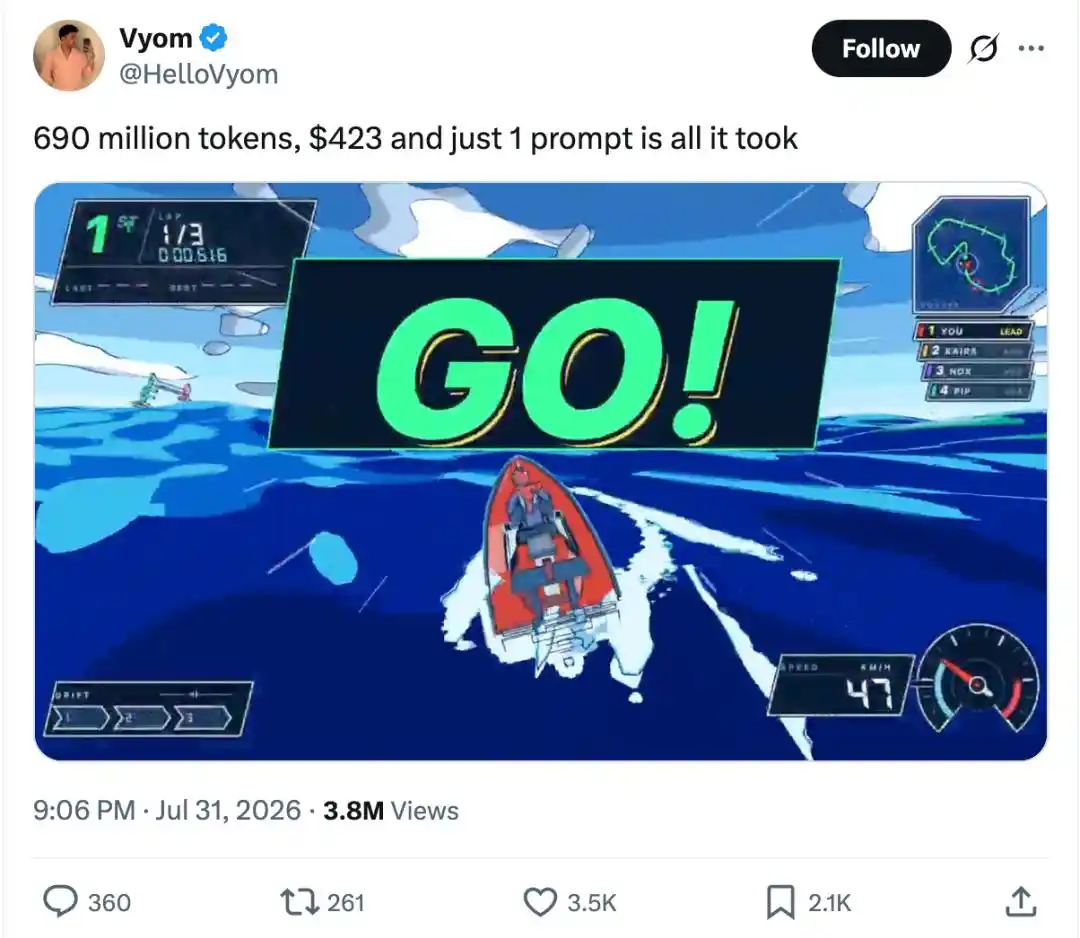
"Just" 690 million tokens, $423, and one prompt are all it takes to create an American-style high-speed boat racing game that went viral.
And it's playable online; anyone can play it.
So says netizen Vyom.
Taking a closer look, the game is quite impressive.
American cartoon style, retro arcade boat racing gameplay, complete with a countdown, lap counter, and ranking system.
Even the UI is fully designed with a unified, hardcore street racing dashboard aesthetic, and it feels pretty engaging to play.
This is the result of a single prompt, one-shot generation using Opus 5. Gotta say, Opus 5 has some skills.
But the celebration didn't last long. Another netizen replicated it using GPT-5.6 Sol on Codex.
And it only cost $5!!!
Opus 5 + Single Prompt Creates a Water Racing Game
The water racing game created by netizen Vyom is called "INK TIDE".
I'll admit, I was fooled the moment I opened the game.
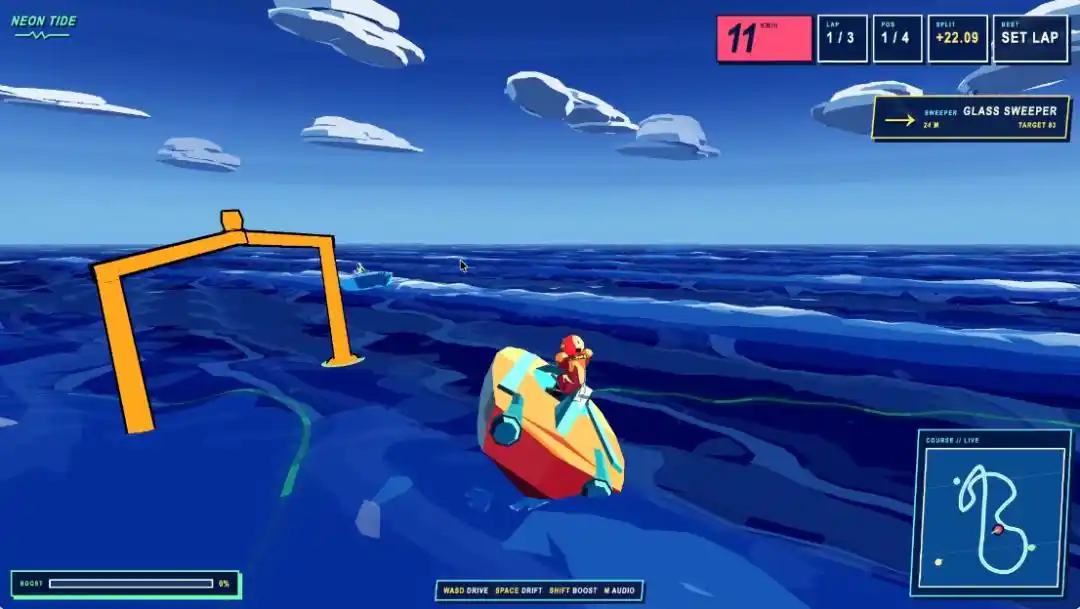
The visuals are in an American cartoon style. When controlling the boat, the pitch and roll of the hull feel very realistic.
The bottom right of the screen features a dashboard, while the top right shows a minimap and a real-time ranking board.
Charging and acceleration have clear visual effects. If you take a wrong turn or collide with an opponent's boat, there are clear on-screen prompts.
In short, it's bang-bang exciting.
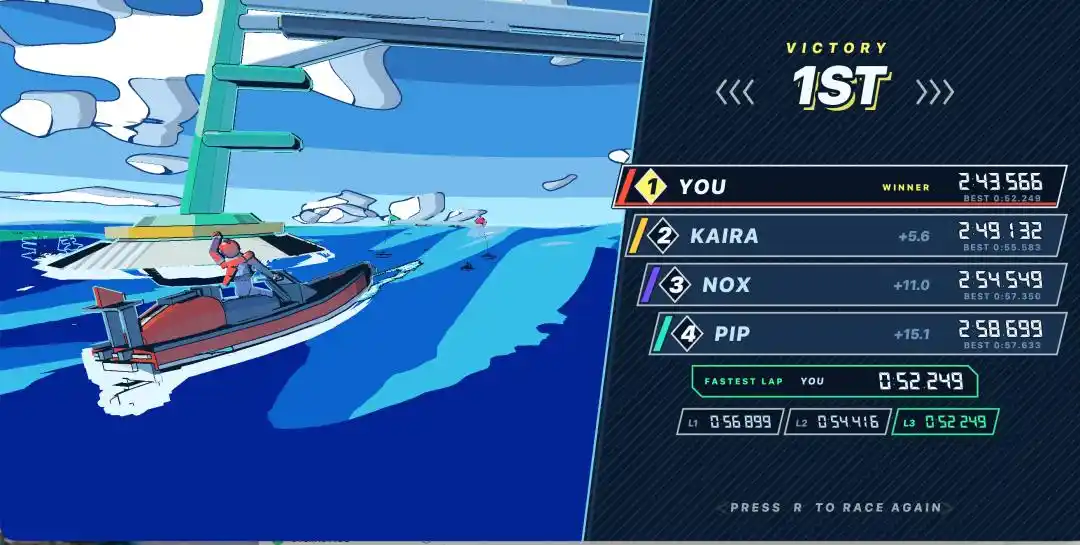
The downside is that the three AI opponents are too weak; I easily came in first just by casually playing.
The author, Vyom, stated that this game was generated using just one prompt, one-shot.
It's a single prompt, alright, but you didn't mention that the prompt was 2000 words long...
Be like:

The game is developed using Vite, TypeScript, and Three.js, completely without any external resources. All models, textures, and sounds are generated by code.
No wonder such a polished demo could be generated in one go. This isn't just a prompt; it's a comprehensive requirements document.
The hierarchical structure is very clear: first define hard constraints, then visual standards, then functional requirements, then the development process, and finally delivery standards.
This is the same order a human project manager would follow when writing a requirements document.
From this, we can also decipher why the water effects in this game are so good. The prompt dedicates an entire chapter to the water system.

Notably, the prompt also includes a fairly detailed section on "Sub-Agent Division of Labor."

The author instructs Claude to first define a shared architecture, then split the project among multiple sub-agents:
One is responsible for water, another for cartoon rendering, another for boat physics, and others handle AI opponents, character animation, audiovisuals, and performance, all developing in parallel.
In a multi-agent workflow, each sub-agent receives a narrower task, focusing on its own module within a relatively independent context, before the main agent coordinates and integrates everything.
This arrangement is primarily to combat "attention dilution" in large tasks.
If water, rendering, physics, AI, UI, and audio are all thrown at the same agent, it can easily get sidetracked.
For example, modifying water might break physics, designing UI might forget about performance, and interfaces agreed upon earlier might be overturned later.
The author addresses this by assigning clear responsibilities to different sub-agents, even stipulating which files each can modify. Boundaries are fixed first, then they work in parallel.
Going a step further, the author also appoints a dedicated "Quality Inspector" for this agent team.
He instructs Claude to first create a screenshot harness, then run a visual review sub-agent that scrutinizes screenshots for flaws, with each subsystem iterating in cycles until the review has no more complaints.

This is like having the AI act as its own inspector. After completing each module, it must actually run it, take screenshots for acceptance, and then rework based on specific issues found in the visuals.
I delved deeper into the project's GitHub repository and finally understood why the three AI opponents are so weak.
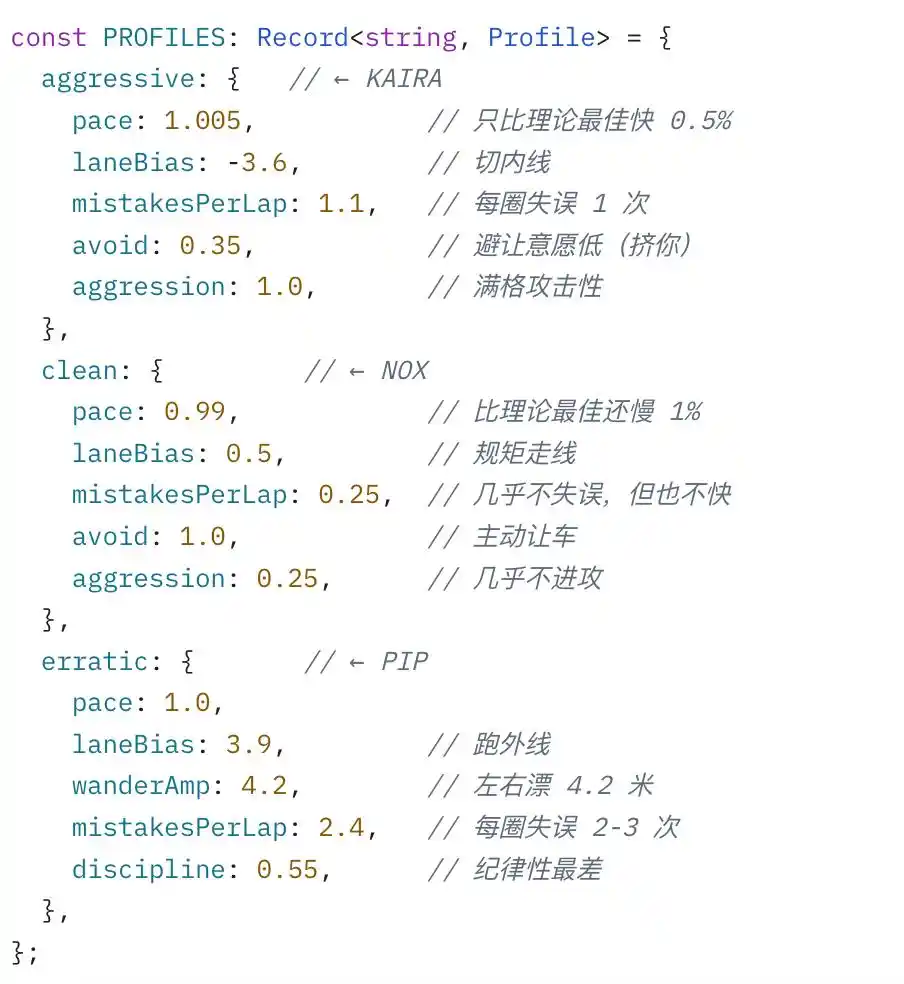
The parameters for the three NPCs are hardcoded. Even the fastest, KAIRA, is only 0.5% faster than the theoretical optimal speed.
As long as the player follows the racing line normally and uses drift boosts, they can easily outpace this margin.
Another opponent, PIP, is set to make 2-3 mistakes per lap—sometimes going wide, sometimes lifting off the throttle, sometimes veering off the track.
It's blatantly going easy on the player.
Perhaps the author also wanted to keep it simple to attract more players...
Overall, as a demo, this game is sufficiently polished and complete, but there's no advanced mechanics or gameplay yet. Hitting barriers or other boats has no consequences.
It's more like a single-player time-trial game.
Codex's $5 Replica is Here
Soon, the replica was served up.
Netizen Anul Agarwal created a similar game using Codex, taking about 5 hours and 2 input prompts.
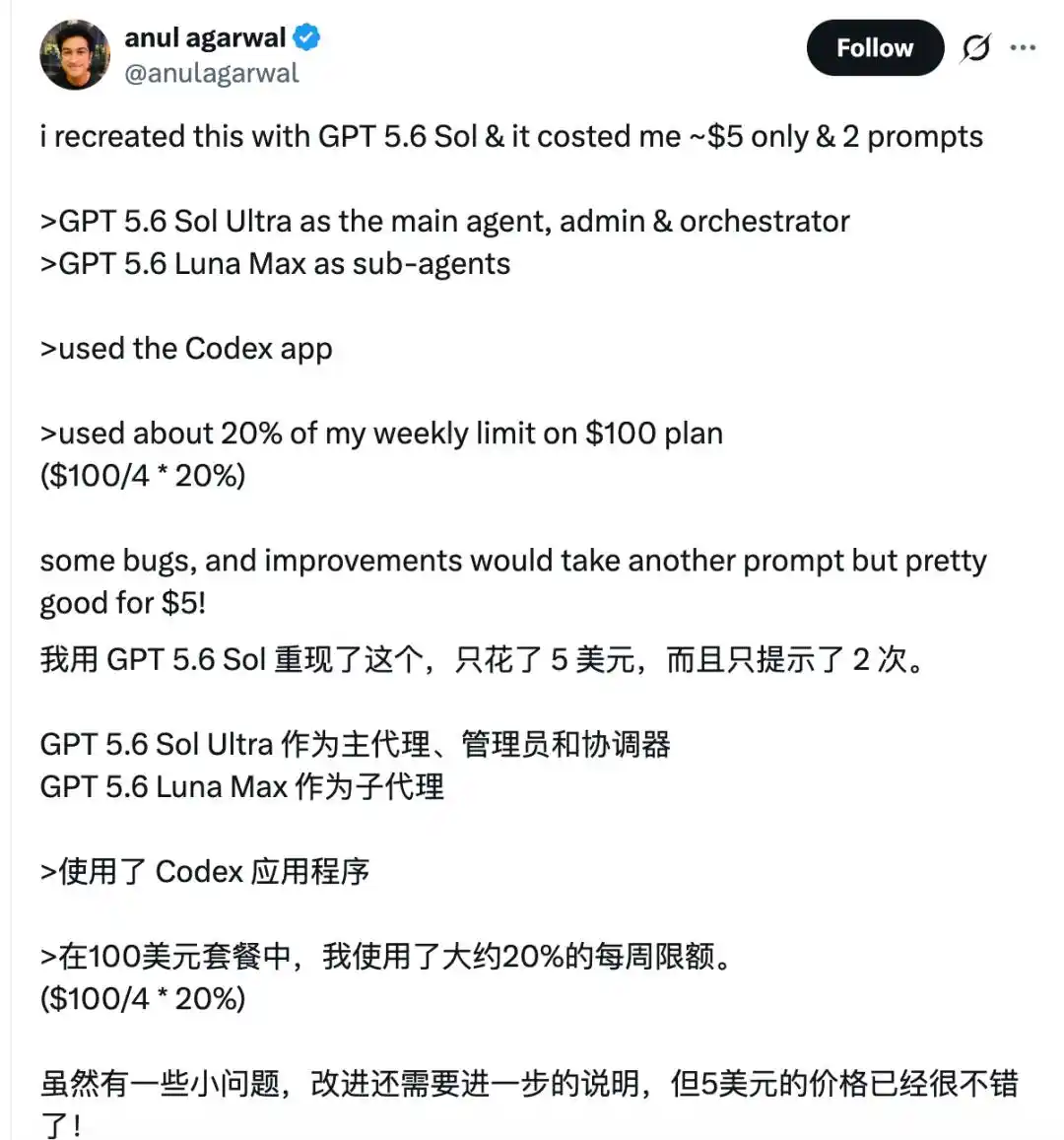
This time, he assembled an agent team:
GPT-5.6 Sol Ultra acts as the main agent, responsible for coordination, management, and scheduling;
GPT-5.6 Luna Max acts as the sub-agent, handling specific development tasks;
The entire process was completed in Codex.
The estimated cost was around just $5.
GPT...OpenAI...Long live Altman!!
Wait, before popping the champagne, you'll notice the two assignments aren't on the same level of completion.
While it replicates the most eye-catching elements of the original—also featuring boat racing on water, cartoon-style water rendering, a green track, racing UI, and multiple boats racing simultaneously—
Even the UI layout is somewhat similar.
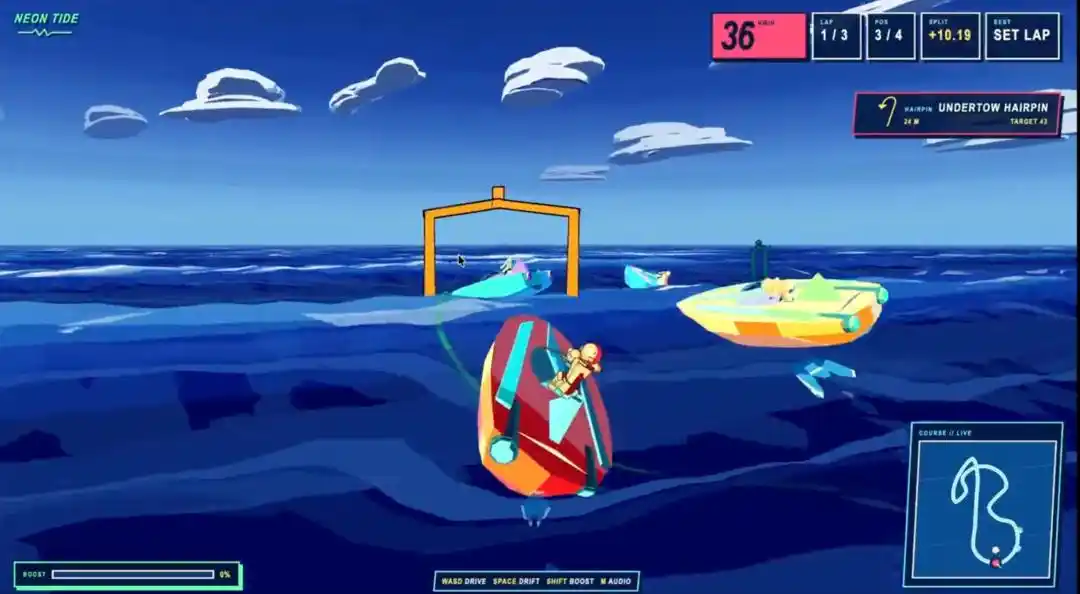
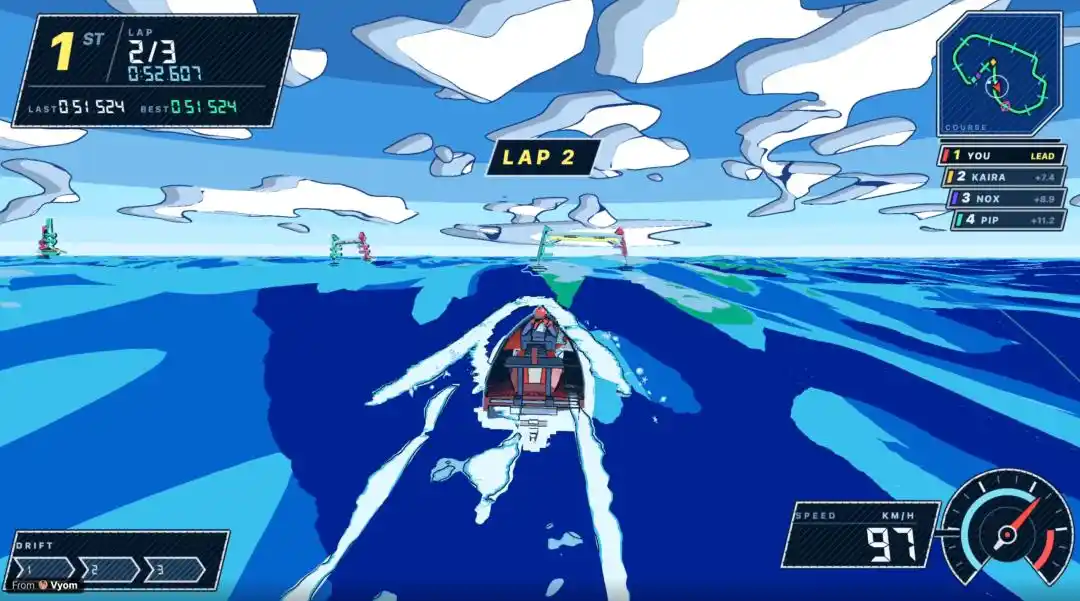
But when placed side by side, it's clear that the water detail, character presentation, and visual consistency of the replica above are relatively rough.
Which is superior is already obvious.
Also, the $5 isn't a strict cost; it mainly comes from折算 (zhesuan, conversion/calculation) of subscription package credits, not an independent API bill.
The author noted that he finds GPT-5.6 Sol particularly well-suited for game development.

Creating this $5 alternative only used about 20% of the weekly quota. If you're just building an MVP, it's indeed quite cost-effective.
Premium edition vs. basic edition—it all depends on your budget~
It's evident that AI can now generate an engineering-viable game, but the ultimate quality ceiling still depends on human judgment.
And your bill.
Game Play Link: https://wave-racer.vercel.app/
Reference Links:
[1]https://x.com/HelloVyom/status/2083177530287353961
[2]https://github.com/Vyom-26/Wave-Racer3
[3]https://x.com/anulagarwal/status/2083847470920946152
This article is from the WeChat public account "QbitAI", author: Tingyu