Long-Divided Must Unite, Long-United Must Divide: When L1 Becomes Its Own Rollup, What Is Ethereum's Endgame?

链捕手Published on 2026-07-22Last updated on 2026-07-22

Abstract

"The Inevitable Cycle: When L1 Becomes Its Own Rollup – What is Ethereum's Endgame?" For years, the Ethereum community grappled with concerns that L2s were fragmenting the ecosystem and eroding L1's value. While L2s provided cheaper execution, they also splintered liquidity and the unified user experience of a single chain. This has prompted a fundamental reassessment of the relationship between L1 and L2. Ethereum's roadmap is evolving. The "Scale" initiative merges L1 and L2 expansion into a holistic framework. L1 itself is advancing with higher gas limits, statelessness, and zkEVM verification, no longer content to be just a low-throughput settlement layer. Consequently, the primary value proposition of L2s is shifting from merely providing cheap blockspace to offering L1 cannot easily provide: application-specific optimizations, privacy features, and flexible governance models. L2s are becoming a spectrum of execution environments with varying degrees of security inheritance from Ethereum. A critical challenge in this multi-chain future is interoperability. The vision is to make Ethereum "feel like one chain again." This relies on advancements in native account abstraction (like EIP-7702) and intent-based architectures (Open Intents Framework), where users declare desired outcomes, and solvers handle the complex cross-chain execution. Furthermore, shortening Ethereum's finality time from minutes to seconds is crucial, as it underpins trust between chains for bridges, s...

"Are L2s cannibalizing L1's value?" "Is Ethereum losing its global composability?" During the years when L2s were at the peak of their popularity, such anxieties almost permeated the entire Ethereum community.

In Ethereum's scaling framework at that time, L1 was the stable but expensive settlement layer, while L2s, as cheap and efficient execution layers, indeed granted Ethereum more block space, but also gradually eroded the experience of a "unified chain."

Therefore, over the past two years, these questions have continuously driven Ethereum to re-examine the relationship between L1 and L2.

On one hand, Ethereum L1 persistently increased the Gas Limit, advanced statelessness and zkEVM verification, no longer content with merely being a low-throughput settlement base; on the other hand, community discussions intensified. Early this year, Vitalik explicitly stated that as Ethereum's own scaling capabilities improve, some premises of the roadmap established five years ago—which viewed L2s as the primary scaling solution—had already changed.

More recently, Ethereum researcher Barnabé Monnot further expressed the need to re-evaluate the long-term relationship between L1 and L2, including how L2s should create value in the future, why finality needs to be dramatically shortened, and whether L1 could also become a sort of "rollup of itself" as proof systems gradually enter the mainnet validation process.

While these viewpoints do not yet equate to a confirmed protocol roadmap, they provide a valuable lens for observation.

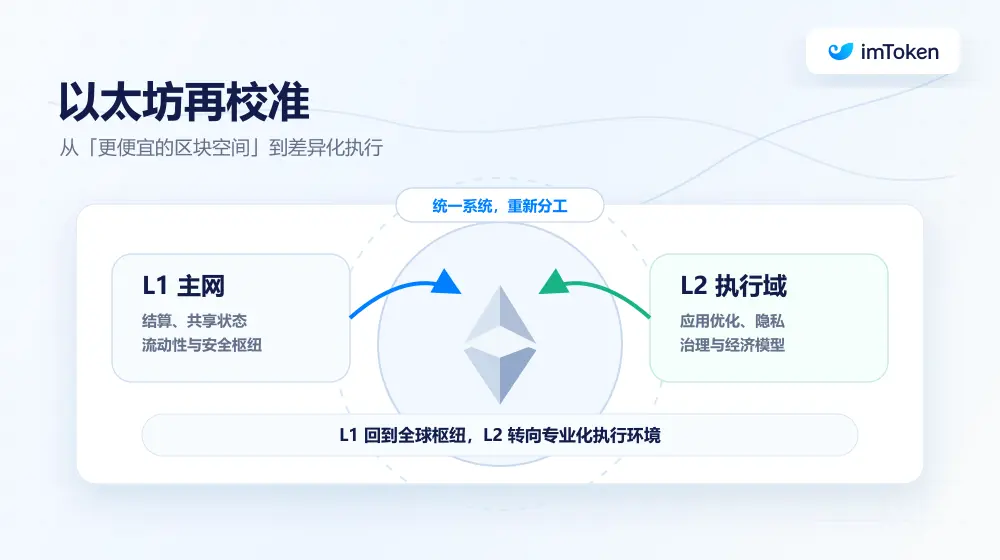
Ultimately, the problem Ethereum faces today is not just about continuing to increase block space, but rather how to re-divide labor among L1, L2, execution layers, and settlement layers as transactions, assets, and user states are dispersed across an increasing number of execution environments.
1. Ethereum Hasn't "Abandoned" L2, But Must Find a New Positioning

To be realistic, when the Ethereum scaling roadmap centered around Rollups was initially formed, L2's most important task was relatively singular: to provide Ethereum with more and cheaper transaction space.

Under the technological conditions of that time, this division of labor was quite reasonable.

Because Ethereum validators all needed to re-execute L1 transactions, mainnet throughput couldn't be aggressively increased in the short term. Rollups, however, could execute transactions in batches off-chain, submitting only compressed data or state commitments back to the mainnet, retaining a degree of Ethereum's security properties while significantly reducing unit transaction costs.

Thus, scaling gradually formed two parallel paths: L1 remained restrained, prioritizing decentralization and security, while L2s accommodated new transactions, continuously reducing costs through Blobs, data compression, and proof technologies.

But now, the premises of this division have changed.

In 2026, the Ethereum Foundation consolidated its protocol work, merging the previously separate "Scaling L1" and "Scaling Blobs" into a unified Scale roadmap. Increasing the Gas Limit, expanding data availability, optimizing execution clients, advancing statelessness, and zkEVM attester clients were all placed within the same scaling framework.

In other words, Ethereum no longer views L1 and L2 scaling as two separate tasks but has begun to reallocate execution, consensus, and data capacity from a system-wide perspective.

This change does not mean Ethereum is preparing to abandon L2s or pull all activity back to the mainnet. On the contrary, it means L2s can no longer easily justify their long-term value merely by being "faster and cheaper."

After all, if L1 itself can increase execution capacity by several orders of magnitude while maintaining security and decentralization, then ordinary EVM execution and low-cost block space will no longer be capabilities unique to L2s; L2s will need to shift focus towards providing differentiated needs that L1 cannot uniformly satisfy, such as application-specific optimizations, privacy features, and more flexible governance and economic models.

The Ethereum Foundation's latest statement this year on the L1-L2 relationship also explicitly emphasizes this. Previously, L2's primary goal was to scale Ethereum, with differentiation and customization as secondary values; now, it's about providing differentiated functionality while continuing to contribute additional scaling capacity.

Correspondingly, L1 needs to become a sufficiently powerful, permissionless, and highly resilient global hub, carrying settlement, shared state, liquidity, and DeFi.

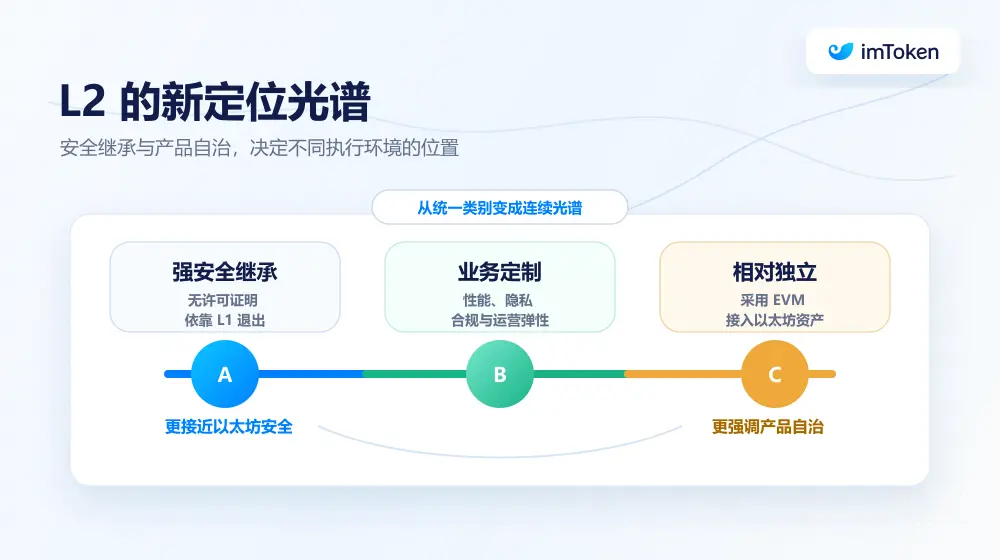
This essentially pushes L2 from a uniform technical category towards a more complex continuum:

  • At one end of the spectrum are Rollups that aim to inherit as many of Ethereum's security properties as possible, seeking to reduce multisig security committees, open permissionless proof mechanisms, and ensure users can still exit to L1 even if operators cease functioning.
  • In the middle are execution environments that inherit some Ethereum properties based on business needs, potentially possessing stronger management permissions, independent sequencers, or specific compliance designs in exchange for performance, privacy, and operational flexibility.
  • At the other end might be chains that adopt EVM, use Ethereum assets, or connect to some cross-chain facilities, but are relatively independent in terms of security and settlement.

This is why Ethereum isn't abandoning L2s, but rather redefining the division of labor. Essentially, over the past 3-5 years, L2 first and foremost represented a scaling technology; in the future, it is more likely to represent a set of execution environments that establish different security, settlement, and liquidity relationships with Ethereum.
2. Interoperability Isn't Just About Cross-Chain, But How States Trust Each Other

However, as Ethereum scales into a system comprising numerous L2s, another perennial issue gradually surfaces: the proliferation of L2s inevitably fragments liquidity, account states, and application experiences.

This has been vividly demonstrated in actual usage over the past few years. For instance, users might hold assets on one chain, use applications on another, and need to go to a third chain to complete a transaction. This results in the same stable币 having different versions across networks, and the same account needing to handle different Gas Tokens, bridges, and asset entry points.

Therefore, interoperability has become an increasingly important part of Ethereum's roadmap.

The Ethereum protocol team has focused its 2026 "Improve UX" roadmap on two directions: native account abstraction and interoperability, believing the core to solving L2 fragmentation lies in making Ethereum "feel like one chain again." This vision relies on the maturation of intent-based architecture.

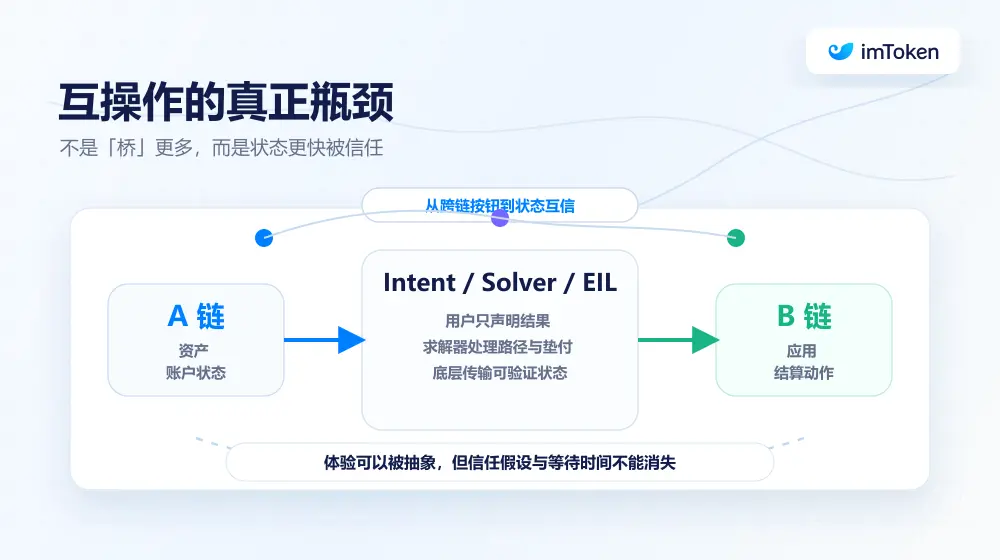
  • Among them, the Open Intents Framework allows users to simply declare their desired outcome, such as "convert a certain asset on Chain A to USDC on Chain B," with solvers handling path computation, bridging, execution, and fund rebalancing behind the scenes.
  • A step further, the Ethereum Interoperability Layer (EIL) attempts to build a trustless transport layer, aiming for cross-L2 transactions to have an experience indistinguishable from single-chain transactions.

On the account side, EIP-7702 in the Pectra upgrade already allows traditional EOAs to temporarily execute smart contract code, supporting transaction batching, gas sponsorship, and recovery mechanisms. Subsequent native account abstraction proposals, represented by EIP-8141, aim to further embed smart account logic into the protocol, making smart contract wallets the default account form and reducing reliance on additional Bundlers, Relayers, and intermediary services.

The L1 Fast Finality proposal attempts to provide a stronger confirmation signal within tens of seconds, before full finality is achieved, significantly shortening application wait times in most normal scenarios. This directly benefits all cross-chain applications relying on L1 finality, which is crucial for bridges, stablecoin settlement, and RWA asset trading.

Because the real bottleneck for many cross-chain interactions isn't whether a message can be sent, but when the target chain can be sufficiently confident that the state on the source chain will not be reverted.

A commonly overlooked point is that a transaction being included in a block does not mean it has achieved finality—from a user's perspective, a transaction might show success within seconds, but for bridges, exchanges, lending protocols, and cross-chain solvers, they still need to assess the possibility of this transaction being affected by a chain reorganization, and whether they can release assets or execute the next operation on another chain based on it.

This is why many cross-chain services today that appear "instant" do not actually wait for the source chain to achieve finality; rather, solvers or liquidity providers advance the funds. This mechanism optimizes user experience but doesn't make the underlying wait time disappear.
Therefore, Ethereum's long-term goal is to gradually shorten finality itself from minutes to seconds. However, this is not a single upgrade scheduled for deployment, but a set of research tasks requiring phased advancement, including decoupling finality votes from fork choice, optimizing validator sets, vote aggregation and network propagation, and gradually changing the consensus protocol.

Overall, good interoperability experience is not about giving dozens of chains the same cross-chain button, but about enabling different execution environments to trust each other's states faster and at lower cost.

3. When L1 Becomes a Rollup, Does the Layered Boundary Still Exist?

If the repositioning of L2s and shortening finality are adjustments within the existing layered architecture, then another point raised by Barnabé touches the very definition of L1 and L2: with proof systems entering the Ethereum mainnet, L1 may eventually also become a sort of "rollup of itself."

This sounds somewhat counterintuitive.

After all, a rollup is typically understood as a scaling network built on top of L1; it executes transactions externally, with L1 validating the state results. So how could Ethereum, being the underlying consensus and settlement network, become its own L2?

Understanding this viewpoint requires first separating "Rollup" from the hierarchical relationship. In today's Ethereum, after a node receives a block, it needs to re-execute all transactions within, independently compute state changes, and judge whether the block adheres to protocol rules.

This model ensures nodes can verify independently, but it also means the network's overall execution capacity must be constrained by ordinary nodes' hardware capabilities. The more computation in a block, the more hardware and time validators need to complete execution.

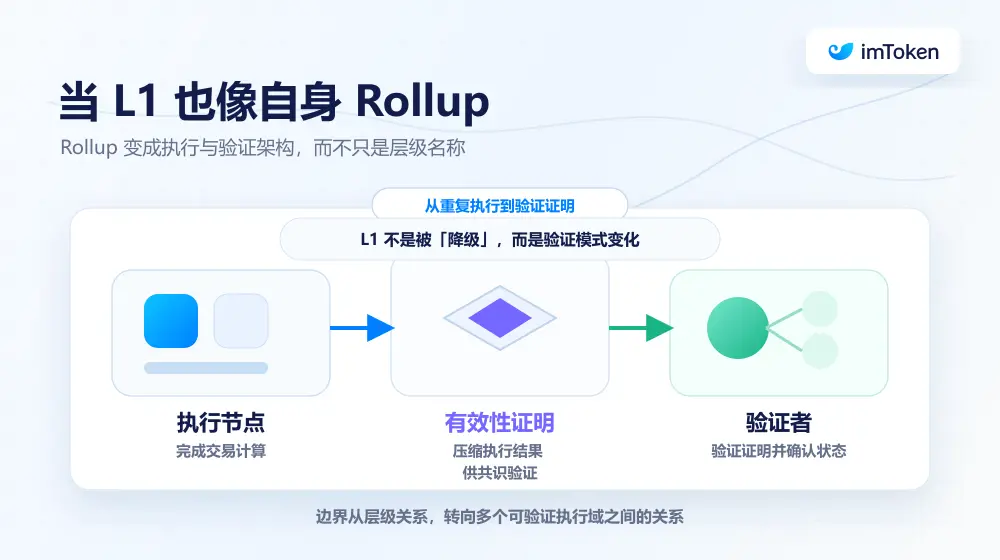
In the future, as real-time proofs and L1 zkEVM mature, transactions can still be computed by high-performance execution nodes, but ordinary validators may not need to personally re-execute every transaction. For instance, after an execution node completes computation and generates a validity proof, other validators only need to verify the smaller, cheaper proof to confirm the state transition is correct.

From the perspective of the relationship between execution and verification, this indeed shares similarities with Rollups: a subset of participants is responsible for high-performance execution, execution results are compressed into cryptographic proofs, and a broader set of consensus participants no longer repeats all computations, but verifies proofs and confirms the final state.

Therefore, Barnabé's phrase "L1 becoming its own rollup" is better understood as a summary of this verification paradigm, not that the Ethereum mainnet will be placed on another underlying chain or be "demoted" to its own L2.

His point is that when proofs gradually replace repeated execution by all nodes, a rollup may no longer be just a layer name above L1, but become a more general execution and verification architecture.
This will further blur the traditional boundary between L1 and L2.

On one hand, L1 can expand its own execution capacity with zkEVM proofs; on the other hand, Native Rollups aim to allow L2s to more directly invoke validation capabilities within the Ethereum protocol, with L1 validating L2 state transitions in a more native, unified manner.

Today, different Rollups typically need to build their own proof systems, verification contracts, upgrade mechanisms, and security committees. Once a proof system has errors, a protocol needs emergency upgrades, or an operator fails, users often still rely on additional governance and trust structures. The long-term direction of Native Rollups is to turn part of the Rollup validation logic into a native Ethereum capability, allowing L2s to reduce self-built security structures, inherit L1's state transition rules more completely, and potentially move away from security committees.

Going a step further, when multiple L2s can rely on faster L1 confirmation, unified proof mechanisms, and synchronous composability to access each other's states, their relationship with the mainnet may no longer be connected by bridges as it is today.

They would be more like multiple execution domains under the same Ethereum consensus, some responsible for general finance, some for gaming, social, or payments, some providing privacy or special compliance capabilities. They have different execution logics and product forms, yet collectively rely on a set of verifiable state, security foundations, and asset settlement systems.

Of course, this remains a long-term direction.

But regardless of the final form these technologies take, they have already transformed the L1-L2 boundary from a clear architectural line into a spectrum of different degrees of security inheritance.

In Conclusion

Long-divided, must unite; long-united, must divide.

Ethereum once gained global composability through shared state; later, it split execution out via Rollups to gain greater capacity. Now, its task is to reconnect the fragmented assets, accounts, and applications without undoing the scaling achievements.

For ordinary users, the ideal Ethereum should never be a network map of dozens of chains, different Gas tokens, and bridges. Where transactions execute, where liquidity comes from, and who ultimately settles can gradually be handled by wallets, applications, and underlying protocols. However, the trust assumptions, security boundaries, and exit paths involved cannot be hidden along with the operational experience.

Therefore, the endgame for L2s is perhaps neither replacing L1 nor being made obsolete by an increasingly scalable L1. Instead, it is to become a set of execution environments with different functionalities and performances, yet sharing security, liquidity, and state relationships.

In the past, Ethereum gained greater capacity by splitting execution apart.

In the next phase, let's see if, after being split apart, it can still be put back together as one Ethereum.


Trending Cryptos

Related Questions

QAccording to the article, what is the main reason for the shift in the division of roles between L1 and L2?

AThe shift is driven by the premise that L1 is no longer just a low-throughput settlement layer. With advancements like increased Gas Limit, statelessness, and zkEVM verification, Ethereum L1 is enhancing its own scalability. This means L2 can no longer justify its long-term value solely based on being 'faster and cheaper.' L2 must now focus on providing differentiated needs that L1 cannot uniformly satisfy, such as application-specific optimizations, privacy features, and more flexible governance and economic models.

QWhat is the primary goal of the 'Scale' roadmap that merged the previously separate 'Expanding L1' and 'Expanding Blob' workstreams?

AThe primary goal of the unified 'Scale' roadmap is to approach L1 and L2 scaling not as two separate tasks, but from the perspective of the entire system. It aims to reallocate execution, consensus, and data capacity holistically, allowing Ethereum to become a more powerful, permissionless, and resilient global hub for settlement, shared state, liquidity, and DeFi.

QHow does the article define the spectrum of future L2 roles in relation to Ethereum L1?

AThe article defines a complex continuous spectrum for L2 roles. At one end are Rollups that inherit as much of Ethereum's security properties as possible. In the middle are execution environments that inherit some Ethereum properties for specific business needs like performance or privacy. At the other end are chains that are relatively independent in security and settlement but might use EVM, Ethereum assets, or cross-chain facilities. Thus, L2 will represent a set of execution environments with different security, settlement, and liquidity relationships with Ethereum.

QWhat does the researcher Barnabé Monnot suggest about the future relationship between L1 and Rollup architecture?

ABarnabé Monnot suggests that as proof systems gradually enter the mainnet validation process, L1 itself could become a 'rollup of itself' in a sense. This means that with technologies like real-time proofs and L1 zkEVM, high-performance nodes could execute transactions and generate validity proofs. Other validators would then verify these proofs instead of re-executing every transaction, blurring the traditional boundary between L1 and L2. In this future, 'Rollup' might become a more generic execution and verification architecture rather than just a layer above L1.

QWhat are the two key directions of Ethereum's 'Improve UX' roadmap for 2026, as mentioned in the article, to address L2 fragmentation?

AThe two key directions are native account abstraction and interoperability. The goal is to make Ethereum 'feel like one chain again.' This relies on the maturity of intent-based architectures like the Open Intents Framework (which lets users declare desired outcomes) and the Ethereum Interoperability Layer (EIL), which aims to build a trustless transport layer for seamless cross-L2 transactions.

Related Reads

Can Japan Buy Growth with AI? Will the Bond Market Believe It?

Japan's cabinet has introduced the 2026 Basic Policy on Economic and Fiscal Management and Reform, shifting its primary fiscal target. The new framework moves away from the traditional annual primary balance goal and instead prioritizes a stable reduction of the debt-to-GDP ratio. This change is tied to a strategy of increased "responsible proactive fiscal" spending, aiming to boost long-term growth through investments in strategic sectors like AI, semiconductors, energy, and robotics. The government estimates total public and private investment in 62 key technologies could exceed 370 trillion yen by 2040. The market reaction has been mixed and cautious. While equity markets may respond to policy signals, bond markets are focused on fiscal credibility. Concerns center on whether the weakening of the clear primary balance anchor could lead to looser fiscal discipline. If investors doubt that these strategic investments will generate sufficient productivity gains, tax revenue, and nominal growth to outpace rising interest costs, they may demand higher yields on Japanese Government Bonds (JGBs). Recent volatility in the yen and JGB yields, with the 10-year yield briefly reaching 2.9%, reflects this skepticism. The success of this new framework hinges on two factors: whether Japan can achieve a nominal growth rate consistently higher than its long-term interest rates, and whether future budgets demonstrate disciplined control over bond issuance. The government's narrative is that strategic investment is essential to break Japan's cycle of low growth, aging, and labor shortages. However, the bond market will continuously assess the credibility of this plan, pricing the risk that it may represent fiscal expansion rather than a viable growth strategy.

marsbit20m ago

Can Japan Buy Growth with AI? Will the Bond Market Believe It?

marsbit20m ago

Misjudged A-Shares: Resilience, Expectations, and Confidence

China's A-share market recently faced selling pressure, especially in tech sectors, initially triggered by a global tech sell-off that began in South Korea. However, the article argues this is a case of "mistaken injury" and highlights the market's underlying resilience. This resilience stems from three main pillars: **1) Tech Sector Fundamentals:** Unlike Korea's market dominated by a few memory chip stocks, China's tech sector is diversified across computing, communications, electronics, and semiconductors, supported by dual narratives of global AI supply chains and domestic substitution. Core areas like optical modules and fiber optics continue to show strong earnings growth. **2) "National Team" Support:** State-backed institutions and large corporations have made significant market purchases and announced buybacks, providing liquidity and signaling confidence. This is seen as a stabilizing policy signal, often associated with market bottoms. **3) Broader Market Pillars:** Other major sectors are showing endogenous recovery momentum. Consumer stocks benefit from stabilizing CPI and signs of sector recovery (e.g., liquor price hikes). Cyclical sectors like aluminum have high earnings, potential price increases due to tight supply, and low valuations. The financial sector offers stable dividends and low valuations. The conclusion is that the sell-off was driven by external contagion, not a collapse in fundamentals. With strong policy support and recovering momentum across key sectors, the A-share market possesses the toughness to regain stability.

marsbit51m ago

Misjudged A-Shares: Resilience, Expectations, and Confidence

marsbit51m ago

Trading

Spot

Hot Articles

What is SONIC

Sonic: Pioneering the Future of Gaming in Web3 Introduction to Sonic In the ever-evolving landscape of Web3, the gaming industry stands out as one of the most dynamic and promising sectors. At the forefront of this revolution is Sonic, a project designed to amplify the gaming ecosystem on the Solana blockchain. Leveraging cutting-edge technology, Sonic aims to deliver an unparalleled gaming experience by efficiently processing millions of requests per second, ensuring that players enjoy seamless gameplay while maintaining low transaction costs. This article delves into the intricate details of Sonic, exploring its creators, funding sources, operational mechanics, and the timeline of significant events that have shaped its journey. What is Sonic? Sonic is an innovative layer-2 network that operates atop the Solana blockchain, specifically tailored to enhance the existing Solana gaming ecosystem. It accomplishes this through a customised, VM-agnostic game engine paired with a HyperGrid interpreter, facilitating sovereign game economies that roll up back to the Solana platform. The primary goals of Sonic include: Enhanced Gaming Experiences: Sonic is committed to offering lightning-fast on-chain gameplay, allowing players and developers to engage with games at previously unattainable speeds. Atomic Interoperability: This feature enables transactions to be executed within Sonic without the need to redeploy Solana programmes and accounts. This makes the process more efficient and directly benefits from Solana Layer1 services and liquidity. Seamless Deployment: Sonic allows developers to write for Ethereum Virtual Machine (EVM) based systems and execute them on Solana’s SVM infrastructure. This interoperability is crucial for attracting a broader range of dApps and decentralised applications to the platform. Support for Developers: By offering native composable gaming primitives and extensible data types - dining within the Entity-Component-System (ECS) framework - game creators can craft intricate business logic with ease. Overall, Sonic's unique approach not only caters to players but also provides an accessible and low-cost environment for developers to innovate and thrive. Creator of Sonic The information regarding the creator of Sonic is somewhat ambiguous. However, it is known that Sonic's SVM is owned by the company Mirror World. The absence of detailed information about the individuals behind Sonic reflects a common trend in several Web3 projects, where collective efforts and partnerships often overshadow individual contributions. Investors of Sonic Sonic has garnered considerable attention and support from various investors within the crypto and gaming sectors. Notably, the project raised an impressive $12 million during its Series A funding round. The round was led by BITKRAFT Ventures, with other notable investors including Galaxy, Okx Ventures, Interactive, Big Brain Holdings, and Mirana. This financial backing signifies the confidence that investment foundations have in Sonic’s potential to revolutionise the Web3 gaming landscape, further validating its innovative approaches and technologies. How Does Sonic Work? Sonic utilises the HyperGrid framework, a sophisticated parallel processing mechanism that enhances its scalability and customisability. Here are the core features that set Sonic apart: Lightning Speed at Low Costs: Sonic offers one of the fastest on-chain gaming experiences compared to other Layer-1 solutions, powered by the scalability of Solana’s virtual machine (SVM). Atomic Interoperability: Sonic enables transaction execution without redeployment of Solana programmes and accounts, effectively streamlining the interaction between users and the blockchain. EVM Compatibility: Developers can effortlessly migrate decentralised applications from EVM chains to the Solana environment using Sonic’s HyperGrid interpreter, increasing the accessibility and integration of various dApps. Ecosystem Support for Developers: By exposing native composable gaming primitives, Sonic facilitates a sandbox-like environment where developers can experiment and implement business logic, greatly enhancing the overall development experience. Monetisation Infrastructure: Sonic natively supports growth and monetisation efforts, providing frameworks for traffic generation, payments, and settlements, thereby ensuring that gaming projects are not only viable but also sustainable financially. Timeline of Sonic The evolution of Sonic has been marked by several key milestones. Below is a brief timeline highlighting critical events in the project's history: 2022: The Sonic cryptocurrency was officially launched, marking the beginning of its journey in the Web3 gaming arena. 2024: June: Sonic SVM successfully raised $12 million in a Series A funding round. This investment allowed Sonic to further develop its platform and expand its offerings. August: The launch of the Sonic Odyssey testnet provided users with the first opportunity to engage with the platform, offering interactive activities such as collecting rings—a nod to gaming nostalgia. October: SonicX, an innovative crypto game integrated with Solana, made its debut on TikTok, capturing the attention of over 120,000 users within a short span. This integration illustrated Sonic’s commitment to reaching a broader, global audience and showcased the potential of blockchain gaming. Key Points Sonic SVM is a revolutionary layer-2 network on Solana explicitly designed to enhance the GameFi landscape, demonstrating great potential for future development. HyperGrid Framework empowers Sonic by introducing horizontal scaling capabilities, ensuring that the network can handle the demands of Web3 gaming. Integration with Social Platforms: The successful launch of SonicX on TikTok displays Sonic’s strategy to leverage social media platforms to engage users, exponentially increasing the exposure and reach of its projects. Investment Confidence: The substantial funding from BITKRAFT Ventures, among others, emphasizes the robust backing Sonic has, paving the way for its ambitious future. In conclusion, Sonic encapsulates the essence of Web3 gaming innovation, striking a balance between cutting-edge technology, developer-centric tools, and community engagement. As the project continues to evolve, it is poised to redefine the gaming landscape, making it a notable entity for gamers and developers alike. As Sonic moves forward, it will undoubtedly attract greater interest and participation, solidifying its place within the broader narrative of blockchain gaming.

1.9k Total ViewsPublished 2024.04.04Updated 2024.12.03

What is SONIC

What is $S$

Understanding SPERO: A Comprehensive Overview Introduction to SPERO As the landscape of innovation continues to evolve, the emergence of web3 technologies and cryptocurrency projects plays a pivotal role in shaping the digital future. One project that has garnered attention in this dynamic field is SPERO, denoted as SPERO,$$s$. This article aims to gather and present detailed information about SPERO, to help enthusiasts and investors understand its foundations, objectives, and innovations within the web3 and crypto domains. What is SPERO,$$s$? SPERO,$$s$ is a unique project within the crypto space that seeks to leverage the principles of decentralisation and blockchain technology to create an ecosystem that promotes engagement, utility, and financial inclusion. The project is tailored to facilitate peer-to-peer interactions in new ways, providing users with innovative financial solutions and services. At its core, SPERO,$$s$ aims to empower individuals by providing tools and platforms that enhance user experience in the cryptocurrency space. This includes enabling more flexible transaction methods, fostering community-driven initiatives, and creating pathways for financial opportunities through decentralised applications (dApps). The underlying vision of SPERO,$$s$ revolves around inclusiveness, aiming to bridge gaps within traditional finance while harnessing the benefits of blockchain technology. Who is the Creator of SPERO,$$s$? The identity of the creator of SPERO,$$s$ remains somewhat obscure, as there are limited publicly available resources providing detailed background information on its founder(s). This lack of transparency can stem from the project's commitment to decentralisation—an ethos that many web3 projects share, prioritising collective contributions over individual recognition. By centring discussions around the community and its collective goals, SPERO,$$s$ embodies the essence of empowerment without singling out specific individuals. As such, understanding the ethos and mission of SPERO remains more important than identifying a singular creator. Who are the Investors of SPERO,$$s$? SPERO,$$s$ is supported by a diverse array of investors ranging from venture capitalists to angel investors dedicated to fostering innovation in the crypto sector. The focus of these investors generally aligns with SPERO's mission—prioritising projects that promise societal technological advancement, financial inclusivity, and decentralised governance. These investor foundations are typically interested in projects that not only offer innovative products but also contribute positively to the blockchain community and its ecosystems. The backing from these investors reinforces SPERO,$$s$ as a noteworthy contender in the rapidly evolving domain of crypto projects. How Does SPERO,$$s$ Work? SPERO,$$s$ employs a multi-faceted framework that distinguishes it from conventional cryptocurrency projects. Here are some of the key features that underline its uniqueness and innovation: Decentralised Governance: SPERO,$$s$ integrates decentralised governance models, empowering users to participate actively in decision-making processes regarding the project’s future. This approach fosters a sense of ownership and accountability among community members. Token Utility: SPERO,$$s$ utilises its own cryptocurrency token, designed to serve various functions within the ecosystem. These tokens enable transactions, rewards, and the facilitation of services offered on the platform, enhancing overall engagement and utility. Layered Architecture: The technical architecture of SPERO,$$s$ supports modularity and scalability, allowing for seamless integration of additional features and applications as the project evolves. This adaptability is paramount for sustaining relevance in the ever-changing crypto landscape. Community Engagement: The project emphasises community-driven initiatives, employing mechanisms that incentivise collaboration and feedback. By nurturing a strong community, SPERO,$$s$ can better address user needs and adapt to market trends. Focus on Inclusion: By offering low transaction fees and user-friendly interfaces, SPERO,$$s$ aims to attract a diverse user base, including individuals who may not previously have engaged in the crypto space. This commitment to inclusion aligns with its overarching mission of empowerment through accessibility. Timeline of SPERO,$$s$ Understanding a project's history provides crucial insights into its development trajectory and milestones. Below is a suggested timeline mapping significant events in the evolution of SPERO,$$s$: Conceptualisation and Ideation Phase: The initial ideas forming the basis of SPERO,$$s$ were conceived, aligning closely with the principles of decentralisation and community focus within the blockchain industry. Launch of Project Whitepaper: Following the conceptual phase, a comprehensive whitepaper detailing the vision, goals, and technological infrastructure of SPERO,$$s$ was released to garner community interest and feedback. Community Building and Early Engagements: Active outreach efforts were made to build a community of early adopters and potential investors, facilitating discussions around the project’s goals and garnering support. Token Generation Event: SPERO,$$s$ conducted a token generation event (TGE) to distribute its native tokens to early supporters and establish initial liquidity within the ecosystem. Launch of Initial dApp: The first decentralised application (dApp) associated with SPERO,$$s$ went live, allowing users to engage with the platform's core functionalities. Ongoing Development and Partnerships: Continuous updates and enhancements to the project's offerings, including strategic partnerships with other players in the blockchain space, have shaped SPERO,$$s$ into a competitive and evolving player in the crypto market. Conclusion SPERO,$$s$ stands as a testament to the potential of web3 and cryptocurrency to revolutionise financial systems and empower individuals. With a commitment to decentralised governance, community engagement, and innovatively designed functionalities, it paves the way toward a more inclusive financial landscape. As with any investment in the rapidly evolving crypto space, potential investors and users are encouraged to research thoroughly and engage thoughtfully with the ongoing developments within SPERO,$$s$. The project showcases the innovative spirit of the crypto industry, inviting further exploration into its myriad possibilities. While the journey of SPERO,$$s$ is still unfolding, its foundational principles may indeed influence the future of how we interact with technology, finance, and each other in interconnected digital ecosystems.

155 Total ViewsPublished 2024.12.17Updated 2024.12.17

What is $S$

What is AGENT S

Agent S: The Future of Autonomous Interaction in Web3 Introduction In the ever-evolving landscape of Web3 and cryptocurrency, innovations are constantly redefining how individuals interact with digital platforms. One such pioneering project, Agent S, promises to revolutionise human-computer interaction through its open agentic framework. By paving the way for autonomous interactions, Agent S aims to simplify complex tasks, offering transformative applications in artificial intelligence (AI). This detailed exploration will delve into the project's intricacies, its unique features, and the implications for the cryptocurrency domain. What is Agent S? Agent S stands as a groundbreaking open agentic framework, specifically designed to tackle three fundamental challenges in the automation of computer tasks: Acquiring Domain-Specific Knowledge: The framework intelligently learns from various external knowledge sources and internal experiences. This dual approach empowers it to build a rich repository of domain-specific knowledge, enhancing its performance in task execution. Planning Over Long Task Horizons: Agent S employs experience-augmented hierarchical planning, a strategic approach that facilitates efficient breakdown and execution of intricate tasks. This feature significantly enhances its ability to manage multiple subtasks efficiently and effectively. Handling Dynamic, Non-Uniform Interfaces: The project introduces the Agent-Computer Interface (ACI), an innovative solution that enhances the interaction between agents and users. Utilizing Multimodal Large Language Models (MLLMs), Agent S can navigate and manipulate diverse graphical user interfaces seamlessly. Through these pioneering features, Agent S provides a robust framework that addresses the complexities involved in automating human interaction with machines, setting the stage for myriad applications in AI and beyond. Who is the Creator of Agent S? While the concept of Agent S is fundamentally innovative, specific information about its creator remains elusive. The creator is currently unknown, which highlights either the nascent stage of the project or the strategic choice to keep founding members under wraps. Regardless of anonymity, the focus remains on the framework's capabilities and potential. Who are the Investors of Agent S? As Agent S is relatively new in the cryptographic ecosystem, detailed information regarding its investors and financial backers is not explicitly documented. The lack of publicly available insights into the investment foundations or organisations supporting the project raises questions about its funding structure and development roadmap. Understanding the backing is crucial for gauging the project's sustainability and potential market impact. How Does Agent S Work? At the core of Agent S lies cutting-edge technology that enables it to function effectively in diverse settings. Its operational model is built around several key features: Human-like Computer Interaction: The framework offers advanced AI planning, striving to make interactions with computers more intuitive. By mimicking human behaviour in tasks execution, it promises to elevate user experiences. Narrative Memory: Employed to leverage high-level experiences, Agent S utilises narrative memory to keep track of task histories, thereby enhancing its decision-making processes. Episodic Memory: This feature provides users with step-by-step guidance, allowing the framework to offer contextual support as tasks unfold. Support for OpenACI: With the ability to run locally, Agent S allows users to maintain control over their interactions and workflows, aligning with the decentralised ethos of Web3. Easy Integration with External APIs: Its versatility and compatibility with various AI platforms ensure that Agent S can fit seamlessly into existing technological ecosystems, making it an appealing choice for developers and organisations. These functionalities collectively contribute to Agent S's unique position within the crypto space, as it automates complex, multi-step tasks with minimal human intervention. As the project evolves, its potential applications in Web3 could redefine how digital interactions unfold. Timeline of Agent S The development and milestones of Agent S can be encapsulated in a timeline that highlights its significant events: September 27, 2024: The concept of Agent S was launched in a comprehensive research paper titled “An Open Agentic Framework that Uses Computers Like a Human,” showcasing the groundwork for the project. October 10, 2024: The research paper was made publicly available on arXiv, offering an in-depth exploration of the framework and its performance evaluation based on the OSWorld benchmark. October 12, 2024: A video presentation was released, providing a visual insight into the capabilities and features of Agent S, further engaging potential users and investors. These markers in the timeline not only illustrate the progress of Agent S but also indicate its commitment to transparency and community engagement. Key Points About Agent S As the Agent S framework continues to evolve, several key attributes stand out, underscoring its innovative nature and potential: Innovative Framework: Designed to provide an intuitive use of computers akin to human interaction, Agent S brings a novel approach to task automation. Autonomous Interaction: The ability to interact autonomously with computers through GUI signifies a leap towards more intelligent and efficient computing solutions. Complex Task Automation: With its robust methodology, it can automate complex, multi-step tasks, making processes faster and less error-prone. Continuous Improvement: The learning mechanisms enable Agent S to improve from past experiences, continually enhancing its performance and efficacy. Versatility: Its adaptability across different operating environments like OSWorld and WindowsAgentArena ensures that it can serve a broad range of applications. As Agent S positions itself in the Web3 and crypto landscape, its potential to enhance interaction capabilities and automate processes signifies a significant advancement in AI technologies. Through its innovative framework, Agent S exemplifies the future of digital interactions, promising a more seamless and efficient experience for users across various industries. Conclusion Agent S represents a bold leap forward in the marriage of AI and Web3, with the capacity to redefine how we interact with technology. While still in its early stages, the possibilities for its application are vast and compelling. Through its comprehensive framework addressing critical challenges, Agent S aims to bring autonomous interactions to the forefront of the digital experience. As we move deeper into the realms of cryptocurrency and decentralisation, projects like Agent S will undoubtedly play a crucial role in shaping the future of technology and human-computer collaboration.

822 Total ViewsPublished 2025.01.14Updated 2025.01.14

What is AGENT S

Discussions

Welcome to the HTX Community. Here, you can stay informed about the latest platform developments and gain access to professional market insights. Users' opinions on the price of S (S) are presented below.

活动图片












