Losses from the Coldcard Hack: How Researchers Track Stolen Bitcoin

cryptonews.ruPublished on 2026-08-11Last updated on 2026-08-11

Abstract

A security breach affecting Coldcard hardware wallets highlights the challenges of estimating losses from attacks on non-custodial wallets, as there is no complete list of compromised addresses. Analytic firms have provided differing estimates. CryptoQuant confirms losses of 1,432 BTC, using a strict methodology that only counts funds from publicly reported victim addresses. Galaxy Research and TRM Labs assess a higher minimum of around 1,730 to 1,816 BTC stolen from over 5,200 addresses. They combine direct victim reports with analysis of on-chain transaction patterns linked to the attack's waves. Galaxy notes that while victim reports have helped identify over 450 BTC in confirmed losses and pattern-matching suggests over 730 BTC more, many suspected funds remain unconfirmed. Experts agree that establishing a precise total is difficult. Julio Moreno of CryptoQuant stated the final figure will always be an estimate, as researchers can only verify what victims disclose publicly. The lack of a central entity, like an exchange, complicates verification, and relying solely on on-chain patterns risks false positives and overestimation.

The Coldcard hack has shown how difficult it is to assess the damage to owners of non-custodial wallets: the scale of the theft is largely determined by reports from victims.

The blockchain analytics platform CryptoQuant currently estimates confirmed losses at 1,432 $BTC, while other analysts have tracked significantly more funds linked to the attack.

Galaxy Research and blockchain analytics firm TRM Labs believe the damage is higher. They distinguish between losses directly confirmed by victims and funds attributed to the attack based on on-chain patterns.

This complicates the assessment of attacks on non-custodial wallets: unlike a centralized exchange hack, there is no complete list of affected addresses. Researchers have to build estimates, not determine a final damage figure.

Galaxy Tracks Losses Beyond Victim Reports

Alex Thorn from Galaxy told Cointelegraph that the platform's previous estimate—up to 1,816 $BTC—was a preliminary, not a confirmed total loss figure.

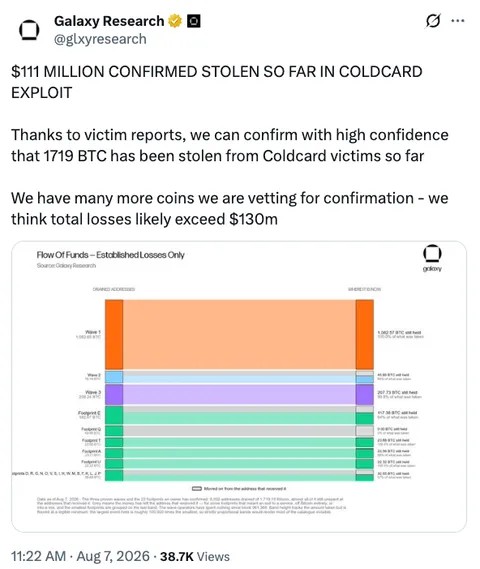
As of Tuesday, Galaxy assessed with high confidence a minimum damage of 1,730 $BTC. According to Thorn, the amount could rise if new victim reports confirm the attack patterns.
Source: Galaxy Research

"We have directly confirmed over 450 $BTC based on victim reports; however, these reports helped identify other, previously unknown victims with losses exceeding 730 $BTC," Thorn said. Galaxy uses these reports to confirm broader attack patterns but does not count funds it suspects are linked but cannot reliably verify yet. "We are still not counting many $BTC that are suspicious but lack sufficient confirmation," Thorn added.

Related: Coldcard Hackers Moved 64 $BTC and 200 ETH to Crypto Mixers

TRM Labs stated that its independent estimate is in the same range as Galaxy's, and recent analysis showed that the attackers stole about 1,816 $BTC from over 5,200 addresses across four attack waves. "Researchers should expect the estimate to rise before stabilizing," Ari Redbord, TRM's Global Head of Policy, told Cointelegraph.

CryptoQuant Applies a Stricter Approach

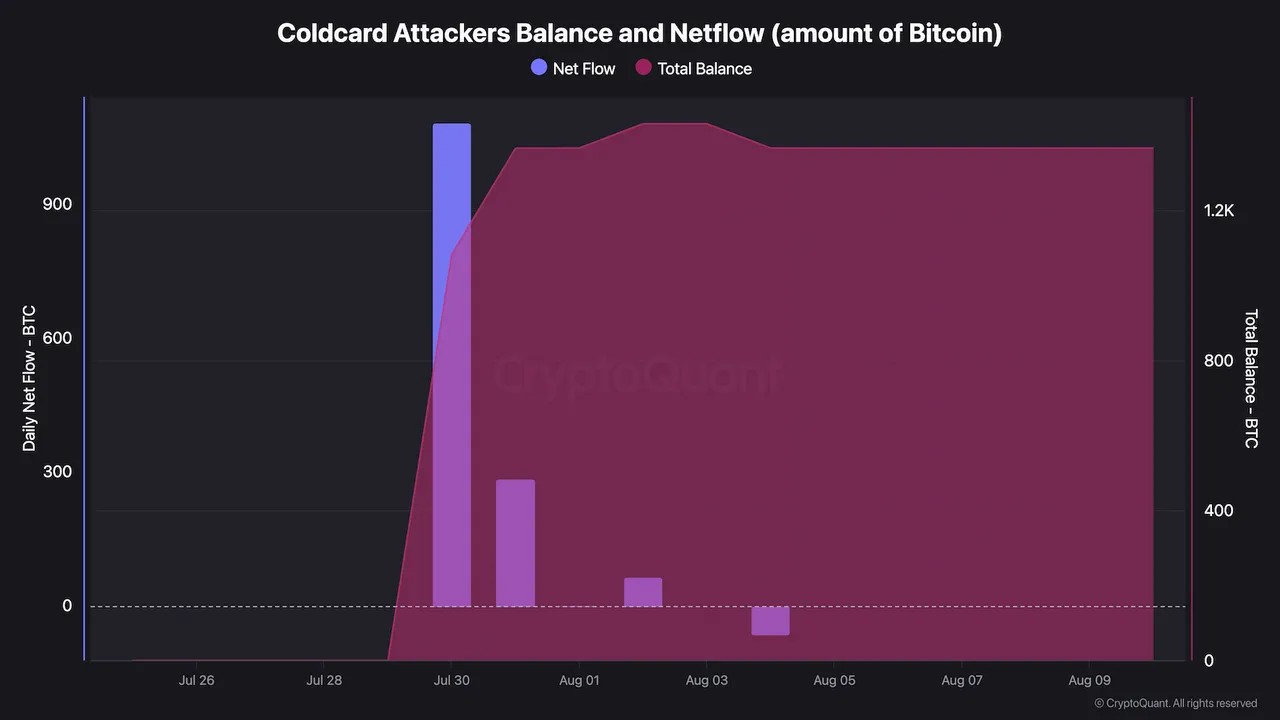
CryptoQuant Head of Research Julio Moreno told Cointelegraph that the company starts with public victim reports, including wallet addresses and transaction IDs, then cross-references them with known on-chain attack patterns.

This approach gives CryptoQuant a confirmed estimate of 1,432 $BTC. Moreno called it a lower bound that could rise if more victims publicly reveal their compromised addresses.
Source: CryptoQuant

Moreno stated that CryptoQuant is cautious about identifying victims based solely on on-chain patterns, as it could lead to false positives and inflate the estimate.

"Since the stolen bitcoins belonged to individuals and not a centralized organization like an exchange, we can only confirm what each victim discloses publicly," he said.

Difficult to Pinpoint an Exact Figure

Moreno emphasized that the total amount will remain an estimate, as researchers can only confirm information disclosed by victims. He explained:

"It is difficult to establish the total number of stolen $BTC, and it will always be an estimate."

Chainalysis told Cointelegraph that it had not conducted an independent loss assessment, while blockchain researcher ZachXBT publicly stated he does not plan to track or investigate this incident.

Magazine: Do Coldcard Attacks Mean All Hardware Wallets Are Now Insecure?

end-content

Trending Cryptos

Related Questions

QWhat is the main difficulty in assessing the damage from the Coldcard hack, according to the article?

AThe main difficulty is that, unlike a centralized exchange hack, there is no complete list of affected addresses. Researchers must rely on victim reports and on-chain pattern analysis to build estimates rather than establish a definitive total.

QWhat are the differing approaches to estimating the losses, as mentioned in the article?

AGalaxy Research and TRM Labs use victim reports to identify wider attack patterns and estimate higher losses, while CryptoQuant applies a stricter method, starting only with publicly confirmed victim reports to avoid false positives, resulting in a lower confirmed estimate.

QWhat is CryptoQuant's current confirmed estimate of losses from the Coldcard hack, and why is it considered a 'lower bound'?

ACryptoQuant's confirmed estimate is 1432 BTC. It is considered a 'lower bound' because it only includes losses from victims who have publicly revealed their compromised addresses and transaction IDs. The figure could grow if more victims come forward.

QWhat does Galaxy Research consider its 'high-confidence' minimum damage estimate, and how does it arrive at this figure?

AGalaxy Research's high-confidence minimum damage estimate is 1730 BTC. It arrives at this by directly confirming over 450 BTC from victim reports and using those reports to identify patterns that point to other, previously unknown victims with over 730 BTC in losses.

QWhy does the article state that establishing a total number of stolen BTC will always be an estimate?

ABecause the stolen funds belonged to individuals using non-custodial wallets, not a centralized entity. Researchers can only confirm what victims choose to disclose publicly. Without a complete victim list, any total figure remains an approximation based on available data and pattern analysis.

Related Reads

Hyperliquid is Strongly Strangling HyperEVM

The article analyzes the apparent failure of HyperEVM, the application engine of the Hyperliquid blockchain, contrasting it with the success of its core trading engine, HyperCore. Hyperliquid operates on a dual-engine architecture. HyperCore is a closed, high-performance order-book exchange for perpetuals and spot trading, which dominates on-chain volume and generates massive fees. HyperEVM, launched in February 2025, is an EVM-compatible layer meant for DeFi applications like lending and DEXs, which can access HyperCore's liquidity. Despite Hyperliquid's overall strength in a bear market, a stark divergence exists: * **HyperCore (Trading):** Captures over half of on-chain perpetual volume, generating ~$56M in fees over 30 days. * **HyperEVM (Applications):** All DeFi protocols combined generate less than $60M in fees. TVL is shrinking, daily active addresses are low (~8k), and the ecosystem lacks diversity. The DEX sector is particularly anemic, with most volume concentrated in a single protocol. The article identifies four key reasons for HyperEVM's struggles: 1. **Core Monopoly on Execution:** HyperCore exclusively handles order matching. This makes native DEXs on HyperEVM redundant and limits viable applications to those leveraging its order book (e.g., staking, lending). 2. **Architectural Concentration:** Shared liquidity across interfaces naturally leads to a "winner-takes-most" outcome, explaining the high concentration in both the trading (e.g., trade.xyz) and application layers. 3. **"No Insider" Philosophy:** Hyperliquid's commitment to fair launch means it provides no grants, business development, or marketing support to ecosystem projects, stunting growth. 4. **Complex Developer Experience:** The asynchronous design between HyperEVM and HyperCore (via the CoreWriter contract) creates non-standard development hurdles, as EVM transactions don't roll back if the core action fails. The conclusion is that HyperEVM's weakness is a deliberate trade-off, not an accident. Hyperliquid prioritized building an unbeatable trading engine, sacrificing the development of a broad, independent application ecosystem. HyperEVM functions more as a tokenization layer for HyperCore's liquidity rather than a general-purpose chain. The debate isn't whether it's "dead"—it serves a niche—but whether Hyperliquid ever intended to build a thriving, diverse DeFi ecosystem beyond its core trading product.

marsbit36m ago

Hyperliquid is Strongly Strangling HyperEVM

marsbit36m ago

UltraPure Applied Materials Lists on Shenzhen Stock Exchange: Annual Revenue of 5 Billion, Post-Adjustment Net Profit of 2 Billion, Market Cap of 51.2 Billion

SuperPure Applied Materials (Stock Code: 301717) debuted on the Shenzhen Stock Exchange's ChiNext board. The company issued 25.4615 million shares at an offering price of 65.99 yuan per share, raising approximately 1.68 billion yuan. The stock opened at 450 yuan, soaring 582% from the IPO price, and closed at 503 yuan, up 662%, giving the company a market capitalization of 51.2 billion yuan. The company specializes in special coating processes and related technologies and materials, providing precision components and services for the semiconductor manufacturing and precision optics sectors. Its products cover core equipment parts for wafer fabrication, packaging, and silicon wafer manufacturing, with notable technical advantages in etching, lithography, measurement/inspection, annealing, and thin-film deposition equipment. Financially, SuperPure reported revenues of 169 million, 260 million, and 496 million yuan for 2023, 2024, and 2025 respectively, with corresponding net profits of 64.8 million, 82.26 million, and 185 million yuan. For Q1 2026, revenue reached 147 million yuan, a 62% year-over-year increase. The company forecasts H1 2026 revenue between 270 to 290 million yuan and net profit between 103 to 110 million yuan. The company's controlling shareholder and actual controller is Chai Jie, who directly and indirectly controls 48.23% of the voting rights. Together with his brother Chai Lin, a concerted action person, they control a total of 68.84% of the voting rights. Major pre-IPO shareholders included GSD Venture Capital, BYD, and AMEC.

marsbit1h ago

UltraPure Applied Materials Lists on Shenzhen Stock Exchange: Annual Revenue of 5 Billion, Post-Adjustment Net Profit of 2 Billion, Market Cap of 51.2 Billion

marsbit1h ago

Trading

Spot

Hot Articles

What is $BITCOIN

DIGITAL GOLD ($BITCOIN): A Comprehensive Analysis Introduction to DIGITAL GOLD ($BITCOIN) DIGITAL GOLD ($BITCOIN) is a blockchain-based project operating on the Solana network, which aims to combine the characteristics of traditional precious metals with the innovation of decentralized technologies. While it shares a name with Bitcoin, often referred to as “digital gold” due to its perception as a store of value, DIGITAL GOLD is a separate token designed to create a unique ecosystem within the Web3 landscape. Its goal is to position itself as a viable alternative digital asset, although specifics regarding its applications and functionalities are still developing. What is DIGITAL GOLD ($BITCOIN)? DIGITAL GOLD ($BITCOIN) is a cryptocurrency token explicitly designed for use on the Solana blockchain. In contrast to Bitcoin, which provides a widely recognized value storage role, this token appears to focus on broader applications and characteristics. Notable aspects include: Blockchain Infrastructure: The token is built on the Solana blockchain, known for its capacity to handle high-speed and low-cost transactions. Supply Dynamics: DIGITAL GOLD has a maximum supply capped at 100 quadrillion tokens (100P $BITCOIN), although details regarding its circulating supply are currently undisclosed. Utility: While precise functionalities are not explicitly outlined, there are indications that the token could be utilized for various applications, potentially involving decentralized applications (dApps) or asset tokenization strategies. Who is the Creator of DIGITAL GOLD ($BITCOIN)? At present, the identity of the creators and development team behind DIGITAL GOLD ($BITCOIN) remains unknown. This situation is typical among many innovative projects within the blockchain space, particularly those aligning with decentralized finance and meme coin phenomena. While such anonymity may foster a community-driven culture, it intensifies concerns about governance and accountability. Who are the Investors of DIGITAL GOLD ($BITCOIN)? The available information indicates that DIGITAL GOLD ($BITCOIN) does not have any known institutional backers or prominent venture capital investments. The project seems to operate on a peer-to-peer model focused on community support and adoption rather than traditional funding routes. Its activity and liquidity are primarily situated on decentralized exchanges (DEXs), such as PumpSwap, rather than established centralized trading platforms, further highlighting its grassroots approach. How DIGITAL GOLD ($BITCOIN) Works The operational mechanics of DIGITAL GOLD ($BITCOIN) can be elaborated on based on its blockchain design and network attributes: Consensus Mechanism: By leveraging Solana’s unique proof-of-history (PoH) combined with a proof-of-stake (PoS) model, the project ensures efficient transaction validation contributing to the network's high performance. Tokenomics: While specific deflationary mechanisms have not been extensively detailed, the vast maximum token supply implies that it may cater to microtransactions or niche use cases that are still to be defined. Interoperability: There exists the potential for integration with Solana’s broader ecosystem, including various decentralized finance (DeFi) platforms. However, the details regarding specific integrations remain unspecified. Timeline of Key Events Here is a timeline that highlights significant milestones concerning DIGITAL GOLD ($BITCOIN): 2023: The initial deployment of the token occurs on the Solana blockchain, marked by its contract address. 2024: DIGITAL GOLD gains visibility as it becomes available for trading on decentralized exchanges like PumpSwap, allowing users to trade it against SOL. 2025: The project witnesses sporadic trading activity and potential interest in community-led engagements, although no noteworthy partnerships or technical advancements have been documented as of yet. Critical Analysis Strengths Scalability: The underlying Solana infrastructure supports high transaction volumes, which could enhance the utility of $BITCOIN in various transaction scenarios. Accessibility: The potential low trading price per token could attract retail investors, facilitating wider participation due to fractional ownership opportunities. Risks Lack of Transparency: The absence of publicly known backers, developers, or an audit process may yield skepticism regarding the project's sustainability and trustworthiness. Market Volatility: The trading activity is heavily reliant on speculative behavior, which can result in significant price volatility and uncertainty for investors. Conclusion DIGITAL GOLD ($BITCOIN) emerges as an intriguing yet ambiguous project within the rapidly evolving Solana ecosystem. While it attempts to leverage the “digital gold” narrative, its departure from Bitcoin's established role as a store of value underscores the need for a clearer differentiation of its intended utility and governance structure. Future acceptance and adoption will likely depend on addressing the current opacity and defining its operational and economic strategies more explicitly. Note: This report encompasses synthesised information available as of October 2023, and developments may have transpired beyond the research period.

1.8k Total ViewsPublished 2025.05.13Updated 2025.05.13

What is $BITCOIN

Discussions

Welcome to the HTX Community. Here, you can stay informed about the latest platform developments and gain access to professional market insights. Users' opinions on the price of BTC (BTC) are presented below.

活动图片