Zuckerberg's 'Mango' Image Generation Model Trails Only GPT Image 2, It Learned to Revise Prompts on Its Own

marsbitPublished on 2026-07-08Last updated on 2026-07-08

Abstract

Meta's MSL has launched Muse Image, an advanced image generation model nicknamed "Mango," which ranks second globally in text-to-image benchmarks, closely trailing OpenAI's GPT Image 2. Its key innovation is agent-like behavior: it searches for factual information, writes code for charts, and, most notably, has developed self-correction abilities through reinforcement learning, allowing it to revise its own outputs without explicit programming. This shift emphasizes reasoning over immediate generation. Integrated with Meta's ecosystem, Mango connects with the Muse Spark language model for complex tasks and features a unique "@" function that can incorporate public Instagram photos into generated images—raising privacy concerns as it's enabled by default. The model is directly accessible in Meta AI, Instagram, and WhatsApp, leveraging Meta's vast user base for distribution rather than competing solely on image quality. Accompanying Mango is the preview of Muse Video, a video generation model with integrated audio, currently ranked third in its category. All Mango-generated images include an invisible, persistent watermark (Content Seal) for AI identification, alongside a public detection tool. While Mango advances "thinking" image models, its use of social data poses new ethical questions about consent and digital boundaries.

【Introduction】 First Avocado, now Mango. Zuckerberg's AI counterattack has begun.

Just now, Zuckerberg made his move.

Meta's Superintelligence Lab (MSL) has dropped its first image generation model, Muse Image, codenamed 'Mango'.

This is our most advanced image generation model to date.
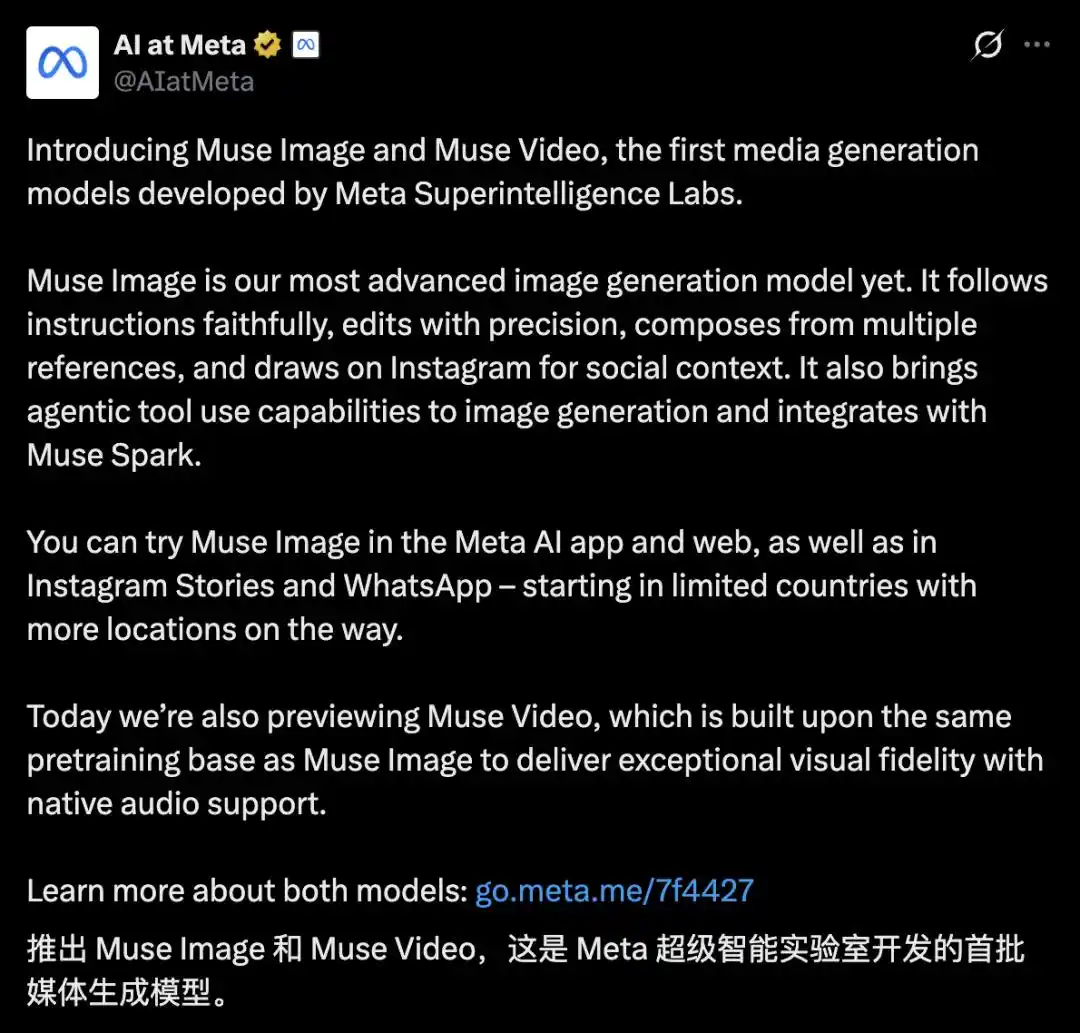
Appearing alongside Muse Image is the video model Muse Video, currently in preview.

On the third-party Arena leaderboard for text-to-image, Muse Image has climbed to second place, closely following OpenAI's GPT Image 2.
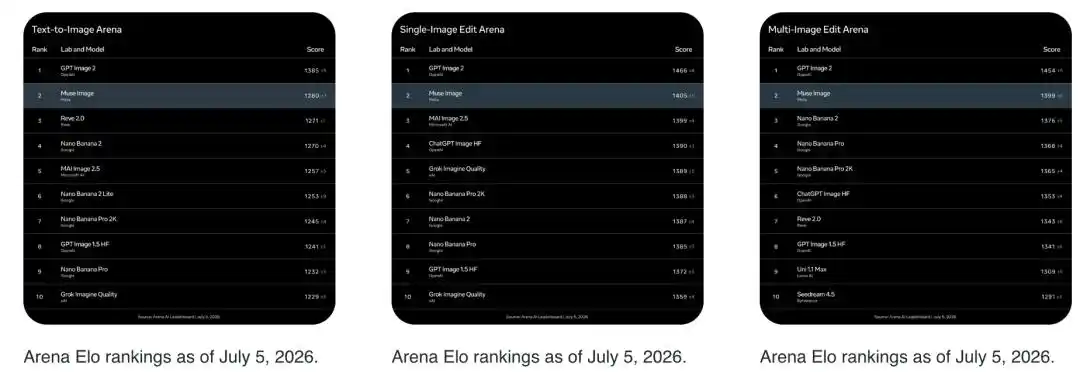
Arena Image Triple Chart Elo rankings, as of July 5, 2026. Muse Image ranks #2 across all three charts, trailing only GPT Image 2. For text-to-image, the score is 1280 vs. 1385, a difference of 105 points. (Source: Arena AI Leaderboard)

While it didn't top the chart in pure image quality this time, Mango did something even more formidable: it changed the way images are created.

And there's one skill that sends a chill down the spine: as long as your Instagram account is public, anyone can @ your username to use your public photos for image generation.

Inside Meta AI, when you @ a public Instagram username, Mango can directly pull that person's appearance from their public photos into the image you want to generate.

Creating an event invitation flyer or a creative concept collage? Just @ the username.

Although it didn't achieve top image quality, Meta holds the trump card: a social network with billions of users. This is its ace in the hole.

No More Instant Output, It Thinks Before It Draws

Muse Image operates as an agent.

It does things traditional image generation models don't.

For instance, when faced with knowledge-dense prompts involving real-world facts, it first searches the web for factual information, anchoring the image in reality.

To generate QR codes or charts, it writes and runs code on the spot, calculating accurately before 'drawing,' and can even use the rendered results to calibrate the image.

The most counterintuitive feature is self-correction: after generating an image, if it detects an issue, it can reflect, make minor edits, or completely redraw if the direction is wrong. If unsure, it can even turn to research.

Meta states this behavior wasn't explicitly designed; it emerged on its own during reinforcement learning.

Because revising prompts earned higher rewards, the model learned to revise. An action not explicitly taught emerged during training.

This kind of 'emergence' suggests that image models are beginning to develop a foundational ability similar to language models: 'the more they practice, the more they learn to figure things out on their own.'
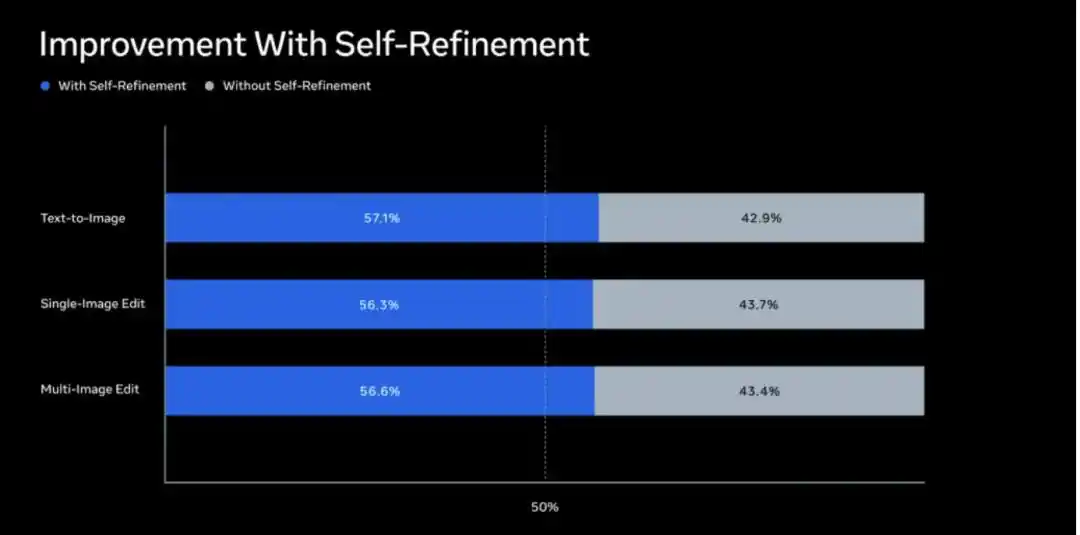
Win rate comparison before and after enabling self-correction (internal ablation tests). 57.1% for text-to-image, 56.3% for single-image editing, 56.6% for multi-image editing—all three metrics exceed 50%, indicating self-correction makes Mango consistently produce better images. (Source: Meta AI official blog)

Simultaneously, Muse Image is following a path parallel to language models: the more it thinks, the better it draws.

During testing, with more computational power allocated, it searches more times, revises more rounds, and the Elo score based on human preference rises accordingly, approximating a log-linear curve.

Meta also found that instead of generating several images at once and picking the best one, it's better to invest the same compute power in careful reasoning: the former plateaus quickly, while the latter can keep improving.

A developer on X pinpointed it in one sentence: 'Image models are starting to think clearly before they finish drawing.'

This is certainly not Meta's direction alone.

OpenAI's GPT Image 2 launched its 'Thinking' mode as early as April this year: reasoning to plan composition, searching the web for references, generating candidates, and then self-checking, beating Mango by two and a half months.

Looking further back, the academic world proposed the 'think before generating' paradigm as early as 2025.

The image generation track is shifting from 'competing on quality' to 'competing on whether it can think.'

Mango Served with Avocado, Two Fruits on One Plate

Mango isn't fighting alone—it's integrated with Avocado (Muse Spark): the two models share tools and plan together.

The language model thinks, the image model draws, and together they can do more than just 'output an image.'

In an official demo, Mango created a 'growth' asset pack for a cream-colored Persian cat: generating images from kitten, to young adult cat, to senior cat, then packaging them into a playable 2048-style web game.

Mango, in collaboration with Muse Spark, generated images of Persian cat Mochi across six life stages (from kitten to senior) and packaged them into a playable 2048-style fusion web game. (Source: Meta AI official blog)

For Meta, building its own image generation model is significant in itself.

Previously, its image and video features were powered by third-party models like Midjourney and Black Forest Labs.

Now, with Mango's launch, a capability called billions of times daily becomes 'self-made.'

For video, Muse Video shares the same pre-trained base model as Mango, focusing on native audio: generating picture and sound together.

Muse Video is currently in 'preview,' not yet officially open, but it's already on Arena for blind testing, ranking #3 for text-to-video.

Arena Text-to-Video chart Elo ranking, as of July 5, 2026. Muse Video in preview ranks 3rd (1459), behind Google's Gemini Omni Flash (1527) and ByteDance's Seedance 2.0 (1482). (Source: Arena AI Leaderboard)

Meta also openly acknowledges shortcomings, noting gaps in audio-visual synchronization and the physical accuracy of fast motion.

@ing Can Draw Your Social Network into the Image

Mango's regular features include:

Fusing multiple reference images into one, drawing/annotating directly on an image for it to edit, clearly rendering Chinese characters in images without blur, taking a photo of a room and having it redesign it using real products from Facebook Marketplace...

Take a photo of a room, Mango searches Facebook Marketplace for real second-hand furniture for sale, and generates a whole-room renovation concept image. (Source: Meta AI official blog)

On Instagram Stories, it brings over 30 new AI effects at once: one-click to transform photos into disposable camera aesthetics, add night flash, or even input a prompt to create a custom effect, launching first in the US.

The truly unique feature is the @ function, a capability neither OpenAI nor Google can offer. But the problem lies here: this feature is enabled by default.

As long as your Instagram is a public account, others can @ you to use your photos for image generation, and you won't receive any notification.

To disable it, you must manually dig into settings, find the 'Sharing and Reuse' section, and turn it off. Images already generated won't be deleted even after disabling.

Wired directly calls this default-on setting a privacy concern.

Such worries are not unfounded.

During the 'Cambridge Analytica' incident, data from 87 million users was used without consent by a political consulting firm.

For this, Meta received a $5 billion fine from the FTC in 2019, the largest US government privacy violation penalty at the time.

In 2021, it proactively shut down its entire facial recognition system, deleting facial recognition templates for over 1 billion people.

This time, Mango offers a feature no one else can provide, but it also introduces a problem no one else has touched.

Meta's Killer Move Isn't the Model

Although Mango didn't top the charts in image quality, its real killer move is distribution.

Mango is directly integrated into Meta AI, Instagram, and WhatsApp now, with Facebook and Messenger following next. Advertisers can also call it via Advantage+.

Combined, these apps have nearly 4 billion monthly active users, the world's largest social network.

While Midjourney and ChatGPT bet on 'who draws best,' Meta is betting on something else: when AI image generation becomes as effortless as posting on social media, whoever is closest to the user wins.

Of course, the wider images are distributed, the clearer their origin must be labeled.

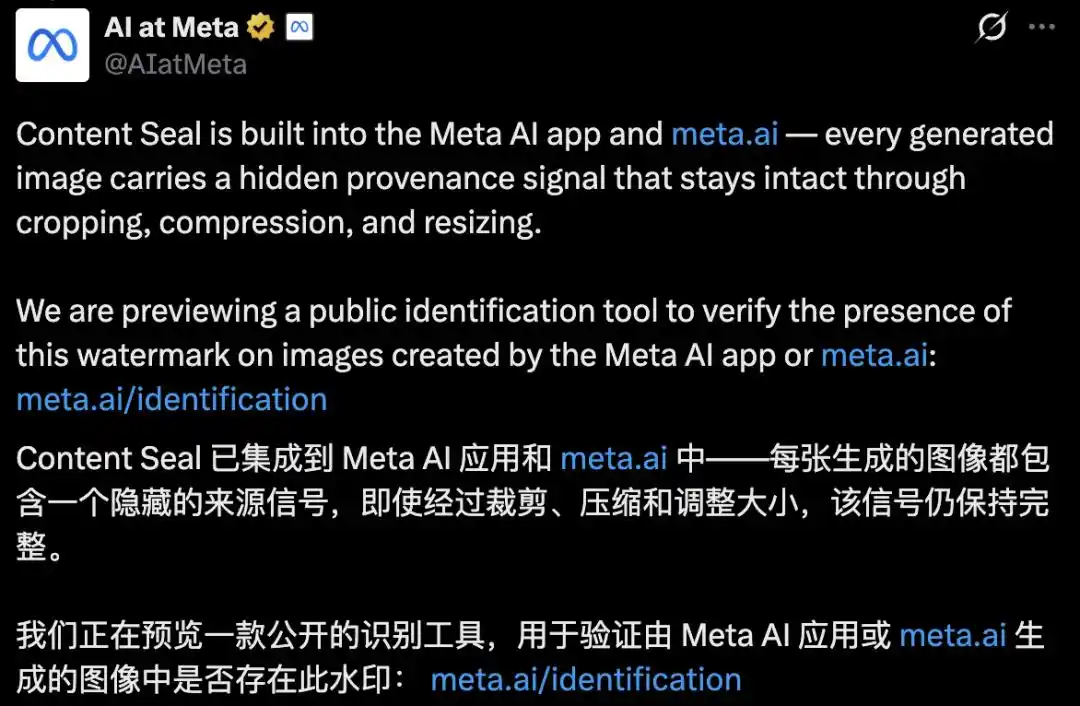
Every image generated by Mango carries an invisible watermark called Content Seal, resistant to cropping, compression, and scaling, specifically marking it as 'AI-generated.'

Meta has also released a public detection tool (meta.ai/identification). Anyone can upload an image to check if it was generated by Meta AI.
This time, Meta is not only keeping pace with 'thinking image generation models' but also holds the world's largest social network.

However, when @ing a stranger allows using their photos for image generation, where exactly the boundaries lie, Mango hasn't provided an answer.

References:

https://ai.meta.com/blog/introducing-muse-image-muse-video-msl/

https://about.fb.com/news/2026/07/introducing-muse-image-meta-ai/

https://x.com/AIatMeta/status/2074587884665901143

This article comes from the WeChat public account 'AI New Frontier' (新智元), author: ASI启示录; editor: 元宇


Trending Cryptos

Related Questions

QAccording to the article, what is the most significant advancement of Meta's Muse Image (Mango) beyond its image quality?

AIts most significant advancement is that it operates as an intelligent agent that 'thinks before drawing.' It can search the web for factual information, generate and run code for elements like QR codes, and crucially, perform self-correction—a behavior that emerged through reinforcement learning without explicit training. This represents a shift in the image generation field from competing on 'image quality' to competing on 'intelligence and reasoning'.

QHow does Meta's 'Mango' model leverage the company's social network platforms to create a unique feature?

AMango is integrated with Instagram, allowing users to @mention a public Instagram username in their prompt. The model can then incorporate the visual appearance of that person from their public photos into the generated image for purposes like creating event invitations or concept art. This feature, which is enabled by default, leverages Meta's vast social network data to offer a capability competitors like OpenAI and Google cannot provide.

QWhat potential privacy concern is raised in the article regarding the default settings of Muse Image's @mention feature?

AThe article highlights that the @mention feature is enabled by default. This means anyone can use a public Instagram user's photos to generate images by @mentioning their username, and the user will not receive any notification. Users must manually opt-out in their settings. This is cited as a privacy hazard, drawing parallels to past incidents like the Cambridge Analytica scandal, and raises questions about consent and the ethical boundaries of using personal data for AI generation.

QBesides image generation, what other model did Meta release alongside Muse Image, and how does it perform?

AMeta also released a preview version of its video generation model called Muse Video. It shares the same pre-trained base as Muse Image and focuses on native audio generation (generating sound along with the video). According to the Arena AI leaderboard as of July 5, 2026, the preview of Muse Video ranked 3rd in text-to-video generation.

QWhat strategy is Meta betting on with the release of Muse Image, according to the article's conclusion?

AMeta's core strategy is not solely about having the highest-quality model but leveraging its unparalleled distribution network. Muse Image is being integrated directly into Meta's family of apps (Meta AI, Instagram, WhatsApp, Facebook, Messenger), which have nearly 4 billion monthly active users combined. The bet is that when AI image generation becomes as convenient and everyday as posting on social media, the platform closest to the user will win, regardless of marginal differences in model quality.

Related Reads

Embodied Intelligence 'Gaokao' is Insanely Hard, Humans Score 100, Best Model Only 12.8

Embodied AI Faces a Daunting "Everest": New Benchmark Reveals Huge Gap Between Models and Humans A comprehensive new benchmark for robotic manipulation, RoboDojo, has been released, painting a stark picture of the current state of embodied AI. It serves as a unified evaluation platform covering both simulation and real-world robot tasks. The benchmark assesses five core capabilities: Generalization (adapting to new scenes/objects), Memory, Precision manipulation, Long-Horizon multi-step tasks, and Open semantic understanding. It includes 42 simulation tasks and 18 standardized real-world tasks across three dual-arm robot platforms. The results are sobering. In simulation, the best-performing generalist robot policy achieved an average success rate of only 8.80%. Performance in the real world was slightly higher but still low, with the top model succeeding 12.8% of the time on average. In stark contrast, human experts scored 76.03% in simulation and 100% in real-world tests. The benchmark highlights significant, uneven gaps in current models' abilities. While some excel in specific areas like visual recognition or simple actions, they struggle with reliability, especially in long-horizon tasks where errors accumulate and in open-ended semantic instructions. The low scores, particularly in real-world deployment with physical uncertainties like camera noise and contact dynamics, underscore that today's models are far from being robust, general-purpose operational robots. RoboDojo is more than just a ranking; it's an infrastructure designed for fair, reproducible comparison. Its companion system, XPolicyLab, standardizes the interface for different models to be evaluated. Maintained by an academic consortium without commercial ties, it aims to provide a community-wide "altitude meter" to track genuine progress toward reliable and generalizable robot manipulation.

marsbit1h ago

Embodied Intelligence 'Gaokao' is Insanely Hard, Humans Score 100, Best Model Only 12.8

marsbit1h ago

Weng Li's New Blog Proposes 'Self-Evolution Should Start from Harness', DeepSeek's Cui Tianyi Endorses with Repost

Lilian Weng, former OpenAI security VP and co-founder of Thinking Machines Lab, has published a new blog post titled "Harness Engineering for Self-Improvement," proposing a pragmatic path for AI self-evolution. She argues that Recursive Self-Improvement (RSI) may practically begin at the "Harness" layer—the external runtime system governing how models use tools, manage context, and execute tasks—rather than directly from the model rewriting its own weights. The blog outlines a progression from optimizing prompts (Context Engineering) to designing workflows, and ultimately to Self-Improving Harness systems. These systems can identify their own weaknesses, propose targeted, verifiable modifications to the harness code, and validate improvements. Works like Self-Harness and Darwin Gödel Machine (DGM) demonstrate significant performance gains on benchmarks like SWE-bench through such automated harness evolution, rivaling handcrafted agents. DeepSeek researcher Tianyi Cui endorsed the view, noting harness-based self-evolution is as promising as model-based approaches. Weng emphasizes this is complementary to model training, with both reinforcing each other. However, key challenges remain: weak evaluators for subjective tasks, reward hacking, diversity collapse, managing long-term system health versus short-term success, and defining the human oversight role. The consensus is growing: the harness is a critical variable, as the same model can exhibit vastly different capabilities within different harness systems.

marsbit2h ago

Weng Li's New Blog Proposes 'Self-Evolution Should Start from Harness', DeepSeek's Cui Tianyi Endorses with Repost

marsbit2h ago

Trading

Spot

Hot Articles

What is SONIC

Sonic: Pioneering the Future of Gaming in Web3 Introduction to Sonic In the ever-evolving landscape of Web3, the gaming industry stands out as one of the most dynamic and promising sectors. At the forefront of this revolution is Sonic, a project designed to amplify the gaming ecosystem on the Solana blockchain. Leveraging cutting-edge technology, Sonic aims to deliver an unparalleled gaming experience by efficiently processing millions of requests per second, ensuring that players enjoy seamless gameplay while maintaining low transaction costs. This article delves into the intricate details of Sonic, exploring its creators, funding sources, operational mechanics, and the timeline of significant events that have shaped its journey. What is Sonic? Sonic is an innovative layer-2 network that operates atop the Solana blockchain, specifically tailored to enhance the existing Solana gaming ecosystem. It accomplishes this through a customised, VM-agnostic game engine paired with a HyperGrid interpreter, facilitating sovereign game economies that roll up back to the Solana platform. The primary goals of Sonic include: Enhanced Gaming Experiences: Sonic is committed to offering lightning-fast on-chain gameplay, allowing players and developers to engage with games at previously unattainable speeds. Atomic Interoperability: This feature enables transactions to be executed within Sonic without the need to redeploy Solana programmes and accounts. This makes the process more efficient and directly benefits from Solana Layer1 services and liquidity. Seamless Deployment: Sonic allows developers to write for Ethereum Virtual Machine (EVM) based systems and execute them on Solana’s SVM infrastructure. This interoperability is crucial for attracting a broader range of dApps and decentralised applications to the platform. Support for Developers: By offering native composable gaming primitives and extensible data types - dining within the Entity-Component-System (ECS) framework - game creators can craft intricate business logic with ease. Overall, Sonic's unique approach not only caters to players but also provides an accessible and low-cost environment for developers to innovate and thrive. Creator of Sonic The information regarding the creator of Sonic is somewhat ambiguous. However, it is known that Sonic's SVM is owned by the company Mirror World. The absence of detailed information about the individuals behind Sonic reflects a common trend in several Web3 projects, where collective efforts and partnerships often overshadow individual contributions. Investors of Sonic Sonic has garnered considerable attention and support from various investors within the crypto and gaming sectors. Notably, the project raised an impressive $12 million during its Series A funding round. The round was led by BITKRAFT Ventures, with other notable investors including Galaxy, Okx Ventures, Interactive, Big Brain Holdings, and Mirana. This financial backing signifies the confidence that investment foundations have in Sonic’s potential to revolutionise the Web3 gaming landscape, further validating its innovative approaches and technologies. How Does Sonic Work? Sonic utilises the HyperGrid framework, a sophisticated parallel processing mechanism that enhances its scalability and customisability. Here are the core features that set Sonic apart: Lightning Speed at Low Costs: Sonic offers one of the fastest on-chain gaming experiences compared to other Layer-1 solutions, powered by the scalability of Solana’s virtual machine (SVM). Atomic Interoperability: Sonic enables transaction execution without redeployment of Solana programmes and accounts, effectively streamlining the interaction between users and the blockchain. EVM Compatibility: Developers can effortlessly migrate decentralised applications from EVM chains to the Solana environment using Sonic’s HyperGrid interpreter, increasing the accessibility and integration of various dApps. Ecosystem Support for Developers: By exposing native composable gaming primitives, Sonic facilitates a sandbox-like environment where developers can experiment and implement business logic, greatly enhancing the overall development experience. Monetisation Infrastructure: Sonic natively supports growth and monetisation efforts, providing frameworks for traffic generation, payments, and settlements, thereby ensuring that gaming projects are not only viable but also sustainable financially. Timeline of Sonic The evolution of Sonic has been marked by several key milestones. Below is a brief timeline highlighting critical events in the project's history: 2022: The Sonic cryptocurrency was officially launched, marking the beginning of its journey in the Web3 gaming arena. 2024: June: Sonic SVM successfully raised $12 million in a Series A funding round. This investment allowed Sonic to further develop its platform and expand its offerings. August: The launch of the Sonic Odyssey testnet provided users with the first opportunity to engage with the platform, offering interactive activities such as collecting rings—a nod to gaming nostalgia. October: SonicX, an innovative crypto game integrated with Solana, made its debut on TikTok, capturing the attention of over 120,000 users within a short span. This integration illustrated Sonic’s commitment to reaching a broader, global audience and showcased the potential of blockchain gaming. Key Points Sonic SVM is a revolutionary layer-2 network on Solana explicitly designed to enhance the GameFi landscape, demonstrating great potential for future development. HyperGrid Framework empowers Sonic by introducing horizontal scaling capabilities, ensuring that the network can handle the demands of Web3 gaming. Integration with Social Platforms: The successful launch of SonicX on TikTok displays Sonic’s strategy to leverage social media platforms to engage users, exponentially increasing the exposure and reach of its projects. Investment Confidence: The substantial funding from BITKRAFT Ventures, among others, emphasizes the robust backing Sonic has, paving the way for its ambitious future. In conclusion, Sonic encapsulates the essence of Web3 gaming innovation, striking a balance between cutting-edge technology, developer-centric tools, and community engagement. As the project continues to evolve, it is poised to redefine the gaming landscape, making it a notable entity for gamers and developers alike. As Sonic moves forward, it will undoubtedly attract greater interest and participation, solidifying its place within the broader narrative of blockchain gaming.

1.8k Total ViewsPublished 2024.04.04Updated 2024.12.03

What is SONIC

What is $S$

Understanding SPERO: A Comprehensive Overview Introduction to SPERO As the landscape of innovation continues to evolve, the emergence of web3 technologies and cryptocurrency projects plays a pivotal role in shaping the digital future. One project that has garnered attention in this dynamic field is SPERO, denoted as SPERO,$$s$. This article aims to gather and present detailed information about SPERO, to help enthusiasts and investors understand its foundations, objectives, and innovations within the web3 and crypto domains. What is SPERO,$$s$? SPERO,$$s$ is a unique project within the crypto space that seeks to leverage the principles of decentralisation and blockchain technology to create an ecosystem that promotes engagement, utility, and financial inclusion. The project is tailored to facilitate peer-to-peer interactions in new ways, providing users with innovative financial solutions and services. At its core, SPERO,$$s$ aims to empower individuals by providing tools and platforms that enhance user experience in the cryptocurrency space. This includes enabling more flexible transaction methods, fostering community-driven initiatives, and creating pathways for financial opportunities through decentralised applications (dApps). The underlying vision of SPERO,$$s$ revolves around inclusiveness, aiming to bridge gaps within traditional finance while harnessing the benefits of blockchain technology. Who is the Creator of SPERO,$$s$? The identity of the creator of SPERO,$$s$ remains somewhat obscure, as there are limited publicly available resources providing detailed background information on its founder(s). This lack of transparency can stem from the project's commitment to decentralisation—an ethos that many web3 projects share, prioritising collective contributions over individual recognition. By centring discussions around the community and its collective goals, SPERO,$$s$ embodies the essence of empowerment without singling out specific individuals. As such, understanding the ethos and mission of SPERO remains more important than identifying a singular creator. Who are the Investors of SPERO,$$s$? SPERO,$$s$ is supported by a diverse array of investors ranging from venture capitalists to angel investors dedicated to fostering innovation in the crypto sector. The focus of these investors generally aligns with SPERO's mission—prioritising projects that promise societal technological advancement, financial inclusivity, and decentralised governance. These investor foundations are typically interested in projects that not only offer innovative products but also contribute positively to the blockchain community and its ecosystems. The backing from these investors reinforces SPERO,$$s$ as a noteworthy contender in the rapidly evolving domain of crypto projects. How Does SPERO,$$s$ Work? SPERO,$$s$ employs a multi-faceted framework that distinguishes it from conventional cryptocurrency projects. Here are some of the key features that underline its uniqueness and innovation: Decentralised Governance: SPERO,$$s$ integrates decentralised governance models, empowering users to participate actively in decision-making processes regarding the project’s future. This approach fosters a sense of ownership and accountability among community members. Token Utility: SPERO,$$s$ utilises its own cryptocurrency token, designed to serve various functions within the ecosystem. These tokens enable transactions, rewards, and the facilitation of services offered on the platform, enhancing overall engagement and utility. Layered Architecture: The technical architecture of SPERO,$$s$ supports modularity and scalability, allowing for seamless integration of additional features and applications as the project evolves. This adaptability is paramount for sustaining relevance in the ever-changing crypto landscape. Community Engagement: The project emphasises community-driven initiatives, employing mechanisms that incentivise collaboration and feedback. By nurturing a strong community, SPERO,$$s$ can better address user needs and adapt to market trends. Focus on Inclusion: By offering low transaction fees and user-friendly interfaces, SPERO,$$s$ aims to attract a diverse user base, including individuals who may not previously have engaged in the crypto space. This commitment to inclusion aligns with its overarching mission of empowerment through accessibility. Timeline of SPERO,$$s$ Understanding a project's history provides crucial insights into its development trajectory and milestones. Below is a suggested timeline mapping significant events in the evolution of SPERO,$$s$: Conceptualisation and Ideation Phase: The initial ideas forming the basis of SPERO,$$s$ were conceived, aligning closely with the principles of decentralisation and community focus within the blockchain industry. Launch of Project Whitepaper: Following the conceptual phase, a comprehensive whitepaper detailing the vision, goals, and technological infrastructure of SPERO,$$s$ was released to garner community interest and feedback. Community Building and Early Engagements: Active outreach efforts were made to build a community of early adopters and potential investors, facilitating discussions around the project’s goals and garnering support. Token Generation Event: SPERO,$$s$ conducted a token generation event (TGE) to distribute its native tokens to early supporters and establish initial liquidity within the ecosystem. Launch of Initial dApp: The first decentralised application (dApp) associated with SPERO,$$s$ went live, allowing users to engage with the platform's core functionalities. Ongoing Development and Partnerships: Continuous updates and enhancements to the project's offerings, including strategic partnerships with other players in the blockchain space, have shaped SPERO,$$s$ into a competitive and evolving player in the crypto market. Conclusion SPERO,$$s$ stands as a testament to the potential of web3 and cryptocurrency to revolutionise financial systems and empower individuals. With a commitment to decentralised governance, community engagement, and innovatively designed functionalities, it paves the way toward a more inclusive financial landscape. As with any investment in the rapidly evolving crypto space, potential investors and users are encouraged to research thoroughly and engage thoughtfully with the ongoing developments within SPERO,$$s$. The project showcases the innovative spirit of the crypto industry, inviting further exploration into its myriad possibilities. While the journey of SPERO,$$s$ is still unfolding, its foundational principles may indeed influence the future of how we interact with technology, finance, and each other in interconnected digital ecosystems.

100 Total ViewsPublished 2024.12.17Updated 2024.12.17

What is $S$

What is AGENT S

Agent S: The Future of Autonomous Interaction in Web3 Introduction In the ever-evolving landscape of Web3 and cryptocurrency, innovations are constantly redefining how individuals interact with digital platforms. One such pioneering project, Agent S, promises to revolutionise human-computer interaction through its open agentic framework. By paving the way for autonomous interactions, Agent S aims to simplify complex tasks, offering transformative applications in artificial intelligence (AI). This detailed exploration will delve into the project's intricacies, its unique features, and the implications for the cryptocurrency domain. What is Agent S? Agent S stands as a groundbreaking open agentic framework, specifically designed to tackle three fundamental challenges in the automation of computer tasks: Acquiring Domain-Specific Knowledge: The framework intelligently learns from various external knowledge sources and internal experiences. This dual approach empowers it to build a rich repository of domain-specific knowledge, enhancing its performance in task execution. Planning Over Long Task Horizons: Agent S employs experience-augmented hierarchical planning, a strategic approach that facilitates efficient breakdown and execution of intricate tasks. This feature significantly enhances its ability to manage multiple subtasks efficiently and effectively. Handling Dynamic, Non-Uniform Interfaces: The project introduces the Agent-Computer Interface (ACI), an innovative solution that enhances the interaction between agents and users. Utilizing Multimodal Large Language Models (MLLMs), Agent S can navigate and manipulate diverse graphical user interfaces seamlessly. Through these pioneering features, Agent S provides a robust framework that addresses the complexities involved in automating human interaction with machines, setting the stage for myriad applications in AI and beyond. Who is the Creator of Agent S? While the concept of Agent S is fundamentally innovative, specific information about its creator remains elusive. The creator is currently unknown, which highlights either the nascent stage of the project or the strategic choice to keep founding members under wraps. Regardless of anonymity, the focus remains on the framework's capabilities and potential. Who are the Investors of Agent S? As Agent S is relatively new in the cryptographic ecosystem, detailed information regarding its investors and financial backers is not explicitly documented. The lack of publicly available insights into the investment foundations or organisations supporting the project raises questions about its funding structure and development roadmap. Understanding the backing is crucial for gauging the project's sustainability and potential market impact. How Does Agent S Work? At the core of Agent S lies cutting-edge technology that enables it to function effectively in diverse settings. Its operational model is built around several key features: Human-like Computer Interaction: The framework offers advanced AI planning, striving to make interactions with computers more intuitive. By mimicking human behaviour in tasks execution, it promises to elevate user experiences. Narrative Memory: Employed to leverage high-level experiences, Agent S utilises narrative memory to keep track of task histories, thereby enhancing its decision-making processes. Episodic Memory: This feature provides users with step-by-step guidance, allowing the framework to offer contextual support as tasks unfold. Support for OpenACI: With the ability to run locally, Agent S allows users to maintain control over their interactions and workflows, aligning with the decentralised ethos of Web3. Easy Integration with External APIs: Its versatility and compatibility with various AI platforms ensure that Agent S can fit seamlessly into existing technological ecosystems, making it an appealing choice for developers and organisations. These functionalities collectively contribute to Agent S's unique position within the crypto space, as it automates complex, multi-step tasks with minimal human intervention. As the project evolves, its potential applications in Web3 could redefine how digital interactions unfold. Timeline of Agent S The development and milestones of Agent S can be encapsulated in a timeline that highlights its significant events: September 27, 2024: The concept of Agent S was launched in a comprehensive research paper titled “An Open Agentic Framework that Uses Computers Like a Human,” showcasing the groundwork for the project. October 10, 2024: The research paper was made publicly available on arXiv, offering an in-depth exploration of the framework and its performance evaluation based on the OSWorld benchmark. October 12, 2024: A video presentation was released, providing a visual insight into the capabilities and features of Agent S, further engaging potential users and investors. These markers in the timeline not only illustrate the progress of Agent S but also indicate its commitment to transparency and community engagement. Key Points About Agent S As the Agent S framework continues to evolve, several key attributes stand out, underscoring its innovative nature and potential: Innovative Framework: Designed to provide an intuitive use of computers akin to human interaction, Agent S brings a novel approach to task automation. Autonomous Interaction: The ability to interact autonomously with computers through GUI signifies a leap towards more intelligent and efficient computing solutions. Complex Task Automation: With its robust methodology, it can automate complex, multi-step tasks, making processes faster and less error-prone. Continuous Improvement: The learning mechanisms enable Agent S to improve from past experiences, continually enhancing its performance and efficacy. Versatility: Its adaptability across different operating environments like OSWorld and WindowsAgentArena ensures that it can serve a broad range of applications. As Agent S positions itself in the Web3 and crypto landscape, its potential to enhance interaction capabilities and automate processes signifies a significant advancement in AI technologies. Through its innovative framework, Agent S exemplifies the future of digital interactions, promising a more seamless and efficient experience for users across various industries. Conclusion Agent S represents a bold leap forward in the marriage of AI and Web3, with the capacity to redefine how we interact with technology. While still in its early stages, the possibilities for its application are vast and compelling. Through its comprehensive framework addressing critical challenges, Agent S aims to bring autonomous interactions to the forefront of the digital experience. As we move deeper into the realms of cryptocurrency and decentralisation, projects like Agent S will undoubtedly play a crucial role in shaping the future of technology and human-computer collaboration.

769 Total ViewsPublished 2025.01.14Updated 2025.01.14

What is AGENT S

Discussions

Welcome to the HTX Community. Here, you can stay informed about the latest platform developments and gain access to professional market insights. Users' opinions on the price of S (S) are presented below.

活动图片