Bitcoin Hash Ribbons Trigger Buy Signal, Has Miner Capitulation Concluded?

newsbtcPublished on 2023-01-16Last updated on 2023-01-16

Abstract

In late November, the hash ribbons indicator signaled the beginning of a second wave of Bitcoin miner capitulation within one cycle.

The collapse of FTX triggered a historic event for the Bitcoin market. In late November, the hash ribbons indicator signaled the beginning of a second wave of Bitcoin miner capitulation within one cycle. As NewsBTC reported, the hash rate dropped dramatically while some of the largest miners reported bankruptcy and dumped their BTC holdings on the market.

However, this poor state of the Bitcoin mining industry and the associated pressure on the Bitcoin price may have come to an end. As the net position change of miners already indicated since the beginning of January, the selling pressure has decreased significantly.

For the first time in over four months, miners had been hodling BTC instead of dumping the majority of their coins. The termination of the strong selling pressure from Bitcoin miners is now also confirmed by the hash ribbon indicator.

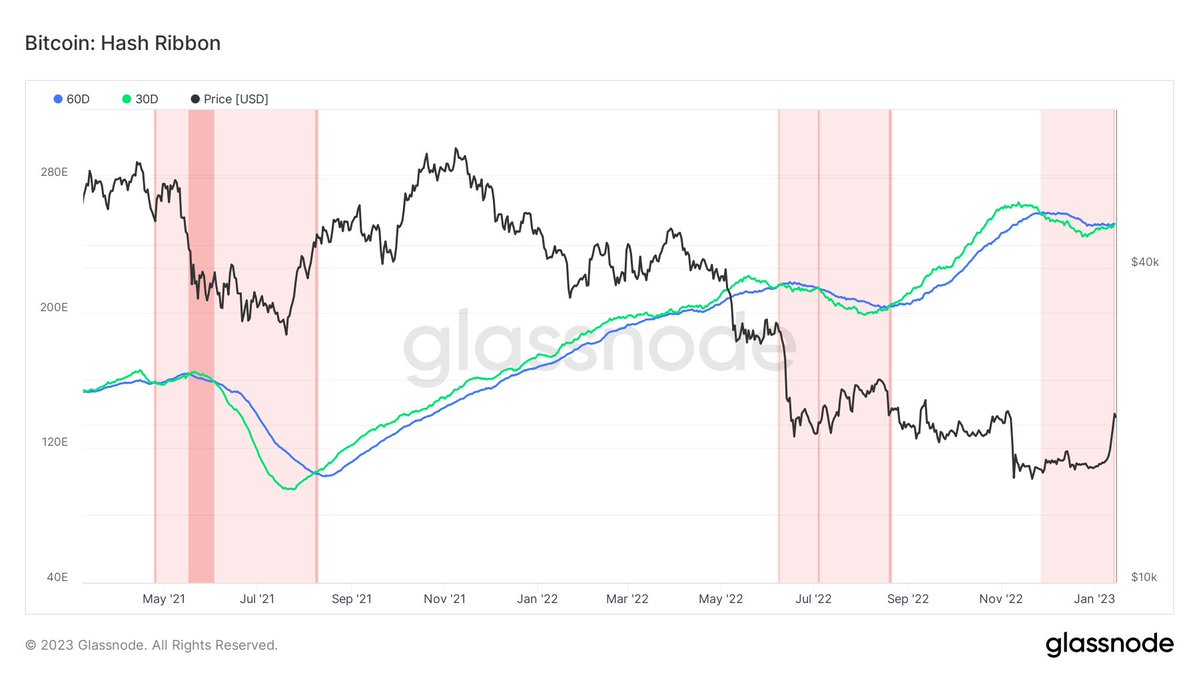
As the chart below shows, the hash bands are displaying a bullish cross. “Miners have stopped selling and are now plugging in machines at a sufficient rate to declare this period of miner capitulation over,” stated Will Clemente from Reflexivity Research.
What Does This Mean For Bitcoin?

The hash ribbon is a market indicator that assumes BTC tends to hit a bottom when miners capitulate. Currently, the hash ribbons indicate that the worst of the miner capitulation is over as the 30-day MA of the hash rate crossed over the 60d MA.

In other words: When the hash ribbons indicate a cross, it signifies a paradigm shift. This is historically an extremely good buying opportunity. As Charles Edwards once said, it may be the strongest buy signal of all.

Why? Because the hash rate is a leading indicator for identifying capitulation to mining difficulty. Since the mining difficulty, unlike the hash rate, is not adjusted daily, but only every 2,016 blocks, the difficulty lags behind the hash rate by as much as two weeks.

Therefore, the difficulty is a somewhat lagging indicator of miner capitulation. But difficulty also shows the growing euphoria among miners. Bitcoin initiated a mining difficulty adjustment yesterday at block height 772,128. Mining difficulty climbed 10.26% to 37.59T, a record high.

This also confirms the thesis that miners are increasingly plugging their miners back into the network. The hashrate of the entire network is now 269.02 EH/s, also approaching its highs again. Thus, miners are clearly signaling their bullish sentiment.

The creator of the hash ribbon indicator, Charles Edwards, tweeted:

Hash Ribbon buy confirmed. The signal date was the second lowest price in the last 48 days. Our December newsletter: ‘a price low typically forms during the capitulation and before we see hash rate recover. Sometimes the first candle of the miner capitulation is the price low.’

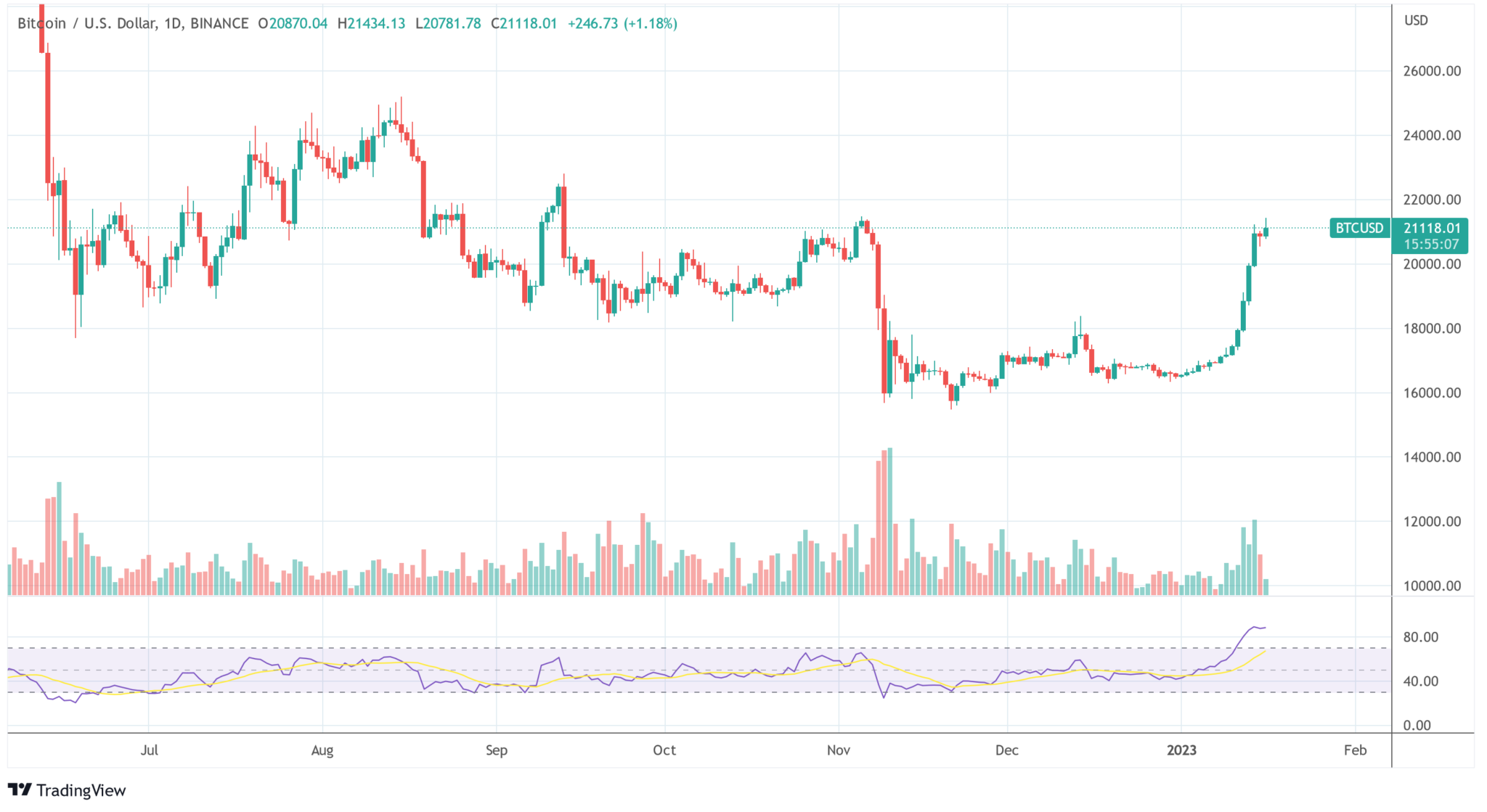
At press time, Bitcoin was trading at $21,118. On the daily chart, the RSI was at 89, indicating an overbought territory.
Trending Cryptos

Related Reads

Bitcoin's "Anti-Data Spam" Soft Fork BIP110: Collective Miner Resistance, Doomed to Fail?

The article discusses the contentious BIP110 proposal, a "data-reducing" soft fork aimed at limiting transactions containing additional data interpretable by external software (such as in Ordinals inscriptions). Proponents argue this data violates network principles, but the author strongly opposes the fork. The core argument is that Bitcoin's fundamental value lies in its open-access, censorship-resistant ledger. Just as free speech protects unpopular opinions, Bitcoin must allow any valid transaction, regardless of its perceived "non-monetary" use. The author contends there's no clear line between monetary and non-monetary transactions, and node operators don't care about transaction details—only validity. Bitcoin's existing protocol limits (block size, sigops) already minimize network strain from data-heavy transactions and have spurred layer-2 innovation (e.g., Lightning Network). BIP110's proposed technical changes are described as the most radical script restrictions since 2010, including capping script sizes, disabling certain Tapscript features, and invalidating upgrades. Its activation process is criticized for having an unusually low 55% miner signaling threshold and a forced activation mechanism with a short timeline. The author argues BIP110 attempts the impossible—controlling how users interpret data on an open ledger—and that those it targets have already adapted to work around it. The proposal is deemed unnecessary, rushed, and lacking consensus. With miners, developers, and the broader ecosystem largely opposed, the article concludes BIP110 is destined to fail, leaving Bitcoin's core principles intact.

Foresight News23m ago

Bitcoin's "Anti-Data Spam" Soft Fork BIP110: Collective Miner Resistance, Doomed to Fail?

Foresight News23m ago

Trading

Spot

Hot Articles

What is $BITCOIN

DIGITAL GOLD ($BITCOIN): A Comprehensive Analysis Introduction to DIGITAL GOLD ($BITCOIN) DIGITAL GOLD ($BITCOIN) is a blockchain-based project operating on the Solana network, which aims to combine the characteristics of traditional precious metals with the innovation of decentralized technologies. While it shares a name with Bitcoin, often referred to as “digital gold” due to its perception as a store of value, DIGITAL GOLD is a separate token designed to create a unique ecosystem within the Web3 landscape. Its goal is to position itself as a viable alternative digital asset, although specifics regarding its applications and functionalities are still developing. What is DIGITAL GOLD ($BITCOIN)? DIGITAL GOLD ($BITCOIN) is a cryptocurrency token explicitly designed for use on the Solana blockchain. In contrast to Bitcoin, which provides a widely recognized value storage role, this token appears to focus on broader applications and characteristics. Notable aspects include: Blockchain Infrastructure: The token is built on the Solana blockchain, known for its capacity to handle high-speed and low-cost transactions. Supply Dynamics: DIGITAL GOLD has a maximum supply capped at 100 quadrillion tokens (100P $BITCOIN), although details regarding its circulating supply are currently undisclosed. Utility: While precise functionalities are not explicitly outlined, there are indications that the token could be utilized for various applications, potentially involving decentralized applications (dApps) or asset tokenization strategies. Who is the Creator of DIGITAL GOLD ($BITCOIN)? At present, the identity of the creators and development team behind DIGITAL GOLD ($BITCOIN) remains unknown. This situation is typical among many innovative projects within the blockchain space, particularly those aligning with decentralized finance and meme coin phenomena. While such anonymity may foster a community-driven culture, it intensifies concerns about governance and accountability. Who are the Investors of DIGITAL GOLD ($BITCOIN)? The available information indicates that DIGITAL GOLD ($BITCOIN) does not have any known institutional backers or prominent venture capital investments. The project seems to operate on a peer-to-peer model focused on community support and adoption rather than traditional funding routes. Its activity and liquidity are primarily situated on decentralized exchanges (DEXs), such as PumpSwap, rather than established centralized trading platforms, further highlighting its grassroots approach. How DIGITAL GOLD ($BITCOIN) Works The operational mechanics of DIGITAL GOLD ($BITCOIN) can be elaborated on based on its blockchain design and network attributes: Consensus Mechanism: By leveraging Solana’s unique proof-of-history (PoH) combined with a proof-of-stake (PoS) model, the project ensures efficient transaction validation contributing to the network's high performance. Tokenomics: While specific deflationary mechanisms have not been extensively detailed, the vast maximum token supply implies that it may cater to microtransactions or niche use cases that are still to be defined. Interoperability: There exists the potential for integration with Solana’s broader ecosystem, including various decentralized finance (DeFi) platforms. However, the details regarding specific integrations remain unspecified. Timeline of Key Events Here is a timeline that highlights significant milestones concerning DIGITAL GOLD ($BITCOIN): 2023: The initial deployment of the token occurs on the Solana blockchain, marked by its contract address. 2024: DIGITAL GOLD gains visibility as it becomes available for trading on decentralized exchanges like PumpSwap, allowing users to trade it against SOL. 2025: The project witnesses sporadic trading activity and potential interest in community-led engagements, although no noteworthy partnerships or technical advancements have been documented as of yet. Critical Analysis Strengths Scalability: The underlying Solana infrastructure supports high transaction volumes, which could enhance the utility of $BITCOIN in various transaction scenarios. Accessibility: The potential low trading price per token could attract retail investors, facilitating wider participation due to fractional ownership opportunities. Risks Lack of Transparency: The absence of publicly known backers, developers, or an audit process may yield skepticism regarding the project's sustainability and trustworthiness. Market Volatility: The trading activity is heavily reliant on speculative behavior, which can result in significant price volatility and uncertainty for investors. Conclusion DIGITAL GOLD ($BITCOIN) emerges as an intriguing yet ambiguous project within the rapidly evolving Solana ecosystem. While it attempts to leverage the “digital gold” narrative, its departure from Bitcoin's established role as a store of value underscores the need for a clearer differentiation of its intended utility and governance structure. Future acceptance and adoption will likely depend on addressing the current opacity and defining its operational and economic strategies more explicitly. Note: This report encompasses synthesised information available as of October 2023, and developments may have transpired beyond the research period.

803 Total ViewsPublished 2025.05.13Updated 2025.05.13

What is $BITCOIN

Discussions

Welcome to the HTX Community. Here, you can stay informed about the latest platform developments and gain access to professional market insights. Users' opinions on the price of BTC (BTC) are presented below.

活动图片