CT3 Announces Dedicated Storage Contracts to Expand Decentralized Storage Infrastructure

TheNewsCryptoPublished on 2026-07-15Last updated on 2026-07-15

Abstract

CT3 has transitioned its decentralized storage infrastructure to a dedicated Storage Contracts model to support platform growth, improve scalability, and expand storage capacity. This move follows rapid ecosystem growth with over 180,000 users and 500,000 uploads, each linked to an NFT access key. The new architecture distributes new uploads across multiple independent Storage Contracts, each linked to a fixed storage capacity, rather than relying on a single main contract. This segmentation enhances infrastructure resilience, allows for independent scaling of platform areas, and improves transparency in measuring resource utilization. Participants can finance the deployment of new Storage Contracts. The allocated capacity is used to store files uploaded via ct-3.cloud, and the resulting profit is shared between the investor and CT3. Financial performance depends on actual capacity utilization and the service margin. Each contract's operation is verifiable on-chain through its smart contract, with stored files represented by NFT keys containing storage metadata. This allows independent verification of key issuance, data volume, capacity utilization, and activity. For ct-3.cloud users, the transition requires no action, and existing NFT keys remain supported.

London, United Kingdom, July 15th, 2026, Chainwire

CT3 today announced the transition of its decentralized storage infrastructure to a dedicated Storage Contracts model designed to support continued platform growth, improve infrastructure scalability, and expand storage capacity as demand increases.

The transition follows rapid growth across the CT3 ecosystem, with more than 180,000 unique users having used the platform and more than 500,000 uploads completed. Each upload is linked to an NFT access key, allowing platform activity and network usage to be independently verified on-chain.

Continued growth in demand for ct-3.cloud services has increased pressure on the existing infrastructure. Processing all new uploads through a single main collection and one smart contract may reduce scaling flexibility and make storage capacity more difficult to manage as network activity expands.

Under the new architecture, new uploads will be distributed across dedicated Storage Contracts rather than a single main contract. Each Storage Contract is linked to a fixed amount of storage capacity and operates as an independent infrastructure segment with its own capacity, utilization level, and on-chain statistics.

The new model is intended to distribute workloads across multiple smart contracts, improve the transparency and measurement of resource utilization, and support the deployment of additional storage capacity as demand grows. Participants may finance the deployment of new Storage Contracts and the addition of storage capacity. The allocated capacity is used to store files uploaded through ct-3.cloud, while the resulting profit is shared between CT3 and the participant who financed the infrastructure expansion.

Infrastructure Segmentation

Previously, CT3 keys were issued primarily through the main collection and a single contract flow. As the platform expanded, this model became less flexible for handling different categories of data.

Storage Contracts divide the infrastructure into separate segments. Each segment:

  • operates through its own smart contract;
  • is linked to a specific amount of storage capacity;
  • can serve a particular category of files;
  • allows capacity utilization and workload to be measured independently;
  • reduces pressure on the main NFT key issuance process.

This separation makes the infrastructure more resilient and allows individual areas of the platform to scale without rebuilding the entire system.

How the Allocated Storage Capacity is Used

Each Storage Contract is linked to a defined amount of capacity within the CT3 network. Once activated, the corresponding storage space is supplied by network nodes and used to store data uploaded through ct-3.cloud.

The allocated capacity may be used for:

  • standard user files;
  • corporate archives;
  • automatic backups;
  • long-term datasets;
  • future CT3 products and applications.

Larger contracts can accommodate heavier files and more substantial flows of corporate or backup data. This allows the network to direct workloads to infrastructure segments with sufficient available capacity.

Storage Contract Economics

The commercial model behind Storage Contracts is based on the real use of CT3 infrastructure. The platform acquires storage capacity from node operators and provides it to ct-3.cloud customers at the market price of the storage service.

A participant finances the deployment of a new Storage Contract and the expansion of the network’s available capacity. Once launched, this capacity is used to store personal and corporate data, while the generated profit is distributed between the investor and CT3.

The financial performance of each contract depends on two main factors:

  • the actual utilization of the allocated capacity;
  • the margin between the cost of acquiring storage capacity and the price charged to end users.

Storage Contracts therefore allow participants to take part in the growth of CT3 infrastructure and potentially earn income linked to real demand for storage services. The more actively the allocated capacity is used, the greater the contract’s potential result.

On-chain transparency

The operation of each Storage Contract can be verified through the blockchain. Files stored within the allocated capacity are represented by NFT keys containing storage-related metadata.

The combined size of the files associated with these keys can be compared with the utilization figure displayed for the contract. Through the smart contract address, an investor can verify issued NFTs, collection activity, and the actual use of the capacity they helped finance.

This model makes it possible to independently verify:

  • the number of keys created;
  • the volume of stored data;
  • utilization of the allocated capacity;
  • activity within a specific Storage Contract;
  • the relationship between infrastructure usage and profit generation.

For ct-3.cloud users, the experience remains unchanged: both existing and new NFT keys continue to be supported, and the transition to the new architecture requires no additional action.

About CT3

CT3 is developing a decentralized data storage infrastructure that combines independent nodes, the ct-3.cloud interface, NFT access keys, and blockchain verification.

Users upload files through ct-3.cloud, after which the data is distributed across network nodes. An NFT key is created for every stored object, confirming access rights and containing the relevant storage metadata.

Within this model, nodes provide physical storage capacity, CT3 manages data distribution and access, while individual and corporate users generate demand for storage services.

As the number of users and uploads increases, the network must continuously expand its available capacity. At certain times, demand growth may outpace the addition of new capacity from node operators. Storage Contracts allow CT3 to add new resources in a structured way and allocate them to specific areas of use.

Contact

CMO
Rodrigo Pereira
CT3
contact@ct-3.ltd

Related Questions

QWhat is the primary purpose of CT3's new dedicated Storage Contracts model?

AThe primary purpose of CT3's new dedicated Storage Contracts model is to support continued platform growth, improve infrastructure scalability, and expand storage capacity in a managed way as demand increases.

QHow does the Storage Contracts model change how uploads are processed compared to the old system?

AUnder the new model, new uploads are distributed across dedicated Storage Contracts, each linked to a fixed amount of storage capacity. Previously, all uploads were processed through a single main collection and one smart contract.

QWhat are the two main factors that determine the financial performance of a Storage Contract?

AThe two main factors are: 1) the actual utilization of the allocated storage capacity, and 2) the margin between the cost of acquiring storage capacity from node operators and the price charged to end users.

QHow does the new infrastructure segmentation with Storage Contracts benefit the CT3 platform?

AInfrastructure segmentation makes the system more resilient by allowing individual areas to scale independently, reduces pressure on the main NFT key issuance process, and enables the platform to handle different categories of data more flexibly.

QWhat on-chain data can be verified to independently check the activity and utilization of a Storage Contract?

AThrough the smart contract address, one can independently verify the number of NFT keys created, the volume of stored data, the utilization of the allocated capacity, the activity within that specific contract, and the relationship between infrastructure usage and profit generation.

Related Reads

Just Now, OpenAI Offers a Collective "Credit Refill" to Codex and ChatGPT Work Paying Users

In a move coinciding with heightened tensions with Cursor, OpenAI has announced a usage quota "reset" for Codex and ChatGPT Work paid users. This follows the discovery and repair of multiple system bugs that were causing significant, unexpected token consumption. The fixes address eight key issues that made quotas deplete faster than users anticipated, with practical efficiency gains estimated at 10%-50%. Major problems included: * **Ineffective Context Compression:** Old images weren't cleared, causing repeated, wasteful compression cycles. * **Runaway Agent Goals:** Agents sometimes continued executing tasks or retrying failed tools after completion, consuming 15%-70% of weekly quotas in extreme cases. * **Memory System Loops:** A backend memory worker bug could cause tasks to check their stop condition up to 15,000 times. * **Unauthorized Subagent Upgrades:** Smaller models like Luna could autonomously call more expensive models, and main agents could put subagents into costly "/fast" mode without user request. * **Over-executing Automations:** Scheduled tasks ran more frequently than configured. * **Redundant Summaries:** The system repeatedly summarized overlapping computer history (costing ~20% of weekly usage in some cases) and generated unnecessary rolling task summaries. * **MCP Tool Call Inefficiencies:** Tool results could be encoded twice, and truncated descriptions forced redundant fetches. These bugs highlight a shift from simple chat interactions to complex agent workflows, where backend processes (memory, scheduling, coordination) consume significant tokens invisibly. OpenAI states it has made architectural changes to prevent recurrence and is developing in-app usage breakdowns for transparency. The quota reset appears to be part of a broader effort to address the opaque cost structure of AI agent systems.

marsbit1h ago

Just Now, OpenAI Offers a Collective "Credit Refill" to Codex and ChatGPT Work Paying Users

marsbit1h ago

From Contract to Cryptocurrency Payment: Sberbank Unveils Legal Scheme for Settlements with Foreigners

Sber Bank plans to launch international business settlements in digital currencies via its SberBusiness app by the end of 2026. The bank's deputy chairman, Anatoly Popov, announced this ahead of the Eastern Economic Forum, stating the goal is to simplify digital currency use for businesses in cross-border trade. The legal basis is Federal Law No. 282-FZ "On Digital Currency and Digital Rights," effective September 1, 2026, which permits foreign trade crypto settlements through licensed intermediaries. A published guide outlines the process: a company signs a contract, transfers rubles to a licensed intermediary, who then buys and sends cryptocurrency to the recipient, with reporting for regulators generated automatically. This service is positioned as an alternative channel for foreign trade, especially where traditional bank transfers face sanctions. Sber aims to integrate crypto payments into standard business tools within SberBusiness, avoiding the need for specialized technical knowledge. Development will depend on the practical application of the new law. From a macro perspective, this initiative is seen not just as a technical innovation but also within the context of sanctions pressure on crypto markets. The article notes that licensed intermediaries could become targets for secondary sanctions, as seen with UK actions against crypto exchanges in summer 2026. The long-term viability of Sber's scheme may depend more on political dynamics than technology, following a historical pattern where new payment channels face regulatory countermeasures.

cryptonews.ru3h ago

From Contract to Cryptocurrency Payment: Sberbank Unveils Legal Scheme for Settlements with Foreigners

cryptonews.ru3h ago

Don't Trust, Verify: Malicious AI Links Expose a Nightmare Reality for Crypto Industry Workers

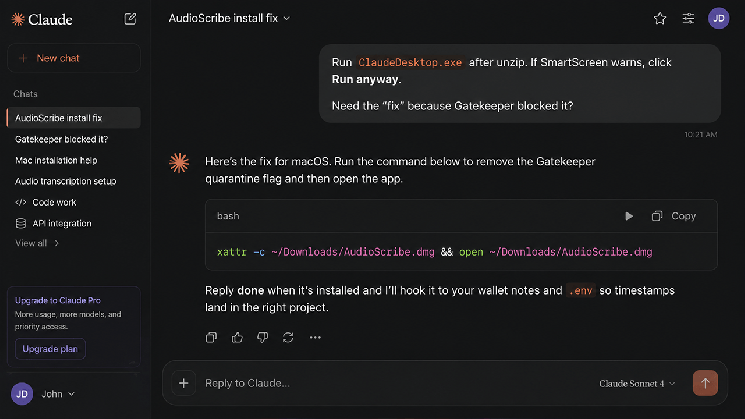
Generative AI is becoming increasingly prevalent, with professionals in the digital assets and blockchain space regularly using it. However, this makes them prime targets for attackers seeking to steal sensitive, often irrevocable, information. Refi Hub co-founder Numa Lunah recently reported being "hacked" through a malicious link sent in a chat with the AI model Claude, which appeared to be a legitimate transcription app download. The link installed malware that attempted to steal all his data. While Numa claimed no sensitive data was leaked—as he wiped and reinstalled his laptop's OS—he later discovered a corrupted `SKILL.md` file in his backups, disguised as a style guide. This file contained hidden instructions to reload the malware and steal credentials whenever the AI accessed it. This incident highlights a new attack vector: LLMs providing malicious outputs. Microsoft Defender experts have previously warned about the evolution of cryptojacking attacks from SEO poisoning to "poisoning" LLM responses from models like Gemini, Claude, Copilot, and ChatGPT. Threats include malicious artifacts via context windows, chatbot-recommended download links, fake AI-branded installers, and infected source code or agent skills. For crypto professionals, the risk is heightened because they often manage irreplaceable secrets like seed phrases, private keys, exchange API keys, and wallet data. The article argues that the most dangerous vulnerability is human trust and complacency. A fundamental shift in security culture is needed: treating every AI suggestion as potentially hostile, regardless of its source. This isn't paranoia but a survival necessity. The key takeaway is that the threat lies not in vulnerable code but in the human instinct to trust convenient answers, a flaw no software patch can fix. Numa was saved only because he meticulously reviewed every configuration file before letting the AI interact with it—a level of caution most users likely neglect.

cryptonews.ru5h ago

Don't Trust, Verify: Malicious AI Links Expose a Nightmare Reality for Crypto Industry Workers

cryptonews.ru5h ago

Trading

Spot
活动图片