比特币重回19000美元,2023年适合上车吗?

Odaily星球日报Published on 2023-01-13Last updated on 2023-01-13

Abstract

链上数据显示比特币处于“潜在底部” 。

今天凌晨,比特币强势突破 19000 美元,ETH 站上 1400 美元,其他币种也多有不同幅度的上涨,加密总市值重回 9000 亿美元。

就连此前一直处于严重折价状态的灰度比特币信托基金(GBTC),也在本周一上涨了 12% ,创下该基金自 2022 年 2 月以来的最大单日涨幅。目前,GBTC 净值折价率从年初的 45.1% 下降至目前的 38.8% ,ETHE(灰度以太坊信托基金)净值折价率从年初的 59.3% 下降至 51% 。

种种迹象似乎在暗示,加密市场正迎来复苏。「牛回速归」等口号响彻各大社交媒体,乐观情绪下的加密投资者貌似又充满了信仰。

不过,相对冷静克制地分析市场: 2023 年全球加息步伐虽会放缓,但流动性依然不佳,金融市场很难大幅度反弹;另外随着三箭资本、Genisis、FTX 等众多加密大公司破产,加密市场处于消化影响阶段,也很难有足够的资金推动急剧上涨。此外,链上数据显示,一些巨鲸开始增持 BTC;从周期来看, 2023 年更像是 2015 年,“这也意味着我们或许将在 2023 年 8 月左右触底”。

一、加密总市值冲击万亿美元大关

2023 年开年,加密市场迎来“小小阳春”。

比特币从年初的 16534 美元持续走高,并在今天突破 19000 美元,年内累计涨幅 9.4% ,目前暂报 18800 美元;ETH 累计涨幅 17.1% ,目前暂报 1402 美元。

纵览其他加密货币,市值前五十的币种中,除稳定币以外,过去 24 小时都录得不错的涨幅;过去 7 天,涨幅普遍在 10% ~ 20 以内。从板块来看,「流动性质押解决方案」备受市场关注,过去 7 天板块整体涨幅 26.3% ,该板块「三驾马车」 Lido DAO(LDO)、Rocket Pool(RPL)以及 Frax Share(FXS)年内累计涨幅分别是 91.5% 、 43.3% 以及 37.1% 。

受此影响,整个加密市场市值升至 9247 亿美元,时隔一个月再次重回 9000 亿美元,正向万亿美元大关发起冲击;从年初以来,加密总市值上涨 962 亿美元,累计涨幅 11.6% 。加密用户交易热情明显上升,今日恐慌与贪婪指数为 30 ,等级仍为“恐慌”,但相较于一周前恐慌程度有所下降。

此外,主流机构对灰度产品兴趣增加,例如摩根士丹利欧洲机会基金透露,本月已购买价值 360 万美元的灰度比特币信托基金 GBTC。这些机构的行动,直接推动 GBTC 在本周一(1 月 9 日)上涨了 12% ,创下该基金自 2022 年 2 月以来的最大单日涨幅,表现优于比特币等其他风险资产。数据显示,GBTC 的资产净值折价率已经从上个月的 49% 下降至目前的 38.8% ;灰度以太坊信托基金(ETHE)净值折价率从年初的 59.3% 下降至 51% 。

目前灰度基金总持仓 161.91 亿美元,主流币种信托折价率如下:ETC(-69.11% )、LTC(-56.21% )、BCH(-52.63% )、ZEC(-44.24% )、MANA(-11.76% )、XLM(-21.66% )、ZEN(-38.96% )、LPT(-44.56% )、BAT(-50.26% ),唯二两个正溢价的产品是 LINK(6.29% )以及 FIL(74.64% ) 。

加密相关上市企业也受上涨行情影响,近一周股价普遍涨幅在 10% 以上。其中,矿机第一股嘉楠科技(NASDAQ: CAN)股价上涨 29.8% 暂报 2.52 美元;美国合规加密平台 Coinbase(NASDAQ:COIN)股价上涨 31.6% 暂报 43.79 美元;最大比特币持仓上市公司 MicroStrategy(NASDAQ:MSTR)股价上涨 24.4% 暂报 194.76 美元;矿企 Argo Blockchain(LON: ARB)今年股价最高上涨超过 122% ,目前涨幅仍有 56.2% 。

二、分析师们的后市预判

大多数时候,要想知道未来行情能否上扬,需要透析到过去熊市根因的影响退散程度。过去一年加密市场表现不佳,可以追溯到几个原因。

首先,宏观经济条件的直接影响加密市场,包括地缘政治不稳定、俄乌之战造成的市场混乱、COVID-19 大流行以及全球央行持续加息,特别是美联储去年一年加息七次,极大降低了全球金融流动性,加密市场亦难以独善其身。

ARPA、Bella Protocol 创始人 Felix Xu 分析称,美联储的终端利率是 5% ,目前已经达到 4.25% 至 4.5% 的水平,虽然 2023 年加息的步伐会放缓,但流动性依然不佳。“ 2023 年的流动性略好于 2022 年,为价格创造了一些支撑,但大幅反弹似乎不太可能。”

Felix Xu 补充说,从周期来看,目前加密市场更像是处于 2015 年,而不是 2019 年。“因为美联储不太可能像 2019 年那样降息 ,这也意味着我们或许将在 2023 年 8 月左右触底。”(注:可参考「年度最大回撤」的数据: 2015 年为 80% , 2019 年为 82% , 2023 年到目前为止为 76% 。)

彭博社加密市场分析师 Jamie Coutts 认为:“ 2023 年很可能仍然是风险资产(衰退)问题重重的一年,但我们的全球流动性措施开始出现好转,这为 BTC 创造了顺风条件,也是新周期的试探性开始。”

与 Gokhshtein 一样,风险投资者 Tim Draper 同样对 2023 年的行情比较看好,其认为 BTC 将飙升至 25 万美元, 2024 年比特币减半也将推动其价格上涨。“比特币为人们提供了一种绕过中间商的途径。与美元相比,零售商在每笔比特币交易中可以节省大约 2 %的成本,一旦零售商们意识到这 2 %可以让他们的利润翻倍,比特币将无处不在。”

除了宏观因素外,加密市场自身也存在众多阻碍因素影响行情上涨。过去的 2022 年,加密市场公司或项目破产事件频发,Terra、三箭资本、Celsius Network、Genisis、FTX 等一系列黑天鹅事件,直接导致比特币自 2020 年以来首次跌破 2 万美元并持续了几个月。当前,众多公司破产带来的影响仍在被市场持续消解。比特币作为一种受流动性和情绪驱动的高度波动的风险资产,只有当市场情绪恢复后才有大幅上涨的可能。

另外,加密市场对 DCG 是否会暴雷的关注度也很高。根据目前各方信息汇总,DCG 短期债务规模为 5.25 亿美元(2023 年 5 月到期),长期债务规模为 11 亿美元(2032 年到期);DCG 官方并未公布目前持有资产价值,只是对外声称其股份价值 100 亿美元。正是这种信息不透明,让投资者对 2023 年的市场预期并不乐观,因而选择持仓观望。

渣打银行全球研究主管 Eric Robertsen 认为,比特币在 2023 年将继续下跌,可能会暴跌 70% 至 5000 美元。他补充说,如果加密货币行业在 FTX 崩盘后出现更多破产,以及美联储决定持续加息,比特币可能会崩盘。

三、链上数据:BTC 巨鲸正在加仓

关于比特币的一些链上数据,或许可以给我们增加一些对未来的信心。

首先,已实现损失显示比特币可能已经触底。每一次比特币价格触底,都是以长时间的强制抛售和已实现损失的增加,即持币者投降出售代币。根据 Glassnode 数据,去年 6 月以及 11 月发生了两次历史性规模的投降事件,特别是 FTX 事件导致单日损失 44.3 亿美元,创造新的历史记录。

此外,Glassnode 观察发现,已实现利润与已实现亏损之间的比率在去年 11 月创下历史新低,此前类似幅度的比率低点出现在 2011 年、 2015 年和 2018 年熊市的周期底部;随后出现宏观趋势转变,次年都开始了牛市。该报告指出,在趋势逆转之前,市场修整可能会持续几个月。

其次,从持币时间来看,超过 75% 的地址持币时间超过 6 个月没有移动代币,可能表明持有者将其视为长期投资。

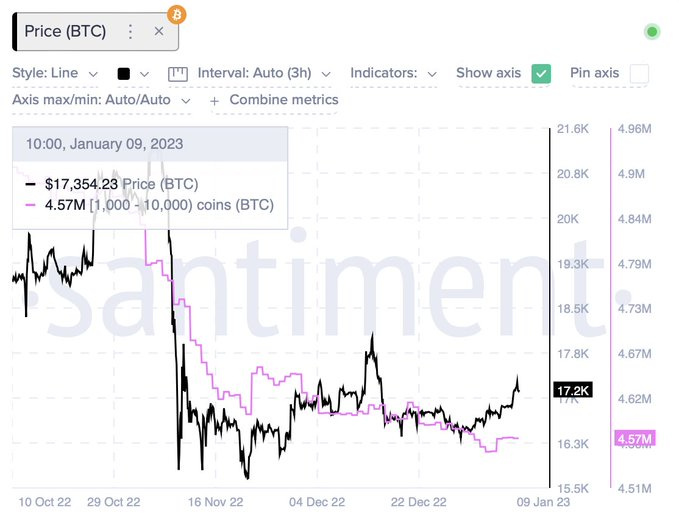
最后,比特币巨鲸开始囤币。根据 Santiment 数据,持有 1000 到 10000 枚 BTC 的鲸鱼地址在 12 月份并不活跃;但从 1 月 5 日以来,这些地址开始增持,累计 BTC 持有量增加了大约 20, 000 枚 。Santiment 数据显示,这些地址目前 BTC 总持有量达到 457 万个,占流通供应量的 23.7% 。此外,超过 10, 000 BTC 的巨鲸地址——这些地址大多属于交易所和“财富阶层”,例如 Michael Saylor,拥有大量 BTC 风险敞口,在过去两个月持币数量增加了 20% 以上,这可能表明最富有的人正在加仓。


Related Reads

imToken's 10th Anniversary Unveils Strategic Direction for the Next Decade: Evolving from a Trusted Main Wallet to a Personal Digital Hub

On its tenth anniversary, decentralized wallet imToken announced its strategic vision for the next decade: evolving from a "trusted main wallet" into a "personal control interface." This new direction aims to help users manage not only digital assets but also identity, permissions, and AI agent actions in an increasingly open and intelligent internet. imToken outlined that while the past decade focused on Store, Send, and Stake—securing assets, enabling transfers, and facilitating network participation—the future introduces a fourth core proposition: Sign. This expanded concept goes beyond transaction signing to encompass expressing intent, granting permissions, setting rules, delegating actions, and revoking authorizations. As AI agents gain autonomy, imToken emphasizes the need for clear, verifiable, and revocable user control over their actions. CEO Ben He stated that imToken's mission is shifting from enabling ownership of digital assets to ensuring user sovereignty over their entire digital world in the AI era. The company's core principle has been upgraded from "Digital Assets, Under Your Control" to "Your Digital World, Under Your Control." Future development will focus on three areas: upholding self-custody principles, extending security from transactions to authorizations and automated actions, and building product capabilities for managing permissions, delegations, policies, and revocations. imToken views the wallet's role as expanding into a trusted control interface for human-AI collaboration, where managing keys, signatures, and permissions forms the infrastructure for personal digital sovereignty. Founded in 2016, imToken serves millions of users across 150+ countries, providing non-custodial wallet services supporting over 50 blockchain networks.

marsbit4m ago

imToken's 10th Anniversary Unveils Strategic Direction for the Next Decade: Evolving from a Trusted Main Wallet to a Personal Digital Hub

marsbit4m ago

With 300 Million Financing to Accumulate ETH, the Hidden Concerns Behind BitMine's High-Yield Preferred Shares

BitMine, led by Thomas Lee, plans to raise up to $300 million through an initial public offering of 3 million shares of perpetual Series A preferred stock on the NYSE (ticker: BMNP). The stock offers a fixed 9.5% annual dividend. The funds are intended to further the company's accumulation of Ethereum, expand its staking node operations, and for general corporate purposes. This move comes as BitMine faces significant challenges. Its massive Ethereum holdings, over 5.3 million ETH (roughly 4.5% of circulating supply), are currently at an unrealized loss exceeding $8.5 billion due to the crypto market downturn. The company's core business model relies on staking these ETH holdings to generate yield, which it presents as the primary means to cover the new, substantial annual dividend obligation of approximately $28.5 million if the offering is fully subscribed. While the model is similar to MicroStrategy's bitcoin-focused strategy of using capital markets to fund crypto acquisitions, BitMine's product differs with its fixed, non-adjustable dividend rate. The company acknowledges risks, stating dividend payments could also come from cash reserves, asset sales, or future financing, and warns that staking yields may underperform or be illiquid during market stress. The 9.5% fixed rate reflects the higher risk premium demanded from investors for a company heavily exposed to Ethereum's volatility.

Foresight News7m ago

With 300 Million Financing to Accumulate ETH, the Hidden Concerns Behind BitMine's High-Yield Preferred Shares

Foresight News7m ago

A Year of Observing Agent Payments: The Cold Reality Behind the Hot Narrative

A Year in Agent Payments: The Cold Reality Behind a Hot Narrative This article examines the current state of "Agent payments," a year after it became a major trend at the intersection of AI, payments, and crypto. Despite significant investments from major players like Stripe, Visa, and Google, the author—having built products and spoken with merchants and developers—finds genuine, large-scale demand still lacking. Key findings across several hyped scenarios reveal structural challenges: * **Agent-to-Merchant Commerce:** For most product categories (e.g., clothing, electronics), AI shopping via chat is inferior to traditional visual e-commerce. Merchant interest is largely defensive, focused on future-proofing rather than current consumer demand. True potential exists only in specific, high-frequency/low-decision scenarios (like food orders) or for simplifying broken checkout experiences, but these require massive consumer distribution, favoring incumbents. * **Agent-to-API/Machine Commerce:** While stablecoin micropayments are touted for API calls, developers already solve small-value payments via prepaid credits and subscriptions. Large SaaS providers prefer enterprise contracts over fragmented micro-pricing. The market exists for long-tail services outside the top providers but is inherently smaller than the hype suggests. * **Agent-to-Agent Payments:** This remains a theoretical long-term vision with negligible real transaction volume. The core challenges—discovery, trust, negotiation, dispute resolution—are unsolved. While the potential for a new, high-speed settlement layer is real, it is not the current market. * **Agent Finance:** This is the sole area with existing, paying customers (fund managers, DeFi users). AI enhances real-time monitoring and autonomous rebalancing, offering real capability gains. However, competition favors established, regulated institutions with existing licenses and client relationships. The author concludes that the core deficiency in the Agent economy is not merely a payment layer, but a more complex **coordination** capability—figuring out how Agents and humans work together, verify task completion, and settle outcomes. Payment is just one component of settlement, which is itself part of coordination. For large companies, investing now is a defensive, long-term bet with minimal cost. For startups, however, the imperative is to find markets that exist today, not wait for a future wave that remains on the horizon.

marsbit9m ago

A Year of Observing Agent Payments: The Cold Reality Behind the Hot Narrative

marsbit9m ago

China's First Embodied Data Compliance Outbound: How Does Paxini Become a Game-Changer for Industry Development?

"Embodied Intelligence Data Compliance Goes Global: A Breakthrough Moment. At the 2026 World Intelligent Industry Expo, Paxini, the sole Chinese company authorized for cross-border embodied data transfer, launched a pioneering project in Tianjin. This marks the first officially approved case of its kind in China, resolving a major industry bottleneck for compliant international data flow. As the ultimate direction of AI evolution, embodied intelligence relies on vast, multi-modal physical world interaction data. Despite booming global demand, stringent compliance had previously trapped the domestic industry. Paxini's breakthrough establishes a formal compliance framework, setting a benchmark for standardized development. The core of Paxini's success lies in its industry-leading data infrastructure and compliant security architecture, aligning with national data strategy. It operates a large-scale 'data collection factory' for high-quality, multi-modal data and has established a full-chain compliant pathway from 'collection-processing-certification-outbound transfer'. This dual advantage in data scale/quality and compliance secures its leadership. Beyond immediate commercial impact, the project signifies long-term strategic value: international market validation from top-tier financial institutions and the compounding benefits of ecosystem building. High-quality physical world data possesses enduring value. By solving fundamental infrastructure and compliance challenges, Paxini not only contributes a 'Chinese model' to the global embodied intelligence industry but also solidifies a key competitive moat for the long haul. This enables safe, efficient global flow of China's quality embodied data, amplifying its influence in the intelligent manufacturing landscape."

marsbit11m ago

China's First Embodied Data Compliance Outbound: How Does Paxini Become a Game-Changer for Industry Development?

marsbit11m ago

Trading

Spot
Futures

Hot Articles

What is $BITCOIN

DIGITAL GOLD ($BITCOIN): A Comprehensive Analysis Introduction to DIGITAL GOLD ($BITCOIN) DIGITAL GOLD ($BITCOIN) is a blockchain-based project operating on the Solana network, which aims to combine the characteristics of traditional precious metals with the innovation of decentralized technologies. While it shares a name with Bitcoin, often referred to as “digital gold” due to its perception as a store of value, DIGITAL GOLD is a separate token designed to create a unique ecosystem within the Web3 landscape. Its goal is to position itself as a viable alternative digital asset, although specifics regarding its applications and functionalities are still developing. What is DIGITAL GOLD ($BITCOIN)? DIGITAL GOLD ($BITCOIN) is a cryptocurrency token explicitly designed for use on the Solana blockchain. In contrast to Bitcoin, which provides a widely recognized value storage role, this token appears to focus on broader applications and characteristics. Notable aspects include: Blockchain Infrastructure: The token is built on the Solana blockchain, known for its capacity to handle high-speed and low-cost transactions. Supply Dynamics: DIGITAL GOLD has a maximum supply capped at 100 quadrillion tokens (100P $BITCOIN), although details regarding its circulating supply are currently undisclosed. Utility: While precise functionalities are not explicitly outlined, there are indications that the token could be utilized for various applications, potentially involving decentralized applications (dApps) or asset tokenization strategies. Who is the Creator of DIGITAL GOLD ($BITCOIN)? At present, the identity of the creators and development team behind DIGITAL GOLD ($BITCOIN) remains unknown. This situation is typical among many innovative projects within the blockchain space, particularly those aligning with decentralized finance and meme coin phenomena. While such anonymity may foster a community-driven culture, it intensifies concerns about governance and accountability. Who are the Investors of DIGITAL GOLD ($BITCOIN)? The available information indicates that DIGITAL GOLD ($BITCOIN) does not have any known institutional backers or prominent venture capital investments. The project seems to operate on a peer-to-peer model focused on community support and adoption rather than traditional funding routes. Its activity and liquidity are primarily situated on decentralized exchanges (DEXs), such as PumpSwap, rather than established centralized trading platforms, further highlighting its grassroots approach. How DIGITAL GOLD ($BITCOIN) Works The operational mechanics of DIGITAL GOLD ($BITCOIN) can be elaborated on based on its blockchain design and network attributes: Consensus Mechanism: By leveraging Solana’s unique proof-of-history (PoH) combined with a proof-of-stake (PoS) model, the project ensures efficient transaction validation contributing to the network's high performance. Tokenomics: While specific deflationary mechanisms have not been extensively detailed, the vast maximum token supply implies that it may cater to microtransactions or niche use cases that are still to be defined. Interoperability: There exists the potential for integration with Solana’s broader ecosystem, including various decentralized finance (DeFi) platforms. However, the details regarding specific integrations remain unspecified. Timeline of Key Events Here is a timeline that highlights significant milestones concerning DIGITAL GOLD ($BITCOIN): 2023: The initial deployment of the token occurs on the Solana blockchain, marked by its contract address. 2024: DIGITAL GOLD gains visibility as it becomes available for trading on decentralized exchanges like PumpSwap, allowing users to trade it against SOL. 2025: The project witnesses sporadic trading activity and potential interest in community-led engagements, although no noteworthy partnerships or technical advancements have been documented as of yet. Critical Analysis Strengths Scalability: The underlying Solana infrastructure supports high transaction volumes, which could enhance the utility of $BITCOIN in various transaction scenarios. Accessibility: The potential low trading price per token could attract retail investors, facilitating wider participation due to fractional ownership opportunities. Risks Lack of Transparency: The absence of publicly known backers, developers, or an audit process may yield skepticism regarding the project's sustainability and trustworthiness. Market Volatility: The trading activity is heavily reliant on speculative behavior, which can result in significant price volatility and uncertainty for investors. Conclusion DIGITAL GOLD ($BITCOIN) emerges as an intriguing yet ambiguous project within the rapidly evolving Solana ecosystem. While it attempts to leverage the “digital gold” narrative, its departure from Bitcoin's established role as a store of value underscores the need for a clearer differentiation of its intended utility and governance structure. Future acceptance and adoption will likely depend on addressing the current opacity and defining its operational and economic strategies more explicitly. Note: This report encompasses synthesised information available as of October 2023, and developments may have transpired beyond the research period.

363 Total ViewsPublished 2025.05.13Updated 2025.05.13

What is $BITCOIN

Discussions

Welcome to the HTX Community. Here, you can stay informed about the latest platform developments and gain access to professional market insights. Users' opinions on the price of BTC (BTC) are presented below.

活动图片