Криптовалюты растут быстрее инфляции, а традиционные активы нет

CryptoSlatePublished on 2022-12-26Last updated on 2022-12-26

Abstract

Помимо того, что пандемия 2020 года поставила мир в тупик, она привела к крупнейшей в истории программе фискального стимулирования.

Помимо того, что пандемия 2020 года поставила мир в тупик, она привела к крупнейшей в истории программе фискального стимулирования.

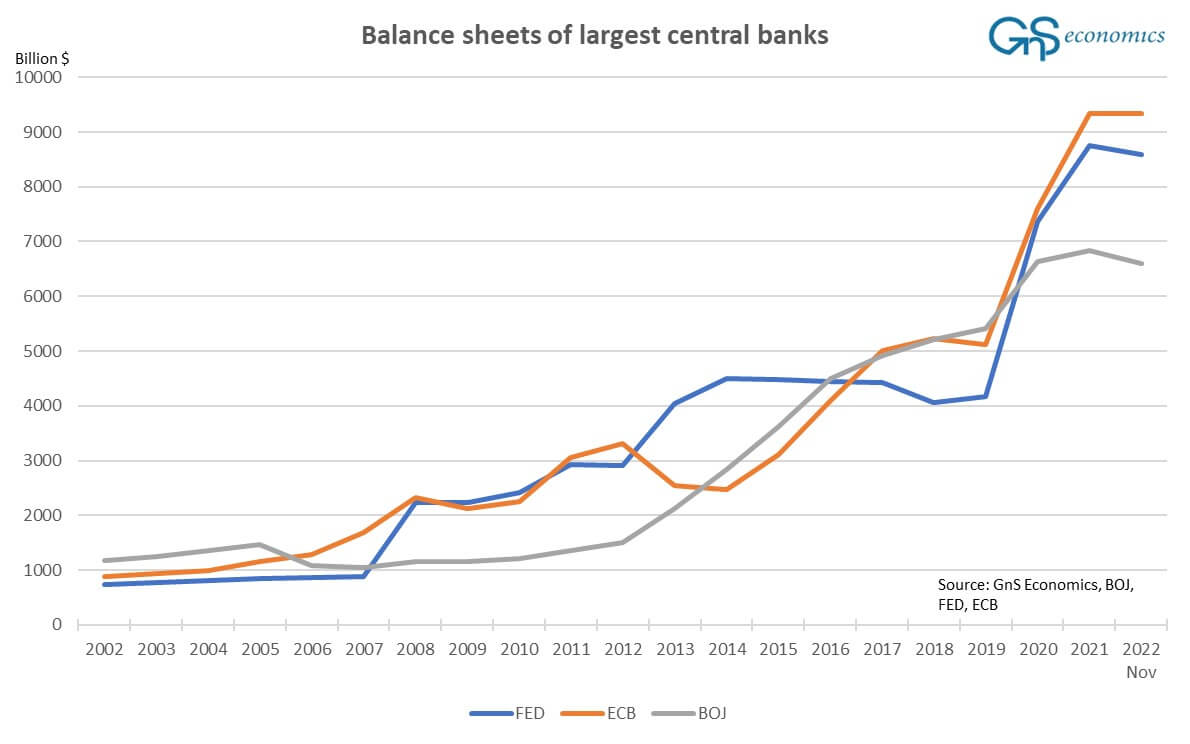
Два крупнейших центральных банка мира, Федеральная резервная система США и Европейский центральный банк (ЕЦБ), менее чем за год удвоили свои балансы. Федеральная резервная система США увеличила свой баланс с чуть более 4 триллионов долларов на конец 2019 года до более 8,7 триллионов долларов на конец 2020 года.

Европейский центральный банк за год увеличил свой баланс с 5 трлн долларов до более чем 9 трлн долларов. Между тем, Банк Японии был более консервативен в отношении своего баланса, добавив около 1,5 трлн долл. США за год, и таким образом его баланс вырос почти до 7 трлн долл. США в 2021 году.

Отчеты по балансам ФРС США, ЕЦБ и Банка Японии (Источник: GnS Economics)

Исторически беспрецедентная программа стимулирования привела к стремительной инфляции, которая еще не достигла своего пика. Индексы потребительских цен по всему миру неуклонно растут с 2020 года и набрали темпы во втором квартале 2022 года.

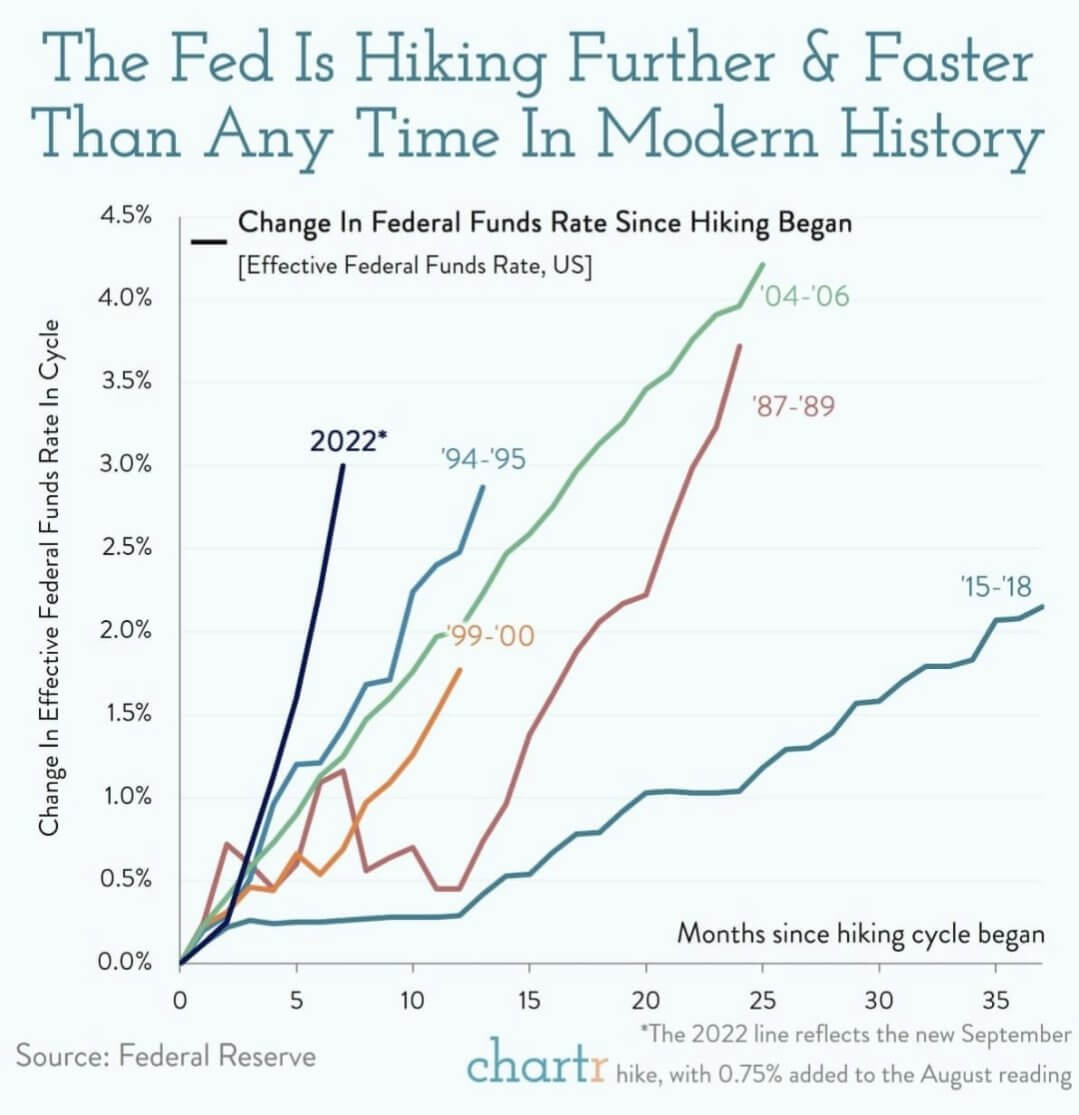
Чтобы сдержать рост ИПЦ, центральные банки по всему миру спешно повышают процентные ставки и делают кредиты более дорогими. С начала 2022 года инфляция в США росла такими угрожающими темпами, что Федеральная резервная система приступила к самому быстрому в современной истории повышению процентных ставок.

График изменения ставки по федеральным фондам с момента начала повышения процентных ставок (Источник: Федеральная резервная система США)

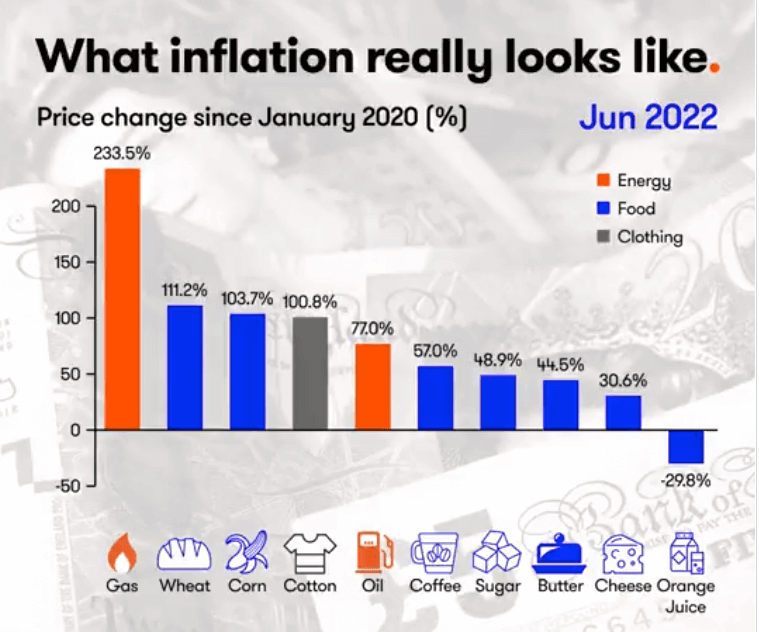
Если посмотреть на однозначный рост ИПЦ в США, то невозможно понять, насколько высока инфляция на самом деле. С 2020 года в процентном выражении цены на многие товары выросли на трехзначную величину, в том числе цены на газ за два года выросли более чем на 233%. Цены на пшеницу, кукурузу и хлопок выросли более чем на 100%.

Изменение цен на сырьевые товары и потребительские товары в США (Источник: Interactive Investor)

Для традиционных финансовых активов последние пара лет также были отмечены невероятной волатильностью.

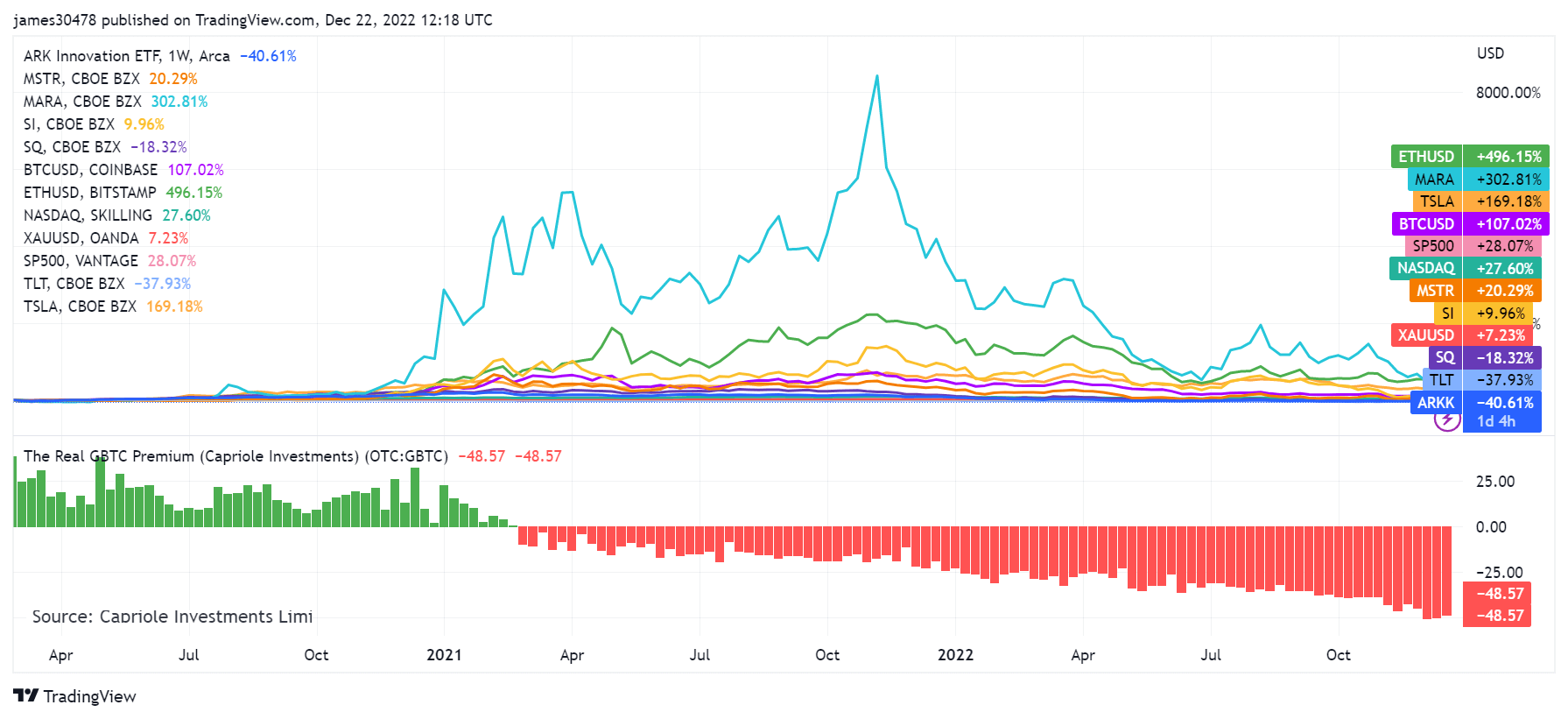
Nasdaq и S&P 500 сумели продемонстрировать скромный рост, который в прошлом году более или менее соответствовал инфляции: первый вырос на 27,6%, а второй – на 28%.

Для золота минувший год был относительно ровным – цена на драгоценный металл увеличилась всего на 7,23% с 2020 года.

С января 2020 года стоимость долгосрочных казначейских облигаций США снизилась более чем на 39%, что свидетельствует о потере доверия инвесторов к государственным облигациям сроком более 20 лет.

С другой стороны, криптоиндустрия и компании, работающие в ней, не только обогнали инфляцию, но и оставили глотать пыль почти все традиционные активы.

С января 2020 года Ethereum и Bitcoin подорожали почти на 496,15% и 107,02% соответственно.

Акции Marathon Digital, одной из крупнейших публично торгуемых майнинговых компаний, выросли на 302,81%, а акции Tesla за тот же период подорожали почти на 170%.

Другие крупные криптовалютные и связанные с криптовалютами компании также выросли в цене: Microstrategy Майкла Сейлора выросла более чем на 20%, а акции Silvergate – почти на 10%.

График, показывающий темпы роста с января 2020 года по декабрь 2022 года для ARKK, MSTR, MARA, SI, SQ, BTCUSD, ETHUSD, NASDAQ, XAUUSD, SP500, TLT, TSLA и GBTC (Источник: TradingView CryptoSlate)

Однако, есть в криптоиндустрии те, кого можно назвать неудачниками. ARK Innovation ETF, фонд, отслеживающий деятельность компании Кэти Вуд Ark Invest, упал более чем на 40% за два года.

Square, финансовая технологическая компания Джека Дорси, показала убыток в 18,32%.

Биткоин-траст Grayscale потерял почти 50% своей стоимости по отношению к cстоимости чистых активов биткоина с 2020 года. До пандемии GBTC торговался с 20% премией к рыночной цене Биткойна.

Автор: Andjela Radmilac. Источник: CryptoSlate.

Trending Cryptos

Related Reads

Base Halts for Two Hours: A Single Invalid Block Reveals the Centralized Reality of L2s

Base, an Ethereum Layer-2 Rollup, experienced a two-hour network outage starting around 00:03 UTC on June 26. The halt was caused by a consensus issue that led to an invalid block being sequenced, which prevented the generation of new blocks after block 47806542. The team identified the problem, restored block sequencing by 01:51 UTC, and confirmed full recovery of ecosystem infrastructure synchronization shortly after. This incident highlights the operational reality for many L2s: while they leverage Ethereum for security and data availability, their day-to-day usability heavily depends on their sequencer and internal systems. Base employs a high-availability sequencer system with one active leader, but this setup did not prevent the outage when a consensus-level problem arose. This follows a previous 33-minute outage in August 2025 related to a faulty sequencer handover process. The downtime occurred near the scheduled activation window for the "Beryl" network upgrade, which has since been postponed. Beryl introduces the native B20 token standard, among other improvements. The incident has sparked renewed discussion about Base potentially launching its own network token in the future, shifting the conversation from mere speculation to questions about how a token might relate to sequencer decentralization, governance, and accountability in such failure scenarios.

Foresight News2m ago

Base Halts for Two Hours: A Single Invalid Block Reveals the Centralized Reality of L2s

Foresight News2m ago

STRC Must Re-Anchor for a BTC Bull Market to Happen

Title: STRC's Depegging Threatens MicroStrategy's Bitcoin-Buying Machine, and Thus the BTC Bull Run Summary: The sustained depegging of MicroStrategy's priority share STRC (trading ~25% below its $100 target) is severely disrupting the company's core business model and poses a major risk to Bitcoin (BTC) price support. STRC was MicroStrategy's most efficient and low-cost funding tool, designed to allow continuous capital raises near its $100 par value to fuel relentless BTC accumulation. Its depegging has effectively blocked this primary funding channel. The situation creates a severe cash flow crisis. STRC and other priority shares now obligate MicroStrategy to pay approximately $1.7 billion in annual cash dividends, while the company's cash reserves are only about $1.4 billion — insufficient to cover one year of payments. To raise cash, MicroStrategy is increasingly resorting to issuing common stock (MSTR) through ATM offerings. However, recent raises show most proceeds (around 90% in one week) are now used to bolster cash reserves rather than buy Bitcoin. This dilutes the key metric of Bitcoin per MSTR share, eroding the fundamental value proposition for equity investors. The company faces grim alternatives: issuing high-cost debt or selling its massive Bitcoin holdings. The latter, though hinted at, would likely trigger significant negative market reactions. Conclusion: As BTC's largest corporate holder and a major marginal buyer, MicroStrategy's funding woes mean reduced, and potentially reversing, institutional buy-side pressure. The company has shifted from being a guaranteed source of BTC demand to a significant overhang on the market. The article argues that without STRC re-anchoring to restore its funding engine, a sustained BTC bull market is in jeopardy.

marsbit22m ago

STRC Must Re-Anchor for a BTC Bull Market to Happen

marsbit22m ago

No Bull Market for BTC Without STRC Re-pegging

Summary: The sustained de-pegging of MicroStrategy's (MSTR) Strategy Preferred Shares (STRC) poses a severe threat to Bitcoin (BTC) and could prevent a bull market. STRC, designed to trade near a $100 target, has plunged to around $75, effectively shutting down MicroStrategy's cheapest and most efficient funding channel. This channel was critical for its "raise funds, buy BTC" business model. More critically, MicroStrategy now faces a massive cash outflow from these preferred shares. With approximately $10.49 billion of STRC outstanding at an 11.5% dividend yield, the annual cash obligation exceeds $1.2 billion. Combined with other preferred shares, the total annual payout nears $1.7 billion, depleting its current ~$1.4 billion cash reserve within a year. To address this, MicroStrategy is increasingly relying on common stock (MSTR) offerings via its ATM program. However, recent sales show most raised capital is now used to bolster cash reserves rather than buy more Bitcoin. This dilutes the key metric of BTC per share for common stockholders, eroding the foundation of its premium valuation. If STRC cannot re-peg, this costly dilution may continue. Worse, if cash pressure intensifies, selling Bitcoin becomes a real risk. As the largest corporate BTC holder (~847,363 BTC), any significant sales could crash the market. Thus, MicroStrategy is transforming from BTC's most reliable institutional buyer into a major potential seller, casting a significant shadow over Bitcoin's price prospects.

Odaily星球日报23m ago

No Bull Market for BTC Without STRC Re-pegging

Odaily星球日报23m ago

Tornado Cash Suffers Another Governance Attack: A Fake Proposal Targets $23 Million Community Treasury

On June 25, 2026, a deceptive governance proposal (#67) appeared in the Tornado Cash DAO, masquerading as an upgrade to implement fee adjustments and token burns. Security researchers, including Sergey Shemyakov and Pascal Caversaccio, quickly identified it as malicious. The proposal's unverified code contained a hidden function designed to stealthily replace the protocol's legitimate governance address (0x5efda50f22d34F262c29268506C5Fa42cB56A1Ce) with an attacker-controlled address (0x5efda50f22d34f272c7077689d6abc42f15e285f). If passed, this would have granted the attacker control over the DAO's treasury, containing approximately $23 million in TORN tokens, and the ability to drain all relayers. The attacker's wallet (0xd4eca8c9242b9f9faa3cf19a78defc21dc97a925) was funded via the privacy protocol Railgun four days prior, obscuring the source. The community response was swift, with the proposal receiving 27,163 TORN votes against (100%) and 0 for, far below the 100,000 TORN quorum required for validity. It is set to expire on June 30. This incident marks the second major governance attack on Tornado Cash, following a May 2023 exploit that stole $2.17 million. It highlights persistent vulnerabilities in DAO structures where power derives from token ownership. The article advises users to follow security researchers, vote against unverified proposals, and delegate voting power. For developers, implementing timelocks—a delay between proposal approval and execution—is presented as a critical security measure to allow for community review and intervention.

Foresight News43m ago

Tornado Cash Suffers Another Governance Attack: A Fake Proposal Targets $23 Million Community Treasury

Foresight News43m ago

Trading

Spot
Futures

Hot Articles

What is $BITCOIN

DIGITAL GOLD ($BITCOIN): A Comprehensive Analysis Introduction to DIGITAL GOLD ($BITCOIN) DIGITAL GOLD ($BITCOIN) is a blockchain-based project operating on the Solana network, which aims to combine the characteristics of traditional precious metals with the innovation of decentralized technologies. While it shares a name with Bitcoin, often referred to as “digital gold” due to its perception as a store of value, DIGITAL GOLD is a separate token designed to create a unique ecosystem within the Web3 landscape. Its goal is to position itself as a viable alternative digital asset, although specifics regarding its applications and functionalities are still developing. What is DIGITAL GOLD ($BITCOIN)? DIGITAL GOLD ($BITCOIN) is a cryptocurrency token explicitly designed for use on the Solana blockchain. In contrast to Bitcoin, which provides a widely recognized value storage role, this token appears to focus on broader applications and characteristics. Notable aspects include: Blockchain Infrastructure: The token is built on the Solana blockchain, known for its capacity to handle high-speed and low-cost transactions. Supply Dynamics: DIGITAL GOLD has a maximum supply capped at 100 quadrillion tokens (100P $BITCOIN), although details regarding its circulating supply are currently undisclosed. Utility: While precise functionalities are not explicitly outlined, there are indications that the token could be utilized for various applications, potentially involving decentralized applications (dApps) or asset tokenization strategies. Who is the Creator of DIGITAL GOLD ($BITCOIN)? At present, the identity of the creators and development team behind DIGITAL GOLD ($BITCOIN) remains unknown. This situation is typical among many innovative projects within the blockchain space, particularly those aligning with decentralized finance and meme coin phenomena. While such anonymity may foster a community-driven culture, it intensifies concerns about governance and accountability. Who are the Investors of DIGITAL GOLD ($BITCOIN)? The available information indicates that DIGITAL GOLD ($BITCOIN) does not have any known institutional backers or prominent venture capital investments. The project seems to operate on a peer-to-peer model focused on community support and adoption rather than traditional funding routes. Its activity and liquidity are primarily situated on decentralized exchanges (DEXs), such as PumpSwap, rather than established centralized trading platforms, further highlighting its grassroots approach. How DIGITAL GOLD ($BITCOIN) Works The operational mechanics of DIGITAL GOLD ($BITCOIN) can be elaborated on based on its blockchain design and network attributes: Consensus Mechanism: By leveraging Solana’s unique proof-of-history (PoH) combined with a proof-of-stake (PoS) model, the project ensures efficient transaction validation contributing to the network's high performance. Tokenomics: While specific deflationary mechanisms have not been extensively detailed, the vast maximum token supply implies that it may cater to microtransactions or niche use cases that are still to be defined. Interoperability: There exists the potential for integration with Solana’s broader ecosystem, including various decentralized finance (DeFi) platforms. However, the details regarding specific integrations remain unspecified. Timeline of Key Events Here is a timeline that highlights significant milestones concerning DIGITAL GOLD ($BITCOIN): 2023: The initial deployment of the token occurs on the Solana blockchain, marked by its contract address. 2024: DIGITAL GOLD gains visibility as it becomes available for trading on decentralized exchanges like PumpSwap, allowing users to trade it against SOL. 2025: The project witnesses sporadic trading activity and potential interest in community-led engagements, although no noteworthy partnerships or technical advancements have been documented as of yet. Critical Analysis Strengths Scalability: The underlying Solana infrastructure supports high transaction volumes, which could enhance the utility of $BITCOIN in various transaction scenarios. Accessibility: The potential low trading price per token could attract retail investors, facilitating wider participation due to fractional ownership opportunities. Risks Lack of Transparency: The absence of publicly known backers, developers, or an audit process may yield skepticism regarding the project's sustainability and trustworthiness. Market Volatility: The trading activity is heavily reliant on speculative behavior, which can result in significant price volatility and uncertainty for investors. Conclusion DIGITAL GOLD ($BITCOIN) emerges as an intriguing yet ambiguous project within the rapidly evolving Solana ecosystem. While it attempts to leverage the “digital gold” narrative, its departure from Bitcoin's established role as a store of value underscores the need for a clearer differentiation of its intended utility and governance structure. Future acceptance and adoption will likely depend on addressing the current opacity and defining its operational and economic strategies more explicitly. Note: This report encompasses synthesised information available as of October 2023, and developments may have transpired beyond the research period.

459 Total ViewsPublished 2025.05.13Updated 2025.05.13

What is $BITCOIN

Discussions

Welcome to the HTX Community. Here, you can stay informed about the latest platform developments and gain access to professional market insights. Users' opinions on the price of BTC (BTC) are presented below.

活动图片