STRC Must Re-Anchor for a BTC Bull Market to Happen

marsbitPublished on 2026-06-26Last updated on 2026-06-26

Abstract

Title: STRC's Depegging Threatens MicroStrategy's Bitcoin-Buying Machine, and Thus the BTC Bull Run Summary: The sustained depegging of MicroStrategy's priority share STRC (trading ~25% below its $100 target) is severely disrupting the company's core business model and poses a major risk to Bitcoin (BTC) price support. STRC was MicroStrategy's most efficient and low-cost funding tool, designed to allow continuous capital raises near its $100 par value to fuel relentless BTC accumulation. Its depegging has effectively blocked this primary funding channel. The situation creates a severe cash flow crisis. STRC and other priority shares now obligate MicroStrategy to pay approximately $1.7 billion in annual cash dividends, while the company's cash reserves are only about $1.4 billion — insufficient to cover one year of payments. To raise cash, MicroStrategy is increasingly resorting to issuing common stock (MSTR) through ATM offerings. However, recent raises show most proceeds (around 90% in one week) are now used to bolster cash reserves rather than buy Bitcoin. This dilutes the key metric of Bitcoin per MSTR share, eroding the fundamental value proposition for equity investors. The company faces grim alternatives: issuing high-cost debt or selling its massive Bitcoin holdings. The latter, though hinted at, would likely trigger significant negative market reactions. Conclusion: As BTC's largest corporate holder and a major marginal buyer, MicroStrategy's funding woes mean ...

Author|Azuma(@azuma_eth)

The "de-anchoring" of Strategy's preferred stock STRC continues to intensify.

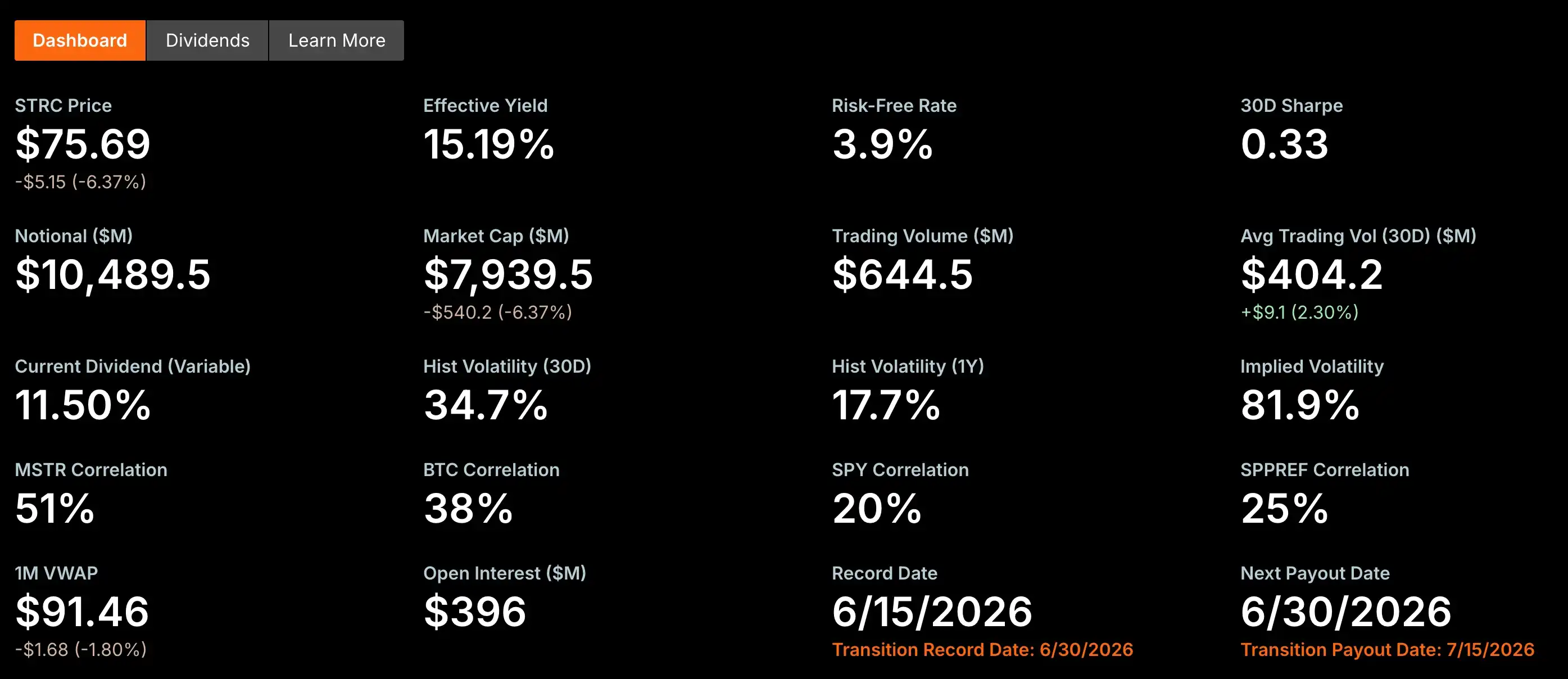
During yesterday's U.S. stock market session, STRC fell below the 80 mark for the first time, touching a low of $73.62 at one point. Although it rebounded slightly by the close, the price remained at only $75.69, nearly 25% "de-anchored" from its target face value of $100.

Last week, we wrote an article titled "STRC De-anchored by 11%, Can Strategy's Perpetual Motion Machine Keep Running?" focusing on the reasons for STRC's de-anchoring and briefly outlining its potential future impacts.

However, judging from community discussions, it seems many readers still do not fully grasp just how dire the consequences of STRC's persistent de-anchoring are, so we decided to write another article to break down this issue.

Strategy's Most Important Fundraising Channel Has Failed

What exactly is STRC? In a nutshell, it is Strategy's cheapest and most efficient fundraising channel.

The essence of Strategy's business model is to continuously raise funds from the market to acquire more BTC, then raise more funds and acquire even more BTC. This is a cycle that must keep turning. Strategy's high valuation is largely based on the market's belief in its ability to persistently raise funds and buy BTC. As long as its fundraising capability remains, it can keep expanding its BTC holdings; and the ever-growing BTC holdings, in turn, further support the market's expectations for its future fundraising ability.

Over the past few years, Strategy has tried almost every fundraising method—issuing common stock, convertible bonds, and various types of preferred stock—and continuously invested the raised funds into BTC. Among all its fundraising tools, STRC was once considered by the market as the one closest to "perfect," and is Michael Saylor's proudest creation. Saylor once boasted, "STRC is a product designed by AI, humans couldn't have designed this."

As a preferred stock, STRC's advantages are very clear. Issuing common stock could dilute existing shareholders' equity; issuing convertible bonds means the company bears future debt repayment pressure; but STRC, as a perpetual preferred stock, has no maturity date, does not dilute common shareholders, and only requires fixed dividend payments. For Strategy and Saylor, this was almost the lowest-cost, highest-efficiency fundraising method.

From its inception, STRC was designed as a product anchored to $100. Strategy envisioned that by dynamically adjusting its dividend yield, STRC would trade long-term around $100 (sound familiar, like algorithmic stablecoins?). As long as the secondary market could maintain this price, the company could continuously issue new STRC at prices close to face value, raise new funds, and continue buying Bitcoin.

In other words, STRC's core value lies in its endless fundraising ability, but this ability is predicated on its price remaining near the target face value. As STRC continues to de-anchor, this fundraising channel is effectively blocked. Because for any investor, if buying the same STRC in the secondary market only costs $75, there is no incentive to participate in the company's new preferred stock issuance at a price close to $100.

For Strategy, the options are either to keep raising the dividend yield to attract funds (which has proven to have limited appeal) or to accept the reduced fundraising efficiency from discounted issuance (which actively breaks the original target face value). Either way, it means this fundraising machine is developing increasingly significant friction.

The Fundraising Tool Has Become a Cash Flow Burden

If it were just a temporary failure of fundraising ability, it might be manageable. The bigger problem is that STRC requires Strategy to make continuous, substantial cash dividend payments.

According to Strategy's latest official disclosure, the current issuance size of STRC is approximately $10.49 billion, with a current dividend yield of 11.5%. This means that for STRC alone, Strategy has an annual cash dividend payment obligation exceeding $1.2 billion. Adding other preferred stocks like STRD, STRK, STRF issued by Strategy, this figure climbs to about $1.7 billion.
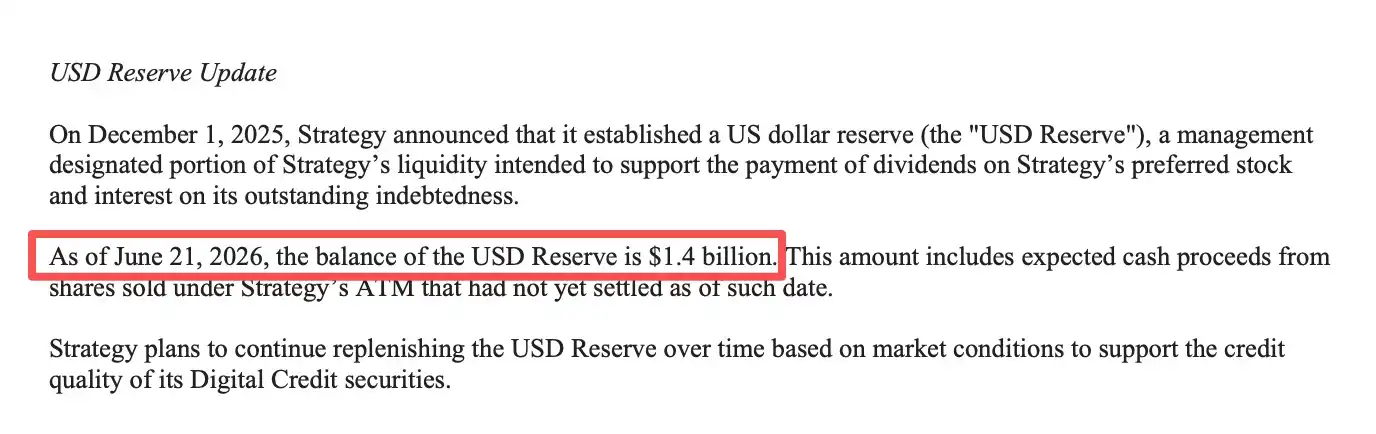
In the common stock issuance filing on June 21st (note: common stock, details below), Strategy disclosed that its cash reserves are approximately $1.4 billion. At this cash reserve level, Strategy's on-book cash can cover less than one year of preferred stock dividend payments.
Resolving the Situation Requires Money, But Where Will It Come From?

Whether to sustain its own business model or to escape its current severe cash flow situation and avoid dividend payment default (the more urgent issue), Strategy needs more money. Theoretically, Strategy now has only three viable paths to "get money."

First, issuing common stock.

This is currently the most direct and mature financing method. Through its ATM (At-the-Market Offering) program, Strategy can continuously sell MSTR common shares to the market to raise funds.

But common stock financing is not without cost. Continuous issuance means the number of outstanding shares keeps increasing. If the growth rate of BTC purchased with newly raised funds cannot outpace the share expansion rate, the BTC per share growth will slow down, and common shareholders will face continuous dilution—note this point, it's important for what follows.

Second, issuing more debt.

Over the past few years, Strategy has repeatedly raised funds through debt instruments like convertible bonds, which were a crucial source of funds for its early large-scale BTC acquisitions.

However, as the scale of preferred stock has continued to expand and fixed cash outflows have persisted, the market has started paying closer attention to Strategy's liquidity and debt repayment capacity. In the current financing environment, if the company issues bonds again, investors are likely to demand higher risk premiums, meaning financing costs will be significantly higher than in the past.

More importantly, bonds differ from preferred or common stock; their interest payments and principal repayments are rigid obligations. Against a backdrop of declining cash reserves and increasing dividend payments, further expanding debt would undoubtedly加重 the company's financial burden and compress its future financing space.

Third, selling BTC.

From a financial perspective, this is the fastest way to replenish cash reserves. Strategy has certainly considered this path. The company stated on its official X account regarding dividend payment pressure: "When considering its massive Bitcoin reserves, they are sufficient to cover 32 years of dividend payments."

But for Strategy, this is also an extremely dangerous choice. Earlier this month, Strategy sold some of its Bitcoin holdings for the first time. Although the sale was only for 32 BTC, and the official presentation framed it as "active market desensitization testing" and mentioned "will buy back more later," it still caused a short-term market dip.

As the largest single holder of Bitcoin in the market, Strategy's actions can easily trigger market chain reactions. If it increases sales volume in the future, it will undoubtedly place huge pressure on the already fragile BTC price. If BTC declines further, Strategy's so-called "reserves" would also quickly shrink.

In summary, in the current situation, every viable fundraising channel for Strategy comes at a higher cost than in the past.

Has Strategy Made Its Choice?

Based on Strategy's latest moves, aside from hinting at possibly selling BTC, the company seems to have already chosen its path.

Since June, Strategy has relied on its common stock ATM (At-the-Market Offering) program for fundraising for three consecutive weeks, with the latest round (June 22nd) being particularly typical.

According to Strategy's latest 8-K filing, the company sold a total of 2,714,839 MSTR common shares in one week, raising $335.5 million. However, that same week, Strategy only purchased 520 BTC, spending a total of $34.9 million, with an average purchase price of around $67,068. In other words, of the $335.5 million raised, only about 10% was actually used to continue acquiring BTC. The remaining funds were primarily used to replenish the company's cash flow reserves, increasing cash from about $1.1 billion previously to the current ~$1.4 billion.

This might seem quite effective? But there's another trap here.

For MSTR common shareholders, the most critical information is: for each new common share issued, how much BTC can the raised funds ultimately buy back? Is it enough to cover the BTC equity corresponding to this new share? If the new financing can buy back more BTC than the share originally corresponded to, then common shareholders' equity is actually enhanced. Conversely, if the raised funds buy back insufficient BTC to cover the new share's corresponding BTC equity, then common shareholders suffer dilution.

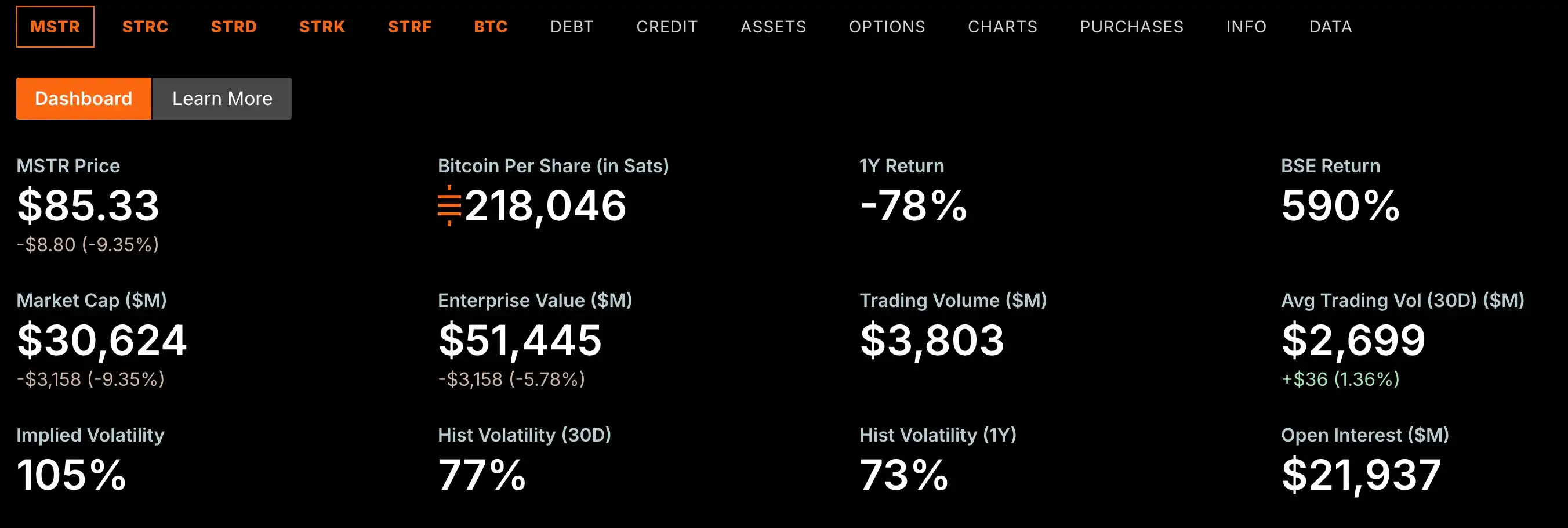
Clearly, Strategy's recent common stock issuance has come at the cost of diluting common shareholder equity. Strategy's official data also shows that MSTR's BTC per share has decreased from a peak of 220,900 Sats to 218,046 Sats.
This is the biggest limitation of common stock financing. For the vast majority of public companies, issuing common stock is just one of many financing methods; but for Strategy, common stock itself is part of its business model.

Over the past few years, Strategy's growth has essentially relied on the continuous operation of the "fundraise ➡️ buy coins ➡️ solidify market expectations ➡️ fundraise again ➡️ buy coins again..." flywheel. The market's core expectation for Strategy lies in its ability to continuously create more BTC equity for common shareholders, not dilute it.

However, when Strategy is forced to rely increasingly on common stock financing to replenish cash reserves rather than continue acquiring BTC, the operating logic of this flywheel changes. While common stock financing can indeed alleviate Strategy's cash pressure in the short term, it is difficult to become a long-term substitute for STRC.

Once common stock financing persistently erodes BTC per share, the foundation upon which MSTR's high premium relies may also be challenged, and this is precisely the core competitive advantage of Strategy's entire business model.

What About BTC?

Over the past few years, Strategy has become the most important marginal buyer in the BTC market (arguably without "one of"). To date, Strategy has accumulated holdings of 847,363 BTC, accounting for about 4% of BTC's current circulating supply, valued at over $50.7 billion. The market has long grown accustomed to Saylor's massive, unwavering weekly purchases.

But now, this situation is changing. Strategy can still raise funds through common stock, but most of the funds are no longer flowing into BTC; they are prioritized for replenishing cash reserves. This means that under the same fundraising scale, the actual new buying power entering the BTC market is diminishing.

More detrimentally, this situation may persist. If STRC fails to re-anchor long-term, and preferred stock financing remains blocked, Strategy will be forced to rely on common stock financing long-term to maintain cash flow, potentially further reducing the proportion of funds used for BTC accumulation. For the BTC market, this means the most stable and certain institutional buying power of the past few years will no longer grow as consistently as before.

But even more concerning is that if excessive common stock issuance overly dilutes MSTR shareholder equity, Strategy may have to consider another financing channel—selling coins.

From weakened new buying power to the emergence of potential selling pressure, today's Strategy is no longer BTC's largest marginal buyer, but a giant sword hanging over BTC.


Trending Cryptos

Related Questions

QWhat is the core function of STRC within Strategy's business model, and why is its 'de-pegging' a critical issue?

ASTRC serves as Strategy's most efficient and low-cost financing channel. Its design aims to trade around a $100 par value, enabling Strategy to continuously issue new shares near that price to raise funds for buying more Bitcoin. The ongoing de-pegging, with the price dropping significantly below $100, has effectively blocked this crucial financing channel. Investors are unwilling to pay near par value for new issues when they can buy cheaper on the secondary market, undermining Strategy's core mechanism for growth.

QAccording to the article, what major financial burden does the STRC de-pegging create for Strategy beyond just hampering fundraising?

ABeyond hindering new fundraising, the de-pegged STRC imposes a massive ongoing cash dividend obligation on Strategy. With approximately $10.49 billion of STRC issued and an 11.5% dividend rate, Strategy must pay over $1.2 billion in cash dividends annually for STRC alone. Combined with other preferred shares, the total annual dividend burden rises to around $1.7 billion, which threatens to deplete its reported $1.4 billion cash reserve in less than a year.

QWhat are the three main paths for Strategy to raise more capital as outlined in the article, and what are the downsides of each?

AThe three main paths are: 1) Issuing common stock (MSTR): This dilutes existing shareholders if the new capital doesn't buy enough Bitcoin to cover the increased share count, eroding the key metric of BTC per share. 2) Issuing more debt (e.g., convertible notes): This increases rigid financial obligations (interest and principal) in an environment where investors would demand higher risk premiums, worsening Strategy's liquidity and debt burden. 3) Selling Bitcoin (BTC): While quickly boosting cash, this risks triggering a market downturn due to Strategy's status as a major holder, which could conversely devalue its own massive BTC reserves.

QHow has Strategy's recent use of common stock (MSTR) ATM offerings changed, and what concerning trend does this reveal?

AStrategy's recent common stock ATM offerings reveal a shift in fund allocation. For example, a late June offering raised $335.5 million, but only about $34.9 million (roughly 10%) was used to buy more Bitcoin. The majority was used to bolster the company's cash reserves. This indicates that new equity financing is increasingly being used not for growth (buying BTC) but for survival (covering cash needs like dividend payments), leading to a dilution of BTC per share for common stockholders.

QWhy does the article argue that 'If STRC doesn't re-peg, BTC has no bull market,' and what is the new risk Strategy poses to Bitcoin?

AThe article argues this because Strategy has been the most significant marginal buyer in the Bitcoin market, with its constant, large-scale purchases driven by efficient financing (like STRC). If STRC remains de-pegged, Strategy loses its primary funding tool and must rely on less efficient methods (common stock sales) that funnel less new money into BTC. This weakens a major source of buy-side pressure. Furthermore, if cash pressures mount, Strategy might be forced to sell Bitcoin, transforming it from the market's biggest steady buyer into a potential large-scale seller—a 'giant blade' hanging over the Bitcoin market.

Related Reads

How to Detect AI-Generated Videos? A Review of Dynamic, Traceable, and Explainable Detection Systems

**How to Detect AI-Generated Videos: A Survey on Dynamic, Traceable, and Explainable Detection Systems** With rapid advances in AI video generation (e.g., Sora, Veo), creating highly realistic, multi-minute videos is now possible, widening the gap with detection research. Current AI video detection, often limited to unreliable binary classifications, is insufficient. This survey, accepted at ACL 2026, reframes the goal as **"factual fidelity verification"**—checking if a video's content (who, when, where, what) aligns with the real world perceptually and cognitively. It categorizes AI-generated videos into three paradigms: **Local Manipulation Videos (LMV**, e.g., face swaps), **Audio-Visual Editing (AVE**, e.g., lip-syncing), and **Generative Video Synthesis (GVS**, fully synthetic videos like Sora's). Detection challenges evolve from visual artifacts in LMV to multi-modal inconsistencies in AVE and higher-level world knowledge violations in GVS. The core proposal is a **Vision-Language Dual-View framework** with four hierarchical layers: 1. **Layer 1 (Intrinsic Visual Cues):** Analyzes low-level signal statistics, noise patterns, and physiological signals. 2. **Layer 2 (Spatiotemporal Consistency):** Checks for temporal coherence in object motion and scene dynamics. 3. **Layer 3 (Cross-Modal Consistency):** Verifies alignment between video, audio, and text within the video. 4. **Layer 4 (Language-Guided World-Level Reasoning):** Uses external knowledge, facts, and physical laws to judge semantic plausibility and factual correctness. The survey traces a shift in detection focus from lower layers (1 & 2) toward higher, language-involved layers (3 & 4). It also reviews evolving evaluation metrics and datasets tailored for each video paradigm. The conclusion advocates for a **dynamic, evidence-first detection system** that moves beyond simple classification. Future trustworthy detection requires combining visual evidence (from CV) with semantic reasoning and explanation (from NLP & multimodal AI), ultimately creating traceable and explainable judgments about a video's adherence to real-world constraints.

marsbit13m ago

How to Detect AI-Generated Videos? A Review of Dynamic, Traceable, and Explainable Detection Systems

marsbit13m ago

It Turns Out the First Real-World Application of AI x Crypto is in Security Auditing

The article explores the surprising trend where AI's first major impact on crypto has been in security auditing, not in areas like trading or analytics. It details how AI-powered tools are dramatically lowering the barrier to finding smart contract vulnerabilities, enabling attackers to scan thousands of contracts and execute exploits within minutes. This has rendered traditional, manually-produced audit reports with their month-long validity periods increasingly obsolete, creating a critical "structural crack" in the old security model. Cases like Drift Protocol and KelpDAO show that even extensively audited protocols can be hacked through social engineering, operational flaws, or infrastructure misconfigurations beyond pure code review. Attackers are also using AI to find and exploit vulnerabilities in years-old, deployed contracts. Notably, OpenZeppelin's co-founder has expressed a grim view that "all DeFi is insecure" due to AI's asymmetric advantage. In response, the audit industry is undergoing a fundamental shift. While there's a short-term spike in defensive re-audits, the long-term business model is changing. Firms are developing AI-assisted systems and moving from one-time report deliveries towards embedded, continuous services like real-time monitoring and formal verification. Examples include AI tools uncovering critical, previously missed vulnerabilities in heavily audited protocols like Curve Finance and Zcash. The conclusion is that security must become a continuous investment, not a one-time checkbox, and audit firms must rapidly evolve their tools and service models to survive.

marsbit20m ago

It Turns Out the First Real-World Application of AI x Crypto is in Security Auditing

marsbit20m ago

Never expected that the first tangible application of AI x Crypto is in security auditing

Unexpectedly, the initial major application of AI in the Crypto sphere has turned out to be security auditing. In 2026, DeFi has faced significant security challenges, with 121 hacking incidents resulting in approximately $942 million in losses. While AI was expected to first impact areas like quantitative trading, its initial breakthrough has instead transformed security auditing by drastically lowering the cost and skill barrier for finding smart contract vulnerabilities. The traditional audit model is facing obsolescence. Advanced AI models, such as Claude Mythos, enable attackers to scan thousands of contracts and identify vulnerability patterns at scale, compressing the time from discovery to execution to mere minutes. This renders the month-long validity of traditional audit reports ineffective. Notably, attacks now frequently target well-audited, established protocols by exploiting business logic flaws, operational security weaknesses, and even years-old historical contracts, demonstrating that old audit reports offer zero protection. This pressure is forcing a fundamental shift in the industry. In the short term, a wave of defensive re-auditing is occurring, driven by projects seeking to meet new AI-era security standards and regulatory requirements. In the long run, audit firms' business models are diverging. The one-time report delivery model is declining in value, as evidenced by platforms like Code4rena shutting down. Leading firms are now pivoting towards AI-powered defense, integrating continuous monitoring, real-time on-chain risk detection, and embedding security directly into the development phase, as seen with tools like OpenZeppelin's Skills system. Ultimately, the era of "audit once, secure forever" is over. Security must become a continuous, embedded infrastructure investment for projects. For audit companies, survival depends on proactively transforming from traditional service providers into platforms offering AI-native, ongoing security solutions.

链捕手27m ago

Never expected that the first tangible application of AI x Crypto is in security auditing

链捕手27m ago

Trading

Spot

Hot Articles

What is SONIC

Sonic: Pioneering the Future of Gaming in Web3 Introduction to Sonic In the ever-evolving landscape of Web3, the gaming industry stands out as one of the most dynamic and promising sectors. At the forefront of this revolution is Sonic, a project designed to amplify the gaming ecosystem on the Solana blockchain. Leveraging cutting-edge technology, Sonic aims to deliver an unparalleled gaming experience by efficiently processing millions of requests per second, ensuring that players enjoy seamless gameplay while maintaining low transaction costs. This article delves into the intricate details of Sonic, exploring its creators, funding sources, operational mechanics, and the timeline of significant events that have shaped its journey. What is Sonic? Sonic is an innovative layer-2 network that operates atop the Solana blockchain, specifically tailored to enhance the existing Solana gaming ecosystem. It accomplishes this through a customised, VM-agnostic game engine paired with a HyperGrid interpreter, facilitating sovereign game economies that roll up back to the Solana platform. The primary goals of Sonic include: Enhanced Gaming Experiences: Sonic is committed to offering lightning-fast on-chain gameplay, allowing players and developers to engage with games at previously unattainable speeds. Atomic Interoperability: This feature enables transactions to be executed within Sonic without the need to redeploy Solana programmes and accounts. This makes the process more efficient and directly benefits from Solana Layer1 services and liquidity. Seamless Deployment: Sonic allows developers to write for Ethereum Virtual Machine (EVM) based systems and execute them on Solana’s SVM infrastructure. This interoperability is crucial for attracting a broader range of dApps and decentralised applications to the platform. Support for Developers: By offering native composable gaming primitives and extensible data types - dining within the Entity-Component-System (ECS) framework - game creators can craft intricate business logic with ease. Overall, Sonic's unique approach not only caters to players but also provides an accessible and low-cost environment for developers to innovate and thrive. Creator of Sonic The information regarding the creator of Sonic is somewhat ambiguous. However, it is known that Sonic's SVM is owned by the company Mirror World. The absence of detailed information about the individuals behind Sonic reflects a common trend in several Web3 projects, where collective efforts and partnerships often overshadow individual contributions. Investors of Sonic Sonic has garnered considerable attention and support from various investors within the crypto and gaming sectors. Notably, the project raised an impressive $12 million during its Series A funding round. The round was led by BITKRAFT Ventures, with other notable investors including Galaxy, Okx Ventures, Interactive, Big Brain Holdings, and Mirana. This financial backing signifies the confidence that investment foundations have in Sonic’s potential to revolutionise the Web3 gaming landscape, further validating its innovative approaches and technologies. How Does Sonic Work? Sonic utilises the HyperGrid framework, a sophisticated parallel processing mechanism that enhances its scalability and customisability. Here are the core features that set Sonic apart: Lightning Speed at Low Costs: Sonic offers one of the fastest on-chain gaming experiences compared to other Layer-1 solutions, powered by the scalability of Solana’s virtual machine (SVM). Atomic Interoperability: Sonic enables transaction execution without redeployment of Solana programmes and accounts, effectively streamlining the interaction between users and the blockchain. EVM Compatibility: Developers can effortlessly migrate decentralised applications from EVM chains to the Solana environment using Sonic’s HyperGrid interpreter, increasing the accessibility and integration of various dApps. Ecosystem Support for Developers: By exposing native composable gaming primitives, Sonic facilitates a sandbox-like environment where developers can experiment and implement business logic, greatly enhancing the overall development experience. Monetisation Infrastructure: Sonic natively supports growth and monetisation efforts, providing frameworks for traffic generation, payments, and settlements, thereby ensuring that gaming projects are not only viable but also sustainable financially. Timeline of Sonic The evolution of Sonic has been marked by several key milestones. Below is a brief timeline highlighting critical events in the project's history: 2022: The Sonic cryptocurrency was officially launched, marking the beginning of its journey in the Web3 gaming arena. 2024: June: Sonic SVM successfully raised $12 million in a Series A funding round. This investment allowed Sonic to further develop its platform and expand its offerings. August: The launch of the Sonic Odyssey testnet provided users with the first opportunity to engage with the platform, offering interactive activities such as collecting rings—a nod to gaming nostalgia. October: SonicX, an innovative crypto game integrated with Solana, made its debut on TikTok, capturing the attention of over 120,000 users within a short span. This integration illustrated Sonic’s commitment to reaching a broader, global audience and showcased the potential of blockchain gaming. Key Points Sonic SVM is a revolutionary layer-2 network on Solana explicitly designed to enhance the GameFi landscape, demonstrating great potential for future development. HyperGrid Framework empowers Sonic by introducing horizontal scaling capabilities, ensuring that the network can handle the demands of Web3 gaming. Integration with Social Platforms: The successful launch of SonicX on TikTok displays Sonic’s strategy to leverage social media platforms to engage users, exponentially increasing the exposure and reach of its projects. Investment Confidence: The substantial funding from BITKRAFT Ventures, among others, emphasizes the robust backing Sonic has, paving the way for its ambitious future. In conclusion, Sonic encapsulates the essence of Web3 gaming innovation, striking a balance between cutting-edge technology, developer-centric tools, and community engagement. As the project continues to evolve, it is poised to redefine the gaming landscape, making it a notable entity for gamers and developers alike. As Sonic moves forward, it will undoubtedly attract greater interest and participation, solidifying its place within the broader narrative of blockchain gaming.

1.7k Total ViewsPublished 2024.04.04Updated 2024.12.03

What is SONIC

What is $S$

Understanding SPERO: A Comprehensive Overview Introduction to SPERO As the landscape of innovation continues to evolve, the emergence of web3 technologies and cryptocurrency projects plays a pivotal role in shaping the digital future. One project that has garnered attention in this dynamic field is SPERO, denoted as SPERO,$$s$. This article aims to gather and present detailed information about SPERO, to help enthusiasts and investors understand its foundations, objectives, and innovations within the web3 and crypto domains. What is SPERO,$$s$? SPERO,$$s$ is a unique project within the crypto space that seeks to leverage the principles of decentralisation and blockchain technology to create an ecosystem that promotes engagement, utility, and financial inclusion. The project is tailored to facilitate peer-to-peer interactions in new ways, providing users with innovative financial solutions and services. At its core, SPERO,$$s$ aims to empower individuals by providing tools and platforms that enhance user experience in the cryptocurrency space. This includes enabling more flexible transaction methods, fostering community-driven initiatives, and creating pathways for financial opportunities through decentralised applications (dApps). The underlying vision of SPERO,$$s$ revolves around inclusiveness, aiming to bridge gaps within traditional finance while harnessing the benefits of blockchain technology. Who is the Creator of SPERO,$$s$? The identity of the creator of SPERO,$$s$ remains somewhat obscure, as there are limited publicly available resources providing detailed background information on its founder(s). This lack of transparency can stem from the project's commitment to decentralisation—an ethos that many web3 projects share, prioritising collective contributions over individual recognition. By centring discussions around the community and its collective goals, SPERO,$$s$ embodies the essence of empowerment without singling out specific individuals. As such, understanding the ethos and mission of SPERO remains more important than identifying a singular creator. Who are the Investors of SPERO,$$s$? SPERO,$$s$ is supported by a diverse array of investors ranging from venture capitalists to angel investors dedicated to fostering innovation in the crypto sector. The focus of these investors generally aligns with SPERO's mission—prioritising projects that promise societal technological advancement, financial inclusivity, and decentralised governance. These investor foundations are typically interested in projects that not only offer innovative products but also contribute positively to the blockchain community and its ecosystems. The backing from these investors reinforces SPERO,$$s$ as a noteworthy contender in the rapidly evolving domain of crypto projects. How Does SPERO,$$s$ Work? SPERO,$$s$ employs a multi-faceted framework that distinguishes it from conventional cryptocurrency projects. Here are some of the key features that underline its uniqueness and innovation: Decentralised Governance: SPERO,$$s$ integrates decentralised governance models, empowering users to participate actively in decision-making processes regarding the project’s future. This approach fosters a sense of ownership and accountability among community members. Token Utility: SPERO,$$s$ utilises its own cryptocurrency token, designed to serve various functions within the ecosystem. These tokens enable transactions, rewards, and the facilitation of services offered on the platform, enhancing overall engagement and utility. Layered Architecture: The technical architecture of SPERO,$$s$ supports modularity and scalability, allowing for seamless integration of additional features and applications as the project evolves. This adaptability is paramount for sustaining relevance in the ever-changing crypto landscape. Community Engagement: The project emphasises community-driven initiatives, employing mechanisms that incentivise collaboration and feedback. By nurturing a strong community, SPERO,$$s$ can better address user needs and adapt to market trends. Focus on Inclusion: By offering low transaction fees and user-friendly interfaces, SPERO,$$s$ aims to attract a diverse user base, including individuals who may not previously have engaged in the crypto space. This commitment to inclusion aligns with its overarching mission of empowerment through accessibility. Timeline of SPERO,$$s$ Understanding a project's history provides crucial insights into its development trajectory and milestones. Below is a suggested timeline mapping significant events in the evolution of SPERO,$$s$: Conceptualisation and Ideation Phase: The initial ideas forming the basis of SPERO,$$s$ were conceived, aligning closely with the principles of decentralisation and community focus within the blockchain industry. Launch of Project Whitepaper: Following the conceptual phase, a comprehensive whitepaper detailing the vision, goals, and technological infrastructure of SPERO,$$s$ was released to garner community interest and feedback. Community Building and Early Engagements: Active outreach efforts were made to build a community of early adopters and potential investors, facilitating discussions around the project’s goals and garnering support. Token Generation Event: SPERO,$$s$ conducted a token generation event (TGE) to distribute its native tokens to early supporters and establish initial liquidity within the ecosystem. Launch of Initial dApp: The first decentralised application (dApp) associated with SPERO,$$s$ went live, allowing users to engage with the platform's core functionalities. Ongoing Development and Partnerships: Continuous updates and enhancements to the project's offerings, including strategic partnerships with other players in the blockchain space, have shaped SPERO,$$s$ into a competitive and evolving player in the crypto market. Conclusion SPERO,$$s$ stands as a testament to the potential of web3 and cryptocurrency to revolutionise financial systems and empower individuals. With a commitment to decentralised governance, community engagement, and innovatively designed functionalities, it paves the way toward a more inclusive financial landscape. As with any investment in the rapidly evolving crypto space, potential investors and users are encouraged to research thoroughly and engage thoughtfully with the ongoing developments within SPERO,$$s$. The project showcases the innovative spirit of the crypto industry, inviting further exploration into its myriad possibilities. While the journey of SPERO,$$s$ is still unfolding, its foundational principles may indeed influence the future of how we interact with technology, finance, and each other in interconnected digital ecosystems.

64 Total ViewsPublished 2024.12.17Updated 2024.12.17

What is $S$

What is AGENT S

Agent S: The Future of Autonomous Interaction in Web3 Introduction In the ever-evolving landscape of Web3 and cryptocurrency, innovations are constantly redefining how individuals interact with digital platforms. One such pioneering project, Agent S, promises to revolutionise human-computer interaction through its open agentic framework. By paving the way for autonomous interactions, Agent S aims to simplify complex tasks, offering transformative applications in artificial intelligence (AI). This detailed exploration will delve into the project's intricacies, its unique features, and the implications for the cryptocurrency domain. What is Agent S? Agent S stands as a groundbreaking open agentic framework, specifically designed to tackle three fundamental challenges in the automation of computer tasks: Acquiring Domain-Specific Knowledge: The framework intelligently learns from various external knowledge sources and internal experiences. This dual approach empowers it to build a rich repository of domain-specific knowledge, enhancing its performance in task execution. Planning Over Long Task Horizons: Agent S employs experience-augmented hierarchical planning, a strategic approach that facilitates efficient breakdown and execution of intricate tasks. This feature significantly enhances its ability to manage multiple subtasks efficiently and effectively. Handling Dynamic, Non-Uniform Interfaces: The project introduces the Agent-Computer Interface (ACI), an innovative solution that enhances the interaction between agents and users. Utilizing Multimodal Large Language Models (MLLMs), Agent S can navigate and manipulate diverse graphical user interfaces seamlessly. Through these pioneering features, Agent S provides a robust framework that addresses the complexities involved in automating human interaction with machines, setting the stage for myriad applications in AI and beyond. Who is the Creator of Agent S? While the concept of Agent S is fundamentally innovative, specific information about its creator remains elusive. The creator is currently unknown, which highlights either the nascent stage of the project or the strategic choice to keep founding members under wraps. Regardless of anonymity, the focus remains on the framework's capabilities and potential. Who are the Investors of Agent S? As Agent S is relatively new in the cryptographic ecosystem, detailed information regarding its investors and financial backers is not explicitly documented. The lack of publicly available insights into the investment foundations or organisations supporting the project raises questions about its funding structure and development roadmap. Understanding the backing is crucial for gauging the project's sustainability and potential market impact. How Does Agent S Work? At the core of Agent S lies cutting-edge technology that enables it to function effectively in diverse settings. Its operational model is built around several key features: Human-like Computer Interaction: The framework offers advanced AI planning, striving to make interactions with computers more intuitive. By mimicking human behaviour in tasks execution, it promises to elevate user experiences. Narrative Memory: Employed to leverage high-level experiences, Agent S utilises narrative memory to keep track of task histories, thereby enhancing its decision-making processes. Episodic Memory: This feature provides users with step-by-step guidance, allowing the framework to offer contextual support as tasks unfold. Support for OpenACI: With the ability to run locally, Agent S allows users to maintain control over their interactions and workflows, aligning with the decentralised ethos of Web3. Easy Integration with External APIs: Its versatility and compatibility with various AI platforms ensure that Agent S can fit seamlessly into existing technological ecosystems, making it an appealing choice for developers and organisations. These functionalities collectively contribute to Agent S's unique position within the crypto space, as it automates complex, multi-step tasks with minimal human intervention. As the project evolves, its potential applications in Web3 could redefine how digital interactions unfold. Timeline of Agent S The development and milestones of Agent S can be encapsulated in a timeline that highlights its significant events: September 27, 2024: The concept of Agent S was launched in a comprehensive research paper titled “An Open Agentic Framework that Uses Computers Like a Human,” showcasing the groundwork for the project. October 10, 2024: The research paper was made publicly available on arXiv, offering an in-depth exploration of the framework and its performance evaluation based on the OSWorld benchmark. October 12, 2024: A video presentation was released, providing a visual insight into the capabilities and features of Agent S, further engaging potential users and investors. These markers in the timeline not only illustrate the progress of Agent S but also indicate its commitment to transparency and community engagement. Key Points About Agent S As the Agent S framework continues to evolve, several key attributes stand out, underscoring its innovative nature and potential: Innovative Framework: Designed to provide an intuitive use of computers akin to human interaction, Agent S brings a novel approach to task automation. Autonomous Interaction: The ability to interact autonomously with computers through GUI signifies a leap towards more intelligent and efficient computing solutions. Complex Task Automation: With its robust methodology, it can automate complex, multi-step tasks, making processes faster and less error-prone. Continuous Improvement: The learning mechanisms enable Agent S to improve from past experiences, continually enhancing its performance and efficacy. Versatility: Its adaptability across different operating environments like OSWorld and WindowsAgentArena ensures that it can serve a broad range of applications. As Agent S positions itself in the Web3 and crypto landscape, its potential to enhance interaction capabilities and automate processes signifies a significant advancement in AI technologies. Through its innovative framework, Agent S exemplifies the future of digital interactions, promising a more seamless and efficient experience for users across various industries. Conclusion Agent S represents a bold leap forward in the marriage of AI and Web3, with the capacity to redefine how we interact with technology. While still in its early stages, the possibilities for its application are vast and compelling. Through its comprehensive framework addressing critical challenges, Agent S aims to bring autonomous interactions to the forefront of the digital experience. As we move deeper into the realms of cryptocurrency and decentralisation, projects like Agent S will undoubtedly play a crucial role in shaping the future of technology and human-computer collaboration.

740 Total ViewsPublished 2025.01.14Updated 2025.01.14

What is AGENT S

Discussions

Welcome to the HTX Community. Here, you can stay informed about the latest platform developments and gain access to professional market insights. Users' opinions on the price of S (S) are presented below.

活动图片











