Ethereum token issuance continues inflationary, deflationary swing

cryptoslatePublished on 2022-12-20Last updated on 2022-12-20

Abstract

Three months since the Merge, net token supply issuance has been majority inflationary due to low network usage being a factor to the rate of burn.

After years in the making, the Merge was finalized on Sept. 15, switching Ethereum from Proof-of-Work (PoW) to Proof-of-Stake (PoS).

The roll-out enacted several benefits, including cutting the chain’s energy consumption by a reported 99% and setting the groundwork for sharding to improve scaling in a future hard fork.

The Merge also picked up with EIP 1559, which rolled out with the London hard fork in August 2021. This introduced a simplification of Ethereum’s fee market mechanism, including breaking fees into base fees and tips, then burning the base fee.

Under a PoS mechanism post-Merge, burning base fees were sold as a deflationary mechanism that would cut token issuance by as much as 88%.

CryptoSlate analyzed Glassnode data to assess whether the claims hold up. Net supply issuance has not been consistently deflationary in the three months since the Merge.

Ethereum deflation fluctuates

According to Ethereum, under the previous PoW system, miners were issued around 13,000 ETH per day in block mining rewards. Now, post-Merge, stakers receive around 1,700 ETH in daily rewards – this equates to an 87% reduction in issuance.

However, with the advent of base fee burns, the scope for a daily net reduction in supply is enabled. Base fee burns depend on network usage. The busier the network on a given day, the more base fees are burnt.

The minimum activity figure for burned base fees to exceed 1,700 ETH, therefore leading to a net decrease in supply, is around 16 Gwei a day.

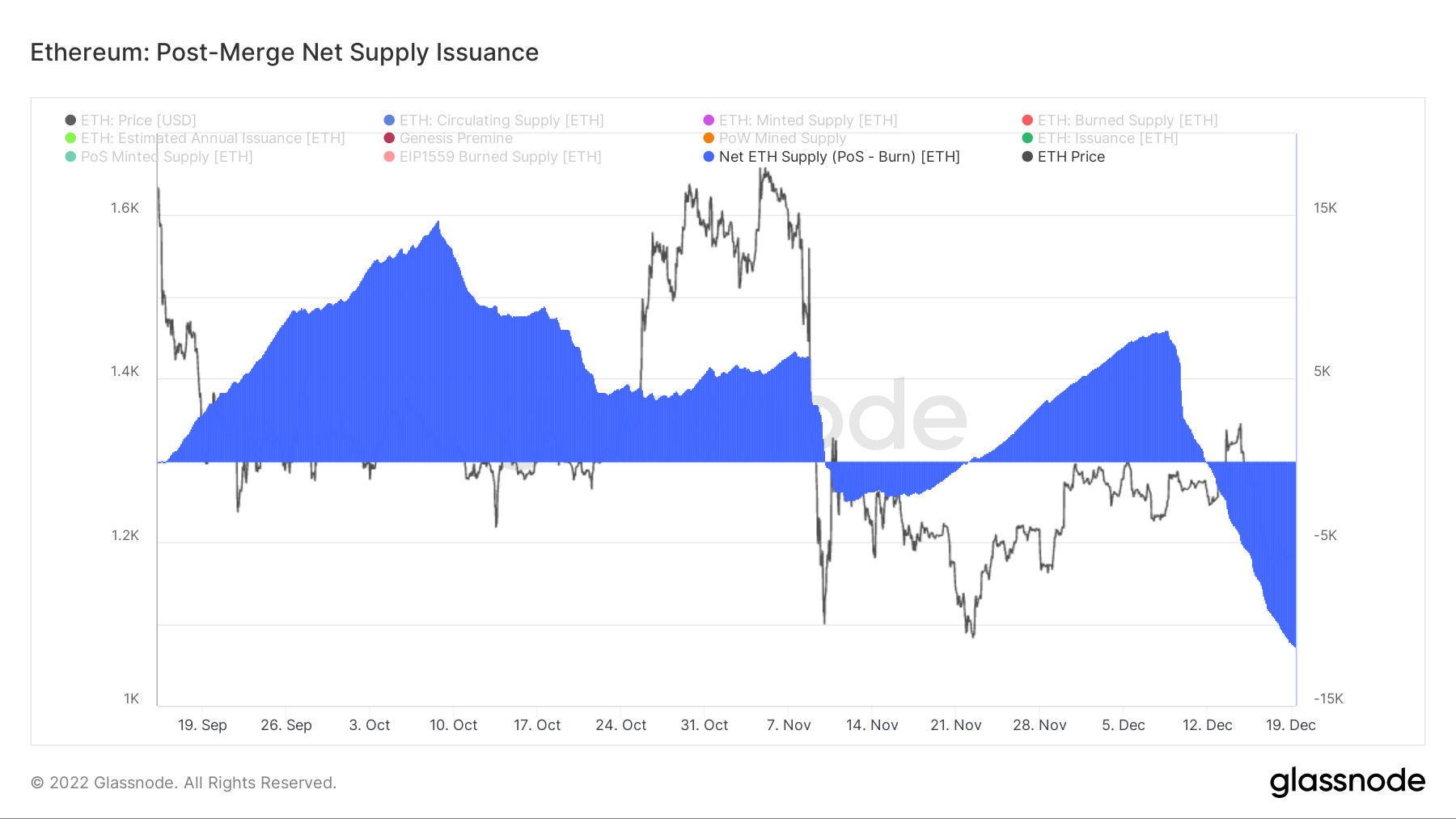
The chart below shows that net supply issuance was inflationary immediately after the Merge until Nov.9, hitting a high of 15,000 tokens in early October.

Following an approximate two-week deflationary stint from Nov. 10, net supply issuance flipped to inflationary once more before returning to a net negative supply issuance from Dec. 12 onwards, sinking to a new low of -11,000 tokens on Dec. 19.

To date, periods of supply inflation exceed supply deflation.
Net Inflation Rate

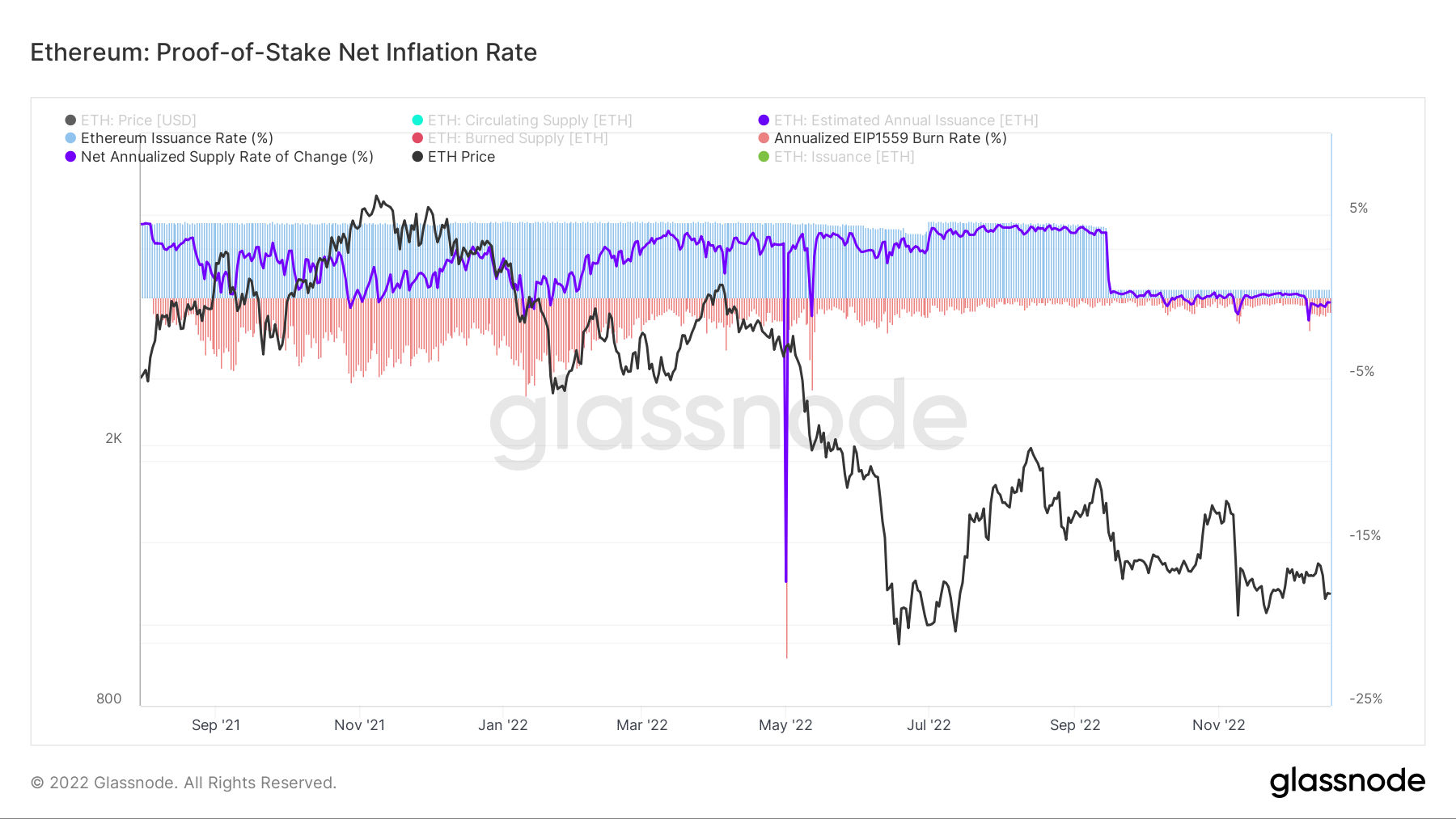
The chart below shows the issuance rate and burn rate dropping post-Merge, with the former metric decreasing significantly after Sept. 15.

Previously, the issuance rate was relatively steady, holding at around 4.1% since October 2021. At the same time, over this period, the burn rate was much more volatile in comparison, peaking at about -5% before declining from August onwards to a rate of 0.35%.

The current issuance rate of 0.5% and burn rate of -0.9% give a net supply change rate of -0.4%.
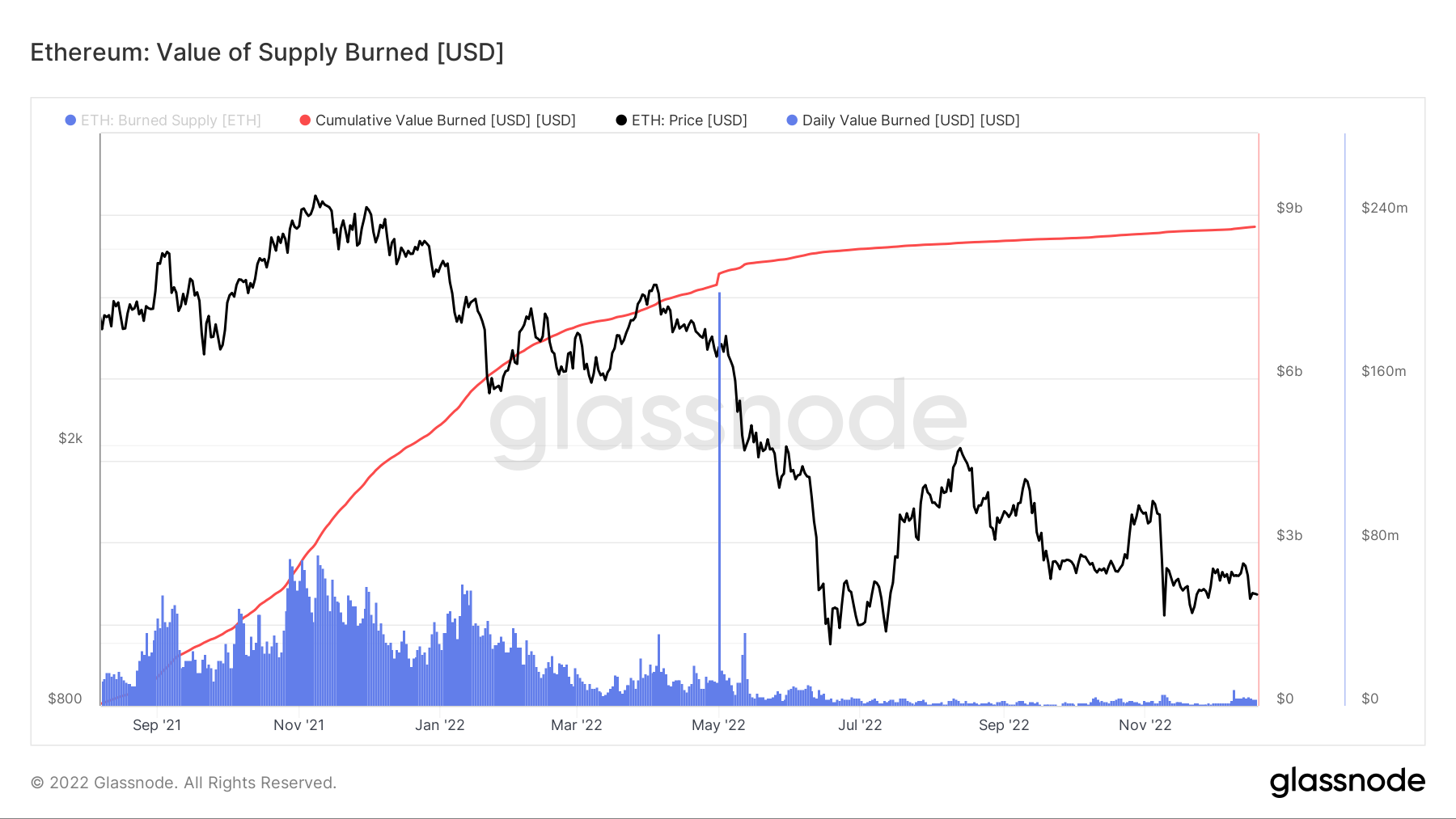
Multiplying the burned base fee by the spot price at the time of burn results in the Value of Supply Burned metric.

Since June 2022, the daily value burned has sunk significantly to approximately $4 million daily. The cumulative sum of all burns to date comes in at just under $9 billion.
Staking metrics

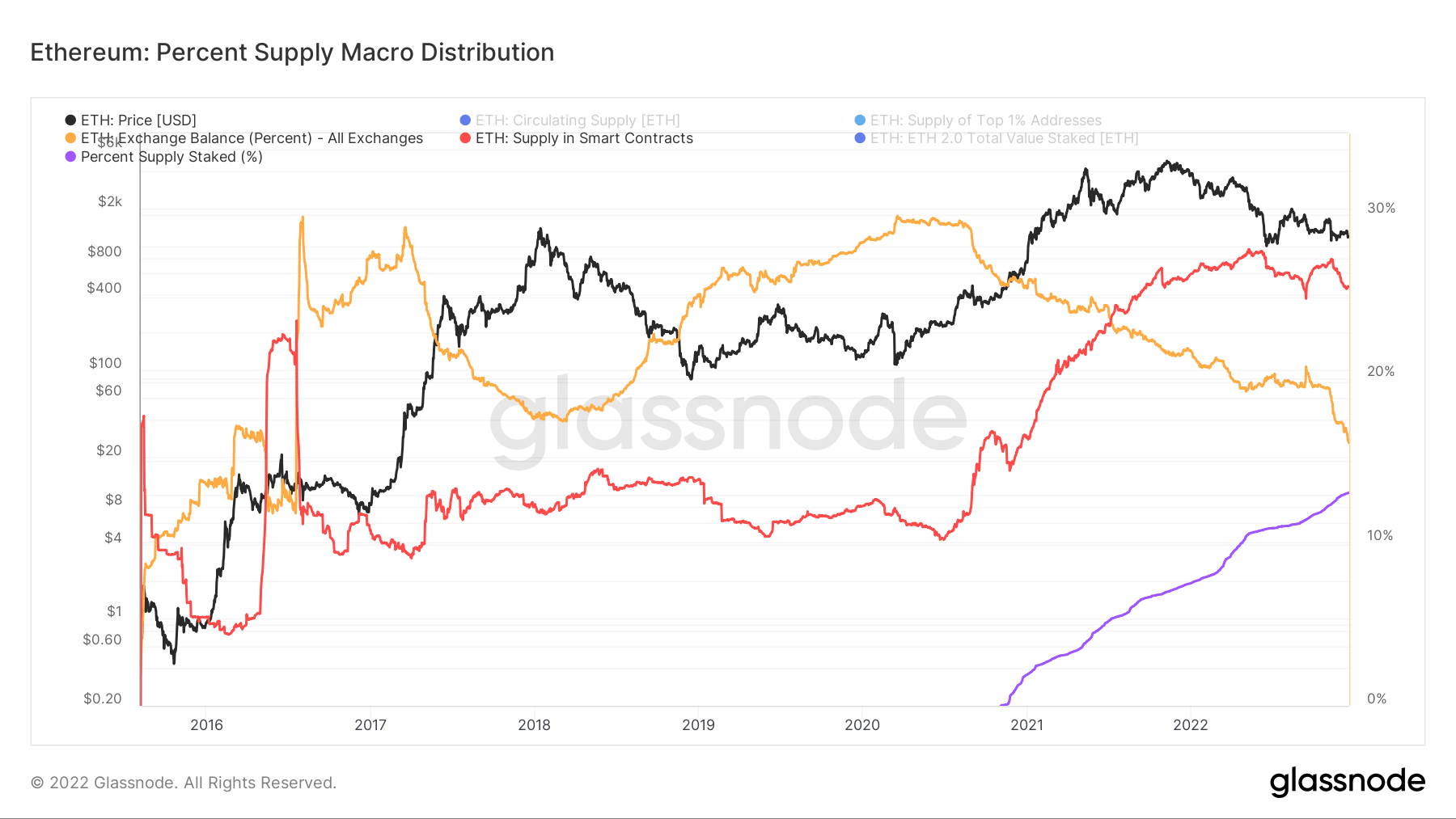
Around 13% of the Ethereum supply is staked. This is significantly less than BNB Chain at 90.2%, Cardano at 71.6%, and Solana at 68.6%.

Currently, staked ETH cannot be unlocked, likely a factor in the relatively low percentage of supply staked versus other large caps. However, once enabled, it is unclear whether this will trigger a mass unstaking of tokens, therefore cutting the issuance of daily ETH staking rewards, or if more tokens will be staked based on being able to move in and out of staking with fewer restrictions.

Since late 2020, the ETH supply on exchanges has fallen from 30% to 16.5%. In contrast, the supply in smart contracts has gone the other way, rising from 15% to 26%—the two cross around mid-2021.
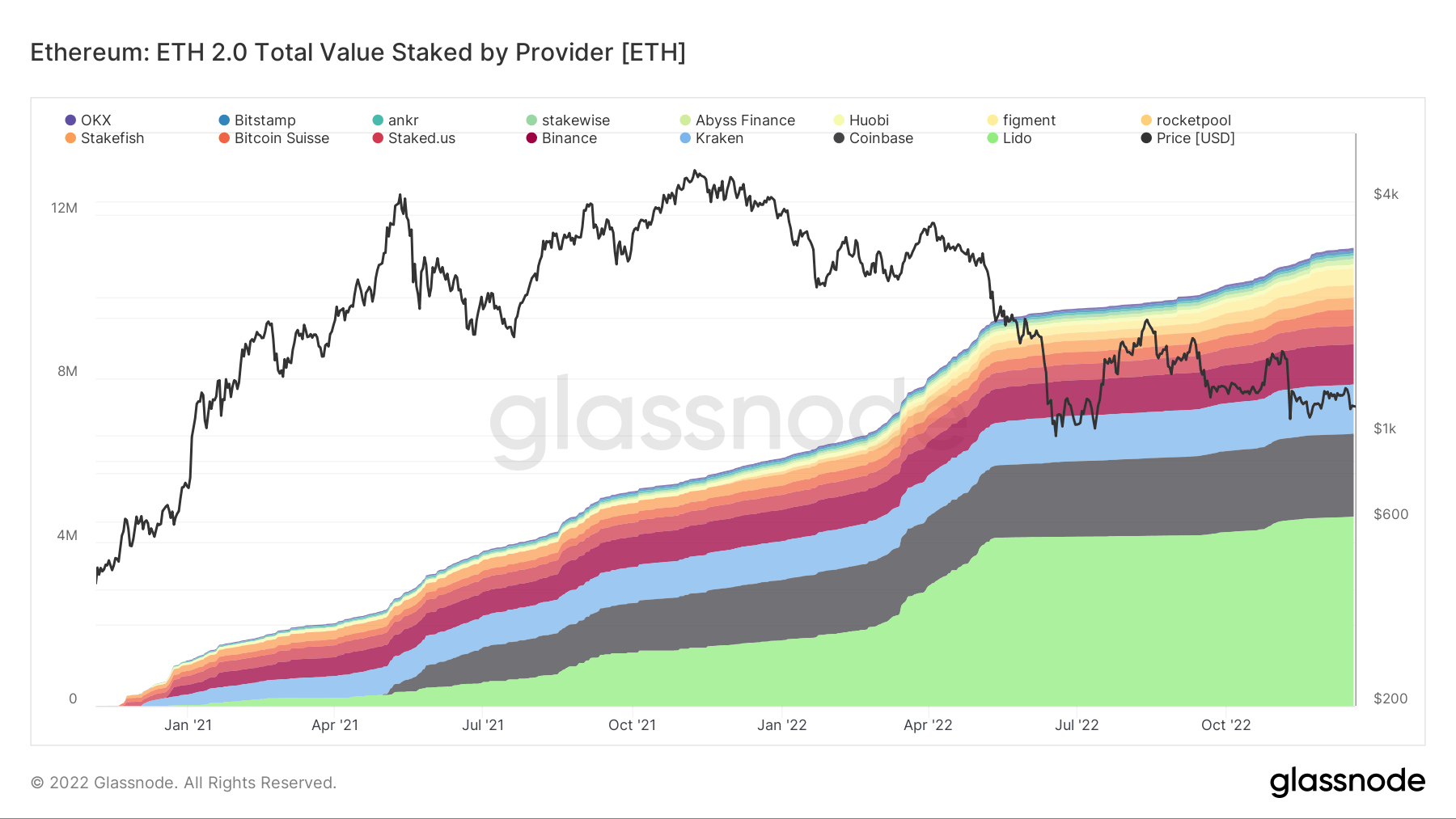
The total number of ETH staked is approaching 12 million. However, the distribution of this is highly concentrated among a few validators as follows:

Lido – 4.6 million

Coinbase -2 million

Kraken – 1.2 million

Binance – 1 million
Trending Cryptos

Related Reads

SemiAnalysis Deep Dive into CXMT: $50 Billion Revenue, An IPO Amidst a Supercycle

SemiAnalysis' in-depth report on ChangXin Memory Technologies (CXMT) details its rapid rise as China's largest upcoming semiconductor IPO. Founded in 2016 by Zhu Yiming, CXMT built its DRAM foundation on acquired patents and talent from the bankrupt German firm Qimonda. It achieved its first annual profit in 2025 after nearly a decade of significant capital support, primarily from patient Hefei municipal investors who fostered a local supply chain. The company is now capitalizing on a strong DRAM supercycle. Its revenue soared from ~$3.3B in 2024 to ~$8.6B in 2025, with Q1 2026 alone reaching ~$7.3B. SemiAnalysis projects full-year 2026 revenue could exceed $50B, driven by soaring ASPs rather than massive market share gains. While CXMT is closing the capacity gap with Micron, its product mix remains heavily focused on commodity DDR/LPDDR, which currently offers higher margins than its nascent HBM business. CXMT faces significant challenges in HBM, struggling with yield and stability for HBM3 8-Hi stacks while lagging behind the big three (Samsung, SK Hynix, Micron) in advanced nodes. However, strategic national priorities for AI self-sufficiency may push it to accelerate HBM capacity. Its complex IPO structure reveals heavy state-backed ownership and voting control over its fabs, with Alibaba appearing as both a key cloud customer and a minority shareholder. The IPO aims to raise ~$4.1B, primarily to strengthen its core DRAM manufacturing base.

marsbit4m ago

SemiAnalysis Deep Dive into CXMT: $50 Billion Revenue, An IPO Amidst a Supercycle

marsbit4m ago

From Corning to Ciena: The 10x Opportunity in the AI Optical Communication Chain

The transition from copper to optical communication in AI data centers is creating significant investment opportunities beyond just chipmakers. The entire photonics supply chain, from glass and fiber to connectors and test equipment, is critical. Corning, a key fiber supplier, has locked in multi-billion dollar, multi-year contracts with major cloud providers (Meta, Amazon, Google, Microsoft, OpenAI, NVIDIA), demonstrating pricing power and scale. Its profit growth is outpacing revenue growth. In the interconnect layer, Amphenol benefits from high growth in AI data centers, driven by strategic acquisitions and operational efficiency, while Credo Technology acts as a bridge between copper and optical solutions, though with high customer concentration risk. At the systems level, Ciena enables higher data capacity on existing fiber lines, with a strong backlog and cloud customer adoption. Further upstream, AXT is a bottleneck supplier of key indium phosphide wafers for lasers but faces geopolitical supply chain risks. VEO Solutions provides essential testing equipment for the entire photonics industry. A new pure-play photonics ETF (FOTO) offers a consolidated investment approach. The core thesis is that the physical limits of copper are driving an inevitable shift to optical technologies, with wealth flowing to essential, often overlooked, suppliers across the photonics value chain.

marsbit16m ago

From Corning to Ciena: The 10x Opportunity in the AI Optical Communication Chain

marsbit16m ago

Collector Crypt's DAU Is Only 800, Yet It's Already One of Crypto's Most Profitable Projects?

"Collector Crypt: A Highly Profitable Crypto Project with Only 800 Daily Active Users?" Collector Crypt (CARDS) is a crypto project tokenizing physical graded trading cards (primarily Pokémon) on Solana, achieving significant real-world profitability and growth. According to a Maelstrom Fund analysis, it generated approximately $53M in annualized profit in May, with a June run-rate nearing $109M, against a $550M FDV. Its core revenue driver is a digital pack-opening 'Gacha' system. The platform bulk-buys cards at a 5-15% discount. Users can open digital packs and choose to keep cards or sell them back to the platform at a 7-15% discount to market price. Most users sell back common cards, creating an efficient model: users get packs with a ~2% positive expected value, while Collector Crypt captures ~4.5% profit. The project aims to disrupt the inefficient $22.2B GMV (Q1 2026) eBay trading card market, which charges sellers 16-20% in total fees. Collector Crypt offers 2% fees, instant settlement, insured custody, and one-click trading. Beyond Gacha, future revenue streams include secondary market trading fees, infrastructure partnerships, and an eBay "snipe" tool. It holds ~$23M in card inventory and ~$10M in cash, and has already begun token buybacks. With a total supply of 2B tokens, effective circulation post-2027 unlocks is estimated at ~1.3B. Trading primarily on DEXs has so far limited large institutional entry. The project is expanding into sports cards and attracting Web2 users. Maelstrom Fund's price target is $4 by summer's end, positioning Collector Crypt at the forefront of migrating collectibles on-chain.

Foresight News28m ago

Collector Crypt's DAU Is Only 800, Yet It's Already One of Crypto's Most Profitable Projects?

Foresight News28m ago

New Chair, Old Inflation, Better-Than-Expected Jobs: How Are Global Assets Repriced After Wash's Debut?

New Fed Chairman Kevin Wash's first FOMC meeting delivered a "hold" decision, keeping rates at 3.50%-3.75%. The key signal was a major shift in communication: the policy statement was shortened, and forward guidance was removed. Wash emphasized the Fed will no longer pre-commit to future actions, instead refocusing markets on economic data itself. The updated "dot plot" revealed a hawkish tilt, with the median forecast for the policy rate rising to 3.8% by year-end, suggesting a potential 25-basis-point hike in 2026. PCE inflation forecasts were also significantly raised. This reflects the Fed's current dilemma: a resilient job market (May nonfarm payrolls beat expectations) coupled with persistent inflation (PCE remains well above 2%) makes rate cuts unlikely and hikes a possibility. Wash inherits a deeply divided committee and a challenging macro environment reminiscent of 1994—strong growth with latent stagflation risks. His primary test is balancing inflation control against economic stability. Markets are repricing assets accordingly. The dollar strengthened on higher rate expectations. Treasury ETFs face pressure from potential hikes but may attract haven flows if growth fears emerge. Gold's role is more as a hedge amid conflicting forces. AI infrastructure stocks face valuation compression from higher rates, but the sector's fundamental demand logic remains intact if cloud CapEx holds. Defense stocks offer some resilience due to long-term government contracts. Looking ahead, key data points will drive market moves: the June nonfarm payrolls (July 2) and CPI (mid-July) will be critical for setting the tone of the July FOMC meeting (July 28-29), where Wash may face his first real policy decision. Political pressure from the White House for rate cuts will also be a persistent theme testing Fed independence.

marsbit41m ago

New Chair, Old Inflation, Better-Than-Expected Jobs: How Are Global Assets Repriced After Wash's Debut?

marsbit41m ago

Trading

Spot
Futures

Hot Articles

Discussions

Welcome to the HTX Community. Here, you can stay informed about the latest platform developments and gain access to professional market insights. Users' opinions on the price of ETH (ETH) are presented below.

活动图片