Last week, new Federal Reserve Chair Kevin Wash delivered his first monetary policy report card after taking office.
The Federal Open Market Committee decided to keep the target range for the federal funds rate unchanged at 3.50%-3.75%. All 12 voting members were in favor, with no dissenting votes (Extended Reading: "On the Eve of Wash's Debut: More Important Than a Rate Cut, How Will the Fed Reshape Expectations?"). It was a rather uneventful decision to "stand pat."
However, at the same time, this policy statement was compressed into three paragraphs and about a hundred words, significantly shorter than those of previous meetings. Phrases previously used to describe risk balance, future policy adjustments, and data dependence were directly deleted, and the "forward guidance" the market had grown accustomed to over many years also disappeared.
Wash explicitly stated at the press conference that the new statement is "shorter, simpler, and removes some of the old language." In his view, having lived through the most intense phase of the 2008 financial crisis, the current environment is changing too rapidly. The Fed should not promise too early what it will do in the future; instead, it should refocus the market's attention on the economic data itself.
This is perhaps the real signal released by the June FOMC meeting: the Fed under Wash's leadership is no longer trying to reduce uncertainty for the market but is preparing to hand some of that uncertainty back to the market.
A new communication framework has begun.
I. The Rate Stayed the Same, But the Fed's Policy Language Changed
For many investors, Wash is still a relatively unfamiliar name.
But he is not a newcomer to the Fed. From 2006 to 2011, Wash served as a Fed Governor, personally experiencing the 2008 financial crisis and the subsequent quantitative easing process. After leaving the Fed, he has long criticized the excessive expansion of central bank balance sheets, the proliferation of forward guidance, and the excessive intervention of monetary policy in financial markets.
Therefore, compared to reducing market volatility through repeated policy hints, Wash believes more in price signals and emphasizes monetary discipline more. His core idea can be summarized as "the central bank should make its objectives clear, but it doesn't need to tell the market every step of its operations in advance."
This thinking has been fully embodied in his first FOMC meeting.
Besides eliminating forward guidance, Wash also refused to submit his own interest rate path in this round of economic projections. He believes the current version of the dot plot is easily misunderstood by the market as a policy commitment, but in reality, each dot is only a conditional forecast made by officials based on the information available at that time.
He even described officials submitting their forecasts as if they were using "a big pencil with a large eraser"—once data changes, the forecast can be erased and rewritten at any time.
However, even though Wash tried to downplay the importance of the dot plot, the market still saw a very clear shift from it. Among the 18 participants who submitted forecasts this time, 9 expected at least one rate hike before the end of 2026, 8 expected rates to remain unchanged, and only 1 expected a rate cut.
More notably, among the 9 expecting hikes, 3 expected one hike, 5 expected two hikes, and 1 expected three hikes. The median policy rate at year-end also rose from the 3.4% predicted in March to 3.8%. This means that under the median scenario, the Fed will not only not cut rates this year but might actually raise them by 25 basis points.
Meanwhile, the Fed significantly raised its 2026 PCE inflation forecast from 2.7% in March to 3.6%, and the core PCE forecast from 2.7% to 3.3%.
In other words, the message from the June meeting is not complicated: the economy isn't weak enough to need rescue, but inflation is already strong enough that discussion of rate cuts must stop. This is also why the much-anticipated "Wash cut trade" quickly faded after his debut.
Additionally, when Trump nominated Wash, the market widely speculated that the new Chair might be more willing to cut rates than his predecessor. However, during the hearings, Wash made it clear that the President had never asked him to pre-commit to any interest rate decisions, and even if such a request were made, he would not accept it.
It seems now that Wash is not in a hurry to prove whether he is a hawk or a dove. First and foremost, he wants to prove that the Fed still has the ability to say no to inflation.
II. What Kind of "Hot Potato" Has Wash Inherited?
Objectively speaking, Wash's first major challenge is still inflation.
U.S. headline PCE rose 3.8% year-over-year in April, and core PCE rose 3.3% year-over-year, still a significant distance from the Fed's long-term 2% target.
What's more troublesome is that the current inflation doesn't stem entirely from a single factor.
On one hand, energy prices and geopolitical tensions continue to affect upstream costs; on the other hand, supply chains, tariffs, and service prices are still generating broader transmission pressures. Once energy price increases further spread to transportation, manufacturing, and household consumption, what the Fed will need to handle is no longer just a short-term shock, but the risk of inflation expectations re-emerging.
At the same time, the job market is much stronger than the market previously anticipated. The U.S. May jobs report released on June 5th showed non-farm payrolls increased by 172,000, about twice market expectations; the unemployment rate remained at 4.3%.
Under normal circumstances, this is data worth welcoming. But in the current environment, "good economic news" has been translated by the market into "bad monetary policy news." On the day the jobs data was released, the Nasdaq Composite Index fell 4.18%, its largest single-day drop in over a year. Semiconductor and high-valuation technology stocks were hit hardest, while bond yields rose significantly.
Trump subsequently posted on Truth Social, writing in bewilderment: "With such a good jobs report, stocks should go up, not down. It's been that way for the past 200 years."
This precisely reveals the most contradictory aspect of the current market. What Wash has inherited is not an economy on its last legs like during the pandemic, one in desperate need of central bank rescue and unlimited easing to stay alive, but rather an economy with a robust pulse on the surface, akin to 1994, yet carrying the hidden danger of stagflation, one that could lose momentum at any moment due to a single monetary policy misstep.
Now, raising rates risks stifling the recovery; cutting rates risks an inflation resurgence. This is precisely his most difficult situation.
This is also why what Wash truly faces is not a binary choice of "hike or cut," but a test of precise policy timing.
It's worth noting that in April this year, the Fed saw four dissenting votes, the first large-scale internal dissent since 1992, and this split did not appear suddenly. Over the past two years, cracks within the Fed have long been accumulating: Doves believe the job market has already cooled and rate cuts should be initiated soon to prevent a hard landing; Hawks insist that inflation is not truly tamed and cutting rates would only undo all the progress.
The unexpected 50-basis-point sharp rate cut in September 2024 sparked fierce internal debate. Then-Governor Michelle Bowman cast a dissenting vote, becoming the first Fed Governor in nearly two decades to publicly oppose the Chair on a rate decision. Trump appointing new members and pressuring Fed independence has made this political dimension seep into monetary policy discussions at a visible pace.
Therefore, Wash has taken over a team deeply divided on policy direction. Now the chair has a new occupant, but those accumulated divisions have not dissipated with the change. Wash hasn't just taken over a position; he's taken over a powder keg that could explode at any public meeting.
Building internal consensus itself is Wash's first test.
III. How Are Global Assets Being Repriced?
For the market, the hawkish tone of this FOMC has become a bellwether for stocks.
First and foremost are the dollar and U.S. Treasuries, the most direct rate trades.
Translated to the asset level, the logic for the dollar-bullish ETF UUP.M is relatively straightforward. After all, the higher the market's expectations for the policy rate, the greater the interest rate advantage of U.S. assets compared to other currency-denominated assets typically becomes. Therefore, the dollar index rose about 0.5% after the June FOMC, a result of the market repricing for a potential rate hike.
The environment for the intermediate-term Treasury ETF IEF.M is more complex. As is well known, bond prices move inversely to yields. So if inflation forecasts continue to be revised upward and the market further bets on rate hikes, intermediate-term Treasury yields may remain high, putting pressure on IEF.M.
But this doesn't mean U.S. Treasuries only have a one-way downside logic. If employment or consumption data suddenly weakens, reigniting recession fears, safe-haven funds could quickly flow back into Treasuries. Therefore, what affects U.S. Treasuries is not just whether the Fed will hike next, but also how the market judges the growth outlook after any hike.
Gold ETFs like GLD.M and IAU.M are relatively tricky assets to position currently. High real rates theoretically suppress gold, but geopolitical risks in the Middle East and ongoing gold purchases by global central banks provide another source of support. Therefore, when these two forces pull against each other, gold is better understood as a hedge rather than an offensive allocation.
Silver ETFs SLV.M and SIVR.M have an additional industrial logic compared to gold. The demand pull from AI infrastructure on power infrastructure and industrial metals gives silver independent demand support beyond its monetary properties. This provides it with an extra layer of cushion under the same macro pressures compared to gold.
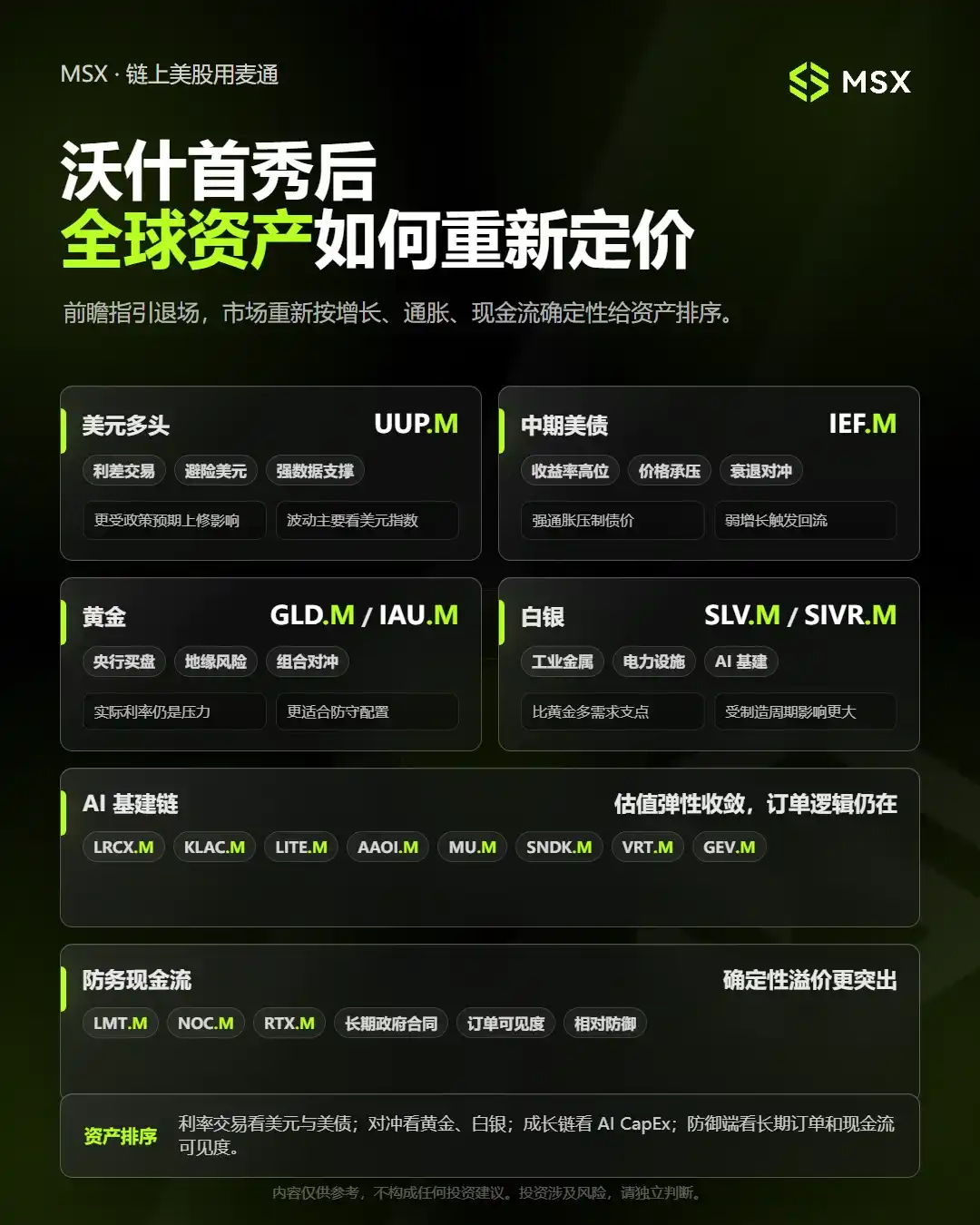
As for the impact of high rates on the AI infrastructure theme, it operates on two levels; one cannot simply say, "If rates rise, AI infrastructure is finished":
- First is valuation pressure: Stocks like semiconductor equipment makers LRCX.M and KLAC.M, optical communication stocks like LITE.M and AAOI.M, memory stocks like MU.M and SNDK.M, and power infrastructure stocks like VRT.M and GEV.M. These companies' valuations are built on revenues expected to materialize over the coming years. The higher the interest rate, the higher the discount rate, and the lower the present value of future cash flows.
- The second layer is capital expenditure risk: Cloud providers' AI CapEx is the lifeblood of the entire chain. In a high-rate environment with rising financing costs, might cloud providers shrink their budgets? Currently, it appears that Microsoft, Google, and Amazon's CapEx are still expanding; the demand-side logic hasn't changed due to rate hikes. Furthermore, rates pressure valuations; the number of orders hasn't decreased. As long as cloud provider CapEx shows no contraction, the industrial logic for AI infrastructure still holds, it's just that the space for valuation expansion is compressed. Reviewing Google's performance in Q1 2026 can lead to this conclusion.
The defense sector also possesses certain defensive attributes.
Companies like LMT.M, NOC.M, and RTX.M derive their revenue mainly from long-term government contracts, with order and cash flow visibility typically higher than that of high-valuation growth stocks. During periods of high interest rates and market preference for certain cash flows, defense assets may gain a relative advantage.
However, this doesn't mean defense stocks are completely immune to interest rates. Rising yields can still pressure their valuations. What truly provides support is the policy certainty of defense budgets and long-term orders, not absolute immunity to interest rate risk.
IV. Looking Ahead, What Should the Market Really Watch?
Wash's first FOMC has given a preliminary answer: the Fed is not prepared to continue planning every step of the policy path for the market; future volatility will be more driven by the data itself.
But this is still just the beginning. Over the next few months, several key nodes are worth investors' continued attention.
First is the June Non-Farm Payrolls on July 2nd. This is the first full-month employment report under Wash's tenure and the most important labor market signal he will receive before the July meeting. If employment remains strong, the window for rate cuts closes further, and the discussion of hikes will shift from expectation to reality. If the data weakens significantly, the market's expectations for the monetary policy path will loosen again, at which point the logic for cuts will have space for repricing.
Therefore, this single data point will likely directly determine the tone of the July meeting.
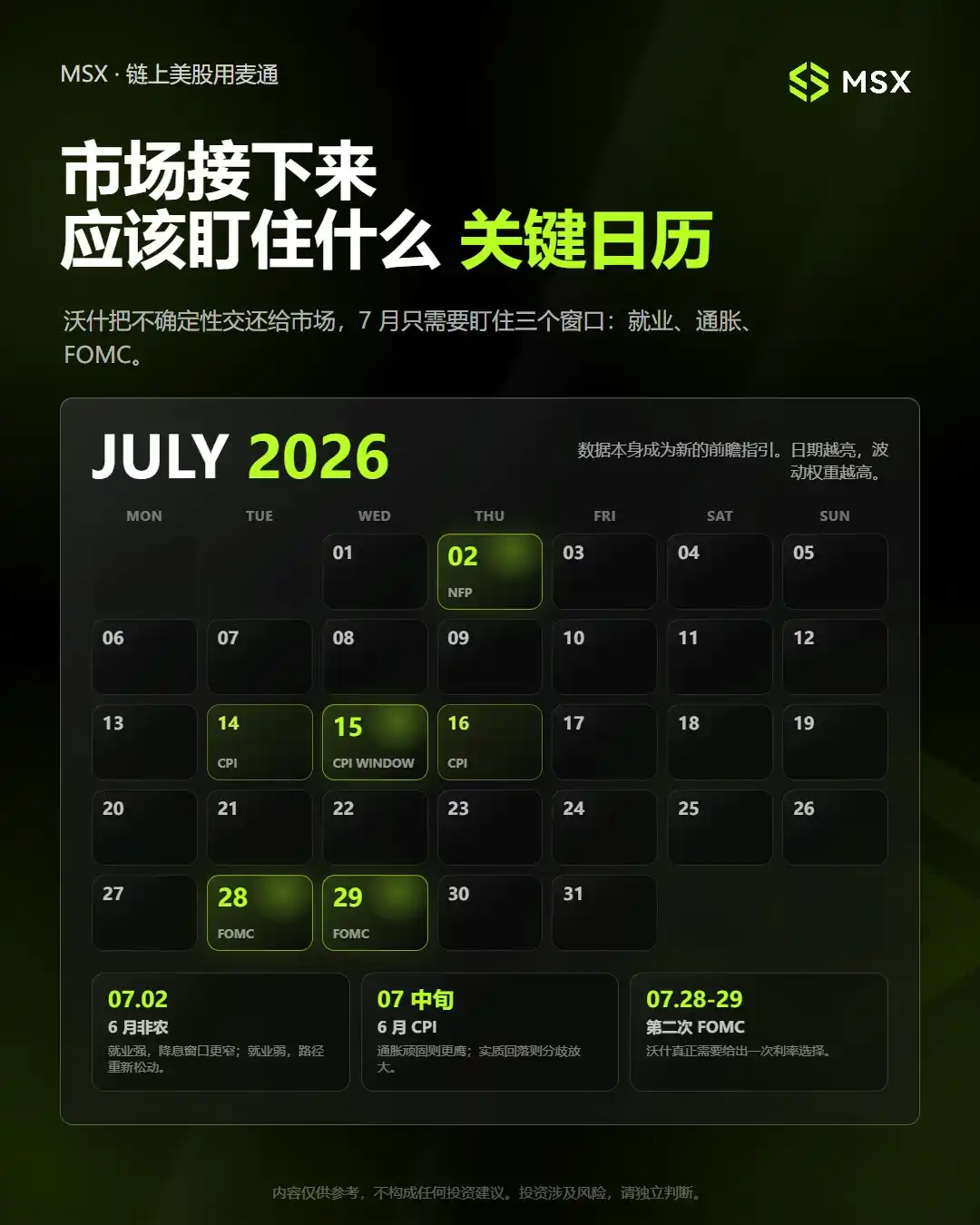
Next is the June CPI in mid-July, the most unignorable data point between two FOMC meetings. Wash made it very clear at the press conference: price stability is the current primary objective. If CPI remains stubborn, his stance at the July meeting will only be more hawkish. If inflation shows substantial easing, the market will diverge in its judgment of his next move. Regardless of the outcome, this data will trigger significant volatility on its release day.
Finally, the second FOMC meeting on July 28-29 might be the first true rate decision belonging to Wash. For the July meeting, with the accumulated data from Non-Farm Payrolls and CPI, he will need to make a real policy choice. By then, the market's understanding of his judgment will be clearer, and the outline of the direction will be more complete.
Of course, the midterm elections in the second half of the year are undoubtedly a variable on a longer time dimension. As the election approaches, the tension between the White House and the Fed is destined to intensify again. Trump's desire for rate cuts will not disappear, and Wash's statement at the hearings, "I won't promise that," will be tested repeatedly every time political pressure heats up.
The proposition of monetary policy independence will continue to be background noise for the market throughout the second half of the year.