从宏观环境到链上指标,比特币到底何时见底?

比推Published on 2022-12-02Last updated on 2022-12-02

Abstract

比特币底部在哪儿?这是市场目前非常关注的话题。

比特币底部在哪儿?这是市场目前非常关注的话题。有人认为,FTX引起的市场去杠杆化仍将继续一段时间,比特币的底部还需要进一步确认;也有投资者认为利空出尽,底部已至。在目前具有趋势性逆转的关键节点,本文将从加密市场周期、链上数据、矿机指标、情绪指标以及宏观市场等五个维度,探讨市场将要发生的趋势性变化。

核心要点

1. 传统金融机构认为,本轮熊市机构投资者占据主导地位,使用的杠杆也相对较大,整体上加密市场的去杠杆化仍将持续一段时间,传统资金也需要更长时间进行评估。

2. 美联储主席鲍威尔表示12月开始放缓加息步伐,这意味着宏观市场开始出现趋势性转折;比特币与美股的关联度也再度表现得较为紧密,联动效应增强。

3. 从比特币减半周期上看,按照过往数据计算推测可得,比特币的价格将在 2022 年 12 月 30 日见底,随后反弹预计持续到2024 年初;然后会在实际减半后出现强劲反弹。

4. 从链上数据上看,比特币确实进入到底部区间,从历史数据观察,比特币是否会进行二次探底仍然具有不确定性,但整体确实处于底部区间。下方可能的潜在低点在13000美元附近。

5. 从矿工的角度看,比特币在16000美元附近的支撑要强于2万美元,这主要在于这是比特币主流矿机的关机价;比特币将在12月5日迎来2022年挖矿难度最大下调,这也意味着矿工已经出现大面积关机,也是市场见底的一个重要信号。

6. 市场目前对于机构破产等恐慌事件表现出麻木之态,比特币价格也并未出现非常大的波动。从技术分析上看,比特币空头力量仍然相对较大,不过目前有筑底迹象,还需等待MA65等均线验证底部。
以史为鉴,周期为王

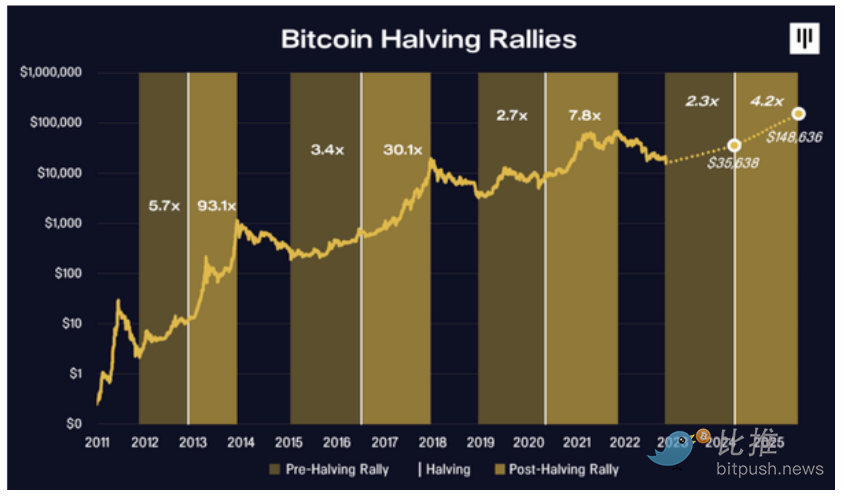
在比特币诞生以来,BTC挖矿奖励每四年减半一次,比特币的趋势行情也因此经历牛熊周期。比特币的四年减半,实质上符合短期经济周期,也即基钦周期。从周期的角度看,比特币预计在12月30日见底。

比特币历史上曾在减半前 477 天触底,然后一路攀升,之后又开始上涨。减半后的反弹平均持续 480天,从减半到下一个牛市周期的顶峰。如果历史重演,比特币的价格将在 2022 年 12 月 30 日见底,随后反弹预计持续到2024 年初;然后会在实际减半后出现强劲反弹。下一次减半预计发生在 2024 年 4 月 20 日;如果历史重演,那么在下一个减半之前比特币将涨到 3.6 万美元,之后涨到 14.9 万美元。下面的图表显示了比特币重复减半轨迹可能出现的趋势变化。
数据不会骗人,链上指标释放了哪些信号

比特币减半周期虽然重复在历史中上演,但是这种依托历史规律的预测也还是缺乏有力支撑。相比之下,链上数据对于底部的预测则更为有力和直观。本文下面就几个重要的链上数据进行整理和归纳。

1.@0xCryptoChan在推特上发文表示:当前BTC价格已触底CVDD。CVDD是BTC币天销毁(Coin Days Destroyed)的累计美元价值与BTC市场年龄(以天计)之比,该指标历史上对大底的捕捉十分准确。(批注:从图表上看,比特币已经接近底部,从上轮牛市底部看,比特币还有一次回踩,不过这不一定发生,因为图表显示的2015年熊市底部就只有一次触底迹象,但触底之后也出现了一次较大回撤)
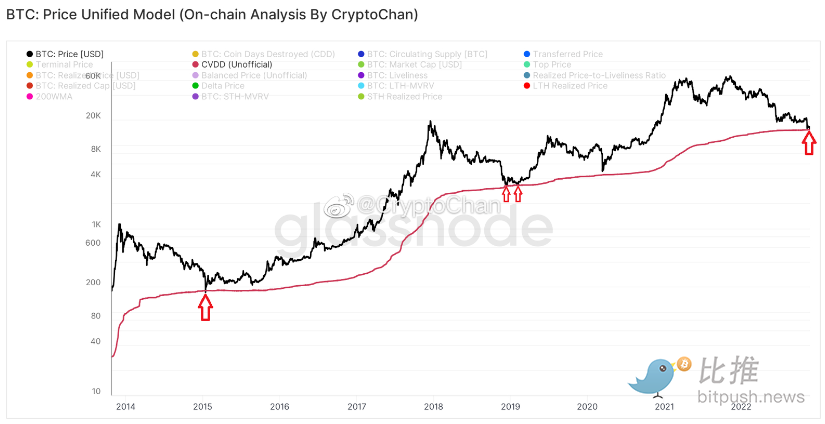
CryptoChan同时也列出了Realized Hodl Ratio图表,认为两次比特币低点位置意味着双底结构的形成。

2. Willy Woo也引用了CVDD 指标,本文不在赘述;不过, Willy Woo还观察了另外两个链上指标,其分别是:Max Pain和MVRV。Willy Woo认为,比特币在Max Pain模型下接近底部。从历史上看,当58%-61%的代币处于水下(橙色)时,BTC价格则达到宏观周期底部。绿色阴影根据锁定在GBTC Trust中的代币进行调整。Willy Woo随后在回复中表示,这一模型暗示的潜在底部在13000美元,但并不是每一次都会触碰底部,不过目前确实接近底部。

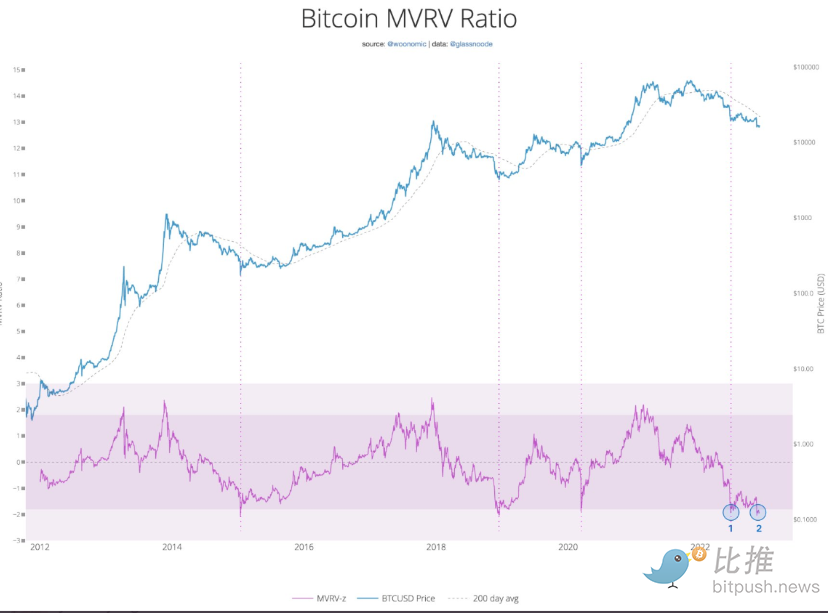
他同时认为,MVRV 比率位于价值区域的深处。在这个信号下,我们已经触底(1) ,直到最近的 FTX 崩盘将我们带回买入区域(2)。注:MVRV 是由@dpuellARK 和 @MustStopMurad,这一指标跟踪比特币的市值与投入网络的资本之间的比率。
春江水暖鸭先知,BTC矿机指标值得重视

从比特币历史周期经验看,主流矿机的关机价是一个很好的见底指标。据F2pool在11月10日数据显示,随着比特币跌至约16,000美元位置,按照0.06美元/度电费并基于当前挖矿难度计算,包括蚂蚁S17全系列、犀鸟H8 Pro、蜂鸟H9 Pro在内的绝大部分矿机已到达关机币价。最高算力矿机蚂蚁S19 XP Hyd. 单一矿机日净收益为6.5美元(关机币价8742.82美元),其他型号单一矿机日净收益均不足4美元。可以说,正是由于16000美元大概是主流矿机的一个关机价,所以这个位置的支撑才会如此之强,甚至超过两万美元这个重要的心理支撑位。

据《比推》11月29日报道, 比特币网络预计将在12月5日迎来难度调整,分析显示本次难度调整幅度可能会降低6.13-10%,预计将超过7月21日创下的5.01%降幅,成为2022年内最大降幅。行业分析师Charles Edwards在社交媒体透露,比特币哈希带刚刚形成一个死亡交叉,这意味着市场正在进入矿工投降期,随着越来越多的矿工关机,比特币网络算力近期呈现下跌趋势,上周末一度下滑至200 EH/s低点。这意味已经有很多矿机关机,比特币价格目前处于一个较为合理的估值。

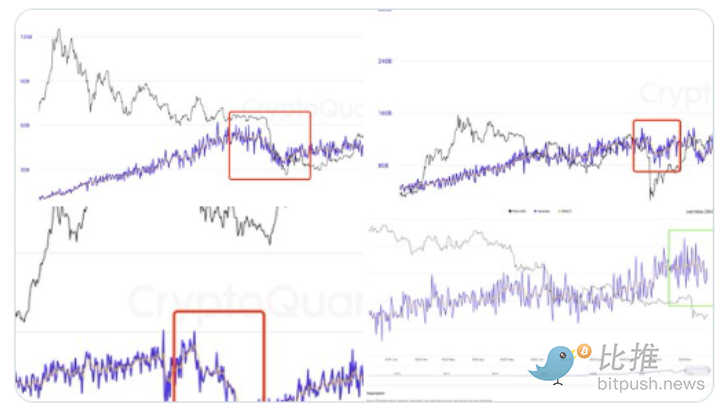
不过有推特用户认为,目前比特币算力并没有跌到位。推特用户@0xcryptowizard认为,以算力看目前矿工的状态:18年熊底,60b到30b,腰斩;2020年312事件时,136b到75b,腰斩;2021年519事件时,200b到57b,腰斩再腰斩;现在,高点315b,低点224b,降了30%。

本文认为@0xcryptowizard的统计没有周期性可言,2020年3月21日,是由于新冠疫情影响,全球金融出现大崩盘;2021年5月19日,是由于中国彻底清退比特币挖矿,国内算力被彻底清退,随着国内算力迁移国外,这个算力水平大抵要高出不少。目前比特币的接受程度要比2018年好很多,很多国外矿企也积极布局,整体上看,比特币算力或许还有进一步下跌空间,但应该并不大。(注:下图为推特用户@0xcryptowizard所说的四次算力大跌示意图。)
市场情绪指标“躺平”,技术指标显示仍需等待

近期,受FTX暴雷影响,大量交易所遭遇挤兑危机,比如,Genesis、BlockFi等,市场恐慌情绪一度非常严重,市场甚至担心DCG可能暴雷。不过,从BTC币价表现看,比特币跌幅相对有限,市场对于交易所破产事件显现出“躺平”之势。由于FTX暴雷,WBTC/BTC 兑换比例小幅低于 1 ,在各种不利的外部条件下,FUD 进一步传播到 WETH,各路大 V 甚至开起玩笑,但加密市场整体也没有出现大的波动。从贪婪与恐慌指标看,FTX暴雷后,市场恐慌情绪明显上升,恐慌与贪婪指数出现连续下跌,虽然后市连锁反应不断,但市场情绪对于后续恐慌基本“躺平”,目前已有走出底部迹象。

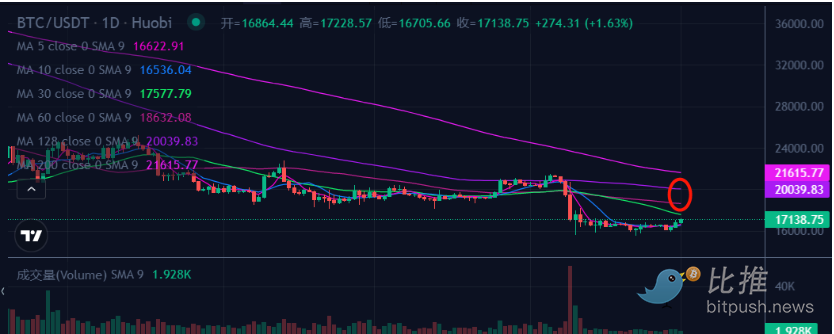
从技术分析的角度看,MA65是比特币行情趋势中非常重要的中期指标,MA128是非常重要的中长期趋势指标。从图中可以看出,目前MA65和MA128仍然还在比特币上方,尚需一段时间下移,这意味比特币还需一段时间消化抛压盘,只有当比特币有效站稳MA65,这时才是较为确认的底部。
宏观环境出现逆转迹象,比特币与美股联动效应增加

我们之前在《FTX暴雷后的“群雄博弈”,加密市场何时为底》一文曾提出一个很重要的观点:从目前加密市场环境看,加密市场内在脆弱性和宏观环境成为加密市场的主要影响力量,而这两种力量将随着时间而出现交替变化;伴随加密市场自身问题的不断爆发,宏观市场转暖对加密市场的影响力逐渐凸显。从目前的行情看,比特币与美股联动再度表现得较为密切。

由 Jan Hatzius 领导的高盛分析团队认为,美联储预计12 月再次加息 50 个基点,随后在 2023 年加息一次,然后将利率维持在 4.25% 至 4.50% 的范围内,直到 2024 年。随后,预计美联储将在2024 年降息一次。分析师在报告中写道:”我们看到了改变计划的几个原因,股市努力摆脱美联储金融紧缩政策下的压力,劳动力市场的强劲减少了现阶段对过度紧缩的担忧,美联储官员现在似乎希望在扭转过热方面取得更快、更一致的进展,部分官员可能已经重新评估了短期中性利率。”

据《比推》11月30日报道,鲍威尔在布鲁金斯学会(Brookings Institution)就劳动力市场和经济形势发表讲话时表示:“美联储可能会从12月开始放缓加息步伐;尽管抗击通胀的进展在很大程度上是不够的,但未来可能会小幅加息。” 美联储的这一表态使得宏观环境有放松迹象,美股大幅反弹,比特币也出现较大涨幅。从某种意义上看,宏观环境已经开始出现非常大的逆转,这也为比特币见底奠定了有利的宏观环境。

市场到底没有,各路大V怎么看

本文筛选了一些主要传统金融机构对于加密市场的看法,并试图探讨比特币可能的底部。

摩根士丹利 (MS) 周三在一份研究报告中表示,传统金融客户对受监管产品的需求有所增加,市场正在重新评估所有发行的项目代币价值,以及它们是否已被用作杠杆资产,加密行业预计将进一步破产和去杠杆化。加密货币市场在这个周期中的杠杆比上一个周期更大。这可能是因为做市商、公司和投资者等加密货币机构是这次市场的主要交易者,而在2017-18年散户占主导地位。

摩根大通策略分析师团队表示,FTX的危机将使加密市场面临数周的去杠杆化,这段动荡时期可能将比特币推低至13,000美元。鉴于交易所、FTX姊妹交易公司Alameda Research和加密生态系统的其他部分之间的相互作用,“一连串的追加保证金通知”可能正在进行中。

BitMEX创始人Arthur Hayes此前发文表示,虽然我非常看好 2023 年加密货币的前景,但我相信我们的市场行情会创新低,因为每个人都想知道下一个因向 FTX / Alameda 放贷而破产的大机构是谁。准备好迎接更长时间的低潮吧,因为它就要来了。


Trending Cryptos

Related Reads

After Tokenized U.S. Treasury Bonds, Tokenized Stocks Are Becoming the New Battleground for RWA

**Tokenized Stocks Emerge as the New RWA Battleground** Following the initial surge of tokenized U.S. Treasuries, the tokenized stock market is rapidly expanding in both scale and quality. Unlike the currently stagnating treasury tokenization market, tokenized stock offerings are seeing significant growth and attracting major players from traditional finance, fintech, crypto exchanges, and native Web3 platforms. The U.S. SEC has outlined a framework for tokenized securities, which applies to stocks: **Issuer-Sponsored Tokenized Securities** (direct tokenization by the issuer, inheriting all shareholder rights but with strict compliance, e.g., Securitize); **Custodial Tokenized Securities** (tokenization of custodied interests, e.g., DTCC, Ondo's recent IVV/MU tokens); **Linked Securities** (tokenized debt notes backed by the stock, offering price exposure and greater on-chain utility, e.g., Ondo, xStocks, Robinhood's new Stock Tokens); and **Security-Based Swaps** (tokenized derivatives contracts, e.g., Robinhood's earlier Classic Stock Tokens). Key platforms are pursuing different strategies: * **Securitize** leads with an issuer-sponsored model, ensuring full rights but limiting on-chain interactions via its compliance-enforcing DS Protocol. * **Ondo** and **xStocks** use the linked security structure for broad accessibility on CEXs and DeFi, though this fragments liquidity and excludes U.S. users. * **Robinhood** recently launched linked security-based Stock Tokens, leveraging its user base and new Robinhood Chain. * Traditional infrastructure giants like **DTCC**, the **NYSE**, and **Nasdaq** are actively developing pilots and platforms for tokenized settlement and trading. * **Coinbase** has announced plans for tokenized stocks, likely using a structure that offers on-chain utility while excluding U.S. customers. Despite different approaches, all players are converging on tokenized stocks as the next major catalyst for the RWA sector. The evolving regulatory landscape and market adoption will shape this competitive new battlefield.

marsbit24m ago

After Tokenized U.S. Treasury Bonds, Tokenized Stocks Are Becoming the New Battleground for RWA

marsbit24m ago

Nvidia Faces Collective Selling by Funds: What Are Private Equity Firms Sniffing Out?

Several prominent Chinese private equity funds, including Gaoyi Asset and Dantoo's Orient Harbor, made significant portfolio adjustments in Q2 2024, as revealed in their latest SEC 13F filings. The most notable move was a collective retreat from AI chip leader NVIDIA, with Gaoyi reducing its stake by over 70%, Jilin Asset selling out completely, and Orient Harbor trimming its holdings. This shift does not signal a loss of faith in the AI trend, but rather a change in investment focus from "expectation-driven" to "realization-driven" valuation. Capital is flowing from crowded, high-valuation names towards segments with clearer profitability visibility and better risk-reward profiles. The funds' new major conviction is Taiwan Semiconductor Manufacturing Company (TSMC), which Gaoyi built into its top holding. The thesis centers on TSMC's role as a critical bottleneck in the AI supply chain due to its dominance in advanced semiconductor manufacturing and, crucially, advanced CoWoS packaging capacity. As demand for AI chips explodes, TSMC's "must-pass" foundry services grant it significant pricing power, suggesting a potential migration of profits from chip designers to manufacturers. Simultaneously, both Gaoyi and Orient Harbor substantially increased positions in memory chip companies like Micron and SanDisk. The investment logic here is twofold: a cyclical recovery in the memory market combined with a new, structural growth driver from AI. High Bandwidth Memory (HBM), essential for AI processor performance, is supply-constrained and its production diverts capacity from standard DRAM and NAND, creating a broad-based pricing tailwind for the memory sector. The collective reduction in NVIDIA reflects a view that its massive prior gains have compressed its future upside potential ("lowered赔率"). The market now demands flawless execution and faces new risks like rising costs from TSMC and HBM suppliers, as well as competition from cloud companies' custom chips. The funds' reallocation highlights a broader thematic: as the AI boom matures, investment opportunities and excess profits are shifting along the supply chain—from design to the physical constraints of manufacturing and memory. The next phase of AI investing may be defined by pricing power derived from tangible bottlenecks like advanced packaging and HBM capacity.

marsbit56m ago

Nvidia Faces Collective Selling by Funds: What Are Private Equity Firms Sniffing Out?

marsbit56m ago

Reverse Turing Test: This 'Pure Handcrafted Large Model' Is Driving Netizens Crazy

An art project called ChatTJB, humorously billed as a "next-generation, single-operator Large Language Experience" (LLE), gained viral attention in San Francisco. Promoted via a billboard, its website mimicked a genuine AI service with a chat interface, documentation, and even a "Pro" subscription. The twist? It was entirely manual. A single person, named Tucker, personally read, thought about, and typed replies to thousands of user queries using his thumbs, even hand-drawing images. He coined terms like "human-powered reasoning layer" to describe this process, highlighting its inherent human limitations: speed depended on his alertness, capacity was strictly one conversation at a time, and errors were traceable to a specific individual. The project's popularity overwhelmed Tucker, forcing a pause on new users and leading to plans for a community version with volunteer "AIs" (Average Individuals). While initially a source of amusement, Tucker noted that some users began sharing genuine personal concerns, valuing the knowledge that a real person was attentively listening and responding. The project satirizes AI hype while underscoring the irreplaceable value of human connection and attention in an age of automated, scalable interactions. A similar platform, "Your AI Slop Bores Me," was mentioned, where users either submit requests or role-play as the "AI" to fulfill others' text or drawing prompts, further emphasizing the human element behind the interface. The core message: sometimes, knowing there's a real person on the other end is what truly matters.

marsbit1h ago

Reverse Turing Test: This 'Pure Handcrafted Large Model' Is Driving Netizens Crazy

marsbit1h ago

Overnight, GPT-5.6 Sol Was Accelerated 14x by OpenAI

OpenAI, in collaboration with chipmaker Cerebras, has unveiled a limited preview of an "Ultrafast Mode" for its flagship GPT-5.6 Sol model. This new service tier reportedly achieves output speeds of up to 750 tokens per second—a 14x increase over the standard mode's baseline of ~53 tokens/s—without any loss in quality. Key to this acceleration is Cerebras's wafer-scale architecture (WSE-3), which houses model parameters entirely in on-chip SRAM to eliminate the memory bandwidth bottlenecks typical of traditional GPU clusters. In benchmark testing on the challenging "Humanity's Last Exam" (HLE), GPT-5.6 Sol in Ultrafast Mode answered all 2500 questions in 11 hours and 11 minutes, compared to over 78 hours for a competitor model, while maintaining similar accuracy. The speed boost also translated to a 5.6x faster end-to-end performance on the GDP-Val benchmark for economically valuable knowledge work. OpenAI highlights several potential applications for such rapid inference, including real-time event response and reliability analysis, dynamic financial research and security, complex customer support, interactive shopping assistance, and accelerated research and experimentation workflows that enable multiple iterative cycles within a single workday. This advancement may allow users to deploy the highest-tier models for tasks previously requiring slower secondary models, significantly compressing multi-step agent workflows from hours to minutes.

marsbit1h ago

Overnight, GPT-5.6 Sol Was Accelerated 14x by OpenAI

marsbit1h ago

Trading

Spot

Hot Articles

What is $BITCOIN

DIGITAL GOLD ($BITCOIN): A Comprehensive Analysis Introduction to DIGITAL GOLD ($BITCOIN) DIGITAL GOLD ($BITCOIN) is a blockchain-based project operating on the Solana network, which aims to combine the characteristics of traditional precious metals with the innovation of decentralized technologies. While it shares a name with Bitcoin, often referred to as “digital gold” due to its perception as a store of value, DIGITAL GOLD is a separate token designed to create a unique ecosystem within the Web3 landscape. Its goal is to position itself as a viable alternative digital asset, although specifics regarding its applications and functionalities are still developing. What is DIGITAL GOLD ($BITCOIN)? DIGITAL GOLD ($BITCOIN) is a cryptocurrency token explicitly designed for use on the Solana blockchain. In contrast to Bitcoin, which provides a widely recognized value storage role, this token appears to focus on broader applications and characteristics. Notable aspects include: Blockchain Infrastructure: The token is built on the Solana blockchain, known for its capacity to handle high-speed and low-cost transactions. Supply Dynamics: DIGITAL GOLD has a maximum supply capped at 100 quadrillion tokens (100P $BITCOIN), although details regarding its circulating supply are currently undisclosed. Utility: While precise functionalities are not explicitly outlined, there are indications that the token could be utilized for various applications, potentially involving decentralized applications (dApps) or asset tokenization strategies. Who is the Creator of DIGITAL GOLD ($BITCOIN)? At present, the identity of the creators and development team behind DIGITAL GOLD ($BITCOIN) remains unknown. This situation is typical among many innovative projects within the blockchain space, particularly those aligning with decentralized finance and meme coin phenomena. While such anonymity may foster a community-driven culture, it intensifies concerns about governance and accountability. Who are the Investors of DIGITAL GOLD ($BITCOIN)? The available information indicates that DIGITAL GOLD ($BITCOIN) does not have any known institutional backers or prominent venture capital investments. The project seems to operate on a peer-to-peer model focused on community support and adoption rather than traditional funding routes. Its activity and liquidity are primarily situated on decentralized exchanges (DEXs), such as PumpSwap, rather than established centralized trading platforms, further highlighting its grassroots approach. How DIGITAL GOLD ($BITCOIN) Works The operational mechanics of DIGITAL GOLD ($BITCOIN) can be elaborated on based on its blockchain design and network attributes: Consensus Mechanism: By leveraging Solana’s unique proof-of-history (PoH) combined with a proof-of-stake (PoS) model, the project ensures efficient transaction validation contributing to the network's high performance. Tokenomics: While specific deflationary mechanisms have not been extensively detailed, the vast maximum token supply implies that it may cater to microtransactions or niche use cases that are still to be defined. Interoperability: There exists the potential for integration with Solana’s broader ecosystem, including various decentralized finance (DeFi) platforms. However, the details regarding specific integrations remain unspecified. Timeline of Key Events Here is a timeline that highlights significant milestones concerning DIGITAL GOLD ($BITCOIN): 2023: The initial deployment of the token occurs on the Solana blockchain, marked by its contract address. 2024: DIGITAL GOLD gains visibility as it becomes available for trading on decentralized exchanges like PumpSwap, allowing users to trade it against SOL. 2025: The project witnesses sporadic trading activity and potential interest in community-led engagements, although no noteworthy partnerships or technical advancements have been documented as of yet. Critical Analysis Strengths Scalability: The underlying Solana infrastructure supports high transaction volumes, which could enhance the utility of $BITCOIN in various transaction scenarios. Accessibility: The potential low trading price per token could attract retail investors, facilitating wider participation due to fractional ownership opportunities. Risks Lack of Transparency: The absence of publicly known backers, developers, or an audit process may yield skepticism regarding the project's sustainability and trustworthiness. Market Volatility: The trading activity is heavily reliant on speculative behavior, which can result in significant price volatility and uncertainty for investors. Conclusion DIGITAL GOLD ($BITCOIN) emerges as an intriguing yet ambiguous project within the rapidly evolving Solana ecosystem. While it attempts to leverage the “digital gold” narrative, its departure from Bitcoin's established role as a store of value underscores the need for a clearer differentiation of its intended utility and governance structure. Future acceptance and adoption will likely depend on addressing the current opacity and defining its operational and economic strategies more explicitly. Note: This report encompasses synthesised information available as of October 2023, and developments may have transpired beyond the research period.

1.8k Total ViewsPublished 2025.05.13Updated 2025.05.13

What is $BITCOIN

Discussions

Welcome to the HTX Community. Here, you can stay informed about the latest platform developments and gain access to professional market insights. Users' opinions on the price of BTC (BTC) are presented below.

活动图片