
解析新型空投骗局:警惕相同尾号伪装地址

慢雾科技Published on 2022-11-03Last updated on 2022-11-03

Abstract

近期,有多个用户向我们反映资产被盗。

本文主要介绍了骗子利用用户复制交易记录中过往地址的这个习惯,生成相同尾号的地址作为伪装地址,并利用伪装地址向用户不断空投小额的 Token,使得骗子的地址出现在用户的交易记录中,用户稍不注意就复制错误地址,导致资产损失。

近期,有多个用户向我们反映资产被盗。
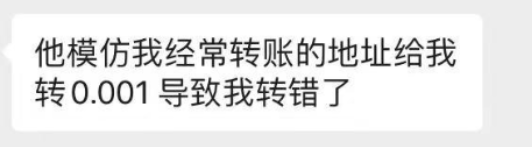
根据多名中招用户的反馈,似乎是攻击者针对交易规模较大频率较高的用户不断空投小额数量的 Token(例如 0.01 USDT 或0.001 USDT 等),攻击者地址尾数和用户地址尾数几乎一样,通常为后几位,用户去复制历史转账记录中的地址时一不小心就复制错,导致资产损失。
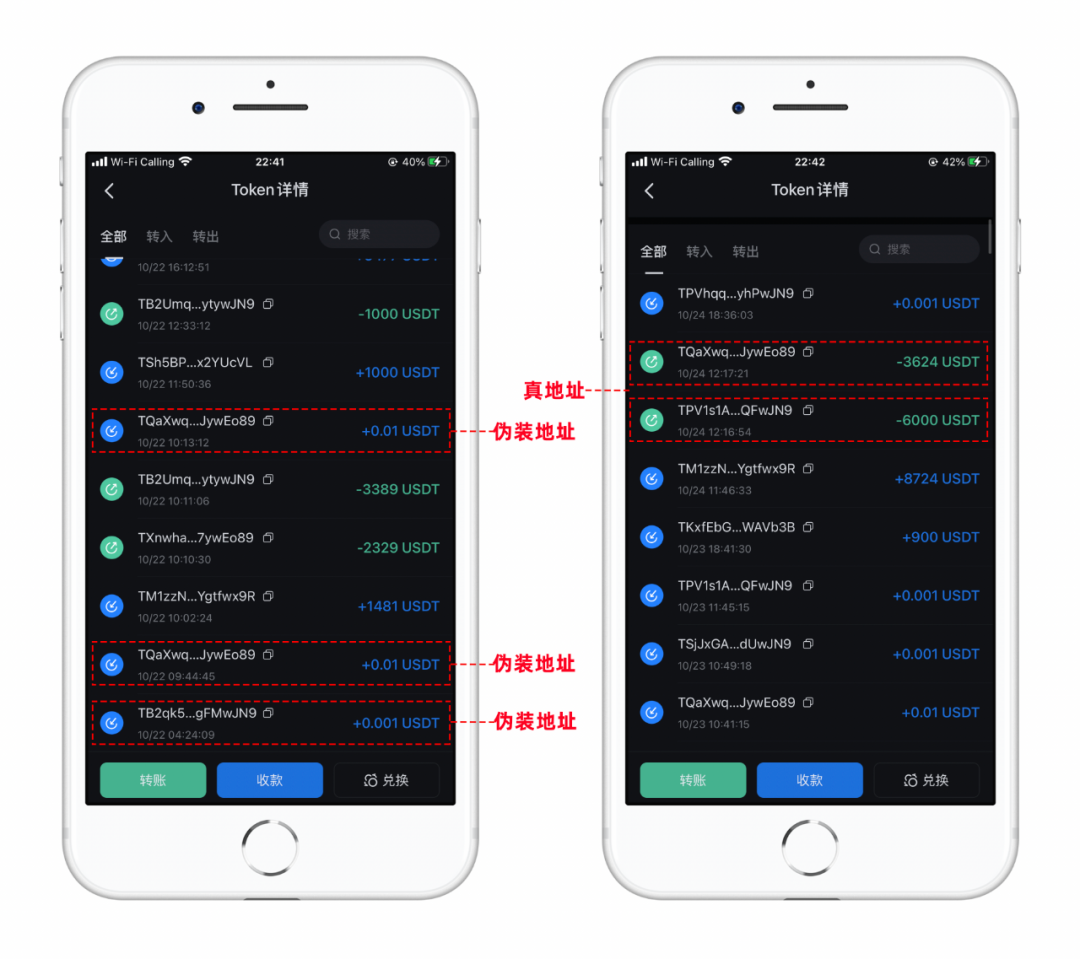
相关信息

攻击者地址 1:TX...dWfKz

用户地址 1:TW...dWfKz

攻击者地址 2:TK...Qw5oH

用户地址 2:TW...Qw5oH

MistTrack分析

先看看两个攻击者地址大致的交易情况。
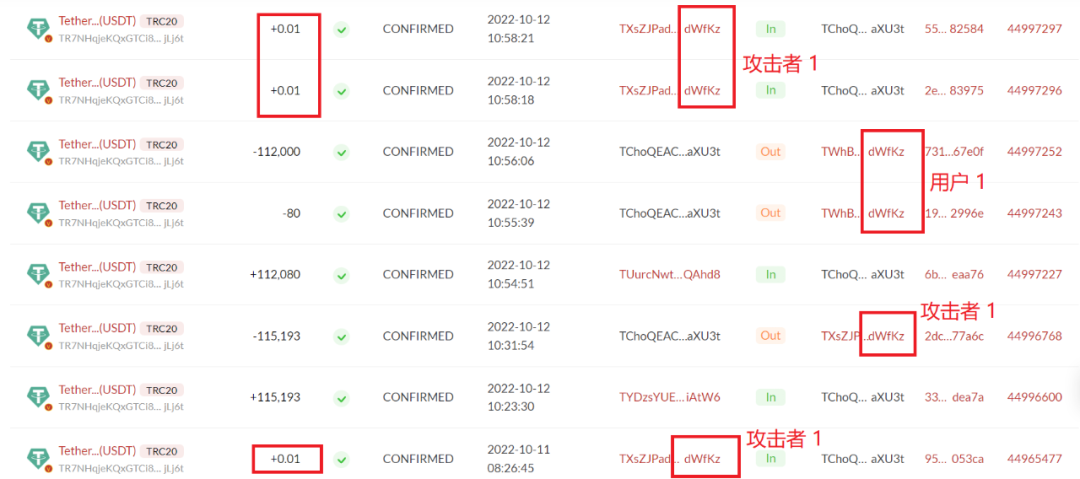
可以看到,攻击者地址 1(TX...dWfKz)与用户地址(TW...dWfKz)尾数都是 dWfKz,在用户损失了 115,193 USDT 后,攻击者又先后使用两个新的地址分别对用户地址空投 0.01 USDT 和 0.001 USDT,尾数同样是 dWfKz。

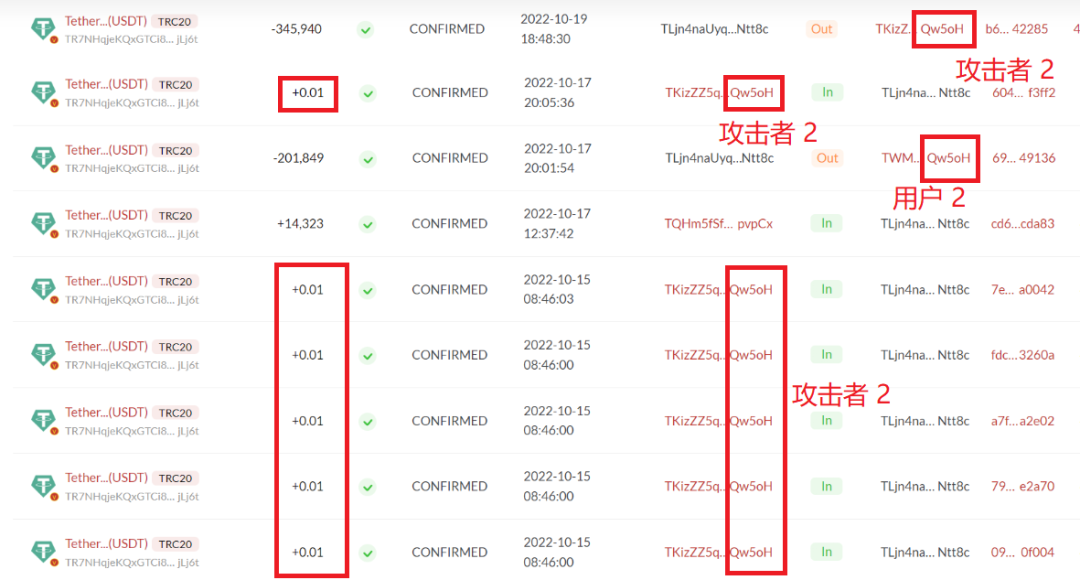
同样,攻击者地址 2(TK...Qw5oH)与用户地址(TW...Qw5oH)尾数都是 Qw5oH,在用户损失了 345,940 USDT 后,攻击者又使用新的地址(尾数为 Qw5oH)对用户地址空投 0.01 USDT。
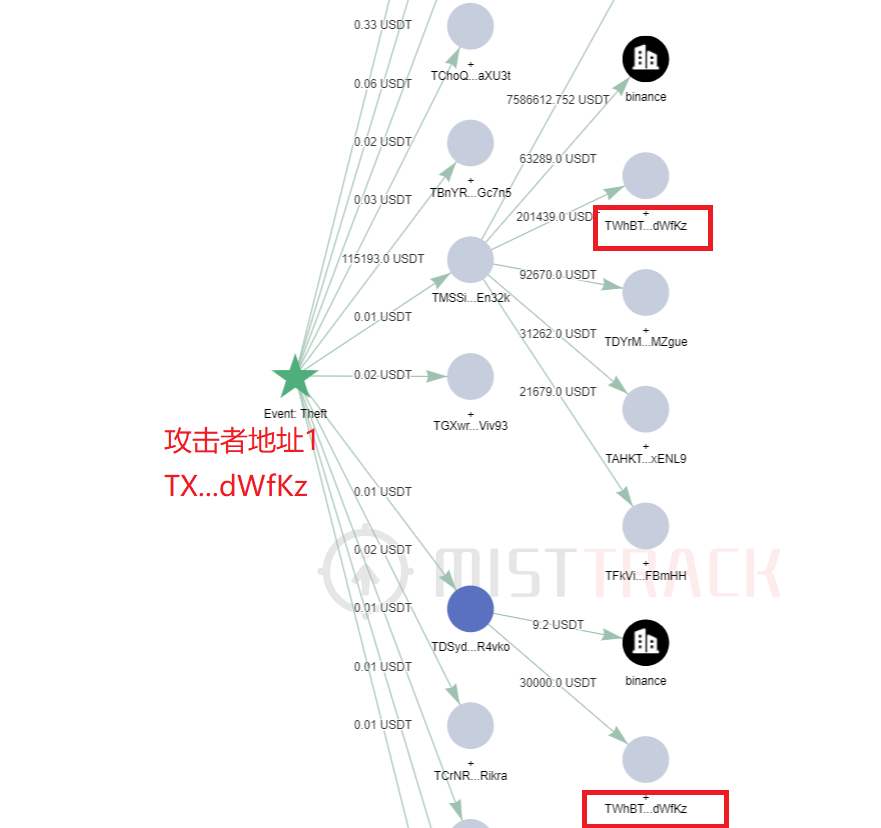
接下来,我们使用 MistTrack 来分析攻击者地址 1(TX...dWfKz)。如下图,攻击者地址 1 将 0.01 USDT、0.02 USDT 不断空投到各目标地址,而这些目标地址都曾与尾号为 dWfKz 的地址有过交互。
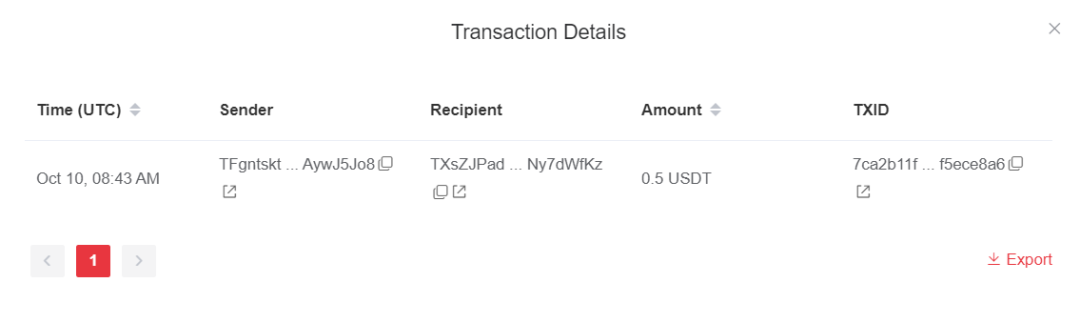
往上追溯看看该地址的资金来源。最早一笔来自地址 TF...J5Jo8 于 10 月 10 日转入的 0.5 USDT。
初步分析下地址 TF...J5Jo8:
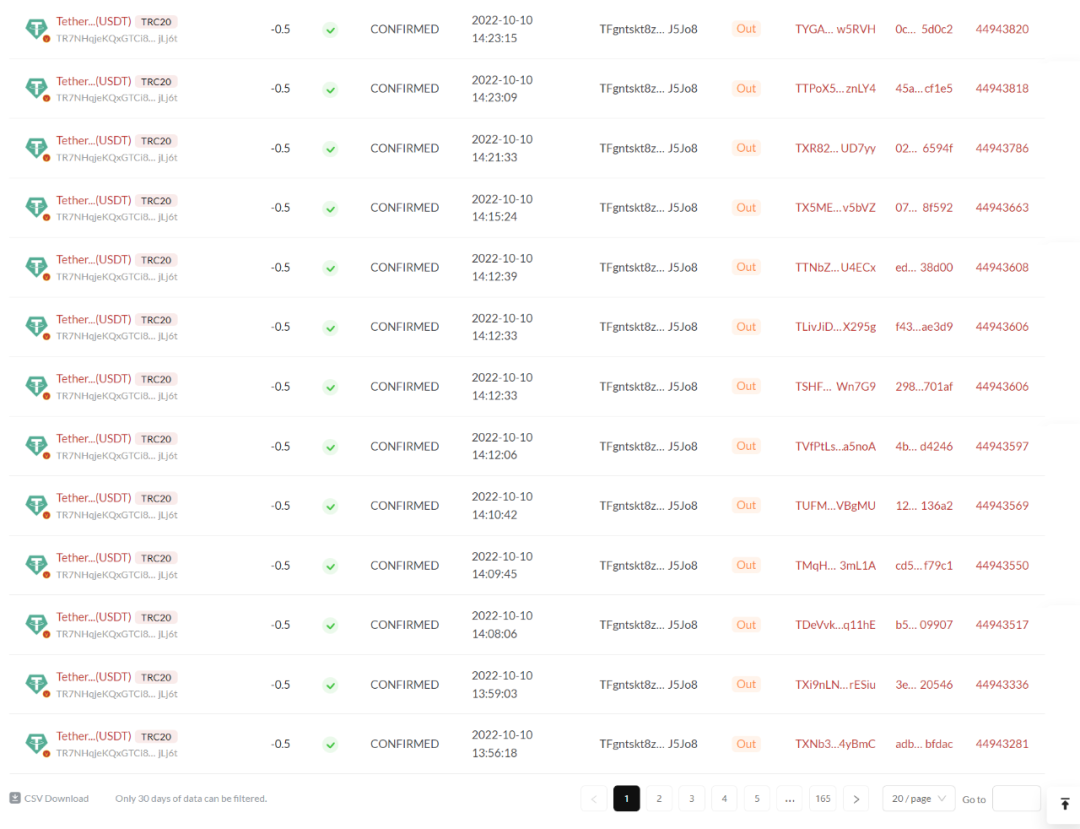
该地址对将近 3300 个地址分别转入 0.5 USDT,也就是说,这些接收地址都有可能是攻击者用来空投的地址,我们随机选择一个地址验证。

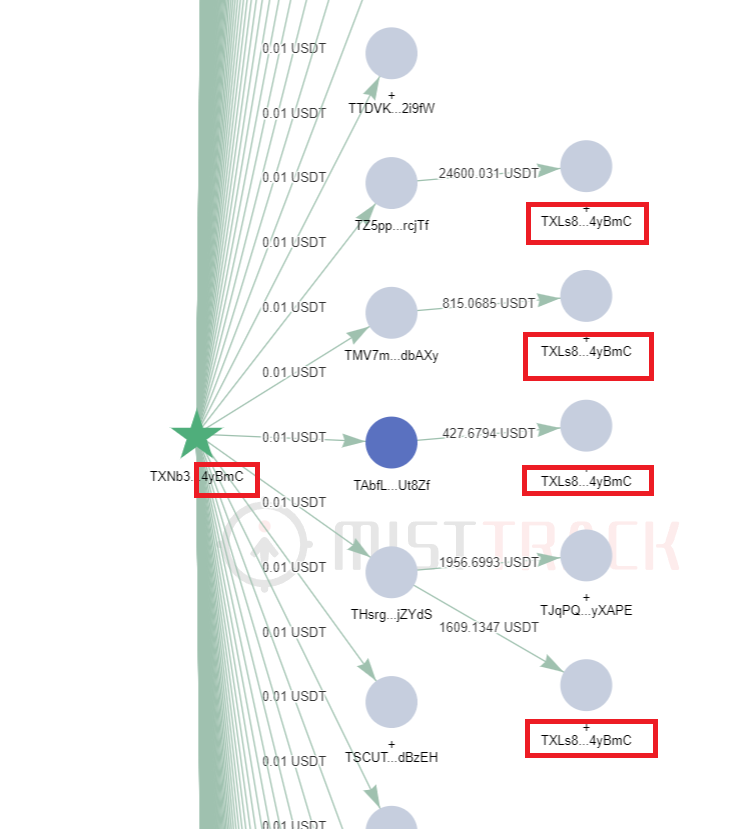
使用 MistTrack 对上图最后一个地址 TX...4yBmC 进行分析。如下图显示,该地址 TX...4yBmC 就是攻击者用来空投的地址,对多个曾与尾号为 4yBmC 地址有过交互的地址空投 0.01 USDT。
我们再来看看攻击者地址 2(TK...Qw5oH)的情况:空投 0.01 USDT 到多个地址,且初始资金来自地址 TD...psxmk 转入的 0.6 USDT。

这次往下追踪,攻击者地址 2 将 0.06 USDT 转到地址 TD...kXbFq,而地址 TD...kXbFq 也曾与尾号为 Qw5oH 的 FTX 用户充币地址有过交互。
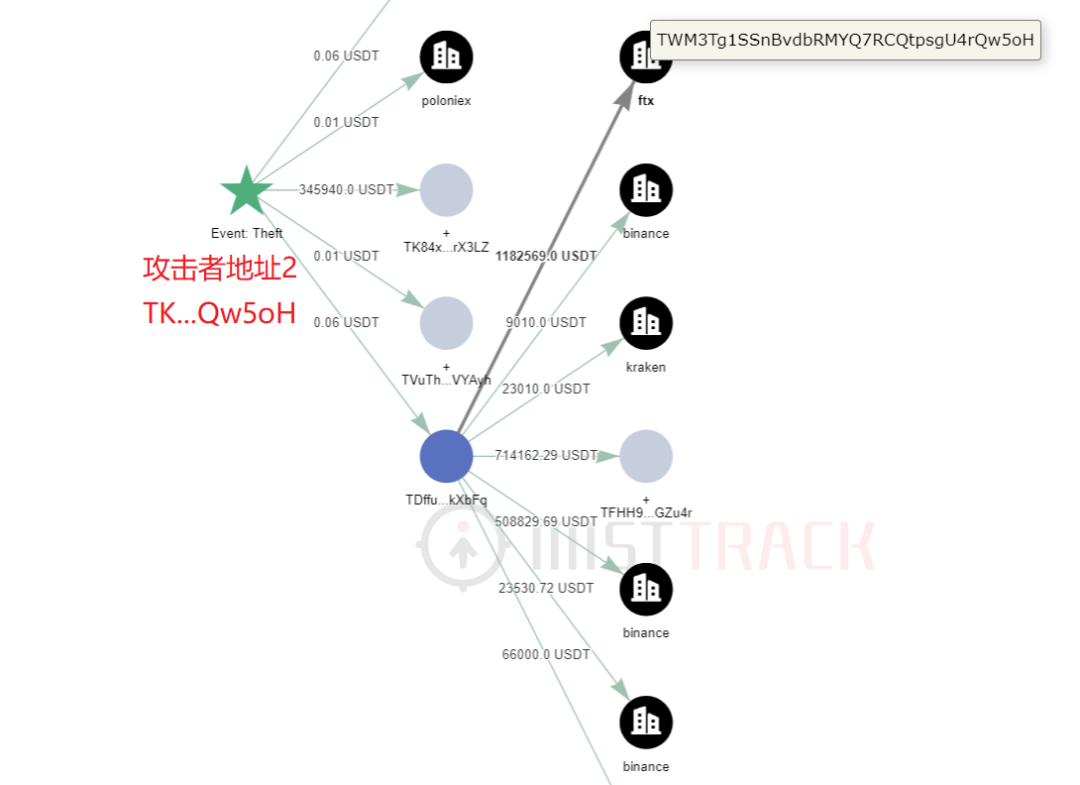
那我们反向猜想下,其他与 TD...kXbFq 交互过的地址,是否也有相同尾号的地址对它们进行空投?随机选择两个地址验证一下(例如上图的 Kraken 充币地址 TU...hhcWoT 和 Binance 充币地址 TM...QM7me)。

不出所料,攻击者布了一个巨大的网,只钓粗心人。

其他地址情况这里不再赘述。

总结

本文主要介绍了骗子利用用户复制交易记录中过往地址的这个习惯,生成相同尾号的地址作为伪装地址,并利用伪装地址向用户不断空投小额的 Token,使得骗子的地址出现在用户的交易记录中,用户稍不注意就复制错误地址,导致资产损失。慢雾在此提醒,由于区块链技术是不可篡改的,链上操作是不可逆的,所以在进行任何操作前,请务必仔细核对地址,同时建议使用钱包的地址簿转账功能,可直接通过选择地址转账。


Trending Cryptos

Related Reads

A Threefold Performance Leap! NEAR Achieves 200ms Physical Block Time Limit with SPICE

NEAR's core development team, Near One, has announced its next major protocol evolution: SPICE (Separation of Consensus and Execution). Currently in development, SPICE represents the most significant upgrade before the full implementation of Nightshade 3.0. Its core innovation is decoupling the consensus layer, responsible for ordering transactions, from the execution layer, which processes them. This allows the consensus layer to run at full speed without waiting for transaction execution to complete. Once deployed, SPICE is projected to triple NEAR's block production speed, achieving a 200ms block time, which is considered the physical limit due to the speed of light and network latency. This leap will dramatically reduce transaction latency and finality, with transactions confirming in roughly 0.4 seconds—faster than a typical card payment. The upgrade also enables more complex, long-running transactions and significantly improves user experience for applications like NEAR Intents and near.com. Beyond raw speed, SPICE enhances network scalability and security. It enables deeper parallelism, efficiently distributing workload across shards and improving resource utilization. The simpler block structure and lighter contracts also facilitate formal verification and security auditing. Furthermore, SPICE lays the critical groundwork for future Nightshade 3.0 features, most notably atomic cross-shard transactions, which would simplify complex contract logic and eliminate development hurdles caused by asynchronous execution. The Near One team is actively developing SPICE, targeting deployment in the coming months.

Foresight News59m ago

A Threefold Performance Leap! NEAR Achieves 200ms Physical Block Time Limit with SPICE

Foresight News59m ago

Deep Insight: Decentralized Inference is Not Hype, but a Key Track for AI to Break Through Centralized Monopoly

Decentralized Reasoning: Beyond the Hype, a Key to Breaking AI's Centralized Monopoly A future scenario where a powerful AI model is banned by a major government illustrates the core value proposition of decentralized AI: resistance to censorship. The core bet of decentralized inference networks is mitigating this risk, with other benefits like cost being secondary. The path is extremely difficult, involving four key challenges: 1. **Running Massive Models:** Distributing a single model across a decentralized GPU swarm requires sophisticated techniques like pipeline and speculative decoding to overcome crippling network latency, aiming for usable speeds (e.g., 30-40 tokens/second). 2. **Proving Model Integrity:** Verifying that a node runs the correct model is critical. Solutions range from cryptographically secure but slow ZKML to faster, economically-secure methods like statistical fingerprints, deterministic re-execution, or live-weight proofs, each involving trade-offs between integrity, latency, and cost. 3. **Ensuring Prompt Privacy:** Simply sharding a model does not protect user inputs from nodes. Robust solutions currently require trusted hardware (TEEs) or advanced cryptography (FHE), which are not yet widely deployed in consumer swarms. 4. **Building a Real Market:** Identifying the ideal customer is tough. Beyond speculative AI agents, the viable market currently consists of startups embedding AI and projects needing batch processing (e.g., synthetic data generation), where decentralized aggregation can be an advantage over low-latency needs. The article analyzes several projects tackling these problems, such as Dolphin Network (live-weight proofs), Inference.net (statistical verification), Morpheus (TEE-based), and Darkbloom (Apple Secure Enclave). It provides a framework: decentralization is a "tax" for latency-sensitive applications (e.g., chat) but a potential supply-side advantage for throughput-oriented tasks (e.g., batch processing). The long-term vision is a closed data loop where decentralized inference generates valuable data (traces, preferences) to feed decentralized training networks, which in turn produce better open-weight models for the inference networks. A due diligence checklist advises focusing on projects that: are truly decentralized at specific layers; have a credible integrity method; offer real cost benefits; ensure genuine privacy; handle node reliability; have paying users; and are built by teams with deep AI expertise. The ultimate goal should be products that appeal beyond the crypto-native audience, using crypto mechanisms invisibly to deliver better cost, performance, or privacy.

Foresight News1h ago

Deep Insight: Decentralized Inference is Not Hype, but a Key Track for AI to Break Through Centralized Monopoly

Foresight News1h ago

Trading

Spot
Futures

Hot Articles

Discussions

Welcome to the HTX Community. Here, you can stay informed about the latest platform developments and gain access to professional market insights. Users' opinions on the price of ETH (ETH) are presented below.

活动图片