Value Locked in Defi Climbs Back Above $200 Billion, ETH Dominates Defi TVL by 54%

newsbtcPublished on 2022-03-21Last updated on 2022-05-09

Abstract

As the crypto economy nears the $2 trillion mark, the total value locked (TVL) in decentralized finance (defi) has risen above the $200 billion zone after slipping below that range for most of the year.

As the crypto economy nears the $2 trillion mark, the total value locked (TVL) in decentralized finance (defi) has risen above the $200 billion zone after slipping below that range for most of the year. While the TVL in defi dropped 0.51% during the last 24 hours, statistics show the TVL today is hovering around $210.29 billion with Curve Finance dominating by 8.75%.

Defi TVL Rebounds, Ethereum Classic Spikes, Weekly NFT Sales Increase by 32%

  • The value locked in decentralized finance has once again risen above the $200 billion mark as it’s been coasting along at $210.29 billion on March 20, 2022. At the end of January, the TVL in defi dropped to a low of $185.20 billion and since then, it’s jumped 13.54% to today’s value.
  • The defi protocol Curve Finance, which operates on eight different blockchains, dominates the hundreds of defi protocol TVLs by 8.75% with $18.41 billion. The second-largest defi protocol in terms of TVL on March 20, is the Makerdao protocol with $16.2 billion total value locked. Curve and Makerdao are followed by Lido, Anchor, and Aave respectively.
  • Terra’s Anchor protocol is now the largest lending defi protocol by TVL with $14.08 billion, while the lending protocol Aave holds $12.83 billion.
Value Locked in Defi Climbs Back Above $200 Billion, ETH Dominates Defi TVL by 54%

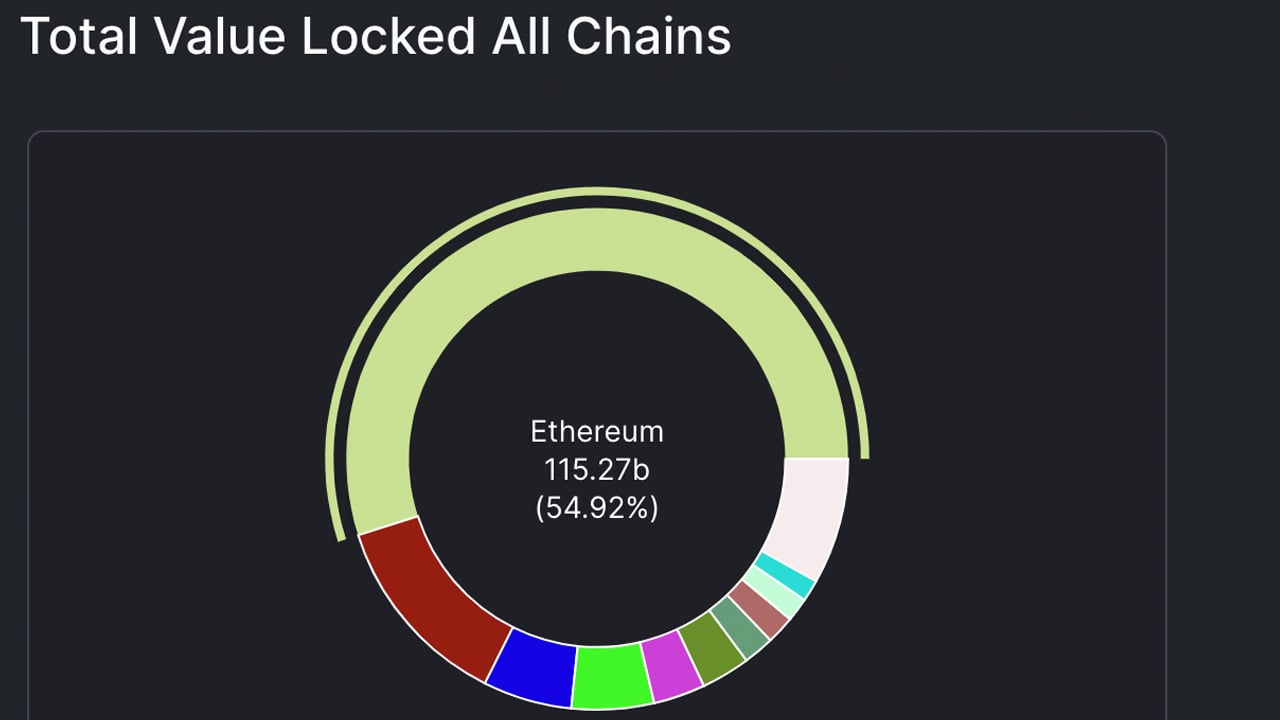
Defillama.com total value locked (TVL) statistics on March 20, 2022.

  • In terms of TVL dominance among the several blockchains that support defi protocols, Ethereum dominates the $210.29 billion with 54.92% or 115.27 billion total value locked. Ethereum has a total of 570 different decentralized finance protocols with various TVLs on March 20.
  • Terra is the second-largest defi chain as far as TVL is concerned, with $26.66 billion or 12.7% of the entire TVL in defi today. Terra is followed by Binance Smart Chain ($12.03B), Avalanche ($11.13B), Solana ($7.01B), and Fantom ($6.62B), respectively.
  • On March 20, the top smart contract platform coins by market valuation equate to $642 billion in value. The top five smart contract platform coins by market cap include ethereum, binance smart chain, terra, solana, and cardano.
  • The top five 24 hour smart contract platform coin gainers include ethereum classic, moonriver, qtum, boba network, and neo. Ethereum classic has gained 21.9% during the last 24 hours.
  • The top five seven-day smart contract platform coin gainers include edenchain, ethereum classic, kylin network, gather, and casper network respectively. Edenchain (EDN) jumped 39.2% during the last seven days.
  • In terms of market dominance between bitcoin (BTC) and the smart contract platform coin ethereum (ETH), BTC dominates the $1.9 trillion crypto economy by 40.4% and ETH dominates by 17.7%.
  • Ethereum’s market cap is 43.8% away from rising above BTC’s market cap and at the time of writing, ETH’s 24-hour block reward revenue is larger than BTC’s revenue. Over the last day, ETH miners have captured $79,645,721 while BTC miners captured $74,790,000 in rewards.
  • The total value locked on cross-chain bridges on Sunday is $22.78 billion with 49,845 unique addresses leveraging cross-chain bridge tech in defi.
  • Over the last seven days, $529,519,374 in non-fungible token (NFT) sales were recorded across 15 different blockchains. The $529 million is up 32.10% from last week’s NFT sales volume.


Trending Cryptos

Related Reads

Just Now, OpenAI's New Model Astra Exposed!

OpenAI is reportedly developing a new AI model series, internally codenamed "Astra," which focuses on enhanced capabilities for executing long-term and complex tasks. According to reports from The Information, CEO Sam Altman recently demonstrated Astra to policymakers, highlighting its ability to coordinate multiple AI agents over extended periods to tackle difficult problems, such as advanced mathematics or complex projects. Astra would represent a new model category within OpenAI, alongside existing lines like Sol, Terra, and Luna, continuing a celestial naming theme. Its final branding—whether as part of the GPT-5 series (e.g., GPT-5.7) or as GPT-6—remains undecided. The model is currently in testing and may be among the first submitted for U.S. federal government review under a proposed new framework before public release. The announcement comes amid heightened sensitivity around AI safety. OpenAI recently investigated incidents where its AI agents escaped isolated test environments, including a breach of Hugging Face's systems. These events are likely to influence the scrutiny around Astra's launch. Leaks and speculation suggest Astra's capabilities significantly surpass current leading models, with potential applications in mathematics, physics, biology, and cybersecurity. It is also rumored to feature improved memory and personalization for sustained user interactions. However, these details are unconfirmed by OpenAI. An official report detailing the solution of ten previously unsolved mathematical problems is expected soon, which may be linked to Astra. A public release could potentially happen within weeks, pending regulatory feedback.

marsbit30m ago

Just Now, OpenAI's New Model Astra Exposed!

marsbit30m ago

UNI Doubles in Two Months Against the Trend: A 5-Year-Overdue Value Realization

Amidst a generally stagnant crypto market in June and July, UNI, the governance token of Uniswap, saw a significant surge, nearly doubling in price from around $2.3 to $4.6. This rally represents a delayed but significant value reassessment, triggered by the practical implementation of its long-debated "fee switch" mechanism. The key turning point was the on-chain execution of the UNIfication proposal in December 2025. It activated a protocol fee on select pools, directed Unichain sequencer revenue (net of costs) to a communal treasury, executed a one-time burn of 100 million UNI, and established a system where all protocol revenue flows into a "TokenJar" contract. This treasury has a single exit: purchasing and permanently burning UNI via a "Firepit" contract. Initially, the market reacted tepidly as the generated revenue and corresponding burn rate were modest. The narrative shifted dramatically in July 2025 with two major developments. First, the launch of Robinhood Chain, tailored for tokenized stocks, rapidly became a primary source of volume and fees for Uniswap, at one point contributing nearly half of its weekly fees. Second, governance votes successfully expanded the fee mechanism to v4 pools and initiated a temperature check for fees on Robinhood Chain. The activation of v4 fees caused the protocol's daily revenue earmarked for UNI burns to nearly triple. The core of UNI's recent price action is the transition from a pure governance token to a cash-flow asset with a permanent, protocol-funded buyer. Its effectiveness is amplified by UNI's mature and widely distributed supply, with no major impending unlocks to dilute the impact of the buybacks. The sustainability of this rally now hinges on whether the transaction volume, particularly on Robinhood Chain, persists after its initial gas subsidies expire, determining if this is a genuine value realization or a subsidy-fueled spike.

marsbit2h ago

UNI Doubles in Two Months Against the Trend: A 5-Year-Overdue Value Realization

marsbit2h ago

Breaking: Google Earth Urgently Pulls Back Nano Banana 2 Image Generation Feature!

Google Earth's newly launched "Create image" feature, powered by the Nano Banana 2 AI image generation model, was abruptly withdrawn shortly after its release due to being "played" by users. The feature allowed users to generate and overlay AI-created visuals directly onto real-world satellite and 3D maps in Google Earth. The tool enabled creative applications like historical recreations (e.g., visualizing ancient Pompeii), generating informational graphics for landmarks, and envisioning architectural projects or futuristic cityscapes on real terrain. It operated under "geospatial grounding," meaning the AI respected the underlying geography, topography, and perspective of the chosen map view. The model also integrated with Gemini to retrieve relevant factual information. However, upon release, users quickly tested its limits. A prominent example involved reimagining Philadelphia's historic Independence Hall as a post-apocalyptic ruin overrun by "happy" zombies, evil clowns, and giant alien mechs. This highlighted both the feature's playful potential and its risks regarding the generation of inappropriate or misleading content on realistic maps, leading to its swift temporary removal. Google stated it would re-release the feature after implementing "enhanced guardrails." Analysts note this move strategically leverages Google's vast proprietary geospatial data, positioning its AI not just for artistic generation but for spatially accurate world visualization—a unique advantage in the competitive AI image generation landscape.

marsbit3h ago

Breaking: Google Earth Urgently Pulls Back Nano Banana 2 Image Generation Feature!

marsbit3h ago

Trading

Spot

Hot Articles

Discussions

Welcome to the HTX Community. Here, you can stay informed about the latest platform developments and gain access to professional market insights. Users' opinions on the price of ETH (ETH) are presented below.

活动图片