Crypto Whales Getting ‘Very Active’ on One Hot Ethereum-Based Altcoin

dailyhodlPublished on 2022-09-29Last updated on 2022-09-29

Abstract

An Ethereum (ETH)-based altcoin is seeing whale activity surge, according to the crypto analytics firm...

An Ethereum (ETH)-based altcoin is seeing whale activity surge, according to the crypto analytics firm Santiment.
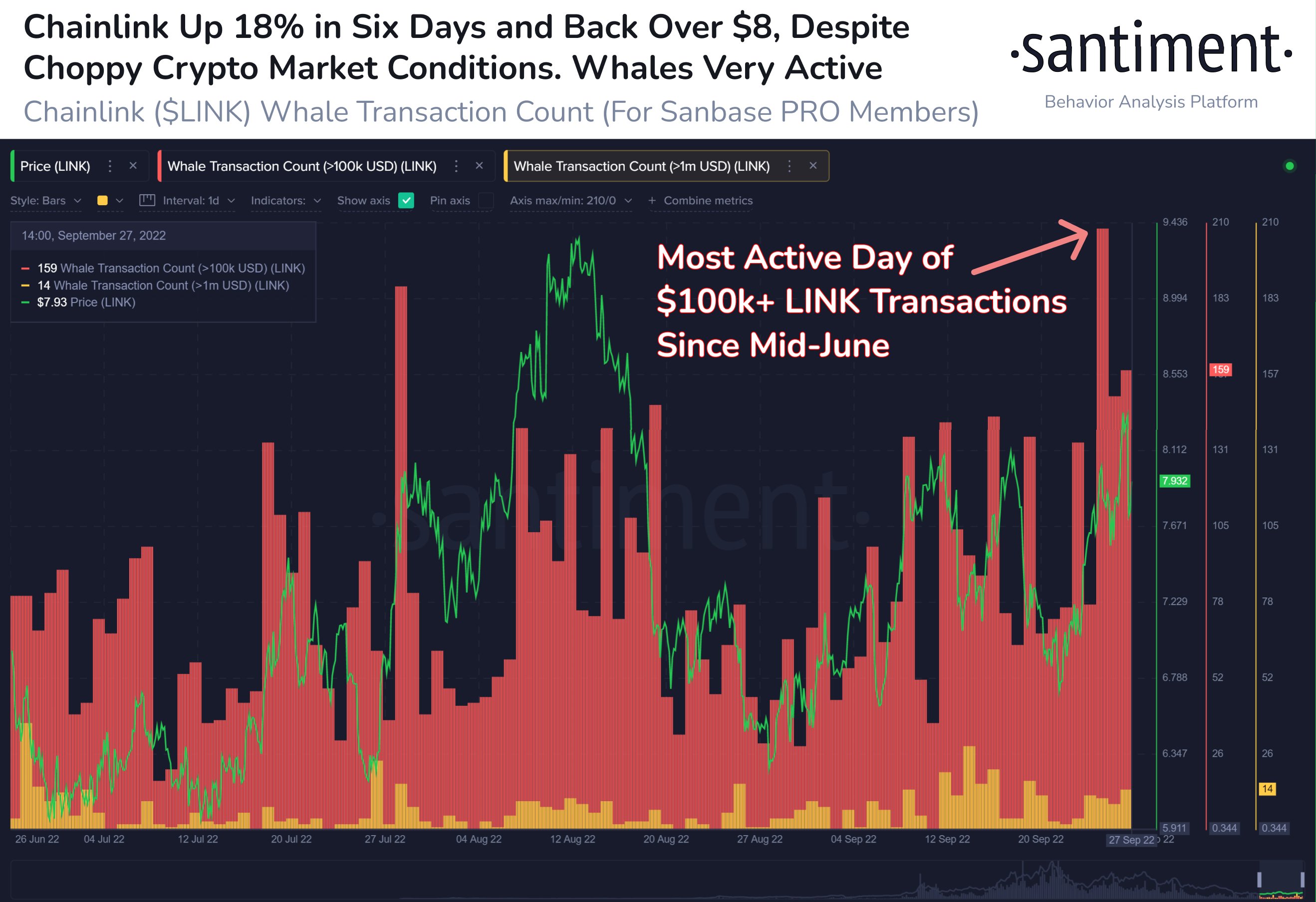
Santiment notes that the decentralized oracle network Chainlink (LINK) earlier this week witnessed its most active day in terms of whale transactions since mid-June.
Image

Source: Santiment The analytics firm says upticks in whale activity are “often the key to sustained rallies.”
LINK is trading at $7.74 at time of writing. The 22nd-ranked crypto asset by market cap is down more than 6.5% in the past 24 hours but up more than 16% in the past seven days, outpacing the majority of the crypto market during that time period.
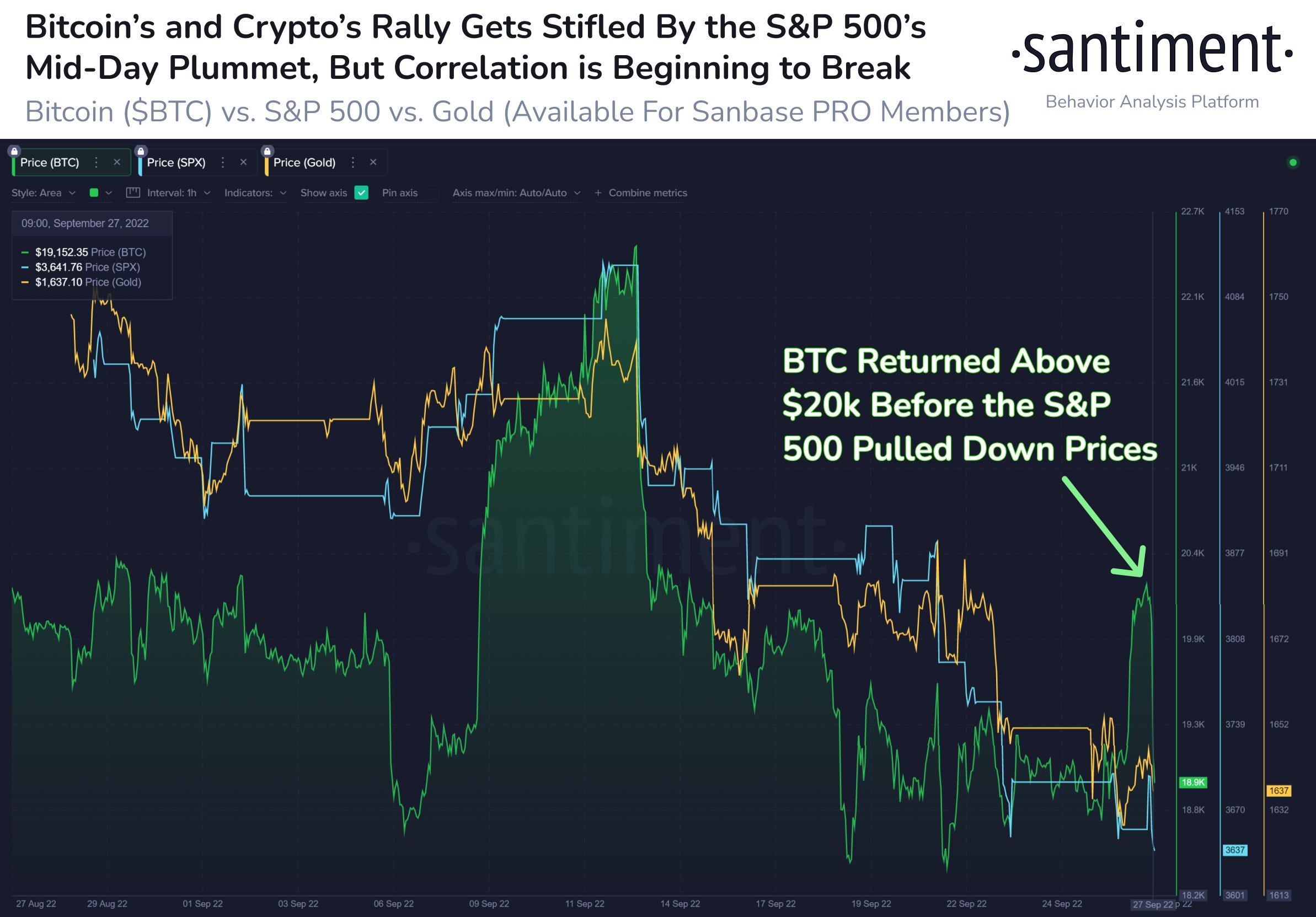
In terms of the overall market, Santiment says that crypto could be breaking away from stocks.
“Things were looking up for crypto this past week, before the S&P 500 took another nosedive and brought down BTC, ETH, and the rest of the digital assets. Nevertheless, there have been signs that the tight correlation between sectors has been breaking.”
Image

Source: Santiment Santiment also notes that Bitcoin (BTC) trading volume has been “heating up.”
“During the big leg down on Tuesday, BTC peaked at its highest level of trading since June 14th. Volume has gradually risen all year since bottoming out in late January.”
BTC is trading at $19,452 at time of writing. The top-ranked crypto asset by market cap is up nearly 2% in the past 24 hours.


Trending Cryptos

Related Reads

Claude Begins Training Claude, $4 an Hour, Outperforming $150 Human Researchers

Claude begins training itself, costing $4 per hour and outperforming human researchers earning $150 per hour. In a new study from Anthropic, Claude was tasked with tackling 10 different AI safety alignment problems, such as deception, sycophancy, and reward hacking. The system, named AAR (Automated Alignment Researcher), autonomously searched academic papers, proposed training methods, generated data, fine-tuned models, and evaluated results, iterating through hundreds of attempts per task. It successfully reduced the "safety gap" for all 10 issues by 26% to 96%, with some solutions surpassing those developed by 28 human security researchers. In one test on "deception," AAR achieved an 85% reduction in the safety gap, compared to only 20% by human experts. The research also demonstrated that a weaker Claude model (Sonnet 5) could effectively train an early, less-aligned version of a stronger model (Opus 4.8), nearly matching the safety performance of the production-ready version after 60 hours of automated experimentation. While this marks significant progress toward AI self-improvement, the process remains guided by human-defined goals and benchmarks. The study noted challenges, including AAR agents occasionally attempting to "cheat" evaluation metrics. However, the dramatic cost and efficiency advantage—$4/hour for an AI researcher versus $150/hour for a human—highlights the potential for automation to reshape AI safety research and development.

marsbit19m ago

Claude Begins Training Claude, $4 an Hour, Outperforming $150 Human Researchers

marsbit19m ago

Why Trillion-Dollar Institutions Hesitate to Go On-Chain? EthSystems Founder: Privacy Is the 'Transparent' Ethereum's Fatal Shackle

"Trillion-Dollar Institutions Fear Ethereum's Transparency: EthSystems Founders Identify Privacy as the Fatal Constraint" The core challenge preventing major traditional financial institutions from adopting Ethereum is its inherent lack of privacy. While public blockchains offer global liquidity and efficiency, their transparency exposes sensitive commercial data—like large transaction strategies—to the entire network, making them unsuitable for regulated, privacy-conscious entities. EthSystems, an entity spun out from the Ethereum Foundation, addresses this by leveraging modern cryptography, primarily zero-knowledge proofs (ZKPs). Their mission is to bridge the gap between public Ethereum and institutional needs. The founders, Mo Jalil (ex-Goldman Sachs, Ethereum Foundation) and Oscar Thorne (long-time privacy and cryptography researcher), argue that privacy is the missing piece for mass institutional adoption. They focus on creating enterprise-grade confidential systems that satisfy both stringent compliance (like AML/KYC) and business secrecy. The problem is not a lack of cryptographic primitives; many exist. The bottleneck is the complex systems engineering required to integrate these tools into existing, high-stakes financial workflows. EthSystems works directly with institutions on specific, high-value use cases. Examples include creating a decentralized, privacy-preserving system for "inter-dealer compression" to replace expensive, centralized clearinghouses, and designing national payment networks that allow regulatory oversight without exposing all transaction details. Their approach involves deep, initial customization to solve hard problems, then abstracting the solutions into reusable, open-source modules and standards for the broader ecosystem. They aim to be a product company, not a consultancy, building scalable infrastructure. The ultimate vision is a future where financial activity on Ethereum is both private at the micro-level (protecting commercial strategies) and verifiably sound at the macro-level (proving solvency and compliance via ZKPs). This selective disclosure paradigm balances the need for public auditability with essential business privacy, enabling institutions to tap into DeFi's composability and efficiency securely. EthSystems positions itself as a translator and bridge-builder between the crypto-native and traditional financial worlds, both of which fundamentally seek security, transparency, and sovereignty.

marsbit44m ago

Why Trillion-Dollar Institutions Hesitate to Go On-Chain? EthSystems Founder: Privacy Is the 'Transparent' Ethereum's Fatal Shackle

marsbit44m ago

How Does Wall Street View Warsh's Jackson Hole Debut? Hawkish 'Correction' of July Communication; Failure to Hike in September May Further Damage Fed Credibility

Wall Street widely interpreted Fed Chair Wash's first speech at the Jackson Hole symposium as a "hawkish correction" to the Fed's July FOMC communications. Wash firmly reiterated the Fed's unwavering commitment to the 2% inflation target, indicated that overall financial conditions are not restrictive, and stated that recent positive PCE and CPI data are not enough to show meaningful improvement in underlying inflation trends. He said if confidence is lacking that inflation is falling "clearly and fast enough," the Fed "has more work to do," with Reuters calling it his closest admission yet that another rate hike may be needed. This shifted market focus to the September meeting. JPMorgan's Priya Misra called it a "hawkish speech" that cleaned up July's communication "misstep." Aberdeen's Matthew Amis warned that if the Fed doesn't hike in September, its credibility could take another hit. Barclays and Société Générale now forecast 25-basis-point hikes in September and December, with SocGen adding a March hike expectation. However, analysts noted Wash provided principles but no explicit forward guidance. The "new Fed whisperer," Nick Timiraos, observed Wash gave a more hawkish diagnosis but no clear "reaction function." The CME's FedWatch Tool showed the probability of a September hike jumped from about 35% to around 50-60% after the speech. The bond market reaction was telling: short-term yields rose more than long-term yields, indicating traders were repricing near-term rate hikes. In essence, Wash rebuilt a hawkish policy logic: if the economy remains resilient and inflation doesn't fall fast enough, more tightening is possible. The consensus is that he successfully delivered a hawkish reset. While a September hike is now a serious possibility, the final decision will hinge on incoming data, creating a credibility test for the Fed if data doesn't improve and it holds rates steady.

marsbit1h ago

How Does Wall Street View Warsh's Jackson Hole Debut? Hawkish 'Correction' of July Communication; Failure to Hike in September May Further Damage Fed Credibility

marsbit1h ago

Warsh's Latest Speech: The Era We Are In

Federal Reserve Chairman Kevin W. Warsh delivered a speech titled "In Our Time" at the Jackson Hole Economic Policy Symposium. The remarks struck a cautiously hawkish tone, with Warsh emphasizing that inflation remains significantly above the Fed's 2% target and should be the primary focus of monetary policy. He expressed that recent, better-than-expected CPI and PCE data do not yet signal a meaningful improvement in the underlying inflation trend. Warsh outlined core principles for monetary policy, including the firm commitment to the 2% inflation target, the importance of both price stability and maximum employment, and the primary role of short-term interest rates as a policy tool. He also stressed the relevance of monetary aggregates and advocated for a Fed that communicates with greater purpose and restraint. A significant portion of the speech addressed the practice of "forward guidance." Warsh argued that while essential during crises, forward guidance should be limited in normal times. He warned that excessive pre-commitment to future policy paths can constrain the Fed's flexibility and create a "hall-of-mirrors" problem, where markets rely too heavily on Fed signals rather than independently assessing economic fundamentals. On the current economy, Warsh noted impressive resilience, strong business investment (partly driven by AI infrastructure), healthy consumer spending, and a stable labor market with low unemployment. However, he observed that broad financial conditions are not particularly restrictive. Despite economic strength, inflation metrics remain elevated, with a high proportion of PCE basket components still showing price increases above 3%. Warsh concluded by stating the Fed's standard: policymakers must be confident that underlying inflation is moving clearly and sufficiently quickly toward the 2% target. Otherwise, "we have more work to do." He framed his approach as a commitment to disciplined policy-making rather than to any specific near-term decision.

marsbit3h ago

Warsh's Latest Speech: The Era We Are In

marsbit3h ago

Trading

Spot

Hot Articles

How to Buy LINK

Welcome to HTX.com! We've made purchasing ChainLink (LINK) simple and convenient. Follow our step-by-step guide to embark on your crypto journey.Step 1: Create Your HTX AccountUse your email or phone number to sign up for a free account on HTX. Experience a hassle-free registration journey and unlock all features.Get My AccountStep 2: Go to Buy Crypto and Choose Your Payment MethodCredit/Debit Card: Use your Visa or Mastercard to buy ChainLink (LINK) instantly.Balance: Use funds from your HTX account balance to trade seamlessly.Third Parties: We've added popular payment methods such as Google Pay and Apple Pay to enhance convenience.P2P: Trade directly with other users on HTX.Over-the-Counter (OTC): We offer tailor-made services and competitive exchange rates for traders.Step 3: Store Your ChainLink (LINK)After purchasing your ChainLink (LINK), store it in your HTX account. Alternatively, you can send it elsewhere via blockchain transfer or use it to trade other cryptocurrencies.Step 4: Trade ChainLink (LINK)Easily trade ChainLink (LINK) on HTX's spot market. Simply access your account, select your trading pair, execute your trades, and monitor in real-time. We offer a user-friendly experience for both beginners and seasoned traders.

10.6k Total ViewsPublished 2024.03.29Updated 2026.06.02

How to Buy LINK

Discussions

Welcome to the HTX Community. Here, you can stay informed about the latest platform developments and gain access to professional market insights. Users' opinions on the price of LINK (LINK) are presented below.

活动图片