50% Of All Bitcoin In Circulation Are Now Sitting On Major Losses, Is This A Bottom Signal?

bitcoinistPublished on 2026-06-09Last updated on 2026-06-09

Abstract

Bitcoin is potentially flashing a key contrarian signal as over 10.46 million BTC, roughly half of its circulating supply, is now held at a loss. This metric, highlighted by analyst Ali Martinez using Glassnode data, has historically coincided with major market turning points. The significant increase in underwater supply, alongside Bitcoin's price decline of over 40% from its highs to around $63,242, suggests heightened investor stress. Martinez notes that such elevated loss holdings can reduce selling pressure as holders are less incentivized to realize losses. Supporting this, the Net Unrealized Profit/Loss (NUPL) indicator has entered the "Hope-Fear" zone, reflecting shaken confidence. While a definitive bottom is unconfirmed, the scale of unrealized losses places Bitcoin in a historical accumulation zone, raising debate on whether the current decline is nearing its end.

Bitcoin may be flashing one of its most closely watched contrarian signals. With more than 10 million BTC now held below their acquisition cost, a growing portion of the market is underwater. According to recent on-chain observations highlighted by analyst Ali Martinez, this development places Bitcoin in a zone that has historically coincided with major market turning points, raising fresh debate over whether the latest decline is nearing a bottom.

Bitcoin’s Underwater Supply Reaches A Historic Threshold

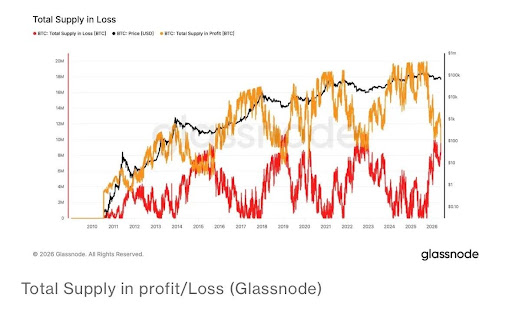
The latest data points to a remarkable shift in market positioning. According to Glassnode, BTC’s Total Supply in Loss metric shows that approximately 10.46 million BTC are currently being held at a loss. Given Bitcoin’s circulating supply of just under 21 million coins, that figure represents roughly half of all coins in existence.
Source: Glassnode

The significance of this threshold becomes clearer when viewed against Bitcoin’s historical market cycles. Previous major bottoms have frequently developed when the amount of BTC held at a loss climbed beyond 10 million coins. Similar conditions emerged during some of the market’s deepest corrections, many of which later gave way to prolonged recoveries.

The latest on-chain data also highlights the shifting balance between profitable and unprofitable holdings. As Bitcoin’s price retreated from its highs, the number of coins held in profit contracted while the amount of supply sitting at a loss expanded considerably. By June 2026, the latter had risen to roughly 10.46 million BTC, pushing the market into a zone that has historically been associated with severe downturns and heightened investor stress.

At the same time, Bitcoin’s price has fallen substantially from its cycle highs. Recent market data shows BTC trading around $63,242, with losses extending across multiple timeframes, including a decline of more than 40% over the previous year. Those figures help explain why such a large share of the network has slipped into unrealized losses.

Bottom Signal Or Just Another Stage Of A Correction?

This is where the discussion becomes particularly interesting. Martinez argues that elevated loss holdings can reduce the intensity of selling activity. When large numbers of investors are already deeply underwater, the incentive to liquidate positions often diminishes. Rather than locking in losses, many holders choose to wait, causing selling pressure to gradually weaken.

Recent Glassnode data appears to support the idea that sentiment has deteriorated significantly. Bitcoin’s Net Unrealized Profit/Loss (NUPL) indicator has fallen into the “Hope–Fear” zone after spending much of the previous year in more optimistic territory. Historically, these lower NUPL ranges have reflected periods when confidence has been shaken, but widespread capitulation has not necessarily intensified further.
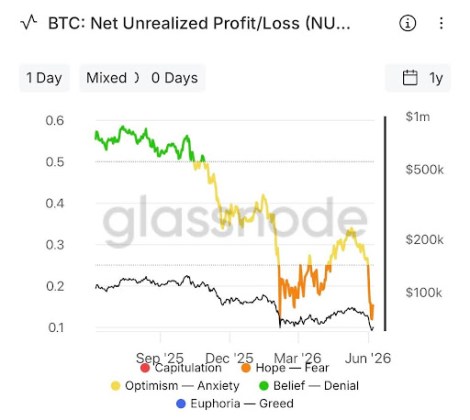
The combination of more than 10 million BTC in loss, weak sentiment, and a steep decline from previous highs has historically appeared near major market bottoms. While a definitive bottom remains unconfirmed, the scale of unrealized losses across the network indicates that Bitcoin is once again trading in a zone often associated with accumulation and recovery.

BTC bears push price down | Source: BTCUSD on Tradingview.com

Related Questions

QWhat is the key metric indicating that 50% of all Bitcoin in circulation are currently held at a loss?

AThe key metric is the 'Total Supply in Loss' from Glassnode, which shows approximately 10.46 million BTC are currently being held at a loss.

QAccording to the article, what has historically happened when the amount of BTC held at a loss surpasses 10 million coins?

AHistorically, when the amount of BTC held at a loss surpasses 10 million coins, it has frequently coincided with major market bottoms and deep corrections that later gave way to prolonged recoveries.

QWhat is the current price of Bitcoin mentioned in the article, and what is its approximate decline over the previous year?

AThe current price of Bitcoin mentioned is around $63,242, with a decline of more than 40% over the previous year.

QAccording to analyst Ali Martinez, why can elevated loss holdings potentially lead to a reduction in selling pressure?

AAli Martinez argues that when many investors are already deeply underwater, the incentive to liquidate positions often diminishes. Many holders choose to wait instead of locking in losses, which causes selling pressure to gradually weaken.

QWhat does the article suggest about Bitcoin's Net Unrealized Profit/Loss (NUPL) indicator's current position?

AThe article states that Bitcoin's Net Unrealized Profit/Loss (NUPL) indicator has fallen into the 'Hope–Fear' zone, reflecting a period where confidence has been shaken.

Related Reads

Dialogue with a Macro Analyst: AI Drains All Liquidity from U.S. Stocks, $40K Bitcoin is the True Bottom

In a recent discussion, macro strategist Luke Groman, founder of FFT LC, presented a sobering analysis of current markets. He argues that while the S&P 500 hits new highs, this is largely driven by just seven AI stocks, which are "sucking all the oxygen and liquidity out of the room." Bitcoin, which he calls the "last working smoke alarm for liquidity," is signaling trouble, having entered a difficult period. Groman explains that the AI boom is fueled by accounting practices that front-load revenue, creating an illusion of high profits while cash is being depleted. He warns this cycle could reverse sharply when construction slows. His base case is that stocks will rise in dollar terms but fall significantly when measured in gold or Bitcoin, highlighting that long-term US Treasury futures have already lost 90% of their value against gold over the past decade. He points to major structural risks, including China's dominance in rare earths—a small commodity market underpinning trillions in tech stock value—and the prolonged closure of the Strait of Hormuz, which he calls a "Suez Moment" for the US. This, combined with a shift towards a "no ticky, no washy" proof-of-work system for settling trade (using gold, not trust), signals deeper systemic distrust. Regarding US debt, Groman notes that historically, all 58 countries that reached a 130% debt-to-GDP ratio defaulted, primarily through inflation. The US crossed this threshold in 2020. He also highlights a contradiction in the AI narrative: if it's as transformative as claimed, it must destroy white-collar jobs, threatening half of US tax revenue—a reality at odds with the "no job loss" messaging from tech leaders. On Bitcoin, Groman sold most of his position near the top and hasn't fully re-entered. Citing technical analysis from Northstar Bad Charts, he suggests a potential bottom around $40,000 could materialize in Q3 or Q4. He concludes that while he may be labeled a doomsayer, his view is simply realistic, grounded in historical precedents and current macro pressures.

marsbit3h ago

Dialogue with a Macro Analyst: AI Drains All Liquidity from U.S. Stocks, $40K Bitcoin is the True Bottom

marsbit3h ago

Trading

Spot
Futures

Hot Articles

What is $BITCOIN

DIGITAL GOLD ($BITCOIN): A Comprehensive Analysis Introduction to DIGITAL GOLD ($BITCOIN) DIGITAL GOLD ($BITCOIN) is a blockchain-based project operating on the Solana network, which aims to combine the characteristics of traditional precious metals with the innovation of decentralized technologies. While it shares a name with Bitcoin, often referred to as “digital gold” due to its perception as a store of value, DIGITAL GOLD is a separate token designed to create a unique ecosystem within the Web3 landscape. Its goal is to position itself as a viable alternative digital asset, although specifics regarding its applications and functionalities are still developing. What is DIGITAL GOLD ($BITCOIN)? DIGITAL GOLD ($BITCOIN) is a cryptocurrency token explicitly designed for use on the Solana blockchain. In contrast to Bitcoin, which provides a widely recognized value storage role, this token appears to focus on broader applications and characteristics. Notable aspects include: Blockchain Infrastructure: The token is built on the Solana blockchain, known for its capacity to handle high-speed and low-cost transactions. Supply Dynamics: DIGITAL GOLD has a maximum supply capped at 100 quadrillion tokens (100P $BITCOIN), although details regarding its circulating supply are currently undisclosed. Utility: While precise functionalities are not explicitly outlined, there are indications that the token could be utilized for various applications, potentially involving decentralized applications (dApps) or asset tokenization strategies. Who is the Creator of DIGITAL GOLD ($BITCOIN)? At present, the identity of the creators and development team behind DIGITAL GOLD ($BITCOIN) remains unknown. This situation is typical among many innovative projects within the blockchain space, particularly those aligning with decentralized finance and meme coin phenomena. While such anonymity may foster a community-driven culture, it intensifies concerns about governance and accountability. Who are the Investors of DIGITAL GOLD ($BITCOIN)? The available information indicates that DIGITAL GOLD ($BITCOIN) does not have any known institutional backers or prominent venture capital investments. The project seems to operate on a peer-to-peer model focused on community support and adoption rather than traditional funding routes. Its activity and liquidity are primarily situated on decentralized exchanges (DEXs), such as PumpSwap, rather than established centralized trading platforms, further highlighting its grassroots approach. How DIGITAL GOLD ($BITCOIN) Works The operational mechanics of DIGITAL GOLD ($BITCOIN) can be elaborated on based on its blockchain design and network attributes: Consensus Mechanism: By leveraging Solana’s unique proof-of-history (PoH) combined with a proof-of-stake (PoS) model, the project ensures efficient transaction validation contributing to the network's high performance. Tokenomics: While specific deflationary mechanisms have not been extensively detailed, the vast maximum token supply implies that it may cater to microtransactions or niche use cases that are still to be defined. Interoperability: There exists the potential for integration with Solana’s broader ecosystem, including various decentralized finance (DeFi) platforms. However, the details regarding specific integrations remain unspecified. Timeline of Key Events Here is a timeline that highlights significant milestones concerning DIGITAL GOLD ($BITCOIN): 2023: The initial deployment of the token occurs on the Solana blockchain, marked by its contract address. 2024: DIGITAL GOLD gains visibility as it becomes available for trading on decentralized exchanges like PumpSwap, allowing users to trade it against SOL. 2025: The project witnesses sporadic trading activity and potential interest in community-led engagements, although no noteworthy partnerships or technical advancements have been documented as of yet. Critical Analysis Strengths Scalability: The underlying Solana infrastructure supports high transaction volumes, which could enhance the utility of $BITCOIN in various transaction scenarios. Accessibility: The potential low trading price per token could attract retail investors, facilitating wider participation due to fractional ownership opportunities. Risks Lack of Transparency: The absence of publicly known backers, developers, or an audit process may yield skepticism regarding the project's sustainability and trustworthiness. Market Volatility: The trading activity is heavily reliant on speculative behavior, which can result in significant price volatility and uncertainty for investors. Conclusion DIGITAL GOLD ($BITCOIN) emerges as an intriguing yet ambiguous project within the rapidly evolving Solana ecosystem. While it attempts to leverage the “digital gold” narrative, its departure from Bitcoin's established role as a store of value underscores the need for a clearer differentiation of its intended utility and governance structure. Future acceptance and adoption will likely depend on addressing the current opacity and defining its operational and economic strategies more explicitly. Note: This report encompasses synthesised information available as of October 2023, and developments may have transpired beyond the research period.

363 Total ViewsPublished 2025.05.13Updated 2025.05.13

What is $BITCOIN

Discussions

Welcome to the HTX Community. Here, you can stay informed about the latest platform developments and gain access to professional market insights. Users' opinions on the price of BTC (BTC) are presented below.

活动图片















