Rate hikes, CPI and war in Europe — 5 things to watch in Bitcoin this week

CointelegraphPublished on 2022-03-07Last updated on 2022-03-07

Abstract

Bitcoin (BTC) starts a new week in the shadow of a deepening geopolitical nightmare unfolding around Russia.

Bitcoin (BTC) starts a new week in the shadow of a deepening geopolitical nightmare unfolding around Russia.
As retaliations for the Ukraine invasion grow, and the macroeconomic consequences grow with them, crypto by and large is struggling to keep up.
A curious paradox has presented itself this month: despite investors and those directly impacted by the war assumedly looking for a safe haven, that safe haven has broadly not been Bitcoin or even stablecoins.
Instead, stocks, which have taken a hit thanks to sanctions and their consequences, now form a major guide for how BTC/USD performs.
As such, the trend for Bitcoin remains down, all within the same familiar macro range, which has characterized all of 2022.
What could switch things up? Cointelegraph takes a look at a handful of factors worth keeping an eye on as the unprecedented European conflict plays out.
Macro forces signal volatile, "rough" week ahead
Historical precedent aside, it has become clear that the stock market does not “like” the current European hostilities.
Losses mounted last week, with global equities in total shedding $2.9 trillion of value. Add to that a warning that indices still seem “expensive” for the current environment and the midterm picture starts to look decidedly unappetizing.
It is not just what has already taken place which is rocking the boat — new sanctions against Russia are on the table, among them some serious issues which would only be felt on longer timeframes should they come to fruition.
Among them is a ban on Russian oil imports, a move set to upend the global status quo and trigger a seismic shift in how the economy fuels itself.
“If this happened. I would think there’d be a high probability of stocks limiting down immediately off the news,” popular trader and analyst Pentoshi reacted to news of the idea, which hit over the weekend.
Pentoshi had already sounded the alarm for stocks going forward, raising the concept of a Wall Street Crash type event triggering a modern-day counterpart of the Great Depression.
While an extreme scenario, there is nonetheless precious little to be bullish about while the conflict remains unresolved and the fallout worsens.
For Mike McGlone, chief commodity strategist at Bloomberg Intelligence, Bitcoin’s intraday performance meant that the coming week should indeed be “rough” for risk assets.
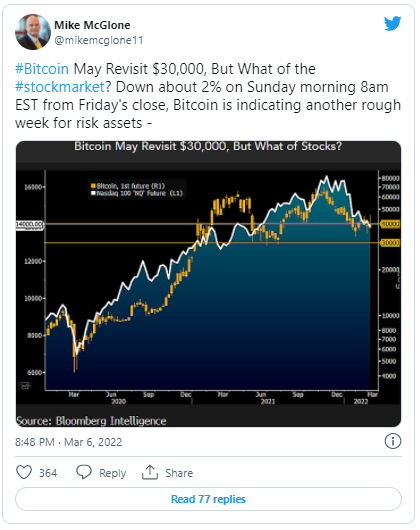
Comparing BTC/USD to the Nasdaq in particular this year, however, McGlone was not of the opinion that the only way is down.
“Bitcoin faces deflationary forces after 2021 excesses, but the crypto shows divergent strength,” part of Twitter comments read Friday.
“With 2002 losses less than half those for the Nasdaq 100, Bitcoin may be maturing toward global digital collateral.”
CME gap sets up $40,000 rematch
Should that be the case, Bitcoin hodlers are in for a choppy ride in the coming days.
Sensitive stocks combined with rocketing commodities prices — an atmosphere of stagflation in the making, some say — hardly provides fertile ground for bullish sentiment.
Overnight on Sunday, BTC/USD wicked down to $37,592 on Bitstamp, marking its lowest levels since late February and wholly erasing its subsequent gains.
Even more frustrating is that the entire move was a repeat of a previous one, cementing the current price range as more definitive support and resistance.
A look at the daily chart from Cointelegraph Markets Pro and TradingView shows just how persistent the range has been — and that in order to exit it, a breakout above the yearly open at $46,200 is needed.

BTC/USD 1-day candle chart (Bitstamp). Source: TradingViewFor trader Matthew Hyland, however, the immediate picture suggests that such a move is unlikely.
“Bitcoin has fallen below the crucial support zone,” he warned on Monday, showing the various price levels he argues figure as support and resistance in the range.
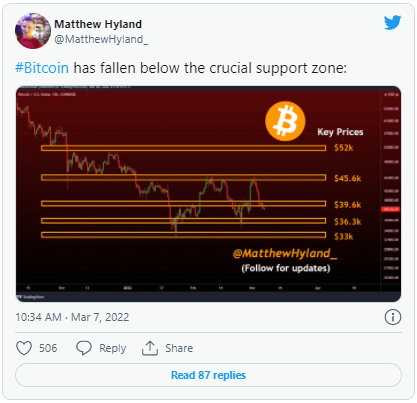
The latest of those to go — around $39,600 — happens to coincide with Friday’s closing price on CME Group’s Bitcoin futures market.
Given Bitcoin’s propensity to return to Friday close levels the following week, the area just below $40,000 could thus form a focus on Monday — and lay the foundations for a support/resistance flip should bulls gain momentum.
“Great choppy movements of Bitcoin, but in the end it will come back to the price of the CME close of Friday evening,” Cointelegraph contributor Michaël van de Poppe summarized.
In a subsequent tweet, Van de Poppe joined McGlone in predicting a “volatile” week ahead.
Traders brace for CPI, rate hike double whammy
Where would the current narrative be without the topic of inflation?
What began as a “temporary” phenomenon has mushroomed into a cornerstone feature of the economic landscape this year — something many crypto industry participants predicted in advance.
The Federal Reserve is now stuck with it, and has been criticized for failing to act quickly enough.
Thus, despite the Russia fallout, lawmakers are eyeing a rate hike this month, and a decision will come on March 16. Prior to that, tension for Bitcoin may increase, as last-minute bets keep traders guessing on the outcome for risk assets.
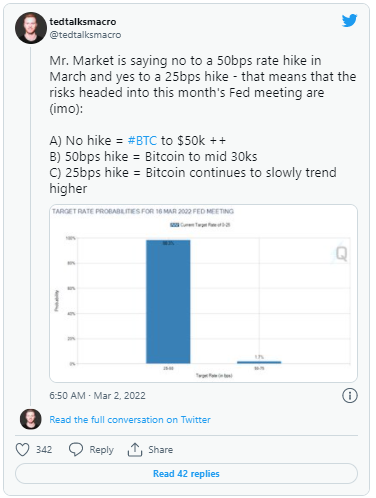
Should a 25 basis point hike be enough to maintain the status quo for Bitcoin, it may already have come too late.
Prior to the Fed announcement, the latest Consumer Price Index (CPI) data for the U.S. is due to hit — and any major deviations from the forecast could upend the delicate balance.
Already at 40-year highs, CPI became infamous last month as Bitcoin put in multiple “fakeout” moves in the hours after the monthly numbers were released.
Extreme, but not extreme enough?
A familiar face shows just how big a hit crypto sentiment has taken in recent days.
As BTC/USD fell from the top of its range, the Crypto Fear & Greed Index fell with it — right back into the “extreme fear” zone.
The bullishness in early March is clearly visible on the Index, which more than doubled its normalized sentiment score to reach 51/100 before proceeding to lose it all again and reach just 22/100.

Crypto Fear & Greed Index (screenshot). Source: Alternative.meFear & Greed uses a basket of factors to depict the mood, and currently suggests that there is room for further deterioration — local market bottoms tend to be accompanied by a score of around 10/100.
“It's a short visioned market, meaning that the horizon is maybe a few days, and sentiment switches,” Van de Poppe added about the current setup.
In a jibe at weak hands, meanwhile, popular trader Crypto Daan argued that even a collapse to $20,000 would not constitute a major trend violation on long enough timeframes for Bitcoin.
“A backtest to 20k, technically wouldn't be bad at all. Not nice for sentiment, but technically nice back test,” he tweeted Sunday.
Reserve Risk enters the green
How on edge are hodlers really?
Related: Top 5 cryptocurrencies to watch this week: BTC, XRP, NEAR, XMR, WAVES
As ever, there is a clear line to be drawn between long-term and short-term BTC investors, with the former still stubbornly riding out the comedown from all-time highs.
One key metric supporting the view that confidence in Bitcoin does not match the price is Reserve Risk.
Created in 2019, Reserve Risk pits sentiment against price in a way that shows when to invest in order to have a good chance of producing what on-chain analytics site LookIntoBitcoin calls “outsized” returns.
Currently, BTC/USD is heading back into the green “buy” zone, indicating that conditions favor long-term investors once more — high confidence and low price.
“It is now entering value btfd territory on macro timeframes as price trends down,” LookIntoBitcoin creator Philip Swift commented on the “very useful” Reserve Risk data.

Bitcoin Reserve Risk chart. Source: LookIntoBitcoin


Related Reads

CRCL 暴涨暴跌,COIN 跟着跳水:CLARITY Act 背后真正的利益战争

A recent draft of the CLARITY Act sparked market volatility, with Circle (CRCL) and Coinbase (COIN) stocks plunging. The core issue is Section 404 of the draft, which proposes prohibiting digital asset service providers from paying interest or rewards *solely* for holding payment stablecoins. The article argues this is not merely a technical debate over rewards, but a fundamental battle over the future role of stablecoins: Will they remain purely payment/transaction tools, or evolve into on-chain savings accounts that compete with bank deposits? US banks, fearing deposit outflow, have lobbied heavily for such restrictions. While Circle and Coinbase were both hit, their exposures differ. Circle's direct revenue primarily comes from reserve earnings, so the draft impacts its future growth narrative. Coinbase, however, relies heavily on USDC rewards and balances as part of its "Everything Exchange" platform strategy, making its growth engine more directly vulnerable. The analysis identifies three deeper layers often missed: 1) The political economy of preventing stablecoins from becoming savings substitutes. 2) The distinct impact on issuers (Circle) versus distributors/platforms (Coinbase). 3) The migration of yield demand to other tokenized securities (like MMFs) regulated under existing frameworks, as hinted in Section 505 of the same draft. In essence, three major battles are underway: banks defending their deposit base, Coinbase fighting for user entry and distribution rights, and Wall Street aiming to control the compliant path for tokenization. While a short-term headwind for crypto-native platforms, the article suggests this regulatory push could force the industry to build more sustainable value in real payment and B2B infrastructure.

marsbit10m ago

CRCL 暴涨暴跌,COIN 跟着跳水:CLARITY Act 背后真正的利益战争

marsbit10m ago

Tom Lee充值信仰:加密春天已至,ETH会涨到25万美元

Tom Lee, Chairman of BitMine (NYSE: BMNR), asserts that "Crypto Spring" has arrived and predicts ETH could reach $250,000. In his speech at "Proof of Talk 2026," he outlines five macro catalysts: the end of the Iran war reducing oil-price inflation, the likely passing of pro-crypto US legislation (the Clarity Act), a supportive White House, a crypto-friendly new Fed Chair (Kevin Warsh), and strong demographic-driven equity market growth. Lee argues that two key trends will drive ETH's value: Agentic AI/robotics, which will require blockchain for control and payments, and the massive tokenization of real-world assets (potentially a $300 trillion market). He believes Ethereum is poised to become a future monetary unit, with its price closely linked to software stocks that are already benefiting from AI. He notes the evolving role of the Ethereum Foundation, whose ETH holdings have shrunk to 0.1% of supply. He positions public treasury companies like BitMine—which holds 4.47% of ETH's circulating supply—as the new key ecosystem funders and validators. Finally, Lee promotes BitMine as a leveraged play on ETH's rise. He highlights BitMine's investments in AI/identity (via Eightco/ORBS), its massive ETH staking operation generating ~$1M daily, its stake in content creator MrBeast, and its upcoming inclusion in the Russell 1000 index, which could drive significant institutional buying. He concludes that if ETH reaches $25,000, BitMine's stock could rise dramatically from its current ~$18 price.

Odaily星球日报27m ago

Tom Lee充值信仰:加密春天已至,ETH会涨到25万美元

Odaily星球日报27m ago

Trading

Spot
Futures

Hot Articles

What is $BITCOIN

DIGITAL GOLD ($BITCOIN): A Comprehensive Analysis Introduction to DIGITAL GOLD ($BITCOIN) DIGITAL GOLD ($BITCOIN) is a blockchain-based project operating on the Solana network, which aims to combine the characteristics of traditional precious metals with the innovation of decentralized technologies. While it shares a name with Bitcoin, often referred to as “digital gold” due to its perception as a store of value, DIGITAL GOLD is a separate token designed to create a unique ecosystem within the Web3 landscape. Its goal is to position itself as a viable alternative digital asset, although specifics regarding its applications and functionalities are still developing. What is DIGITAL GOLD ($BITCOIN)? DIGITAL GOLD ($BITCOIN) is a cryptocurrency token explicitly designed for use on the Solana blockchain. In contrast to Bitcoin, which provides a widely recognized value storage role, this token appears to focus on broader applications and characteristics. Notable aspects include: Blockchain Infrastructure: The token is built on the Solana blockchain, known for its capacity to handle high-speed and low-cost transactions. Supply Dynamics: DIGITAL GOLD has a maximum supply capped at 100 quadrillion tokens (100P $BITCOIN), although details regarding its circulating supply are currently undisclosed. Utility: While precise functionalities are not explicitly outlined, there are indications that the token could be utilized for various applications, potentially involving decentralized applications (dApps) or asset tokenization strategies. Who is the Creator of DIGITAL GOLD ($BITCOIN)? At present, the identity of the creators and development team behind DIGITAL GOLD ($BITCOIN) remains unknown. This situation is typical among many innovative projects within the blockchain space, particularly those aligning with decentralized finance and meme coin phenomena. While such anonymity may foster a community-driven culture, it intensifies concerns about governance and accountability. Who are the Investors of DIGITAL GOLD ($BITCOIN)? The available information indicates that DIGITAL GOLD ($BITCOIN) does not have any known institutional backers or prominent venture capital investments. The project seems to operate on a peer-to-peer model focused on community support and adoption rather than traditional funding routes. Its activity and liquidity are primarily situated on decentralized exchanges (DEXs), such as PumpSwap, rather than established centralized trading platforms, further highlighting its grassroots approach. How DIGITAL GOLD ($BITCOIN) Works The operational mechanics of DIGITAL GOLD ($BITCOIN) can be elaborated on based on its blockchain design and network attributes: Consensus Mechanism: By leveraging Solana’s unique proof-of-history (PoH) combined with a proof-of-stake (PoS) model, the project ensures efficient transaction validation contributing to the network's high performance. Tokenomics: While specific deflationary mechanisms have not been extensively detailed, the vast maximum token supply implies that it may cater to microtransactions or niche use cases that are still to be defined. Interoperability: There exists the potential for integration with Solana’s broader ecosystem, including various decentralized finance (DeFi) platforms. However, the details regarding specific integrations remain unspecified. Timeline of Key Events Here is a timeline that highlights significant milestones concerning DIGITAL GOLD ($BITCOIN): 2023: The initial deployment of the token occurs on the Solana blockchain, marked by its contract address. 2024: DIGITAL GOLD gains visibility as it becomes available for trading on decentralized exchanges like PumpSwap, allowing users to trade it against SOL. 2025: The project witnesses sporadic trading activity and potential interest in community-led engagements, although no noteworthy partnerships or technical advancements have been documented as of yet. Critical Analysis Strengths Scalability: The underlying Solana infrastructure supports high transaction volumes, which could enhance the utility of $BITCOIN in various transaction scenarios. Accessibility: The potential low trading price per token could attract retail investors, facilitating wider participation due to fractional ownership opportunities. Risks Lack of Transparency: The absence of publicly known backers, developers, or an audit process may yield skepticism regarding the project's sustainability and trustworthiness. Market Volatility: The trading activity is heavily reliant on speculative behavior, which can result in significant price volatility and uncertainty for investors. Conclusion DIGITAL GOLD ($BITCOIN) emerges as an intriguing yet ambiguous project within the rapidly evolving Solana ecosystem. While it attempts to leverage the “digital gold” narrative, its departure from Bitcoin's established role as a store of value underscores the need for a clearer differentiation of its intended utility and governance structure. Future acceptance and adoption will likely depend on addressing the current opacity and defining its operational and economic strategies more explicitly. Note: This report encompasses synthesised information available as of October 2023, and developments may have transpired beyond the research period.

363 Total ViewsPublished 2025.05.13Updated 2025.05.13

What is $BITCOIN

Discussions

Welcome to the HTX Community. Here, you can stay informed about the latest platform developments and gain access to professional market insights. Users' opinions on the price of BTC (BTC) are presented below.

活动图片