a16z's Latest Discovery: The Capital Winds Have Shifted, Blowing from 'Bits' to 'Atoms'

marsbitPublished on 2026-08-24Last updated on 2026-08-24

Abstract

In its "Charts of the Week," a16z highlights three structural shifts in the U.S. economy indicating capital and labor are moving from digital ("bits") to physical ("atoms"). First, ETF themes have rotated from clean energy and healthcare in 2020 to AI, nuclear energy, space, defense, and infrastructure by 2026. Second, data center construction is a major economic driver, creating high-wage blue-collar jobs with significant wage premiums (up to 50% for construction workers) and reshaping local economies. Third, ride-hailing prices are rising (Uber fares up ~20% since 2024), while the gig economy sees explosive growth in social commerce. Meanwhile, AI agents, though early-stage, are consuming nearly 5x more tokens than humans and beginning to displace traditional automation tools like Zapier.

Author: Moses Sternstein, a16z

Compiled by: Deep Tide TechFlow

Deep Tide Introduction: This week, a16z's 'Charts of the Week' outlines three forming structural forces in the U.S. economy. Firstly, the themes of ETFs have completely changed in just a few years—from clean energy, emerging market technology, and healthcare in 2020, to AI, nuclear power, space, defense, and infrastructure dominating by 2026. Secondly, data centers are not only behemoths of capital expenditure but are also quietly reshaping blue-collar employment and wages: offering construction workers an hourly wage approximately 50% higher than the market rate. Thirdly, ride-hailing prices are rising, with 'social commerce' emerging strongly in the gig economy. Meanwhile, AI Agents, though in their infancy, are consuming nearly 5 times more tokens than humans and beginning to encroach on traditional automation tools. These three scenarios point to the same conclusion: the winds of capital and labor are shifting from 'bits' back to 'atoms'.

The Wind of Thematic Rotation

ETFs have become an increasingly prominent presence in public markets, especially for retail investors. Beyond thematic ETFs, there are active and passive ETFs, index-tracking ETFs, credit ETFs—a wide variety, with varying degrees of leverage. The surge of ETFs owes much to low fees, low barriers to entry, easier distribution, and excellent marketing (and, of course, an overall increase in retail participation).

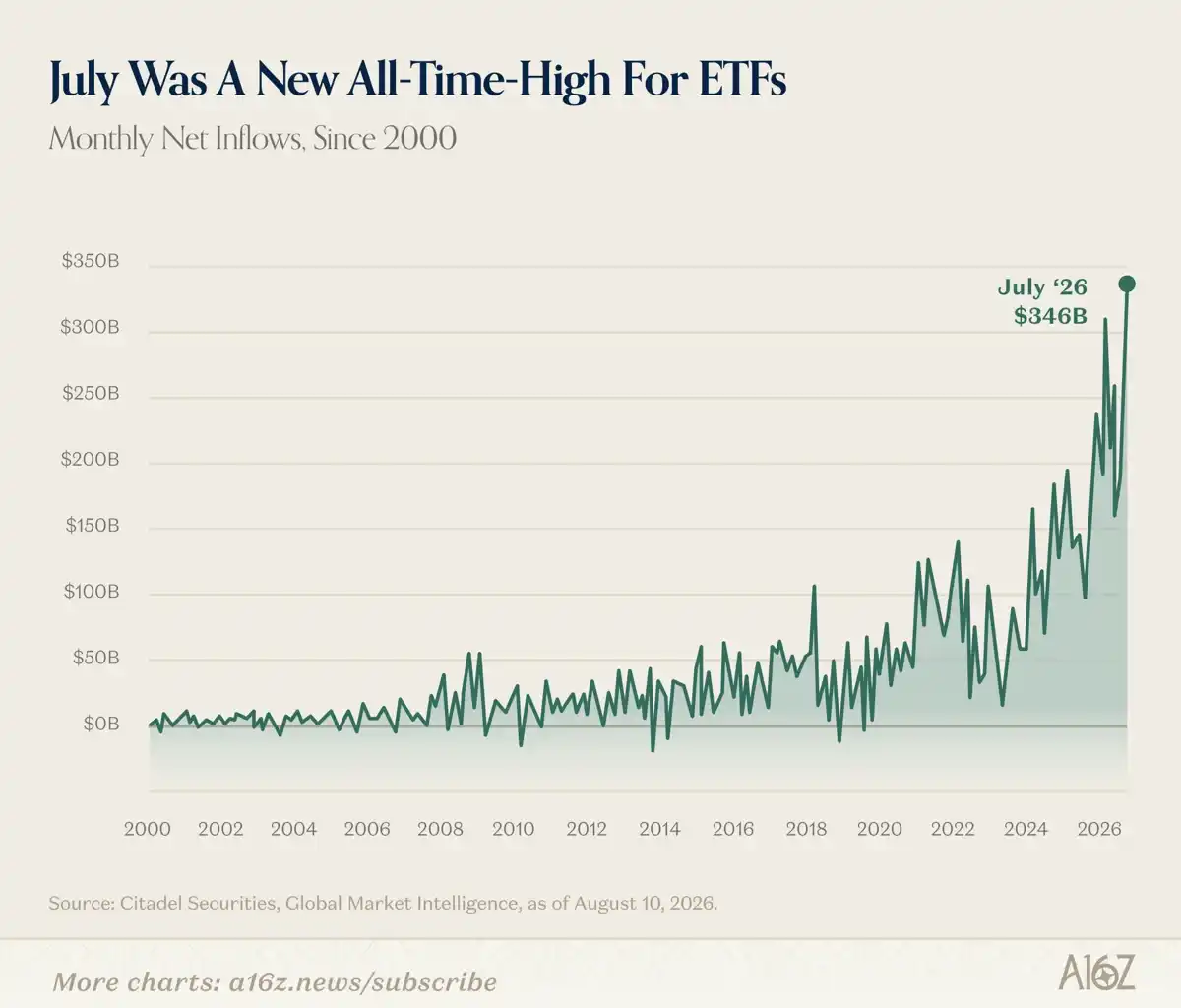
According to Citadel data, ETF net inflows are heading towards their strongest year on record, with July hitting an all-time high.

One thing ETFs excel at is latching onto any hot theme of the moment. "Oh, you think robotics is the next big opportunity? We have an ETF for that. Want to ride the memory chip rocket? You'll love the taste of DRAM. Looking for something spicier? Try our latest photonics product PHOX; it pairs nicely."

That statement is interesting in itself, but perhaps more intriguing is how dramatically the 'themes' of ETFs have rotated in a relatively short period—
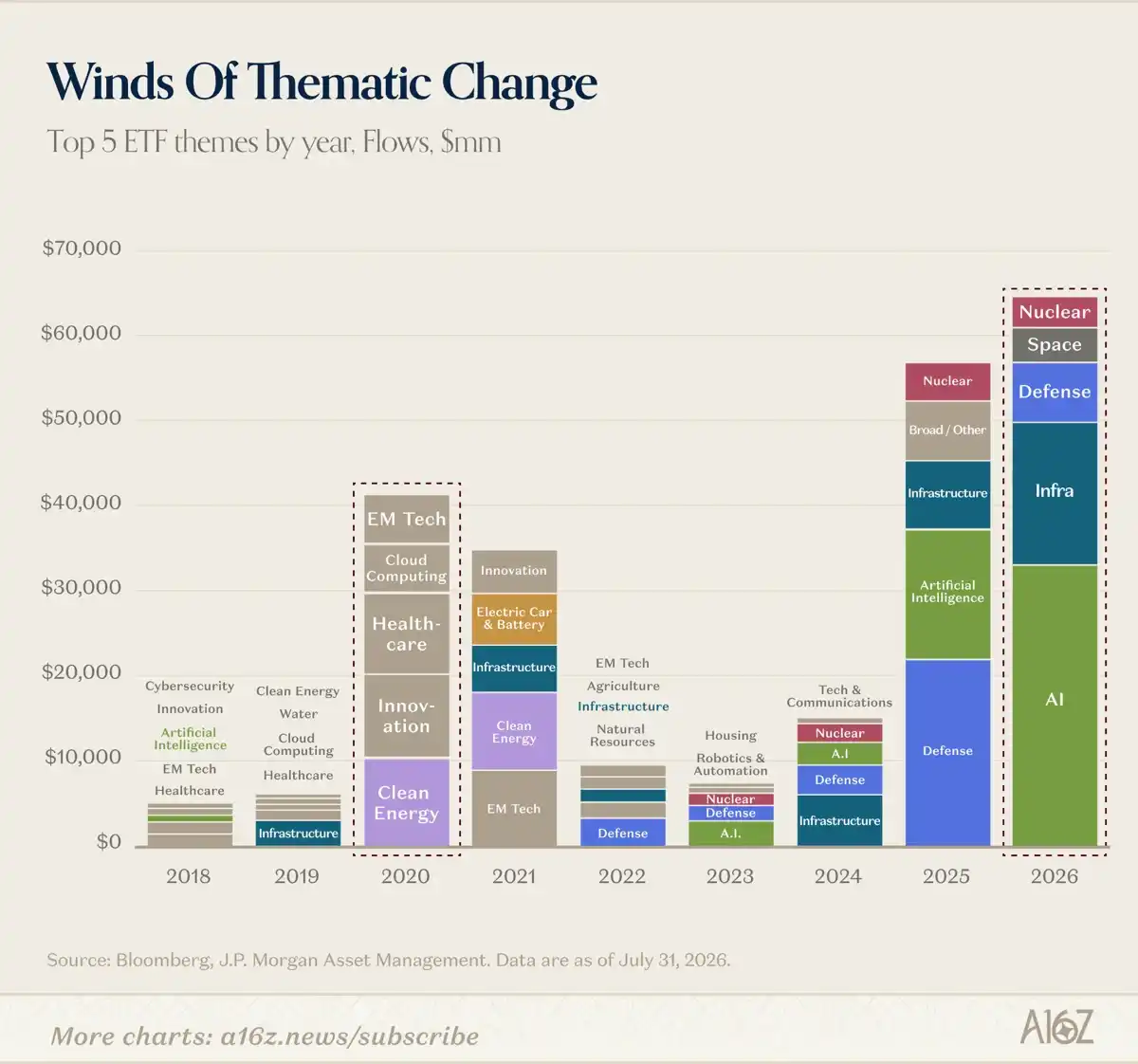
In 2020, the top five themes included clean energy, emerging market technology, and healthcare. By 2026, the thematic narrative has been completely rewritten: AI, nuclear power, space, defense, and infrastructure dominate the rankings.

For capital-intensive, ambitious businesses where 'atoms matter more than bits,' this amounts to an ETF blitz. As for the outcome, the charts cannot predict, but it must be said: 2026 is indeed far more interesting than before.

Data Centers Are a Boon for Blue-Collar Workers

People might love putting data centers into their ETFs, but somehow, they increasingly dislike seeing data centers near their homes.

I don't intend to jump into that debate prematurely (at least not yet). I'll just say this: whether you like it or not, data centers are economically significant, and in some cases, they are the most important thing locally.

For states that are actually building data centers, this construction represents a significant portion of all non-residential building expenditures:

New Mexico and Wyoming aren't building much—under 3 gigawatts under construction—but because these states don't have much construction activity to begin with, data centers account for about 60%(!) of private non-residential building spending. Even in a much larger state like Pennsylvania, a mere ~3 GW of data centers approaches 30% of non-residential spending. In contrast, Texas, with much more capacity under construction, only accounts for 10% of total spending—still substantial but far less dramatic than 60%.

Regardless, no matter your view on data centers, one fact remains unchanged: they are one of the most important (if not *the* most important) economic pulses at present.

Wells Fargo attempted to parse the 'notable economic benefits' accompanying data centers (whether operational or under construction):
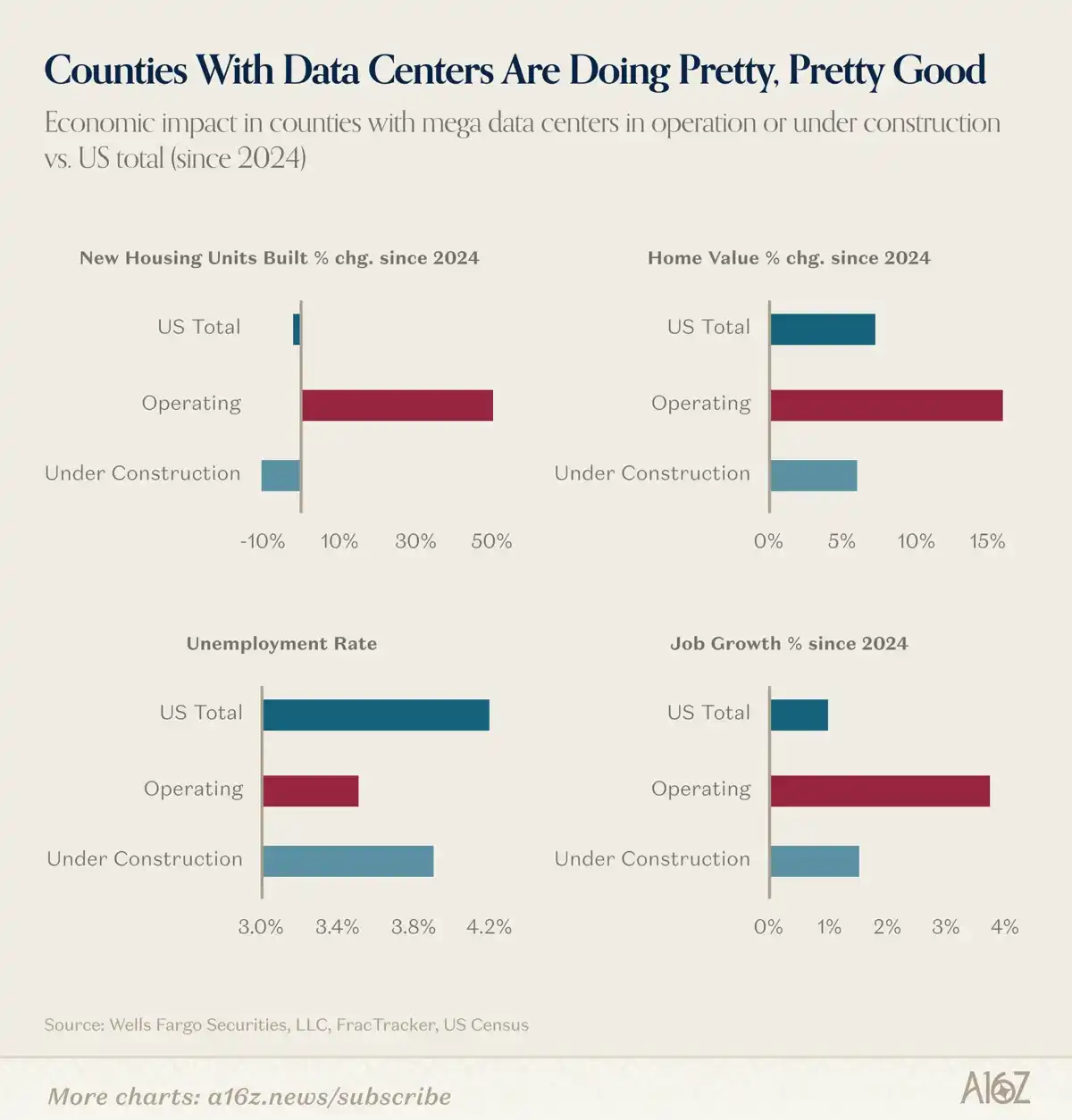
Since 2024, counties with operational data centers have uniformly better metrics: more housing, higher home prices, lower unemployment, faster employment growth. For counties building data centers, employment conditions are indeed better, but new housing construction has seen a more noticeable decline, and home price increases aren't as high.

To be fair, causality here isn't clear-cut. Many existing (and new) data centers are in Loudoun County, Virginia—one of the wealthiest counties in the U.S. Similarly, many new data centers are in Texas, which experienced historic residential construction (and home price increases) before 2024, so the housing decline starts from a much higher base.

But back to the point above: building a data center is almost certainly good for employment. Beyond the hundreds of hard-hat jobs being created, data centers offer significantly better pay than comparable employers:

According to Indeed data, data centers offer wage premiums as high as 64% (facility manager), and even the lowest-paid electrical engineers see a 10% premium.
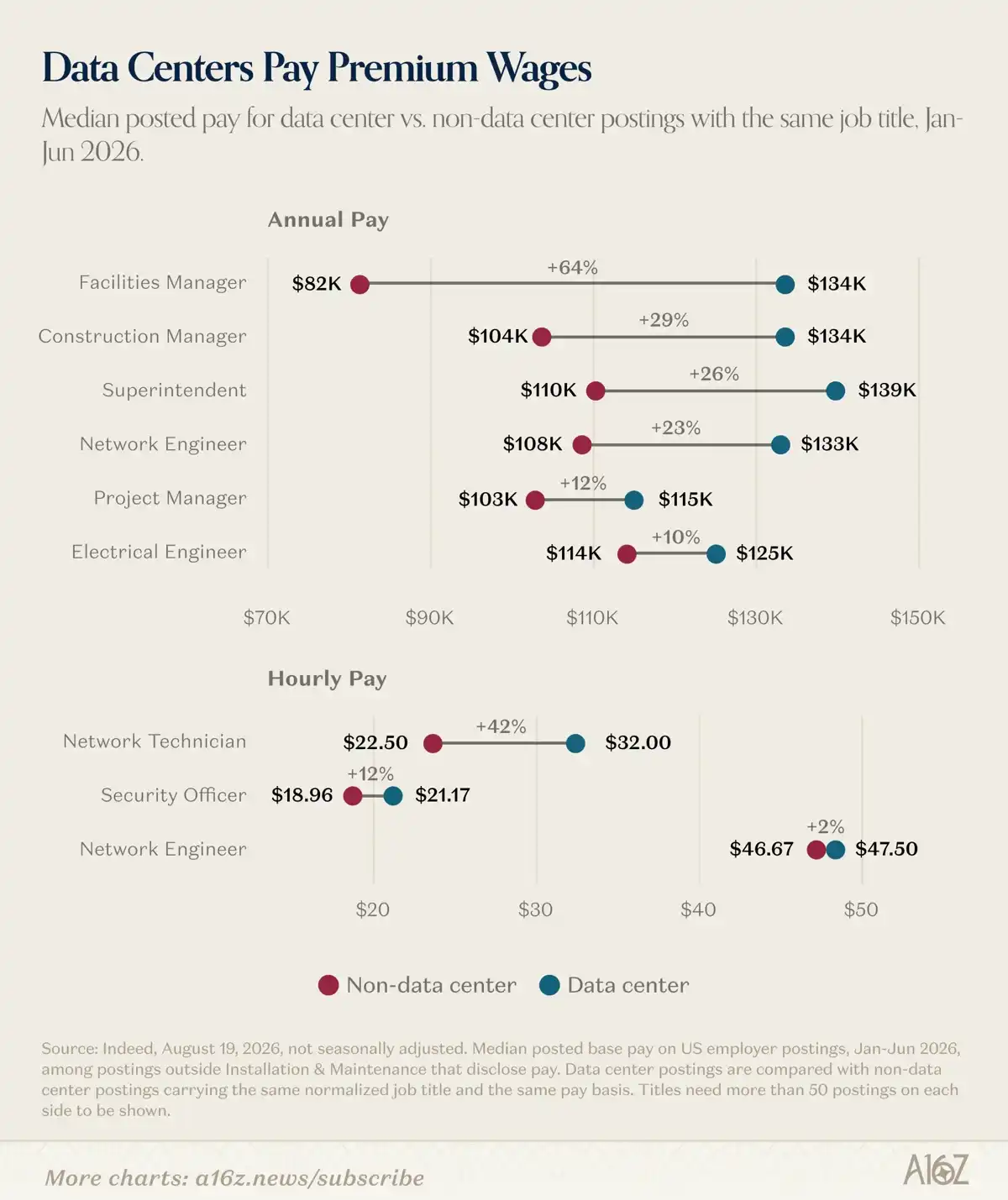
Data centers are making good times even brighter for skilled trades. A recent commentary from a Dallas Fed report hits the nail on the head:

A heavy industrial construction contractor stated: "We've been offering what we thought were competitive wages for skilled concrete workers, $28–$32 per hour. Data centers are offering $45 per hour, plus a $150 per day per diem."

For concrete workers on data centers, that's about a 50% wage premium—a life-changing raise.

ADP data tells a similar story. Looking at wage premiums for job switchers—a proxy for 'where demand is hot,' since a raise is needed to induce someone to change jobs—premiums for data-center-related categories are simply 'sizzling':
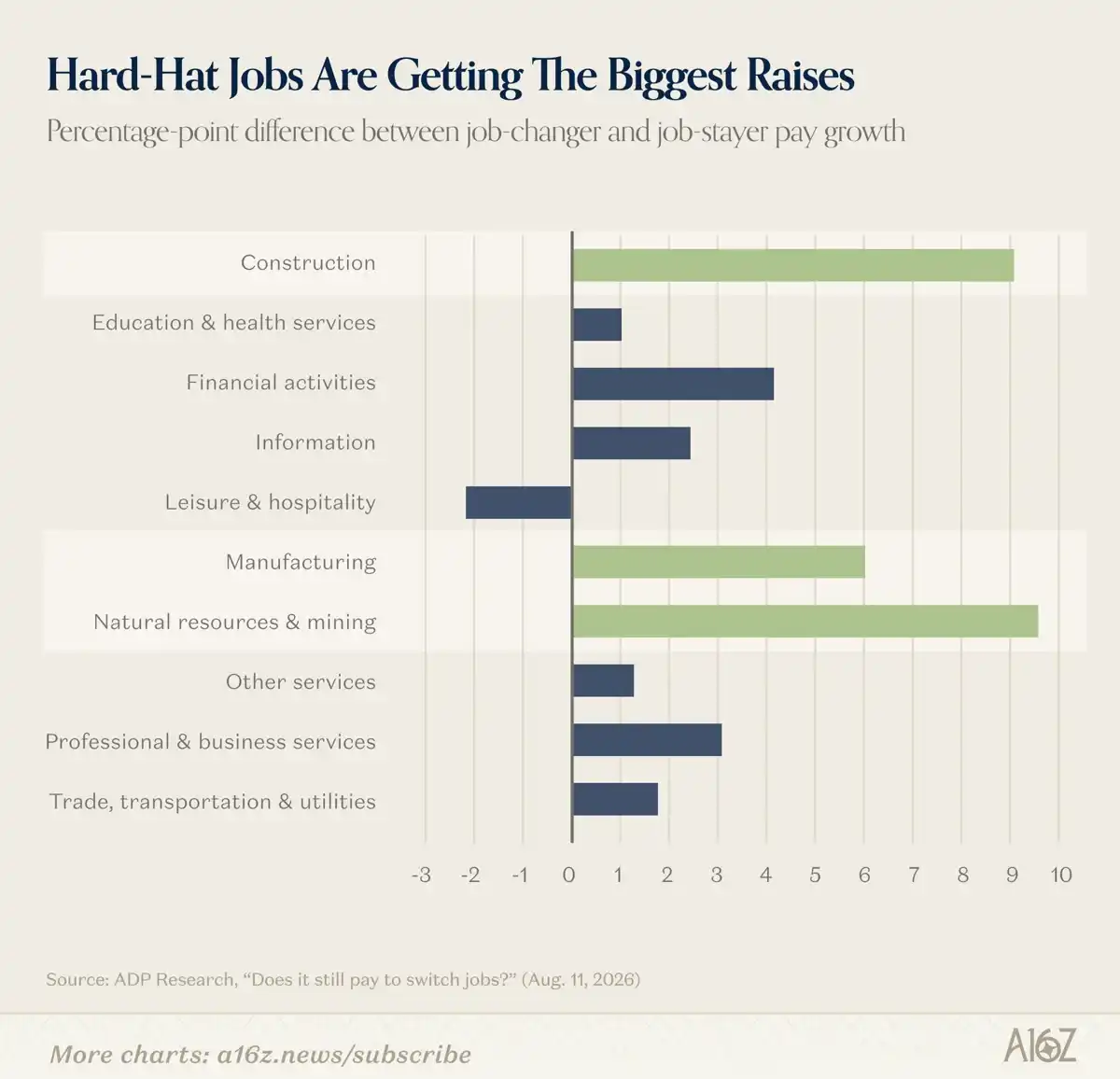
Wage growth for job switchers in construction, manufacturing, and natural resources/mining is 6–9.5 percentage points higher than for those who stay. This switching premium far exceeds that of any other industry.

Again, the point here is not to deliver a definitive defense of data centers. The point is to note: saying 'no' to data centers almost certainly means saying 'no' to higher wages for blue-collar workers (and the surrounding most substantial investment pulse).

Ride-Hailing Is Indeed More Expensive—It's Not Your Imagination

If you feel Uber rides have been more expensive lately, it's probably because—they are. At least, that's what Gridwise Analytics data suggests.

Since 2024, both the average and median Uber fares have increased by about 20% (and seem to keep climbing):

Notably, during this period, only Uber has increased prices—Lyft's median and average fares are actually slightly cheaper than at the start of 2024 (overall about 24% lower than Uber), although they have also risen recently.

A significant source of the price increase seems to be rising platform fees, especially for Uber:
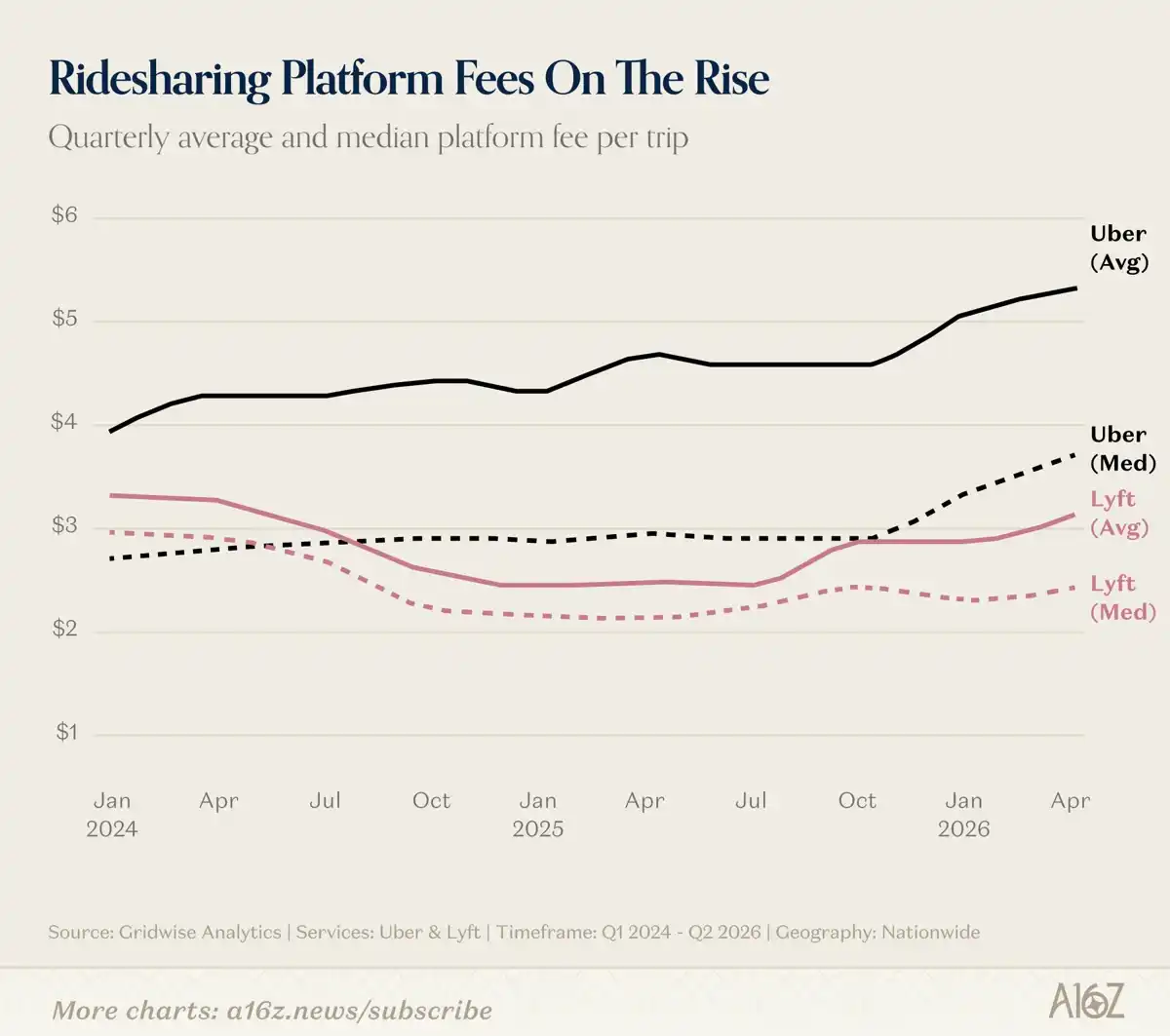
Uber's platform fees have been steadily rising over the past year (median fees jumped noticeably in October), while Lyft's platform fees, after a period of significant decline, have only just started to rise.

This is good for Uber and good for Lyft.

To be fair, it's not just the platforms benefiting—Uber/Lyft drivers are also getting a share:

Average gross driver earnings per trip have also been rising continuously since 2024, recently hitting an all-time high.

In the long term, whether higher ride-hailing prices will put downward pressure on demand remains to be seen; but for now, fares are getting more expensive, and the gains are flowing to both platforms and drivers.

Another interesting aside: despite the overall weak hiring market, besides more people starting their own businesses, more are also turning to 'gig' work—likely partly attracted by rising earnings.

However, while ride-hailing gigs are growing in popularity, they are far from the fastest-growing type of gig. The hottest new thing in the gig space is undoubtedly 'social commerce,' the QVC of the social media era:

In Bank of America's client accounts, all categories of gig work grew except vacation rentals, but social commerce surged over 30%, far outpacing any other category—despite a smaller base.

Exactly why social commerce is exploding is anyone's guess. Perhaps it's the shift of media consumption from TV to social, combined with the broader e-commerce boom; it's also likely that AI has lowered the cost of all other aspects of running a social-media version of QVC, making social commerce a more sustainable livelihood for more people. Or maybe Instagram's ad targeting is just too precise to resist. Or perhaps all of the above.

AI Agents Are Early, But Already Changing the Game (And Other Stories from the Frontier)

Charts previously observed: although overall AI demand is rising, growth is far from normally distributed. There's a massive divergence in usage between median and heavy users, and recent data from OpenAI (OAI) suggests this divergence is widening further.

Output tokens for the typical enterprise roughly doubled, but the top 10% are pulling further away:
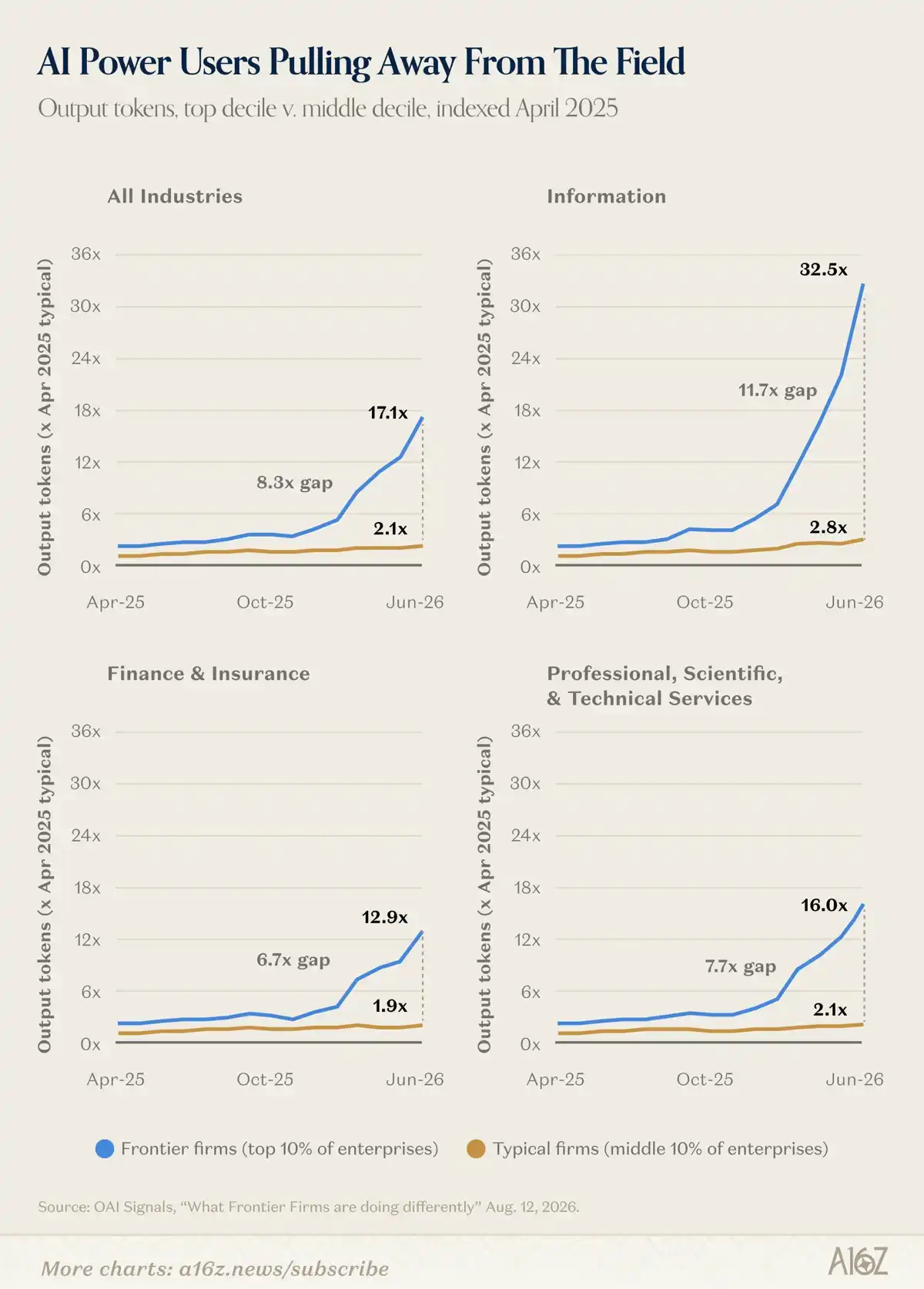
Across all industries, the token output gap between the typical enterprise and the top 10% is about 8x, with the latter's output growing over 17x since April 2025. In certain specific industries, the gap is larger—close to 12x in the Information (i.e., tech) sector, where the top 10%'s token output is 32.5x(!) higher than over a year ago.

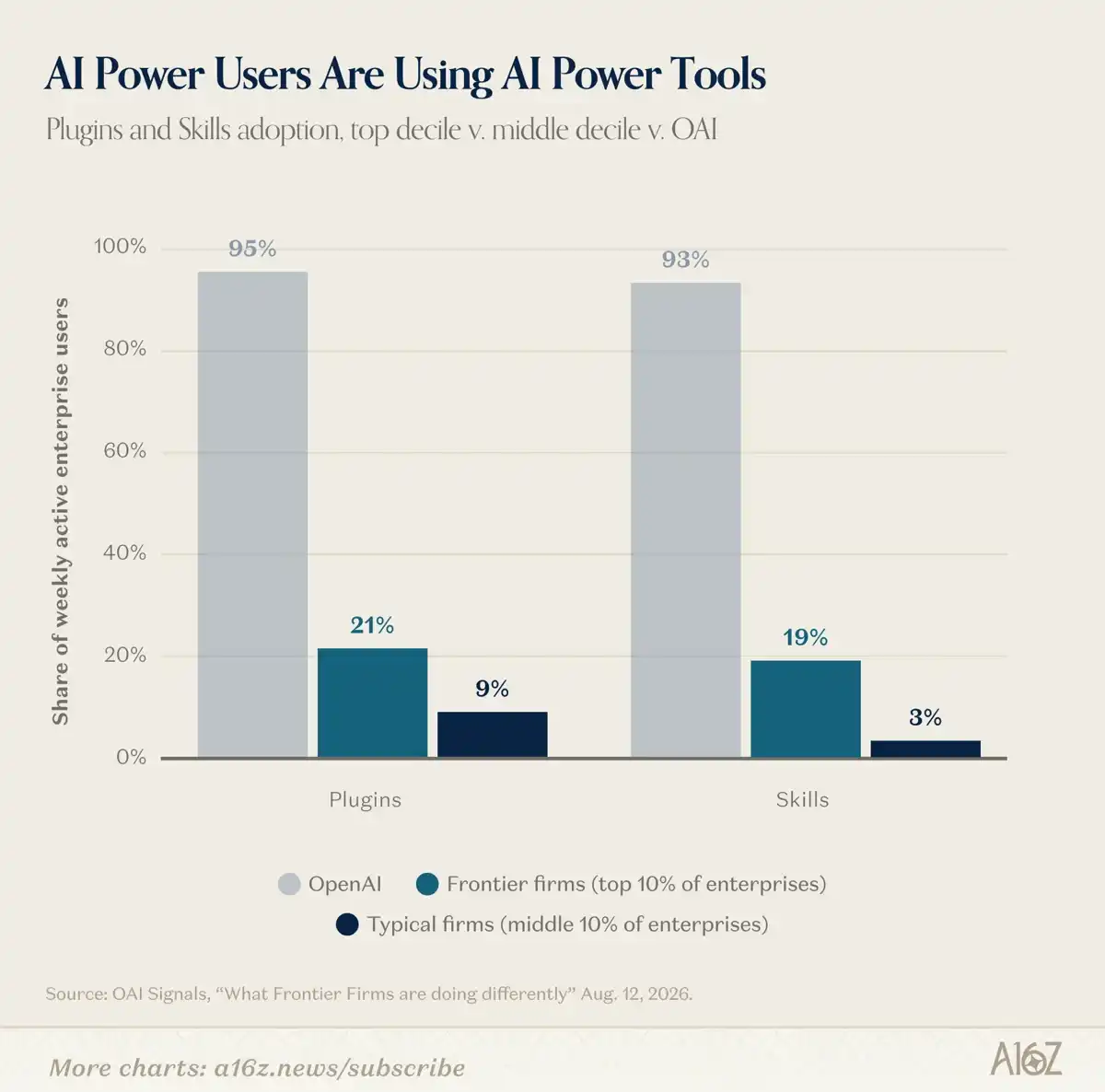
Unsurprisingly, heavy users aren't generating more tokens by chatting with AI companions. They have largely moved beyond chatting toward more advanced AI tools:

The adoption rate of plugins and Skills among the top 10% is about 2x and 6x that of the typical enterprise, respectively, although even heavy users have a long way to go compared to OAI's internal adoption levels.
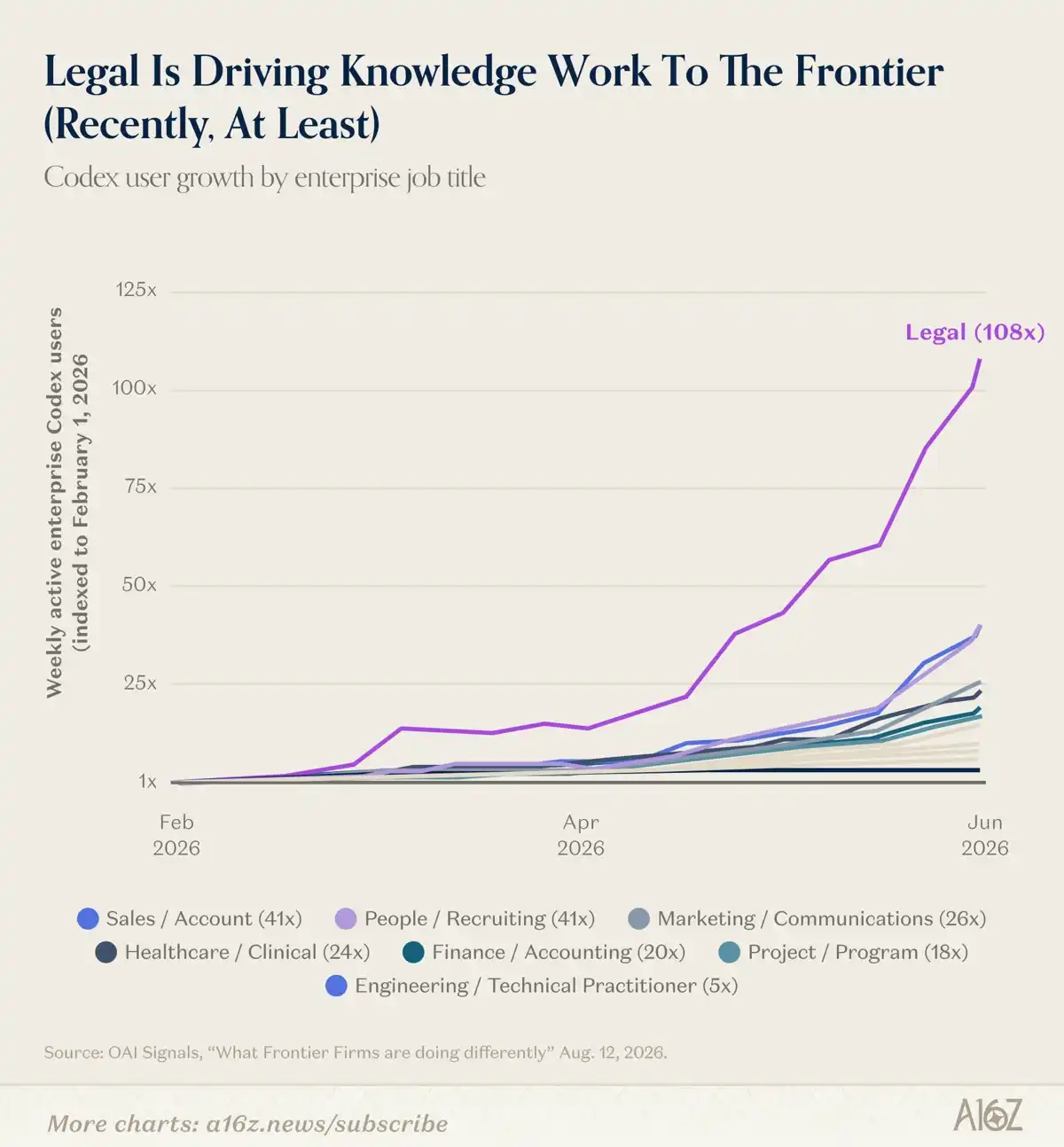
However, interestingly, tech is not the sector with the fastest recent growth in adopting more powerful tools. If Codex adoption is used as a measure of maturity, then overall knowledge worker maturity is increasing, but no group stands out more than legal professionals:

Codex adoption among legal practitioners has skyrocketed 108x since February 2026. How much of this is driven by broader Codex rollouts is debatable, but regardless, the legal field stands out.
Another implication of this shift towards more sophisticated AI adoption is that it is dramatically changing the growth and composition of token consumption.

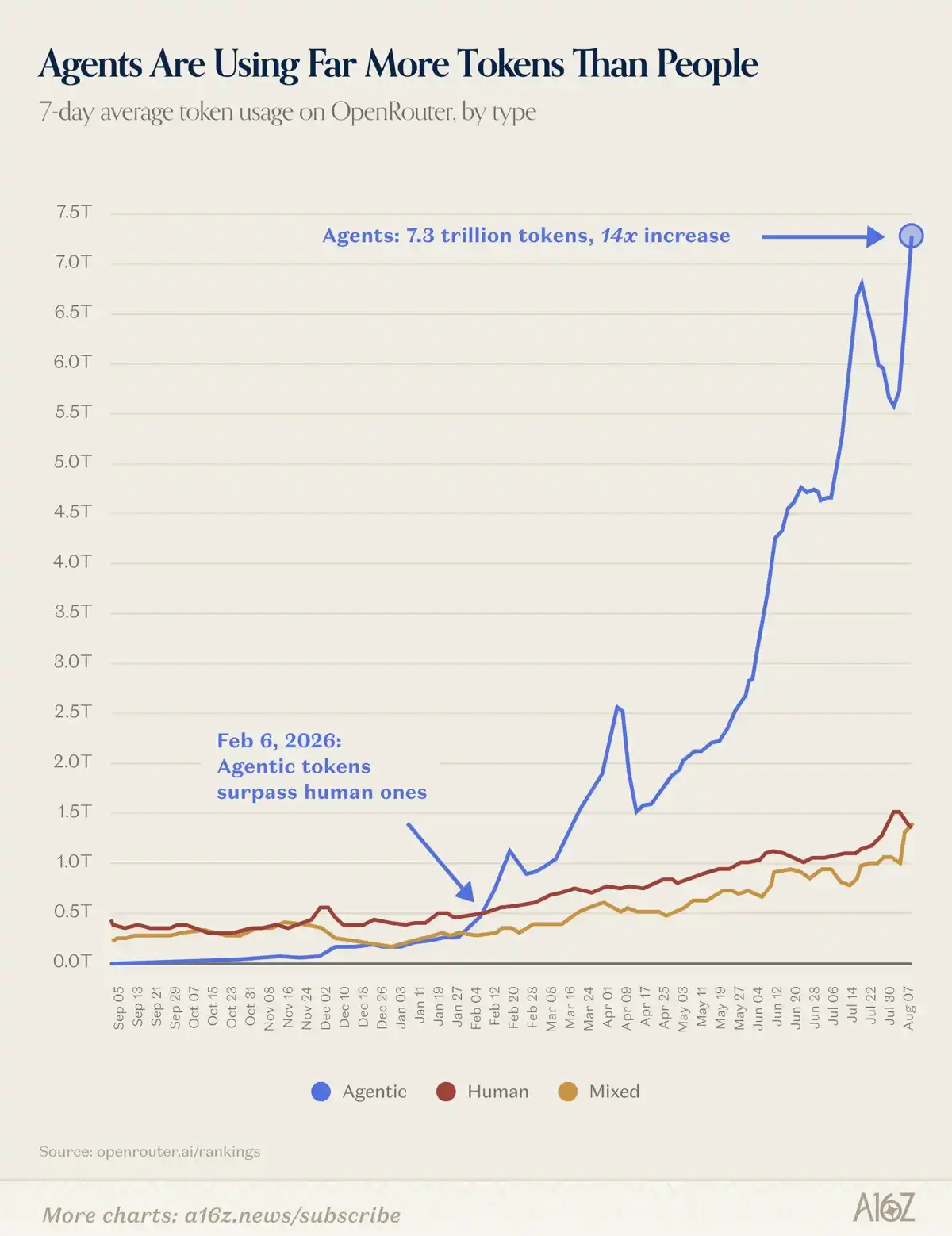
Although only a tiny fraction of AI adopters have deployed full Agents, Agents contribute a massive share of tokens:

According to OpenRouter (and chart author Peter Walker), Agents use almost 5x more tokens than humans, and Agent usage has grown about 14x since February.
Agents not only use far more tokens than humans but also use them in a fundamentally different way. Agents do much more work with cached tokens than humans do:

Also according to OpenRouter, over 85% of Agent token consumption comes from cached prompts—and cached tokens constitute almost all of the relative growth in token usage.
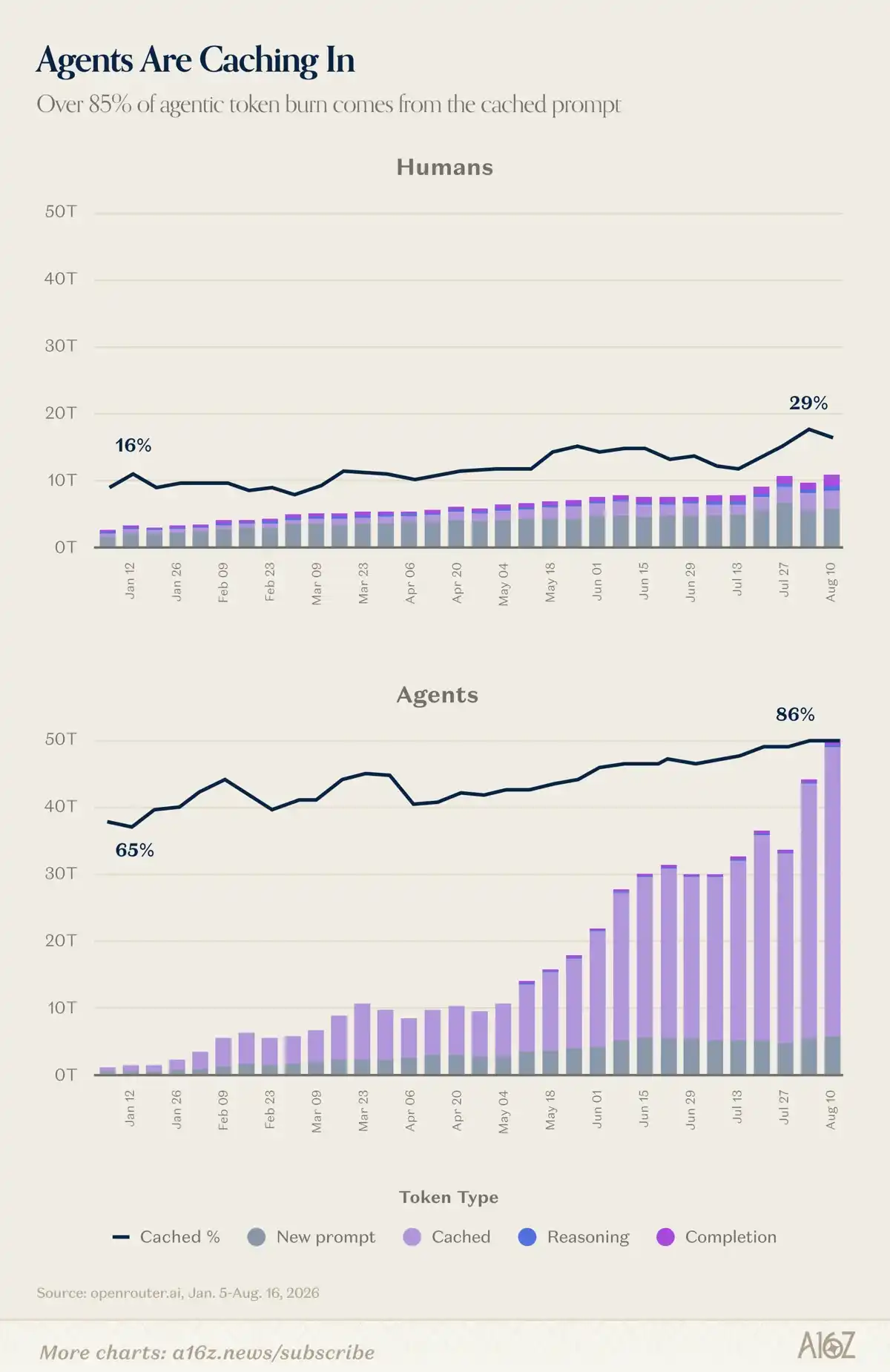
The reason is fairly straightforward: humans tend toward 'question-answer' dialogues, while Agents are designed to iterate repeatedly toward a goal. The initial prompt contains token-dense 'pre-fill' (i.e., core context around the goal, be it policy processes, code specifications, etc.), then the Agent incrementally reads and writes—progressively adding content to the cache as it moves toward a final result.

Cached tokens are far cheaper than pre-fill—this is good, making Agent economics increasingly viable—but (by definition) are also extremely memory-intensive. Now you understand why high-bandwidth memory is especially sought after—all those busy Agents (which don't need to start from scratch each cycle) need memory to 'fire.' And though overall development remains very early, Agents are proliferating rapidly.

Another notable potential second-order effect of Agents: they may be undermining demand for traditional automation and workflow tools.

According to Similarweb data, traffic to automation tool websites is consistently declining, except for Gumloop:

N8N, Zapier, and Make all predate LLMs, and although they dominate the entire automation segment (by visits), each has seen double-digit declines on a rolling 12-week basis. In contrast, Gumloop, launched in 2023 as an 'AI-native Agent builder,' is the only automation platform still gaining momentum (per Similarweb).

It's too early to pronounce death on the Zapiers—they have AI too—but Agents have just arrived and are already substantively changing the game.

To be continued.

Trending Cryptos

Related Questions

QWhat is the main conclusion of the a16z report regarding capital and labor trends?

AThe main conclusion is that the direction of capital and labor is shifting from the digital ('bits') back towards the physical ('atoms'). This is evidenced by changes in ETF themes, significant investment in data centers impacting blue-collar jobs, and rising prices in services like ride-hailing.

QHow have the themes of top-performing ETFs changed from 2020 to 2026 according to the article?

AIn 2020, the top themes were clean energy, emerging market tech, and healthcare. By 2026, the leading themes have completely shifted to AI, nuclear energy, space, defense, and infrastructure, reflecting a move towards capital-intensive 'atoms'-focused industries.

QWhat economic impact do data centers have on local employment and wages?

AData centers create a significant number of construction jobs and offer substantial wage premiums. For example, concrete workers for data centers can earn about a 50% higher hourly wage compared to the market rate. Data center-related roles, such as facility managers, can command wage premiums as high as 64%, significantly boosting local blue-collar employment and income.

QWhat is the trend in Uber and Lyft pricing as described in the article?

ASince 2024, Uber's average and median fares have increased by about 20% and continue to rise, largely due to increasing platform fees. In contrast, Lyft's fares were slightly cheaper than at the start of 2024 and about 24% lower than Uber's on average, though they have recently started to increase as well. Drivers for both platforms have also seen their gross earnings per trip rise to record highs.

QWhat role do AI Agents play in the current AI landscape according to the report?

AAI Agents, though still in early stages, are consuming nearly 5 times more tokens than human users and are growing rapidly. They operate differently, heavily utilizing cached tokens for iterative tasks, which is more memory-intensive. Their rise is also potentially disrupting demand for traditional automation and workflow tools like Zapier, as seen with the growth of AI-native platforms like Gumloop.

Related Reads

Altcoin Hacked, Leading to Sharp Price Drop! Also Listed on Major Exchanges!

The price of the NES token plummeted significantly following suspicious activity and large sell-offs detected on the network. Blockchain observers suggested that one wallet minted approximately $55 million worth of NES tokens and began selling them on decentralized exchanges. This selling pressure caused the price of NES to drop by up to 40%. According to the data, the address in question still holds around $18 million worth of NES, indicating that market sell-off pressure may continue. Prior to the incident, it was reported that about $12.35 million worth (62.9 million NES tokens) were transferred to the Ethereum mainnet in the morning (Turkish time), with claims that liquidity was withdrawn and tokens were sold on the market later that evening. However, data regarding the $55 million token mint and the transfer of 62.9 million NES tokens has not been independently confirmed. The NESA team confirmed in a statement that they detected malicious activity exploiting a vulnerability in their Layer 1 network originating from Cosmos EVM. They stated they are working to contain the impact, responded promptly, and will restore services after implementing a software patch and additional measures to ensure secure network operation. Nesa also notified all cryptocurrency exchanges and stated deposit operations will resume after necessary work is completed. The article includes a chart showing the NES price decline following the exploit and concludes with a standard disclaimer that this is not investment advice.

cryptonews.ru27m ago

Altcoin Hacked, Leading to Sharp Price Drop! Also Listed on Major Exchanges!

cryptonews.ru27m ago

PeaqOS and World ID Integrate ZK Proofs into Autonomous Robots

The integration of PeaqOS and World ID now allows autonomous machines to verify they are interacting with real, unique individuals without collecting names, photos, or other personal data. This update, available via robotic.sh, enables connected devices to directly request and verify World ID proofs. The system leverages zero-knowledge technology, letting a person prove they are human while maintaining the privacy of their identity. This addresses a key challenge for operators of delivery robots, shared machines, and autonomous systems: how to authenticate a user as genuine without relying on insecure PINs, pickup codes, or traditional identity checks that require personal data collection. Instead of obtaining identifying information, a device receives a cryptographic proof that the user is a real person. PeaqOS acts as a coordination layer, allowing devices to utilize World ID via decentralized identifiers and a device marketplace. A robot can request verification, receive a zero-knowledge proof, and register an auditable record of the interaction—all without exposing underlying personal data. The system also supports uniqueness verification, enabling machines to enforce rules like "one item per person" without maintaining user identity databases. A demonstrated use case involves autonomous medicine delivery: a patient verifies via the World App when placing an order, a pharmacist verifies before loading the medication, and the patient verifies again upon delivery so the robot can confirm the recipient is linked to the order before unlocking the compartment. Similarly, promotional robots could ensure one item per person, and shared vending machines could grant access to verified individuals without requiring accounts or personal data. This integration for PeaqOS-powered robots and devices minimizes the identity information collected or stored while allowing autonomous systems to confirm they are interacting with real humans.

cryptonews.ru1h ago

PeaqOS and World ID Integrate ZK Proofs into Autonomous Robots

cryptonews.ru1h ago

Trading

Spot

Hot Articles

What is SONIC

Sonic: Pioneering the Future of Gaming in Web3 Introduction to Sonic In the ever-evolving landscape of Web3, the gaming industry stands out as one of the most dynamic and promising sectors. At the forefront of this revolution is Sonic, a project designed to amplify the gaming ecosystem on the Solana blockchain. Leveraging cutting-edge technology, Sonic aims to deliver an unparalleled gaming experience by efficiently processing millions of requests per second, ensuring that players enjoy seamless gameplay while maintaining low transaction costs. This article delves into the intricate details of Sonic, exploring its creators, funding sources, operational mechanics, and the timeline of significant events that have shaped its journey. What is Sonic? Sonic is an innovative layer-2 network that operates atop the Solana blockchain, specifically tailored to enhance the existing Solana gaming ecosystem. It accomplishes this through a customised, VM-agnostic game engine paired with a HyperGrid interpreter, facilitating sovereign game economies that roll up back to the Solana platform. The primary goals of Sonic include: Enhanced Gaming Experiences: Sonic is committed to offering lightning-fast on-chain gameplay, allowing players and developers to engage with games at previously unattainable speeds. Atomic Interoperability: This feature enables transactions to be executed within Sonic without the need to redeploy Solana programmes and accounts. This makes the process more efficient and directly benefits from Solana Layer1 services and liquidity. Seamless Deployment: Sonic allows developers to write for Ethereum Virtual Machine (EVM) based systems and execute them on Solana’s SVM infrastructure. This interoperability is crucial for attracting a broader range of dApps and decentralised applications to the platform. Support for Developers: By offering native composable gaming primitives and extensible data types - dining within the Entity-Component-System (ECS) framework - game creators can craft intricate business logic with ease. Overall, Sonic's unique approach not only caters to players but also provides an accessible and low-cost environment for developers to innovate and thrive. Creator of Sonic The information regarding the creator of Sonic is somewhat ambiguous. However, it is known that Sonic's SVM is owned by the company Mirror World. The absence of detailed information about the individuals behind Sonic reflects a common trend in several Web3 projects, where collective efforts and partnerships often overshadow individual contributions. Investors of Sonic Sonic has garnered considerable attention and support from various investors within the crypto and gaming sectors. Notably, the project raised an impressive $12 million during its Series A funding round. The round was led by BITKRAFT Ventures, with other notable investors including Galaxy, Okx Ventures, Interactive, Big Brain Holdings, and Mirana. This financial backing signifies the confidence that investment foundations have in Sonic’s potential to revolutionise the Web3 gaming landscape, further validating its innovative approaches and technologies. How Does Sonic Work? Sonic utilises the HyperGrid framework, a sophisticated parallel processing mechanism that enhances its scalability and customisability. Here are the core features that set Sonic apart: Lightning Speed at Low Costs: Sonic offers one of the fastest on-chain gaming experiences compared to other Layer-1 solutions, powered by the scalability of Solana’s virtual machine (SVM). Atomic Interoperability: Sonic enables transaction execution without redeployment of Solana programmes and accounts, effectively streamlining the interaction between users and the blockchain. EVM Compatibility: Developers can effortlessly migrate decentralised applications from EVM chains to the Solana environment using Sonic’s HyperGrid interpreter, increasing the accessibility and integration of various dApps. Ecosystem Support for Developers: By exposing native composable gaming primitives, Sonic facilitates a sandbox-like environment where developers can experiment and implement business logic, greatly enhancing the overall development experience. Monetisation Infrastructure: Sonic natively supports growth and monetisation efforts, providing frameworks for traffic generation, payments, and settlements, thereby ensuring that gaming projects are not only viable but also sustainable financially. Timeline of Sonic The evolution of Sonic has been marked by several key milestones. Below is a brief timeline highlighting critical events in the project's history: 2022: The Sonic cryptocurrency was officially launched, marking the beginning of its journey in the Web3 gaming arena. 2024: June: Sonic SVM successfully raised $12 million in a Series A funding round. This investment allowed Sonic to further develop its platform and expand its offerings. August: The launch of the Sonic Odyssey testnet provided users with the first opportunity to engage with the platform, offering interactive activities such as collecting rings—a nod to gaming nostalgia. October: SonicX, an innovative crypto game integrated with Solana, made its debut on TikTok, capturing the attention of over 120,000 users within a short span. This integration illustrated Sonic’s commitment to reaching a broader, global audience and showcased the potential of blockchain gaming. Key Points Sonic SVM is a revolutionary layer-2 network on Solana explicitly designed to enhance the GameFi landscape, demonstrating great potential for future development. HyperGrid Framework empowers Sonic by introducing horizontal scaling capabilities, ensuring that the network can handle the demands of Web3 gaming. Integration with Social Platforms: The successful launch of SonicX on TikTok displays Sonic’s strategy to leverage social media platforms to engage users, exponentially increasing the exposure and reach of its projects. Investment Confidence: The substantial funding from BITKRAFT Ventures, among others, emphasizes the robust backing Sonic has, paving the way for its ambitious future. In conclusion, Sonic encapsulates the essence of Web3 gaming innovation, striking a balance between cutting-edge technology, developer-centric tools, and community engagement. As the project continues to evolve, it is poised to redefine the gaming landscape, making it a notable entity for gamers and developers alike. As Sonic moves forward, it will undoubtedly attract greater interest and participation, solidifying its place within the broader narrative of blockchain gaming.

2.4k Total ViewsPublished 2024.04.04Updated 2024.12.03

What is SONIC

What is $S$

Understanding SPERO: A Comprehensive Overview Introduction to SPERO As the landscape of innovation continues to evolve, the emergence of web3 technologies and cryptocurrency projects plays a pivotal role in shaping the digital future. One project that has garnered attention in this dynamic field is SPERO, denoted as SPERO,$$s$. This article aims to gather and present detailed information about SPERO, to help enthusiasts and investors understand its foundations, objectives, and innovations within the web3 and crypto domains. What is SPERO,$$s$? SPERO,$$s$ is a unique project within the crypto space that seeks to leverage the principles of decentralisation and blockchain technology to create an ecosystem that promotes engagement, utility, and financial inclusion. The project is tailored to facilitate peer-to-peer interactions in new ways, providing users with innovative financial solutions and services. At its core, SPERO,$$s$ aims to empower individuals by providing tools and platforms that enhance user experience in the cryptocurrency space. This includes enabling more flexible transaction methods, fostering community-driven initiatives, and creating pathways for financial opportunities through decentralised applications (dApps). The underlying vision of SPERO,$$s$ revolves around inclusiveness, aiming to bridge gaps within traditional finance while harnessing the benefits of blockchain technology. Who is the Creator of SPERO,$$s$? The identity of the creator of SPERO,$$s$ remains somewhat obscure, as there are limited publicly available resources providing detailed background information on its founder(s). This lack of transparency can stem from the project's commitment to decentralisation—an ethos that many web3 projects share, prioritising collective contributions over individual recognition. By centring discussions around the community and its collective goals, SPERO,$$s$ embodies the essence of empowerment without singling out specific individuals. As such, understanding the ethos and mission of SPERO remains more important than identifying a singular creator. Who are the Investors of SPERO,$$s$? SPERO,$$s$ is supported by a diverse array of investors ranging from venture capitalists to angel investors dedicated to fostering innovation in the crypto sector. The focus of these investors generally aligns with SPERO's mission—prioritising projects that promise societal technological advancement, financial inclusivity, and decentralised governance. These investor foundations are typically interested in projects that not only offer innovative products but also contribute positively to the blockchain community and its ecosystems. The backing from these investors reinforces SPERO,$$s$ as a noteworthy contender in the rapidly evolving domain of crypto projects. How Does SPERO,$$s$ Work? SPERO,$$s$ employs a multi-faceted framework that distinguishes it from conventional cryptocurrency projects. Here are some of the key features that underline its uniqueness and innovation: Decentralised Governance: SPERO,$$s$ integrates decentralised governance models, empowering users to participate actively in decision-making processes regarding the project’s future. This approach fosters a sense of ownership and accountability among community members. Token Utility: SPERO,$$s$ utilises its own cryptocurrency token, designed to serve various functions within the ecosystem. These tokens enable transactions, rewards, and the facilitation of services offered on the platform, enhancing overall engagement and utility. Layered Architecture: The technical architecture of SPERO,$$s$ supports modularity and scalability, allowing for seamless integration of additional features and applications as the project evolves. This adaptability is paramount for sustaining relevance in the ever-changing crypto landscape. Community Engagement: The project emphasises community-driven initiatives, employing mechanisms that incentivise collaboration and feedback. By nurturing a strong community, SPERO,$$s$ can better address user needs and adapt to market trends. Focus on Inclusion: By offering low transaction fees and user-friendly interfaces, SPERO,$$s$ aims to attract a diverse user base, including individuals who may not previously have engaged in the crypto space. This commitment to inclusion aligns with its overarching mission of empowerment through accessibility. Timeline of SPERO,$$s$ Understanding a project's history provides crucial insights into its development trajectory and milestones. Below is a suggested timeline mapping significant events in the evolution of SPERO,$$s$: Conceptualisation and Ideation Phase: The initial ideas forming the basis of SPERO,$$s$ were conceived, aligning closely with the principles of decentralisation and community focus within the blockchain industry. Launch of Project Whitepaper: Following the conceptual phase, a comprehensive whitepaper detailing the vision, goals, and technological infrastructure of SPERO,$$s$ was released to garner community interest and feedback. Community Building and Early Engagements: Active outreach efforts were made to build a community of early adopters and potential investors, facilitating discussions around the project’s goals and garnering support. Token Generation Event: SPERO,$$s$ conducted a token generation event (TGE) to distribute its native tokens to early supporters and establish initial liquidity within the ecosystem. Launch of Initial dApp: The first decentralised application (dApp) associated with SPERO,$$s$ went live, allowing users to engage with the platform's core functionalities. Ongoing Development and Partnerships: Continuous updates and enhancements to the project's offerings, including strategic partnerships with other players in the blockchain space, have shaped SPERO,$$s$ into a competitive and evolving player in the crypto market. Conclusion SPERO,$$s$ stands as a testament to the potential of web3 and cryptocurrency to revolutionise financial systems and empower individuals. With a commitment to decentralised governance, community engagement, and innovatively designed functionalities, it paves the way toward a more inclusive financial landscape. As with any investment in the rapidly evolving crypto space, potential investors and users are encouraged to research thoroughly and engage thoughtfully with the ongoing developments within SPERO,$$s$. The project showcases the innovative spirit of the crypto industry, inviting further exploration into its myriad possibilities. While the journey of SPERO,$$s$ is still unfolding, its foundational principles may indeed influence the future of how we interact with technology, finance, and each other in interconnected digital ecosystems.

437 Total ViewsPublished 2024.12.17Updated 2024.12.17

What is $S$

What is AGENT S

Agent S: The Future of Autonomous Interaction in Web3 Introduction In the ever-evolving landscape of Web3 and cryptocurrency, innovations are constantly redefining how individuals interact with digital platforms. One such pioneering project, Agent S, promises to revolutionise human-computer interaction through its open agentic framework. By paving the way for autonomous interactions, Agent S aims to simplify complex tasks, offering transformative applications in artificial intelligence (AI). This detailed exploration will delve into the project's intricacies, its unique features, and the implications for the cryptocurrency domain. What is Agent S? Agent S stands as a groundbreaking open agentic framework, specifically designed to tackle three fundamental challenges in the automation of computer tasks: Acquiring Domain-Specific Knowledge: The framework intelligently learns from various external knowledge sources and internal experiences. This dual approach empowers it to build a rich repository of domain-specific knowledge, enhancing its performance in task execution. Planning Over Long Task Horizons: Agent S employs experience-augmented hierarchical planning, a strategic approach that facilitates efficient breakdown and execution of intricate tasks. This feature significantly enhances its ability to manage multiple subtasks efficiently and effectively. Handling Dynamic, Non-Uniform Interfaces: The project introduces the Agent-Computer Interface (ACI), an innovative solution that enhances the interaction between agents and users. Utilizing Multimodal Large Language Models (MLLMs), Agent S can navigate and manipulate diverse graphical user interfaces seamlessly. Through these pioneering features, Agent S provides a robust framework that addresses the complexities involved in automating human interaction with machines, setting the stage for myriad applications in AI and beyond. Who is the Creator of Agent S? While the concept of Agent S is fundamentally innovative, specific information about its creator remains elusive. The creator is currently unknown, which highlights either the nascent stage of the project or the strategic choice to keep founding members under wraps. Regardless of anonymity, the focus remains on the framework's capabilities and potential. Who are the Investors of Agent S? As Agent S is relatively new in the cryptographic ecosystem, detailed information regarding its investors and financial backers is not explicitly documented. The lack of publicly available insights into the investment foundations or organisations supporting the project raises questions about its funding structure and development roadmap. Understanding the backing is crucial for gauging the project's sustainability and potential market impact. How Does Agent S Work? At the core of Agent S lies cutting-edge technology that enables it to function effectively in diverse settings. Its operational model is built around several key features: Human-like Computer Interaction: The framework offers advanced AI planning, striving to make interactions with computers more intuitive. By mimicking human behaviour in tasks execution, it promises to elevate user experiences. Narrative Memory: Employed to leverage high-level experiences, Agent S utilises narrative memory to keep track of task histories, thereby enhancing its decision-making processes. Episodic Memory: This feature provides users with step-by-step guidance, allowing the framework to offer contextual support as tasks unfold. Support for OpenACI: With the ability to run locally, Agent S allows users to maintain control over their interactions and workflows, aligning with the decentralised ethos of Web3. Easy Integration with External APIs: Its versatility and compatibility with various AI platforms ensure that Agent S can fit seamlessly into existing technological ecosystems, making it an appealing choice for developers and organisations. These functionalities collectively contribute to Agent S's unique position within the crypto space, as it automates complex, multi-step tasks with minimal human intervention. As the project evolves, its potential applications in Web3 could redefine how digital interactions unfold. Timeline of Agent S The development and milestones of Agent S can be encapsulated in a timeline that highlights its significant events: September 27, 2024: The concept of Agent S was launched in a comprehensive research paper titled “An Open Agentic Framework that Uses Computers Like a Human,” showcasing the groundwork for the project. October 10, 2024: The research paper was made publicly available on arXiv, offering an in-depth exploration of the framework and its performance evaluation based on the OSWorld benchmark. October 12, 2024: A video presentation was released, providing a visual insight into the capabilities and features of Agent S, further engaging potential users and investors. These markers in the timeline not only illustrate the progress of Agent S but also indicate its commitment to transparency and community engagement. Key Points About Agent S As the Agent S framework continues to evolve, several key attributes stand out, underscoring its innovative nature and potential: Innovative Framework: Designed to provide an intuitive use of computers akin to human interaction, Agent S brings a novel approach to task automation. Autonomous Interaction: The ability to interact autonomously with computers through GUI signifies a leap towards more intelligent and efficient computing solutions. Complex Task Automation: With its robust methodology, it can automate complex, multi-step tasks, making processes faster and less error-prone. Continuous Improvement: The learning mechanisms enable Agent S to improve from past experiences, continually enhancing its performance and efficacy. Versatility: Its adaptability across different operating environments like OSWorld and WindowsAgentArena ensures that it can serve a broad range of applications. As Agent S positions itself in the Web3 and crypto landscape, its potential to enhance interaction capabilities and automate processes signifies a significant advancement in AI technologies. Through its innovative framework, Agent S exemplifies the future of digital interactions, promising a more seamless and efficient experience for users across various industries. Conclusion Agent S represents a bold leap forward in the marriage of AI and Web3, with the capacity to redefine how we interact with technology. While still in its early stages, the possibilities for its application are vast and compelling. Through its comprehensive framework addressing critical challenges, Agent S aims to bring autonomous interactions to the forefront of the digital experience. As we move deeper into the realms of cryptocurrency and decentralisation, projects like Agent S will undoubtedly play a crucial role in shaping the future of technology and human-computer collaboration.

1.1k Total ViewsPublished 2025.01.14Updated 2025.01.14

What is AGENT S

Discussions

Welcome to the HTX Community. Here, you can stay informed about the latest platform developments and gain access to professional market insights. Users' opinions on the price of S (S) are presented below.

活动图片