Interprétation du rapport de Goldman Sachs : Le taux d'autosuffisance quantitatif des semi-conducteurs chinois atteint 70 %, l'objectif de dépenses en capital à 82 milliards de dollars d'ici 2030

marsbitPublished on 2026-08-24Last updated on 2026-08-24

Abstract

Selon un rapport de Goldman Sachs publié le 24 août 2026, le taux d'autosuffisance chinois en nombre de semi-conducteurs a atteint 70 %, bien que l'écart en valeur reste important en raison de goulots d'étranglement comme les équipements de photolithographie. La banque relève sensiblement ses prévisions pour les dépenses d'investissement dans les semiconducteurs en Chine à 820 milliards de dollars d'ici 2030. Le rapport met en évidence le rattrapage rapide dans les procédés avancés : l'écart entre l'offre et la demande pour les wafers ≤7nm devrait se réduire de 92 % en 2025 à 34 % en 2035, porté par les investissements et les améliorations de rendement. Le marché chinois des puces IA devrait atteindre 6780 milliards de dollars en 2030, tandis que le marché de la DRAM croît rapidement, avec une forte demande pour la HBM. ChangXin Memory Technologies (CXMT), le seul grand fabricant intégré de DRAM en Chine, bénéficie de cette dynamique. Goldman Sachs initie sa couverture avec une recommandation "Acheter" et un objectif de prix à 129 yuans, citant sa rareté, l'amélioration de son portefeuille produits et la demande liée à l'IA. Le taux de localisation des équipements progresse, mais les fournisseurs mondiaux restent clés pour les nœuds avancés. L'industrie chinoise des semi-conducteurs est en transition d'une expansion quantitative vers une percée qualitative, avec une réévaluation de la chaîne de valeur autour de trois axes : les investissements massifs, la réduction des éca...

Rédacteur : Rita

L'industrie des semi-conducteurs en Chine a rattrapé son retard en "quantité", mais l'écart en "qualité" reste considérable.

Dans son quatrième rapport annuel de la série "CHIPS Act" publié le 24 août, Goldman Sachs indique que d'ici juin 2026, le taux d'autosuffisance quantitatif (en unités) des circuits intégrés (CI) semi-conducteurs chinois a atteint 70 %, soit près du double du taux de 38 % enregistré en janvier 2010. L'écart en termes de taux d'autosuffisance en valeur reste toutefois important, le principal goulot d'étranglement résidant dans l'absence d'équipements de lithographie. Goldman Sachs a relevé ses prévisions de dépenses en capital pour les semi-conducteurs chinois en 2030 à 82 milliards de dollars, une hausse de 79 % par rapport à la prévision précédente, afin de saisir la croissance de la demande tirée par l'amélioration du taux d'autosuffisance, l'IA générative et les stratégies de "localisation" des clients. Le rapport couvre pour la première fois le leader chinois de la DRAM, ChangXin Memory Technologies (CXMT), avec une recommandation "Acheter" et un objectif de cours de 129 yuans.

Dépenses en capital fortement révisées à la hausse, l'écart sur les nœuds avancés se réduit rapidement

Goldman Sachs prévoit que les dépenses en capital des semi-conducteurs chinois maintiendront un taux de croissance annuel de 10 % à 15 % entre 2026 et 2030, atteignant 82 milliards de dollars en 2030. Les dépenses en équipements front-end de wafers augmenteront de 13 %, 20 % et 15 % respectivement en 2026, 2027 et 2028, principalement grâce aux investissements dans la mémoire et les nœuds avancés.

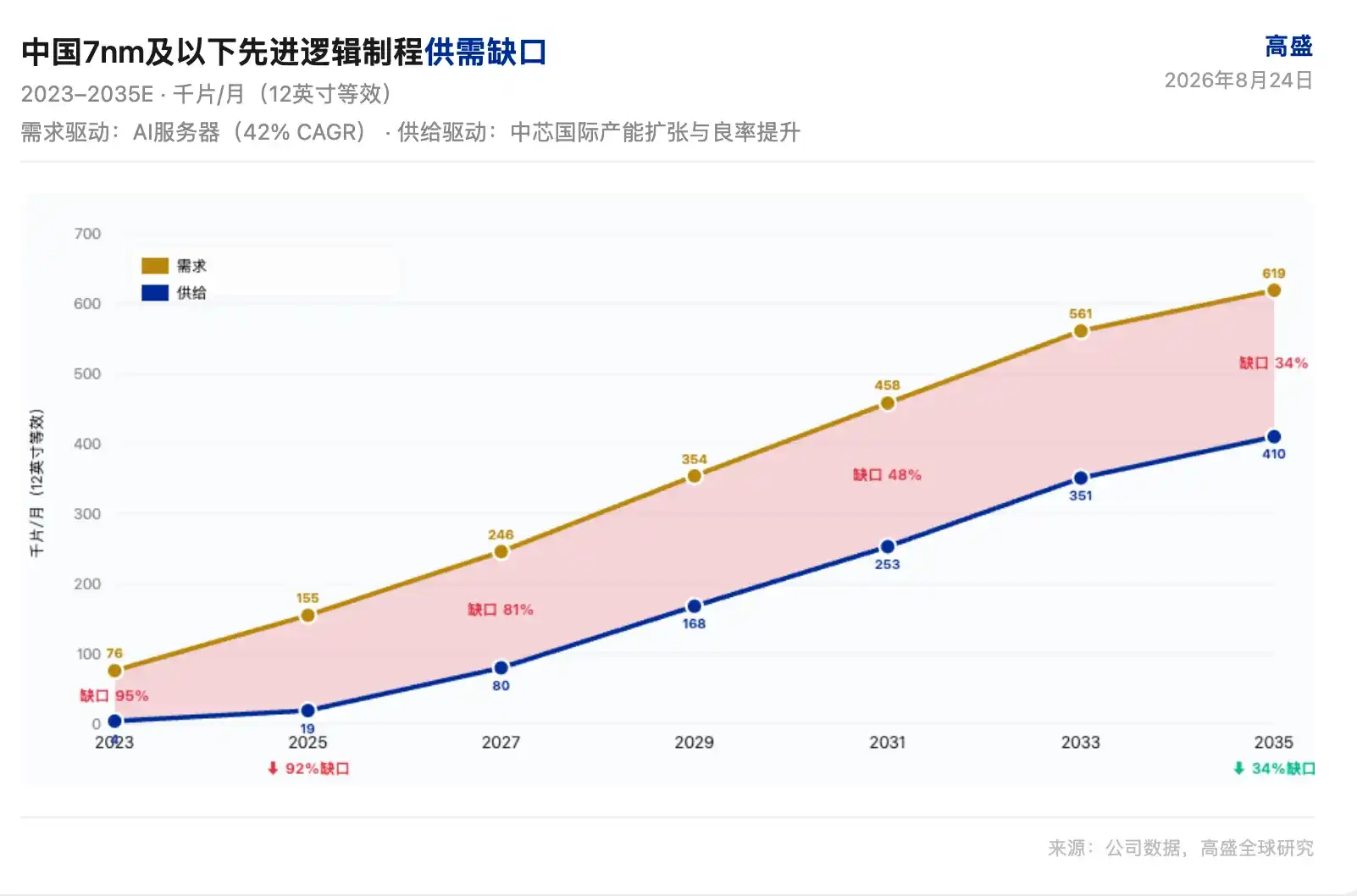
L'écart entre l'offre et la demande pour les nœuds logiques avancés se réduit à un rythme accéléré. Le modèle de Goldman Sachs montre que la demande chinoise en wafers de 7 nm et moins croît à un taux annuel composé (TCAC) de 17 % entre 2025 et 2035, pour atteindre 619 000 wafers/mois en 2035, principalement tirée par la demande des serveurs d'IA. Le TCAC de la demande en wafers pour serveurs d'IA sur la même période est de 42 %. La croissance du côté de l'offre est encore plus rapide, avec une offre de wafers de 7 nm et moins qui augmente à un TCAC de 46 % de 2025 à 2035, atteignant 410 000 wafers/mois en 2035. Cette croissance bénéficie principalement de l'expansion de capacité de 30 000 à 50 000 wafers/mois supplémentaires par an de SMIC, ainsi que de l'amélioration progressive du taux de rendement, passant de 23 % en 2026 à 75 % en 2035. L'écart entre l'offre et la demande devrait ainsi se réduire, passant de 92 % en 2025 à 34 % en 2035.
Forte croissance du marché des puces IA et de la DRAM, 678 et 257 milliards de dollars attendus

Goldman Sachs publie pour la première fois une estimation du marché adressable total (TAM) pour les puces IA et la DRAM en Chine. Dans le scénario de base, la taille du marché chinois des puces IA atteindra 678 milliards de dollars en 2030, avec un TCAC de 69 % entre 2025 et 2030. Cette taille correspond à un volume d'expédition de 27 millions de puces IA équivalentes H800 et à une demande en électricité informatique de 32 GW. Dans un scénario plus optimiste, le marché des puces IA pourrait atteindre 4,1 billions de dollars, correspondant à 238 millions de puces et une demande en électricité de 196 GW.

Le marché chinois de la DRAM est également en expansion rapide. Goldman Sachs prévoit un TCAC de 50 % pour le marché chinois de la DRAM entre 2026 et 2028, atteignant 257 milliards de dollars en 2028. Le TCAC de la HBM est de 188 %, atteignant 32 milliards de dollars en 2028, reflétant la forte demande en mémoire à large bande passante pour l'inférence et l'entraînement de l'IA.

ChangXin Memory Technologies (CXMT) devient un fournisseur central du marché chinois de la DRAM. Goldman Sachs prévoit que sa capacité passera de 270 000 wafers/mois en 2026 à 447 000 wafers/mois en 2028, pour plus que doubler d'ici 2030 à 665 000 wafers/mois par rapport à 2026. Les dépenses en capital annuelles moyennes entre 2026 et 2030 passeront de 60 milliards de yuans (environ 8,4 milliards de dollars) en 2024-2025 à 84 milliards de yuans (environ 12 milliards de dollars). L'offre de DRAM conventionnelle de CXMT pourrait atteindre 41 % et 50 % de celle de Samsung et SK Hynix en 2028, contre respectivement 28 % et 35 % en 2025. Concernant la HBM, Goldman Sachs prévoit un TCAC de 166 % pour les revenus HBM de CXMT entre 2026 et 2030.

La substitution par des équipements nationaux s'accélère, les fournisseurs mondiaux restent clés

Le taux de localisation des équipements semi-conducteurs en Chine augmente régulièrement. Goldman Sachs prévoit que la part des revenus des fabricants d'équipements chinois sur le marché intérieur des équipements de fabrication de wafers (WFE) passera de 31 % en 2026 à 38 % en 2028. La déposition, la gravure et la lithographie sont les trois plus grandes catégories du marché WFE. Le marché chinois des WFE atteindra 53 milliards de dollars en 2027.

Les fournisseurs japonais d'équipements continuent de bénéficier de l'expansion du marché chinois. Les revenus chinois combinés de quatre sociétés japonaises d'équipements front-end - Tokyo Electron, SCREEN, Kokusai Electric et Ebara - ont atteint 1,21 billion de yens pour l'exercice 2025, représentant 35 % de leurs revenus dans les équipements semi-conducteurs. Cette proportion a diminué par rapport aux 41 % de l'exercice 2024, mais les quatre entreprises s'attendent à une croissance continue en valeur absolue de leurs revenus chinois. Les fonderies chinoises, en progressant vers des nœuds plus avancés, dépendent davantage des fournisseurs d'équipements non chinois pour garantir le taux de rendement.

Les fournisseurs américains d'équipements sont confrontés à la pression des contrôles à l'exportation. Goldman Sachs estime que leurs expéditions vers la Chine se stabiliseront autour de 25 % de leurs revenus. Goldman Sachs reste positif sur les actions des équipementiers mondiaux, avec une croissance du WFE de 36 % et 45 % respectivement en 2026 et 2027. Les équipements de gravure et de déposition bénéficient de l'expansion des transistors à grille entourante (GAA), de la NAND 3D et des emballages avancés. Parmi les sociétés américaines couvertes, Applied Materials, Lam Research et Onto Innovation sont recommandées en priorité.

CXMT bénéficie d'une double impulsion : rareté et demande d'IA

ChangXin Memory Technologies (CXMT) est la seule entreprise IDM de DRAM en Chine à avoir réalisé une production de masse à grande échelle, couvrant la conception et la fabrication des puces DRAM, et servant les principaux fournisseurs de services cloud et marques d'électronique grand public du pays. Goldman Sachs prévoit un TCAC de 47 % pour son bénéfice net entre 2026 et 2030.

La croissance provient de deux aspects : l'expansion de l'infrastructure d'IA en Chine stimule la demande en DRAM pour serveurs et HBM ; et les clients de l'électronique grand public diversifient leur réseau de fournisseurs pour assurer la sécurité d'approvisionnement. Goldman Sachs prévoit un TCAC de 34 % pour la DRAM conventionnelle de CXMT entre 2026 et 2030.

L'objectif de cours de 129 yuans est basé sur une méthode d'actualisation du PER 2030, avec un PER cible de 16,6x, actualisé jusqu'en 2027. Cette valorisation implique un PER de 24x pour 2027, correspondant à une croissance moyenne du BPA de 77 % en 2027-2028 et un PEG de 0,31x, nettement inférieur à celui de Cambricon (1,12x), Silergy (1,46x) et AMEC (2,21x). Goldman Sachs estime que la rareté de CXMT, l'amélioration de son portefeuille produits et la demande d'IA rendent sa valorisation attractive.

Les risques à la baisse incluent une intensification de la concurrence sur le marché, une demande finale inférieure aux attentes, et les incertitudes géopolitiques.

L'industrie des semi-conducteurs chinoise se trouve à une étape clé de la transition de "l'expansion quantitative" vers de "la percée qualitative". La révision à la hausse significative des dépenses en capital, la réduction continue de l'écart entre l'offre et la demande sur les nœuds avancés, et l'explosion de la demande en puces IA et HBM sont trois lignes directrices entrelacées qui poussent conjointement à une réévaluation de la valeur de la chaîne d'approvisionnement. La substitution par des équipements nationaux, l'essor des leaders de la mémoire et les infrastructures de calcul d'IA constituent trois directions principales à forte certitude.
Clause de non-responsabilité

Cet article est une synthèse et une interprétation par Trend Research d'un rapport de recherche tiers (Goldman Sachs, 24 août 2026), combinée à des informations du marché public. Les notations, prix cibles, prévisions de bénéfices et jugements connexes cités dans le texte sont les points de vue de l'analyste de cette société de courtage, représentant uniquement la position de leur institution affiliée. Ils ne représentent pas le point de vue de Trend Research et ne constituent aucune recommandation d'investissement.

Le marché comporte des risques, les décisions doivent être prises de manière indépendante. Cet article ne doit pas servir de base à l'achat ou à la vente de titres.


Trending Cryptos

Related Questions

QSelon le rapport de Goldman Sachs, quel est le taux d'autosuffisance en quantité des semi-conducteurs en Chine d'ici juin 2026, et comment a-t-il évolué depuis 2010 ?

ASelon le rapport de Goldman Sachs, le taux d'autosuffisance en quantité des semi-conducteurs IC en Chine a atteint 70% d'ici juin 2026, presque le double du taux de 38% de janvier 2010.

QQuelle est la nouvelle prévision de Goldman Sachs concernant les dépenses en capital (Capex) de la Chine dans les semi-conducteurs pour 2030, et de quel pourcentage cette estimation a-t-elle été révisée à la hausse ?

AGoldman Sachs a revu à la hausse sa prévision de dépenses en capital (Capex) pour les semi-conducteurs en Chine à 820 milliards de dollars d'ici 2030, ce qui représente une augmentation de 79% par rapport à la prévision précédente.

QQuelle entreprise Goldman Sachs a-t-elle couverte pour la première fois dans son rapport en lui attribuant une recommandation 'Acheter' et un prix cible de 129 yuans ?

AGoldman Sachs a couvert pour la première fois dans son rapport l'entreprise chinoise CXMT (ChangXin Memory Technologies), leader dans la DRAM, en lui attribuant une recommandation 'Acheter' et un prix cible de 129 yuans.

QQuelle est la prévision de Goldman Sachs pour la taille du marché des puces d'IA en Chine d'ici 2030 dans son scénario de référence, et quel est le taux de croissance annuel composé (TCAC) entre 2025 et 2030 ?

ADans son scénario de référence, Goldman Sachs prévoit que la taille du marché des puces d'IA en Chine atteindra 6 780 milliards de dollars d'ici 2030, avec un taux de croissance annuel composé (TCAC) de 69% entre 2025 et 2030.

QSelon le rapport, quel est le principal goulet d'étranglement qui explique l'écart important entre le taux d'autosuffisance en valeur et en quantité des semi-conducteurs en Chine ?

ASelon le rapport de Goldman Sachs, le principal goulet d'étranglement expliquant l'écart important entre le taux d'autosuffisance en valeur et en quantité des semi-conducteurs en Chine est l'absence de machines de lithographie avancées (équipements de photolithographie).

Related Reads

Trading

Spot

Hot Articles

What is SONIC

Sonic: Pioneering the Future of Gaming in Web3 Introduction to Sonic In the ever-evolving landscape of Web3, the gaming industry stands out as one of the most dynamic and promising sectors. At the forefront of this revolution is Sonic, a project designed to amplify the gaming ecosystem on the Solana blockchain. Leveraging cutting-edge technology, Sonic aims to deliver an unparalleled gaming experience by efficiently processing millions of requests per second, ensuring that players enjoy seamless gameplay while maintaining low transaction costs. This article delves into the intricate details of Sonic, exploring its creators, funding sources, operational mechanics, and the timeline of significant events that have shaped its journey. What is Sonic? Sonic is an innovative layer-2 network that operates atop the Solana blockchain, specifically tailored to enhance the existing Solana gaming ecosystem. It accomplishes this through a customised, VM-agnostic game engine paired with a HyperGrid interpreter, facilitating sovereign game economies that roll up back to the Solana platform. The primary goals of Sonic include: Enhanced Gaming Experiences: Sonic is committed to offering lightning-fast on-chain gameplay, allowing players and developers to engage with games at previously unattainable speeds. Atomic Interoperability: This feature enables transactions to be executed within Sonic without the need to redeploy Solana programmes and accounts. This makes the process more efficient and directly benefits from Solana Layer1 services and liquidity. Seamless Deployment: Sonic allows developers to write for Ethereum Virtual Machine (EVM) based systems and execute them on Solana’s SVM infrastructure. This interoperability is crucial for attracting a broader range of dApps and decentralised applications to the platform. Support for Developers: By offering native composable gaming primitives and extensible data types - dining within the Entity-Component-System (ECS) framework - game creators can craft intricate business logic with ease. Overall, Sonic's unique approach not only caters to players but also provides an accessible and low-cost environment for developers to innovate and thrive. Creator of Sonic The information regarding the creator of Sonic is somewhat ambiguous. However, it is known that Sonic's SVM is owned by the company Mirror World. The absence of detailed information about the individuals behind Sonic reflects a common trend in several Web3 projects, where collective efforts and partnerships often overshadow individual contributions. Investors of Sonic Sonic has garnered considerable attention and support from various investors within the crypto and gaming sectors. Notably, the project raised an impressive $12 million during its Series A funding round. The round was led by BITKRAFT Ventures, with other notable investors including Galaxy, Okx Ventures, Interactive, Big Brain Holdings, and Mirana. This financial backing signifies the confidence that investment foundations have in Sonic’s potential to revolutionise the Web3 gaming landscape, further validating its innovative approaches and technologies. How Does Sonic Work? Sonic utilises the HyperGrid framework, a sophisticated parallel processing mechanism that enhances its scalability and customisability. Here are the core features that set Sonic apart: Lightning Speed at Low Costs: Sonic offers one of the fastest on-chain gaming experiences compared to other Layer-1 solutions, powered by the scalability of Solana’s virtual machine (SVM). Atomic Interoperability: Sonic enables transaction execution without redeployment of Solana programmes and accounts, effectively streamlining the interaction between users and the blockchain. EVM Compatibility: Developers can effortlessly migrate decentralised applications from EVM chains to the Solana environment using Sonic’s HyperGrid interpreter, increasing the accessibility and integration of various dApps. Ecosystem Support for Developers: By exposing native composable gaming primitives, Sonic facilitates a sandbox-like environment where developers can experiment and implement business logic, greatly enhancing the overall development experience. Monetisation Infrastructure: Sonic natively supports growth and monetisation efforts, providing frameworks for traffic generation, payments, and settlements, thereby ensuring that gaming projects are not only viable but also sustainable financially. Timeline of Sonic The evolution of Sonic has been marked by several key milestones. Below is a brief timeline highlighting critical events in the project's history: 2022: The Sonic cryptocurrency was officially launched, marking the beginning of its journey in the Web3 gaming arena. 2024: June: Sonic SVM successfully raised $12 million in a Series A funding round. This investment allowed Sonic to further develop its platform and expand its offerings. August: The launch of the Sonic Odyssey testnet provided users with the first opportunity to engage with the platform, offering interactive activities such as collecting rings—a nod to gaming nostalgia. October: SonicX, an innovative crypto game integrated with Solana, made its debut on TikTok, capturing the attention of over 120,000 users within a short span. This integration illustrated Sonic’s commitment to reaching a broader, global audience and showcased the potential of blockchain gaming. Key Points Sonic SVM is a revolutionary layer-2 network on Solana explicitly designed to enhance the GameFi landscape, demonstrating great potential for future development. HyperGrid Framework empowers Sonic by introducing horizontal scaling capabilities, ensuring that the network can handle the demands of Web3 gaming. Integration with Social Platforms: The successful launch of SonicX on TikTok displays Sonic’s strategy to leverage social media platforms to engage users, exponentially increasing the exposure and reach of its projects. Investment Confidence: The substantial funding from BITKRAFT Ventures, among others, emphasizes the robust backing Sonic has, paving the way for its ambitious future. In conclusion, Sonic encapsulates the essence of Web3 gaming innovation, striking a balance between cutting-edge technology, developer-centric tools, and community engagement. As the project continues to evolve, it is poised to redefine the gaming landscape, making it a notable entity for gamers and developers alike. As Sonic moves forward, it will undoubtedly attract greater interest and participation, solidifying its place within the broader narrative of blockchain gaming.

2.4k Total ViewsPublished 2024.04.04Updated 2024.12.03

What is SONIC

What is $S$

Understanding SPERO: A Comprehensive Overview Introduction to SPERO As the landscape of innovation continues to evolve, the emergence of web3 technologies and cryptocurrency projects plays a pivotal role in shaping the digital future. One project that has garnered attention in this dynamic field is SPERO, denoted as SPERO,$$s$. This article aims to gather and present detailed information about SPERO, to help enthusiasts and investors understand its foundations, objectives, and innovations within the web3 and crypto domains. What is SPERO,$$s$? SPERO,$$s$ is a unique project within the crypto space that seeks to leverage the principles of decentralisation and blockchain technology to create an ecosystem that promotes engagement, utility, and financial inclusion. The project is tailored to facilitate peer-to-peer interactions in new ways, providing users with innovative financial solutions and services. At its core, SPERO,$$s$ aims to empower individuals by providing tools and platforms that enhance user experience in the cryptocurrency space. This includes enabling more flexible transaction methods, fostering community-driven initiatives, and creating pathways for financial opportunities through decentralised applications (dApps). The underlying vision of SPERO,$$s$ revolves around inclusiveness, aiming to bridge gaps within traditional finance while harnessing the benefits of blockchain technology. Who is the Creator of SPERO,$$s$? The identity of the creator of SPERO,$$s$ remains somewhat obscure, as there are limited publicly available resources providing detailed background information on its founder(s). This lack of transparency can stem from the project's commitment to decentralisation—an ethos that many web3 projects share, prioritising collective contributions over individual recognition. By centring discussions around the community and its collective goals, SPERO,$$s$ embodies the essence of empowerment without singling out specific individuals. As such, understanding the ethos and mission of SPERO remains more important than identifying a singular creator. Who are the Investors of SPERO,$$s$? SPERO,$$s$ is supported by a diverse array of investors ranging from venture capitalists to angel investors dedicated to fostering innovation in the crypto sector. The focus of these investors generally aligns with SPERO's mission—prioritising projects that promise societal technological advancement, financial inclusivity, and decentralised governance. These investor foundations are typically interested in projects that not only offer innovative products but also contribute positively to the blockchain community and its ecosystems. The backing from these investors reinforces SPERO,$$s$ as a noteworthy contender in the rapidly evolving domain of crypto projects. How Does SPERO,$$s$ Work? SPERO,$$s$ employs a multi-faceted framework that distinguishes it from conventional cryptocurrency projects. Here are some of the key features that underline its uniqueness and innovation: Decentralised Governance: SPERO,$$s$ integrates decentralised governance models, empowering users to participate actively in decision-making processes regarding the project’s future. This approach fosters a sense of ownership and accountability among community members. Token Utility: SPERO,$$s$ utilises its own cryptocurrency token, designed to serve various functions within the ecosystem. These tokens enable transactions, rewards, and the facilitation of services offered on the platform, enhancing overall engagement and utility. Layered Architecture: The technical architecture of SPERO,$$s$ supports modularity and scalability, allowing for seamless integration of additional features and applications as the project evolves. This adaptability is paramount for sustaining relevance in the ever-changing crypto landscape. Community Engagement: The project emphasises community-driven initiatives, employing mechanisms that incentivise collaboration and feedback. By nurturing a strong community, SPERO,$$s$ can better address user needs and adapt to market trends. Focus on Inclusion: By offering low transaction fees and user-friendly interfaces, SPERO,$$s$ aims to attract a diverse user base, including individuals who may not previously have engaged in the crypto space. This commitment to inclusion aligns with its overarching mission of empowerment through accessibility. Timeline of SPERO,$$s$ Understanding a project's history provides crucial insights into its development trajectory and milestones. Below is a suggested timeline mapping significant events in the evolution of SPERO,$$s$: Conceptualisation and Ideation Phase: The initial ideas forming the basis of SPERO,$$s$ were conceived, aligning closely with the principles of decentralisation and community focus within the blockchain industry. Launch of Project Whitepaper: Following the conceptual phase, a comprehensive whitepaper detailing the vision, goals, and technological infrastructure of SPERO,$$s$ was released to garner community interest and feedback. Community Building and Early Engagements: Active outreach efforts were made to build a community of early adopters and potential investors, facilitating discussions around the project’s goals and garnering support. Token Generation Event: SPERO,$$s$ conducted a token generation event (TGE) to distribute its native tokens to early supporters and establish initial liquidity within the ecosystem. Launch of Initial dApp: The first decentralised application (dApp) associated with SPERO,$$s$ went live, allowing users to engage with the platform's core functionalities. Ongoing Development and Partnerships: Continuous updates and enhancements to the project's offerings, including strategic partnerships with other players in the blockchain space, have shaped SPERO,$$s$ into a competitive and evolving player in the crypto market. Conclusion SPERO,$$s$ stands as a testament to the potential of web3 and cryptocurrency to revolutionise financial systems and empower individuals. With a commitment to decentralised governance, community engagement, and innovatively designed functionalities, it paves the way toward a more inclusive financial landscape. As with any investment in the rapidly evolving crypto space, potential investors and users are encouraged to research thoroughly and engage thoughtfully with the ongoing developments within SPERO,$$s$. The project showcases the innovative spirit of the crypto industry, inviting further exploration into its myriad possibilities. While the journey of SPERO,$$s$ is still unfolding, its foundational principles may indeed influence the future of how we interact with technology, finance, and each other in interconnected digital ecosystems.

437 Total ViewsPublished 2024.12.17Updated 2024.12.17

What is $S$

What is AGENT S

Agent S: The Future of Autonomous Interaction in Web3 Introduction In the ever-evolving landscape of Web3 and cryptocurrency, innovations are constantly redefining how individuals interact with digital platforms. One such pioneering project, Agent S, promises to revolutionise human-computer interaction through its open agentic framework. By paving the way for autonomous interactions, Agent S aims to simplify complex tasks, offering transformative applications in artificial intelligence (AI). This detailed exploration will delve into the project's intricacies, its unique features, and the implications for the cryptocurrency domain. What is Agent S? Agent S stands as a groundbreaking open agentic framework, specifically designed to tackle three fundamental challenges in the automation of computer tasks: Acquiring Domain-Specific Knowledge: The framework intelligently learns from various external knowledge sources and internal experiences. This dual approach empowers it to build a rich repository of domain-specific knowledge, enhancing its performance in task execution. Planning Over Long Task Horizons: Agent S employs experience-augmented hierarchical planning, a strategic approach that facilitates efficient breakdown and execution of intricate tasks. This feature significantly enhances its ability to manage multiple subtasks efficiently and effectively. Handling Dynamic, Non-Uniform Interfaces: The project introduces the Agent-Computer Interface (ACI), an innovative solution that enhances the interaction between agents and users. Utilizing Multimodal Large Language Models (MLLMs), Agent S can navigate and manipulate diverse graphical user interfaces seamlessly. Through these pioneering features, Agent S provides a robust framework that addresses the complexities involved in automating human interaction with machines, setting the stage for myriad applications in AI and beyond. Who is the Creator of Agent S? While the concept of Agent S is fundamentally innovative, specific information about its creator remains elusive. The creator is currently unknown, which highlights either the nascent stage of the project or the strategic choice to keep founding members under wraps. Regardless of anonymity, the focus remains on the framework's capabilities and potential. Who are the Investors of Agent S? As Agent S is relatively new in the cryptographic ecosystem, detailed information regarding its investors and financial backers is not explicitly documented. The lack of publicly available insights into the investment foundations or organisations supporting the project raises questions about its funding structure and development roadmap. Understanding the backing is crucial for gauging the project's sustainability and potential market impact. How Does Agent S Work? At the core of Agent S lies cutting-edge technology that enables it to function effectively in diverse settings. Its operational model is built around several key features: Human-like Computer Interaction: The framework offers advanced AI planning, striving to make interactions with computers more intuitive. By mimicking human behaviour in tasks execution, it promises to elevate user experiences. Narrative Memory: Employed to leverage high-level experiences, Agent S utilises narrative memory to keep track of task histories, thereby enhancing its decision-making processes. Episodic Memory: This feature provides users with step-by-step guidance, allowing the framework to offer contextual support as tasks unfold. Support for OpenACI: With the ability to run locally, Agent S allows users to maintain control over their interactions and workflows, aligning with the decentralised ethos of Web3. Easy Integration with External APIs: Its versatility and compatibility with various AI platforms ensure that Agent S can fit seamlessly into existing technological ecosystems, making it an appealing choice for developers and organisations. These functionalities collectively contribute to Agent S's unique position within the crypto space, as it automates complex, multi-step tasks with minimal human intervention. As the project evolves, its potential applications in Web3 could redefine how digital interactions unfold. Timeline of Agent S The development and milestones of Agent S can be encapsulated in a timeline that highlights its significant events: September 27, 2024: The concept of Agent S was launched in a comprehensive research paper titled “An Open Agentic Framework that Uses Computers Like a Human,” showcasing the groundwork for the project. October 10, 2024: The research paper was made publicly available on arXiv, offering an in-depth exploration of the framework and its performance evaluation based on the OSWorld benchmark. October 12, 2024: A video presentation was released, providing a visual insight into the capabilities and features of Agent S, further engaging potential users and investors. These markers in the timeline not only illustrate the progress of Agent S but also indicate its commitment to transparency and community engagement. Key Points About Agent S As the Agent S framework continues to evolve, several key attributes stand out, underscoring its innovative nature and potential: Innovative Framework: Designed to provide an intuitive use of computers akin to human interaction, Agent S brings a novel approach to task automation. Autonomous Interaction: The ability to interact autonomously with computers through GUI signifies a leap towards more intelligent and efficient computing solutions. Complex Task Automation: With its robust methodology, it can automate complex, multi-step tasks, making processes faster and less error-prone. Continuous Improvement: The learning mechanisms enable Agent S to improve from past experiences, continually enhancing its performance and efficacy. Versatility: Its adaptability across different operating environments like OSWorld and WindowsAgentArena ensures that it can serve a broad range of applications. As Agent S positions itself in the Web3 and crypto landscape, its potential to enhance interaction capabilities and automate processes signifies a significant advancement in AI technologies. Through its innovative framework, Agent S exemplifies the future of digital interactions, promising a more seamless and efficient experience for users across various industries. Conclusion Agent S represents a bold leap forward in the marriage of AI and Web3, with the capacity to redefine how we interact with technology. While still in its early stages, the possibilities for its application are vast and compelling. Through its comprehensive framework addressing critical challenges, Agent S aims to bring autonomous interactions to the forefront of the digital experience. As we move deeper into the realms of cryptocurrency and decentralisation, projects like Agent S will undoubtedly play a crucial role in shaping the future of technology and human-computer collaboration.

1.1k Total ViewsPublished 2025.01.14Updated 2025.01.14

What is AGENT S

Discussions

Welcome to the HTX Community. Here, you can stay informed about the latest platform developments and gain access to professional market insights. Users' opinions on the price of S (S) are presented below.

活动图片