Le Trésor américain achète de la dette publique : les cryptomonnaies progressent alors que les rendements des obligations d’État s’effondrent

cryptonews.ruPublished on 2026-08-22Last updated on 2026-08-22

Abstract

La semaine du 14 au 21 août 2026 a été marquée par un rallye majeur sur le marché des cryptomonnaies, catalysé par l'annonce du Trésor américain de doubler ses rachats d'obligations d'État à long terme. Ceci a provoqué un effondrement des rendements des Treasuries et un transfert de capitaux vers les actifs risqués. Le Bitcoin ($BTC) a gagné près de 19%, atteignant un plus haut de 2,5 mois. Cette hausse a été alimentée par des liquidations massives de positions courtes (plus de 2,1 milliards de dollars) et un afflux net d'un milliard de dollars dans les ETF spot, une première depuis janvier. Le soutien rhétorique de Donald Trump aux cryptomonnaies a également joué un rôle. L'Ethereum ($ETH) a progressé de plus de 26%, dépassant les 2300$ pour la première fois depuis mai, soutenu par un volume de trading élevé et des entrées continues dans ses ETF spot. La préparation au hardfork Glamsterdam se poursuit. Parmi les altcoins, Dogecoin (DOGE) a suivi le mouvement (+20%), tandis que Zcash ($ZEC) a bondi de 31% suite à la nouvelle soumission de Grayscale d'une demande d'ETF spot. Ethena ($ENA) a enregistré la plus forte hausse (+59,5%) après le lancement d'un programme de prêts d'un milliard de dollars avec FalconX. Techniquement, le BTC et l'ETH affichent désormais une tendance haussière, bien que des indicateurs comme le RSI signalent une surachat potentielle. L'indice de peur et de cupidité est passé à 72, indiquant un marché dominé par l'avidité.

Le Bitcoin a gagné près de 19 % du 14 au 21 août 2026. Cela a permis à $BTC d’établir un nouveau sommet de prix sur les deux mois et demi derniers. Le mercredi 19 août, journée où la plus grande cryptomonnaie par capitalisation a augmenté de plus de 7 %, a été le meilleur jour des six derniers mois.
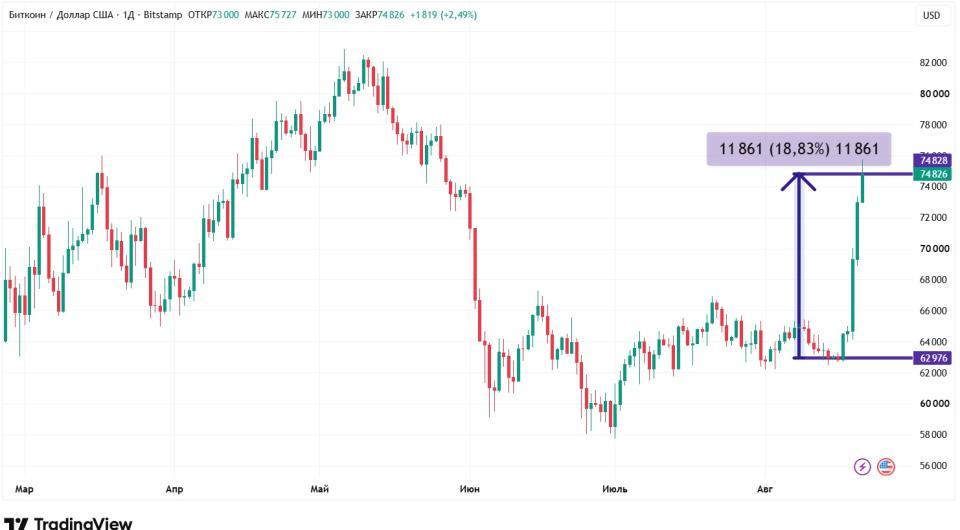
Source : tradingview.com

Le principal catalyseur de la hausse rapide du Bitcoin a été l’annonce du département du Trésor américain concernant le doublement au minimum du rachat d’obligations d’État à échéances de 10 à 20 ans et de 20 à 30 ans. Cette annonce a provoqué un effondrement des rendements des obligations du Trésor (Treasuries) et un transfert de capitaux vers des actifs risqués comme le Bitcoin.

Le soutien à $BTC est venu de la rencontre de Donald Trump le 19 août avec des représentants de l’industrie crypto. Le président américain a appelé le Congrès à examiner le projet de loi CLARITY, resté en suspens. La rhétorique positive de Trump concernant les cryptomonnaies a donné du tonus aux investisseurs.

Une autre raison de la hausse de $BTC — les liquidations massives de positions courtes (shorts) du 19 au 21 août. En moins de trois jours, des positions courtes d’une valeur de plus de 2,1 milliards de dollars ont été fermées de force. Sur la même période, seules 48,19 millions de dollars de positions longues (longs) ont été liquidées, soit 43,6 fois moins.
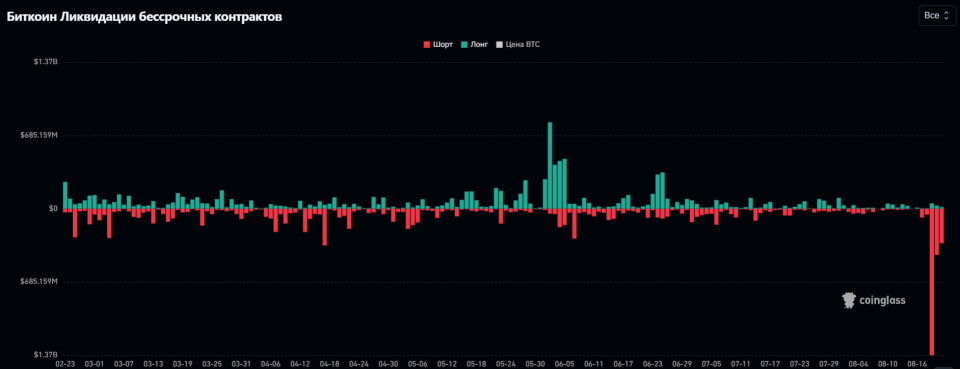
Source : coinglass.com

Les ETF spot sur Bitcoin ont enregistré pour la première fois depuis janvier des entrées de fonds hebdomadaires d’un milliard de dollars. La plus grande partie de cette somme, 588,54 millions de dollars, est revenue au fonds de BlackRock, l’iShares Bitcoin Trust (IBIT).
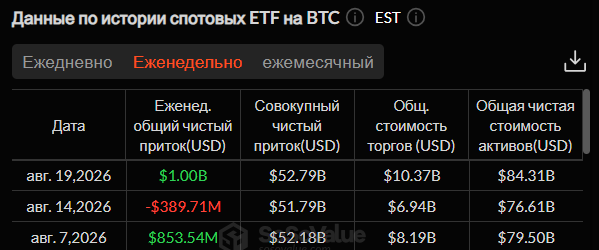
Source : sosovalue.com

D’un point de vue d’analyse technique, la tendance du Bitcoin est devenue haussière. Cela est confirmé par le dépassement par le prix de la moyenne mobile à 50 jours (en bleu) et sa position bien au-dessus. En revanche, l’indicateur RSI est entré en zone de surachat, ce qui présage d’une correction, au moins à court terme. L’ancien niveau de résistance à 67 253 $ est désormais devenu un support. Le principe d’inversion de polarité a fonctionné. La nouvelle résistance sur le graphique quotidien se situe autour de 76 000 $.
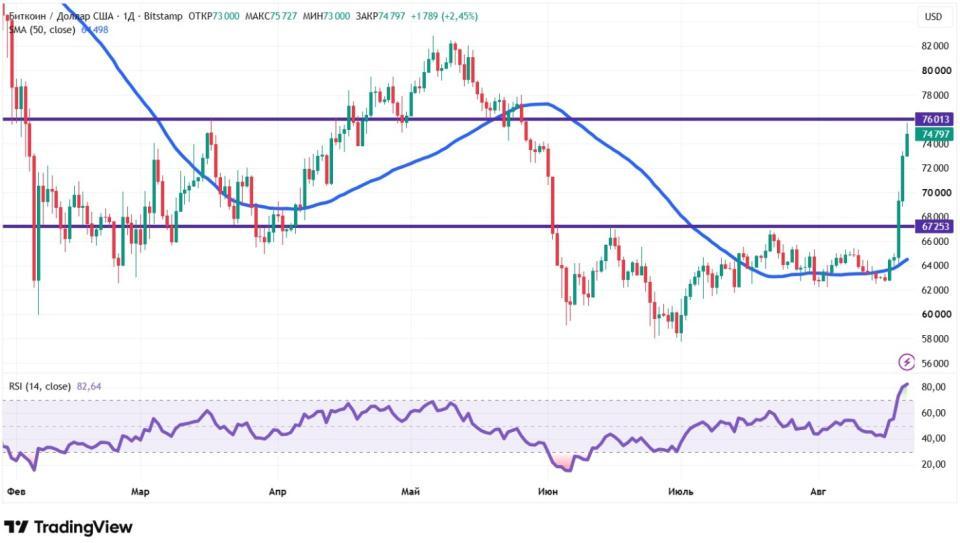
Source : tradingview.com

L’indice de peur et de cupidité a réalisé une énorme progression de 43 points par rapport à la semaine dernière, atteignant 72. Le sentiment de cupidité prévaut désormais parmi les crypto-investisseurs.

Ethereum

L’Ether a gagné plus de 26 % du 14 au 21 août. $ETH a dépassé les 2300 $ pour la première fois depuis mai. La majeure partie de la hausse est survenue le mercredi 19 août, lorsque la deuxième cryptomonnaie par capitalisation a augmenté de 17,51 % en une seule journée.
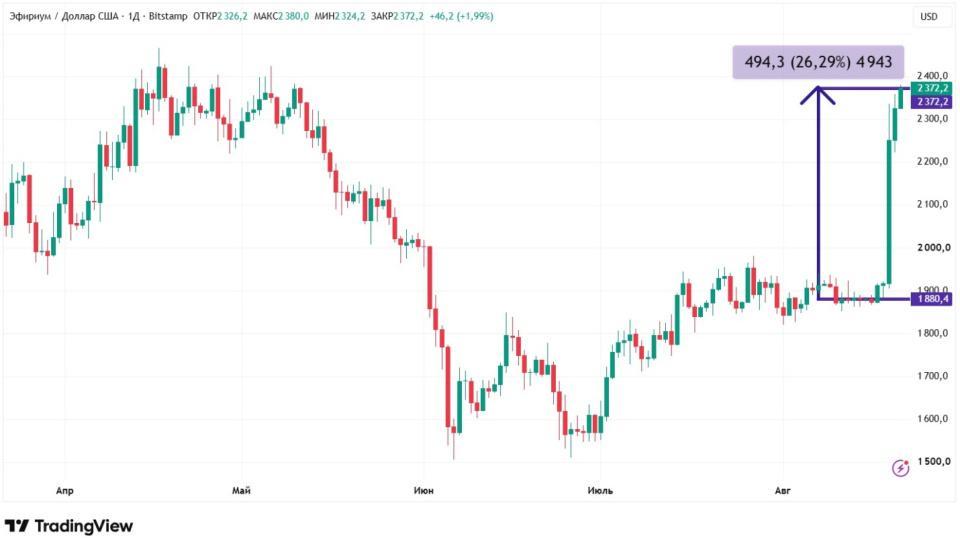
Source : tradingview.com

La hausse de l’Ether a été favorisée par un pic de volume de transactions. Selon les données du portail Coinglass, le 20 août, le cumul a dépassé 90 milliards de dollars. Auparavant, le volume de transactions sur l’Ether avait atteint de tels chiffres pour la dernière fois le 6 juin.
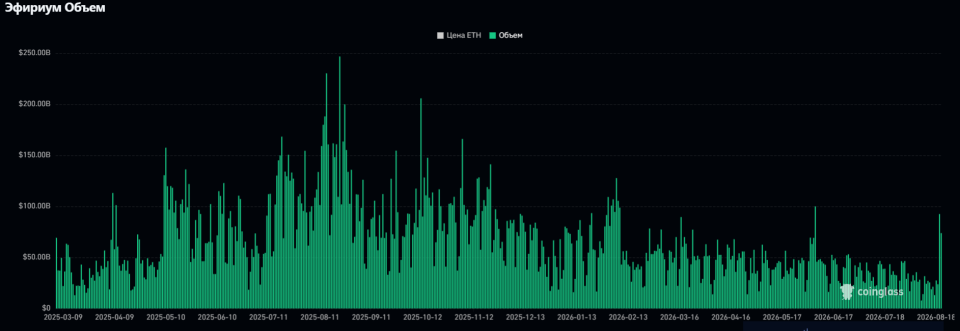
Source : coinglass.com

Les ETF spot sur l’Ether ont enregistré pour la sixième fois en sept semaines des entrées de fonds. Leur montant cette fois-ci est de 291,47 millions de dollars. La plus grande partie de cette somme, 212,7 millions de dollars, est revenue au fonds de BlackRock, l’iShares Ethereum Trust (ETHA).

Ethereum continue de se préparer au hardfork Glamsterdam. Cette semaine, les développeurs ont lancé le nouveau réseau de test Plataberget. Il sera utilisé pour tester les capacités du hardfork. Ensuite, Glamsterdam sera déployé sur les réseaux de test plus anciens Sepolia et Houdi. On suppose que Plataberget utilisera 50 000 validateurs, répartis sur 50 nœuds, pour tester différentes combinaisons de logiciels clients.
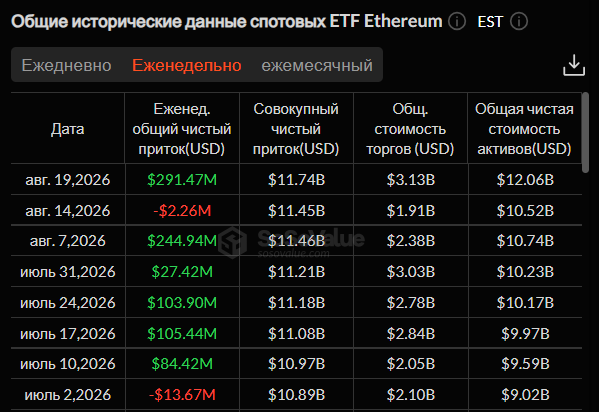
Source : sosovalue.com

D’un point de vue d’analyse technique, l’Ether, comme le Bitcoin, est passé à une tendance haussière. Cela est confirmé par le dépassement par le prix de la moyenne mobile à 50 jours (en bleu). Néanmoins, le stochastique est entré en zone de surachat, ce qui indique une probable correction dans un avenir proche. Les niveaux de support et de résistance les plus proches sur le graphique quotidien sont : 2219,3 $ et 2469,3 $.
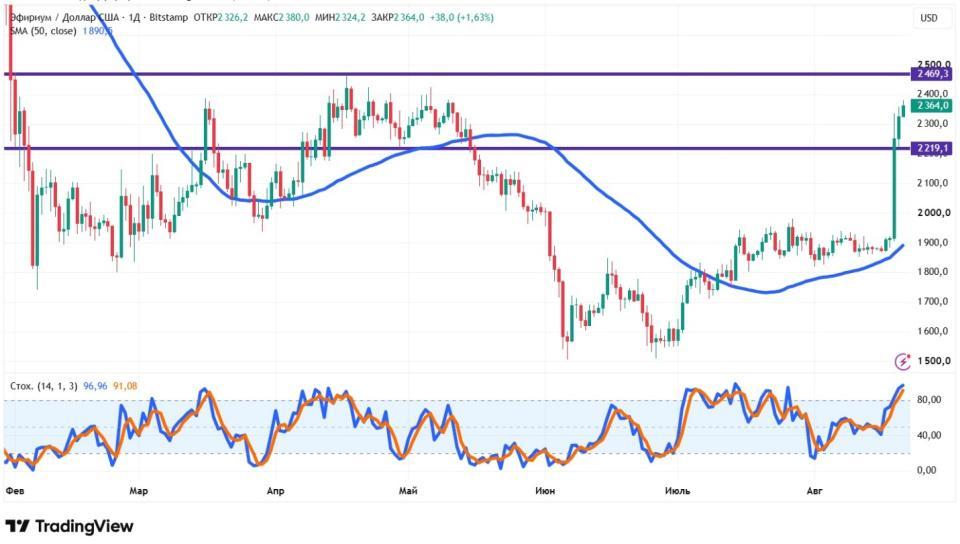
Source : tradingview.com

Dogecoin

Le plus grand mème-coin par capitalisation, Dogecoin, comme les autres grands altcoins, a également bénéficié de la hausse de $BTC et $ETH. Le co-fondateur de cette cryptomonnaie, Billy Markus (connu sous le pseudonyme Shibetoshi Nakamoto), s’est exprimé à ce sujet :

« Les cryptomonnaies font leur retour !?!?!?!?! Le cauchemar de 2026 est terminé ?!?!!? »

Les déclarations sur les réseaux sociaux influencent généralement fortement l’humeur des détenteurs et investisseurs de DOGE. Cette fois, la positivité s’est traduite par une hausse de 20,12 % du 14 au 21 août.
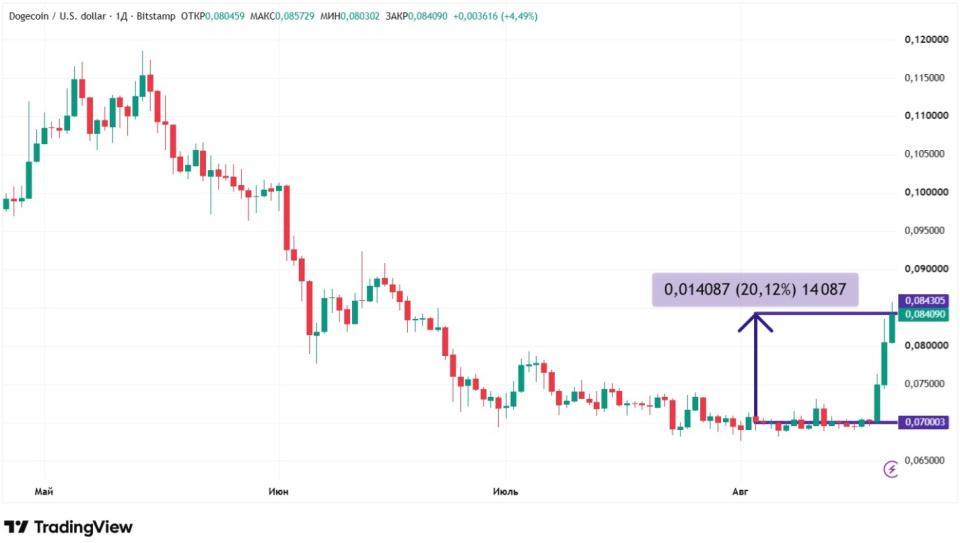
Source : tradingview.com

Zcash

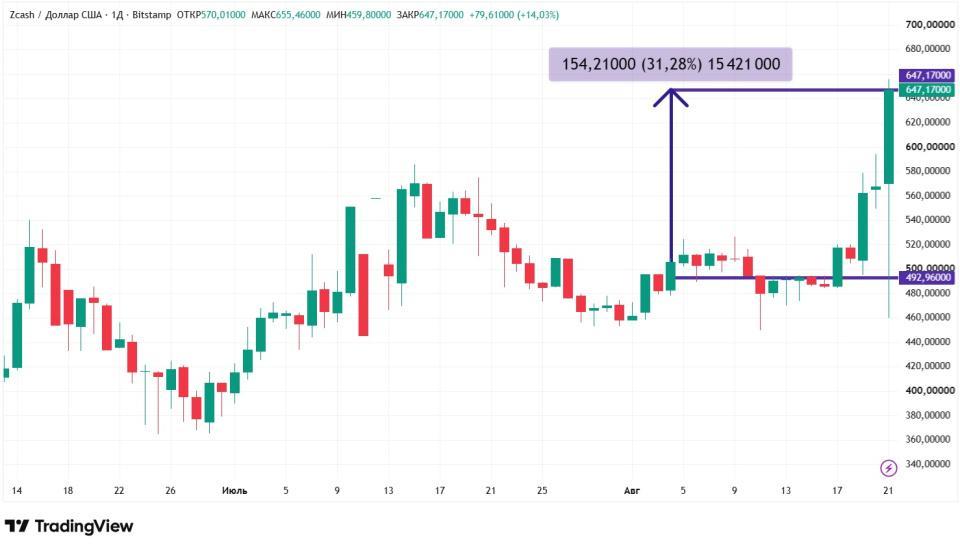
L’industrie crypto se rapproche de plus en plus de l’apparition du premier ETF spot sur $ZEC. Cette semaine, la société Grayscale a soumis sa quatrième version de demande à la Securities and Exchange Commission (SEC) américaine pour convertir son Grayscale Zcash Trust en un fonds négocié en bourse (ETF). Par rapport à la version précédente, la principale différence réside dans la manière dont les actions (parts) de l’ETF seront créées et rachetées. Principalement contre de l’argent fiduciaire. Néanmoins, pour la création d’actions, l’option d’un règlement en nature reste possible, mais pas pour le rachat. L’intention de DCG, la société mère de Grayscale, d’investir via un participant autorisé du marché en bourse 200 000 $ZEC (environ 110 millions de dollars) dans les actions du fonds a également été révélée. Le potentiel nouveau ETF sera négocié sur la plateforme NYSE Arca, mais les informations sur les frais de gestion ne sont pas encore dévoilées.

L’apparition d’un fonds négocié en bourse spot sur Zcash suppose un afflux de capitaux institutionnels. Il n’est pas surprenant que les investisseurs aient réagi positivement à la nouvelle, ce qui s’est traduit par une croissance hebdomadaire de 31,28 %.
Source : tradingview.com

Ethena

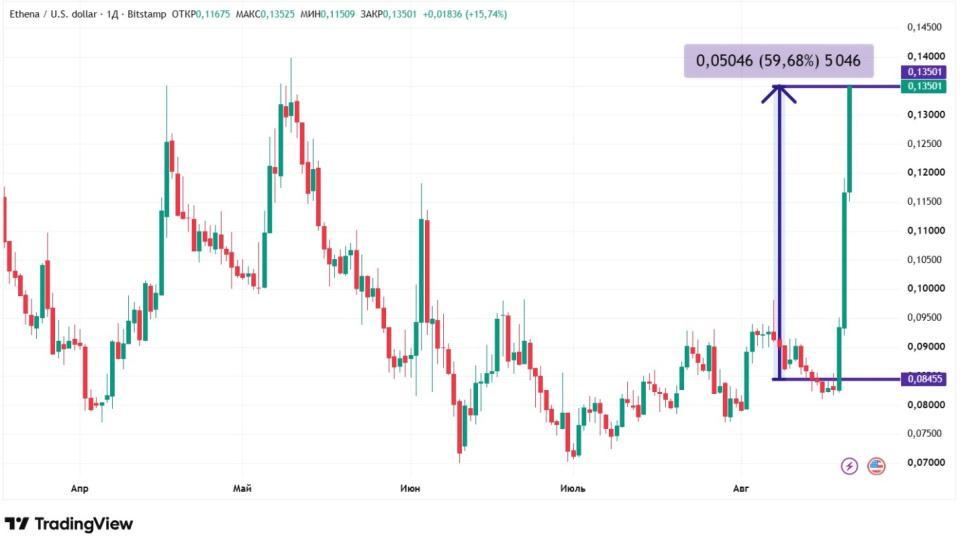
Les développeurs de la cryptomonnaie Ethena, en partenariat avec la société de courtage crypto FalconX, ont lancé un programme de prêts d’un milliard de dollars. Le programme est destiné aux investisseurs institutionnels. Les réserves garantissant le stablecoin $USDe seront utilisées comme fonds empruntés. Le prêt peut être obtenu en mettant en garantie des actifs d’une valeur supérieure à celle des fonds empruntés. FalconX est responsable de tout le travail administratif. L’avantage pour Ethena est une source de revenus supplémentaire liée au $USDe.

Sur fond de lancement de ce nouveau produit, ainsi que d’optimisme général sur le marché crypto, Ethena a gagné 59,5 % au cours de la semaine écoulée, se rapprochant de ses sommets de mai.
Source : tradingview.com

Conclusion

La semaine s’est conclue par une croissance fulgurante de la valeur du Bitcoin et des altcoins. Les investisseurs ont accueilli positivement la nouvelle de l’augmentation du budget que le département du Trésor américain consacrera au rachat d’obligations d’État. Cela a entraîné une augmentation des volumes de transactions sur les plateformes d’échange crypto et des liquidations de positions courtes des spéculateurs.

Ce matériel et les informations qu’il contient ne constituent pas une recommandation individuelle ou autre. L’opinion de la rédaction peut différer de celles des portails analytiques et des experts.



end-content

Trending Cryptos

Related Questions

QQuel a été le principal catalyseur de la forte hausse du prix du Bitcoin du 14 au 21 août 2026, selon l'article ?

ALe principal catalyseur a été l'annonce du ministère des Finances américain (Ministère des Finances des États-Unis) de doubler au moins le rachat d'obligations d'État à échéance de 10 à 20 ans et de 20 à 30 ans. Cette annonce a provoqué un effondrement du rendement des Treasuries et un transfert de capitaux vers des actifs à risque comme le Bitcoin.

QQuelle a été l'évolution de l'indice de peur et de cupidité (Fear & Greed Index) sur le marché des crypto-monnaies cette semaine-là ?

AL'indice de peur et de cupidité a fait un bond énorme de 43 points par rapport à la semaine précédente pour atteindre 72. Dans les sentiments des investisseurs en crypto-monnaies, la cupidité prédomine désormais.

QQuelle est la signification technique du fait que le prix du Bitcoin ait dépassé sa moyenne mobile sur 50 jours (en bleu sur le graphique) ?

ALe fait que le prix du Bitcoin ait dépassé et se maintienne bien au-dessus de sa moyenne mobile sur 50 jours est, du point de vue de l'analyse technique, une confirmation que la tendance est devenue haussière.

QPourquoi le prix de l'Ethereum ($ETH) a-t-il augmenté de manière significative cette semaine-là, en dehors de la tendance générale du marché ?

ALa croissance de l'Ethereum a été facilitée par une flambée de son volume de transactions. Le 20 août, le volume cumulé a dépassé 90 milliards de dollars, un niveau atteint pour la dernière fois le 6 juin. De plus, les ETF au comptant sur l'Ethereum ont enregistré un afflux de fonds pour la sixième fois en sept semaines, d'un montant de 291,47 millions de dollars.

QQuelle nouvelle a provoqué une forte hausse du prix du Zcash ($ZEC) de plus de 30 % sur la semaine ?

ALa forte hausse du Zcash est principalement due à la nouvelle que Grayscale a soumis sa quatrième version d'une demande à la SEC américaine pour convertir son Grayscale Zcash Trust en un fonds négocié en bourse (ETF). Cette perspective d'un ETF au comptant sur le Zcash laisse présager un afflux de capitaux institutionnels, ce que les investisseurs ont accueilli positivement.

Related Reads

U.S. Aims at Iran's Crypto Sector Due to Oil Payments Exceeding $100 Billion

The U.S. Treasury Department has expanded sanctions on Iran to target its digital asset sector, citing over $100 million in cryptocurrency payments allegedly used to facilitate Iranian oil sales. The Treasury’s Office of Foreign Assets Control (OFAC) announced new sectoral sanctions covering digital assets, technology, gold, aviation, and shipping, alongside sanctions against nearly 60 entities, individuals, and vessels linked to nuclear, missile, cyber, and oil networks. The move allows OFAC to sanction foreign persons and firms operating in or supporting Iran’s crypto sector, which the Treasury stated is increasingly used as a "tool of choice" to circumvent sanctions, including by the Islamic Revolutionary Guard Corps (IRGC). Specific targets include Ukrainian broker Ivan Obukhov and his UAE-registered firm Foscom FZE, accused of processing over $100 million in crypto payments to facilitate oil sales for the IRGC’s Quds Force. This follows recent U.S. actions against Iran-linked crypto exchanges, including sanctions against UK-based Zedcex and Zedxion in January, four Iranian exchanges including Nobitex in June, and exchanges Shelbit and Aban Tether in August. Unlike previous targeted sanctions, the new measures establish a framework to penalize broader involvement in Iran’s crypto sector, significantly expanding OFAC’s authority under Executive Order 13902. Designated persons’ U.S.-linked property will be blocked, and foreign banks facilitating significant transactions for them may face U.S. account restrictions.

cryptonews.ru3m ago

U.S. Aims at Iran's Crypto Sector Due to Oil Payments Exceeding $100 Billion

cryptonews.ru3m ago

Conversation with Charles Zhang: Amidst the AI Frenzy, Why Pursue 'Anti-Efficiency' Content?

Dialogue with Charles Zhang: In the Era of AI's Sprint, Why Create "Anti-Efficiency" Content Standing out among China's early internet pioneers, Charles Zhang, founder and CEO of Sohu, maintains a distinct personal identity. He keeps a consistent public presence and embodies traits of high-energy individuals: sleeping only 4-5 hours daily, running 5km or marathons, and hosting frequent offline tech forums and dialogues with Nobel laureates. He has shifted focus from external business expansion to internal self-reconstruction, adhering to his own pace. "People aren't afraid of being busy; the busier you are, the better your health. Having nothing to do can lead to emotional issues and poor health." Marking the 10th anniversary of his live-streamed "Charles Zhang's English Class," he recently took it offline for a real-world classroom session. Following this, he discussed the course's decade-long journey, Sohu Video's content ecosystem, and the value of content in the AI era. **Pen and Mouth Diligence: A Class Against Instant Mastery** His English class began in August 2016 on "Qianfan Live." He spends about 40 minutes daily preparing, reviewing dozens of news headlines, reading five in detail, and selecting three for the lesson. Over ten years, he has completed over 2000 live sessions totaling more than 110,000 minutes, with over 52 million views. Initially, the stream was a way to "talk more" and combat emotional struggles. He started by repeating after TV news anchors, then moved to live-streaming with the launch of Qianfan Live. It was 40% for personal emotional regulation ("like a monk chanting sutras"), 30% to deliver authentic news, and 30% to promote the new platform. This daily "ritual" helped him overcome depression, leading to what he calls his "peak life state." From a product perspective, it was counter-intuitive—launched without prior market research or growth strategies, based on the founder's personal need that resonated with users. Yet, his content creation follows a strict routine. The decade of covering geopolitics, economics, tech, health, and society has built a vast "knowledge compound interest" system. In an age of AI summaries and algorithmic content, Zhang insists on "hard work": meticulous reading, handwritten notes, and manually created teaching materials, refusing AI-generated content. The English class is now a fixed daily rhythm; preparing for his weekly physics class requires a full day of solitary deduction on a blackboard. In his live streams, Zhang positions himself as a "content creator," not a CEO or teacher. He sees physics as extreme brain training and English as a "sensor" to understand the world. This explains why a top entrepreneur persists for a decade in seemingly "unprofessional" pursuits—it's the information input and psychological healing method he found during a low point. It's fundamentally an "anti-efficiency" commitment. He believes the meaning of reading lies in finding community and spiritual support, not just fleeting conversation points. For today's media, he states: "Reading news isn't the goal. As humans with many confusions, we need reference points, to find a group, find kindred spirits, or seek support and spiritual nourishment. Large language models can't satisfy these starting points; they only give you information." This offers solace and a value defense for media professionals impacted by AI summaries. **"Don't Think Earth Stops Turning Because AI Arrived"** A content creator expressed anxiety: after feeding their article to AI, it produced a more comprehensive, profound version, making their work feel valueless. Zhang responded with an analogy: "Carrots from the market, with a bit of soil, not glossy, taste delicious and flavorful. Tomatoes forced by chemical fertilizer have no taste at all." He sees AI giving world content a "plastic feel," but acknowledges its significant role in improving information access efficiency, especially in physics and social science research where he often queries AI for quick professional answers. The key, Zhang stresses, is that the outside world still needs to guide our perspective. LLMs provide "information," while the outside world offers "viewpoints." He cares deeply about *what* that external viewpoint is and *how* someone thinks about an issue. "Don't think the Earth stops turning because AI arrived," he analyzes. AI currently replaces rule-based work, noting significant impact on the software industry with many programmers laid off as even less experienced people can now write decent code. However, AI cannot yet replace arts, social sciences, emotions, and creative content. "Hollywood remains thriving, producing great works. Oscars will continue, Nobel Literature Prizes will still be awarded—all by real people, with works conceived by real people." While wary of AI, Zhang isn't anti-technology and is open to its applications. Sohu itself has launched AI assistants. In Sohu's AI practice, Zhang defines his role as a "large language model corpus provider." He believes LLM training is inseparable from human-original content as its data foundation, so original content retains irreplaceable value. "The era of self-media indeed offers everyone new ways to discover their strengths and achieve growth." He suggests every young person should consider self-media. Most importantly, the bottom line of content creation should be "authenticity." If using AI avatars, they must be clearly labeled; not doing so and misleading viewers wastes their time, especially when people still prefer real human content. Behind AI's sprint lie unavoidable realities. As AI quickly provides seemingly perfect answers, people grow accustomed to accepting "summarized" results, omitting processes of questioning, deduction, and trial-and-error, leading to a decline in deep thinking. Zhang's "anti-efficiency" practice with his two live-streamed classes is his answer to AI's狂奔: In an algorithm-driven era chasing ultimate efficiency, don't expect AI to fill inner voids. Read books, speak in front of a camera, sweat on a running track, and build connections with real people.

marsbit13m ago

Conversation with Charles Zhang: Amidst the AI Frenzy, Why Pursue 'Anti-Efficiency' Content?

marsbit13m ago

Zcash's ETF Gilding: How a Privacy Coin Was Packaged by Wall Street into a Compliant Asset

The article traces the decade-long path of Zcash (ZEC), a privacy-focused cryptocurrency, to its potential launch as the first privacy coin spot ETF, with Grayscale's ZCSH filing in August 2026. It argues ZEC's suitability stemmed not from regulatory acceptance of its privacy technology, but from its centralized, institutional structure from inception—a commercial company (ECC) with venture capital backing and a Founder's Reward—making it easier to package than decentralized alternatives. Three key institutions, intertwined in a network, drove the process: Grayscale (owned by DCG, an early ZEC investor), which had held ZEC in a trust since 2017; Coinbase, providing custody, prime brokerage, derivatives, and venture investment; and ZODL, a new for-profit entity formed in 2026 when ECC's core development team split from the non-profit foundation. The major regulatory hurdle was SEC scrutiny (2023-2026) over ZEC's historical structure, which resembled an unregistered investment contract due to automatic block rewards to ECC and the Foundation. This was resolved through governance changes (NU6 upgrade in 2024) that ended direct funding and shifted control to community voting, coinciding with a broader shift in SEC enforcement policy. Notably, the law firm Davis Polk represented both the Zcash Foundation in its SEC defense and Grayscale in the ETF filing. The push is also driven by DCG's dire financial needs amid Genesis bankruptcy lawsuits, seeking high-fee products (the ZEC ETF charges 2.5%). Concurrently, major mining operations by entities like Cypherpunk Technologies (backed by Winklevoss Capital) and DCG's Fortitude Mining expanded, motivated by profitability and aiming to influence the network. The article concludes with irony: to become a compliant ETF asset, ZEC must shed its core privacy feature for the fund's holdings, which will be held in transparent, auditable addresses. Wall Street is not adopting privacy technology but packaging the *concept* of privacy into a tradable, fee-generating financial product. The transformation was not a single master plan but the result of a network of aligned interests capitalizing on regulatory, governance, and market shifts over ten years.

marsbit23m ago

Zcash's ETF Gilding: How a Privacy Coin Was Packaged by Wall Street into a Compliant Asset

marsbit23m ago

Bitcoin Core Developer Warns That Bitcoin Payments Are Disappearing at 'Bitcoin Beach'

A Bitcoin Core developer, John Atack, who has lived in El Salvador since 2022, shared a concerning anecdote about Bitcoin adoption in the country. While dining at El Zonte, a region known as "Bitcoin Beach," he paid with Bitcoin and was told it was the first such payment the establishment had received in a month. Staff explained Bitcoin payments, once common, have now virtually disappeared, with nearly all customers using cards. An employee even declined a Bitcoin tip, stating she had forgotten how to use her wallet and declaring "It's already dead." Atack emphasized this was a single observation but noted the employee had witnessed the payment evolution over three years. His comments sparked mixed reactions. Some disputed his experience, with one user confirming successful Bitcoin payments in the same area. However, Bitcoin reporter Juan Galt acknowledged an underlying "economic problem," arguing that expecting price appreciation makes using Bitcoin for everyday transactions counterintuitive to economic incentives needed for a circular crypto economy. Despite the concerning report, Atack also reflected that El Salvador remains a global leader in cryptocurrency adoption and progressive legislation, sometimes causing locals to take these advancements for granted. The story highlights the ongoing challenges of mainstream Bitcoin adoption for daily commerce, even in pioneering nations.

cryptonews.ru25m ago

Bitcoin Core Developer Warns That Bitcoin Payments Are Disappearing at 'Bitcoin Beach'

cryptonews.ru25m ago

Trading

Spot

Hot Articles

What is $BITCOIN

DIGITAL GOLD ($BITCOIN): A Comprehensive Analysis Introduction to DIGITAL GOLD ($BITCOIN) DIGITAL GOLD ($BITCOIN) is a blockchain-based project operating on the Solana network, which aims to combine the characteristics of traditional precious metals with the innovation of decentralized technologies. While it shares a name with Bitcoin, often referred to as “digital gold” due to its perception as a store of value, DIGITAL GOLD is a separate token designed to create a unique ecosystem within the Web3 landscape. Its goal is to position itself as a viable alternative digital asset, although specifics regarding its applications and functionalities are still developing. What is DIGITAL GOLD ($BITCOIN)? DIGITAL GOLD ($BITCOIN) is a cryptocurrency token explicitly designed for use on the Solana blockchain. In contrast to Bitcoin, which provides a widely recognized value storage role, this token appears to focus on broader applications and characteristics. Notable aspects include: Blockchain Infrastructure: The token is built on the Solana blockchain, known for its capacity to handle high-speed and low-cost transactions. Supply Dynamics: DIGITAL GOLD has a maximum supply capped at 100 quadrillion tokens (100P $BITCOIN), although details regarding its circulating supply are currently undisclosed. Utility: While precise functionalities are not explicitly outlined, there are indications that the token could be utilized for various applications, potentially involving decentralized applications (dApps) or asset tokenization strategies. Who is the Creator of DIGITAL GOLD ($BITCOIN)? At present, the identity of the creators and development team behind DIGITAL GOLD ($BITCOIN) remains unknown. This situation is typical among many innovative projects within the blockchain space, particularly those aligning with decentralized finance and meme coin phenomena. While such anonymity may foster a community-driven culture, it intensifies concerns about governance and accountability. Who are the Investors of DIGITAL GOLD ($BITCOIN)? The available information indicates that DIGITAL GOLD ($BITCOIN) does not have any known institutional backers or prominent venture capital investments. The project seems to operate on a peer-to-peer model focused on community support and adoption rather than traditional funding routes. Its activity and liquidity are primarily situated on decentralized exchanges (DEXs), such as PumpSwap, rather than established centralized trading platforms, further highlighting its grassroots approach. How DIGITAL GOLD ($BITCOIN) Works The operational mechanics of DIGITAL GOLD ($BITCOIN) can be elaborated on based on its blockchain design and network attributes: Consensus Mechanism: By leveraging Solana’s unique proof-of-history (PoH) combined with a proof-of-stake (PoS) model, the project ensures efficient transaction validation contributing to the network's high performance. Tokenomics: While specific deflationary mechanisms have not been extensively detailed, the vast maximum token supply implies that it may cater to microtransactions or niche use cases that are still to be defined. Interoperability: There exists the potential for integration with Solana’s broader ecosystem, including various decentralized finance (DeFi) platforms. However, the details regarding specific integrations remain unspecified. Timeline of Key Events Here is a timeline that highlights significant milestones concerning DIGITAL GOLD ($BITCOIN): 2023: The initial deployment of the token occurs on the Solana blockchain, marked by its contract address. 2024: DIGITAL GOLD gains visibility as it becomes available for trading on decentralized exchanges like PumpSwap, allowing users to trade it against SOL. 2025: The project witnesses sporadic trading activity and potential interest in community-led engagements, although no noteworthy partnerships or technical advancements have been documented as of yet. Critical Analysis Strengths Scalability: The underlying Solana infrastructure supports high transaction volumes, which could enhance the utility of $BITCOIN in various transaction scenarios. Accessibility: The potential low trading price per token could attract retail investors, facilitating wider participation due to fractional ownership opportunities. Risks Lack of Transparency: The absence of publicly known backers, developers, or an audit process may yield skepticism regarding the project's sustainability and trustworthiness. Market Volatility: The trading activity is heavily reliant on speculative behavior, which can result in significant price volatility and uncertainty for investors. Conclusion DIGITAL GOLD ($BITCOIN) emerges as an intriguing yet ambiguous project within the rapidly evolving Solana ecosystem. While it attempts to leverage the “digital gold” narrative, its departure from Bitcoin's established role as a store of value underscores the need for a clearer differentiation of its intended utility and governance structure. Future acceptance and adoption will likely depend on addressing the current opacity and defining its operational and economic strategies more explicitly. Note: This report encompasses synthesised information available as of October 2023, and developments may have transpired beyond the research period.

2.1k Total ViewsPublished 2025.05.13Updated 2025.05.13

What is $BITCOIN

Discussions

Welcome to the HTX Community. Here, you can stay informed about the latest platform developments and gain access to professional market insights. Users' opinions on the price of BTC (BTC) are presented below.

活动图片