Perdarahan Perbankan Rusia dan Perburuan Kripto: Publik Telah Tarik 24 Miliar Euro dari Bank Tahun Ini, RUU yang Batasi Total Pembelian Kripto Segera Berlaku

marsbitPublished on 2026-08-20Last updated on 2026-08-20

Abstract

Penarikan Tunai dan Regulasi Kripto di Rusia: Masyarakat Tarik 24 Miliar Euro dari Bank, Hukum Kripto Segera Berlaku Dalam 7 bulan pertama tahun 2026, masyarakat Rusia telah menarik sekitar 24,4 miliar euro (2,4 triliun rubel) dalam bentuk tunai dari sistem perbankan, dengan arus keluar yang terus meningkat, termasuk rekor tertinggi pada Juli. Data menunjukkan penurunan deposit di berbagai bank besar, seperti Gazprombank dan Sberbank. Sementara itu, uang yang ditarik tersebut diduga mengalir ke aset kripto. Wakil Menteri Keuangan Rusia menyatakan transaksi kripto harian masyarakat mencapai sekitar 500 miliar rubel, sering dijadikan alat untuk menghadapi depresiasi rubel dan ketidakpastian keuangan. Untuk mengatur aliran ini, Presiden Putin pada 4 Agustus menandatangani "Hukum Mata Uang Digital dan Hak Digital", yang akan berlaku inti pada 1 September. Hukum ini membatasi investor ritel non-terakreditasi untuk membeli kripto maksimal 30.000 rubel (sekitar $3.600) per tahun per platform berlisensi, dengan aset terbatas pada Bitcoin, Ethereum, dan USDT. Investor terakreditasi dan bisnis tidak dibatasi. Pihak berwenang Rusia menjelaskan lonjakan tunai karena faktor teknis seperti kenaikan pajak dan gangguan pembayaran digital. Namun, analis pasar menghubungkannya dengan kekhawatiran atas biaya perang, nasionalisasi aset, dan ketidakstabilan sistem keuangan. Pada tanggal yang sama (1 September), "Ruble Digital" atau mata uang digital bank sentral juga akan diluncurkan untuk p...

Penulis: Claude, Deep Tide TechFlow

Panduan Deep Tide: Pada 4 Agustus, Presiden Rusia Vladimir Putin menandatangani "Undang-Undang Mata Uang Digital dan Hak Digital", dengan klausul intinya mulai berlaku pada 1 September. Investor ritel non-kualifikasi di Rusia tidak boleh membeli mata uang kripto melebihi 300 ribu rubel (sekitar $3.600) per tahun melalui satu perantara berlisensi mana pun, dan draf bank sentral membatasi aset yang dapat dibeli hanya pada Bitcoin, Ethereum, dan USDT. Hampir bersamaan, data dari Bank Sentral Rusia menunjukkan bahwa dalam 7 bulan pertama 2026, publik telah menarik uang tunai sekitar 24,4 miliar euro dari sistem perbankan, dengan peningkatan sirkulasi uang tunai pada bulan Juli saja mencapai rekor tertinggi tahun ini. Di satu sisi, simpanan bank tradisional mengalami pelarian cepat, di sisi lain, pembelian aset kripto dikenakan kuota ketat. Dua jalur 'pelarian' yang dapat digunakan warga Rusia biasa semakin menyempit.

Perbankan Sedang Kehilangan Darah: 24,4 Miliar Euro Uang Tunai Mengalir Keluar dalam 7 Bulan
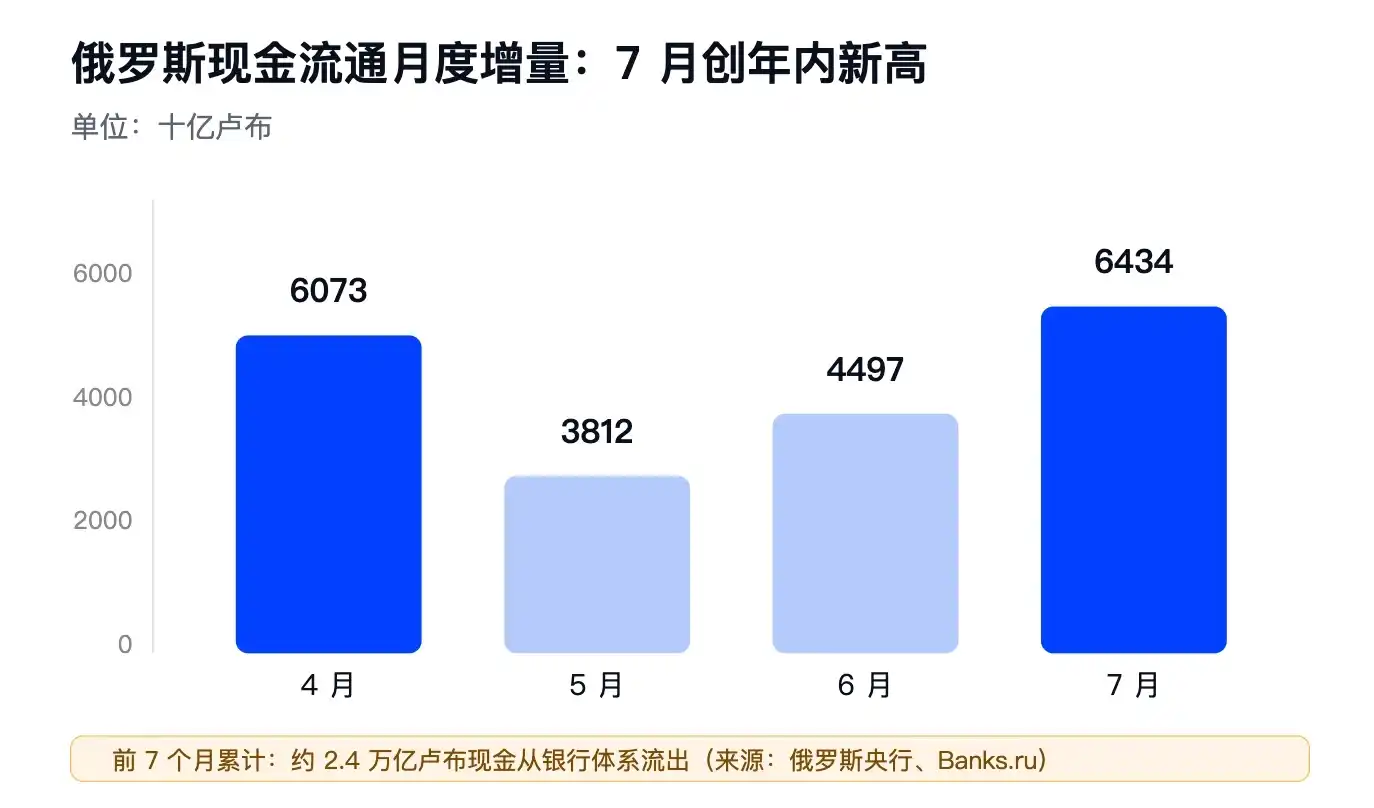
Orang Rusia sedang menarik uang tunai dari bank. Menurut laporan media seperti Financial Times dan Washington Post, dalam 7 bulan pertama 2026, jumlah uang tunai yang ditarik orang Rusia dari sistem perbankan mencapai sekitar 24,4 miliar euro (setara 2,4 triliun rubel). Data dari platform data keuangan lokal Rusia, Banks.ru, menunjukkan bahwa gelombang penarikan ini dimulai pada awal Maret, dengan sekitar 300 miliar rubel meninggalkan rekening pribadi setiap bulannya.

Kecepatan arus keluar semakin meningkat. Data Bank Sentral Rusia menunjukkan, sirkulasi uang tunai meningkat 6.073 miliar rubel pada April, meningkat 3.812 miliar rubel pada Mei (mencapai rekor tertinggi bulan Mei sejak 1995), meningkat 4.497 miliar rubel pada Juni, dan meningkat lagi 6.434 miliar rubel pada Juli, menjadi peningkatan bulanan terbesar pada tahun 2026. Hingga Juli tahun ini, total uang tunai di tangan publik dan perusahaan Rusia telah melebihi 21,9 triliun rubel.

Data simpanan bank tertentu lebih menjelaskan masalah ini. Gazprombank kehilangan 2.995 miliar rubel simpanan pribadi dalam 4 bulan, atau 10,8% dari total simpanannya; Rosselkhozbank kehilangan 2.705 miliar rubel, penurunannya melebihi 15%; bank swasta terbesar Rusia, Alfa-Bank, kehilangan 1.794 miliar rubel, turun 5,6%. Bahkan Sberbank yang biasanya stabil tidak luput, kehilangan 2.116 miliar rubel pada Juni saja, dan 318 miliar rubel lagi pada Juli.

Uang Ini Tidak Hilang, Melainkan Mengalir ke Mata Uang Kripto
Bersamaan dengan arus keluar uang tunai dari bank, volume perdagangan kripto membesar dengan cepat. Pada Februari 2025, Wakil Menteri Keuangan Rusia Ivan Chebeskov dalam konferensi Alfa Talk menyatakan bahwa volume perdagangan mata uang kripto harian di kalangan masyarakat Rusia mencapai sekitar 50 miliar rubel, setara dengan sekitar $648 juta menurut kurs saat itu, dengan jutaan warga berpartisipasi setiap tahunnya.

Kata-kata asli Chebeskov adalah: "Volume perdagangan mata uang kripto tahunan di negara kami melebihi 10 triliun rubel, semuanya terjadi di luar wilayah pengawasan." Pernyataan ini menyoroti kecemasan nyata dari regulator. Masyarakat tidak menganggap mata uang kripto sebagai mainan spekulatif, melainkan sebagai alat tabungan untuk melawan depresiasi rubel, menghindari kontrol modal, dan menghadapi ketidakpastian keuangan.

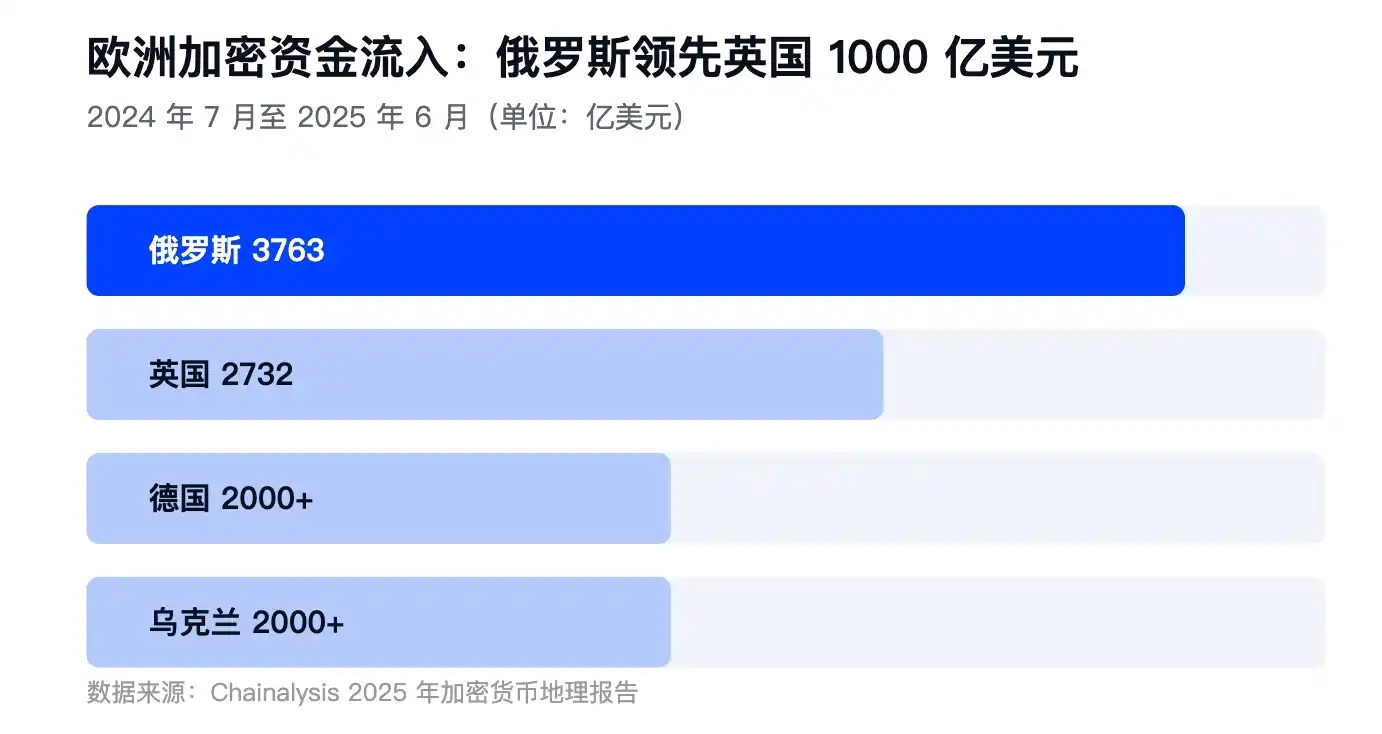
Data Chainalysis mengonfirmasi besarnya pasar ini dari sisi lain. Dari Juli 2024 hingga Juni 2025, aliran masuk dana kripto yang diterima Rusia mencapai $376,3 miliar, hampir 1,4 kali lipat dari $273,2 miliar Inggris, menempati peringkat pertama di Eropa. Ketua Dewan Pengawas Bursa Moskow, Sergei Shvetsov, memperkirakan bahwa pengguna Rusia membayar sekitar $15 miliar dalam biaya kepada platform kripto luar negeri setiap tahun.

UU Kripto Baru Berlaku 1 September, Investor Ritel Terkunci pada 300 Ribu Rubel per Tahun
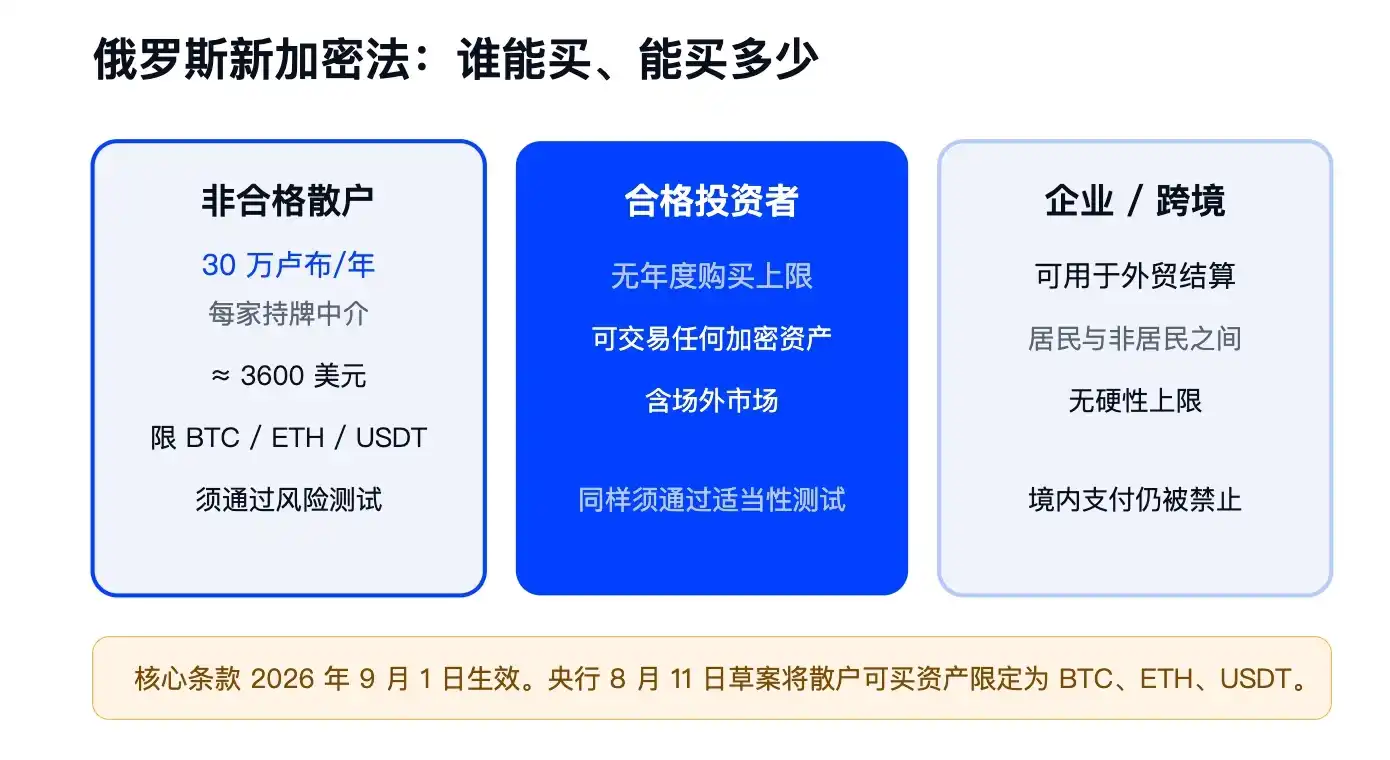
Pemerintah memilih untuk mengatur saluran abu-abu ini dengan cara legislatif. Pada 21 Juli 2026, Duma Negara Rusia menyelesaikan pembacaan kedua dan ketiga "Undang-Undang Mata Uang Digital dan Hak Digital" dalam satu hari; pada 4 Agustus, Putin menandatanganinya menjadi undang-undang. Klausul inti undang-undang ini akan resmi berlaku pada 1 September 2026.

Untuk investor ritel biasa, undang-undang menetapkan syarat akses yang ketat. Investor non-kualifikasi harus lulus tes kelayakan Bank Sentral Rusia, dan jumlah pembelian mata uang kripto melalui satu perantara berlisensi mana pun tidak boleh melebihi 300 ribu rubel per tahun, setara dengan $3.600 hingga $3.800. Pada 11 Agustus, Bank Sentral Rusia menerbitkan draf instruksi yang membatasi aset kripto yang dapat dibeli investor ritel hanya pada tiga jenis: Bitcoin, Ethereum, dan USDT.

Investor kualifikasi tidak dikenai batasan ini dan dapat bertransaksi dengan bebas di bursa dan pasar luar bursa. Perusahaan dan importir/eksportir juga dapat menggunakan mata uang kripto untuk penyelesaian lintas batas, tanpa batas atas yang ketat. Undang-undang ini juga mempertahankan larangan penggunaan mata uang kripto untuk pembayaran barang dan jasa di dalam negeri.

Dengan kata lain, orang biasa yang ingin melindungi nilai aset dengan kripto hanya dapat membeli sekitar $3.600 per tahun per platform; sementara perusahaan dan individu beraset tinggi masih memiliki banyak saluran. Desain ini membiarkan celah untuk "arus keluar besar" di sisi institusi, sementara sisi investor ritel diperketat.

Mengapa Bank Kehilangan Darah? Dua Penjelasan Ada Bersamaan

Terkait arus keluar uang tunai, pihak resmi Rusia dan pasar memberikan penjelasan yang berbeda.

Pejabat Bank Sentral Rusia dan Kementerian Keuangan berulang kali menekankan bahwa tidak ada rencana untuk membekukan simpanan penduduk, dan Menteri Keuangan Anton Siluanov bahkan menyebut rumor terkait sebagai "informasi palsu". Wakil Gubernur Bank Sentral Alexei Zabotkin pada Agustus 2025 pernah menyatakan secara terbuka bahwa membatasi penarikan akan menimbulkan konsekuensi "merusak" bagi sistem keuangan.

Bank sentral mengaitkan lonjakan uang tunai dengan beberapa faktor teknis: kenaikan pajak pertambahan nilai (PPN) dari 20% menjadi 22% mulai Januari 2026, dan bisnis akuisisi bank juga dimasukkan ke dalam PPN, mendorong UKM beralih ke uang tunai untuk menghindari pajak; gangguan frekuensi komunikasi seluler dan internet sejak musim semi menyebabkan pembayaran digital gagal, memaksa publik dan perusahaan menimbun uang tunai; selain itu, turunnya suku bunga simpanan juga mengurangi daya tarik simpanan.

Namun, tingkat pasar memberikan narasi lain. Financial Times dan Washington Post mengutip analis dan mantan pejabat keuangan anonim yang mengatakan bahwa di balik penarikan uang tunai oleh publik terdapat kekhawatiran tentang meningkatnya biaya perang, nasionalisasi aset, dan ketidakstabilan sistem perbankan. Jaksa Rusia tahun lalu memindahkan sekitar $51,5 miliar aset swasta ke bawah kontrol negara, dan pada Juni juga menyita sekitar $7,6 miliar aset terkait taipan pertanian Vadim Moshkovich. Peristiwa-peristiwa ini membuat rumor "simpanan mungkin disita pemerintah" terus beredar.

1 September Bukan Hanya Berlaku UU Kripto, Rubel Digital Juga Akan Diluncurkan

Patut dicatat bahwa 1 September juga merupakan hari mata uang digital bank sentral "Rubel Digital" dibuka untuk pengguna biasa. Sberbank, VTB, Alfa-Bank, Gazprombank, T-Bank, dan 12 bank penting sistem lainnya harus memungkinkan klien untuk melakukan transaksi Rubel Digital, dan pengecer dengan omset tahunan lebih dari 120 juta rubel juga harus menerima pembayaran dengan Rubel Digital.

Ini berarti pada hari yang sama, Rusia akan melakukan dua hal sekaligus: di satu sisi, membawa perdagangan kripto masyarakat ke dalam kerangka pengaturan melalui perantara berlisensi; di sisi lain, menarik kembali pembayaran ritel ke dalam sistem resmi melalui mata uang digital bank sentral. Bagi warga Rusia biasa, daya tarik simpanan bank menurun, kuota pembelian kripto dikunci, sementara Rubel Digital menawarkan jalan ketiga, tetapi jalan ini sepenuhnya dikendalikan negara.

Ketika 24,4 miliar euro uang tunai mengalir keluar dari sistem perbankan dan $650 juta perdagangan kripto harian beredar di wilayah abu-abu, undang-undang yang ditandatangani Putin pada 4 Agustus lebih menyerupai sebuah garis pemisah. Bagi warga Rusia biasa, saluran untuk mengatur kekayaan secara mandiri semakin sedikit, dan setiap pilihan di baliknya membawa kepemilikan kontrol yang berbeda.

Trending Cryptos

Related Questions

QApa inti dari Undang-Undang Mata Uang Digital dan Hak Digital Rusia yang mulai berlaku 1 September?

AInti dari Undang-Undang ini adalah untuk mengatur transaksi cryptocurrency di Rusia melalui perantara berlisensi. Untuk investor ritel non-kualifikasi, hukum membatasi pembelian cryptocurrency hingga maksimal 30.000 rubel (sekitar $3600) per tahun melalui satu perantara berlisensi mana pun. Bank Sentral Rusia juga membatasi aset kripto yang dapat dibeli oleh investor ritel hanya pada Bitcoin, Ethereum, dan USDT. Investor kualifikasi dan perusahaan tidak terkena batasan ini.

QBerapa banyak uang tunai yang telah ditarik warga Rusia dari sistem perbankan pada 7 bulan pertama tahun 2026, dan mengapa hal ini terjadi?

AMenurut data dari Bank Sentral Rusia dan media internasional, warga Rusia telah menarik sekitar 244 miliar euro (sekitar 2,4 triliun rubel) dalam bentuk tunai dari sistem perbankan dalam 7 bulan pertama tahun 2026. Ada dua narasi yang menjelaskan hal ini: Narasi resmi pemerintah menghubungkannya dengan peningkatan pajak, gangguan pembayaran digital, dan rendahnya suku bunga deposito. Sementara narasi pasar dan analis menunjuk pada kekhawatiran publik tentang biaya perang, ketidakstabilan sistem keuangan, dan ketakutan bahwa deposit bank dapat disita atau dinasionalisasi oleh negara.

QApa peran cryptocurrency dalam perekonomian Rusia menurut artikel tersebut?

AMenurut artikel, cryptocurrency berperan sebagai alat perlindungan nilai (store of value) bagi warga Rusia untuk melawan depresiasi rubel, menghindari kontrol modal, dan menghadapi ketidakpastian finansial. Transaksi harian cryptocurrency di Rusia diperkirakan mencapai 500 miliar rubel (sekitar $6,48 miliar), dengan volume perdagangan tahunan melebihi 10 triliun rubel. Data Chainalysis juga menunjukkan Rusia sebagai penerima aliran dana kripto terbesar di Eropa.

QSiapa saja yang tidak terkena batasan pembelian cryptocurrency 30.000 rubel per tahun menurut hukum baru Rusia?

AMenurut hukum baru tersebut, batasan pembelian tahunan sebesar 30.000 rubel hanya berlaku untuk investor ritel non-kualifikasi. Investor kualifikasi (yang biasanya memiliki kekayaan bersih atau pengalaman investasi lebih tinggi) tidak terkena batasan ini dan dapat berdagang secara bebas di bursa dan pasar over-the-counter (OTC). Selain itu, perusahaan dan importir/eksportir juga dibebaskan dari batasan ini untuk melakukan penyelesaian transaksi lintas batas menggunakan cryptocurrency.

QPeristiwa penting apa lagi yang akan terjadi di Rusia pada tanggal 1 September selain berlakunya undang-undang cryptocurrency?

APada tanggal 1 September yang sama, Bank Sentral Rusia juga akan meluncurkan mata uang digitalnya sendiri, Rubel Digital (Digital Ruble), untuk pengguna biasa. Dua belas bank penting sistemik diwajibkan memungkinkan klien mereka melakukan transaksi dengan Rubel Digital, dan pengecer dengan omset tahunan di atas 1,2 miliar rubel juga harus mulai menerimanya sebagai alat pembayaran.

Related Reads

Mysterious "Ox Alpha" Large Model Goes Viral with Limited-Time Free Access

A mysterious anonymous AI model named "Ox Alpha," nicknamed "Cow is Coming" by Chinese netizens, has appeared on OpenRouter, sparking widespread speculation. The model offers a 1 million token context, supports text, image, and video inputs, can call tools, and is currently free. Its standout feature is strong coding ability. Initial tests on the DeepSWE benchmark, which evaluates real-world software engineering tasks, showed an 80% pass rate on a subset of tasks, reportedly nearing top-tier code models. However, follow-up tests yielded a 63% score, with variations attributed to different task sets and configurations. The model's true developer is a major topic of debate. The prevailing theory points to Zhipu AI's unreleased GLM-5.3 Flash or its multimodal variant. Evidence cited includes identical visual token consumption patterns with GLM-5V-Turbo for videos, a consistent offset in text token counts compared to GLM-5.3, and similar behavioral traits like refusing audio processing. Zhipu has a precedent of anonymous testing. Simultaneously, another anonymous model, "korrine," appeared on Code Arena, with guesses ranging from Moonshot's Kimi K3.1 to models from Qwen or MiMo, adding to the industry's guessing game. This trend of anonymous "undercover" testing allows for unbiased performance evaluation in platforms like Arena and provides real-world, high-pressure testing through tools like OpenRouter before official release. It also serves as an effective marketing tactic, prolonging discussion through suspense. If Ox Alpha is indeed a "Flash" model, its performance raises expectations for the full-scale version's potential.

marsbit3h ago

Mysterious "Ox Alpha" Large Model Goes Viral with Limited-Time Free Access

marsbit3h ago

Breaking News: DeepSeek Announces All-Day Off-Peak Pricing on Weekends, Making Weekend Work More Cost-Effective?

DeepSeek has announced a significant change to its API pricing model, effective August 23. The new policy removes peak/off-peak distinctions on weekends (Saturdays and Sundays), charging the lower off-peak rate for the entire two-day period. This adjustment has sparked mixed reactions within the developer and professional communities. For developers and businesses heavily reliant on DeepSeek's V4-Flash and V4-Pro APIs, this is welcome news. It allows them to schedule bulk processing tasks on weekends without the higher peak-hour costs, potentially halving their API bills for such workloads. Some users have celebrated the move for making weekend work more cost-effective. However, the announcement has also raised concerns among employees. There is apprehension that companies, particularly in cost-sensitive sectors like AI-powered short drama production, might reorganize work schedules to align with these new cost incentives. Instances are already emerging where teams schedule high-token tasks during cheaper nighttime hours or adjust staff shifts. This has led to worries about a potential shift towards weekend workdays and weekday time-off, prioritizing cost savings over traditional work-life balance. Debate has ensued regarding the practicality of such schedule changes, with questions about increased communication overhead and overall efficiency. Speculation about DeepSeek's motives for the change includes theories that peak pricing correlates with internal model training schedules, though others counter that training is largely automated. The new pricing structure is now in effect, prompting users to reconsider their task scheduling strategies.

marsbit4h ago

Breaking News: DeepSeek Announces All-Day Off-Peak Pricing on Weekends, Making Weekend Work More Cost-Effective?

marsbit4h ago

Just Now, The World's First Human vs. Robot Tennis Match Begins, Robot's Desperate Save Leaves Zheng Jie Astonished

Just now, the world's first human vs. robot tennis match began, featuring stunning robotic saves that left tennis star Zheng Jie in awe. This historic event, part of the second World Humanoid Robot Games and broadcast live globally by China Media Group, marked a pivotal moment in Chinese technological innovation and embodied artificial intelligence. The match featured both mixed human-robot doubles and a groundbreaking singles match between Zheng Jie and the "Galaxy Xingzai" humanoid robot developed by Galaxy General. The robot demonstrated impressive skills including serving, forehands, backhands, and strategic court movement, with serves exceeding 100 km/h. It exhibited remarkable adaptability, recovering from a fall to continue play and handling slices and spins. The doubles match highlighted its ability to coordinate dynamically with a human partner. The event's significance extends far beyond a novelty match. Tennis represents an ultimate pressure test for embodied AI, demanding real-time integration of perception, decision-making, full-body motion control, and live博弈 within fractions of a second—a stark contrast to the discrete, contemplative environment of board games like Go mastered by AlphaGo. It directly confronts Moravec's paradox, showcasing AI's move from digital cognition to physical execution. This capability is powered by Galaxy General's proprietary "Galaxy Star Brain" (AstraBrain) model. Its key innovation is a unified architecture that integrates high-level task understanding/tactical decision-making ("brain") and dynamic whole-body motion control ("cerebellum") into a single model, eliminating latency and information loss between separate modules. The model was trained using a two-step process via the "Galaxy Star Workshop" platform. First, it learned foundational movement priors from "imperfect" human motion data (both amateur and professional). Second, it underwent massive-scale evolution in a virtual tennis simulator where multiple AI agents played millions of games against each other. Through this adversarial training, skills like极限救球and recovery from falls emerged autonomously without explicit programming, before being transferred to the physical robot. This "AstraTennis" moment symbolizes a major leap: a decade after AlphaGo conquered the digital world, embodied AI from China has now demonstrated it can operate under the extreme, unpredictable physical pressures of real-world competition.

marsbit4h ago

Just Now, The World's First Human vs. Robot Tennis Match Begins, Robot's Desperate Save Leaves Zheng Jie Astonished

marsbit4h ago

Trading

Spot

Hot Articles

What is SONIC

Sonic: Pioneering the Future of Gaming in Web3 Introduction to Sonic In the ever-evolving landscape of Web3, the gaming industry stands out as one of the most dynamic and promising sectors. At the forefront of this revolution is Sonic, a project designed to amplify the gaming ecosystem on the Solana blockchain. Leveraging cutting-edge technology, Sonic aims to deliver an unparalleled gaming experience by efficiently processing millions of requests per second, ensuring that players enjoy seamless gameplay while maintaining low transaction costs. This article delves into the intricate details of Sonic, exploring its creators, funding sources, operational mechanics, and the timeline of significant events that have shaped its journey. What is Sonic? Sonic is an innovative layer-2 network that operates atop the Solana blockchain, specifically tailored to enhance the existing Solana gaming ecosystem. It accomplishes this through a customised, VM-agnostic game engine paired with a HyperGrid interpreter, facilitating sovereign game economies that roll up back to the Solana platform. The primary goals of Sonic include: Enhanced Gaming Experiences: Sonic is committed to offering lightning-fast on-chain gameplay, allowing players and developers to engage with games at previously unattainable speeds. Atomic Interoperability: This feature enables transactions to be executed within Sonic without the need to redeploy Solana programmes and accounts. This makes the process more efficient and directly benefits from Solana Layer1 services and liquidity. Seamless Deployment: Sonic allows developers to write for Ethereum Virtual Machine (EVM) based systems and execute them on Solana’s SVM infrastructure. This interoperability is crucial for attracting a broader range of dApps and decentralised applications to the platform. Support for Developers: By offering native composable gaming primitives and extensible data types - dining within the Entity-Component-System (ECS) framework - game creators can craft intricate business logic with ease. Overall, Sonic's unique approach not only caters to players but also provides an accessible and low-cost environment for developers to innovate and thrive. Creator of Sonic The information regarding the creator of Sonic is somewhat ambiguous. However, it is known that Sonic's SVM is owned by the company Mirror World. The absence of detailed information about the individuals behind Sonic reflects a common trend in several Web3 projects, where collective efforts and partnerships often overshadow individual contributions. Investors of Sonic Sonic has garnered considerable attention and support from various investors within the crypto and gaming sectors. Notably, the project raised an impressive $12 million during its Series A funding round. The round was led by BITKRAFT Ventures, with other notable investors including Galaxy, Okx Ventures, Interactive, Big Brain Holdings, and Mirana. This financial backing signifies the confidence that investment foundations have in Sonic’s potential to revolutionise the Web3 gaming landscape, further validating its innovative approaches and technologies. How Does Sonic Work? Sonic utilises the HyperGrid framework, a sophisticated parallel processing mechanism that enhances its scalability and customisability. Here are the core features that set Sonic apart: Lightning Speed at Low Costs: Sonic offers one of the fastest on-chain gaming experiences compared to other Layer-1 solutions, powered by the scalability of Solana’s virtual machine (SVM). Atomic Interoperability: Sonic enables transaction execution without redeployment of Solana programmes and accounts, effectively streamlining the interaction between users and the blockchain. EVM Compatibility: Developers can effortlessly migrate decentralised applications from EVM chains to the Solana environment using Sonic’s HyperGrid interpreter, increasing the accessibility and integration of various dApps. Ecosystem Support for Developers: By exposing native composable gaming primitives, Sonic facilitates a sandbox-like environment where developers can experiment and implement business logic, greatly enhancing the overall development experience. Monetisation Infrastructure: Sonic natively supports growth and monetisation efforts, providing frameworks for traffic generation, payments, and settlements, thereby ensuring that gaming projects are not only viable but also sustainable financially. Timeline of Sonic The evolution of Sonic has been marked by several key milestones. Below is a brief timeline highlighting critical events in the project's history: 2022: The Sonic cryptocurrency was officially launched, marking the beginning of its journey in the Web3 gaming arena. 2024: June: Sonic SVM successfully raised $12 million in a Series A funding round. This investment allowed Sonic to further develop its platform and expand its offerings. August: The launch of the Sonic Odyssey testnet provided users with the first opportunity to engage with the platform, offering interactive activities such as collecting rings—a nod to gaming nostalgia. October: SonicX, an innovative crypto game integrated with Solana, made its debut on TikTok, capturing the attention of over 120,000 users within a short span. This integration illustrated Sonic’s commitment to reaching a broader, global audience and showcased the potential of blockchain gaming. Key Points Sonic SVM is a revolutionary layer-2 network on Solana explicitly designed to enhance the GameFi landscape, demonstrating great potential for future development. HyperGrid Framework empowers Sonic by introducing horizontal scaling capabilities, ensuring that the network can handle the demands of Web3 gaming. Integration with Social Platforms: The successful launch of SonicX on TikTok displays Sonic’s strategy to leverage social media platforms to engage users, exponentially increasing the exposure and reach of its projects. Investment Confidence: The substantial funding from BITKRAFT Ventures, among others, emphasizes the robust backing Sonic has, paving the way for its ambitious future. In conclusion, Sonic encapsulates the essence of Web3 gaming innovation, striking a balance between cutting-edge technology, developer-centric tools, and community engagement. As the project continues to evolve, it is poised to redefine the gaming landscape, making it a notable entity for gamers and developers alike. As Sonic moves forward, it will undoubtedly attract greater interest and participation, solidifying its place within the broader narrative of blockchain gaming.

2.4k Total ViewsPublished 2024.04.04Updated 2024.12.03

What is SONIC

What is $S$

Understanding SPERO: A Comprehensive Overview Introduction to SPERO As the landscape of innovation continues to evolve, the emergence of web3 technologies and cryptocurrency projects plays a pivotal role in shaping the digital future. One project that has garnered attention in this dynamic field is SPERO, denoted as SPERO,$$s$. This article aims to gather and present detailed information about SPERO, to help enthusiasts and investors understand its foundations, objectives, and innovations within the web3 and crypto domains. What is SPERO,$$s$? SPERO,$$s$ is a unique project within the crypto space that seeks to leverage the principles of decentralisation and blockchain technology to create an ecosystem that promotes engagement, utility, and financial inclusion. The project is tailored to facilitate peer-to-peer interactions in new ways, providing users with innovative financial solutions and services. At its core, SPERO,$$s$ aims to empower individuals by providing tools and platforms that enhance user experience in the cryptocurrency space. This includes enabling more flexible transaction methods, fostering community-driven initiatives, and creating pathways for financial opportunities through decentralised applications (dApps). The underlying vision of SPERO,$$s$ revolves around inclusiveness, aiming to bridge gaps within traditional finance while harnessing the benefits of blockchain technology. Who is the Creator of SPERO,$$s$? The identity of the creator of SPERO,$$s$ remains somewhat obscure, as there are limited publicly available resources providing detailed background information on its founder(s). This lack of transparency can stem from the project's commitment to decentralisation—an ethos that many web3 projects share, prioritising collective contributions over individual recognition. By centring discussions around the community and its collective goals, SPERO,$$s$ embodies the essence of empowerment without singling out specific individuals. As such, understanding the ethos and mission of SPERO remains more important than identifying a singular creator. Who are the Investors of SPERO,$$s$? SPERO,$$s$ is supported by a diverse array of investors ranging from venture capitalists to angel investors dedicated to fostering innovation in the crypto sector. The focus of these investors generally aligns with SPERO's mission—prioritising projects that promise societal technological advancement, financial inclusivity, and decentralised governance. These investor foundations are typically interested in projects that not only offer innovative products but also contribute positively to the blockchain community and its ecosystems. The backing from these investors reinforces SPERO,$$s$ as a noteworthy contender in the rapidly evolving domain of crypto projects. How Does SPERO,$$s$ Work? SPERO,$$s$ employs a multi-faceted framework that distinguishes it from conventional cryptocurrency projects. Here are some of the key features that underline its uniqueness and innovation: Decentralised Governance: SPERO,$$s$ integrates decentralised governance models, empowering users to participate actively in decision-making processes regarding the project’s future. This approach fosters a sense of ownership and accountability among community members. Token Utility: SPERO,$$s$ utilises its own cryptocurrency token, designed to serve various functions within the ecosystem. These tokens enable transactions, rewards, and the facilitation of services offered on the platform, enhancing overall engagement and utility. Layered Architecture: The technical architecture of SPERO,$$s$ supports modularity and scalability, allowing for seamless integration of additional features and applications as the project evolves. This adaptability is paramount for sustaining relevance in the ever-changing crypto landscape. Community Engagement: The project emphasises community-driven initiatives, employing mechanisms that incentivise collaboration and feedback. By nurturing a strong community, SPERO,$$s$ can better address user needs and adapt to market trends. Focus on Inclusion: By offering low transaction fees and user-friendly interfaces, SPERO,$$s$ aims to attract a diverse user base, including individuals who may not previously have engaged in the crypto space. This commitment to inclusion aligns with its overarching mission of empowerment through accessibility. Timeline of SPERO,$$s$ Understanding a project's history provides crucial insights into its development trajectory and milestones. Below is a suggested timeline mapping significant events in the evolution of SPERO,$$s$: Conceptualisation and Ideation Phase: The initial ideas forming the basis of SPERO,$$s$ were conceived, aligning closely with the principles of decentralisation and community focus within the blockchain industry. Launch of Project Whitepaper: Following the conceptual phase, a comprehensive whitepaper detailing the vision, goals, and technological infrastructure of SPERO,$$s$ was released to garner community interest and feedback. Community Building and Early Engagements: Active outreach efforts were made to build a community of early adopters and potential investors, facilitating discussions around the project’s goals and garnering support. Token Generation Event: SPERO,$$s$ conducted a token generation event (TGE) to distribute its native tokens to early supporters and establish initial liquidity within the ecosystem. Launch of Initial dApp: The first decentralised application (dApp) associated with SPERO,$$s$ went live, allowing users to engage with the platform's core functionalities. Ongoing Development and Partnerships: Continuous updates and enhancements to the project's offerings, including strategic partnerships with other players in the blockchain space, have shaped SPERO,$$s$ into a competitive and evolving player in the crypto market. Conclusion SPERO,$$s$ stands as a testament to the potential of web3 and cryptocurrency to revolutionise financial systems and empower individuals. With a commitment to decentralised governance, community engagement, and innovatively designed functionalities, it paves the way toward a more inclusive financial landscape. As with any investment in the rapidly evolving crypto space, potential investors and users are encouraged to research thoroughly and engage thoughtfully with the ongoing developments within SPERO,$$s$. The project showcases the innovative spirit of the crypto industry, inviting further exploration into its myriad possibilities. While the journey of SPERO,$$s$ is still unfolding, its foundational principles may indeed influence the future of how we interact with technology, finance, and each other in interconnected digital ecosystems.

435 Total ViewsPublished 2024.12.17Updated 2024.12.17

What is $S$

What is AGENT S

Agent S: The Future of Autonomous Interaction in Web3 Introduction In the ever-evolving landscape of Web3 and cryptocurrency, innovations are constantly redefining how individuals interact with digital platforms. One such pioneering project, Agent S, promises to revolutionise human-computer interaction through its open agentic framework. By paving the way for autonomous interactions, Agent S aims to simplify complex tasks, offering transformative applications in artificial intelligence (AI). This detailed exploration will delve into the project's intricacies, its unique features, and the implications for the cryptocurrency domain. What is Agent S? Agent S stands as a groundbreaking open agentic framework, specifically designed to tackle three fundamental challenges in the automation of computer tasks: Acquiring Domain-Specific Knowledge: The framework intelligently learns from various external knowledge sources and internal experiences. This dual approach empowers it to build a rich repository of domain-specific knowledge, enhancing its performance in task execution. Planning Over Long Task Horizons: Agent S employs experience-augmented hierarchical planning, a strategic approach that facilitates efficient breakdown and execution of intricate tasks. This feature significantly enhances its ability to manage multiple subtasks efficiently and effectively. Handling Dynamic, Non-Uniform Interfaces: The project introduces the Agent-Computer Interface (ACI), an innovative solution that enhances the interaction between agents and users. Utilizing Multimodal Large Language Models (MLLMs), Agent S can navigate and manipulate diverse graphical user interfaces seamlessly. Through these pioneering features, Agent S provides a robust framework that addresses the complexities involved in automating human interaction with machines, setting the stage for myriad applications in AI and beyond. Who is the Creator of Agent S? While the concept of Agent S is fundamentally innovative, specific information about its creator remains elusive. The creator is currently unknown, which highlights either the nascent stage of the project or the strategic choice to keep founding members under wraps. Regardless of anonymity, the focus remains on the framework's capabilities and potential. Who are the Investors of Agent S? As Agent S is relatively new in the cryptographic ecosystem, detailed information regarding its investors and financial backers is not explicitly documented. The lack of publicly available insights into the investment foundations or organisations supporting the project raises questions about its funding structure and development roadmap. Understanding the backing is crucial for gauging the project's sustainability and potential market impact. How Does Agent S Work? At the core of Agent S lies cutting-edge technology that enables it to function effectively in diverse settings. Its operational model is built around several key features: Human-like Computer Interaction: The framework offers advanced AI planning, striving to make interactions with computers more intuitive. By mimicking human behaviour in tasks execution, it promises to elevate user experiences. Narrative Memory: Employed to leverage high-level experiences, Agent S utilises narrative memory to keep track of task histories, thereby enhancing its decision-making processes. Episodic Memory: This feature provides users with step-by-step guidance, allowing the framework to offer contextual support as tasks unfold. Support for OpenACI: With the ability to run locally, Agent S allows users to maintain control over their interactions and workflows, aligning with the decentralised ethos of Web3. Easy Integration with External APIs: Its versatility and compatibility with various AI platforms ensure that Agent S can fit seamlessly into existing technological ecosystems, making it an appealing choice for developers and organisations. These functionalities collectively contribute to Agent S's unique position within the crypto space, as it automates complex, multi-step tasks with minimal human intervention. As the project evolves, its potential applications in Web3 could redefine how digital interactions unfold. Timeline of Agent S The development and milestones of Agent S can be encapsulated in a timeline that highlights its significant events: September 27, 2024: The concept of Agent S was launched in a comprehensive research paper titled “An Open Agentic Framework that Uses Computers Like a Human,” showcasing the groundwork for the project. October 10, 2024: The research paper was made publicly available on arXiv, offering an in-depth exploration of the framework and its performance evaluation based on the OSWorld benchmark. October 12, 2024: A video presentation was released, providing a visual insight into the capabilities and features of Agent S, further engaging potential users and investors. These markers in the timeline not only illustrate the progress of Agent S but also indicate its commitment to transparency and community engagement. Key Points About Agent S As the Agent S framework continues to evolve, several key attributes stand out, underscoring its innovative nature and potential: Innovative Framework: Designed to provide an intuitive use of computers akin to human interaction, Agent S brings a novel approach to task automation. Autonomous Interaction: The ability to interact autonomously with computers through GUI signifies a leap towards more intelligent and efficient computing solutions. Complex Task Automation: With its robust methodology, it can automate complex, multi-step tasks, making processes faster and less error-prone. Continuous Improvement: The learning mechanisms enable Agent S to improve from past experiences, continually enhancing its performance and efficacy. Versatility: Its adaptability across different operating environments like OSWorld and WindowsAgentArena ensures that it can serve a broad range of applications. As Agent S positions itself in the Web3 and crypto landscape, its potential to enhance interaction capabilities and automate processes signifies a significant advancement in AI technologies. Through its innovative framework, Agent S exemplifies the future of digital interactions, promising a more seamless and efficient experience for users across various industries. Conclusion Agent S represents a bold leap forward in the marriage of AI and Web3, with the capacity to redefine how we interact with technology. While still in its early stages, the possibilities for its application are vast and compelling. Through its comprehensive framework addressing critical challenges, Agent S aims to bring autonomous interactions to the forefront of the digital experience. As we move deeper into the realms of cryptocurrency and decentralisation, projects like Agent S will undoubtedly play a crucial role in shaping the future of technology and human-computer collaboration.

1.1k Total ViewsPublished 2025.01.14Updated 2025.01.14

What is AGENT S

Discussions

Welcome to the HTX Community. Here, you can stay informed about the latest platform developments and gain access to professional market insights. Users' opinions on the price of S (S) are presented below.

活动图片