BONK : la trésorerie de l'entreprise de cryptomonnaie ne compte plus que 2,1 millions de dollars, mais 70 % de ses revenus proviennent de la plateforme de son fondateur

marsbitPublished on 2026-08-19Last updated on 2026-08-19

Abstract

L'entreprise cotée en bourse Bonk, Inc. (BNKK), liée au célèbre meme coin BONK de Solana, a publié ses résultats semestriels. Malgré une augmentation de 6218% de ses revenus (5,5 millions de dollars), elle a enregistré une perte nette de 7,88 millions de dollars. La situation financière est critique : la trésorerie n'est plus que de 214 000 dollars, soit suffisante pour environ 9 jours d'activité au rythme actuel de consommation, ce qui a conduit l'auditeur à émettre un avertissement sur sa capacité à poursuivre ses activités. Plus inquiétant, 71% de ces revenus (3,92 millions de dollars) proviennent d'une seule source : une redevance sur les revenus de la plateforme LetsBonk.fun, détenue par une entité liée au fondateur Mitchell Rudy. Ce dernier, via Lucky Dog Holdings, contrôle environ 40,2% des actions ordinaires et la totalité des actions privilégiées de série C. Ces actions privilégiées lui permettent de nommer la moitié des administrateurs de l'entreprise, concentrant ainsi le pouvoir décisionnel. La société avait acquis ces actions en échange de jetons BONK, dont la dépréciation est la principale cause des pertes. Malgré l'optimisme affiché par Rudy sur la valeur de la société, la dépendance quasi-exclusive à ses propres plateformes et le manque criant de liquidités posent des questions majeures sur la viabilité future de Bonk, Inc.

Auteur : Claude, Shenchao TechFlow

Introduction de Shenchao : Le 14 août, l'entreprise cotée au Nasdaq Bonk, Inc. (BNKK) a publié ses comptes du premier semestre : des revenus de 5,5 millions de dollars, en hausse de 6218 % sur un an, mais une perte nette de 7,88 millions de dollars. La trésorerie n'est plus que de 214 000 dollars, et l'auditeur a clairement mis en garde contre des « doutes importants sur la continuité de l'exploitation ». Plus préoccupant encore, sur ces 5,5 millions de dollars de revenus, 3,92 millions, soit 71 %, proviennent de la part des revenus de la plateforme liée au fondateur Mitchell Rudy. Rudy détient environ 40,2 % des actions ordinaires et la totalité des actions privilégiées de série C via Lucky Dog Holdings. Ces dernières peuvent élire la moitié des administrateurs de l'entreprise. Cette société cotée, anciennement la boisson Safety Shot, a remis son destin entre les mains d'une seule et même personne.

Présentons d'abord cette entreprise. BONK est l'un des meme coins les plus connus de Solana, lancé fin 2022 via un airdrop communautaire, sans entité légale propre. Bonk, Inc. est l'entreprise cotée au Nasdaq (symbole BNKK), anciennement Safety Shot qui vendait des boissons énergisantes. Elle a changé de nom en octobre 2025, annonçant une transformation pour devenir une « entreprise d'infrastructure numérique connectant les marchés publics traditionnels et l'économie décentralisée » : constituer un trésor de jetons BONK et percevoir des redevances sur la plateforme de lancement de meme coins de l'écosystème BONK, LetsBonk.fun.

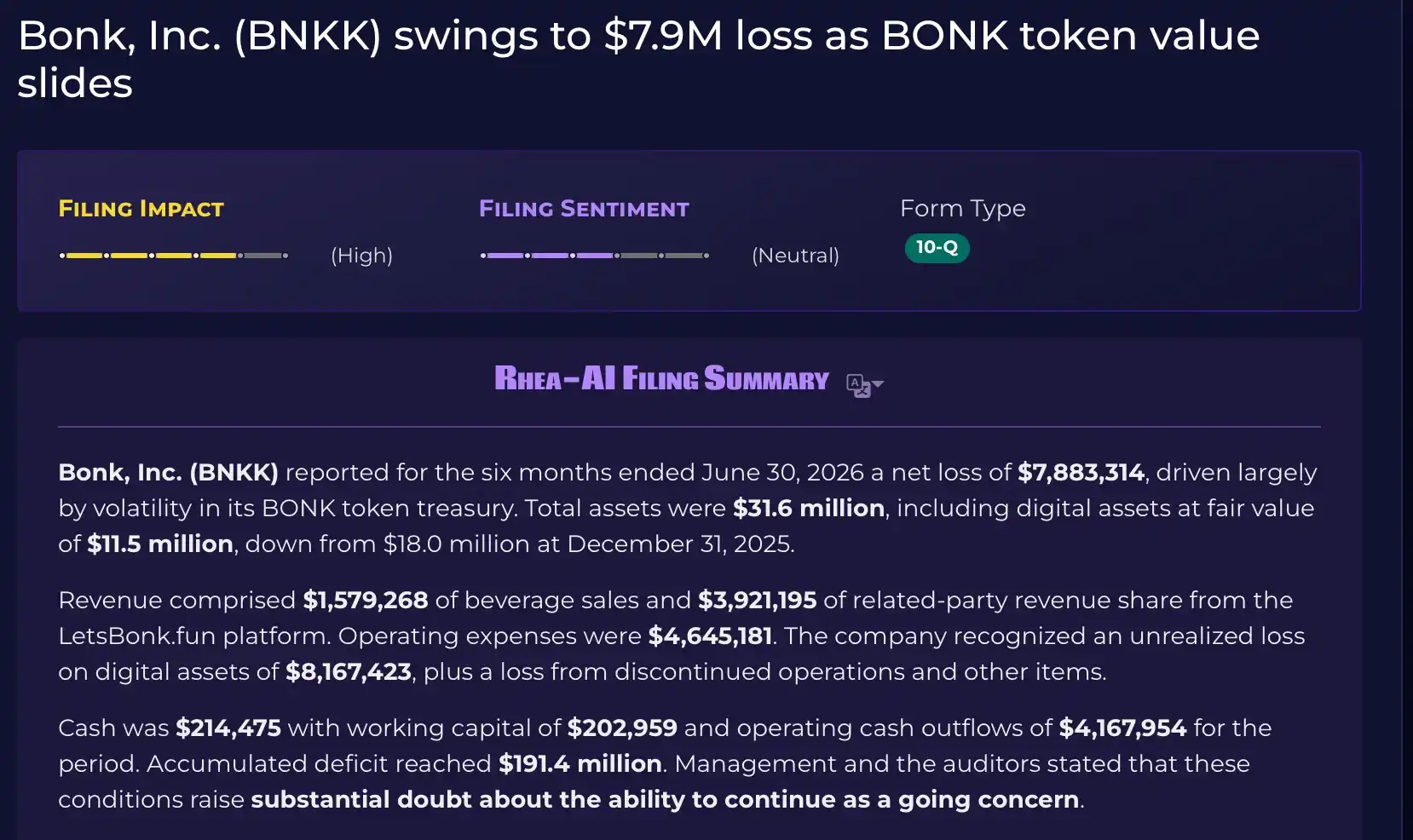
Le 17 août, la société a publié ses résultats semestriels, et le formulaire 10-Q du 14 août a dévoilé les comptes complets. Les chiffres présentent un contraste saisissant : des revenus de 5,5 millions de dollars, en hausse de 6218 % ; mais une perte nette de 7,88 millions de dollars sur la même période, principalement due à une dépréciation de 8,17 millions de dollars sur les jetons BONK détenus. Au 30 juin, la trésorerie s'élève à 214 000 dollars, le fonds de roulement à 203 000 dollars, et les pertes cumulées à 191,4 millions de dollars. L'auditeur M&K CPAS et la direction ont tous deux indiqué dans leur rapport : ces circonstances soulèvent des doutes importants quant à la capacité de l'entreprise à poursuivre son exploitation (ce que les auditeurs appellent le "going concern").
Les revenus du premier semestre explosent de 6218 %, dont 71 % proviennent de la propre plateforme du fondateur

Les 5,5 millions de dollars de revenus se composent de deux parties : les ventes de boissons pour 1,579 million de dollars, et les 3,921 millions de dollars restants proviennent entièrement de la part des revenus d'une partie liée, représentant 71 % des revenus.
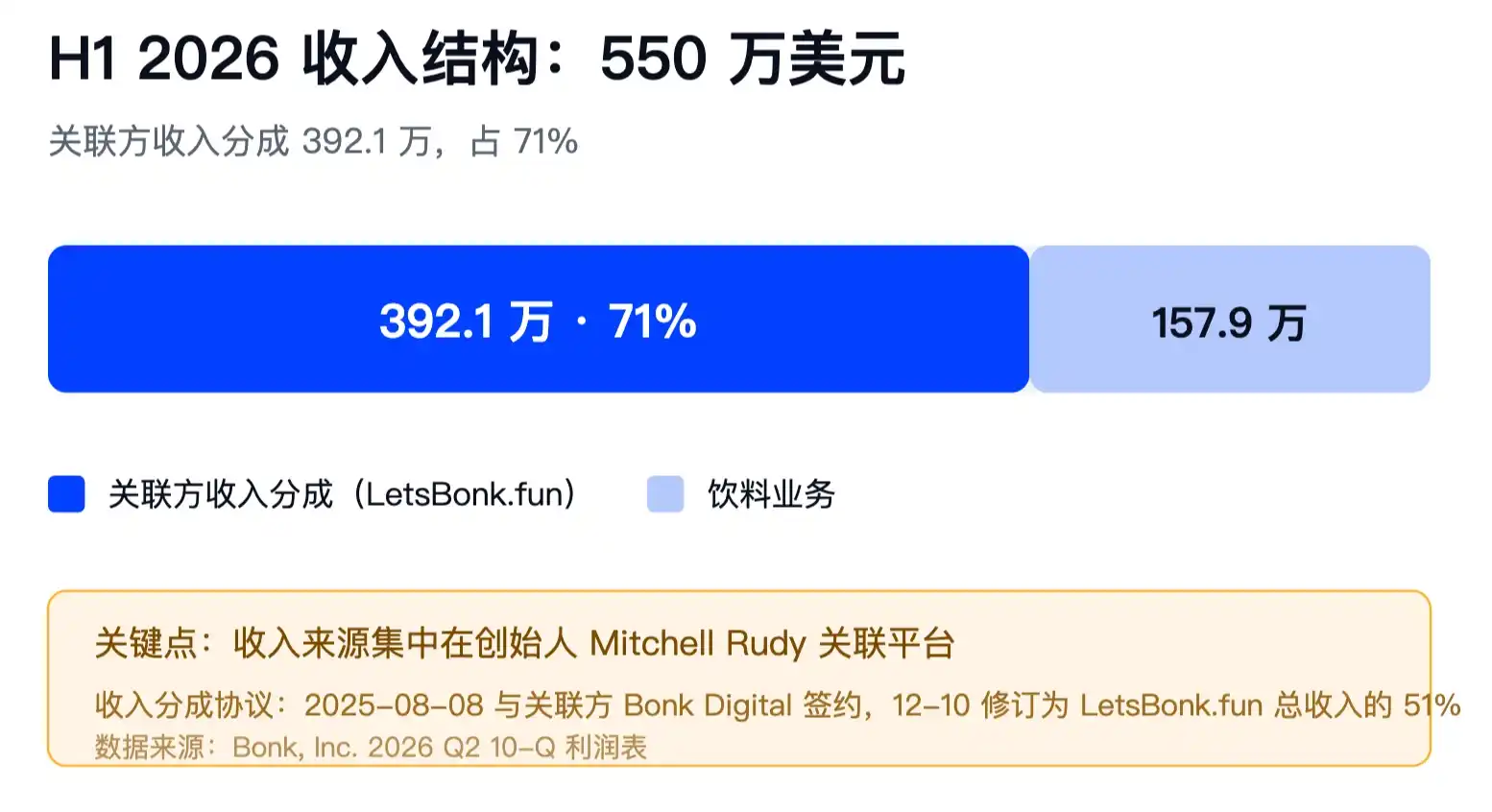
Cette part provient de LetsBonk.fun. Lancée par la communauté BONK en partenariat avec le DEX Raydium, c'est une plateforme de lancement de meme coins sur Solana, fonctionnant de manière similaire à pump.fun : n'importe qui peut lancer un jeton pour une petite quantité de SOL, les transactions s'effectuent sur une courbe de liquidité, puis le jeton rejoint un pool de liquidité Raydium après avoir atteint une certaine taille. La plateforme prélève des frais de transaction de 1 %, une partie étant utilisée pour racheter et brûler des BONK.

De fin 2025 à début 2026, elle a dépassé à plusieurs reprises pump.fun en nombre de jetons lancés par jour, devenant l'une des plateformes de lancement les plus actives sur Solana.

Le 10-Q révèle que le 8 août 2025, la société a signé un accord de partage des revenus avec la partie liée Bonk Digital, Inc., obtenant une partie des flux de revenus futurs de la plateforme ; le 10 décembre, il a été révisé pour lui attribuer 51 % des revenus totaux de LetsBonk.fun, les parties pouvant aussi convenir de revenir à 10 %. Le document ne dévoile pas la structure actionnariale de Bonk Digital, indiquant seulement qu'il s'agit d'une partie liée « par des actions communes et une gouvernance ». En d'autres termes, 71 % des revenus de la société dépendent du succès d'une plateforme au sein de l'écosystème du fondateur.

Le fondateur détient 40,2 % des actions, les actions privilégiées de série C peuvent élire la moitié des administrateurs

Le plus grand actionnaire de la société et cette plateforme liée sont liés aux mêmes personnes. Mitchell Rudy, également connu sous le nom de Nom, est le fondateur et administrateur de Bonk, Inc. Selon la procuration de l'assemblée générale des actionnaires de décembre 2025, Lucky Dog Holdings, contrôlée par Rudy, détient bénéficiairement environ 40,2 % des actions ordinaires, ainsi que la totalité des 135 000 actions privilégiées de série C, représentant ensemble environ 35,5 % des droits de vote totaux.

Les pouvoirs des actions privilégiées de série C sont inhabituels. Les clauses du 10-Q indiquent que tant que les actions privilégiées de série C sont en circulation, leurs détenteurs peuvent, en tant que classe distincte, élire 50 % des administrateurs de la société ; les autres administrateurs sont élus par les actionnaires ordinaires. Rudy détient également des actions directement via Nom Capital ULC, et en avril 2026, il a acheté 31 055 actions sur le marché public à 2,82 dollars par action.

Le conseil d'administration compte 7 sièges. La direction et les administrateurs détiennent ensemble 51,6 % des actions ordinaires. Quel que soit le vote des petits actionnaires, la structure de gouvernance est essentiellement déterminée par le camp de Rudy.
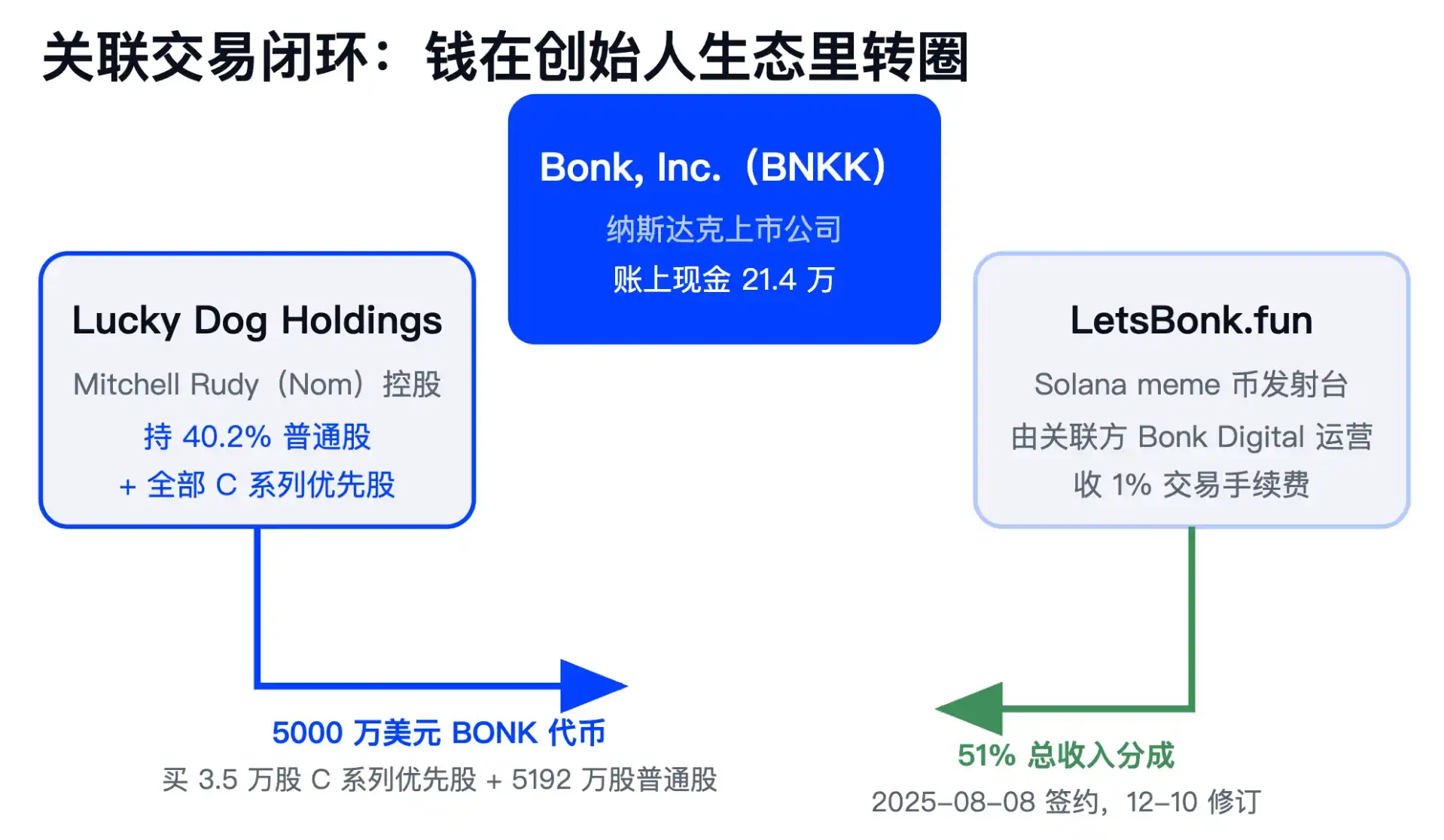
Deux transactions d'actions totalisant 50 millions de dollars, payées en jetons BONK

Comment les entités de Rudy ont-elles obtenu ces actions ? La procuration révèle deux transactions avec des parties liées, toutes deux payées en jetons BONK : Lucky Dog a d'abord acheté 35 000 actions privilégiées de série C pour l'équivalent de 25 millions de dollars en jetons BONK, puis a acheté 51 921 080 actions ordinaires (sous réserve de l'approbation des actionnaires) pour l'équivalent de 25 millions de dollars en jetons BONK.

La société a vendu pour 50 millions de dollars d'actions, mais n'a pas reçu de dollars en échange, seulement le même type de jetons qu'elle détient déjà dans son trésor. Les BONK reçus sont comptabilisés dans la rubrique « actifs numériques » du bilan, et leur valeur marchande fluctue directement dans le compte de résultat : au premier semestre, la juste valeur des actifs numériques de l'entreprise est passée de 17,975 millions de dollars à 11,544 millions de dollars. Rien que cet élément a entraîné une dépréciation non réalisée de 8,17 millions de dollars, principale source de la perte nette de la période.

Trésorerie de 214 000 dollars, suffisante pour seulement 9 jours au rythme actuel

La liquidité est plus critique que la rentabilité. Fin 2025, la société avait encore 2,28 millions de dollars de trésorerie ; six mois plus tard, il ne reste que 214 000 dollars, une baisse de plus de 90 %. La trésorerie nette générée par les activités était négative de 4,17 millions de dollars au premier semestre, dont 2,226 millions de dollars au deuxième trimestre seulement. À ce rythme, la trésorerie disponible ne permettrait de tenir qu'environ 9 jours. L'entreprise n'a pas de dette à long terme, mais n'a non plus aucune réserve.

Le 10-Q cite l'opinion de M&K CPAS : les pertes cumulées de 191,4 millions de dollars, les pertes opérationnelles continues et les niveaux extrêmement bas de trésorerie et de fonds de roulement « ont soulevé des doutes importants quant à la capacité de la société à poursuivre son exploitation ».

Ironiquement, en avril, Rudy déclarait publiquement qu'il augmentait sa participation parce qu'il « croyait en un écart important entre le prix de transaction de BNKK et la réalité de l'entreprise », affirmant que la participation de 51 % aux revenus de LetsBonk.fun détenue par la société avait une valorisation implicite d'environ 30 millions de dollars. Son achat supplémentaire à cette occasion a coûté environ 87 600 dollars, tandis que la société a brûlé 4,17 millions de dollars en six mois.

Lorsque les sources de revenus, la composition du conseil d'administration et le niveau de trésorerie d'une entreprise cotée dépendent toutes d'une seule et même personne, l'avertissement de l'auditeur sur les « doutes importants » n'est pas une formalité. Pour les acteurs de BONK, cette « société mère » derrière une capitalisation boursière d'environ 22 millions de dollars n'a plus que l'équivalent de 9 jours de trésorerie.

Trending Cryptos

Related Questions

QQuels sont les principaux points de vulnérabilité financière mis en évidence dans le rapport de BonK, Inc. ?

ALe rapport met en évidence plusieurs vulnérabilités financières majeures : une trésorerie résiduelle très faible (214 000 $), une perte nette importante (7,88 millions $), une dépendance à une source de revenus unique (71% des revenus proviennent d'une plateforme liée au fondateur), et un avertissement de l'auditeur concernant des doutes substantiels sur la capacité de l'entreprise à poursuivre ses activités.

QComment la structure de gouvernance de BonK, Inc. favorise-t-elle le contrôle du fondateur Mitchell Rudy ?

AMitchell Rudy, via Lucky Dog Holdings, détient environ 40,2% des actions ordinaires et 100% des actions privilégiées de série C. Ces actions privilégiées de série C ont le pouvoir d'élire 50% des administrateurs du conseil d'administration, lui accordant ainsi un contrôle significatif sur la gouvernance de l'entreprise, indépendamment des votes des autres actionnaires.

QQuelle est la source de 71% des revenus de BonK, Inc. et pourquoi cela pose-t-il un problème ?

A71% des revenus de BonK, Inc. (3,921 millions $ sur 5,5 millions $) proviennent des redevances de la plateforme LetsBonk.fun, une entité liée au fondateur Mitchell Rudy. Cela pose un problème de risque de concentration, car la santé financière de la société cotée dépend fortement de la performance d'une seule plateforme contrôlée par son fondateur, créant un conflit d'intérêts potentiel et une vulnérabilité opérationnelle.

QQuel impact la fluctuation de la valeur des actifs numériques (BONK) a-t-elle eu sur les résultats de BonK, Inc. ?

ALa dépréciation de la valeur des actifs numériques détenus (principalement le jeton BONK) a entraîné une perte non réalisée de 8,17 millions de dollars au premier semestre. Cette perte comptable est la principale raison de la perte nette de 7,88 millions de dollars de la société, démontrant la forte volatilité et le risque associé à l'utilisation de crypto-monnaies comme actif principal du trésor.

QQue signifie l'avertissement de l'auditeur concernant les 'doutes substantiels sur la continuité d'exploitation' pour BonK, Inc. ?

AL'avertissement de l'auditeur (going concern) signifie qu'il existe des doutes sérieux sur la capacité de BonK, Inc. à continuer à fonctionner normalement au cours des 12 prochains mois. Ces doutes sont fondés sur ses pertes cumulées importantes (191,4 millions $), ses flux de trésorerie opérationnels négatifs récurrents et son niveau de trésorerie extrêmement bas (214 000 $), qui, au rythme actuel des dépenses, ne suffirait qu'à environ 9 jours d'exploitation.

Related Reads

Jameson Lopp's BIP-110 Postmortem: Bitcoin Is Driven by Game Theory, Not Morality

Jameson Lopp's analysis concludes that BIP-110, a proposal to restrict arbitrary data (like inscriptions) on Bitcoin, failed due to economic and technical realities, not moral arguments. The proposal, championed by Luke Dashjr and others, aimed to "cleanse" the chain but never reached its 55% miner activation threshold. Upon its forced signaling deadline in August, only the OCEAN pool (with ~1% hash rate) supported it, creating a short-lived fork that quickly died as miners faced unredeemable block rewards. Lopp's earlier predictions about its economic infeasibility were proven correct. Technically, BIP-110 was flawed; workarounds to embed data compliant with its rules were demonstrated almost immediately, proving it couldn't achieve its stated goal. The debate often devolved into moralistic rhetoric, with supporters accusing opponents of supporting child exploitation material—a tactic Lopp criticizes as ineffective for building consensus. Lopp argues Bitcoin is driven by incentives and game theory, not morality. Past forks like Bitcoin Cash promised economic benefits, while BIP-110 offered only restrictions and reduced miner fees, gaining no substantial support from major economic players. He predicts the "puritans" behind the failed fork will continue complaining but their new chain will remain insignificant. The episode reaffirms that attempting to censor data on a permissionless, anti-censorship network like Bitcoin is a futile battle.

marsbit7m ago

Jameson Lopp's BIP-110 Postmortem: Bitcoin Is Driven by Game Theory, Not Morality

marsbit7m ago

Tokenization Scale Soars to $4.3 Billion, But Why Did Securitize Incur a $5.5 Million Loss?

Securitize's first quarterly report post-IPO reveals a paradox: while its tokenized assets under management hit a record $4.3 billion (up 16% YoY) and platform trading volume surged 147% to $5.3 billion, total revenue fell 5% to $14.4 million. Tokenization revenue specifically dropped ~12% to $7.8 million, leading to an adjusted EBITDA loss of $5.5 million. CFO Francisco Flores explained that most trading volume is not yet monetized, with the majority of tokenization revenue still coming from one-time projects like new protocol integrations. In contrast, asset servicing revenue, a more recurring stream, grew slightly to $6.6 million. The company has lowered its full-year revenue guidance to $70-$80 million from an initial projection of $110 million. Industry experts note this highlights a structural challenge for the tokenization sector. Scaling assets on-chain doesn't automatically scale a profitable business model. Current implementations often rely on costly, customized projects for each new asset or jurisdiction. The future, they argue, lies in building standardized infrastructure that generates recurring "infrastructure revenue" from post-issuance activities like compliance, distributions, and secondary trading—similar to enterprise software. Analysts caution against misinterpreting high trading volumes as indicative of a mature fee-based model, as Securitize's broad volume metric includes many non-monetized actions. The key test for the industry is whether adding billions in new assets can generate sustainable revenue without constant new custom projects.

marsbit9m ago

Tokenization Scale Soars to $4.3 Billion, But Why Did Securitize Incur a $5.5 Million Loss?

marsbit9m ago

The Five Paradoxes of Artificial Intelligence

**Five Paradoxes of Artificial Intelligence** Artificial intelligence (AI) is an era filled with paradoxes, which we navigate as we advance. **1. The Prediction Paradox** AI experts, from pioneers like Marvin Minsky to contemporary figures like Geoffrey Hinton and Demis Hassabis, have a history of inaccurate forecasts regarding AI's capabilities and timelines, such as achieving human-level machine intelligence or surpassing radiologists. Predictions about Artificial General Intelligence (AGI) vary wildly between optimistic entrepreneurs and skeptical academics, highlighting the inherent unpredictability of technological futures. **2. The Employment Quantification Paradox** Despite numerous studies from institutions like the OECD, IMF, and McKinsey attempting to quantify AI's impact on jobs, estimates of affected employment range from 0.4% to 67%, revealing vast inconsistencies. This paradox arises because isolating AI's effect from other economic, social, and technological factors is virtually impossible, and forecasts depend on static assumptions about a dynamically evolving technology. **3. The Productivity Paradox** While AI is a transformative General Purpose Technology, significant productivity growth has not yet materialized in major economies like the EU and has only matched historical averages in the US. This disconnect between rapid innovation and slow productivity gains, reminiscent of the "Solow Paradox" from the computer age, is often explained by time lags. History shows it takes decades for such technologies to diffuse and trigger complementary innovations that boost productivity. **4. The Data Value Paradox** Data is hailed as the "new oil" and critical for AI, yet its economic value is paradoxical. Its worth is realized only in use, not in straightforward trade. Despite policy emphasis and initiatives for data asset recognition on corporate balance sheets in China, the monetized value remains negligible—accounting for only about 0.06% of major telecom operators' total assets—highlighting the gap between perceived utility and financial valuation. **5. The Industrial Revolution Paradox** For decades, nearly every major new technology, from the internet and nanotechnology to blockchain and now AI, has been proclaimed as the driver of a "Fourth Industrial Revolution." This constant reassignment suggests prior labels were premature. True industrial revolutions are typically identified in hindsight, not in real-time. Furthermore, the coexistence of such a proclaimed transformative revolution with ongoing economic crises would be historically anomalous. Whether AI truly defines a new industrial revolution remains a narrative for the future to decide.

marsbit12m ago

The Five Paradoxes of Artificial Intelligence

marsbit12m ago

Trading

Spot

Hot Articles

What is SONIC

Sonic: Pioneering the Future of Gaming in Web3 Introduction to Sonic In the ever-evolving landscape of Web3, the gaming industry stands out as one of the most dynamic and promising sectors. At the forefront of this revolution is Sonic, a project designed to amplify the gaming ecosystem on the Solana blockchain. Leveraging cutting-edge technology, Sonic aims to deliver an unparalleled gaming experience by efficiently processing millions of requests per second, ensuring that players enjoy seamless gameplay while maintaining low transaction costs. This article delves into the intricate details of Sonic, exploring its creators, funding sources, operational mechanics, and the timeline of significant events that have shaped its journey. What is Sonic? Sonic is an innovative layer-2 network that operates atop the Solana blockchain, specifically tailored to enhance the existing Solana gaming ecosystem. It accomplishes this through a customised, VM-agnostic game engine paired with a HyperGrid interpreter, facilitating sovereign game economies that roll up back to the Solana platform. The primary goals of Sonic include: Enhanced Gaming Experiences: Sonic is committed to offering lightning-fast on-chain gameplay, allowing players and developers to engage with games at previously unattainable speeds. Atomic Interoperability: This feature enables transactions to be executed within Sonic without the need to redeploy Solana programmes and accounts. This makes the process more efficient and directly benefits from Solana Layer1 services and liquidity. Seamless Deployment: Sonic allows developers to write for Ethereum Virtual Machine (EVM) based systems and execute them on Solana’s SVM infrastructure. This interoperability is crucial for attracting a broader range of dApps and decentralised applications to the platform. Support for Developers: By offering native composable gaming primitives and extensible data types - dining within the Entity-Component-System (ECS) framework - game creators can craft intricate business logic with ease. Overall, Sonic's unique approach not only caters to players but also provides an accessible and low-cost environment for developers to innovate and thrive. Creator of Sonic The information regarding the creator of Sonic is somewhat ambiguous. However, it is known that Sonic's SVM is owned by the company Mirror World. The absence of detailed information about the individuals behind Sonic reflects a common trend in several Web3 projects, where collective efforts and partnerships often overshadow individual contributions. Investors of Sonic Sonic has garnered considerable attention and support from various investors within the crypto and gaming sectors. Notably, the project raised an impressive $12 million during its Series A funding round. The round was led by BITKRAFT Ventures, with other notable investors including Galaxy, Okx Ventures, Interactive, Big Brain Holdings, and Mirana. This financial backing signifies the confidence that investment foundations have in Sonic’s potential to revolutionise the Web3 gaming landscape, further validating its innovative approaches and technologies. How Does Sonic Work? Sonic utilises the HyperGrid framework, a sophisticated parallel processing mechanism that enhances its scalability and customisability. Here are the core features that set Sonic apart: Lightning Speed at Low Costs: Sonic offers one of the fastest on-chain gaming experiences compared to other Layer-1 solutions, powered by the scalability of Solana’s virtual machine (SVM). Atomic Interoperability: Sonic enables transaction execution without redeployment of Solana programmes and accounts, effectively streamlining the interaction between users and the blockchain. EVM Compatibility: Developers can effortlessly migrate decentralised applications from EVM chains to the Solana environment using Sonic’s HyperGrid interpreter, increasing the accessibility and integration of various dApps. Ecosystem Support for Developers: By exposing native composable gaming primitives, Sonic facilitates a sandbox-like environment where developers can experiment and implement business logic, greatly enhancing the overall development experience. Monetisation Infrastructure: Sonic natively supports growth and monetisation efforts, providing frameworks for traffic generation, payments, and settlements, thereby ensuring that gaming projects are not only viable but also sustainable financially. Timeline of Sonic The evolution of Sonic has been marked by several key milestones. Below is a brief timeline highlighting critical events in the project's history: 2022: The Sonic cryptocurrency was officially launched, marking the beginning of its journey in the Web3 gaming arena. 2024: June: Sonic SVM successfully raised $12 million in a Series A funding round. This investment allowed Sonic to further develop its platform and expand its offerings. August: The launch of the Sonic Odyssey testnet provided users with the first opportunity to engage with the platform, offering interactive activities such as collecting rings—a nod to gaming nostalgia. October: SonicX, an innovative crypto game integrated with Solana, made its debut on TikTok, capturing the attention of over 120,000 users within a short span. This integration illustrated Sonic’s commitment to reaching a broader, global audience and showcased the potential of blockchain gaming. Key Points Sonic SVM is a revolutionary layer-2 network on Solana explicitly designed to enhance the GameFi landscape, demonstrating great potential for future development. HyperGrid Framework empowers Sonic by introducing horizontal scaling capabilities, ensuring that the network can handle the demands of Web3 gaming. Integration with Social Platforms: The successful launch of SonicX on TikTok displays Sonic’s strategy to leverage social media platforms to engage users, exponentially increasing the exposure and reach of its projects. Investment Confidence: The substantial funding from BITKRAFT Ventures, among others, emphasizes the robust backing Sonic has, paving the way for its ambitious future. In conclusion, Sonic encapsulates the essence of Web3 gaming innovation, striking a balance between cutting-edge technology, developer-centric tools, and community engagement. As the project continues to evolve, it is poised to redefine the gaming landscape, making it a notable entity for gamers and developers alike. As Sonic moves forward, it will undoubtedly attract greater interest and participation, solidifying its place within the broader narrative of blockchain gaming.

2.4k Total ViewsPublished 2024.04.04Updated 2024.12.03

What is SONIC

What is $S$

Understanding SPERO: A Comprehensive Overview Introduction to SPERO As the landscape of innovation continues to evolve, the emergence of web3 technologies and cryptocurrency projects plays a pivotal role in shaping the digital future. One project that has garnered attention in this dynamic field is SPERO, denoted as SPERO,$$s$. This article aims to gather and present detailed information about SPERO, to help enthusiasts and investors understand its foundations, objectives, and innovations within the web3 and crypto domains. What is SPERO,$$s$? SPERO,$$s$ is a unique project within the crypto space that seeks to leverage the principles of decentralisation and blockchain technology to create an ecosystem that promotes engagement, utility, and financial inclusion. The project is tailored to facilitate peer-to-peer interactions in new ways, providing users with innovative financial solutions and services. At its core, SPERO,$$s$ aims to empower individuals by providing tools and platforms that enhance user experience in the cryptocurrency space. This includes enabling more flexible transaction methods, fostering community-driven initiatives, and creating pathways for financial opportunities through decentralised applications (dApps). The underlying vision of SPERO,$$s$ revolves around inclusiveness, aiming to bridge gaps within traditional finance while harnessing the benefits of blockchain technology. Who is the Creator of SPERO,$$s$? The identity of the creator of SPERO,$$s$ remains somewhat obscure, as there are limited publicly available resources providing detailed background information on its founder(s). This lack of transparency can stem from the project's commitment to decentralisation—an ethos that many web3 projects share, prioritising collective contributions over individual recognition. By centring discussions around the community and its collective goals, SPERO,$$s$ embodies the essence of empowerment without singling out specific individuals. As such, understanding the ethos and mission of SPERO remains more important than identifying a singular creator. Who are the Investors of SPERO,$$s$? SPERO,$$s$ is supported by a diverse array of investors ranging from venture capitalists to angel investors dedicated to fostering innovation in the crypto sector. The focus of these investors generally aligns with SPERO's mission—prioritising projects that promise societal technological advancement, financial inclusivity, and decentralised governance. These investor foundations are typically interested in projects that not only offer innovative products but also contribute positively to the blockchain community and its ecosystems. The backing from these investors reinforces SPERO,$$s$ as a noteworthy contender in the rapidly evolving domain of crypto projects. How Does SPERO,$$s$ Work? SPERO,$$s$ employs a multi-faceted framework that distinguishes it from conventional cryptocurrency projects. Here are some of the key features that underline its uniqueness and innovation: Decentralised Governance: SPERO,$$s$ integrates decentralised governance models, empowering users to participate actively in decision-making processes regarding the project’s future. This approach fosters a sense of ownership and accountability among community members. Token Utility: SPERO,$$s$ utilises its own cryptocurrency token, designed to serve various functions within the ecosystem. These tokens enable transactions, rewards, and the facilitation of services offered on the platform, enhancing overall engagement and utility. Layered Architecture: The technical architecture of SPERO,$$s$ supports modularity and scalability, allowing for seamless integration of additional features and applications as the project evolves. This adaptability is paramount for sustaining relevance in the ever-changing crypto landscape. Community Engagement: The project emphasises community-driven initiatives, employing mechanisms that incentivise collaboration and feedback. By nurturing a strong community, SPERO,$$s$ can better address user needs and adapt to market trends. Focus on Inclusion: By offering low transaction fees and user-friendly interfaces, SPERO,$$s$ aims to attract a diverse user base, including individuals who may not previously have engaged in the crypto space. This commitment to inclusion aligns with its overarching mission of empowerment through accessibility. Timeline of SPERO,$$s$ Understanding a project's history provides crucial insights into its development trajectory and milestones. Below is a suggested timeline mapping significant events in the evolution of SPERO,$$s$: Conceptualisation and Ideation Phase: The initial ideas forming the basis of SPERO,$$s$ were conceived, aligning closely with the principles of decentralisation and community focus within the blockchain industry. Launch of Project Whitepaper: Following the conceptual phase, a comprehensive whitepaper detailing the vision, goals, and technological infrastructure of SPERO,$$s$ was released to garner community interest and feedback. Community Building and Early Engagements: Active outreach efforts were made to build a community of early adopters and potential investors, facilitating discussions around the project’s goals and garnering support. Token Generation Event: SPERO,$$s$ conducted a token generation event (TGE) to distribute its native tokens to early supporters and establish initial liquidity within the ecosystem. Launch of Initial dApp: The first decentralised application (dApp) associated with SPERO,$$s$ went live, allowing users to engage with the platform's core functionalities. Ongoing Development and Partnerships: Continuous updates and enhancements to the project's offerings, including strategic partnerships with other players in the blockchain space, have shaped SPERO,$$s$ into a competitive and evolving player in the crypto market. Conclusion SPERO,$$s$ stands as a testament to the potential of web3 and cryptocurrency to revolutionise financial systems and empower individuals. With a commitment to decentralised governance, community engagement, and innovatively designed functionalities, it paves the way toward a more inclusive financial landscape. As with any investment in the rapidly evolving crypto space, potential investors and users are encouraged to research thoroughly and engage thoughtfully with the ongoing developments within SPERO,$$s$. The project showcases the innovative spirit of the crypto industry, inviting further exploration into its myriad possibilities. While the journey of SPERO,$$s$ is still unfolding, its foundational principles may indeed influence the future of how we interact with technology, finance, and each other in interconnected digital ecosystems.

428 Total ViewsPublished 2024.12.17Updated 2024.12.17

What is $S$

What is AGENT S

Agent S: The Future of Autonomous Interaction in Web3 Introduction In the ever-evolving landscape of Web3 and cryptocurrency, innovations are constantly redefining how individuals interact with digital platforms. One such pioneering project, Agent S, promises to revolutionise human-computer interaction through its open agentic framework. By paving the way for autonomous interactions, Agent S aims to simplify complex tasks, offering transformative applications in artificial intelligence (AI). This detailed exploration will delve into the project's intricacies, its unique features, and the implications for the cryptocurrency domain. What is Agent S? Agent S stands as a groundbreaking open agentic framework, specifically designed to tackle three fundamental challenges in the automation of computer tasks: Acquiring Domain-Specific Knowledge: The framework intelligently learns from various external knowledge sources and internal experiences. This dual approach empowers it to build a rich repository of domain-specific knowledge, enhancing its performance in task execution. Planning Over Long Task Horizons: Agent S employs experience-augmented hierarchical planning, a strategic approach that facilitates efficient breakdown and execution of intricate tasks. This feature significantly enhances its ability to manage multiple subtasks efficiently and effectively. Handling Dynamic, Non-Uniform Interfaces: The project introduces the Agent-Computer Interface (ACI), an innovative solution that enhances the interaction between agents and users. Utilizing Multimodal Large Language Models (MLLMs), Agent S can navigate and manipulate diverse graphical user interfaces seamlessly. Through these pioneering features, Agent S provides a robust framework that addresses the complexities involved in automating human interaction with machines, setting the stage for myriad applications in AI and beyond. Who is the Creator of Agent S? While the concept of Agent S is fundamentally innovative, specific information about its creator remains elusive. The creator is currently unknown, which highlights either the nascent stage of the project or the strategic choice to keep founding members under wraps. Regardless of anonymity, the focus remains on the framework's capabilities and potential. Who are the Investors of Agent S? As Agent S is relatively new in the cryptographic ecosystem, detailed information regarding its investors and financial backers is not explicitly documented. The lack of publicly available insights into the investment foundations or organisations supporting the project raises questions about its funding structure and development roadmap. Understanding the backing is crucial for gauging the project's sustainability and potential market impact. How Does Agent S Work? At the core of Agent S lies cutting-edge technology that enables it to function effectively in diverse settings. Its operational model is built around several key features: Human-like Computer Interaction: The framework offers advanced AI planning, striving to make interactions with computers more intuitive. By mimicking human behaviour in tasks execution, it promises to elevate user experiences. Narrative Memory: Employed to leverage high-level experiences, Agent S utilises narrative memory to keep track of task histories, thereby enhancing its decision-making processes. Episodic Memory: This feature provides users with step-by-step guidance, allowing the framework to offer contextual support as tasks unfold. Support for OpenACI: With the ability to run locally, Agent S allows users to maintain control over their interactions and workflows, aligning with the decentralised ethos of Web3. Easy Integration with External APIs: Its versatility and compatibility with various AI platforms ensure that Agent S can fit seamlessly into existing technological ecosystems, making it an appealing choice for developers and organisations. These functionalities collectively contribute to Agent S's unique position within the crypto space, as it automates complex, multi-step tasks with minimal human intervention. As the project evolves, its potential applications in Web3 could redefine how digital interactions unfold. Timeline of Agent S The development and milestones of Agent S can be encapsulated in a timeline that highlights its significant events: September 27, 2024: The concept of Agent S was launched in a comprehensive research paper titled “An Open Agentic Framework that Uses Computers Like a Human,” showcasing the groundwork for the project. October 10, 2024: The research paper was made publicly available on arXiv, offering an in-depth exploration of the framework and its performance evaluation based on the OSWorld benchmark. October 12, 2024: A video presentation was released, providing a visual insight into the capabilities and features of Agent S, further engaging potential users and investors. These markers in the timeline not only illustrate the progress of Agent S but also indicate its commitment to transparency and community engagement. Key Points About Agent S As the Agent S framework continues to evolve, several key attributes stand out, underscoring its innovative nature and potential: Innovative Framework: Designed to provide an intuitive use of computers akin to human interaction, Agent S brings a novel approach to task automation. Autonomous Interaction: The ability to interact autonomously with computers through GUI signifies a leap towards more intelligent and efficient computing solutions. Complex Task Automation: With its robust methodology, it can automate complex, multi-step tasks, making processes faster and less error-prone. Continuous Improvement: The learning mechanisms enable Agent S to improve from past experiences, continually enhancing its performance and efficacy. Versatility: Its adaptability across different operating environments like OSWorld and WindowsAgentArena ensures that it can serve a broad range of applications. As Agent S positions itself in the Web3 and crypto landscape, its potential to enhance interaction capabilities and automate processes signifies a significant advancement in AI technologies. Through its innovative framework, Agent S exemplifies the future of digital interactions, promising a more seamless and efficient experience for users across various industries. Conclusion Agent S represents a bold leap forward in the marriage of AI and Web3, with the capacity to redefine how we interact with technology. While still in its early stages, the possibilities for its application are vast and compelling. Through its comprehensive framework addressing critical challenges, Agent S aims to bring autonomous interactions to the forefront of the digital experience. As we move deeper into the realms of cryptocurrency and decentralisation, projects like Agent S will undoubtedly play a crucial role in shaping the future of technology and human-computer collaboration.

1.1k Total ViewsPublished 2025.01.14Updated 2025.01.14

What is AGENT S

Discussions

Welcome to the HTX Community. Here, you can stay informed about the latest platform developments and gain access to professional market insights. Users' opinions on the price of S (S) are presented below.

活动图片