Crypto short liquidations pass $3B mark as Bitcoin price nears $72K

cointelegraphPublished on 2026-08-20Last updated on 2026-08-20

Abstract

Bitcoin and altcoins surged as the cryptocurrency market witnessed over $3.1 billion in short position liquidations from August 19-20, driven by Bitcoin's rise toward $72,000. This price increase was partly a reaction to a US Treasury liquidity intervention, leading to the largest single-day short squeeze on record. While Bitcoin accounted for about half of these liquidations, this event was smaller than previous long liquidation cascades. Concurrently, short-term Bitcoin holders took profits, moving a record 43,300 BTC to exchanges in 2026 as their cost basis was surpassed, signaling a significant profit-taking move after a period of unrealized losses.

Bitcoin (BTC) and altcoins are breaking records as short position liquidations pass $3 billion over two days.


Key points:


  • Crypto short liquidations since Thursday are in excess of $3.1 billion, per CoinGlass data.
  • Bitcoin continues its upside reaction to a US Treasury liquidity intervention, approaching $72,000.
  • Bitcoin short-term holders take profit on previously underwater positions and move 43,300 BTC.


Two-day crypto short liquidations hit $3.1 billion


Data from CoinGlass shows ongoing crypto short liquidations at $3.1 billion for Aug. 19-20. Thursday’s tally was largest single-day wipeout of shorts ever recorded.
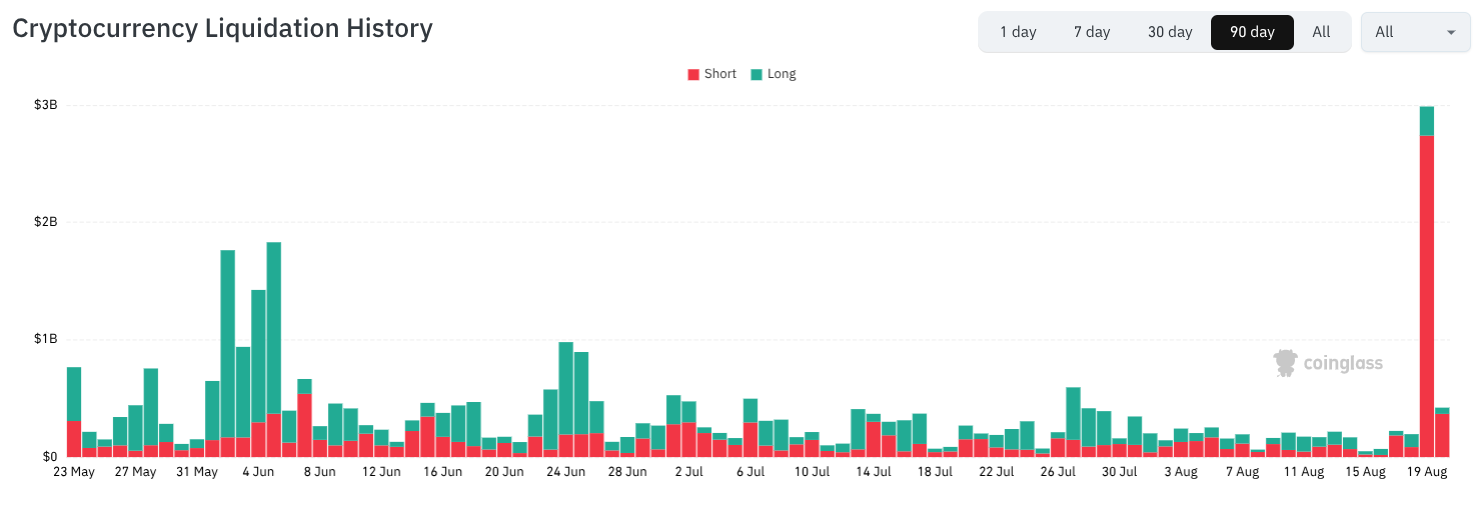

Crypto liquidations history (screenshot). Source: CoinGlass


On Wednesday, BTC/USD led the charge by reacting to a liquidity intervention by the US Treasury with a price spike to the highest levels seen since the start of June. At the time of writing, upside continues, with the pair reaching local highs of $71,992 on Bitstamp, per data from TradingView.
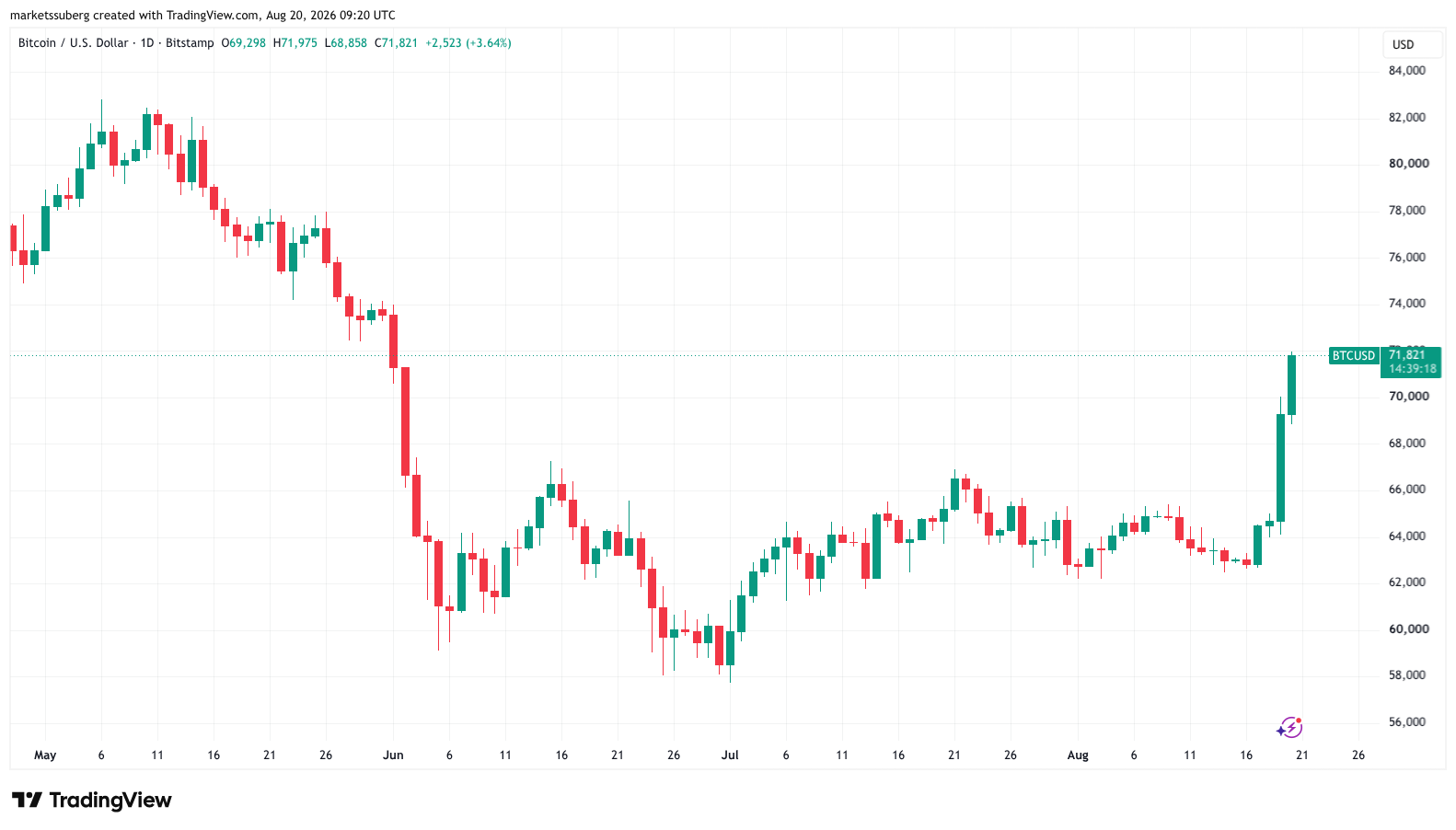

BTC/USD one-day chart. Source: Cointelegraph/TradingView


CoinGlass shows Bitcoin accounting for just over half of the total short liquidations at $1.65 billion.


The numbers do not represent the largest crypto liquidation event if long positions are included. It is dwarfed by the $20 billion long liquidation cascade that followed Bitcoin’s reversal from the most recent all-time high of $126,200 in October 2025.


In US dollar terms, data from CoinMarketCap puts Thursday’s total liquidations in seventh place historically, calculating the day’s long and short liquidations as $3.25 billion.


Bitcoin speculators take profit as cost basis returns


Bitcoin investors, meanwhile, capitalized on positions that were previously held at an unrealized loss.


Related: HYPE jumps 20% as Trump signals legal US path for Hyperliquid


Short-term holders — wallets holding a UTXO for less than 155 days — sent a record 43,300 BTC in profit to exchanges in their largest profit-taking move of 2026, per onchain analytics platform CryptoQuant.
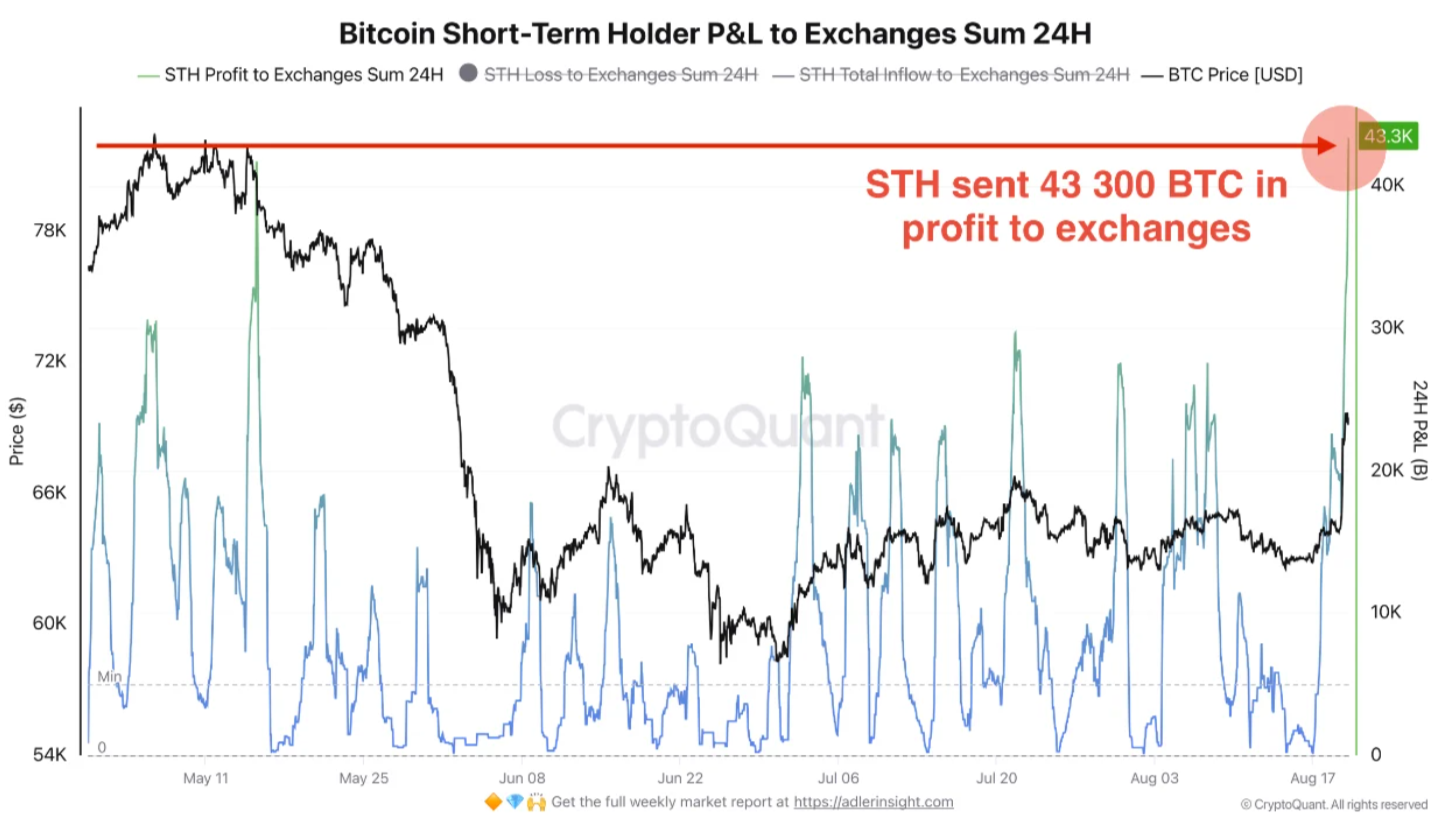

Bitcoin STH profit and loss to exchanges (screenshot). Source: CryptoQuant


As of Thursday, the spent output profit ratio (SOPR) metric for the short-term holder (STH) cohort stood at 1.01, its highest since April. This reflects that the majority of coins in UTXOs from STH wallets moved at a higher price than in their previous transaction.
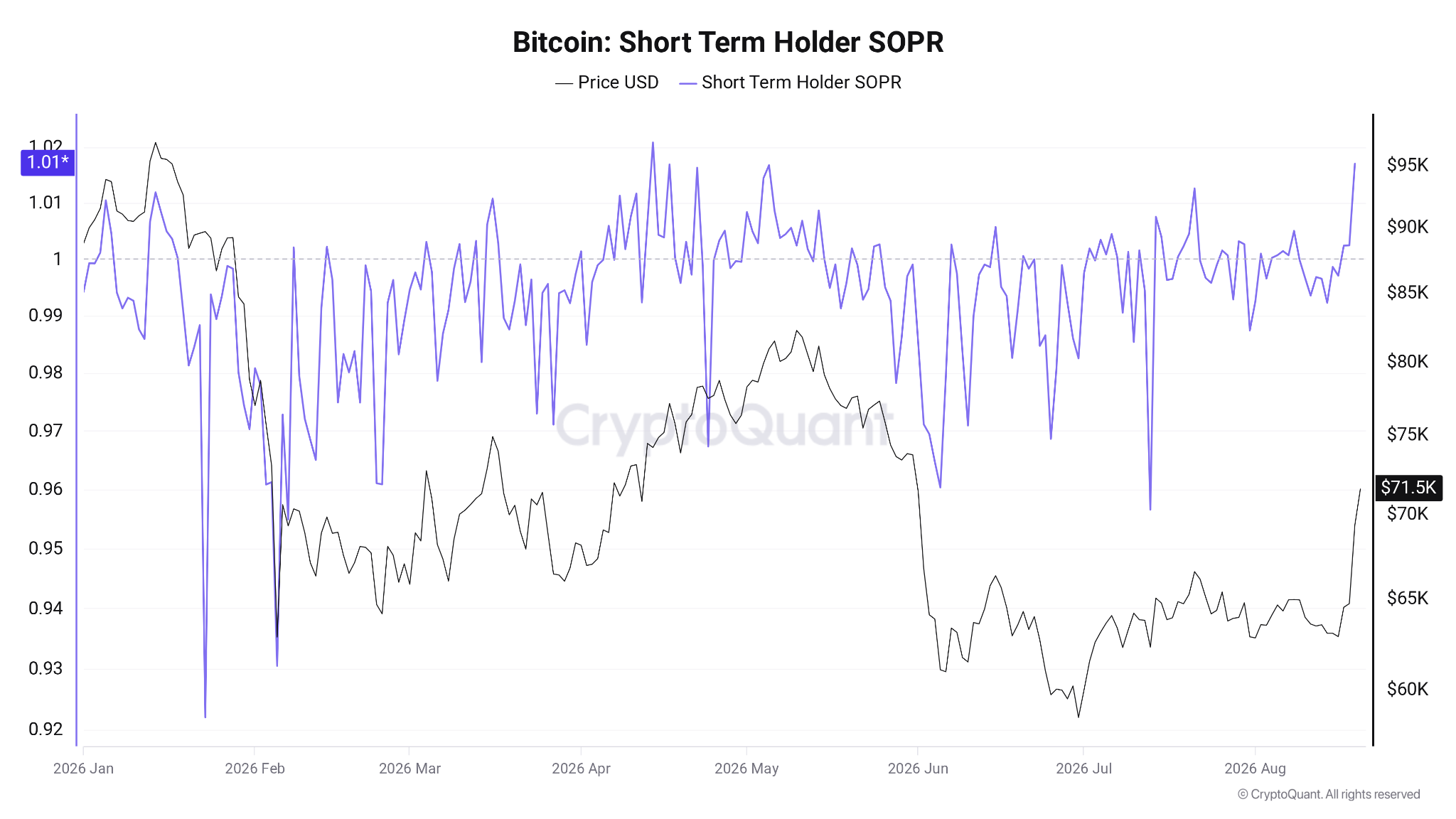

Bitcoin STH-SOPR data. Source: CryptoQuant


Previously, Cointelegraph reported that the STH cohort’s aggregate cost basis, also known as the STH realized price, stood at $68,700. At the time, analysis warned that any price upside could be stifled by the urge of investors in this cohort to exit underwater positions.



Related Questions

QAccording to the article, what was the total value of crypto short liquidations over the two-day period of August 19-20, and what was notable about Thursday's liquidations?

AThe total value of crypto short liquidations over the two-day period was $3.1 billion. Thursday's liquidations were notable for being the largest single-day wipeout of short positions ever recorded.

QWhat event triggered Bitcoin's price spike to its highest levels since early June, according to the article?

ABitcoin's price spike was triggered by its reaction to a liquidity intervention by the US Treasury.

QHow much Bitcoin did short-term holders send to exchanges in profit during their largest profit-taking move of 2026, and what metric indicates they were selling at a profit?

AShort-term holders sent a record 43,300 BTC to exchanges in profit. The spent output profit ratio (SOPR) metric for this cohort stood at 1.01, its highest since April, indicating that the coins were moved at a higher price than in their previous transaction.

QHow does the recent $3.1 billion short liquidation event compare to the largest liquidation event mentioned in the article, which involved long positions?

AThe recent $3.1 billion short liquidation event is dwarfed by the $20 billion long liquidation cascade that followed Bitcoin's reversal from its all-time high of $126,200 in October 2025.

QWhat was the aggregate cost basis (realized price) for the short-term holder cohort, and why was this level significant for price action?

AThe aggregate cost basis for the short-term holder cohort was $68,700. This level was significant because analysis warned that any price upside could be stifled by the urge of these investors to exit their previously underwater positions once the price reached or exceeded this level.

Related Reads

Terence Tao's Remote Dialogue with Wang Hong: Mathematics Must Learn to 'Digest' AI

Two Fields Medalists, Terence Tao and Maryna Viazovska, share a common view on the flood of AI-generated proofs in mathematics: the community must learn to "digest" them. While AI can rapidly produce and even formally verify proofs, Tao argues that a correct proof is only the first step. For a result to become usable knowledge, it must be understood, absorbed, and integrated into the existing mathematical framework by human mathematicians. He illustrates this by spending several days "digesting" an AI-assisted proof of the long-standing Sendov conjecture. His process involved tracing sources, identifying key ideas, simplifying the argument, and rewriting it into a human-readable narrative. This digestion not only verified the proof but also revealed it could solve a stronger conjecture and be presented with more elementary tools. Tao criticizes the current race for priority based solely on who announces a proof first, often skipping verification and explanation. He proposes shifting value to the crucial work of interpreting, reviewing, and consolidating results. In his recent ICM talk, he emphasized that if authors cannot explain their AI-generated proof to peers, it shouldn't be published. To facilitate this new workflow, Tao introduced "Palomar," a registry for Lean-verified results. It serves as a digestion hub, cataloging problems, proof code, and AI involvement, aiming to coordinate efforts and ensure completeness. Under this model, full credit for a result would require multiple milestones: generation, verification, explanation, and final publication. The core message is clear: as AI transforms the front end of mathematical discovery, the irreplaceable role of mathematicians will be to synthesize, contextualize, and communicate these advances, turning raw outputs into enduring knowledge.

marsbit7m ago

Terence Tao's Remote Dialogue with Wang Hong: Mathematics Must Learn to 'Digest' AI

marsbit7m ago

The U.S. Treasury Department Doubles Treasury Repurchases to Stabilize the Market, But U.S. Stocks Only Edge Up Slightly — Is the Real Signal Hidden in Bitcoin?

The US Treasury significantly boosted its long-term bond repurchase program to curb surging yields, sparking a notable rally in Bitcoin while leaving the stock market with only modest gains. Facing high long-term bond yields that pressured equities, especially tech stocks, the Treasury announced it would double the maximum size of its repurchases for 10- to 30-year bonds. This move, seen as the government stepping in to provide liquidity and stabilize confidence, initially pushed bond yields lower. However, the market reaction was unusual. While liquidity-sensitive Bitcoin surged from around $64,000 toward $70,000, major US stock indices posted only minor gains. Previously high-flying AI-related sectors like semiconductors continued to weaken, largely ignoring the news. The article interprets Bitcoin's sharp rise as the key signal, reflecting its role as a gauge for dollar liquidity. The Treasury's action is seen as injecting fresh money into the system. While stocks remain preoccupied with sector-specific concerns, Bitcoin immediately priced in this loosening of financial conditions. This shift suggests the market's underlying dynamic may be transitioning from a fight for existing capital to an expectation of new inflows, potentially broadening the rally beyond the concentrated AI trade that dominated recent months.

marsbit12m ago

The U.S. Treasury Department Doubles Treasury Repurchases to Stabilize the Market, But U.S. Stocks Only Edge Up Slightly — Is the Real Signal Hidden in Bitcoin?

marsbit12m ago

Jameson Lopp's BIP-110 Postmortem: Bitcoin Is Driven by Game Theory, Not Morality

Jameson Lopp's analysis concludes that BIP-110, a proposal to restrict arbitrary data (like inscriptions) on Bitcoin, failed due to economic and technical realities, not moral arguments. The proposal, championed by Luke Dashjr and others, aimed to "cleanse" the chain but never reached its 55% miner activation threshold. Upon its forced signaling deadline in August, only the OCEAN pool (with ~1% hash rate) supported it, creating a short-lived fork that quickly died as miners faced unredeemable block rewards. Lopp's earlier predictions about its economic infeasibility were proven correct. Technically, BIP-110 was flawed; workarounds to embed data compliant with its rules were demonstrated almost immediately, proving it couldn't achieve its stated goal. The debate often devolved into moralistic rhetoric, with supporters accusing opponents of supporting child exploitation material—a tactic Lopp criticizes as ineffective for building consensus. Lopp argues Bitcoin is driven by incentives and game theory, not morality. Past forks like Bitcoin Cash promised economic benefits, while BIP-110 offered only restrictions and reduced miner fees, gaining no substantial support from major economic players. He predicts the "puritans" behind the failed fork will continue complaining but their new chain will remain insignificant. The episode reaffirms that attempting to censor data on a permissionless, anti-censorship network like Bitcoin is a futile battle.

marsbit1h ago

Jameson Lopp's BIP-110 Postmortem: Bitcoin Is Driven by Game Theory, Not Morality

marsbit1h ago

Trading

Spot
活动图片