Công bố số lượng Bitcoin do các nhà đầu tư tự lưu trữ

cryptonews.ruPublished on 2026-08-18Last updated on 2026-08-18

Abstract

Theo báo cáo từ công ty phân tích River, có tổng cộng 7,95 triệu Bitcoin (37,9% tổng nguồn cung) đang được các nhà đầu tư tự lưu trữ (self-custody) trong các ví tích cực. Bên cạnh đó, khoảng 1,62 triệu BTC (7,7%) được xác định là đã mất vĩnh viễn, với hơn 90% số tổn thất này xảy ra trước năm 2011. Các sàn giao dịch tập trung (CEX) hiện đang nắm giữ 2,91 triệu BTC (13,9%), trong khi các dịch vụ lưu ký bên thứ ba (custodial services) kiểm soát 4,66 triệu BTC (22,2%). Quỹ ETF sở hữu 1,51 triệu BTC (7,2%) và các công ty đại chúng nắm giữ 1,05 triệu BTC (5%). Xu hướng tự lưu trữ chiếm ưu thế được River lý giải là do cấu trúc sở hữu tài sản: hơn một nửa số Bitcoin được khai thác trước khi các sàn giao dịch phổ biến. Hơn 12 triệu BTC không hề dịch chuyển trong năm qua và hơn 6 triệu BTC đã không di chuyển ít nhất năm năm. Thị trường lưu ký cũng đang thay đổi. Năm 2021, các sàn giao dịch kiểm soát hơn một nửa số BTC do bên trung gian nắm giữ, nhưng hiện nay tỷ lệ này chỉ còn 38%. Phần lớn số còn lại tập trung vào các dịch vụ lưu trữ chuyên biệt. Gần một nửa số BTC trên các sàn giao dịch hiện được chứng minh dự trữ công khai. Báo cáo trùng khớp với phân tích trước đó từ Santiment, cho thấy tỷ lệ Bitcoin trên các sàn giao dịch tập trung đã giảm xuống mức thấp nhất trong 6 năm, chỉ còn 5,6% tổng nguồn cung.

Trong tổng khối lượng tự lưu trữ 7,95 triệu Bitcoin, tương đương 37,9% nguồn cung, các nhà phân tích River đã phân loại là số tiền dự trữ trong các ví hoạt động. Thêm 1,62 triệu $BTC (7,7%) được các chuyên gia on-chain xem là đã mất vĩnh viễn. Hơn 90% số tổn thất rơi vào thời kỳ trước và bao gồm cả năm 2011.

Hiện tại, 2,91 triệu $BTC (13,9%) được đặt trên các sàn giao dịch tiền mã hóa tập trung, trong khi các dịch vụ lưu ký bên thứ ba kiểm soát 4,66 triệu đồng tiền (22,2%). Quỹ giao dịch trao đổi (ETF) sở hữu 1,51 triệu $BTC (7,2%), các công ty đại chúng sở hữu 1,05 triệu Bitcoin (5%).
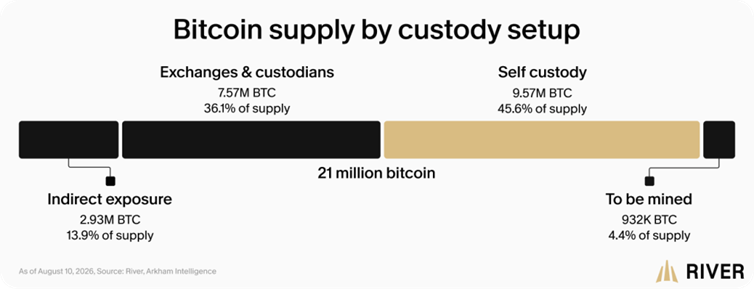
Các đại diện của River liên hệ việc tự lưu trữ chiếm ưu thế với cơ cấu sở hữu tài sản. Hơn một nửa số Bitcoin được khai thác trước khi các sàn giao dịch tiền mã hóa phổ biến rộng rãi. Hơn 12 triệu $BTC đã không di chuyển trong năm qua, và hơn 6 triệu Bitcoin vẫn không hoạt động ít nhất năm năm.

Đồng thời, thị trường dịch vụ lưu ký đang thay đổi. Năm 2021, các sàn giao dịch kiểm soát hơn một nửa số Bitcoin do các trung gian nắm giữ, nhưng hiện nay tỷ lệ của họ chỉ còn 38%. Phần còn lại chủ yếu tập trung ở các dịch vụ lưu trữ tiền mã hóa chuyên biệt. Trong đó, gần một nửa số đồng tiền trên các nền tảng giao dịch được đảm bảo bởi dự trữ có thể kiểm chứng công khai, các chuyên gia River cho biết.

Trước đó, các nhà phân tích của nền tảng on-chain Santiment đã báo cáo rằng tỷ lệ nắm giữ đồng tiền mã hóa đầu tiên trên các sàn giao dịch tiền mã hóa tập trung đã giảm xuống mức thấp nhất trong sáu năm - chỉ còn 5,6% tổng nguồn cung tài sản.

end-content

Trending Cryptos

Related Questions

QCác nhà phân tích River đã báo cáo bao nhiêu Bitcoin đang được nhà đầu tư tự lưu trữ?

ATheo báo cáo, tổng cộng có 7,95 triệu Bitcoin, tương đương 37,9% tổng nguồn cung, đang được nhà đầu tư tự lưu trữ trong các ví tích cực.

QCó bao nhiêu Bitcoin được coi là mất vĩnh viễn và phần lớn tổn thất này xảy ra khi nào?

ACó 1,62 triệu Bitcoin (7,7%) được các chuyên gia on-chain đánh giá là đã mất vĩnh viễn. Hơn 90% số tổn thất này xảy ra trước hoặc trong năm 2011.

QCác công ty công khai và quỹ ETF đang nắm giữ bao nhiêu Bitcoin?

ACác quỹ giao dịch hoán đổi (ETF) đang nắm giữ 1,51 triệu Bitcoin (7,2%), trong khi các công ty công khai nắm giữ 1,05 triệu Bitcoin (5%).

QLý do chính nào được River đưa ra để giải thích cho tỷ lệ tự lưu trữ Bitcoin cao?

ARiver liên hệ sự chiếm ưu thế của hình thức tự lưu trữ với cấu trúc sở hữu tài sản. Hơn một nửa tổng số Bitcoin được khai thác trước khi các sàn giao dịch tiền mã hóa trở nên phổ biến rộng rãi.

QThị phần của các sàn giao dịch trong thị trường dịch vụ lưu ký đã thay đổi như thế nào từ năm 2021?

ANăm 2021, các sàn giao dịch kiểm soát hơn một nửa số Bitcoin do các trung gian nắm giữ. Tuy nhiên, đến nay thị phần của họ chỉ còn 38%, phần còn lại chủ yếu tập trung vào các dịch vụ lưu trữ tiền mã hóa chuyên biệt.

Related Reads

a16z Deep Dive: Stop Chasing the 'AI Smell', Here's a Practical Guide to Writing with AI

"Don't Obsess Over AI Detection: A Practical Guide to Writing Alongside AI" by Steph Zinn (a16z Crypto) This guide moves beyond the flawed premise that AI-generated text can be easily spotted by a set of "tells" and that these features automatically mean poor quality. Instead, it focuses on how writers and founders can use LLMs effectively by understanding, controlling, and editing the common stylistic tendencies of AI-assisted prose. The article breaks down AI writing "tells" into four key dimensions: **1. Rhetorical Features (Insight-Shaped Writing):** AI often produces semantically empty, "corporate-sounding" filler language—vague profundities, hedging phrases, excessive parallelism, and summary statements. The advice is to ruthlessly edit these out, using prompts to make language more specific and direct. **2. Voice Features (The Alexa Voice):** Default AI writing relies on a narrow, fungible vocabulary of low-friction, abstract words and cliché phrases that lack personality. While this generic voice is acceptable for support docs or mass communications, founders should preserve their unique voice for impactful writing. Use LLMs to identify and replace jargon, aiming for concrete, distinctive word choices. **3. Structural Features (Form Without Function):** AI tends towards over-structured text with excessive subheadings, lists, roadmaps, and the rigid "three-point" framework. While clear structure is good for readability and SEO, it shouldn't force ideas into unnatural containers. Choose a structure that serves the format and purpose, borrowing from effective examples. **4. Punctuation Features (Dash Panic):** The overuse of em dashes and colons has become a hallmark, but writers shouldn't avoid useful punctuation just to seem "human." The key is avoiding repetitive, distracting patterns. Use punctuation that is grammatically correct and supports the flow of your argument. The core argument is that many so-called AI flaws are just amplified versions of existing bad writing habits. The goal isn't to eliminate AI's role but to use it as a tool while maintaining editorial control. The final question shouldn't be "Can this be detected as AI?" but "Does this writing effectively do its job?"

marsbit1h ago

a16z Deep Dive: Stop Chasing the 'AI Smell', Here's a Practical Guide to Writing with AI

marsbit1h ago

Podcast Notes | Conversation with Tom Lee: Bitmine Acquiring Nearly 5% of Total ETH Supply Is Not the End Goal, ETH Price Target Set at $10,000

In a podcast interview, Tom Lee, Chairman of BitMine Immersion Technologies, discusses the company's strategy to accumulate nearly 5% of the total Ethereum supply within 14 months, using equity financing and avoiding debt. BitMine has consistently purchased ETH for over 60 consecutive weeks, with recent weeks combining buybacks with purchases. The company's substantial ETH holdings generate approximately $300 million in annual staking rewards, covering operational costs like the dividends for its 9.5% perpetual preferred stock (BMNP). Lee positions ETH as a store-of-value asset, likening it to stocks or land, rather than a pure cash-flow instrument. Looking ahead, Lee suggests BitMine may continue buying beyond the 5% target if institutional adoption grows. He outlines a bullish price target for ETH: surpassing $5,000 in a new crypto bull cycle and potentially exceeding $10,000 within 1-2 years, driven by Wall Street tokenization and AI-related demand. The discussion also covers BitMine's evolution into an ecosystem player, funding Ethereum Foundation spin-offs and developing its Maven staking platform. Lee acknowledges his significant financial interests are tied to ETH's price and BitMine's performance. The interview provides a framework for evaluating ETH as a long-term asset, emphasizing staking yield sustainability and future institutional demand, while noting the uncertainties surrounding macro cycles and real-world adoption.

marsbit1h ago

Podcast Notes | Conversation with Tom Lee: Bitmine Acquiring Nearly 5% of Total ETH Supply Is Not the End Goal, ETH Price Target Set at $10,000

marsbit1h ago

Trading

Spot

Hot Articles

What is $BITCOIN

DIGITAL GOLD ($BITCOIN): A Comprehensive Analysis Introduction to DIGITAL GOLD ($BITCOIN) DIGITAL GOLD ($BITCOIN) is a blockchain-based project operating on the Solana network, which aims to combine the characteristics of traditional precious metals with the innovation of decentralized technologies. While it shares a name with Bitcoin, often referred to as “digital gold” due to its perception as a store of value, DIGITAL GOLD is a separate token designed to create a unique ecosystem within the Web3 landscape. Its goal is to position itself as a viable alternative digital asset, although specifics regarding its applications and functionalities are still developing. What is DIGITAL GOLD ($BITCOIN)? DIGITAL GOLD ($BITCOIN) is a cryptocurrency token explicitly designed for use on the Solana blockchain. In contrast to Bitcoin, which provides a widely recognized value storage role, this token appears to focus on broader applications and characteristics. Notable aspects include: Blockchain Infrastructure: The token is built on the Solana blockchain, known for its capacity to handle high-speed and low-cost transactions. Supply Dynamics: DIGITAL GOLD has a maximum supply capped at 100 quadrillion tokens (100P $BITCOIN), although details regarding its circulating supply are currently undisclosed. Utility: While precise functionalities are not explicitly outlined, there are indications that the token could be utilized for various applications, potentially involving decentralized applications (dApps) or asset tokenization strategies. Who is the Creator of DIGITAL GOLD ($BITCOIN)? At present, the identity of the creators and development team behind DIGITAL GOLD ($BITCOIN) remains unknown. This situation is typical among many innovative projects within the blockchain space, particularly those aligning with decentralized finance and meme coin phenomena. While such anonymity may foster a community-driven culture, it intensifies concerns about governance and accountability. Who are the Investors of DIGITAL GOLD ($BITCOIN)? The available information indicates that DIGITAL GOLD ($BITCOIN) does not have any known institutional backers or prominent venture capital investments. The project seems to operate on a peer-to-peer model focused on community support and adoption rather than traditional funding routes. Its activity and liquidity are primarily situated on decentralized exchanges (DEXs), such as PumpSwap, rather than established centralized trading platforms, further highlighting its grassroots approach. How DIGITAL GOLD ($BITCOIN) Works The operational mechanics of DIGITAL GOLD ($BITCOIN) can be elaborated on based on its blockchain design and network attributes: Consensus Mechanism: By leveraging Solana’s unique proof-of-history (PoH) combined with a proof-of-stake (PoS) model, the project ensures efficient transaction validation contributing to the network's high performance. Tokenomics: While specific deflationary mechanisms have not been extensively detailed, the vast maximum token supply implies that it may cater to microtransactions or niche use cases that are still to be defined. Interoperability: There exists the potential for integration with Solana’s broader ecosystem, including various decentralized finance (DeFi) platforms. However, the details regarding specific integrations remain unspecified. Timeline of Key Events Here is a timeline that highlights significant milestones concerning DIGITAL GOLD ($BITCOIN): 2023: The initial deployment of the token occurs on the Solana blockchain, marked by its contract address. 2024: DIGITAL GOLD gains visibility as it becomes available for trading on decentralized exchanges like PumpSwap, allowing users to trade it against SOL. 2025: The project witnesses sporadic trading activity and potential interest in community-led engagements, although no noteworthy partnerships or technical advancements have been documented as of yet. Critical Analysis Strengths Scalability: The underlying Solana infrastructure supports high transaction volumes, which could enhance the utility of $BITCOIN in various transaction scenarios. Accessibility: The potential low trading price per token could attract retail investors, facilitating wider participation due to fractional ownership opportunities. Risks Lack of Transparency: The absence of publicly known backers, developers, or an audit process may yield skepticism regarding the project's sustainability and trustworthiness. Market Volatility: The trading activity is heavily reliant on speculative behavior, which can result in significant price volatility and uncertainty for investors. Conclusion DIGITAL GOLD ($BITCOIN) emerges as an intriguing yet ambiguous project within the rapidly evolving Solana ecosystem. While it attempts to leverage the “digital gold” narrative, its departure from Bitcoin's established role as a store of value underscores the need for a clearer differentiation of its intended utility and governance structure. Future acceptance and adoption will likely depend on addressing the current opacity and defining its operational and economic strategies more explicitly. Note: This report encompasses synthesised information available as of October 2023, and developments may have transpired beyond the research period.

2.1k Total ViewsPublished 2025.05.13Updated 2025.05.13

What is $BITCOIN

Discussions

Welcome to the HTX Community. Here, you can stay informed about the latest platform developments and gain access to professional market insights. Users' opinions on the price of BTC (BTC) are presented below.

活动图片