Ripple's RLUSD Market Cap Exceeds $2 Billion, With Nearly $1 Billion on XRP Ledger

cryptonews.ruPublished on 2026-08-26Last updated on 2026-08-26

Abstract

Ripple USD's ($RLUSD) market capitalization has surpassed $2 billion, with nearly $1 billion issued on the XRP Ledger. Launched in December 2024, the stablecoin is backed by reserves of cash and cash equivalents, attested monthly by Deloitte. Data shows $RLUSD's market cap at approximately $2.02 billion, split almost evenly between the XRP Ledger ($962.8M) and Ethereum ($1.05B). This represents an eight-fold increase since April 2025. The stablecoin has provided significant dollar liquidity to the XRP Ledger, with over $2.5B processed through RLUSD trading pairs. Ripple is expanding RLUSD's utility through payments integrations (including Mastercard), exchange listings, regional distribution deals, and support for institutional lending initiatives on the XRP Ledger. A new platform, Ripple Mint, also allows qualified institutions to manage RLUSD issuance and redemptions.

Last week, the market capitalization of Ripple USD ($RLUSD) exceeded $2 billion. On August 25, Ripple announced this achievement in a post on X:

"Last week, the market cap of $RLUSD surpassed $2 billion, with nearly $1 billion issued on the $XRP Ledger. The system has been operational since December 2024, built for real-world utility and designed for enterprise use cases."

Each $RLUSD token is designed to maintain a value of $1 through reserves consisting of cash and permitted cash equivalents. Ripple's documentation for $RLUSD states that reserves are held in segregated accounts and include short-term U.S. Treasury bills, government money market funds, overnight reverse repurchase agreements, and bank deposits. According to Ripple, Deloitte performs monthly reserve attestations.

According to RWA.xyz, the market capitalization of $RLUSD was approximately $2.02 billion, having increased by 31.45% over 30 days, with about $962.8 million issued on the $XRP Ledger and $1.05 billion on the Ethereum network. According to the same data, over the previous 30 days, the transfer volume in $RLUSD amounted to $11.81 billion, distributed across 1.39 million transactions.
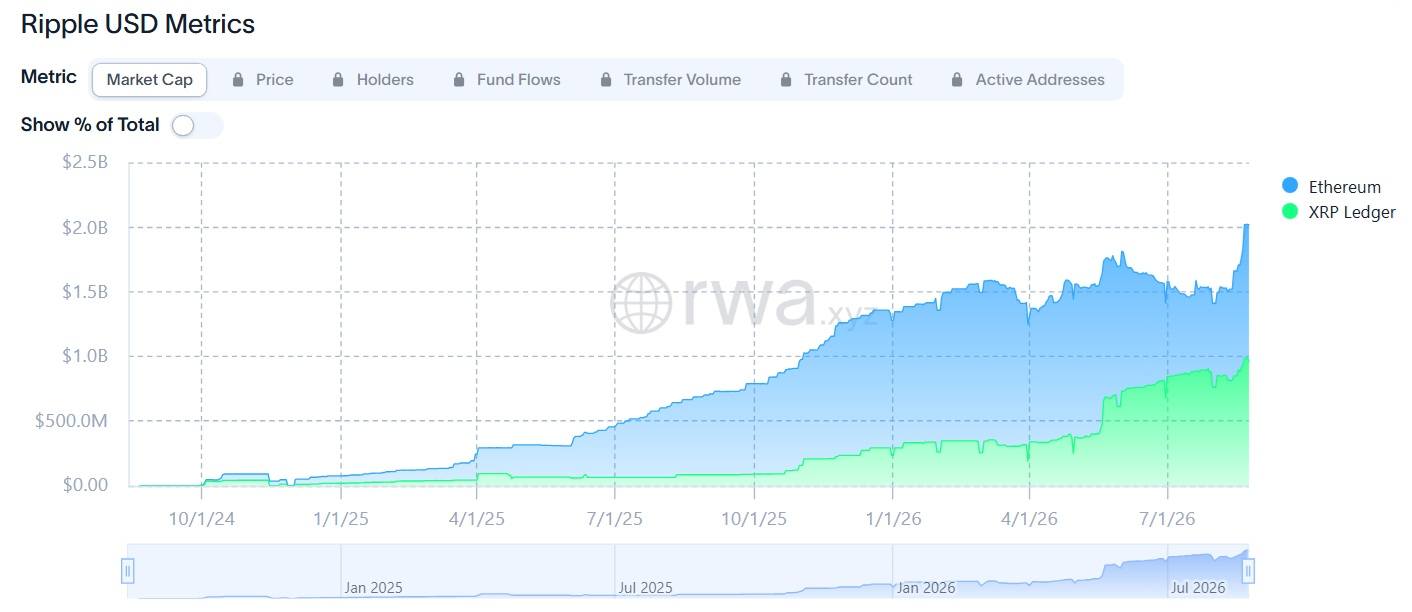
By August 25, the market capitalization of $RLUSD reached approximately $2.02 billion, with about $1.05 billion issued on Ethereum and $962.8 million on the $XRP Ledger. Source: RWA.xyz

Currently, these two networks account for nearly equal portions of the $RLUSD supply, with a difference of less than $90 million between them. Ripple mints the stablecoin directly on each chain rather than bridging them into a single pool, so these two balances comprise almost the entire $2.02 billion sum.

The stablecoin's current market cap is eight times the figure from its first four months post-launch. In April 2025, Ripple reported that the market capitalization of $RLUSD was approaching $250 million. At the time, the company had integrated the stablecoin into the Ripple Payments platform for cross-border transactions, treasury operations, and settlements with institutional investors.

Activity on $XRP Ledger Grows with $RLUSD Supply

The growing issuance of $RLUSD has provided additional dollar liquidity for the trading and payment infrastructure of the $XRP Ledger. According to an analysis by Evernorth, from the stablecoin's launch through the end of June, over $2.5 billion was processed through trading pairs with $RLUSD. The $RLUSD-$XRP pair accounted for approximately $900 million over the previous six months and constituted nearly 90% of $RLUSD trading volume on the network.

$RLUSD could also support institutional lending if two proposed amendments to the $XRP Ledger gain validator approval. Ripple supports an institutional lending initiative for $RLUSD involving Clearpool and Cicada Partners. The system remains in development on the Devnet and depends on the approval of amendments XLS-65 "Discreet Asset Vaults" and XLS-66 "Lending Protocol" before launching on the mainnet.

Institutional users gained another method of accessing the stablecoin when Ripple introduced a unified issuance and redemption platform in July. Ripple Mint allows eligible institutions to manage $RLUSD via a web interface or API. Its features include minting, redeeming, cross-chain bridging, balance monitoring, transaction tracking, and automated notifications, covering every step of the settlement process.

Payments and Multi-Chain Access Expand $RLUSD Utility

Ripple has expanded $RLUSD's utility through integrations with payment systems, exchange listings, regional distribution agreements, and support for additional blockchain networks. Among eight new $RLUSD introductions announced in July were: settlement support via Mastercard, availability in Japan and Turkey, integration with Bitso, and Flutterwave investments related to African payment corridors. Ripple also expanded the stablecoin's reach beyond its initial deployments on the $XRP Ledger and Ethereum.

Stablecoins are cryptocurrencies designed to be pegged to underlying assets, most commonly the U.S. dollar, through reserves, collateral, redemption mechanisms, or other structures. A stablecoin's collateral and redemption models determine how each token aims to maintain its peg to the underlying asset, as well as the risks faced by holders. The transfer volume metric measures on-chain movement, not payments, revenue, or net inflows, while market capitalization reflects the value of tokens in circulation.

end-content

Trending Cryptos

Related Questions

QWhat milestone did Ripple's RLUSD stablecoin achieve recently according to the article?

AThe market capitalization of Ripple USD (RLUSD) recently surpassed $2 billion, with nearly $1 billion of that amount issued on the XRP Ledger.

QHow is the value of each RLUSD token maintained, and how are the reserves audited?

AEach RLUSD token is designed to maintain a value of $1 through reserves consisting of cash and permitted cash equivalents. According to Ripple's documentation, the reserves are held in segregated accounts and include short-term U.S. Treasury bills, government money market funds, overnight reverse repurchase agreements, and bank deposits. The auditing firm Deloitte performs monthly attestations of these reserves.

QWhat is the current distribution of the $2.02 billion RLUSD market cap between the XRP Ledger and Ethereum networks?

AAccording to RWA.xyz, approximately $962.8 million of RLUSD was issued on the XRP Ledger, and $1.05 billion was issued on the Ethereum network. The difference between the two networks is less than $90 million.

QHow has RLUSD contributed to activity within the XRP Ledger ecosystem?

AThe growing issuance of RLUSD has provided additional dollar liquidity for the XRP Ledger's trading and payment infrastructure. Analysis from Evernorth shows that over $2.5 billion was processed through RLUSD trading pairs from its launch until the end of June. The RLUSD-XRP pair alone accounted for approximately $900 million in volume over the previous six months, representing nearly 90% of RLUSD's trading volume on the ledger.

QWhat were some of the key use case expansions for RLUSD announced by Ripple in July?

AIn July, Ripple announced eight expansions for RLUSD, including: enabling settlements via Mastercard, availability in Japan and Turkey, integration with Bitso, and Flutterwave's investment related to African payment corridors. Ripple also expanded the stablecoin's reach beyond its initial deployments on the XRP Ledger and Ethereum.

Related Reads

a16z Deep Dive: Stop Chasing the 'AI Smell', Here's a Practical Guide to Writing with AI

"Don't Obsess Over AI Detection: A Practical Guide to Writing Alongside AI" by Steph Zinn (a16z Crypto) This guide moves beyond the flawed premise that AI-generated text can be easily spotted by a set of "tells" and that these features automatically mean poor quality. Instead, it focuses on how writers and founders can use LLMs effectively by understanding, controlling, and editing the common stylistic tendencies of AI-assisted prose. The article breaks down AI writing "tells" into four key dimensions: **1. Rhetorical Features (Insight-Shaped Writing):** AI often produces semantically empty, "corporate-sounding" filler language—vague profundities, hedging phrases, excessive parallelism, and summary statements. The advice is to ruthlessly edit these out, using prompts to make language more specific and direct. **2. Voice Features (The Alexa Voice):** Default AI writing relies on a narrow, fungible vocabulary of low-friction, abstract words and cliché phrases that lack personality. While this generic voice is acceptable for support docs or mass communications, founders should preserve their unique voice for impactful writing. Use LLMs to identify and replace jargon, aiming for concrete, distinctive word choices. **3. Structural Features (Form Without Function):** AI tends towards over-structured text with excessive subheadings, lists, roadmaps, and the rigid "three-point" framework. While clear structure is good for readability and SEO, it shouldn't force ideas into unnatural containers. Choose a structure that serves the format and purpose, borrowing from effective examples. **4. Punctuation Features (Dash Panic):** The overuse of em dashes and colons has become a hallmark, but writers shouldn't avoid useful punctuation just to seem "human." The key is avoiding repetitive, distracting patterns. Use punctuation that is grammatically correct and supports the flow of your argument. The core argument is that many so-called AI flaws are just amplified versions of existing bad writing habits. The goal isn't to eliminate AI's role but to use it as a tool while maintaining editorial control. The final question shouldn't be "Can this be detected as AI?" but "Does this writing effectively do its job?"

marsbit37m ago

a16z Deep Dive: Stop Chasing the 'AI Smell', Here's a Practical Guide to Writing with AI

marsbit37m ago

Podcast Notes | Conversation with Tom Lee: Bitmine Acquiring Nearly 5% of Total ETH Supply Is Not the End Goal, ETH Price Target Set at $10,000

In a podcast interview, Tom Lee, Chairman of BitMine Immersion Technologies, discusses the company's strategy to accumulate nearly 5% of the total Ethereum supply within 14 months, using equity financing and avoiding debt. BitMine has consistently purchased ETH for over 60 consecutive weeks, with recent weeks combining buybacks with purchases. The company's substantial ETH holdings generate approximately $300 million in annual staking rewards, covering operational costs like the dividends for its 9.5% perpetual preferred stock (BMNP). Lee positions ETH as a store-of-value asset, likening it to stocks or land, rather than a pure cash-flow instrument. Looking ahead, Lee suggests BitMine may continue buying beyond the 5% target if institutional adoption grows. He outlines a bullish price target for ETH: surpassing $5,000 in a new crypto bull cycle and potentially exceeding $10,000 within 1-2 years, driven by Wall Street tokenization and AI-related demand. The discussion also covers BitMine's evolution into an ecosystem player, funding Ethereum Foundation spin-offs and developing its Maven staking platform. Lee acknowledges his significant financial interests are tied to ETH's price and BitMine's performance. The interview provides a framework for evaluating ETH as a long-term asset, emphasizing staking yield sustainability and future institutional demand, while noting the uncertainties surrounding macro cycles and real-world adoption.

marsbit37m ago

Podcast Notes | Conversation with Tom Lee: Bitmine Acquiring Nearly 5% of Total ETH Supply Is Not the End Goal, ETH Price Target Set at $10,000

marsbit37m ago

Pricing Risk Assets in 8 Hours: Tonight's PCE to Set the Discount Rate, Nvidia to Test Earnings Tomorrow Morning

"Pricing Risk Assets in 8 Hours: PCE to Set the Discount Rate Tonight, NVIDIA to Test Profits Tomorrow Morning" Risk asset prices hinge on two variables: the numerator (earnings expectations) and the denominator (the discount rate). Both will be recalibrated within eight hours. First, at 20:30 Beijing time, the US Bureau of Economic Analysis releases July PCE inflation data and the second estimate of Q2 GDP. Consensus expects mild core PCE growth, but a surge in key PPI components poses an upside risk. A hotter-than-expected print could push Treasury yields and the dollar higher, threatening the recent rally in Bitcoin (BTC) above $80K, which was fueled by falling yields. A benign reading would support risk assets. Market sentiment is already "greedy" (Fear & Greed Index at 74), making it vulnerable to disappointment. Second, around 04:20, NVIDIA reports its Q2 FY27 earnings. While consensus revenue of ~$91.85B slightly exceeds company guidance, the market has priced in a beat. The key will be the magnitude of the beat and, crucially, the Q3 guidance. As a bellwether for tech and AI narratives, NVIDIA's results will significantly impact overall risk appetite and AI-related crypto tokens. The combination creates four scenarios: 1) Benign PCE & strong NVIDIA guidance confirms the bullish trend. 2) Hot PCE & strong NVIDIA leads to conflicted signals and likely volatility for BTC. 3) Benign PCE & weak NVIDIA guidance pressures tech but offers some macro support for BTC. 4) Hot PCE & weak NVIDIA guidance presents a "double whammy," risking a sharp pullback in BTC toward the $75K-$76K support zone. The outcomes will set the tone for markets ahead of the upcoming Jackson Hole symposium.

marsbit1h ago

Pricing Risk Assets in 8 Hours: Tonight's PCE to Set the Discount Rate, Nvidia to Test Earnings Tomorrow Morning

marsbit1h ago

Trading

Spot

Hot Articles

What is XRP 2.0

XRP 2.0: A New Frontier in the Cryptocurrency Landscape Introduction to XRP 2.0 In the ever-evolving realm of cryptocurrency, new projects continuously emerge, vying for attention and adoption. One such promising initiative is XRP 2.0, a novel cryptocurrency project designed to leverage advanced blockchain technology and robust encryption methodologies. While the name draws parallels with Ripple’s XRP, it’s crucial to note that XRP 2.0 operates independently, focusing on enhancing transaction security, privacy, and scalability. As the digital financial landscape increasingly embraces decentralized solutions, XRP 2.0 aims to contribute meaningfully to web3 and the overall expansion of crypto projects. What is XRP 2.0? At its core, XRP 2.0 is a cryptocurrency project that aims to create a secure and decentralized digital currency ecosystem. Its foundational technology integrates sophisticated blockchain principles with cutting-edge encryption techniques. The overarching goal of XRP 2.0 is to establish itself as a reliable and efficient platform enabling swift transaction execution while prioritizing enhanced privacy protections for its users. The project is promoted as a solution to many limitations faced by existing cryptocurrencies, proposing a system that can handle a higher volume of transactions with improved speed and privacy. This versatility positions XRP 2.0 as a significant contender in a marketplace riddled with various digital currencies. Who is the Creator of XRP 2.0? The identity of the creator behind XRP 2.0 has been flagged as ‘Wilbur.’ However, comprehensive details regarding Wilbur or their associated entity remain elusive. The anonymity of many cryptocurrency creators is not an uncommon phenomenon in the industry, often designed to maintain a degree of privacy and security. Who are the Investors of XRP 2.0? As of now, specific information related to the investment foundations or organizations supporting XRP 2.0 is not publicly available. In the cryptocurrency sector, the backing by reputed investors can significantly influence a project's credibility and success, yet the transparency regarding the financial supporters of XRP 2.0 has not been established. How Does XRP 2.0 Work? XRP 2.0 stands out by employing a combination of blockchain technology and advanced encryption algorithms that ensures secure and decentralized transactions. Its innovative structure includes unique features designed to foster user engagement and broaden functionalities beyond conventional cryptocurrency transactions. Among these features, XRP 2.0 incorporates AI-powered capabilities, such as text-to-image and text-to-speech functionalities. These additions are designed to enhance the interactive experience for users, promoting broader applicability across various sectors. By bridging technological advancements with user-centered design, XRP 2.0 aims to capture the attention of a diverse range of individuals and enterprises looking to integrate cryptocurrency solutions into their operational frameworks. Timeline of XRP 2.0 Understanding XRP 2.0 requires examining the milestones that have defined its journey thus far: July 23, 2023: XRP 2.0 is introduced as a novel cryptocurrency project, aiming to revolutionize secure and decentralized transaction capabilities in the blockchain domain. September 8, 2023: The launching of another project, XRP20, occurs, marking the emergence of an ERC-20 token on the Ethereum blockchain that remains unrelated to XRP 2.0. November 13, 2023: The XRP Ledger undergoes a significant update with the release of rippled server software version 2.0.0. It is essential to note that this development is disconnected from the XRP 2.0 cryptocurrency project. Key Points About XRP 2.0 To distill the essence of XRP 2.0, several critical factors emerge: Unique Features: The inclusion of features like AI-powered text-to-image and text-to-speech further diversifies the potential applications of XRP 2.0. Blockchain Technology: The framework utilizes advanced blockchain mechanisms and encryption protocols, ensuring a secure and decentralized environment for transactions. Scalability and Privacy: XRP 2.0 prioritizes enhanced privacy protections in transaction processes and the scalability necessary to accommodate a growing user base. No Affiliation with Ripple: Importantly, despite its name, XRP 2.0 does not have any allegiance or collaboration with Ripple’s XRP, distinguishing its operational framework and objectives within the cryptocurrency ecosystem. Conclusion XRP 2.0 represents an ambitious venture into the cryptocurrency sphere, aiming to offer a combination of security, privacy, and efficiency in digital transactions. By integrating sophisticated technologies and user-friendly features, the project sets out to broaden the horizons of what cryptocurrency can achieve in today's digital economy. While the anonymity of its creator and lack of disclosed investors might raise questions for some, XRP 2.0's focus on advanced functionalities and decentralisation enhances its appeal amidst an increasingly crowded crypto market. As the cryptocurrency landscape continues to evolve, XRP 2.0 may yet emerge as a pivotal player in the expansion of secure and scalable blockchain solutions.

1.6k Total ViewsPublished 2024.04.01Updated 2024.12.03

What is XRP 2.0

Discussions

Welcome to the HTX Community. Here, you can stay informed about the latest platform developments and gain access to professional market insights. Users' opinions on the price of XRP (XRP) are presented below.

活动图片