La propriétaire la plus mystérieuse : elle crée un fonds de capital-risque

marsbitPublished on 2026-08-17Last updated on 2026-08-17

Abstract

La figure discrète derrière le capital-risque Xinhe Capital. Yang Jingting, épouse de Liu Sheng, président de Zhongji Innolight (une entreprise cotée atteignant une capitalisation boursière de mille milliards), émerge enfin du silence. Récemment apparue publiquement lors d'une cérémonie de don à l'Université Tsinghua, elle dirige en réalité depuis plusieurs années le fonds Xinhe Capital, dont elle détient 90%. Après des débuts professionnels variés, Yang Jingting s'est lancée dans l'investissement en 2014. Son véhicule principal, Xinhe Capital (gérant 1 à 2 milliards de RMB), se concentre sur les maillons clés de la chaîne d'approvisionnement des semi-conducteurs photovoltaïques : matériaux, puces, composants et équipements. Le fonds investit dans des domaines tels que les centres de données, les terminaux intelligents et les véhicules connectés. Son activité s'est accélérée en 2024, avec environ treize investissements, notamment dans des entreprises comme Mingjia Semiconductor (semi-conducteurs de quatrième génération) et Guanglian Xinke (interconnexion optique). En plus de gérer Xinhe Capital, Yang Jingting effectue des investissements directs (par exemple, dans Suzhou Suna Photoelectric) et agit en tant qu'investisseuse LP dans des fonds de capital-risque. Son parcours s'inscrit dans une tendance plus large : les entrepreneurs chinois ayant bâti des fortunes dans l'industrie se tournent désormais vers le capital-risque technologique. Ils utilisent leur richesse et leur ...

« Connaissez-vous le fonds de la propriétaire de Zhongji Innolight ? Je cherche à entrer en contact. »

Dernièrement, lors d'échanges avec des investisseurs, un nom revient fréquemment – Xinhe Capital, derrière lequel se trouve une investisseuse : Yang Jingting.

Peut-être que ce nom n'est pas familier au public, mais si l'on parle de son mari – Liu Sheng, président du conseil d'administration de Zhongji Innolight, les gens le connaissent. En avril dernier, le couple est apparu ensemble lors d'une cérémonie de donation à l'Université Tsinghua, marquant la première apparition publique de Yang Jingting.

Mais en réalité, ces dernières années, elle a dirigé discrètement Xinhe Capital et a déjà investi dans un réseau d'entreprises caché.

La propriétaire de Zhongji Innolight dirige un fonds de capital-risque

En remontant le fil, commençons par un don.

En avril dernier, la Schwarzman School de l'Université Tsinghua a annoncé une donation – Liu Sheng, diplômé de la promotion 1989 et président du conseil d'administration de Zhongji Innolight, et son épouse Yang Jingting ont fait un don à l'Université Tsinghua, pour soutenir la construction et le développement de la Schwarzman School. Sur la photo de la cérémonie, le couple Liu Sheng et Yang Jingting, ainsi que Stephen Schwarzman, PDG de Blackstone, entre autres personnalités clés, étaient présents.
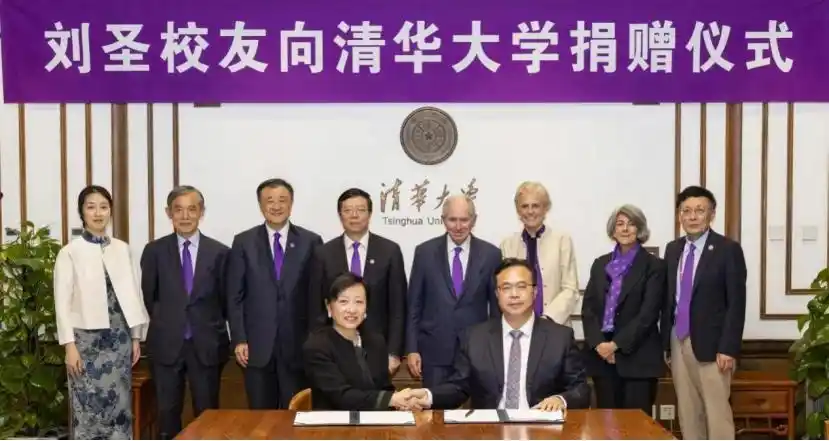
Source de l'image

Liu Sheng n'est pas inconnu du public. Selon le prospectus de l'introduction en bourse sur le marché H de Zhongji Innolight, Liu Sheng a obtenu son diplôme de licence en génie mécanique de l'Université Tsinghua en 1994, puis a poursuivi une maîtrise en automatisation industrielle à l'Institut d'automatisation de l'Académie chinoise des sciences. L'entreprise qu'il dirige, Zhongji Innolight, a atteint une capitalisation boursière de plus de 1 000 milliards de yuans cette année.

Son épouse – Yang Jingting – est extrêmement discrète, et il est presque impossible de trouver des informations sur son passé sur Internet. Cette donation à Tsinghua est probablement la première fois que le public la voit.

Tianyancha (plateforme de données d'entreprises) montre que près de 20 entreprises sont liées au nom de Yang Jingting, incluant des investissements directs dans des projets uniques, des prises de participation en tant qu'investisseuse limitée (LP) dans des fonds de capital-risque, et un fonds qu'elle gère elle-même – Xinhe Capital.

Le gestionnaire de fonds privés de Xinhe Capital est Hainan Xinhe Private Equity Fund Management Partnership (Limited Partnership) (ci-après : Hainan Xinhe). Selon les informations de l'Association chinoise des fonds d'investissement (AMAC), le partenaire exécutif de Hainan Xinhe est Zhu Rui, détenant 10 % des parts, tandis que Yang Jingting en détient 90 %. Zhu Rui était auparavant directeur des investissements au département des investissements de Zhongji Innolight.
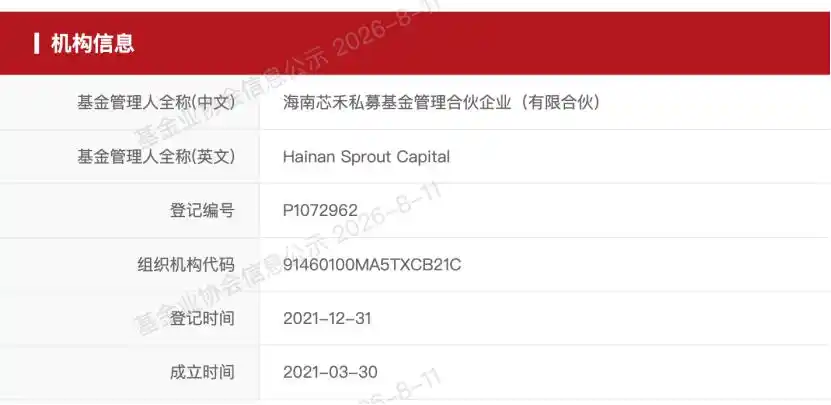
Le parcours professionnel de Yang Jingting apparaît également. Selon les informations de l'AMAC, de juillet 2009 à juin 2013, elle a travaillé au bureau du président de Shanghai New Sun Real Estate Co., Ltd. en tant qu'assistante du président.

À partir de février 2014, elle a officiellement commencé sa carrière d'investisseuse professionnelle, travaillant successivement chez Suzhou Garden Construction Industry Equity Co., Ltd., Changzhou Qizhi Investment Management Co., Ltd., Suzhou Industrial Park Jimu Growth Investment Management Partnership (Limited Partnership), et Changzhou Naxin Venture Capital Partnership (Limited Partnership), occupant des postes tels que vice-présidente du marketing, responsable du contrôle des risques, conseillère principale et membre du comité de décision d'investissement.

En mars 2021, Hainan Xinhe a été enregistrée, son type d'institution étant gestionnaire de fonds de capital-investissement et de capital-risque privés, avec une taille de gestion de 1 à 2 milliards de yuans. En août de la même année, Yang Jingting a rejoint l'entreprise, occupant le poste de partenaire, responsable de la déclaration d'informations et vice-présidente au sein du bureau général de Hainan Xinhe.
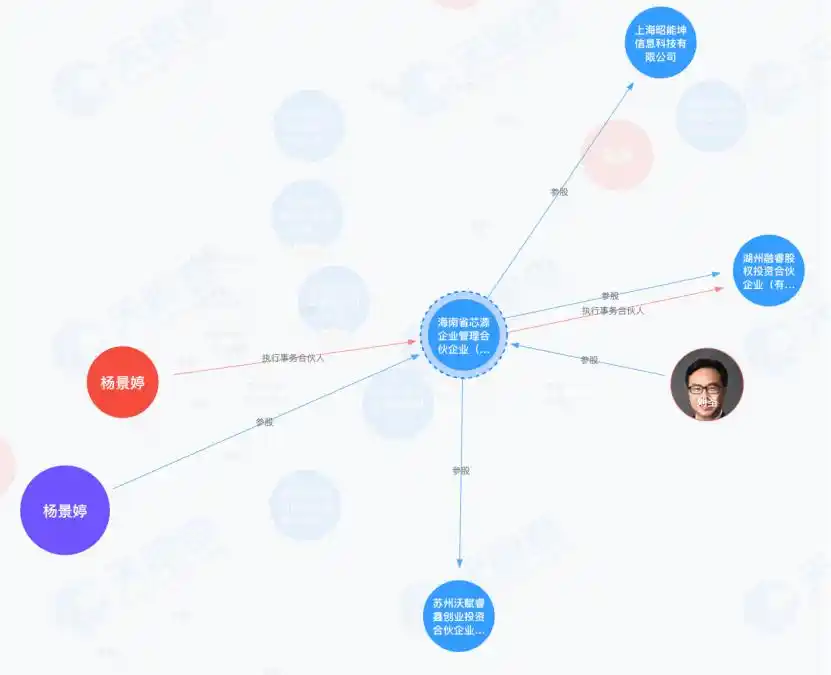
Dans l'ensemble, Yang Jingting et son mari Liu Sheng n'ont pas beaucoup de liens commerciaux directs. Ils ne détiennent conjointement des parts que dans deux sociétés : Hainan Province Xinyuan Enterprise Management Partnership (Limited Partnership) et Shanghai Change Enterprise Management Co., Ltd., toutes deux détenues à 51 % par Yang Jingting et à 49 % par Liu Sheng. La première investit dans un sous-fonds du fonds Wofu Venture Capital.

Révéler la carte des investissements

En creusant, une carte d'investissement cachée apparaît progressivement.

Parlons d'abord des investissements directs. Yang Jingting a directement investi dans Suzhou Suna Optoelectronics Co., Ltd. Cette société, fondée en 2014, a été créée par des scientifiques de l'Université Tsinghua et de l'Académie chinoise des sciences, se spécialisant dans les domaines des puces de communication optique et de capteurs optiques. Elle compte parmi ses investisseurs SDIC Capital, Forise Fund, Yongxin Ark, Wofu Venture Capital, etc. Suna Optoelectronics a entamé le processus d'introduction en bourse.

En tant qu'investisseuse limitée (LP), Yang Jingting a investi dans le sous-fonds de Yongxin Ark, « Suzhou Yongxin Ronghui Venture Capital Partnership (Limited Partnership) », ainsi que dans deux sous-fonds de Qianrong Holdings.

Rappelons qu'en avril dernier, Wei Yong, partenaire gérant de Yongxin Ark, nous a parlé de ses liens avec Zhongji Innolight – dès 2016, Yongxin Ark avait investi dans Zhongji Innolight, c'était le premier projet de Wei Yong après la création de son fonds, avec un montant unique dépassant 180 millions de yuans.

La plateforme d'investissement centrale de Yang Jingting reste néanmoins Xinhe Capital.

Cette institution se concentre sur les matériaux, puces, composants et équipements clés en amont de la chaîne des semi-conducteurs optoélectroniques, ciblant principalement les centres de données, les terminaux intelligents, les véhicules intelligents et autres domaines de pointe. Depuis sa création en 2021, Xinhe Capital n'a pas réalisé un grand nombre d'investissements, mais cette année, elle est particulièrement active, ayant investi dans environ 13 projets depuis le début de l'année, soit le double de l'année dernière.

En juillet 2026, Mingjia Semiconductor, une entreprise de semi-conducteurs de quatrième génération, a achevé un tour de financement Pre-B de plus de 150 millions de yuans, auquel Xinhe Capital a participé. Le même mois, Hefei Jiusi Electronics a achevé un tour de financement A+, mené par Xinhe Capital. Auparavant, Xinhe Capital avait également investi dans des entreprises de semi-conducteurs comme VeriSilicon.

Dans le domaine de l'interconnexion optique et de l'optoélectronique, Xinhe Capital a participé en juin au tour de financement A de près de 500 millions de yuans de Guanglian Xinke ; dans le domaine des semi-conducteurs de puissance, elle vient d'investir dans Xizhi Technology, spécialisée dans les modules de puissance et d'alimentation de grade automobile. De plus, Xinhe Capital a également investi dans des entreprises technologiques comme Qinghe Jingyuan et JBD (Jade Bird Display), et a signé l'année dernière un accord avec Huai'an pour créer le fonds Xinhe Ningrui, afin de promouvoir la modernisation industrielle régionale et la mise en œuvre de projets de fabrication avancée.
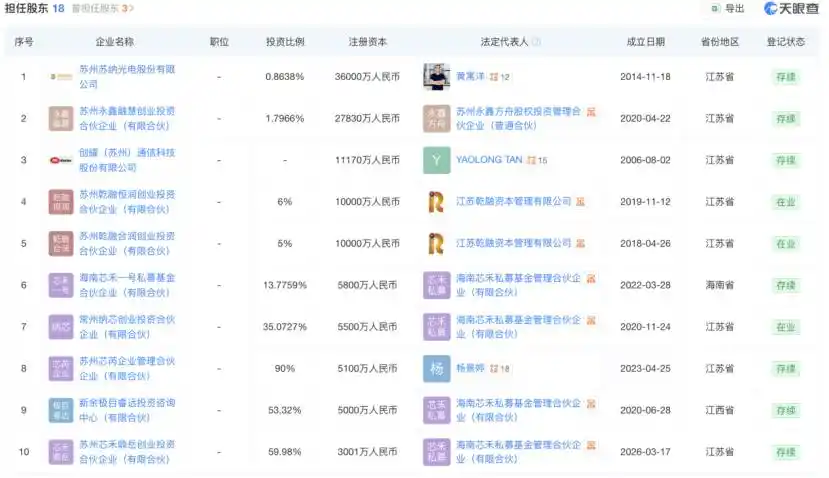
Des matériaux semi-conducteurs à l'interconnexion optique, des dispositifs de puissance aux composants d'équipement, la stratégie de Xinhe Capital est claire – positionner systématiquement des investissements sur les points clés de la chaîne industrielle des semi-conducteurs optoélectroniques.

Parier sur le prochain avenir

De là, une tendance devient de plus en plus claire : les riches Chinois qui ont bâti leur fortune dans l'industrie manufacturière tournent collectivement leur regard vers les technologies de pointe. Ils ne se contentent plus d'être de simples LP, mais prennent eux-mêmes part au jeu, utilisant leurs family offices ou leurs fonds propres pour parier sur la technologie de demain.

En examinant un groupe d'entreprises d'IA vedettes cette année, la présence de Lens Technology apparaît fréquemment. Derrière cela se trouve une femme leader, Zhou Qunfei, qui a écrit une légende d'ascension entrepreneuriale avec une vitre en verre, devenant la « reine du verre » à la tête d'une capitalisation boursière de centaines de milliards de yuans. Ces dernières années, elle et Lens Technology ont commencé à apparaître dans le monde du capital-risque, investissant dans un groupe d'entreprises vedettes comme BrainCo, Xinghai Tu, Qingtian Zu, Kuawei Intelligence, Zhuji Power, Gestalt Technology, etc.

Zhu Xingming, président du conseil d'administration de Inovance Technology, d'une capitalisation boursière de centaines de milliards de yuans, utilise son family office « Minghui Investment » pour investir dans les technologies de pointe, principalement dans l'interface cerveau-ordinateur, le calcul d'IA, etc., ayant investi plus tôt cette année dans Qiaoxin Intelligent, une licorne à corps physique valant des milliards. L'entreprise Luxshare Precision, d'une capitalisation boursière de près de 500 milliards de yuans, a également créé un family office – Liling Fund, ayant investi dans des entreprises technologiques comme Winna Core, SMIC Integration, Corelink Power, etc.

Il y a peu, lors du premier tour de financement de DeepSeek, la présence de iHealth est apparue de manière inattendue. Son dirigeant, Liu Yi, a bâti de zéro iHealth, d'une capitalisation boursière de 30 milliards de yuans. Ayant atteint l'indépendance financière, il a étendu son influence vers le monde du capital-risque : agissant à la fois en tant que LP investissant dans des fonds comme MiraclePlus, 9f Capital, etc., et en investissant directement dans des projets vedettes comme Moonshot AI (Kimi), Stepfun, Zhiyuan Robot, Independent Variable Robot, etc.

En résumé, le point commun de ces entrepreneurs est : avoir accumulé une connaissance industrielle profonde et une immense richesse dans le secteur manufacturier, et utiliser maintenant cette connaissance et cette richesse pour définir la technologie de la prochaine génération. Comparés aux investisseurs financiers, ils n'apportent pas seulement de l'argent, mais aussi des commandes, des scénarios d'application et une synergie de la chaîne industrielle.

La direction des flux de capitaux a toujours une influence profonde.

Pendant longtemps, l'argent des riches Chinois allait souvent vers l'immobilier et l'industrie manufacturière traditionnelle. Aujourd'hui, la marée tourne, et des masses de capitaux convergent collectivement vers des domaines de pointe comme l'IA, les semi-conducteurs, l'intelligence incarnée, l'interface cerveau-ordinateur, la fusion nucléaire contrôlée, etc. Après tout, c'est la direction de l'avenir, être en retard signifie être éliminé.

Cet article provient du compte WeChat officiel « PEdaily (投资界) » (ID : pedaily2012), auteur : Zhou Jiali

Trending Cryptos

Related Questions

QQui est Yang Jingting et quelle est sa relation avec Liu Sheng de Zhongji Xuchuang ?

AYang Jingting est l'épouse de Liu Sheng, le président de Zhongji Xuchuang, une société cotée en bourse. Elle est une investisseuse discrète qui dirige sa propre société de capital-risque, Xinhe Capital.

QQuel est le principal domaine d'investissement de Xinhe Capital, fondée par Yang Jingting ?

AXinhe Capital se concentre sur les matériaux, les puces, les composants et les équipements en amont de la chaîne d'approvisionnement des semi-conducteurs photoniques, investissant dans des domaines comme les centres de données, les terminaux intelligents et les véhicules intelligents.

QComment les entrepreneurs chinois ayant fait fortune dans l'industrie réelle investissent-ils désormais dans la technologie ?

AIls investissent personnellement, via des bureaux de famille ou des fonds propres, dans les technologies de nouvelle génération comme l'IA, les semi-conducteurs, l'intelligence incarnée, les interfaces cerveau-ordinateur et la fusion nucléaire contrôlée, apportant non seulement des capitaux mais aussi des commandes, des scénarios et une synergie industrielle.

QQuels sont certains des investissements directs ou en tant que commanditaire (LP) réalisés par Yang Jingting en dehors de Xinhe Capital ?

AYang Jingting a investi directement dans Suzhou Suna Optoelectronics Co., Ltd. et a participé en tant que commanditaire à des fonds de sociétés comme Yongxin Fangzhou et Qianrong Holdings.

QQuels sont les exemples d'autres entrepreneurs fortunés chinois investissant dans des entreprises technologiques, mentionnés dans l'article ?

AL'article mentionne Zhou Qunfei de Lens Technology investissant dans des entreprises d'IA comme BrainCo et Qiantu ; Zhu Xingming de Inovance Technology investissant via son bureau de famille Minghui Investment ; et Liu Yi de Andon Health investissant dans des projets comme Moon's Dark Side (Kimi) et StepFun.

Related Reads

HIVE Invests $185 Million in 2016 Blackwell Ultra GPUs to Achieve $200 Million Annual Revenue Target

HIVE Digital Technologies announced that its subsidiary BUZZ HPC has signed a five-year contract worth approximately $350 million with a high investment-grade company to provide cloud computing services using GPUs. The deal is expected to generate around $500,000 in daily revenue from high-performance computing once operational in Q4. This marks the second major GPU supply agreement since June. The contract will increase BUZZ HPC's annual revenue by about $70 million, bringing HIVE's total projected annual revenue to approximately $180 million. About $35 million is recognized immediately, with the remaining $145 million under contract to be deployed by the end of 2026. Under the agreement, BUZZ HPC will deploy a dedicated cluster of 2,016 NVIDIA Blackwell Ultra GPUs hosted in GB300 NVL72 racks, using Quantum-X800 InfiniBand networking and VAST Data storage. The cluster, based on an NVIDIA reference architecture, will be located at Bell AI Fabric's site in Merritt, British Columbia, powered by renewable hydroelectricity. HIVE estimates the capital expenditure for the cluster and related equipment at around $185 million. Funding will come from an upfront client payment, proceeds from a future convertible note issuance, and equipment financing. After the contract term, HIVE will retain ownership of the infrastructure. This move is part of HIVE's strategy to reach a $200 million annual revenue target from its GPU cloud business. Other mining companies like IREN, Hut 8, and TeraWulf have also recently announced major AI/cloud deals.

cryptonews.ru5m ago

HIVE Invests $185 Million in 2016 Blackwell Ultra GPUs to Achieve $200 Million Annual Revenue Target

cryptonews.ru5m ago

The AI Boom Faces a Leverage Problem After a Fund with 67% AI Investments Crashes

Situational Awareness AI, a hedge fund founded by a former OpenAI researcher and led by Leopold Aschenbrenner, lost approximately 67% of its value in July 2026. The fund, which had generated a 439% return using roughly 4x leverage on concentrated bets in AI infrastructure and chip stocks, faced margin calls from major brokers as its positions fell 35-47%. Unable to meet the calls, the fund was forced to liquidate its entire public stock portfolio. The collapse highlights the risks of excessive leverage in volatile tech sectors, even when underlying investment theses—like strong demand for AI memory chips from companies like Micron—prove correct. Notably, the fund continues operating, having recently invested $400 million in a chip manufacturing startup. Global regulators, including the Bank of England, had warned of rising leverage in stock markets, particularly around highly valued AI companies, drawing parallels to past blow-ups like Archegos. While AI investment momentum remains strong, with trillions projected for infrastructure, the incident raises questions about how markets will manage risk. Institutional investors may shift toward longer-term, less leveraged structures, as seen in record fundraising for real assets like data centers in 2025. The key uncertainty is whether patient capital or highly leveraged holders will dominate during the next market downturn.

cryptonews.ru5m ago

The AI Boom Faces a Leverage Problem After a Fund with 67% AI Investments Crashes

cryptonews.ru5m ago

Trading

Spot

Hot Articles

What is SONIC

Sonic: Pioneering the Future of Gaming in Web3 Introduction to Sonic In the ever-evolving landscape of Web3, the gaming industry stands out as one of the most dynamic and promising sectors. At the forefront of this revolution is Sonic, a project designed to amplify the gaming ecosystem on the Solana blockchain. Leveraging cutting-edge technology, Sonic aims to deliver an unparalleled gaming experience by efficiently processing millions of requests per second, ensuring that players enjoy seamless gameplay while maintaining low transaction costs. This article delves into the intricate details of Sonic, exploring its creators, funding sources, operational mechanics, and the timeline of significant events that have shaped its journey. What is Sonic? Sonic is an innovative layer-2 network that operates atop the Solana blockchain, specifically tailored to enhance the existing Solana gaming ecosystem. It accomplishes this through a customised, VM-agnostic game engine paired with a HyperGrid interpreter, facilitating sovereign game economies that roll up back to the Solana platform. The primary goals of Sonic include: Enhanced Gaming Experiences: Sonic is committed to offering lightning-fast on-chain gameplay, allowing players and developers to engage with games at previously unattainable speeds. Atomic Interoperability: This feature enables transactions to be executed within Sonic without the need to redeploy Solana programmes and accounts. This makes the process more efficient and directly benefits from Solana Layer1 services and liquidity. Seamless Deployment: Sonic allows developers to write for Ethereum Virtual Machine (EVM) based systems and execute them on Solana’s SVM infrastructure. This interoperability is crucial for attracting a broader range of dApps and decentralised applications to the platform. Support for Developers: By offering native composable gaming primitives and extensible data types - dining within the Entity-Component-System (ECS) framework - game creators can craft intricate business logic with ease. Overall, Sonic's unique approach not only caters to players but also provides an accessible and low-cost environment for developers to innovate and thrive. Creator of Sonic The information regarding the creator of Sonic is somewhat ambiguous. However, it is known that Sonic's SVM is owned by the company Mirror World. The absence of detailed information about the individuals behind Sonic reflects a common trend in several Web3 projects, where collective efforts and partnerships often overshadow individual contributions. Investors of Sonic Sonic has garnered considerable attention and support from various investors within the crypto and gaming sectors. Notably, the project raised an impressive $12 million during its Series A funding round. The round was led by BITKRAFT Ventures, with other notable investors including Galaxy, Okx Ventures, Interactive, Big Brain Holdings, and Mirana. This financial backing signifies the confidence that investment foundations have in Sonic’s potential to revolutionise the Web3 gaming landscape, further validating its innovative approaches and technologies. How Does Sonic Work? Sonic utilises the HyperGrid framework, a sophisticated parallel processing mechanism that enhances its scalability and customisability. Here are the core features that set Sonic apart: Lightning Speed at Low Costs: Sonic offers one of the fastest on-chain gaming experiences compared to other Layer-1 solutions, powered by the scalability of Solana’s virtual machine (SVM). Atomic Interoperability: Sonic enables transaction execution without redeployment of Solana programmes and accounts, effectively streamlining the interaction between users and the blockchain. EVM Compatibility: Developers can effortlessly migrate decentralised applications from EVM chains to the Solana environment using Sonic’s HyperGrid interpreter, increasing the accessibility and integration of various dApps. Ecosystem Support for Developers: By exposing native composable gaming primitives, Sonic facilitates a sandbox-like environment where developers can experiment and implement business logic, greatly enhancing the overall development experience. Monetisation Infrastructure: Sonic natively supports growth and monetisation efforts, providing frameworks for traffic generation, payments, and settlements, thereby ensuring that gaming projects are not only viable but also sustainable financially. Timeline of Sonic The evolution of Sonic has been marked by several key milestones. Below is a brief timeline highlighting critical events in the project's history: 2022: The Sonic cryptocurrency was officially launched, marking the beginning of its journey in the Web3 gaming arena. 2024: June: Sonic SVM successfully raised $12 million in a Series A funding round. This investment allowed Sonic to further develop its platform and expand its offerings. August: The launch of the Sonic Odyssey testnet provided users with the first opportunity to engage with the platform, offering interactive activities such as collecting rings—a nod to gaming nostalgia. October: SonicX, an innovative crypto game integrated with Solana, made its debut on TikTok, capturing the attention of over 120,000 users within a short span. This integration illustrated Sonic’s commitment to reaching a broader, global audience and showcased the potential of blockchain gaming. Key Points Sonic SVM is a revolutionary layer-2 network on Solana explicitly designed to enhance the GameFi landscape, demonstrating great potential for future development. HyperGrid Framework empowers Sonic by introducing horizontal scaling capabilities, ensuring that the network can handle the demands of Web3 gaming. Integration with Social Platforms: The successful launch of SonicX on TikTok displays Sonic’s strategy to leverage social media platforms to engage users, exponentially increasing the exposure and reach of its projects. Investment Confidence: The substantial funding from BITKRAFT Ventures, among others, emphasizes the robust backing Sonic has, paving the way for its ambitious future. In conclusion, Sonic encapsulates the essence of Web3 gaming innovation, striking a balance between cutting-edge technology, developer-centric tools, and community engagement. As the project continues to evolve, it is poised to redefine the gaming landscape, making it a notable entity for gamers and developers alike. As Sonic moves forward, it will undoubtedly attract greater interest and participation, solidifying its place within the broader narrative of blockchain gaming.

2.4k Total ViewsPublished 2024.04.04Updated 2024.12.03

What is SONIC

What is $S$

Understanding SPERO: A Comprehensive Overview Introduction to SPERO As the landscape of innovation continues to evolve, the emergence of web3 technologies and cryptocurrency projects plays a pivotal role in shaping the digital future. One project that has garnered attention in this dynamic field is SPERO, denoted as SPERO,$$s$. This article aims to gather and present detailed information about SPERO, to help enthusiasts and investors understand its foundations, objectives, and innovations within the web3 and crypto domains. What is SPERO,$$s$? SPERO,$$s$ is a unique project within the crypto space that seeks to leverage the principles of decentralisation and blockchain technology to create an ecosystem that promotes engagement, utility, and financial inclusion. The project is tailored to facilitate peer-to-peer interactions in new ways, providing users with innovative financial solutions and services. At its core, SPERO,$$s$ aims to empower individuals by providing tools and platforms that enhance user experience in the cryptocurrency space. This includes enabling more flexible transaction methods, fostering community-driven initiatives, and creating pathways for financial opportunities through decentralised applications (dApps). The underlying vision of SPERO,$$s$ revolves around inclusiveness, aiming to bridge gaps within traditional finance while harnessing the benefits of blockchain technology. Who is the Creator of SPERO,$$s$? The identity of the creator of SPERO,$$s$ remains somewhat obscure, as there are limited publicly available resources providing detailed background information on its founder(s). This lack of transparency can stem from the project's commitment to decentralisation—an ethos that many web3 projects share, prioritising collective contributions over individual recognition. By centring discussions around the community and its collective goals, SPERO,$$s$ embodies the essence of empowerment without singling out specific individuals. As such, understanding the ethos and mission of SPERO remains more important than identifying a singular creator. Who are the Investors of SPERO,$$s$? SPERO,$$s$ is supported by a diverse array of investors ranging from venture capitalists to angel investors dedicated to fostering innovation in the crypto sector. The focus of these investors generally aligns with SPERO's mission—prioritising projects that promise societal technological advancement, financial inclusivity, and decentralised governance. These investor foundations are typically interested in projects that not only offer innovative products but also contribute positively to the blockchain community and its ecosystems. The backing from these investors reinforces SPERO,$$s$ as a noteworthy contender in the rapidly evolving domain of crypto projects. How Does SPERO,$$s$ Work? SPERO,$$s$ employs a multi-faceted framework that distinguishes it from conventional cryptocurrency projects. Here are some of the key features that underline its uniqueness and innovation: Decentralised Governance: SPERO,$$s$ integrates decentralised governance models, empowering users to participate actively in decision-making processes regarding the project’s future. This approach fosters a sense of ownership and accountability among community members. Token Utility: SPERO,$$s$ utilises its own cryptocurrency token, designed to serve various functions within the ecosystem. These tokens enable transactions, rewards, and the facilitation of services offered on the platform, enhancing overall engagement and utility. Layered Architecture: The technical architecture of SPERO,$$s$ supports modularity and scalability, allowing for seamless integration of additional features and applications as the project evolves. This adaptability is paramount for sustaining relevance in the ever-changing crypto landscape. Community Engagement: The project emphasises community-driven initiatives, employing mechanisms that incentivise collaboration and feedback. By nurturing a strong community, SPERO,$$s$ can better address user needs and adapt to market trends. Focus on Inclusion: By offering low transaction fees and user-friendly interfaces, SPERO,$$s$ aims to attract a diverse user base, including individuals who may not previously have engaged in the crypto space. This commitment to inclusion aligns with its overarching mission of empowerment through accessibility. Timeline of SPERO,$$s$ Understanding a project's history provides crucial insights into its development trajectory and milestones. Below is a suggested timeline mapping significant events in the evolution of SPERO,$$s$: Conceptualisation and Ideation Phase: The initial ideas forming the basis of SPERO,$$s$ were conceived, aligning closely with the principles of decentralisation and community focus within the blockchain industry. Launch of Project Whitepaper: Following the conceptual phase, a comprehensive whitepaper detailing the vision, goals, and technological infrastructure of SPERO,$$s$ was released to garner community interest and feedback. Community Building and Early Engagements: Active outreach efforts were made to build a community of early adopters and potential investors, facilitating discussions around the project’s goals and garnering support. Token Generation Event: SPERO,$$s$ conducted a token generation event (TGE) to distribute its native tokens to early supporters and establish initial liquidity within the ecosystem. Launch of Initial dApp: The first decentralised application (dApp) associated with SPERO,$$s$ went live, allowing users to engage with the platform's core functionalities. Ongoing Development and Partnerships: Continuous updates and enhancements to the project's offerings, including strategic partnerships with other players in the blockchain space, have shaped SPERO,$$s$ into a competitive and evolving player in the crypto market. Conclusion SPERO,$$s$ stands as a testament to the potential of web3 and cryptocurrency to revolutionise financial systems and empower individuals. With a commitment to decentralised governance, community engagement, and innovatively designed functionalities, it paves the way toward a more inclusive financial landscape. As with any investment in the rapidly evolving crypto space, potential investors and users are encouraged to research thoroughly and engage thoughtfully with the ongoing developments within SPERO,$$s$. The project showcases the innovative spirit of the crypto industry, inviting further exploration into its myriad possibilities. While the journey of SPERO,$$s$ is still unfolding, its foundational principles may indeed influence the future of how we interact with technology, finance, and each other in interconnected digital ecosystems.

411 Total ViewsPublished 2024.12.17Updated 2024.12.17

What is $S$

What is AGENT S

Agent S: The Future of Autonomous Interaction in Web3 Introduction In the ever-evolving landscape of Web3 and cryptocurrency, innovations are constantly redefining how individuals interact with digital platforms. One such pioneering project, Agent S, promises to revolutionise human-computer interaction through its open agentic framework. By paving the way for autonomous interactions, Agent S aims to simplify complex tasks, offering transformative applications in artificial intelligence (AI). This detailed exploration will delve into the project's intricacies, its unique features, and the implications for the cryptocurrency domain. What is Agent S? Agent S stands as a groundbreaking open agentic framework, specifically designed to tackle three fundamental challenges in the automation of computer tasks: Acquiring Domain-Specific Knowledge: The framework intelligently learns from various external knowledge sources and internal experiences. This dual approach empowers it to build a rich repository of domain-specific knowledge, enhancing its performance in task execution. Planning Over Long Task Horizons: Agent S employs experience-augmented hierarchical planning, a strategic approach that facilitates efficient breakdown and execution of intricate tasks. This feature significantly enhances its ability to manage multiple subtasks efficiently and effectively. Handling Dynamic, Non-Uniform Interfaces: The project introduces the Agent-Computer Interface (ACI), an innovative solution that enhances the interaction between agents and users. Utilizing Multimodal Large Language Models (MLLMs), Agent S can navigate and manipulate diverse graphical user interfaces seamlessly. Through these pioneering features, Agent S provides a robust framework that addresses the complexities involved in automating human interaction with machines, setting the stage for myriad applications in AI and beyond. Who is the Creator of Agent S? While the concept of Agent S is fundamentally innovative, specific information about its creator remains elusive. The creator is currently unknown, which highlights either the nascent stage of the project or the strategic choice to keep founding members under wraps. Regardless of anonymity, the focus remains on the framework's capabilities and potential. Who are the Investors of Agent S? As Agent S is relatively new in the cryptographic ecosystem, detailed information regarding its investors and financial backers is not explicitly documented. The lack of publicly available insights into the investment foundations or organisations supporting the project raises questions about its funding structure and development roadmap. Understanding the backing is crucial for gauging the project's sustainability and potential market impact. How Does Agent S Work? At the core of Agent S lies cutting-edge technology that enables it to function effectively in diverse settings. Its operational model is built around several key features: Human-like Computer Interaction: The framework offers advanced AI planning, striving to make interactions with computers more intuitive. By mimicking human behaviour in tasks execution, it promises to elevate user experiences. Narrative Memory: Employed to leverage high-level experiences, Agent S utilises narrative memory to keep track of task histories, thereby enhancing its decision-making processes. Episodic Memory: This feature provides users with step-by-step guidance, allowing the framework to offer contextual support as tasks unfold. Support for OpenACI: With the ability to run locally, Agent S allows users to maintain control over their interactions and workflows, aligning with the decentralised ethos of Web3. Easy Integration with External APIs: Its versatility and compatibility with various AI platforms ensure that Agent S can fit seamlessly into existing technological ecosystems, making it an appealing choice for developers and organisations. These functionalities collectively contribute to Agent S's unique position within the crypto space, as it automates complex, multi-step tasks with minimal human intervention. As the project evolves, its potential applications in Web3 could redefine how digital interactions unfold. Timeline of Agent S The development and milestones of Agent S can be encapsulated in a timeline that highlights its significant events: September 27, 2024: The concept of Agent S was launched in a comprehensive research paper titled “An Open Agentic Framework that Uses Computers Like a Human,” showcasing the groundwork for the project. October 10, 2024: The research paper was made publicly available on arXiv, offering an in-depth exploration of the framework and its performance evaluation based on the OSWorld benchmark. October 12, 2024: A video presentation was released, providing a visual insight into the capabilities and features of Agent S, further engaging potential users and investors. These markers in the timeline not only illustrate the progress of Agent S but also indicate its commitment to transparency and community engagement. Key Points About Agent S As the Agent S framework continues to evolve, several key attributes stand out, underscoring its innovative nature and potential: Innovative Framework: Designed to provide an intuitive use of computers akin to human interaction, Agent S brings a novel approach to task automation. Autonomous Interaction: The ability to interact autonomously with computers through GUI signifies a leap towards more intelligent and efficient computing solutions. Complex Task Automation: With its robust methodology, it can automate complex, multi-step tasks, making processes faster and less error-prone. Continuous Improvement: The learning mechanisms enable Agent S to improve from past experiences, continually enhancing its performance and efficacy. Versatility: Its adaptability across different operating environments like OSWorld and WindowsAgentArena ensures that it can serve a broad range of applications. As Agent S positions itself in the Web3 and crypto landscape, its potential to enhance interaction capabilities and automate processes signifies a significant advancement in AI technologies. Through its innovative framework, Agent S exemplifies the future of digital interactions, promising a more seamless and efficient experience for users across various industries. Conclusion Agent S represents a bold leap forward in the marriage of AI and Web3, with the capacity to redefine how we interact with technology. While still in its early stages, the possibilities for its application are vast and compelling. Through its comprehensive framework addressing critical challenges, Agent S aims to bring autonomous interactions to the forefront of the digital experience. As we move deeper into the realms of cryptocurrency and decentralisation, projects like Agent S will undoubtedly play a crucial role in shaping the future of technology and human-computer collaboration.

1.1k Total ViewsPublished 2025.01.14Updated 2025.01.14

What is AGENT S

Discussions

Welcome to the HTX Community. Here, you can stay informed about the latest platform developments and gain access to professional market insights. Users' opinions on the price of S (S) are presented below.

活动图片