La chaîne BIP-110 s'apprête à un long combat pour sa survie

cryptonews.ruPublished on 2026-08-15Last updated on 2026-08-15

Abstract

La faction BIP-110 s'est séparée du réseau principal de Bitcoin et a réussi à miner une petite chaîne de quatre blocs. Habituellement, cela condamnerait immédiatement un fork, mais les partisans du BIP-110 envisagent une autre voie de survie : abandonner la difficulté insoutenable du SHA-256 sur la chaîne minoritaire en remplaçant complètement la fonction de hachage cryptographique du Proof of Work (PoW). Des rumeurs indiquent une transition potentielle vers un nouvel algorithme de PoW en septembre. À ce jour, le groupe "Roughnecks" a fait progresser la chaîne minoritaire jusqu'au bloc 961635, mais le processus est à nouveau bloqué depuis trois jours. Des frais de transaction considérables s'accumulent dans le bloc suivant, mais sans soutien notable des plateformes d'échange, il est impossible d'évaluer de manière fiable la valeur des actifs créés par ce fork. Le plan est de remplacer la fonction de hachage PoW SHA-256 par Blake2b. Ce choix, issu d'une sélection aléatoire, vise une meilleure performance sur les processeurs 64 bits modernes tout en maintenant une sécurité cryptographique élevée. Blake2b est utilisé par quelques blockchains comme Siacoin. Pour que cela fonctionne, les développeurs du BIP-110 doivent réécrire le mécanisme de vérification des en-têtes, et toute l'infrastructure (logiciels de minage, serveurs Stratum, pools, explorateurs, portefeuilles) doit être mise à jour pour supporter le nouveau format. Les mineurs auront également besoin de matériel ou de ...

La faction BIP-110 s'est séparée du réseau principal de Bitcoin et a réussi à extraire une minuscule chaîne de quatre blocs. Normalement, cela condamnerait immédiatement un fork, mais les partisans du BIP-110 ont une autre voie de sauvetage : se débarrasser de la difficulté écrasante du SHA-256 sur la chaîne minoritaire en remplaçant complètement la fonction de hachage cryptographique de la preuve de travail (PoW). Selon la rumeur, le passage à un nouvel algorithme de PoW pourrait avoir lieu en septembre.
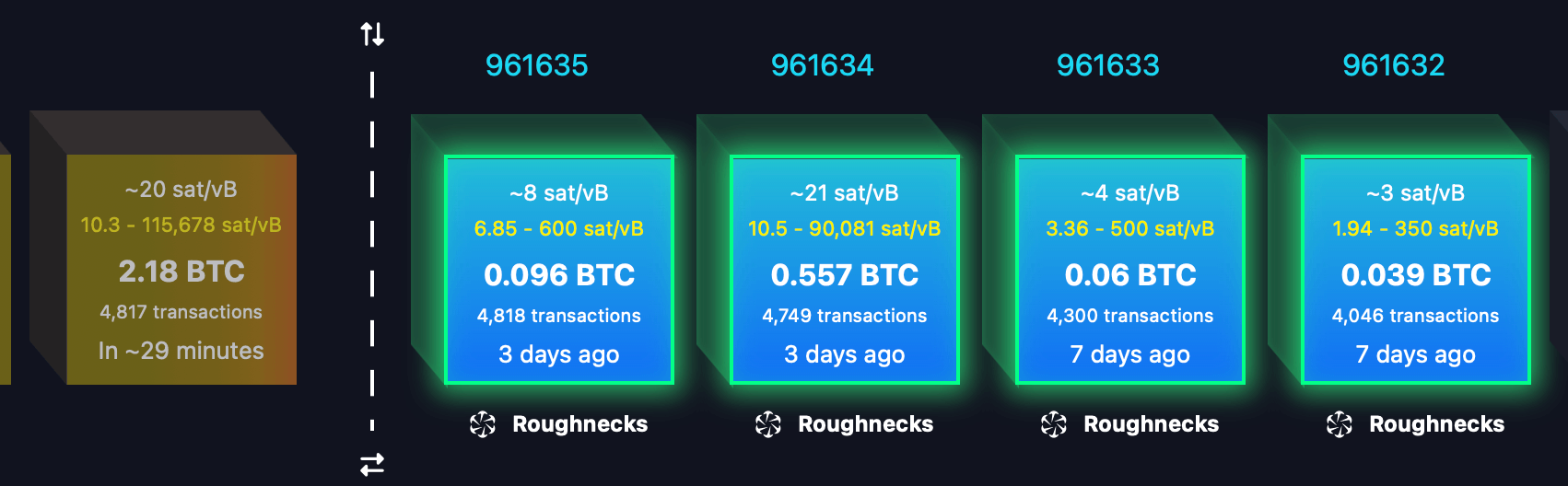
Les quatre blocs extraits par les Roughnecks.

À ce jour, les Roughnecks ont fait progresser la chaîne minoritaire jusqu'au bloc 961635, mais après que ce bloc a été miné il y a trois jours, le 12 août, le processus s'est à nouveau arrêté. Depuis, des frais stupéfiants se sont accumulés dans le bloc 961636, mais avec un soutien pratiquement nul des bourses, personne ne peut évaluer de manière fiable la valeur de l'actif créé par le fork BIP-110 ni déterminer la valeur de ces frais.

Le plan : Blake2b

Les partisans du BIP-110, dont le cofondateur d'Ocean Luke Dash Jr., affirment que la chaîne minoritaire remplacera sa fonction de hachage PoW, passant du SHA-256 au Blake2b. Selon les informations disponibles, ce choix a été fait parmi plusieurs fonctions de hachage et algorithmes PoW sélectionnés au hasard. Il est important de noter que remplacer la fonction de hachage PoW de la chaîne minoritaire ne signifie pas inventer ou déployer un tout nouveau mécanisme de consensus.

L'algorithme original Blake a été développé en 2008, et Blake2 est apparu le 21 décembre 2012 grâce à Christian Winnerlein, Jean-Philippe Omaisson, Samuel Neves et le fondateur de Zcash, Zooko Wilcox-O'Hearn. Blake2b est une variante optimisée en 64 bits de cette primitive, conçue pour offrir de meilleures performances sur les processeurs modernes. Blake2b a été conçu pour surpasser SHA-256 sur les processeurs 64 bits modernes, tout en maintenant un niveau de sécurité cryptographique équivalent ou supérieur.
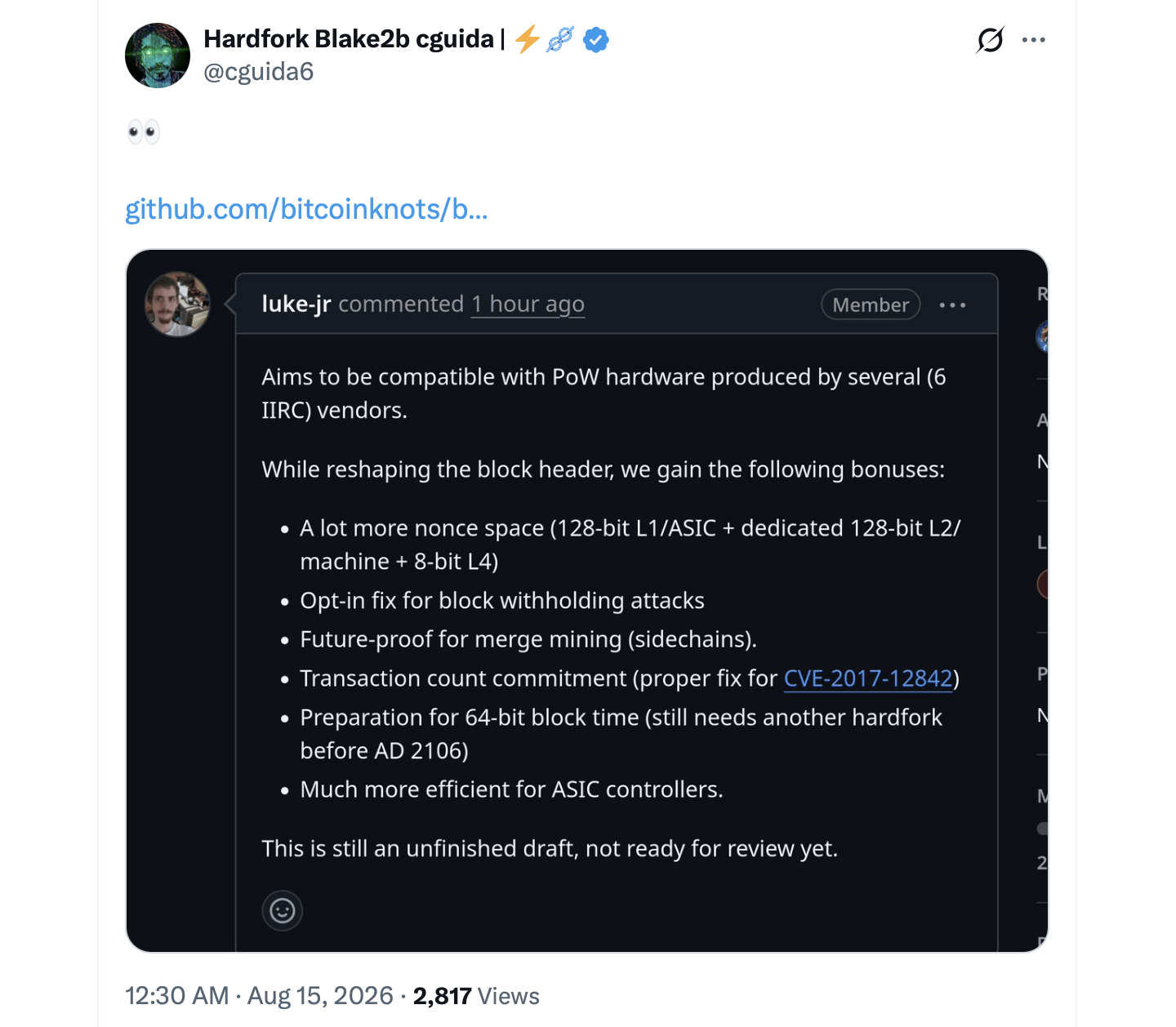
Les développeurs de Knots/BIP-110 ont élaboré une feuille de route pour modifier l'algorithme PoW de la chaîne minoritaire. Source de l'image : X.

En tant que primitive de minage basée sur le consensus de Nakamoto, Blake2b a connu une adoption relativement limitée : il est utilisé dans Siacoin et seulement quelques autres blockchains en PoW. Pour que Blake2b fonctionne, les développeurs du BIP-110 doivent réécrire le mécanisme de validation des en-têtes et implémenter une nouvelle vérification PoW dans la chaîne minoritaire. Le logiciel de minage, les serveurs Stratum et l'infrastructure des pools de minage doivent prendre en charge le format d'en-tête mis à jour et la nouvelle fonction de hachage.

Les explorateurs de blocs, les portefeuilles et les outils d'indexation nécessitent également des mises à jour pour reconnaître la chaîne modifiée et ses jetons. Les mineurs, quant à eux, auront besoin de matériel ou de logiciels capables de traiter Blake2b efficacement. C'est une entreprise d'envergure, mais ses partisans semblent déterminés à la mener à bien.

Pas d'échanges signifie pas de prix pour la nouvelle pièce

La pièce issue du fork BIP-110 n'est encore listée sur aucune bourse. Il n'y a ni demande, ni offre, ni marché liquide capable d'établir un prix fiable. Selon les règles en vigueur, les pièces minées par les Roughnecks ne peuvent pas être dépensées avant d'avoir obtenu 100 confirmations. Pour l'instant, les transferts sont principalement limités aux détenteurs qui savent comment diviser leurs pièces en toute sécurité et aux utilisateurs qui envoient involontairement des pièces BIP-110 en raison de l'absence de protection contre la relecture (replay protection) dans le fork.
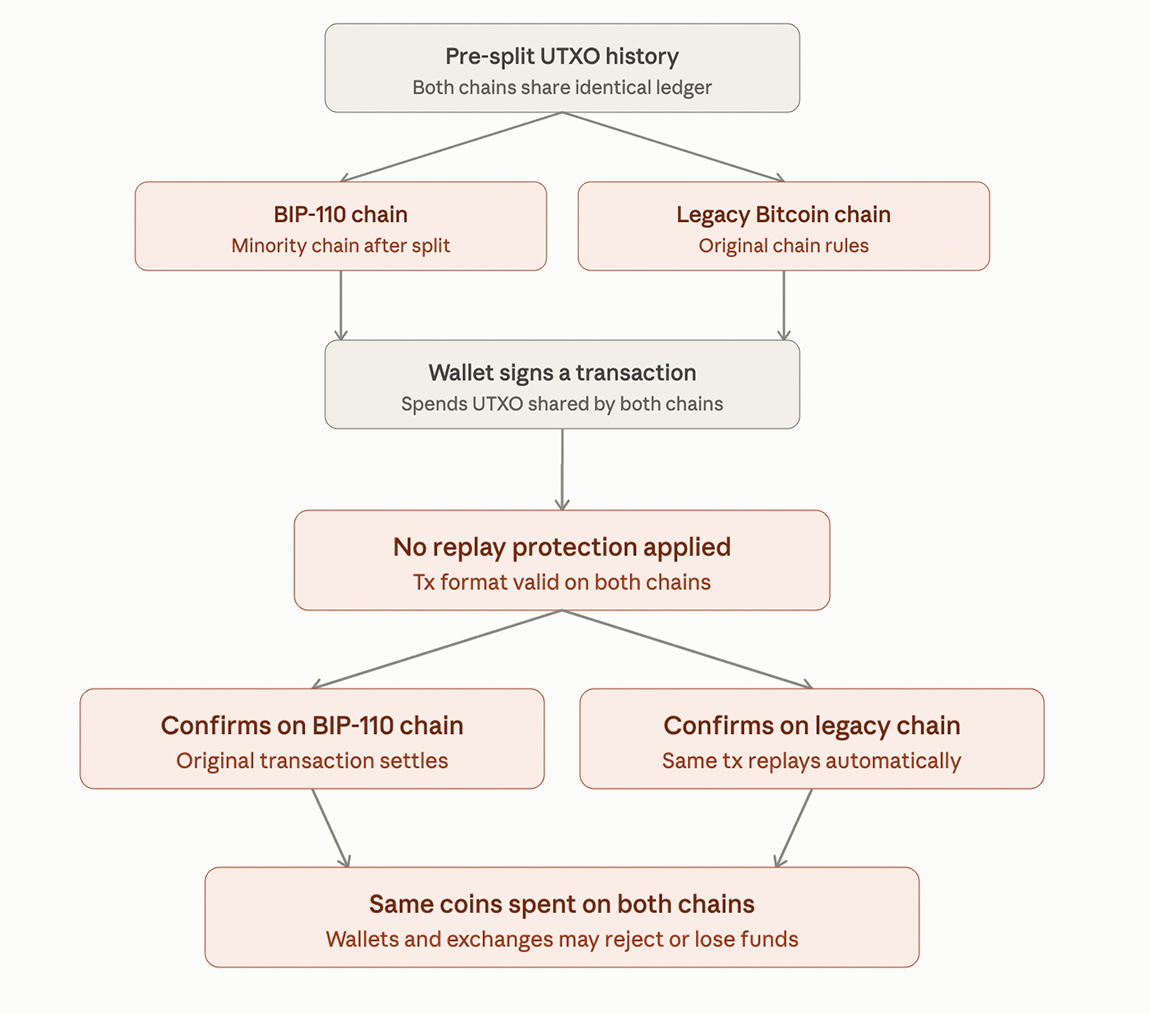
Illustration visuelle d'une attaque par relecture sur un réseau blockchain. Les attaques par relecture se produisent lorsqu'une transaction valide dans une branche peut être copiée et diffusée sur une autre chaîne. Sans protection contre la relecture, dépenser des bitcoins sur une chaîne peut involontairement entraîner le déplacement de pièces issues du fork vers une autre chaîne.

En ce week-end, plus de 400 000 transactions se sont accumulées en attente d'un bloc et de confirmations dans la chaîne minoritaire. Le fork étant bloqué après seulement quatre blocs, cet embouteillage ne sera pas résolu de sitôt. Presque sans incitation économique, les partisans de la chaîne minoritaire sont déjà confrontés à une lutte féroce et difficile. Ce fork bénéficie peut-être du soutien infrastructurel le plus faible de l'industrie depuis la fièvre des forks de 2017, où des dizaines de pièces dissidentes avaient tout de même réussi à obtenir la reconnaissance des grands portefeuilles et des bourses.

Ici, cela ne s'est pas produit du tout, et la communauté crypto est forcée d'observer la suite des événements. Le véritable test surviendra si les partisans du BIP-110 abandonnent réellement le SHA-256 au profit de Blake2b, réinitialisent la difficulté de minage excessive et ajoutent enfin une protection adéquate contre la relecture.

end-content

Trending Cryptos

Related Questions

QQuel est le principal défi auquel fait face la chaîne minoritaire BIP-110 pour sa survie ?

ALe principal défi est le manque quasi total de soutien des plateformes d'échange, ce qui empêche d'établir un prix et une liquidité pour le nouvel actif, ainsi que la difficulté extrême de minage SHA-256 sur une chaîne avec si peu de puissance de hachage.

QQuel changement technique majeur les partisans de BIP-110 prévoient-ils d'apporter à leur chaîne ?

AIls prévoient de remplacer complètement la fonction de hachage de preuve de travail (PoW) en abandonnant le SHA-256 au profit de l'algorithme Blake2b.

QQuels sont les risques liés à l'absence de protection contre la réexécution (replay protection) dans le fork BIP-110 ?

ASans protection contre la réexécution, une transaction valide sur une chaîne (comme Bitcoin principal) peut être copiée et diffusée sur l'autre chaîne (BIP-110). Cela signifie que dépenser des bitcoins sur la chaîne principale pourrait transférer par inadvertance les pièces du fork sur l'autre chaîne, et vice-versa.

QQuelle est la situation actuelle de la production de blocs sur la chaîne minoritaire BIP-110 ?

ALa production de blocs est à l'arrêt. Seuls quatre blocs ont été minés, le dernier (le bloc 961635) remontant au 12 août. Le bloc suivant (961636) accumule des transactions mais n'a pas été trouvé depuis.

QPourquoi le choix de l'algorithme Blake2b a-t-il été fait pour la nouvelle preuve de travail ?

ABlake2b a été choisi parmi plusieurs fonctions de hachage sélectionnées de manière aléatoire. Il est conçu pour offrir des performances supérieures au SHA-256 sur les processeurs 64 bits modernes tout en maintenant un niveau de sécurité cryptographique équivalent ou supérieur.

Related Reads

AI Boosting Efficiency and Cutting Costs Makes VC Increasingly Expensive

"AI for Cost Reduction Makes VC Funding More Expensive" Despite the "cost-reduction and efficiency" narrative of AI, venture capital (VC) investment in the AI sector is becoming increasingly costly. While AI tools lower the initial costs for many startups—with team sizes shrinking across funding stages—the market is polarizing. For top-tier AI teams, especially those from leading companies like Google and OpenAI, funding rounds are now larger and valuations are higher than ever at the seed and early stages. For example, new ventures by prominent researchers are securing billions in funding with valuations reaching tens of billions before having a mature product. This creates a "barbell" market: lightweight startups need less capital, while elite AI firms attract massive investments early on. This dynamic raises the cost for VCs to acquire and maintain meaningful ownership stakes. As valuations soar early, securing the same equity percentage requires significantly larger capital commitments. VCs must now invest more upfront and reserve substantial funds for follow-on rounds to avoid dilution, prompting large firms like Accel and a16z to raise massive new funds. Consequently, capital is concentrating intensely in a few perceived winners like OpenAI and Anthropic, widening the gap between large and small VC funds. While high valuations bake in future growth expectations, they also compress potential returns, demanding that portfolio companies achieve unprecedented scale. For major VCs, the core strategy is clear: secure early positions in potential winners and maintain the capital to keep investing as valuations rapidly escalate.

marsbit18m ago

AI Boosting Efficiency and Cutting Costs Makes VC Increasingly Expensive

marsbit18m ago

An Eight-Year Investment Takes a Sharp Turn: Why Did Ethereum Suddenly Abandon Poseidon?

On August 13, Ethereum researcher Justin Drake announced a significant shift in Ethereum's Layer-1 cryptographic roadmap: abandoning the SNARK-friendly hash function Poseidon in favor of traditional functions like SHA2 or BLAKE2. This decision ends eight years of research and investment, marking a major revision to the post-quantum security strategy. Poseidon, introduced in 2019, was highly efficient for zkRollups and zkVMs within SNARK circuits. However, its need for prolonged cryptanalysis and the pressing timeline for quantum resistance revealed limitations. Recent breakthroughs in SNARK design, specifically using binary fields, now enable traditional, battle-tested hash functions to perform as efficiently as Poseidon within SNARKs. Benchmarks show modern laptops can now verify over a million traditional hash calls per second. This change is partly driven by accelerated concerns over quantum computing threats. Reports warn that "Cryptographically Relevant Quantum Computers" could break current blockchain signatures like ECDSA by the early 2030s, risking trillions in assets. Ethereum's response focuses on hash-based post-quantum signature schemes, deemed more quantum-resistant than some lattice-based alternatives under pressure from AI cryptanalysis. Ethereum's updated post-quantum roadmap targets a production-ready "leanVM" for signature aggregation by 2027, with full deployment across consensus, execution, and data layers by 2028. The shift to mature hash functions like SHA2 reduces reliance on newer algorithms and aligns with the goal of using widely analyzed cryptographic primitives. Other major blockchains are also preparing. Solana's core teams have independently chosen the NIST-standardized Falcon signature scheme for its compact size. Starknet plans a phased migration, starting with replacing its Pedersen hash with BLAKE2. Ethereum's move signifies a strategic pivot towards proven security foundations for the quantum era.

marsbit1h ago

An Eight-Year Investment Takes a Sharp Turn: Why Did Ethereum Suddenly Abandon Poseidon?

marsbit1h ago

Programmers Worldwide Are Wasting Money on Anthropic! The Company Can't Stand It Anymore

Anthropic recently published guidelines to help developers using Claude Code reduce unnecessary token costs. The key recommendations include: 1) Clear (/clear) conversations after completing a task to avoid carrying irrelevant file reads and command outputs into the next task. 2) Set the model and reasoning effort level at the start of a session, as switching mid-session invalidates the prompt cache, requiring a full-price recalculation of the entire dialog history. 3) Attach files using @ references instead of typing paths manually to avoid extra tool calls and searches that bloat the context. 4) Add quiet flags to verbose commands (e.g., in CLAUDE.md) to minimize lengthy output in the dialog history. 5) Use /compact while the session cache is still warm (before breaks) to compress the dialog at one-tenth the cost. 6) Offload large-output tasks to a sub-agent, which runs in an isolated context and only returns conclusions, preventing intermediate outputs from polluting the main dialog. The article explains token pricing: input tokens (prefill) are processed in parallel, while output tokens (decode) are generated serially, making output tokens five times more expensive. Caching is crucial for savings—if a request's prefix (system prompt, CLAUDE.md, dialog history) matches the previous one byte-for-byte, reading it costs only 10% of the standard input price. However, cache invalidation occurs when changing models, effort levels, fast mode, compressing dialogs, after cache expiration, or when resuming old sessions. Dialog history also grows quadratically (O(n²)) as file contents and command outputs accumulate, increasing costs per round. Proactive context management—like isolating noisy tasks, using /rewind to trim unproductive turns, and task-based session clearing—is becoming an essential skill for cost-effective AI-assisted development.

marsbit3h ago

Programmers Worldwide Are Wasting Money on Anthropic! The Company Can't Stand It Anymore

marsbit3h ago

Pax Silica vs. WAICO: The US Wants to Prohibit Europe from Using Chinese Artificial Intelligence

The United States is preparing to demand that European and other partners abandon Chinese artificial intelligence initiatives, threatening exclusion from the American-led "Pax Silica" coalition, according to a leaked U.S. State Department document. This ultimatum forces signatories of the "AI Opportunity Statement" to choose between the Western technological ecosystem and alternative frameworks, with China not explicitly named but clearly targeted. Pax Silica is a U.S. strategy for AI and semiconductor hegemony, launched in late 2025. Its European presence expanded significantly in mid-2026. Concurrently, China, Russia, and 27 other nations established the World AI Cooperation Organization (WAICO) in July 2026 as an independent intergovernmental platform promoting AI governance based on UN principles. This situation creates a difficult choice, especially for European nations balancing strategic autonomy with dependence on U.S. tech and security. It also pressures Global South countries with pragmatic ties to both Washington and Beijing. The formation of competing blocks risks fragmenting the global tech landscape, forcing companies to split supply chains, increasing costs, and potentially leading to incompatible standards and protocols. The era of open globalization in AI may be ending, replaced by geopolitical confrontation where technological sovereignty trumps economic efficiency. The decisions made will shape the global digital economy for decades.

cryptonews.ru5h ago

Pax Silica vs. WAICO: The US Wants to Prohibit Europe from Using Chinese Artificial Intelligence

cryptonews.ru5h ago

Trading

Spot

Hot Articles

What is $BITCOIN

DIGITAL GOLD ($BITCOIN): A Comprehensive Analysis Introduction to DIGITAL GOLD ($BITCOIN) DIGITAL GOLD ($BITCOIN) is a blockchain-based project operating on the Solana network, which aims to combine the characteristics of traditional precious metals with the innovation of decentralized technologies. While it shares a name with Bitcoin, often referred to as “digital gold” due to its perception as a store of value, DIGITAL GOLD is a separate token designed to create a unique ecosystem within the Web3 landscape. Its goal is to position itself as a viable alternative digital asset, although specifics regarding its applications and functionalities are still developing. What is DIGITAL GOLD ($BITCOIN)? DIGITAL GOLD ($BITCOIN) is a cryptocurrency token explicitly designed for use on the Solana blockchain. In contrast to Bitcoin, which provides a widely recognized value storage role, this token appears to focus on broader applications and characteristics. Notable aspects include: Blockchain Infrastructure: The token is built on the Solana blockchain, known for its capacity to handle high-speed and low-cost transactions. Supply Dynamics: DIGITAL GOLD has a maximum supply capped at 100 quadrillion tokens (100P $BITCOIN), although details regarding its circulating supply are currently undisclosed. Utility: While precise functionalities are not explicitly outlined, there are indications that the token could be utilized for various applications, potentially involving decentralized applications (dApps) or asset tokenization strategies. Who is the Creator of DIGITAL GOLD ($BITCOIN)? At present, the identity of the creators and development team behind DIGITAL GOLD ($BITCOIN) remains unknown. This situation is typical among many innovative projects within the blockchain space, particularly those aligning with decentralized finance and meme coin phenomena. While such anonymity may foster a community-driven culture, it intensifies concerns about governance and accountability. Who are the Investors of DIGITAL GOLD ($BITCOIN)? The available information indicates that DIGITAL GOLD ($BITCOIN) does not have any known institutional backers or prominent venture capital investments. The project seems to operate on a peer-to-peer model focused on community support and adoption rather than traditional funding routes. Its activity and liquidity are primarily situated on decentralized exchanges (DEXs), such as PumpSwap, rather than established centralized trading platforms, further highlighting its grassroots approach. How DIGITAL GOLD ($BITCOIN) Works The operational mechanics of DIGITAL GOLD ($BITCOIN) can be elaborated on based on its blockchain design and network attributes: Consensus Mechanism: By leveraging Solana’s unique proof-of-history (PoH) combined with a proof-of-stake (PoS) model, the project ensures efficient transaction validation contributing to the network's high performance. Tokenomics: While specific deflationary mechanisms have not been extensively detailed, the vast maximum token supply implies that it may cater to microtransactions or niche use cases that are still to be defined. Interoperability: There exists the potential for integration with Solana’s broader ecosystem, including various decentralized finance (DeFi) platforms. However, the details regarding specific integrations remain unspecified. Timeline of Key Events Here is a timeline that highlights significant milestones concerning DIGITAL GOLD ($BITCOIN): 2023: The initial deployment of the token occurs on the Solana blockchain, marked by its contract address. 2024: DIGITAL GOLD gains visibility as it becomes available for trading on decentralized exchanges like PumpSwap, allowing users to trade it against SOL. 2025: The project witnesses sporadic trading activity and potential interest in community-led engagements, although no noteworthy partnerships or technical advancements have been documented as of yet. Critical Analysis Strengths Scalability: The underlying Solana infrastructure supports high transaction volumes, which could enhance the utility of $BITCOIN in various transaction scenarios. Accessibility: The potential low trading price per token could attract retail investors, facilitating wider participation due to fractional ownership opportunities. Risks Lack of Transparency: The absence of publicly known backers, developers, or an audit process may yield skepticism regarding the project's sustainability and trustworthiness. Market Volatility: The trading activity is heavily reliant on speculative behavior, which can result in significant price volatility and uncertainty for investors. Conclusion DIGITAL GOLD ($BITCOIN) emerges as an intriguing yet ambiguous project within the rapidly evolving Solana ecosystem. While it attempts to leverage the “digital gold” narrative, its departure from Bitcoin's established role as a store of value underscores the need for a clearer differentiation of its intended utility and governance structure. Future acceptance and adoption will likely depend on addressing the current opacity and defining its operational and economic strategies more explicitly. Note: This report encompasses synthesised information available as of October 2023, and developments may have transpired beyond the research period.

1.9k Total ViewsPublished 2025.05.13Updated 2025.05.13

What is $BITCOIN

Discussions

Welcome to the HTX Community. Here, you can stay informed about the latest platform developments and gain access to professional market insights. Users' opinions on the price of BTC (BTC) are presented below.

活动图片