La Banque centrale contrôlera le « misselling » lors de la vente de cryptomonnaies

cryptonews.ruPublished on 2026-08-14Last updated on 2026-08-14

Abstract

La Banque de Russie va surveiller les cas potentiels de méselling (pratiques commerciales trompeuses) lors de la vente de cryptomonnaies et d'instruments numériques, a déclaré le vice-président de la Banque centrale, Mikhail Mamuta, le 13 août. Il a souligné l'importance de contrôler la qualité de l'information fournie par les institutions financières sur les risques des cryptomonnaies, surtout pendant la phase initiale de la nouvelle régulation. L'ordre d'achat des cryptomonnaies pour le grand public prévoit un test préalable des connaissances des investisseurs et des limites de risque basées sur le montant investi. Cependant, ces mesures n'excluent pas la nécessité d'un contrôle supplémentaire des actions des organisations financières. Le régulateur prendra des mesures en cas de violations. Par ailleurs, la Banque centrale a inclus le Bitcoin, l'Ethereum et le Tether USDT dans la liste des cryptomonnaies autorisées à la négociation publique sur les bourses. Les investisseurs qualifiés pourront acheter toutes les cryptomonnaies négociées sur les marchés sans restriction. Cette annonce fait suite à la signature, le 4 août par le président Vladimir Poutine, d'une loi établissant le cadre juridique pour la circulation des cryptomonnaies en Russie.

La Banque de Russie entend surveiller les éventuels cas de « misselling » lors de la vente de cryptomonnaies et d'instruments numériques. C'est ce qu'a annoncé le 13 août le vice-président de la Banque centrale, Mikhaïl Mamouta.

« Cela va certainement être le cas, car la régulation des monnaies numériques est nouvelle et ne fait que débuter. Il est très important pour nous, surtout dans un premier temps, de contrôler la qualité avec laquelle les institutions financières informeront les gens sur les risques des cryptomonnaies, et pas seulement sur leurs opportunités, et de voir comment cela sera organisé », a-t-il expliqué dans un entretien avec TASS.

Mamouta a noté que la procédure d'achat de cryptomonnaies pour le grand public prévoit une vérification préalable des connaissances des investisseurs et des limites en fonction du niveau de risque en rapport avec le montant investi. Cependant, selon lui, ces mesures n'excluent pas la nécessité d'un contrôle supplémentaire des actions des institutions financières.

Le vice-président de la Banque centrale a souligné qu'en cas de détection de violations, le régulateur prendrait les mesures appropriées. Parallèlement, il a exprimé l'espoir que les acteurs du marché respecteraient les exigences établies.

Le service de presse de la Banque centrale a annoncé le 11 août que le régulateur avait inclus dans la liste des cryptomonnaies autorisées à la circulation publique sur les bourses le Bitcoin, l'Ethereum et le Tether USDT. Il a été souligné que les investisseurs qualifiés pourront acquérir toutes les cryptomonnaies qui seront négociées sur les marchés réglementés et de gré à gré, sans restriction.

Le président russe Vladimir Poutine a signé une loi qui établit les bases juridiques de la circulation des cryptomonnaies dans le pays. Le document, daté du 4 août, vise à réglementer les opérations avec les monnaies numériques et définit les modalités de leur utilisation dans le cadre de la législation russe. La loi régit les relations dans l'organisation de la circulation, de la comptabilisation et du stockage des monnaies numériques et des instruments numériques étrangers, du minage, de l'émission et de la circulation des droits numériques.

Trending Cryptos

Related Questions

QQuelle institution financière surveillera les pratiques de méselling lors de la vente de crypto-monnaies en Russie?

ALa Banque centrale de Russie (Banque de Russie ou ЦБ).

QQui a annoncé cette intention de surveillance et quand l'a-t-il fait?

ALe vice-président de la Banque centrale, Mikhail Mamouta, l'a annoncé le 13 août.

QQuelle est la raison principale évoquée pour justifier ce contrôle renforcé sur les informations données aux clients?

AComme la régulation des monnaies numériques est nouvelle et vient juste d'être introduite, il est très important, surtout dans un premier temps, de contrôler la qualité avec laquelle les institutions financières informent les gens sur les risques des crypto-monnaies, et pas seulement sur leurs opportunités.

QQuelles sont les trois crypto-monnaies que la Banque centrale a incluses dans la liste des actifs disponibles pour la négociation publique sur les bourses?

ABitcoin, Ethereum et Tether USDT.

QQui, en Russie, pourra acheter toutes les crypto-monnaies négociées sur les marchés boursiers et de gré à gré sans restriction?

ALes investisseurs qualifiés.

Related Reads

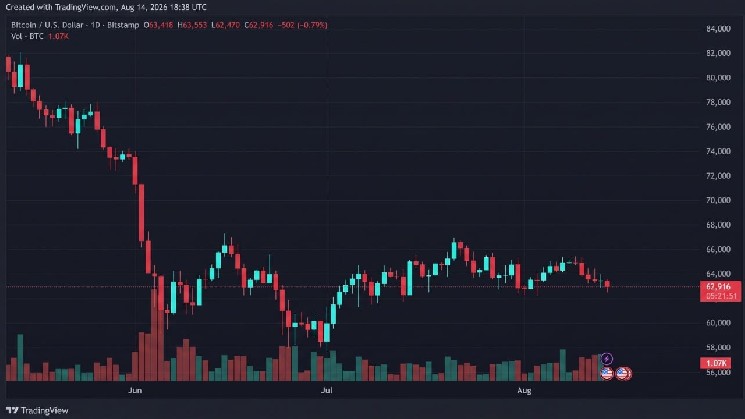
Bitcoin Price Drops to $62,470 as Sellers Retest $63,000 Support Level

Bitcoin's price fell below $63,000 for a second consecutive day on Friday, hitting an intraday low of $62,470. The cryptocurrency later recovered to trade just above $63,000, leaving it nearly flat for the past 24 hours and for August overall, with a weekly loss of 2.6%. The volatility triggered significant liquidations, with $26 million of leveraged long Bitcoin positions liquidated over 24 hours. Market sentiment was further dampened by data showing over $131 million in outflows from spot Bitcoin ETFs for a second straight day, signaling a potential pullback by institutional investors. Adding to the negative pressure, index provider MSCI has proposed new criteria for "non-operating companies" in its global indexes, which could lead to the exclusion of firms holding significant digital assets like Bitcoin on their balance sheets. Companies such as Strategy and Metaplanet could be affected, potentially forcing index-tracking funds to sell their shares. Strategy publicly criticized the proposal, arguing digital assets are legitimate assets and index providers should not dictate what companies can own. Public consultations on MSCI's proposal end September 30, with a final decision expected by October 16. If approved, exclusions could begin in November, potentially triggering sustained institutional selling and damaging a key bridge for Bitcoin adoption in the corporate sector.

cryptonews.ru31m ago

Bitcoin Price Drops to $62,470 as Sellers Retest $63,000 Support Level

cryptonews.ru31m ago

Trading

Spot

Hot Articles

What is $BANK

Bank AI: A Revolutionary Step in the Future of Banking Introduction In an era marked by rapid advancements in technology, Bank AI stands at the intersection of artificial intelligence (AI) and banking services. This innovative project seeks to redefine the financial landscape, enhancing operational efficiency, security measures, and customer experiences through the power of AI. As we embark on this exploration of Bank AI, we will delve into what the project entails, its operational dynamics, its historical context, and significant milestones. What is Bank AI? At its core, Bank AI represents a transformative initiative aimed at integrating artificial intelligence into various banking operations. This project harnesses the capabilities of AI to automate processes, improve risk management protocols, and enhance customer interaction through personalised services. The primary objectives of Bank AI include: Automation of Banking Functions: By leveraging AI technologies, Bank AI aims to automate routine tasks, reducing the burden on human resources and enhancing efficiency. Enhanced Risk Management: The project utilises AI algorithms to predict and identify risks, thereby fortifying security measures against fraud and other threats. Personalisation of Banking Services: Bank AI focuses on offering tailored financial products and services by analysing customer data and behaviours. Improving Customer Experience: The implementation of AI-driven solutions, such as chatbots and virtual assistants, aims to provide users with more human-like interactions, revolutionising the way customers engage with banks. With these goals, Bank AI positions itself as a crucial player in rendering banking more efficient, secure, and user-centric. Who is the Creator of Bank AI? Details regarding the creator of Bank AI remain unknown. As such, no specific individual or organisation has been identified in the available information. The anonymity surrounding the project's inception raises questions but does not detract from its ambitious vision and objectives. Who are the Investors of Bank AI? Similar to the project's creator, specific information regarding the investors or supporting organisations of Bank AI has not been disclosed. Without this information, it is challenging to outline the financial backing and institutional support that might be propelling the project forward. Nevertheless, the importance of having a robust investment foundation is pivotal for sustaining development in such an innovative field. How Does Bank AI Work? Bank AI operates on several innovative fronts, focusing on unique factors that differentiate it from traditional banking frameworks. Below are key operational features: Automation: By applying machine learning algorithms, Bank AI automates various manual processes within banks. This results in reduced operational costs and allows human workers to redirect their efforts towards more strategic activities. Advanced Risk Management: The integration of AI into risk management practices equips banks with tools to accurately predict potential threats such as fraud, ensuring that customer information and assets remain secure. Tailored Financial Recommendations: Through continuous learning from customer interactions, the AI systems develop a nuanced understanding of user needs, enabling them to offer tailored advice on financial decisions. Enhanced Customer Interactions: Utilizing chatbots and virtual assistants powered by AI, Bank AI enables a more engaging customer experience, allowing users to have their queries resolved quickly, thus reducing wait times and improving satisfaction levels. Together, these operational features position Bank AI as a pioneer in the banking sector, establishing new benchmarks for service delivery and operational excellence. Timeline of Bank AI Understanding the trajectory of Bank AI requires a look at its historical context. Below is a timeline highlighting important milestones and developments: Early 2010s: The conceptualisation of AI integration into banking services began to gain attention as banking institutions recognised the potential benefits. 2018: A marked increase in the implementation of AI technologies occurred when banks started using AI tools like chatbots for basic customer service and risk management systems for improved security handling. 2023: The sophistication of AI continued to advance, with generative AI being introduced for more complex tasks such as document processing and real-time investment analysis. This year marked a significant leap in the capabilities afforded to banks by AI technology. 2024-Current Status: As of this year, Bank AI is on an upward trajectory, with ongoing research and developments poised to further enhance capabilities in banking operations. Continued exploration of AI applications hints at exciting developments yet to come. Key Points About Bank AI Integration of AI in Banking: Bank AI focuses on adopting artificial intelligence to streamline banking processes and improve user experiences. Automation and Risk Management Focus: The project strongly emphasises these areas, aiming to shift the burden of routine tasks while enhancing security frameworks through predictive analytics. Personalised Banking Solutions: By harnessing customer data, Bank AI enables tailored banking services that cater to individual user needs. Commitment to Development: Bank AI remains committed to ongoing research and development efforts, ensuring its adaptability and ongoing relevance as technology continues to evolve. Conclusion In summary, Bank AI exemplifies a crucial step forward in the banking industry, leveraging artificial intelligence to reshape operational paradigms, enhance security, and promote customer satisfaction. Despite gaps in information surrounding the creator and investors, the clear objectives and functional mechanisms of Bank AI provide a strong foundation for its ongoing evolution. As AI technology continues to advance and merge with the banking sector, Bank AI is well-positioned to significantly impact the future of financial services, enhancing the way we understand and interact with banking.

362 Total ViewsPublished 2024.04.06Updated 2024.12.03

What is $BANK

Discussions

Welcome to the HTX Community. Here, you can stay informed about the latest platform developments and gain access to professional market insights. Users' opinions on the price of BANK (BANK) are presented below.

活动图片