PYUSD en la mano izquierda, Open USD en la derecha: la 'cobertura' de PayPal frente a los riesgos de las stablecoins

Odaily星球日报Published on 2026-08-13Last updated on 2026-08-13

Abstract

PayPal ha publicado resultados del segundo trimestre con ingresos de 8.680 millones de dólares, superando expectativas. Su stablecoin PYUSD, integrada en los servicios de pago de la empresa, se presenta como un facilitador clave para PayPal World, con un enfoque en el comercio y un despliegue en múltiples cadenas de bloques. Sin embargo, tras alcanzar un máximo de 4.200 millones de dólares en marzo, su oferta circulante se ha reducido en un 31% a unos 2.700 millones, lo que señala desafíos para mantener el crecimiento sin incentivos. La aparición de Open USD, una nueva stablecoin respaldada por un consorcio que incluye a gigantes como Visa y Stripe, plantea un modelo de competencia basado en gobernanza compartida. PayPal figura como uno de los más de 140 socios de Open USD, manteniendo simultáneamente su apuesta por PYUSD. Esta estrategia dual refleja la incertidumbre del mercado y la voluntad de cubrir diferentes escenarios. Para PYUSD, el reto crítico será transformar su infraestructura existente en una adopción orgánica y sostenible, sin depender de subsidios.

Original | Odaily 星球日报(@OdailyChina)

Autor|jk
Recientemente, el gigante de pagos PayPal publicó sus resultados financieros del segundo trimestre: ingresos de 8.68 mil millones de dólares, superando las expectativas del mercado, y un volumen total de pagos de 486.4 mil millones de dólares, con un aumento interanual del 10%.

Además, PayPal ha posicionado a PYUSD (PayPal USD) como el "principal facilitador/factor clave" (major enabler) de su plataforma PayPal World, enfatizando su papel central como una stablecoin "commerce-first" (orientada al comercio) dirigida a escenarios principales de consumidores y comerciantes.

En el competitivo mercado de las stablecoins, PYUSD siempre ha tenido un desempeño moderado. ¿Cuáles son sus perspectivas de desarrollo futuro? ¿Y puede PayPal realmente soportar este coste?

Resultados del segundo trimestre: ¿Dónde se sitúa PYUSD?

Los ingresos de PayPal este trimestre fueron de 8.68 mil millones de dólares, con un crecimiento interanual de aproximadamente el 5%, superando las expectativas de los analistas de 8.47 mil millones de dólares frente a los 8.68 mil millones reportados; el beneficio por acción ajustado fue de 1.38 dólares, también mejor que el 1.28 dólares esperado por el mercado, mientras que el beneficio por acción GAAP fue de 1.26 dólares, ligeramente por debajo de las expectativas. El volumen total de pagos alcanzó los 486.4 mil millones de dólares, con un crecimiento interanual del 10%, un 9% en términos neutrales a la moneda, y la guía de beneficio por acción ajustado para el año completo se revisó al alza hasta aproximadamente 5.38 dólares.

Observando solo estos indicadores clave, se trata de un informe de resultados ligeramente superior a lo esperado.
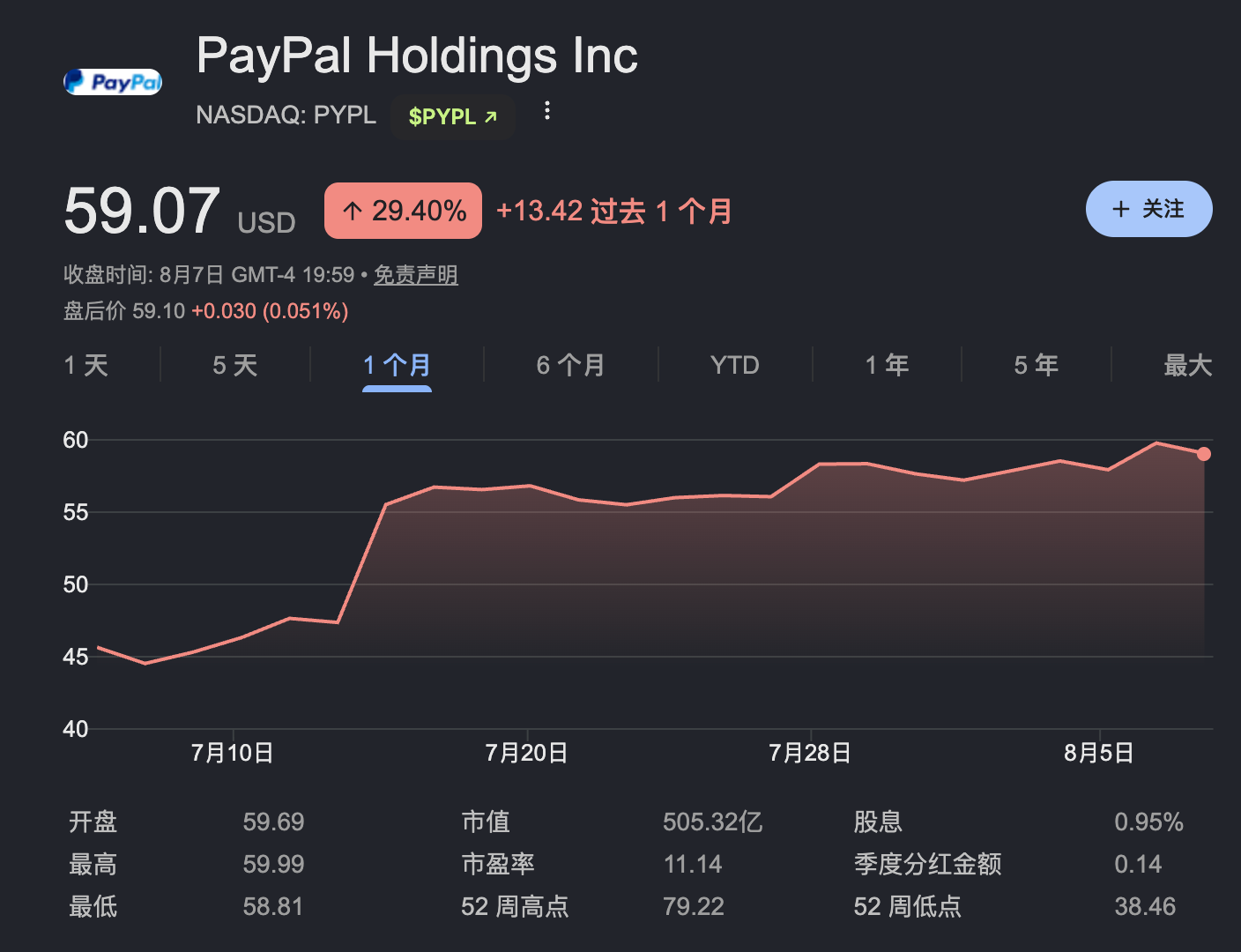
El precio de la acción ha estado creciendo durante el último mes. Fuente: Google

Pero la otra cara de la rentabilidad cuenta una historia diferente. El margen de beneficio GAAP cayó del 18.1% del mismo período del año anterior al 16.4%. En el informe, la empresa atribuyó una pérdida neta de 81 millones de dólares a inversiones estratégicas y activos criptográficos mantenidos con fines de inversión, excluyéndolos de los resultados no GAAP. En otras palabras, los activos criptográficos ya están ejerciendo cierta presión sobre los beneficios contables de PayPal. Pero aún es difícil concluir si esta pérdida es solo una pérdida flotante temporal debido a la caída del mercado, o si la empresa está asumiendo costes activamente para impulsar la expansión de negocios relacionados.

Al mismo tiempo, PayPal estableció este trimestre un nuevo departamento de "Servicios de Pago y Cripto" (Payment Services & Crypto), integrando PYUSD y los servicios de procesamiento para comerciantes en la misma línea. El CEO Enrique Lores declaró en la conferencia de resultados que la compañía planea lanzar más productos para comerciantes impulsados por pagos agentes (agentic payments) con PYUSD e IA. PYUSD ya se ha incorporado al núcleo del sistema de pagos para comerciantes de PayPal, dejando de ser un proyecto de innovación relativamente independiente. En comparación con las declaraciones verbales de la gerencia sobre su "valor estratégico", este reajuste organizativo refleja mejor el posicionamiento real de PayPal respecto a PYUSD.

Sin embargo, la empresa aún no ha revelado por separado la contribución específica de PYUSD a los ingresos, la retención de comerciantes o el margen de beneficio de las transacciones. Los inversores solo pueden inferir en qué medida esta stablecoin impulsa realmente los resultados a partir de los datos agregados y las declaraciones de la gerencia, siendo esta la brecha de información más importante para rastrear en los próximos trimestres.

El significado estratégico de PYUSD para PayPal: La narrativa de expansión y la oferta en contracción

Desde su emisión en agosto de 2023, PYUSD ha experimentado una fase de expansión y contracción con los ciclos alcistas y bajistas del mercado.

En marzo de este año, la empresa amplió su cobertura a 70 mercados, y su oferta alcanzó un máximo de unos 4.2 mil millones de dólares, con una tasa de crecimiento interanual que en un momento llegó a ser cercana al 680%, siendo la de más rápido crecimiento entre las stablecoins principales. Hasta la fecha, PYUSD se ha desplegado en nueve blockchains públicas, incluyendo Ethereum, Solana, Arbitrum, Stellar, Avalanche, Aptos, Sei, Tron y Abstract. En febrero de este año, PayPal también estableció a Solana como su red de procesamiento de pagos predeterminada.

El 9 de julio, PYUSD se lanzó de forma nativa a través de Open Money Stack de Polygon, integrando carteras, canales de entrada de dinero fiduciario, herramientas de cumplimiento normativo y capacidades de liquidación en cadena, apuntando explícitamente a escenarios empresariales de pagos transfronterizos. El marco PYUSDx, lanzado por PayPal en colaboración con MoonPay, permite a los desarrolladores emitir stablecoins específicas de aplicaciones basadas en las reservas de PYUSD, intentando convertir a PYUSD en una capa de infraestructura sobre la que otros puedan construir, y no solo en un producto de consumo final. Kraken también anunció recientemente que admitiría depósitos y retiros de PYUSD en la red Stellar, ampliando aún más su aplicación en el lado de los intercambios.

Estas acciones, juntas, delinean la historia que PayPal quiere contar: PYUSD está evolucionando de una herramienta de saldo para usuarios de PayPal a una capa de infraestructura de pagos que carteras de terceros, intercambios y desarrolladores pueden utilizar directamente.

Es decir, en el futuro, cuando las empresas planeen realizar cobros globales, podrán utilizar directamente o desarrollar sus propias herramientas basadas en PYUSD para recibir pagos de todo el mundo, sin necesidad de pasar por los prolongados trámites aduaneros y cambiarios como con el dinero fiduciario, ni limitarse a usuarios relacionados con las criptomonedas como con otras stablecoins. Este es un escenario soñado por todos los involucrados en el comercio exterior: todos los fondos se reciben en tiempo real, los costes son más bajos en comparación con antes, y los usuarios que pagan apenas se dan cuenta. El dinero fiduciario entregado por el pagador se convierte en PYUSD en segundo plano, y luego se convierte nuevamente en otra moneda fiduciaria para el receptor, todo el proceso es rápido y conveniente.

Y esta es también la razón por la que PayPal lo menciona junto con la IA en su informe de resultados. La empresa afirma que está utilizando aprendizaje automático para optimizar la detección de fraudes, reducir los costes de procesamiento y admitir la conversión automática entre monedas fiduciarias y stablecoins basada en tipos de cambio y comportamiento del usuario.

Pero los datos on-chain no son tan alentadores: después de alcanzar un pico de unos 4.2 mil millones de dólares en marzo, la oferta de PYUSD cayó aproximadamente un 31% a finales del segundo trimestre, situándose en torno a los 2.7 mil millones de dólares. Esta es la primera vez desde su emisión que se produce una caída significativa, principalmente debido a la reducción de incentivos y a la rotación de fondos hacia otros activos. Hasta principios de agosto, la oferta circulante de PYUSD es de aproximadamente 2.7 mil millones de tokens, con una capitalización de mercado de unos 2.72 mil millones de dólares, ocupando alrededor del puesto 32 en el ranking de stablecoins de CoinGecko.
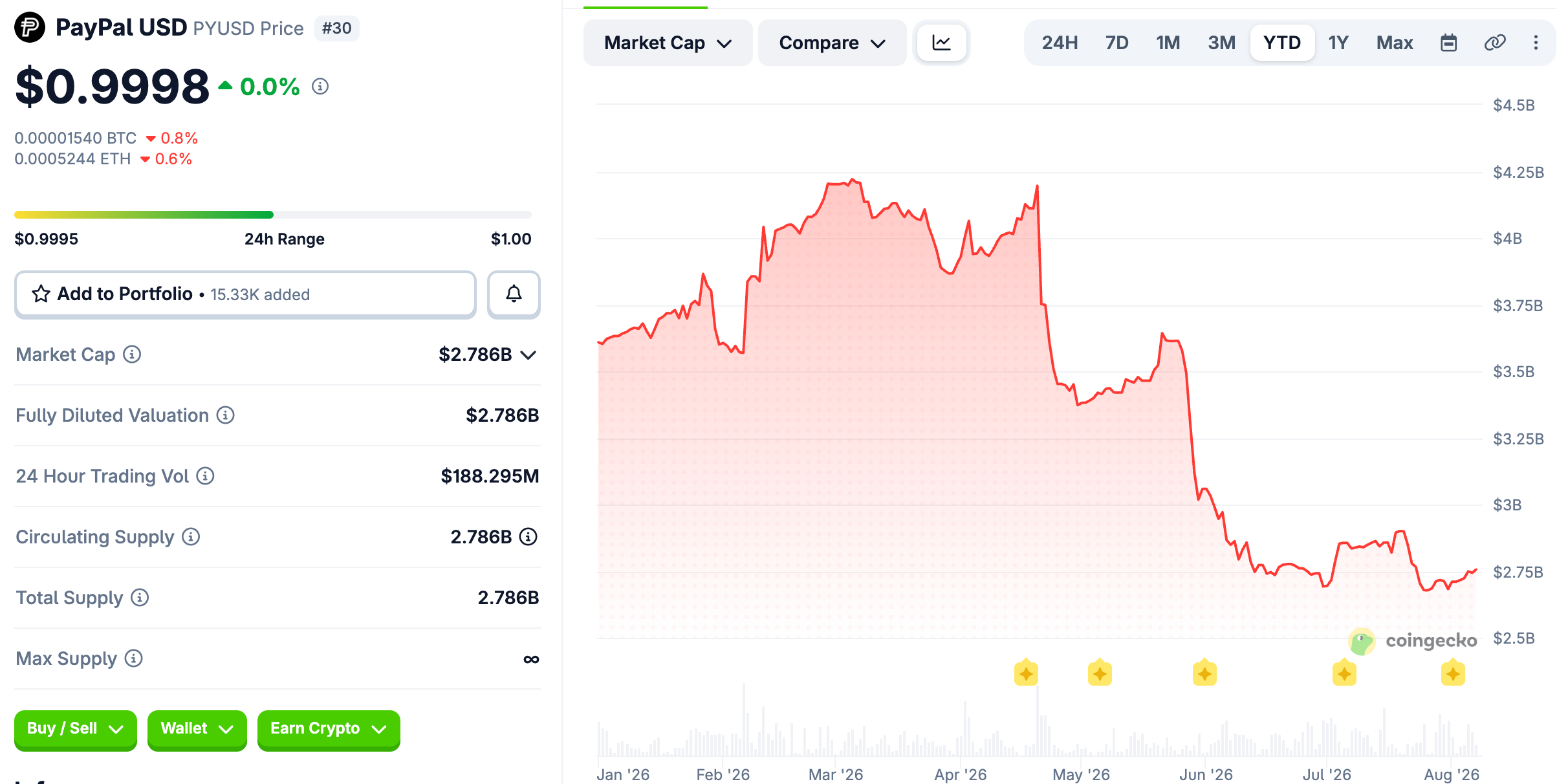
La escala de PYUSD está disminuyendo. Fuente: Coingecko

Esto significa que, mientras la narrativa del informe de resultados enfatiza la amplitud de la cobertura y la integración en cadena, la escala de circulación real se contrajo casi un tercio en el mismo período. La narrativa de expansión y la oferta en contracción coexisten, reflejando una realidad muy cruda: la singularidad en términos de cuota de mercado y posición regulatoria (PYUSD es la primera stablecoin del dólar emitida por una entidad regulada a nivel federal, Paxos, una identidad que se consolidó aún más a finales de 2025 cuando Paxos se convirtió en una entidad regulada por la OCC) no se traduce necesariamente en una demanda sostenida de tenencia de tokens. Cuando se retiraron los incentivos, la cantidad inicial no se convirtió en un volumen de uso estable, y la competencia con USDC aún tiene un largo camino por recorrer. Si los subsidios, al igual que las estrategias de la industria cripto en años anteriores, no son efectivos, entonces el pastel actual de PYUSD tampoco podrá seguir creciendo.

PYUSD frente a Open USD: ¿Por qué PYUSD es anterior pero tiene menos influencia?

Si PYUSD representa una stablecoin del modelo de emisor único, entonces Open USD, que apareció el 30 de junio, representa un camino estructuralmente diferente, y este momento coincidió con menos de un mes antes de la publicación de los resultados del segundo trimestre de PayPal.

Open USD está operado por una nueva empresa independiente llamada Open Standard, cuyo CEO fundador es Zach Abrams, cofundador de Bridge, propiedad de Stripe. Cuenta con más de 140 socios signatarios, cubriendo prácticamente toda la lista de principales actores de la industria de pagos y finanzas: en redes de pago están Visa y Mastercard; en infraestructura de pagos, Stripe y Shopify; en gestión de activos y banca, BlackRock, BNY y Standard Chartered; en plataformas tecnológicas, Google e IBM; y en el ámbito criptonativo, Coinbase, Solana y Aave. Se espera que el proyecto se lance en la segunda mitad de 2026 y aún no se ha emitido oficialmente.

La diferencia más fundamental entre Open USD y PYUSD radica en su estructura económica y modelo de gobernanza: En términos simples, solo PayPal se beneficia directamente de PYUSD, mientras que en Open USD se benefician todos.

PYUSD es emitido por Paxos como único emisor, que custodia los activos de reserva y obtiene rendimientos variables, mientras que PayPal, como propietario de la marca, dirige la hoja de ruta del producto y la estrategia de mercado. Este es el modelo clásico que aún utilizan USDT y USDC. Open USD, por el contrario, ofrece la acuñación y el reembolso de forma completamente gratuita y sin límites a los socios. Los ingresos generados por los activos de reserva, después de deducir pequeñas tarifas de gestión, se devuelven a las instituciones socias que participan en la distribución, en lugar de ser disfrutados exclusivamente por un único emisor; el poder de gobernanza también se delega a un consejo de administración compuesto por instituciones socias, en lugar de estar en manos de una sola empresa. Según comentarios de la industria, esto se acerca más a la lógica de gobernanza de redes de liquidación interbancaria como ACH o SWIFT, que a la lógica de gobernanza actual de USDC o USDT.

Un detalle que se pasa por alto fácilmente pero que es clave para entender la situación de PayPal es que el propio PayPal es uno de los más de 140 signatarios de Open USD, aunque PYUSD seguirá existiendo como un activo emitido de forma independiente. Esto significa que PayPal no se ha vinculado completamente a la barca de PYUSD, sino que ocupa simultáneamente una posición en ambos tipos de stablecoins, por un lado continuando apostando por PYUSD como activo de marca propia, y por el otro reservándose una posición en el posible panorama de la industria mediante su firma con Open USD.

En contraste, Circle y Tether no aparecen en la lista de socios de Open USD. El precio de las acciones de Circle cayó más del 16% el día del anuncio. El CEO de Circle, Jeremy Allaire, respondió posteriormente públicamente, enfatizando el efecto de red y la profundidad de distribución de USDC, y citó la stablecoin USDG de Paxos, que también sigue un modelo de consorcio, como precedente, señalando que más de dos años después de su lanzamiento, su oferta solo alcanzaba unos 3 mil millones de dólares, muy por debajo de las expectativas optimistas iniciales.

Viendo estos tres elementos juntos, el panorama competitivo al que se enfrenta PayPal se está volviendo más complejo. PYUSD, con su ventaja de ser el primero, ya ha establecido un cierto grado de reconocimiento de marca y una base de despliegue multiblockchain, pero su volumen absoluto sigue siendo aproximadamente una vigésima parte del de USDC, y recientemente ha mostrado signos de contracción en la oferta. Si Open USD se implementa con éxito, su verdadera amenaza no radica en arrebatar a los actuales poseedores de PYUSD, sino en que intenta redefinir la economía de distribución de toda la industria. Si incluso distribuidores del calibre de Stripe, Visa y Mastercard pueden compartir los ingresos de las reservas a través de un modelo de consorcio, el modelo de stablecoin de emisor único podría ser completamente reemplazado.

La elección de PayPal de apostar por ambos lados es, en cierta medida, un reconocimiento de esta incertidumbre. En lugar de apostar por que un solo modelo prevalezca, prefiere mantener una posición en ambos. Para PYUSD, lo que realmente necesita demostrar en los próximos trimestres no es cuántos mercados o blockchains cubre, sino si, una vez desaparecidos los incentivos, puede convertir la red de distribución ya establecida en una demanda sostenida que no dependa de subsidios. Si finalmente no logra seguir ese camino, entonces 2.7 mil millones podría ser el pico actual de PYUSD.


Trending Cryptos

Related Questions

Q¿Cómo ha afectado PYUSD a los resultados financieros de PayPal en el segundo trimestre, según el artículo?

AEl artículo menciona que en el segundo trimestre, PayPal registró una pérdida neta de 81 millones de dólares atribuida a 'inversiones estratégicas y activos criptográficos mantenidos con fines de inversión', lo que ejerció presión sobre su margen de beneficio GAAP, que cayó del 18.1% al 16.4% en comparación interanual.

Q¿Qué cambios organizativos realizó PayPal respecto a PYUSD y qué objetivo persiguen?

APayPal creó una nueva división llamada 'Payment Services & Crypto', que integra PYUSD con los servicios de procesamiento para comerciantes. Este cambio refleja la intención de la empresa de incorporar PYUSD de manera central en su sistema principal de pagos para comerciantes, respaldando nuevos productos impulsados por PYUSD y pagos con agentes de IA, en lugar de mantenerlo como un proyecto innovador aislado.

QSegún el artículo, ¿cuál es la narrativa estratégica que PayPal está construyendo para PYUSD y cómo contrasta con los datos reales de adopción?

ALa narrativa estratégica de PayPal presenta a PYUSD evolucionando de una herramienta de saldo para usuarios a una infraestructura de pago de base que pueden utilizar directamente carteras, intercambios y desarrolladores externos, especialmente para pagos transfronterizos empresariales. Sin embargo, esta narrativa de expansión contrasta con una contracción real del suministro en circulación, que cayó aproximadamente un 31% desde su máximo en marzo, situándose en torno a los 2.7 mil millones de dólares a finales del segundo trimestre, lo que indica una adopción aún inestable sin incentivos.

Q¿En qué se diferencian fundamentalmente los modelos económicos y de gobernanza de PYUSD y Open USD, según se describe en el texto?

APYUSD sigue el modelo clásico de emisor único, donde Paxos (el emisor) custodia los activos de reserva y se beneficia de los ingresos por intereses, y PayPal dirige la estrategia. En cambio, Open USD adopta un modelo de consorcio: la creación y el reembolso son gratuitos para los socios, los ingresos generados por las reservas (tras una pequeña tarifa de gestión) se distribuyen entre las instituciones socias que participan en la distribución, y la gobernanza recae en una junta directiva compuesta por dichos socios, no en una sola entidad.

Q¿Qué posición ocupa PayPal en el ecosistema de Open USD y qué implica esta estrategia para el futuro de PYUSD?

APayPal es una de las más de 140 entidades socias firmantes de Open USD, a pesar de seguir desarrollando PYUSD de forma independiente. Esta estrategia de 'participación en ambos bandos' implica que PayPal no apuesta exclusivamente por el éxito de su propio stablecoin, sino que también se reserva un lugar en un posible nuevo estándar de consorcio liderado por la industria. Reconocen la incertidumbre sobre qué modelo podría prevalecer a largo plazo.

Related Reads

Michael Saylor Compares Bitcoin and Gold!

Michael Saylor, founder of MicroStrategy, argues that Bitcoin fundamentally changes how wealth is stored and transferred by transforming digital scarcity into economic value. He describes Bitcoin as the first digital monetary network, combining computers, digital networks, and cryptography. It digitizes monetary assets, allowing their supply to be controlled by public protocols rather than institutions, thus converting economic value into information transmissible over global networks. Comparing Bitcoin to gold, Saylor states that while increasing Bitcoin's supply is harder, its integration with software and transfer is easier. He highlights Bitcoin's proof-of-work mechanism, which ties it to the physical world by consuming real energy to secure the ledger, making past transactions immutable. This creates a shared security system involving miners, energy companies, and investors. Saylor suggests "digital monetary energy" is a more accurate term than "digital gold." He emphasizes that the Bitcoin network is an adaptive ecosystem of miners, nodes, developers, and users. Its core design is intentionally simple, focused on maintaining a secure ledger for scarce digital assets, with complex functionalities built in higher-layer applications. This architecture allows Bitcoin to serve as a foundation for transmitting value and fostering innovation in payments and financial services. Saylor notes Bitcoin's deeper impact lies in creating digital sovereignty, where private keys give individuals permissionless control over their economic power, with ownership verified mathematically, not by institutions. He concludes that while gold's physical scarcity makes it money, Bitcoin's digital scarcity does the same, characterizing Bitcoin as the monetary energy of the digital age.

cryptonews.ru1h ago

Michael Saylor Compares Bitcoin and Gold!

cryptonews.ru1h ago

Trading

Spot

Hot Articles

What is SONIC

Sonic: Pioneering the Future of Gaming in Web3 Introduction to Sonic In the ever-evolving landscape of Web3, the gaming industry stands out as one of the most dynamic and promising sectors. At the forefront of this revolution is Sonic, a project designed to amplify the gaming ecosystem on the Solana blockchain. Leveraging cutting-edge technology, Sonic aims to deliver an unparalleled gaming experience by efficiently processing millions of requests per second, ensuring that players enjoy seamless gameplay while maintaining low transaction costs. This article delves into the intricate details of Sonic, exploring its creators, funding sources, operational mechanics, and the timeline of significant events that have shaped its journey. What is Sonic? Sonic is an innovative layer-2 network that operates atop the Solana blockchain, specifically tailored to enhance the existing Solana gaming ecosystem. It accomplishes this through a customised, VM-agnostic game engine paired with a HyperGrid interpreter, facilitating sovereign game economies that roll up back to the Solana platform. The primary goals of Sonic include: Enhanced Gaming Experiences: Sonic is committed to offering lightning-fast on-chain gameplay, allowing players and developers to engage with games at previously unattainable speeds. Atomic Interoperability: This feature enables transactions to be executed within Sonic without the need to redeploy Solana programmes and accounts. This makes the process more efficient and directly benefits from Solana Layer1 services and liquidity. Seamless Deployment: Sonic allows developers to write for Ethereum Virtual Machine (EVM) based systems and execute them on Solana’s SVM infrastructure. This interoperability is crucial for attracting a broader range of dApps and decentralised applications to the platform. Support for Developers: By offering native composable gaming primitives and extensible data types - dining within the Entity-Component-System (ECS) framework - game creators can craft intricate business logic with ease. Overall, Sonic's unique approach not only caters to players but also provides an accessible and low-cost environment for developers to innovate and thrive. Creator of Sonic The information regarding the creator of Sonic is somewhat ambiguous. However, it is known that Sonic's SVM is owned by the company Mirror World. The absence of detailed information about the individuals behind Sonic reflects a common trend in several Web3 projects, where collective efforts and partnerships often overshadow individual contributions. Investors of Sonic Sonic has garnered considerable attention and support from various investors within the crypto and gaming sectors. Notably, the project raised an impressive $12 million during its Series A funding round. The round was led by BITKRAFT Ventures, with other notable investors including Galaxy, Okx Ventures, Interactive, Big Brain Holdings, and Mirana. This financial backing signifies the confidence that investment foundations have in Sonic’s potential to revolutionise the Web3 gaming landscape, further validating its innovative approaches and technologies. How Does Sonic Work? Sonic utilises the HyperGrid framework, a sophisticated parallel processing mechanism that enhances its scalability and customisability. Here are the core features that set Sonic apart: Lightning Speed at Low Costs: Sonic offers one of the fastest on-chain gaming experiences compared to other Layer-1 solutions, powered by the scalability of Solana’s virtual machine (SVM). Atomic Interoperability: Sonic enables transaction execution without redeployment of Solana programmes and accounts, effectively streamlining the interaction between users and the blockchain. EVM Compatibility: Developers can effortlessly migrate decentralised applications from EVM chains to the Solana environment using Sonic’s HyperGrid interpreter, increasing the accessibility and integration of various dApps. Ecosystem Support for Developers: By exposing native composable gaming primitives, Sonic facilitates a sandbox-like environment where developers can experiment and implement business logic, greatly enhancing the overall development experience. Monetisation Infrastructure: Sonic natively supports growth and monetisation efforts, providing frameworks for traffic generation, payments, and settlements, thereby ensuring that gaming projects are not only viable but also sustainable financially. Timeline of Sonic The evolution of Sonic has been marked by several key milestones. Below is a brief timeline highlighting critical events in the project's history: 2022: The Sonic cryptocurrency was officially launched, marking the beginning of its journey in the Web3 gaming arena. 2024: June: Sonic SVM successfully raised $12 million in a Series A funding round. This investment allowed Sonic to further develop its platform and expand its offerings. August: The launch of the Sonic Odyssey testnet provided users with the first opportunity to engage with the platform, offering interactive activities such as collecting rings—a nod to gaming nostalgia. October: SonicX, an innovative crypto game integrated with Solana, made its debut on TikTok, capturing the attention of over 120,000 users within a short span. This integration illustrated Sonic’s commitment to reaching a broader, global audience and showcased the potential of blockchain gaming. Key Points Sonic SVM is a revolutionary layer-2 network on Solana explicitly designed to enhance the GameFi landscape, demonstrating great potential for future development. HyperGrid Framework empowers Sonic by introducing horizontal scaling capabilities, ensuring that the network can handle the demands of Web3 gaming. Integration with Social Platforms: The successful launch of SonicX on TikTok displays Sonic’s strategy to leverage social media platforms to engage users, exponentially increasing the exposure and reach of its projects. Investment Confidence: The substantial funding from BITKRAFT Ventures, among others, emphasizes the robust backing Sonic has, paving the way for its ambitious future. In conclusion, Sonic encapsulates the essence of Web3 gaming innovation, striking a balance between cutting-edge technology, developer-centric tools, and community engagement. As the project continues to evolve, it is poised to redefine the gaming landscape, making it a notable entity for gamers and developers alike. As Sonic moves forward, it will undoubtedly attract greater interest and participation, solidifying its place within the broader narrative of blockchain gaming.

2.4k Total ViewsPublished 2024.04.04Updated 2024.12.03

What is SONIC

What is $S$

Understanding SPERO: A Comprehensive Overview Introduction to SPERO As the landscape of innovation continues to evolve, the emergence of web3 technologies and cryptocurrency projects plays a pivotal role in shaping the digital future. One project that has garnered attention in this dynamic field is SPERO, denoted as SPERO,$$s$. This article aims to gather and present detailed information about SPERO, to help enthusiasts and investors understand its foundations, objectives, and innovations within the web3 and crypto domains. What is SPERO,$$s$? SPERO,$$s$ is a unique project within the crypto space that seeks to leverage the principles of decentralisation and blockchain technology to create an ecosystem that promotes engagement, utility, and financial inclusion. The project is tailored to facilitate peer-to-peer interactions in new ways, providing users with innovative financial solutions and services. At its core, SPERO,$$s$ aims to empower individuals by providing tools and platforms that enhance user experience in the cryptocurrency space. This includes enabling more flexible transaction methods, fostering community-driven initiatives, and creating pathways for financial opportunities through decentralised applications (dApps). The underlying vision of SPERO,$$s$ revolves around inclusiveness, aiming to bridge gaps within traditional finance while harnessing the benefits of blockchain technology. Who is the Creator of SPERO,$$s$? The identity of the creator of SPERO,$$s$ remains somewhat obscure, as there are limited publicly available resources providing detailed background information on its founder(s). This lack of transparency can stem from the project's commitment to decentralisation—an ethos that many web3 projects share, prioritising collective contributions over individual recognition. By centring discussions around the community and its collective goals, SPERO,$$s$ embodies the essence of empowerment without singling out specific individuals. As such, understanding the ethos and mission of SPERO remains more important than identifying a singular creator. Who are the Investors of SPERO,$$s$? SPERO,$$s$ is supported by a diverse array of investors ranging from venture capitalists to angel investors dedicated to fostering innovation in the crypto sector. The focus of these investors generally aligns with SPERO's mission—prioritising projects that promise societal technological advancement, financial inclusivity, and decentralised governance. These investor foundations are typically interested in projects that not only offer innovative products but also contribute positively to the blockchain community and its ecosystems. The backing from these investors reinforces SPERO,$$s$ as a noteworthy contender in the rapidly evolving domain of crypto projects. How Does SPERO,$$s$ Work? SPERO,$$s$ employs a multi-faceted framework that distinguishes it from conventional cryptocurrency projects. Here are some of the key features that underline its uniqueness and innovation: Decentralised Governance: SPERO,$$s$ integrates decentralised governance models, empowering users to participate actively in decision-making processes regarding the project’s future. This approach fosters a sense of ownership and accountability among community members. Token Utility: SPERO,$$s$ utilises its own cryptocurrency token, designed to serve various functions within the ecosystem. These tokens enable transactions, rewards, and the facilitation of services offered on the platform, enhancing overall engagement and utility. Layered Architecture: The technical architecture of SPERO,$$s$ supports modularity and scalability, allowing for seamless integration of additional features and applications as the project evolves. This adaptability is paramount for sustaining relevance in the ever-changing crypto landscape. Community Engagement: The project emphasises community-driven initiatives, employing mechanisms that incentivise collaboration and feedback. By nurturing a strong community, SPERO,$$s$ can better address user needs and adapt to market trends. Focus on Inclusion: By offering low transaction fees and user-friendly interfaces, SPERO,$$s$ aims to attract a diverse user base, including individuals who may not previously have engaged in the crypto space. This commitment to inclusion aligns with its overarching mission of empowerment through accessibility. Timeline of SPERO,$$s$ Understanding a project's history provides crucial insights into its development trajectory and milestones. Below is a suggested timeline mapping significant events in the evolution of SPERO,$$s$: Conceptualisation and Ideation Phase: The initial ideas forming the basis of SPERO,$$s$ were conceived, aligning closely with the principles of decentralisation and community focus within the blockchain industry. Launch of Project Whitepaper: Following the conceptual phase, a comprehensive whitepaper detailing the vision, goals, and technological infrastructure of SPERO,$$s$ was released to garner community interest and feedback. Community Building and Early Engagements: Active outreach efforts were made to build a community of early adopters and potential investors, facilitating discussions around the project’s goals and garnering support. Token Generation Event: SPERO,$$s$ conducted a token generation event (TGE) to distribute its native tokens to early supporters and establish initial liquidity within the ecosystem. Launch of Initial dApp: The first decentralised application (dApp) associated with SPERO,$$s$ went live, allowing users to engage with the platform's core functionalities. Ongoing Development and Partnerships: Continuous updates and enhancements to the project's offerings, including strategic partnerships with other players in the blockchain space, have shaped SPERO,$$s$ into a competitive and evolving player in the crypto market. Conclusion SPERO,$$s$ stands as a testament to the potential of web3 and cryptocurrency to revolutionise financial systems and empower individuals. With a commitment to decentralised governance, community engagement, and innovatively designed functionalities, it paves the way toward a more inclusive financial landscape. As with any investment in the rapidly evolving crypto space, potential investors and users are encouraged to research thoroughly and engage thoughtfully with the ongoing developments within SPERO,$$s$. The project showcases the innovative spirit of the crypto industry, inviting further exploration into its myriad possibilities. While the journey of SPERO,$$s$ is still unfolding, its foundational principles may indeed influence the future of how we interact with technology, finance, and each other in interconnected digital ecosystems.

400 Total ViewsPublished 2024.12.17Updated 2024.12.17

What is $S$

What is AGENT S

Agent S: The Future of Autonomous Interaction in Web3 Introduction In the ever-evolving landscape of Web3 and cryptocurrency, innovations are constantly redefining how individuals interact with digital platforms. One such pioneering project, Agent S, promises to revolutionise human-computer interaction through its open agentic framework. By paving the way for autonomous interactions, Agent S aims to simplify complex tasks, offering transformative applications in artificial intelligence (AI). This detailed exploration will delve into the project's intricacies, its unique features, and the implications for the cryptocurrency domain. What is Agent S? Agent S stands as a groundbreaking open agentic framework, specifically designed to tackle three fundamental challenges in the automation of computer tasks: Acquiring Domain-Specific Knowledge: The framework intelligently learns from various external knowledge sources and internal experiences. This dual approach empowers it to build a rich repository of domain-specific knowledge, enhancing its performance in task execution. Planning Over Long Task Horizons: Agent S employs experience-augmented hierarchical planning, a strategic approach that facilitates efficient breakdown and execution of intricate tasks. This feature significantly enhances its ability to manage multiple subtasks efficiently and effectively. Handling Dynamic, Non-Uniform Interfaces: The project introduces the Agent-Computer Interface (ACI), an innovative solution that enhances the interaction between agents and users. Utilizing Multimodal Large Language Models (MLLMs), Agent S can navigate and manipulate diverse graphical user interfaces seamlessly. Through these pioneering features, Agent S provides a robust framework that addresses the complexities involved in automating human interaction with machines, setting the stage for myriad applications in AI and beyond. Who is the Creator of Agent S? While the concept of Agent S is fundamentally innovative, specific information about its creator remains elusive. The creator is currently unknown, which highlights either the nascent stage of the project or the strategic choice to keep founding members under wraps. Regardless of anonymity, the focus remains on the framework's capabilities and potential. Who are the Investors of Agent S? As Agent S is relatively new in the cryptographic ecosystem, detailed information regarding its investors and financial backers is not explicitly documented. The lack of publicly available insights into the investment foundations or organisations supporting the project raises questions about its funding structure and development roadmap. Understanding the backing is crucial for gauging the project's sustainability and potential market impact. How Does Agent S Work? At the core of Agent S lies cutting-edge technology that enables it to function effectively in diverse settings. Its operational model is built around several key features: Human-like Computer Interaction: The framework offers advanced AI planning, striving to make interactions with computers more intuitive. By mimicking human behaviour in tasks execution, it promises to elevate user experiences. Narrative Memory: Employed to leverage high-level experiences, Agent S utilises narrative memory to keep track of task histories, thereby enhancing its decision-making processes. Episodic Memory: This feature provides users with step-by-step guidance, allowing the framework to offer contextual support as tasks unfold. Support for OpenACI: With the ability to run locally, Agent S allows users to maintain control over their interactions and workflows, aligning with the decentralised ethos of Web3. Easy Integration with External APIs: Its versatility and compatibility with various AI platforms ensure that Agent S can fit seamlessly into existing technological ecosystems, making it an appealing choice for developers and organisations. These functionalities collectively contribute to Agent S's unique position within the crypto space, as it automates complex, multi-step tasks with minimal human intervention. As the project evolves, its potential applications in Web3 could redefine how digital interactions unfold. Timeline of Agent S The development and milestones of Agent S can be encapsulated in a timeline that highlights its significant events: September 27, 2024: The concept of Agent S was launched in a comprehensive research paper titled “An Open Agentic Framework that Uses Computers Like a Human,” showcasing the groundwork for the project. October 10, 2024: The research paper was made publicly available on arXiv, offering an in-depth exploration of the framework and its performance evaluation based on the OSWorld benchmark. October 12, 2024: A video presentation was released, providing a visual insight into the capabilities and features of Agent S, further engaging potential users and investors. These markers in the timeline not only illustrate the progress of Agent S but also indicate its commitment to transparency and community engagement. Key Points About Agent S As the Agent S framework continues to evolve, several key attributes stand out, underscoring its innovative nature and potential: Innovative Framework: Designed to provide an intuitive use of computers akin to human interaction, Agent S brings a novel approach to task automation. Autonomous Interaction: The ability to interact autonomously with computers through GUI signifies a leap towards more intelligent and efficient computing solutions. Complex Task Automation: With its robust methodology, it can automate complex, multi-step tasks, making processes faster and less error-prone. Continuous Improvement: The learning mechanisms enable Agent S to improve from past experiences, continually enhancing its performance and efficacy. Versatility: Its adaptability across different operating environments like OSWorld and WindowsAgentArena ensures that it can serve a broad range of applications. As Agent S positions itself in the Web3 and crypto landscape, its potential to enhance interaction capabilities and automate processes signifies a significant advancement in AI technologies. Through its innovative framework, Agent S exemplifies the future of digital interactions, promising a more seamless and efficient experience for users across various industries. Conclusion Agent S represents a bold leap forward in the marriage of AI and Web3, with the capacity to redefine how we interact with technology. While still in its early stages, the possibilities for its application are vast and compelling. Through its comprehensive framework addressing critical challenges, Agent S aims to bring autonomous interactions to the forefront of the digital experience. As we move deeper into the realms of cryptocurrency and decentralisation, projects like Agent S will undoubtedly play a crucial role in shaping the future of technology and human-computer collaboration.

1.1k Total ViewsPublished 2025.01.14Updated 2025.01.14

What is AGENT S

Discussions

Welcome to the HTX Community. Here, you can stay informed about the latest platform developments and gain access to professional market insights. Users' opinions on the price of S (S) are presented below.

活动图片