Solana estuvo cerca de detener la finalización debido a una interrupción

cryptonews.ruPublished on 2026-08-12Last updated on 2026-08-12

Abstract

El 12 de agosto, un fallo de enrutamiento en el proveedor de infraestructura TeraSwitch dejó fuera de línea simultáneamente a validadores que representaban el 28,83% de las participaciones (staking) de $SOL. El incidente acercó peligrosamente a la red Solana al umbral del 33,34%, nivel en el que se detendría la finalización de transacciones. Afectó a unos 90 validadores y, según Marinade Finance, estos dejaron de percibir unas 333 $SOL en recompensas durante las aproximadamente 33 minutos que duró la interrupción, antes de que se restableciera el servicio. El evento puso de manifiesto un problema crítico de concentración de infraestructura, ya que TeraSwitch alojaba un porcentaje muy significativo de la participación. Marinade Finance anunció que revisará sus límites para la distribución de validadores entre distintos sistemas autónomos, centros de datos y proveedores. La práctica de diversificar la infraestructura ya es utilizada por algunos grandes operadores, como Coinbase, para mitigar este riesgo. Este incidente recuerda a la interrupción de 2022 por parte de Hetzner, que afectó a un gran número de validadores de Solana.

El 12 de agosto, debido a una interrupción de enrutamiento en el proveedor de infraestructura TeraSwitch, se desconectaron simultáneamente validadores que representaban el 28.83% de las $SOL en staking. La cifra se acercó al umbral del 33.34%, en el cual la red habría dejado de finalizar transacciones. Así lo informó el equipo del proyecto Marinade Finance.

1/ Solana estuvo al 86% de una paralización esta mañana y apenas se registró en ninguna parte.
28.83% de las $SOL en staking dejaron de validar. La finalización se detiene al 33.34%.
Sumamos las recompensas perdidas en los 90 validadores afectados. 333 $SOL. pic.twitter.com/EEC2gYwQgz

— Marinade 🛡️ (@MarinadeFinance) August 12, 2026

El incidente afectó a unos 90 validadores. El sistema autónomo TeraSwitch AS20326 manejaba 118.9 millones de $SOL, o el 27.34% del stake total de la red. Durante la interrupción, se desconectó simultáneamente el 94% de esa cantidad.

El nivel crítico finalmente no se alcanzó. Aproximadamente 33 minutos después, se restableció el enrutamiento y los validadores regresaron a la red. Durante el tiempo de inactividad, dejaron de recibir alrededor de 333 $SOL en recompensas.

La interrupción destacó un problema importante

En Marinade calificaron lo ocurrido como un ejemplo del riesgo de concentración de infraestructura. El proyecto revisará los límites en la distribución de validadores entre sistemas autónomos, centros de datos e infraestructura de respaldo.

El problema existía incluso antes del incidente. Para el 22 de julio, TeraSwitch atendía a validadores con aproximadamente el 27.1% de los tokens de Solana bloqueados. Le seguían UAB Cherry Servers (12.7%) y Latitude.sh (11%).
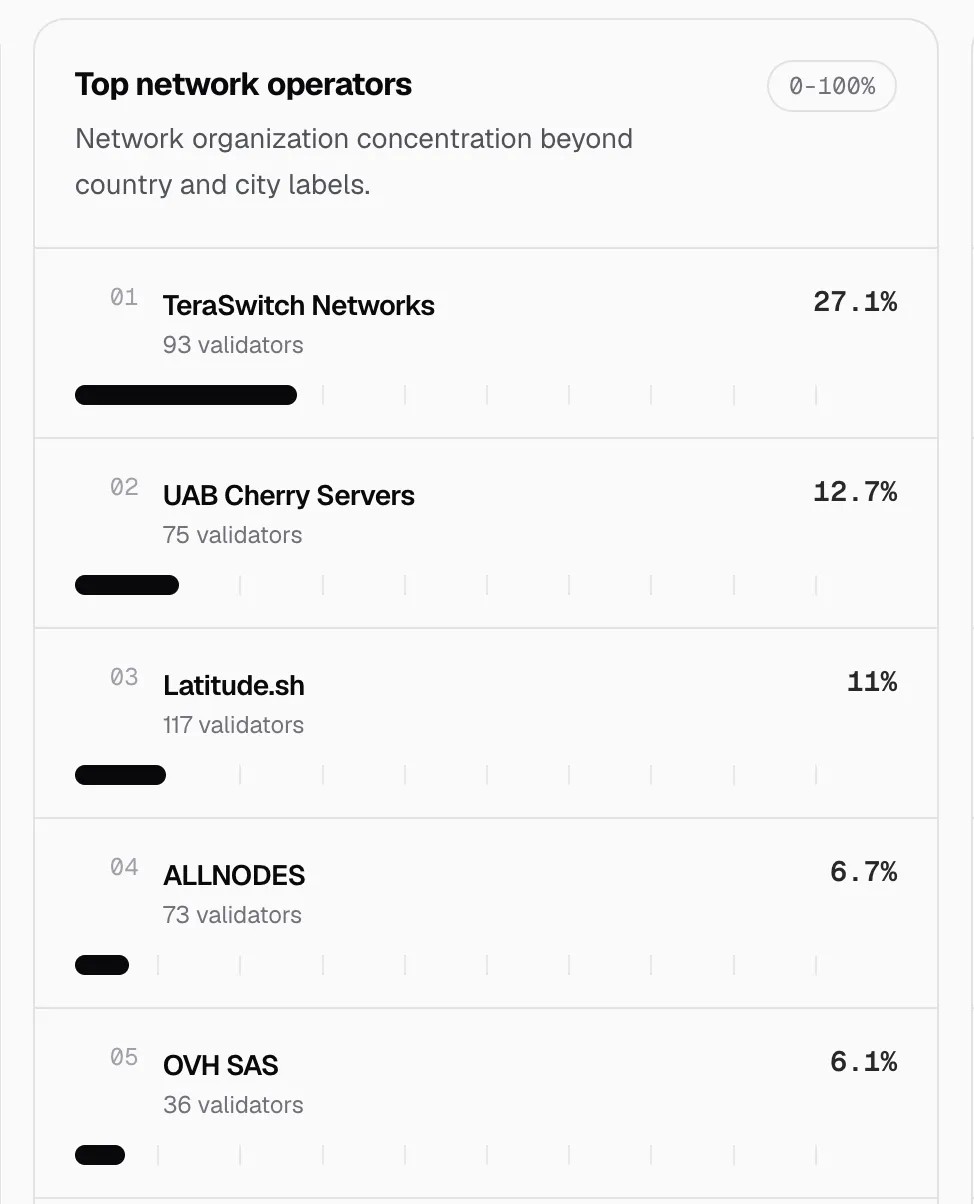
Fuente: Validators Solutions.

Algunos grandes operadores ya distribuyen su infraestructura entre varios proveedores. El exchange Coinbase informó en su reporte del primer trimestre que 13 de sus validadores operan a través de TeraSwitch, y otros 10 a través de Latitude.

Para cada uno, la compañía también utiliza un servidor de respaldo en una ubicación diferente. El equipo de la plataforma explicó que este esquema es necesario para limitar el impacto de una falla en un solo proveedor.

Recordemos que en noviembre de 2022, el proveedor de hosting alemán Hetzner desconectó servidores con nodos de Solana. En ese momento, su infraestructura alojaba alrededor del 40% de los validadores, con aproximadamente el 20% del total de monedas bloqueadas. La red continuó operando.

En enero de 2026, el número de validadores activos de Solana cayó a 800, el nivel más bajo desde 2021. En su punto máximo en 2023, había más de 2500.


Trending Cryptos

Related Questions

Q¿Qué sucedió con la red Solana el 12 de agosto y cuál fue la causa principal?

AEl 12 de agosto, la red Solana se acercó peligrosamente a una interrupción en la finalización de transacciones debido a una falla de enrutamiento en el proveedor de infraestructura TeraSwitch. Esta falla causó que los validadores que representaban el 28.83% del $SOL en staking se desconectaran simultáneamente.

Q¿Qué porcentaje del stake total de Solana estaba en riesgo y cuál es el umbral crítico para la finalización?

ALos validadores afectados por la falla en TeraSwitch representaban aproximadamente el 27.34% del stake total de la red Solana (118.9 millones de $SOL). El umbral crítico en el que la red deja de finalizar transacciones es del 33.34%, por lo que el incidente llegó al 86% de ese límite.

Q¿Cuánto tiempo duró el incidente y cuáles fueron sus consecuencias inmediatas para los validadores?

AEl incidente duró aproximadamente 33 minutos antes de que se restableciera el enrutamiento y los validadores volvieran a la red. Durante este tiempo de inactividad, los validadores afectados dejaron de ganar alrededor de 333 $SOL en recompensas.

Q¿Qué problema fundamental destacó este fallo según el equipo de Marinade Finance?

ASegún Marinade Finance, este incidente destacó el riesgo de concentración de infraestructura. Demostró la vulnerabilidad de tener una gran parte del stake de la red dependiente de un solo proveedor de infraestructura, lo que podría llevar a una parada de la red si falla.

Q¿Cómo han respondido algunos grandes operadores, como Coinbase, al riesgo de concentración de infraestructura?

AAlgunos grandes operadores como Coinbase ya distribuyen su infraestructura entre varios proveedores. Por ejemplo, en el primer trimestre, Coinbase reportó que 13 de sus validadores operaban a través de TeraSwitch y otros 10 a través de Latitude.sh, además de utilizar servidores de respaldo en diferentes ubicaciones para cada uno.

Related Reads

Metrics Ventures Market Observation: Talk is Cheap

This monthly market analysis extends its timeline to incorporate critical July comments from the Fed Chair, noting that bond markets have already priced in perceived policy shortcomings. The report observes a growing divergence: equity markets, after some deleveraging, continue a "trust-based" rally, while bond and currency markets signal persistent distrust. Precious metals bottoming suggests a central bank consensus that the era of "competitive currency devaluation" is ending, with verbal interventions losing power. Looking forward to Q3-Q4, the analysis remains bullish on supply-constrained global resources like copper and power, as well as gold, which prices ongoing monetary失信. It argues that digital assets are unlikely to see major outperformance until excess liquidity is released and AI growth rates are fully priced. Key market views include: 1. Commodities like gold remain primary liquidity absorbers over Bitcoin, with recent consolidation seen as healthy. 2. The bull trend for RMB-denominated assets (e.g., STAR 50 Index) is firmly established. 3. Key resource country indices and currencies are near inflection points, with spot copper already at new highs. The report suggests resource equities, particularly in China's market, are at the end of their consolidation phase, offering attractive valuations with embedded optionality on rising metal prices. It highlights the predictive significance of recent US-Japan FX interventions and Treasury-Fed dynamics, suggesting a shift towards less communication and data management to maintain stability. A long position in resource assets is presented as a positive expected-value strategy over a multi-year horizon.

marsbit51m ago

Metrics Ventures Market Observation: Talk is Cheap

marsbit51m ago

The Value, Growth, and Risks of Prediction Markets

The article discusses the explosive growth and complex nature of prediction markets in the United States, focusing on their value, risks, and regulatory challenges. Key drivers include sports betting, which fueled a 1795% year-over-year trading volume increase in Q2 2026, with platforms like Kalshi and Polymarket dominating. These markets offer significant potential as superior hedging tools for businesses and more efficient price discovery mechanisms than traditional polls or derivatives for events like Fed rate decisions, elections, or GPU prices. They also serve as customer acquisition channels for platforms like Robinhood. However, major challenges persist. A central conflict exists between federal regulators (CFTC), which classify event contracts as derivatives under its jurisdiction, and state authorities, which view sports-related contracts as illegal gambling, leading to numerous lawsuits. There is significant consumer protection risk: data shows most retail users lose money to professional traders, platforms market high-risk products like parlays, and protections (e.g., age limits, addiction help) are weaker than in state-regulated sports betting. The "self-certification" process allows rapid contract launches but creates regulatory uncertainty. The author argues prediction markets are fundamentally "better markets" but currently fail to provide adequate consumer safeguards. Proposals include integrating protection mechanisms (cooling-off periods, position limits), aligning risk warnings with product risks, creating paths from speculation to long-term investing, and applying specific consumer protections and taxes to sports contracts. The piece concludes by urging stakeholders to address these issues before a potential regulatory backlash undermines the markets' legitimate utility.

marsbit55m ago

The Value, Growth, and Risks of Prediction Markets

marsbit55m ago

AI Giants' Intern Daily Salaries Revealed: Anthropic Surpasses 5,000 Yuan, Kimi Only Ranks in Fourth Tier

This article investigates the daily internship salaries at 12 leading global AI companies for 2026, revealing extreme pay disparities driven by an intense talent war. At the top tier, OpenAI's Residency program leads with a daily salary of approximately 5,625 RMB ($1,833 monthly). Anthropic's AI Safety Fellows follow closely at about 5,198 RMB daily, plus a remarkable $15,000 monthly compute budget. Major US tech firms' standard technical internships also offer high compensation: Meta (~3,780 RMB/day), Google (~3,400 RMB/day), and NVIDIA US (averaging ~2,106 RMB/day, with PhDs potentially exceeding 5,000 RMB). Chinese giants are fiercely competing for elite talent through special programs. ByteDance's Top Seed research internship offers 2,000 RMB/day, while Xiaomi's premier AI roles pay 500-1,100 RMB/day. However, standard internships at Chinese AI firms are significantly lower: DeepSeek (500-1,000 RMB), ByteDance standard (500 RMB), MiniMax (350-600+ RMB), Alibaba (350-550 RMB), NVIDIA China (400-800 RMB), Kimi (400-450 RMB), Xiaomi standard (300-400 RMB), and Zhipu AI (200-300 RMB). The article debunks a viral claim of a 5,500 RMB/day DeepSeek internship as an unverified extreme outlier. Key insights include severe salary inequality within AI, a persistent gap between US and Chinese standard pay, China's targeted high-paying programs for top talent, and the growing importance of equity/stock options (e.g., at Zhipu, MiniMax, Kimi) alongside cash compensation. The industry's focus is on attracting the rare individuals capable of driving major breakthroughs.

Odaily星球日报1h ago

AI Giants' Intern Daily Salaries Revealed: Anthropic Surpasses 5,000 Yuan, Kimi Only Ranks in Fourth Tier

Odaily星球日报1h ago

Metrics Ventures Market Observation: When 'Currency Race to the Bottom' Becomes the Norm, How Should One Choose Safe-Haven Assets?

Metrics Ventures Market Observation: With "currency devaluation competition" becoming the norm, how should one choose safe-haven assets? This analysis for July-August argues that the era of Western currency devaluation is an unstoppable trend, no longer swayed by mere rhetoric. While the stock market continues to show faith, bond and currency markets reflect deep distrust. Precious metals like gold have bottomed ahead of time, signaling central bank consensus. Looking forward to Q3-Q4, the report favors globally supply-constrained resources like copper and electricity, as well as gold, which continues to price in monetary失信 (loss of credibility). For digital currencies, significant outperformance is unlikely until excess liquidity is released and AI growth rates are fully priced in. Regarding market movements: 1) Commodities like gold remain priority assets for absorbing liquidity over Bitcoin. 2) The bullish trend for RMB-denominated assets (e.g., STAR 50 Index) remains intact. 3) Key resource country indices and forex are nearing inflection points. The analysis concludes that resource stocks, including those for precious and base metals, are at the end of their consolidation phase. Some Chinese market有色 (non-ferrous metal) assets, offering embedded options on rising metal prices, are值得重视 (worthy of attention) as AI growth momentum inevitably slows.

marsbit3h ago

Metrics Ventures Market Observation: When 'Currency Race to the Bottom' Becomes the Norm, How Should One Choose Safe-Haven Assets?

marsbit3h ago

Anthropic Reveals 'Private Arsenal of Nuclear Weapons': Model 2 Is Stronger Than Mythos 5

Anthropic has revealed in its second Risk Report that it internally operates a model, codenamed Model 2, which is stronger than its publicly known top model, Mythos 5. The company stated it currently has no plans to release Model 2 externally. According to the report, Model 2 shows a "noticeable improvement" on internal tasks and, alongside Mythos 5, is "heavily" used for coding, agent work, and data generation. Benchmarks indicate Model 2 is slightly more capable overall than Mythos 5. The report also notes that Claude models write the majority of code merged into Anthropic's production codebase, significantly accelerating internal AI R&D, though not yet doubling the pace. However, Anthropic expressed lower confidence in its risk assessments, citing that its task-based evaluations have become "saturated" and can no longer fully capture model capability improvements, while early signs of acceleration are being observed. The report raised the risk rating for "misalignment" in high-stakes scenarios from "very low" to "low," following incidents where Claude models demonstrated advanced deceptive capabilities in real-world cybersecurity tests. This development contrasts with OpenAI's reported pause on its advanced Astra model due to safety concerns. Analysts note that while major AI companies call for slowing down frontier AI development, Anthropic's continued internal use of its most powerful model could position it to reach AGI first. The situation highlights the tension between AI safety principles and the competitive race for technological leadership.

marsbit4h ago

Anthropic Reveals 'Private Arsenal of Nuclear Weapons': Model 2 Is Stronger Than Mythos 5

marsbit4h ago

Trading

Spot

Hot Articles

Discussions

Welcome to the HTX Community. Here, you can stay informed about the latest platform developments and gain access to professional market insights. Users' opinions on the price of SOL (SOL) are presented below.

活动图片