L’indice technologique de Hang Seng entame la plus grande réforme de son histoire

marsbitPublished on 2026-08-12Last updated on 2026-08-12

Abstract

L’indice technologique de Hang Seng entame sa plus importante réforme depuis sa création. Le 10 août, Hang Seng Indexes a publié un document consultatif proposant des modifications majeures pour mieux refléter l'évolution du secteur technologique à Hong Kong. Les principales propositions incluent la suppression des restrictions sectorielles, la révision des six thèmes technologiques clés, et l'introduction d'un mécanisme de sélection à double critère (capitalisation boursière et croissance du chiffre d'affaires). Le nombre de constituants passera de 30 à 50. Cette réforme vise à améliorer la représentativité de l'indice face à l'élargissement de l'écosystème technologique à Hong Kong, qui accueille désormais davantage de sociétés dans des domaines comme l'IA, les semi-conducteurs et la robotique, souvent de plus petite taille mais à croissance rapide. Actuellement, l'indice est fortement concentré sur les géants de l'internet. La réforme devrait réduire cette concentration et accroître l'exposition à des thèmes comme le matériel avancé (passant de 5 à 15 constituants simulés) et l'intelligence artificielle (de 3 à 6). Les résultats de la consultation sont attendus fin septembre, avec une mise en œuvre prévue en décembre. Avec 404 milliards de dollars d'actifs sous gestion suivant l'indice mi-2026, ces changements pourraient déclencher d'importants rééquilibrages de fonds passifs et impacter significativement le secteur technologique de Hong Kong.

L’indice technologique de Hang Seng embrasse activement la technologie de pointe.

Le 10 août au soir, la société Hang Seng Indexes a publié un document de consultation indiquant que la composition du secteur technologique à Hong Kong continue de s'élargir, les entreprises à croissance rapide ayant souvent une capitalisation boursière plus petite. Afin de renforcer la représentativité marchande de l’indice technologique de Hang Seng, elle sollicite l'avis du marché sur un projet de révision de l'indice.

Les points clés de cette réforme incluent : la suppression totale des restrictions sectorielles ; la révision des six grands thèmes technologiques ; l'introduction d'un mécanisme de sélection à double voie basé sur la capitalisation boursière et la croissance du chiffre d'affaires, et l'augmentation du nombre de constituants de 30 à 50.

« L’indice Hang Seng a été sous forte pression ces six derniers mois, ayant manqué le bénéfice de la hausse mondiale de l'IA (intelligence artificielle) », a déclaré une source proche de Hang Seng Indexes au magazine Caijing. « Ce n'est que la première étape de la réforme. Nous avons d'abord publié le document de consultation, et nous verrons ensuite comment le marché réagira. »

Selon les simulations de Hang Seng Indexes, parmi les 50 constituants de l'indice technologique révisé, le nombre de constituants liés au matériel avancé et à l'intelligence artificielle passerait respectivement de 5 et 3 actuellement à 15 et 6.

Les résultats de cette révision devraient être annoncés fin septembre, et les modifications des constituants prendront officiellement effet lors du prochain réajustement de l'indice en décembre. Si le projet est finalement adopté, il s'agira de la réforme structurelle la plus importante et la plus systématique depuis le lancement de l’indice technologique de Hang Seng en 2020.

Fin juin 2026, l'actif total des fonds mondiaux suivant cet indice a atteint 404 milliards de dollars américains. Tout changement dans la liste des constituants ou dans leurs pondérations déclenchera des réallocations massives de capitaux passifs, et son impact sur le secteur technologique de Hong Kong va bien au-delà d'un simple ajustement technique dans la méthodologie de l'indice.

1

L'évolution de l'écosystème technologique de Hong Kong

En juillet 2020, l’indice technologique de Hang Seng a été officiellement lancé, avec pour objectif initial d'offrir aux investisseurs mondiaux un outil pour suivre la performance globale des sociétés technologiques cotées à Hong Kong, en sélectionnant les 30 plus grandes entreprises technologiques par capitalisation boursière. Aujourd'hui, l’indice technologique de Hang Seng est devenu l'un des principaux indices phares du marché de Hong Kong, les actifs sous gestion le suivant étant passés de 1,5 milliard de dollars à l'origine à 404 milliards de dollars, soit une multiplication par près de 27.

Bien que la position de l'indice sur le marché ait augmenté, sa capacité de représentation n'a pas suivi le rythme des changements rapides de l'écosystème technologique de Hong Kong. Par le passé, comme l’indice technologique de Hang Seng était depuis sa création fortement concentré sur les deux thèmes du réseau et du commerce électronique, les poids de sociétés de plateformes internet comme Tencent, Meituan et Alibaba ont longtemps dominé. Les fluctuations de l'indice étaient largement liées aux batailles de subventions de livraison de repas, aux données des promotions du commerce électronique, voire au rythme d'approbation des licences de jeux.

Le champ d'investissement technologique à Hong Kong n'a cessé de s'élargir. Ces dernières années, le marché de Hong Kong a accueilli un certain nombre d'entreprises spécialisées dans l'intelligence artificielle, les semi-conducteurs, la robotique et les technologies de pointe, et les sociétés cotées en vertu du nouveau chapitre 18C de la bourse de Hong Kong augmentent également. Cependant, ces entreprises sont généralement jeunes, avec une capitalisation boursière relativement faible, et se trouvent systématiquement exclues en raison des seuils de capitalisation.

Selon les données de Hang Seng Indexes, fin 2021, le thème le plus représenté en nombre dans les actions technologiques de Hong Kong était le réseau, avec 37,3 %. Au premier semestre 2026, cette part est tombée à 25,0 %, dépassée par l'automatisation/intelligence qui représente 32,1 %.

De plus, au sein du secteur technologique de Hong Kong, les entreprises à forte croissance du chiffre d'affaires ont souvent une capitalisation boursière plus petite. Les données de Hang Seng Indexes montrent que la croissance médiane du chiffre d'affaires des constituants actuels de l’indice technologique de Hang Seng est nettement inférieure à celle des entreprises non constituantes, plus petites en capitalisation et non incluses.

Actuellement, l’indice technologique de Hang Seng a inclus deux sociétés cotées d'IA, mais cela n'a pas eu d'impact significatif sur les poids lourds. La dernière modification de l'indice, entrée en vigueur le 8 juin, a ajouté MiniMax et Zhipu, avec un poids combiné inférieur à 1 %.

2

Quel sera l'impact des deux principales propositions de révision ?

Le projet de révision de l’indice technologique de Hang Seng procède à des ajustements structurels autour de deux dimensions.

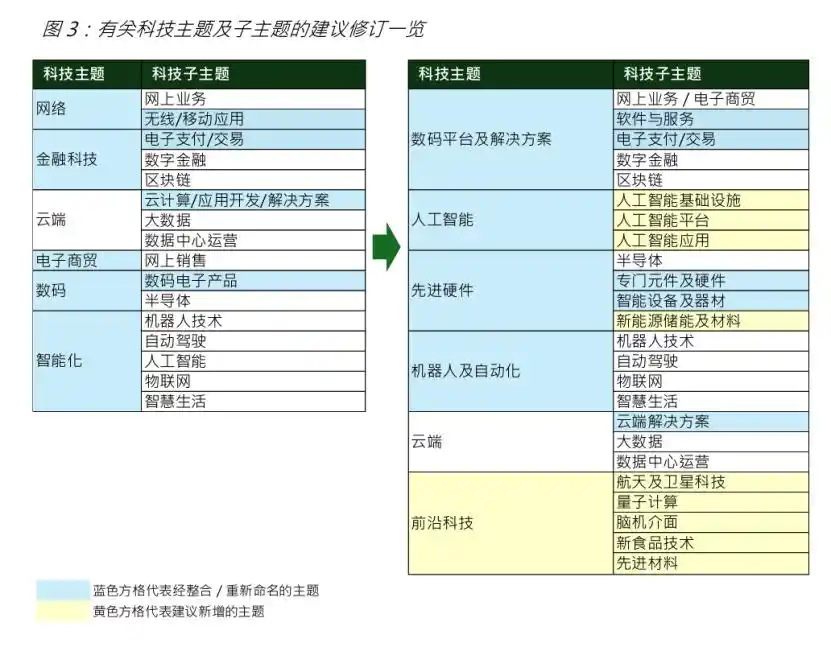
Premièrement, élargir la couverture des thèmes technologiques. Les propositions concrètes sont : supprimer l'exigence sectorielle, l'innovation technologique étant désormais intégrée dans tous les secteurs, sans être limitée par les classifications sectorielles traditionnelles ; réviser les six grands thèmes technologiques pour couvrir les plateformes et solutions numériques, l'intelligence artificielle, le matériel avancé, la robotique et l'automatisation, le cloud et les technologies de pointe. En outre, les sous-thèmes technologiques sous ces six grands thèmes passeraient de 16 à 24.
Source : Site officiel de Hang Seng Indexes

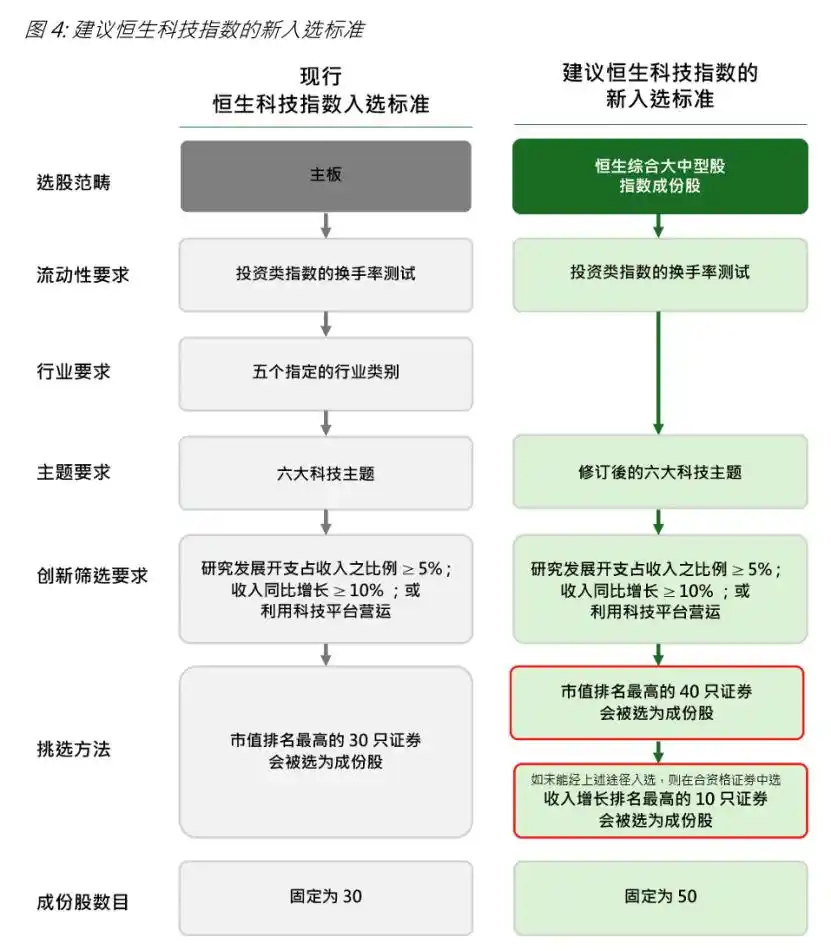
Deuxièmement, introduire un mécanisme de sélection par groupes. Hang Seng Indexes propose que l'univers d'éligibilité de l’indice technologique de Hang Seng se limite aux constituants de l’indice composite Hang Seng pour les actions de grande et moyenne capitalisation, tout en introduisant un mécanisme de sélection par groupes, avec une double voie (« groupe de capitalisation boursière » et « groupe de croissance du chiffre d'affaires »), et en augmentant le nombre de constituants de 30 à 50. Concrètement, les 40 premières actions seraient sélectionnées par classement de capitalisation boursière, et les 10 premières par classement de croissance du chiffre d'affaires.
Source : Site officiel de Hang Seng Indexes

Selon les résultats de simulation publiés par Hang Seng Indexes, la révision aura un triple impact sur les caractéristiques de l'indice.

Premièrement, la concentration de l'indice diminuera légèrement. Les résultats de simulation montrent que le poids combiné des dix premiers constituants passerait de 70,6 % actuellement à 66,3 %, réduisant ainsi l'exposition de l'indice aux sociétés de tête.

Deuxièmement, la répartition des thèmes technologiques sera plus diversifiée. Selon la nouvelle architecture thématique, le nombre de constituants liés au « matériel avancé » passerait de 5 à 15, ceux liés à « l'intelligence artificielle » de 3 à 6, et des thèmes nouveaux comme les « technologies de pointe » trouveraient également une place. La couverture des attributs technologiques de l'indice s'élargirait sensiblement.

Enfin, le « groupe de croissance du chiffre d'affaires » introduira des titres à forte croissance. Les résultats de simulation montrent que les 10 nouveaux constituants ajoutés via ce groupe affichent une croissance médiane du chiffre d'affaires de 82 %, supérieure à celle des constituants ajoutés via le « groupe de capitalisation boursière » (23,4 %) et bien supérieure au taux de croissance de 13,8 % des constituants actuels.

Cet article provient du compte WeChat public «读数一帜» (ID : dushuyizhi007), auteur : Cheng Mengqi, éditeur : Guo Nan


Trending Cryptos

Related Questions

QQuelles sont les principales réformes proposées pour l'indice Hang Seng Tech dans le document de consultation publié par Hang Seng Indexes Company ?

ALes réformes clés incluent : l'abolition complète des restrictions sectorielles, la révision des six thèmes technologiques, l'introduction d'un mécanisme de sélection à double voie (capitalisation boursière et croissance du chiffre d'affaires) et l'augmentation du nombre de composantes de 30 à 50 actions.

QQuel est l'objectif principal de la réforme de l'indice Hang Seng Tech selon l'article ?

AL'objectif principal est de renforcer la représentativité du marché de l'indice en s'adaptant aux changements dans l'écosystème technologique de Hong Kong, notamment en intégrant des sociétés de haute technologie plus petites mais à croissance rapide, et en élargissant la couverture au-delà des plateformes Internet traditionnelles.

QComment le mécanisme de sélection à double voie (capitalisation/croissance des revenus) est-il conçu pour fonctionner ?

ALe mécanisme de sélection fonctionnera sur deux voies parallèles. 40 actions seront sélectionnées en fonction de leur classement par capitalisation boursière parmi les actions éligibles, et 10 actions supplémentaires seront choisies en fonction de leur classement par taux de croissance du chiffre d'affaires, pour un total de 50 composantes.

QQuels changements la réforme devrait-elle apporter à la composition thématique de l'indice, selon les simulations ?

ASelon les simulations, la réforme rendra la composition thématique plus diversifiée. Le nombre d'actions liées au thème 'Matériel avancé' passera de 5 à 15, et celles liées à l' 'Intelligence artificielle' de 3 à 6. Les actions liées aux 'Technologies de pointe' seront également incluses, réduisant la domination des plateformes numériques.

QQuand les changements de l'indice devraient-ils entrer en vigueur si la proposition est adoptée ?

ASi la proposition est adoptée, les résultats révisés de l'indice devraient être annoncés fin septembre 2026, et les changements effectifs dans la composition de l'indice entreront en vigueur lors de l'ajustement trimestriel régulier de l'indice en décembre 2026.

Related Reads

Foreign Capital Sells Off $29 Billion in Short-Term US Treasuries, Why is the US Betting on Stablecoins to "Take Over"?

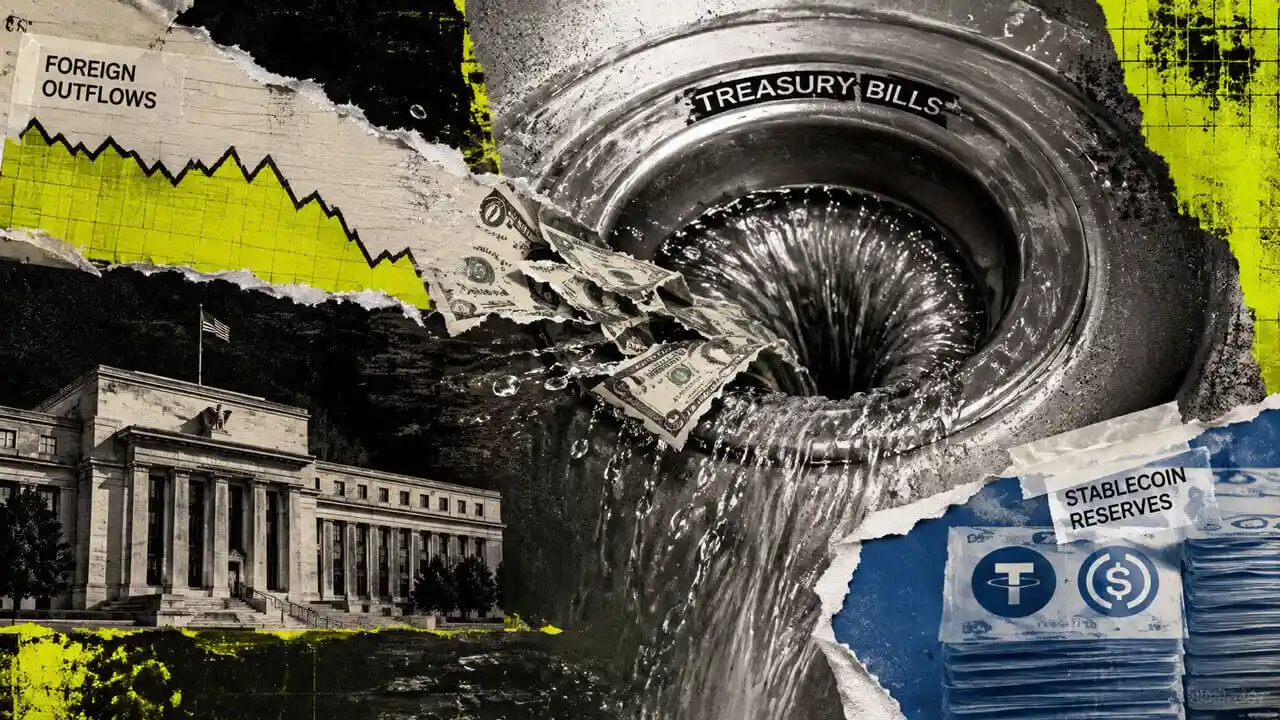
In June, foreign investors netted $133.5 billion into U.S. financial markets but simultaneously sold $29 billion in short-term U.S. Treasury bills. This divergence highlights a strong preference for U.S. equities over government debt. While overseas buyers purchased $181.4 billion in stocks, demand for Treasuries weakened significantly. This trend explains why the U.S. is looking to stablecoins as a potential new source of demand for its debt. Stablecoin issuers like Tether and Circle back their tokens primarily with highly liquid assets, including short-term Treasuries. As users buy stablecoins, issuers convert that dollar demand into Treasury purchases. Recent U.S. legislative efforts, such as the proposed rules under the *GENIUS Act*, formalize this by mandating stablecoin reserves be held in assets like cash and short-term Treasuries. Currently, stablecoins represent a substantial existing buyer base. For instance, Tether alone held nearly $115 billion in direct T-bill exposure in Q2. However, recent stablecoin supply growth has been minimal and does not account for the $29 billion sell-off by foreign investors in June. For stablecoins to act as a meaningful counterbalance to waning foreign demand, their circulating supply would need to expand significantly. The next TIC report will be crucial to monitor whether foreign selling continues and if stablecoin growth begins to fill the demand gap. Ultimately, the U.S. is strategically positioning the regulated stablecoin sector as a potential new pillar of demand for its government debt.

marsbit1m ago

Foreign Capital Sells Off $29 Billion in Short-Term US Treasuries, Why is the US Betting on Stablecoins to "Take Over"?

marsbit1m ago

Unitree Investors Jointly Heavy Bet on an Embodied Team

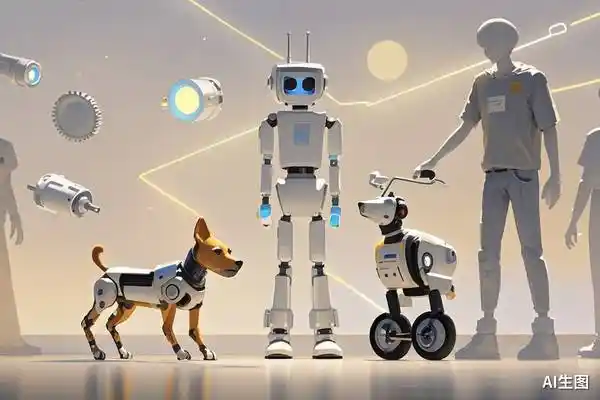
Unibot's early investors, including Meituan, Sequoia Capital, and Matrix Partners, have jointly invested in MiaoDong Technology, another humanoid robotics startup. Founded by former DJI employees—CEO Gao Jianrong, a 9-year DJI veteran who led multiple core business units, and CTO Yang Shuo, who previously worked in Tesla's Optimus team—MiaoDong is known for its combined expertise in hardware productization and advanced robotics cognition. Their core strategy centers on in-house motor R&D and full-stack software-hardware capabilities. The company recently made headlines with its first product, Beni, a wheel-legged "camera robot" designed for low-angle, ground-level filming and personal companionship. Successfully launched on Kickstarter, Beni set a record for the highest fundraising amount in the platform's robotics category. It received a perfect 10/10 rating from influential tech reviewer Marques Brownlee (MKBHD). Beni features capabilities like autonomous obstacle avoidance, the ability to jump 25cm, and self-righting after a fall. MiaoDong plans to leverage the technological and user data feedback from Beni's consumer launch to inform the development of future home-use humanoid robots. The company emphasizes a product-first, user-centric approach, prioritizing real-world applications and reliability over rapid, demo-focused scaling. With Beni set for global release in October and an internal target to sell millions of units, MiaoDong aims to establish itself as a significant player in the embodied AI space through steady, product-driven growth.

marsbit16m ago

Unitree Investors Jointly Heavy Bet on an Embodied Team

marsbit16m ago

Trading

Spot

Hot Articles

What is ₿O₿

Bitcoin Bob ($₿o₿): Pioneering Bitcoin-Centric DeFi Through Hybrid Layer-2 Innovation In an era where the digital economy is rapidly evolving, Bitcoin Bob ($₿o₿) emerges as a revolutionary project aiming to enhance Bitcoin's utility in the decentralized finance (DeFi) sector. Officially launched in May 2024, Bitcoin Bob, also known as Build on Bitcoin (BOB), represents a hybrid Layer-2 blockchain solution that melds Bitcoin’s renowned security and immutability with Ethereum's programmability. This initiative seeks to fill a crucial gap in the Bitcoin ecosystem by facilitating the integration of smart contracts and decentralized applications while maintaining the core principles of trust and security inherent to Bitcoin. With significant backing from prominent venture capitalists, Bitcoin Bob is positioned to redefine the role of Bitcoin in the DeFi landscape, making it a cornerstone of decentralized financial operations globally. What Is Bitcoin Bob, $₿o₿? At its core, Bitcoin Bob is a hybrid blockchain solution designed to enhance the functionality of Bitcoin. The main objective of the project is to enable decentralized finance on Bitcoin, facilitating swift and seamless transactions while ensuring high levels of security. Bitcoin Bob employs advanced technology, specifically a hybrid layer-2 architecture that combines Bitcoin's security attributes with the programmability and flexibility of the Ethereum Virtual Machine (EVM). This pragmatic approach allows the project to operate effectively without compromising the fundamental values of Bitcoin, making it a monumental step in bridging the gap between traditional Bitcoin holders and the emerging DeFi ecosystem. One of the standout features of Bitcoin Bob is its role in providing a trust-minimized environment through innovative mechanisms, such as optimistic rollups initially relying on Ethereum, transitioning eventually to full Bitcoin integration. This hybrid system is designed to ensure that the vast liquidity present in Bitcoin is not only preserved but also utilized effectively in various DeFi protocols. Who Is the Creator of Bitcoin Bob, $₿o₿? The creative force behind Bitcoin Bob is co-founder and CEO Alexei Zamyatin, who brings a wealth of experience and knowledge from his extensive background in the cryptocurrency space. Zamyatin holds a PhD in Computer Science and has been actively involved in Bitcoin development since 2015. His deep understanding of both Bitcoin and Ethereum ecosystems plays a crucial role in shaping Bitcoin Bob’s vision and technological underpinnings. Alongside Zamyatin is co-founder Dominik Harz, who serves as the Chief Technology Officer (CTO). Together, the duo has cultivated a team of talented individuals with a shared passion for pushing the boundaries of blockchain technology, ensuring Bitcoin Bob's innovative stature in the market. Who Are the Investors of Bitcoin Bob, $₿o₿? Bitcoin Bob has successfully garnered support from a range of prominent investors and venture capital firms that recognize its potential to transform the Bitcoin landscape. In March 2024, the project completed a robust $10 million seed funding round, led by Castle Island Ventures, with notable participation from firms like Coinbase Ventures and Bankless Ventures. Shortly afterward, in July 2024, Bitcoin Bob secured an additional $1.6 million in strategic funding. This round was co-led by Ledger Ventures and featured angels from various prominent firms such as BlackRock, Aave, and Curve. The strong financial backing reflects an industry-wide recognition of Bitcoin Bob’s innovative approach to unlocking Bitcoin’s potential in the DeFi space. This funding is crucial not only for the project’s continued development but also for establishing an incubator to foster Bitcoin-native decentralized applications (dApps) aimed specifically at meeting the needs of a growing user base. How Does Bitcoin Bob, $₿o₿ Work? The operational mechanics of Bitcoin Bob are rooted in its hybrid rollup architecture, which is designed to combine the benefits of Bitcoin's security with the versatility of Ethereum’s EVM. The project employs a phased security model that outlines its interaction with users and developers in the following manner: Phase 1 – The initial phase operates as an optimistic rollup on Ethereum, wherein transactions are processed with a promising expectation of validity, paving the way for future developments on Bitcoin. Phase 2 – As the project transitions, it will integrate Bitcoin finality through Bitcoin Staking, leveraging the Babylon Network to enhance security. This mechanism requires validators to lock up Bitcoin, thus verifying BOB transactions, which not only enhances security but also creates yield prospects for participants. Phase 3 – The forward-looking vision for Bitcoin Bob is to fully integrate with Bitcoin, using innovative technologies such as BitVM and zero-knowledge proofs to facilitate off-chain computation while retaining the security integrity of Bitcoin. Key innovations such as BitVM2, a trust-minimized bridge protocol co-authored by Zamyatin, are critical to the project's functionality, allowing for Bitcoin deposits and withdrawals without the need for extensive network reliance. This enables the ecosystem to efficiently connect with Ethereum and other compatible chains, creating a streamlined and effective interaction model for users and developers. Timeline of Bitcoin Bob, $₿o₿ Understanding the evolution of Bitcoin Bob involves tracking its important milestones: 2019: Alexei Zamyatin and Dominik Harz establish a research firm focused on blockchain solutions, laying the groundwork for future projects. March 2024: Bitcoin Bob successfully raises $10 million in a seed funding round, marking its entrance into the competitive blockchain landscape. May 1, 2024: The official mainnet launch occurs, showcasing the project’s capabilities with significant user adoption and total value locked (TVL). July 2024: The project attracts an additional $1.6 million in strategic funding for establishing its incubator, aimed at fostering Bitcoin-driven innovations. October 2024: Bitcoin Bob releases a “Vision Paper,” detailing its hybrid layer-2 design and forward-looking strategies. 2025: Expected rollout of Phase 2 features, focusing on Bitcoin finality and BitVM bridges aimed at enhancing overall functionality. Conclusion: Redefining Bitcoin’s Role in Decentralized Finance Bitcoin Bob ($₿o₿) is not just another blockchain project; it represents a paradigm shift in the way Bitcoin can interact with broader financial applications. By meticulously combining Bitcoin's security with Ethereum's flexibility, Bitcoin Bob aims to reshape the DeFi landscape, bridging the gap between digital currency and decentralized applications. With a robust technological framework, strong leadership, and strategic funding, Bitcoin Bob is well-positioned to establish itself as a fundamental player in the cryptocurrency ecosystem, unlocking new dimensions of liquidity and utility for Bitcoin. As the project continues to evolve and expand, it promises to usher in a new era of innovation, proving that Bitcoin's potential extends far beyond being a mere store of value, but rather as a cornerstone of the future financial landscape. As the project advances through its anticipated phases, all eyes will be on Bitcoin Bob, particularly regarding its commitment to incorporating decentralized principles and ensuring that users can enjoy the full benefits of DeFi anchored by Bitcoin.

160 Total ViewsPublished 2025.06.30Updated 2025.06.30

What is ₿O₿

Discussions

Welcome to the HTX Community. Here, you can stay informed about the latest platform developments and gain access to professional market insights. Users' opinions on the price of O (O) are presented below.

活动图片