El Índice de Ciencia y Tecnología de Hang Seng inicia la mayor reforma de su historia

marsbitPublished on 2026-08-12Last updated on 2026-08-12

Abstract

El índice tecnológico de Hang Seng inicia su mayor reforma en la historia para abrazar la tecnología avanzada. El 10 de agosto, Hang Seng Indexes publicó un documento de consulta proponiendo cambios estructurales significativos. Las revisiones clave incluyen la eliminación total de restricciones sectoriales, la actualización a seis grandes temas tecnológicos y la introducción de un mecanismo de selección de componentes basado en capitalización bursátil y crecimiento de ingresos, ampliando el número de componentes de 30 a 50. Según simulaciones de Hang Seng Indexes, tras la reforma, los componentes relacionados con hardware avanzado y inteligencia artificial aumentarían de 5 y 3 a 15 y 6, respectivamente. La concentración del índice disminuiría ligeramente y la distribución temática sería más diversificada. La reforma busca mejorar la representatividad del índice ante la expansión del ecosistema tecnológico de Hong Kong, que ha visto surgir más empresas de IA, semiconductores y robótica, a menudo con alta crecimiento pero menor capitalización. La revisión, cuya implementación está prevista para diciembre si se aprueba, es la más amplia desde el lanzamiento del índice en 2020. Con un patrimonio de 404.000 millones de dólares siguiendo al índice, los cambios podrían generar importantes rebalances de capital pasivo.

El Índice de Ciencia y Tecnología de Hang Seng está abrazando activamente la tecnología dura.

El 10 de agosto por la noche, Hang Seng Indexes Company publicó un documento de consulta afirmando que la estructura de composición del sector tecnológico de Hong Kong continúa expandiéndose, y las empresas con un rápido crecimiento de ingresos suelen tener una capitalización de mercado más pequeña. Para reforzar la representatividad de mercado del Índice de Ciencia y Tecnología de Hang Seng, se están solicitando opiniones del mercado sobre el plan de revisión del índice.

Los puntos clave de esta reforma incluyen: eliminar por completo las restricciones sectoriales; revisar los seis temas tecnológicos principales; introducir un mecanismo de selección de acciones de doble vía basado en capitalización de mercado y crecimiento de ingresos, y ampliar los componentes de 30 a 50.

"El Índice de Hang Seng ha estado bajo mucha presión en el último semestre, perdiéndose los beneficios del repunte global de la IA (inteligencia artificial)", dijo una persona cercana a Hang Seng Indexes Company a Caijing. "Actualmente es solo el primer paso de la reforma, primero publicando el documento de consulta, y luego veremos cómo responde el mercado"

Según los cálculos simulados de Hang Seng Indexes Company, entre las 50 acciones componentes del Índice de Ciencia y Tecnología de Hang Seng revisado, las acciones relacionadas con hardware avanzado e inteligencia artificial aumentarían de las 5 y 3 actuales a 15 y 6, respectivamente.

Se espera que los resultados de esta revisión se anuncien a finales de septiembre, y los cambios en los componentes entrarán en vigor oficialmente en el ajuste del índice de diciembre. Si la propuesta finalmente es aprobada, esta será la reforma estructural más amplia y sistemática del Índice de Ciencia y Tecnología de Hang Seng desde su lanzamiento en 2020.

A junio de 2026, los activos de fondos globales que rastrean este índice alcanzaron los 40.400 millones de dólares. Cualquier cambio en la lista de componentes y sus ponderaciones desencadenará grandes ajustes de capital pasivo, y su impacto en el sector tecnológico de Hong Kong va mucho más allá de un mero ajuste técnico en la metodología del índice.

1

La transformación del ecosistema tecnológico de las acciones de Hong Kong

Retrocediendo a julio de 2020, el Índice de Ciencia y Tecnología de Hang Seng se lanzó oficialmente, con el propósito original de proporcionar a los inversores globales una herramienta para seguir el desempeño general de las empresas tecnológicas listadas en Hong Kong, seleccionando las 30 empresas tecnológicas más grandes por capitalización de mercado. Hoy, el Índice de Ciencia y Tecnología de Hang Seng ha crecido hasta convertirse en uno de los índices insignia más influyentes del mercado de Hong Kong, con activos bajo gestión creciendo desde los iniciales 1.500 millones de dólares a 40.400 millones, un aumento de casi 26 veces.

Aunque la posición de mercado del índice ha crecido constantemente, su capacidad representativa no ha logrado seguir el ritmo de los drásticos cambios en el ecosistema tecnológico de las acciones de Hong Kong. En el pasado, dado que el Índice de Ciencia y Tecnología de Hang Seng ha estado altamente concentrado en dos grandes temas, internet y comercio electrónico, desde su establecimiento, las ponderaciones de empresas de plataformas de internet como Tencent, Meituan y Alibaba han dominado durante mucho tiempo. Los altibajos del índice estuvieron en gran medida vinculados a los resultados de las guerras de subsidios de entrega de comida a domicilio, los datos de las temporadas de promociones de comercio electrónico e incluso el ritmo de aprobación de licencias de videojuegos.

El alcance de la inversión tecnológica en acciones de Hong Kong continúa expandiéndose. En los últimos años, Hong Kong ha acogido a un grupo de empresas de inteligencia artificial, semiconductores, robótica y tecnología especializada, y las empresas que cotizan bajo las nuevas normas del Capítulo 18C de HKEX también están aumentando. Sin embargo, estas empresas generalmente tienen un tiempo corto desde su salida a bolsa y una capitalización de mercado relativamente pequeña, siendo sistemáticamente excluidas por el umbral de capitalización.

Según datos de Hang Seng Indexes Company, a finales de 2021, el tema con mayor proporción en el número de acciones tecnológicas de Hong Kong era internet, con un 37.3%. Para la primera mitad de 2026, la proporción de internet había disminuido al 25.0%, siendo superada por "implementación inteligente", con un 32.1%.

Además, dentro del sector tecnológico de las acciones de Hong Kong, las empresas con un crecimiento de ingresos más fuerte suelen tener una capitalización de mercado más pequeña. Los datos de Hang Seng Indexes Company muestran que la mediana del crecimiento de ingresos de los componentes actuales del Índice de Ciencia y Tecnología de Hang Seng es significativamente más baja que la de las empresas no componentes más pequeñas en capitalización y no incluidas.

Actualmente, el Índice de Ciencia y Tecnología de Hang Seng ya ha incluido dos empresas cotizadas de IA, pero esto no ha impactado a las acciones de mayor ponderación. En el último cambio del índice efectivo el 8 de junio, se incluyeron MiniMax y Zhipu AI, con una ponderación combinada inferior al 1%.

2

¿Qué impacto tendrán las dos principales propuestas de revisión?

El plan de revisión del Índice de Ciencia y Tecnología de Hang Seng propone ajustes estructurales en torno a dos dimensiones.

Primero, ampliar la cobertura temática tecnológica. Las sugerencias concretas son: eliminar el requisito sectorial, ya que la innovación tecnológica se ha integrado en todas las industrias y no está limitada por clasificaciones sectoriales tradicionales; revisar los seis temas tecnológicos principales, abarcando plataformas y soluciones digitales, inteligencia artificial, hardware avanzado, robótica y automatización, computación en la nube y tecnología frontera. Además, ampliar los sub-temas tecnológicos bajo los seis temas principales de 16 a 24.
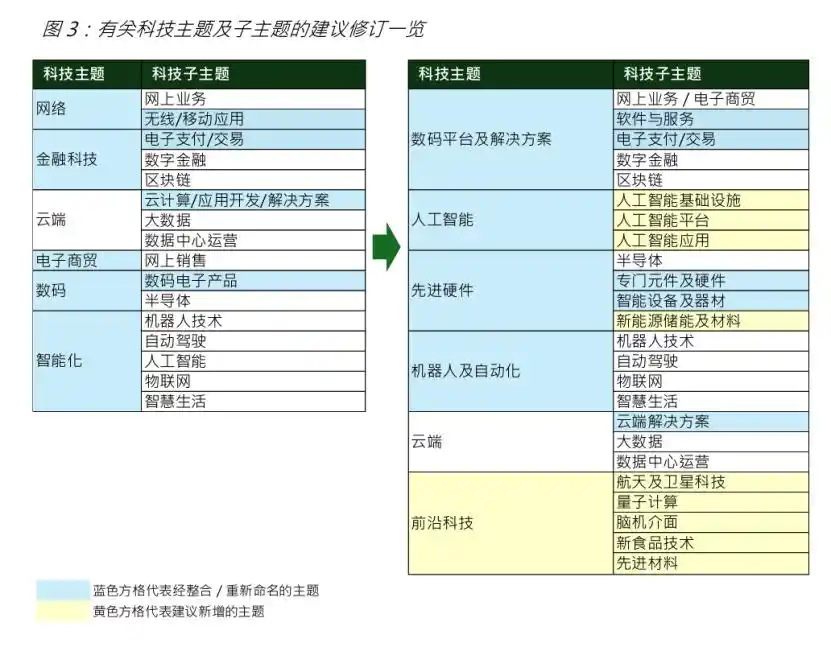
Fuente: Sitio web oficial de Hang Seng Indexes Company

Segundo, introducir un mecanismo de selección por grupos. Hang Seng Indexes Company sugiere que el universo de selección del Índice de Ciencia y Tecnología de Hang Seng se limite a los componentes del Índice Compuesto de Capitalización Grande y Mediana de Hang Seng, introduciendo simultáneamente un mecanismo de selección por grupos, seleccionando mediante un sistema de doble vía por "grupo de capitalización de mercado" y "grupo de crecimiento de ingresos", y aumentando el número de componentes de 30 a 50. Específicamente, seleccionar las primeras 40 por clasificación de capitalización de mercado y las primeras 10 por clasificación de crecimiento de ingresos.
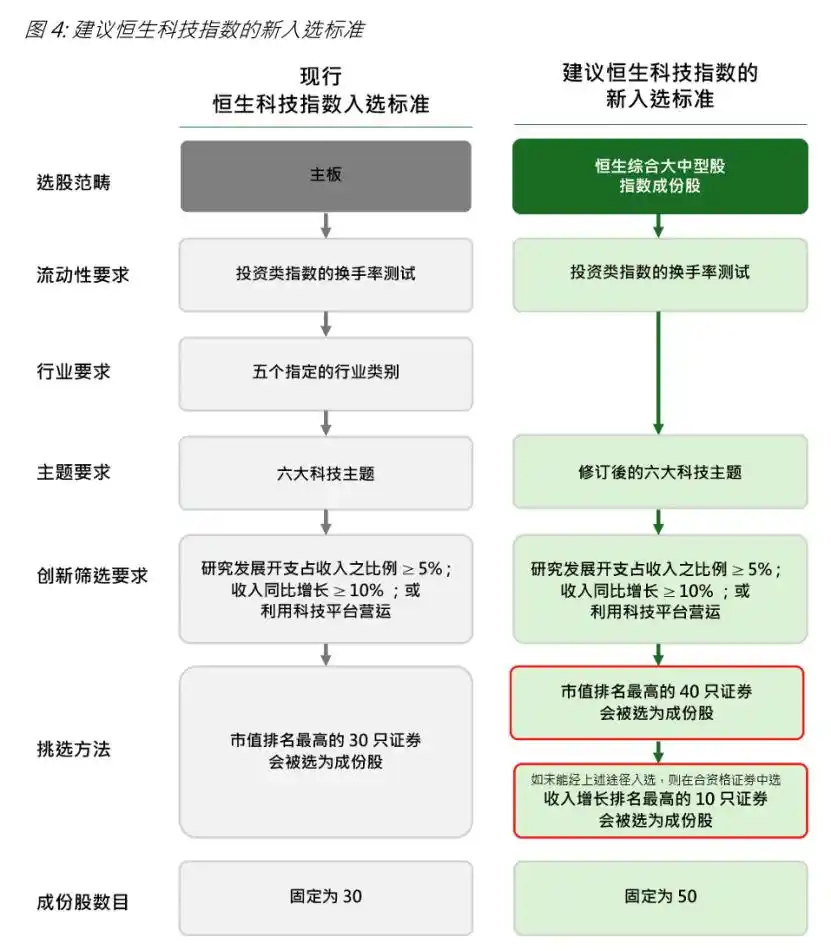
Fuente: Sitio web oficial de Hang Seng Indexes Company

Según los resultados simulados publicados por Hang Seng Indexes Company, la revisión traerá un triple impacto en las características del índice.

En primer lugar, la concentración del índice disminuirá ligeramente. Los resultados simulados de Hang Seng Indexes Company muestran que la ponderación de los diez principales componentes del índice disminuiría del 70.6% actual al 66.3%, dispersándose ligeramente la exposición del índice a las empresas líderes.

En segundo lugar, la distribución temática tecnológica será más diversa. Según la nueva estructura temática, el número de componentes relacionados con "hardware avanzado" aumentaría de 5 a 15, los relacionados con "inteligencia artificial" de 3 a 6, y temas nuevos como "tecnología frontera" también obtendrán espacio de inclusión, ampliándose notablemente la cobertura de atributos tecnológicos del índice.

Finalmente, el grupo de crecimiento de ingresos introducirá objetivos de alto crecimiento. Los resultados simulados muestran que las 10 acciones componentes nuevas del "grupo de crecimiento de ingresos" tienen una mediana de crecimiento de ingresos tan alta como del 82%, superior al 23.4% de las nuevas acciones del "grupo de capitalización de mercado" y mucho mayor que la tasa de crecimiento de ingresos del 13.8% de los componentes actuales.

Este artículo proviene del WeChat público "读数一帜" (ID: dushuyizhi007), autor: Cheng Mengqi, editor: Guo Nan


Trending Cryptos

Related Questions

Q¿Cuál es el principal objetivo de la reforma propuesta para el índice Hang Seng Tech?

AEl principal objetivo de la reforma propuesta para el índice Hang Seng Tech es reforzar su representatividad del mercado. Dado que la composición del sector tecnológico de Hong Kong se ha ampliado continuamente y las empresas con un crecimiento de ingresos más rápido suelen tener una capitalización de mercado más pequeña, la reforma busca adaptar el índice para reflejar mejor este panorama cambiante mediante la eliminación de restricciones sectoriales, la revisión de los temas tecnológicos y la introducción de un mecanismo dual de selección basado en capitalización y crecimiento de ingresos.

Q¿Qué cambios específicos se proponen en la composición del índice Hang Seng Tech?

ALos cambios específicos propuestos en la composición del índice Hang Seng Tech son: 1) Eliminar por completo las restricciones sectoriales. 2) Revisar los seis grandes temas tecnológicos. 3) Introducir un mecanismo dual de selección basado en capitalización de mercado y crecimiento de ingresos. 4) Aumentar el número de componentes del índice de 30 a 50 acciones, seleccionando las 40 principales por capitalización y las 10 principales por crecimiento de ingresos.

QSegún la simulación de la empresa, ¿cómo cambiaría la distribución de las acciones relacionadas con 'Hardware Avanzado' y 'Inteligencia Artificial' en el índice reformado?

ASegún la simulación realizada por Hang Seng Indexes Company, en el índice reformado, el número de componentes relacionados con 'Hardware Avanzado' aumentaría de las 5 acciones actuales a 15, y los relacionados con 'Inteligencia Artificial' pasarían de 3 a 6 acciones. Esto refleja una mayor diversificación en la distribución de los temas tecnológicos cubiertos por el índice.

Q¿Qué problema de representatividad del índice Hang Seng Tech destaca el artículo, especialmente en relación con las empresas de alta tecnología de reciente incorporación al mercado?

AEl artículo destaca que el índice Hang Seng Tech ha perdido representatividad frente a la rápida evolución del ecosistema tecnológico de Hong Kong. Aunque el mercado ha acogido a muchas empresas nuevas en áreas como IA, semiconductores y robótica, estas suelen tener un historial corto de cotización y una capitalización de mercado más pequeña, lo que las excluye sistemáticamente del índice bajo el mecanismo de selección anterior basado principalmente en la capitalización bursátil.

Q¿Cuál es el cronograma propuesto para la implementación de estas revisiones del índice Hang Seng Tech?

AEl cronograma propuesto para la implementación de las revisiones del índice Hang Seng Tech es el siguiente: se espera que los resultados de la revisión se anuncien a finales de septiembre, y los cambios en los componentes del índice entrarán en vigor oficialmente en diciembre, durante el próximo rebalanceo trimestral del índice.

Related Reads

AI Democratizes Hacking, Bitcoin Red Team White Hats Race in Speed-Based Attack-Defense Contest

AI is democratizing powerful hacking tools, putting them in the hands of those with little cybersecurity expertise. Cryptocurrency developers are now in a race to find system vulnerabilities before attackers do. The Bitcoin Red Team, a group of 20-25 volunteers including anonymous developers like Calle, has formed to urgently address these AI-augmented security threats within the Bitcoin ecosystem. Calle emphasizes that while the Bitcoin core protocol itself is secure, the real risk lies in the wallets, applications, services, and other third-party software built on top of it—the software most users interact with. Incidents like the Coldcard wallet hack and the emergence of powerful Chinese AI models have accelerated their proactive security auditing efforts. The team both accepts audit requests from Bitcoin projects and proactively scans major open-source projects. They report found vulnerabilities to developers and refine their classification standards. Notably, Calle states the team frequently uses Chinese AI models over US counterparts, as the latter's strict safety guardrails often block cybersecurity research tasks, hindering their utility for finding or fixing vulnerabilities. Calle warns that AI is erasing the information asymmetry that previously protected some vulnerabilities. It lowers the technical barrier, allowing non-experts to exploit simple flaws. He describes the current state of Bitcoin software as "on fire" and believes the direct financial incentive of cryptocurrency makes it a first target in this industry-wide shift, with other sectors to follow. The era of security through obscurity is over.

marsbit21m ago

AI Democratizes Hacking, Bitcoin Red Team White Hats Race in Speed-Based Attack-Defense Contest

marsbit21m ago

Foreign Capital Sells Off $29 Billion in Short-Term US Treasuries, Why is the US Betting on Stablecoins to "Take Over"?

In June, foreign investors netted $133.5 billion into U.S. financial markets but simultaneously sold $29 billion in short-term U.S. Treasury bills. This divergence highlights a strong preference for U.S. equities over government debt. While overseas buyers purchased $181.4 billion in stocks, demand for Treasuries weakened significantly. This trend explains why the U.S. is looking to stablecoins as a potential new source of demand for its debt. Stablecoin issuers like Tether and Circle back their tokens primarily with highly liquid assets, including short-term Treasuries. As users buy stablecoins, issuers convert that dollar demand into Treasury purchases. Recent U.S. legislative efforts, such as the proposed rules under the *GENIUS Act*, formalize this by mandating stablecoin reserves be held in assets like cash and short-term Treasuries. Currently, stablecoins represent a substantial existing buyer base. For instance, Tether alone held nearly $115 billion in direct T-bill exposure in Q2. However, recent stablecoin supply growth has been minimal and does not account for the $29 billion sell-off by foreign investors in June. For stablecoins to act as a meaningful counterbalance to waning foreign demand, their circulating supply would need to expand significantly. The next TIC report will be crucial to monitor whether foreign selling continues and if stablecoin growth begins to fill the demand gap. Ultimately, the U.S. is strategically positioning the regulated stablecoin sector as a potential new pillar of demand for its government debt.

marsbit21m ago

Foreign Capital Sells Off $29 Billion in Short-Term US Treasuries, Why is the US Betting on Stablecoins to "Take Over"?

marsbit21m ago

Unitree Investors Jointly Heavy Bet on an Embodied Team

Unibot's early investors, including Meituan, Sequoia Capital, and Matrix Partners, have jointly invested in MiaoDong Technology, another humanoid robotics startup. Founded by former DJI employees—CEO Gao Jianrong, a 9-year DJI veteran who led multiple core business units, and CTO Yang Shuo, who previously worked in Tesla's Optimus team—MiaoDong is known for its combined expertise in hardware productization and advanced robotics cognition. Their core strategy centers on in-house motor R&D and full-stack software-hardware capabilities. The company recently made headlines with its first product, Beni, a wheel-legged "camera robot" designed for low-angle, ground-level filming and personal companionship. Successfully launched on Kickstarter, Beni set a record for the highest fundraising amount in the platform's robotics category. It received a perfect 10/10 rating from influential tech reviewer Marques Brownlee (MKBHD). Beni features capabilities like autonomous obstacle avoidance, the ability to jump 25cm, and self-righting after a fall. MiaoDong plans to leverage the technological and user data feedback from Beni's consumer launch to inform the development of future home-use humanoid robots. The company emphasizes a product-first, user-centric approach, prioritizing real-world applications and reliability over rapid, demo-focused scaling. With Beni set for global release in October and an internal target to sell millions of units, MiaoDong aims to establish itself as a significant player in the embodied AI space through steady, product-driven growth.

marsbit35m ago

Unitree Investors Jointly Heavy Bet on an Embodied Team

marsbit35m ago

Trading

Spot

Hot Articles

What is ₿O₿

Bitcoin Bob ($₿o₿): Pioneering Bitcoin-Centric DeFi Through Hybrid Layer-2 Innovation In an era where the digital economy is rapidly evolving, Bitcoin Bob ($₿o₿) emerges as a revolutionary project aiming to enhance Bitcoin's utility in the decentralized finance (DeFi) sector. Officially launched in May 2024, Bitcoin Bob, also known as Build on Bitcoin (BOB), represents a hybrid Layer-2 blockchain solution that melds Bitcoin’s renowned security and immutability with Ethereum's programmability. This initiative seeks to fill a crucial gap in the Bitcoin ecosystem by facilitating the integration of smart contracts and decentralized applications while maintaining the core principles of trust and security inherent to Bitcoin. With significant backing from prominent venture capitalists, Bitcoin Bob is positioned to redefine the role of Bitcoin in the DeFi landscape, making it a cornerstone of decentralized financial operations globally. What Is Bitcoin Bob, $₿o₿? At its core, Bitcoin Bob is a hybrid blockchain solution designed to enhance the functionality of Bitcoin. The main objective of the project is to enable decentralized finance on Bitcoin, facilitating swift and seamless transactions while ensuring high levels of security. Bitcoin Bob employs advanced technology, specifically a hybrid layer-2 architecture that combines Bitcoin's security attributes with the programmability and flexibility of the Ethereum Virtual Machine (EVM). This pragmatic approach allows the project to operate effectively without compromising the fundamental values of Bitcoin, making it a monumental step in bridging the gap between traditional Bitcoin holders and the emerging DeFi ecosystem. One of the standout features of Bitcoin Bob is its role in providing a trust-minimized environment through innovative mechanisms, such as optimistic rollups initially relying on Ethereum, transitioning eventually to full Bitcoin integration. This hybrid system is designed to ensure that the vast liquidity present in Bitcoin is not only preserved but also utilized effectively in various DeFi protocols. Who Is the Creator of Bitcoin Bob, $₿o₿? The creative force behind Bitcoin Bob is co-founder and CEO Alexei Zamyatin, who brings a wealth of experience and knowledge from his extensive background in the cryptocurrency space. Zamyatin holds a PhD in Computer Science and has been actively involved in Bitcoin development since 2015. His deep understanding of both Bitcoin and Ethereum ecosystems plays a crucial role in shaping Bitcoin Bob’s vision and technological underpinnings. Alongside Zamyatin is co-founder Dominik Harz, who serves as the Chief Technology Officer (CTO). Together, the duo has cultivated a team of talented individuals with a shared passion for pushing the boundaries of blockchain technology, ensuring Bitcoin Bob's innovative stature in the market. Who Are the Investors of Bitcoin Bob, $₿o₿? Bitcoin Bob has successfully garnered support from a range of prominent investors and venture capital firms that recognize its potential to transform the Bitcoin landscape. In March 2024, the project completed a robust $10 million seed funding round, led by Castle Island Ventures, with notable participation from firms like Coinbase Ventures and Bankless Ventures. Shortly afterward, in July 2024, Bitcoin Bob secured an additional $1.6 million in strategic funding. This round was co-led by Ledger Ventures and featured angels from various prominent firms such as BlackRock, Aave, and Curve. The strong financial backing reflects an industry-wide recognition of Bitcoin Bob’s innovative approach to unlocking Bitcoin’s potential in the DeFi space. This funding is crucial not only for the project’s continued development but also for establishing an incubator to foster Bitcoin-native decentralized applications (dApps) aimed specifically at meeting the needs of a growing user base. How Does Bitcoin Bob, $₿o₿ Work? The operational mechanics of Bitcoin Bob are rooted in its hybrid rollup architecture, which is designed to combine the benefits of Bitcoin's security with the versatility of Ethereum’s EVM. The project employs a phased security model that outlines its interaction with users and developers in the following manner: Phase 1 – The initial phase operates as an optimistic rollup on Ethereum, wherein transactions are processed with a promising expectation of validity, paving the way for future developments on Bitcoin. Phase 2 – As the project transitions, it will integrate Bitcoin finality through Bitcoin Staking, leveraging the Babylon Network to enhance security. This mechanism requires validators to lock up Bitcoin, thus verifying BOB transactions, which not only enhances security but also creates yield prospects for participants. Phase 3 – The forward-looking vision for Bitcoin Bob is to fully integrate with Bitcoin, using innovative technologies such as BitVM and zero-knowledge proofs to facilitate off-chain computation while retaining the security integrity of Bitcoin. Key innovations such as BitVM2, a trust-minimized bridge protocol co-authored by Zamyatin, are critical to the project's functionality, allowing for Bitcoin deposits and withdrawals without the need for extensive network reliance. This enables the ecosystem to efficiently connect with Ethereum and other compatible chains, creating a streamlined and effective interaction model for users and developers. Timeline of Bitcoin Bob, $₿o₿ Understanding the evolution of Bitcoin Bob involves tracking its important milestones: 2019: Alexei Zamyatin and Dominik Harz establish a research firm focused on blockchain solutions, laying the groundwork for future projects. March 2024: Bitcoin Bob successfully raises $10 million in a seed funding round, marking its entrance into the competitive blockchain landscape. May 1, 2024: The official mainnet launch occurs, showcasing the project’s capabilities with significant user adoption and total value locked (TVL). July 2024: The project attracts an additional $1.6 million in strategic funding for establishing its incubator, aimed at fostering Bitcoin-driven innovations. October 2024: Bitcoin Bob releases a “Vision Paper,” detailing its hybrid layer-2 design and forward-looking strategies. 2025: Expected rollout of Phase 2 features, focusing on Bitcoin finality and BitVM bridges aimed at enhancing overall functionality. Conclusion: Redefining Bitcoin’s Role in Decentralized Finance Bitcoin Bob ($₿o₿) is not just another blockchain project; it represents a paradigm shift in the way Bitcoin can interact with broader financial applications. By meticulously combining Bitcoin's security with Ethereum's flexibility, Bitcoin Bob aims to reshape the DeFi landscape, bridging the gap between digital currency and decentralized applications. With a robust technological framework, strong leadership, and strategic funding, Bitcoin Bob is well-positioned to establish itself as a fundamental player in the cryptocurrency ecosystem, unlocking new dimensions of liquidity and utility for Bitcoin. As the project continues to evolve and expand, it promises to usher in a new era of innovation, proving that Bitcoin's potential extends far beyond being a mere store of value, but rather as a cornerstone of the future financial landscape. As the project advances through its anticipated phases, all eyes will be on Bitcoin Bob, particularly regarding its commitment to incorporating decentralized principles and ensuring that users can enjoy the full benefits of DeFi anchored by Bitcoin.

160 Total ViewsPublished 2025.06.30Updated 2025.06.30

What is ₿O₿

Discussions

Welcome to the HTX Community. Here, you can stay informed about the latest platform developments and gain access to professional market insights. Users' opinions on the price of O (O) are presented below.

活动图片