Pump.fun se queda con el 98% de los ingresos del Launchpad, ya que el volumen diario de transacciones alcanza los 542 millones de dólares

cryptonews.ruPublished on 2026-08-11Last updated on 2026-08-11

Abstract

En las últimas semanas ha habido un notable repunte de actividad en el sector de los memecoins, destacando especialmente la plataforma de lanzamiento Pump.fun en Solana. El 9 de agosto, Pump.fun generó 1,1 millones de dólares en ingresos, acaparando el 98% de los 1,14 millones de dólares totales de la categoría ese día. Su volumen de transacciones fue de 542 millones de dólares, de un total de 650 millones en todas las plataformas. Aunque se lanzaron casi 38.000 tokens ese día solo en Pump.fun, los ingresos del sector son mucho menores que durante el pico de los memecoins en 2024-2025. La dominancia del 98% refleja tanto la contracción del mercado como la captura de la mayor parte del nicho restante por una sola plataforma, más que una recuperación generalizada del interés minorista. Pump.fun ha impulsado este crecimiento con actualizaciones agresivas, como herramientas de trading social, incentivos para atraer usuarios de competidores y su programa de recompra de tokens. Mientras, otras plataformas como Flap o BONKfun generaron solo unos pocos miles de dólares. Aunque la nueva Robinhood Chain ya mueve un 4% del volumen, Solana, y esencialmente Pump.fun, sigue liderando el mercado con gran diferencia.

En las últimas dos semanas se ha observado un notable repunte de la actividad en el sector de las memecoins, algo que se hace evidente al observar las métricas de las plataformas de lanzamiento (launchpads). De hecho, los datos de Blockworks muestran que la semana pasada se crearon más de 587.000 tokens en estos lanzadores, la cifra más alta de tokens lanzados en una sola semana hasta la fecha. Sin embargo, un lanzador en particular ha acaparado toda la atención últimamente y está registrando las cifras más altas.

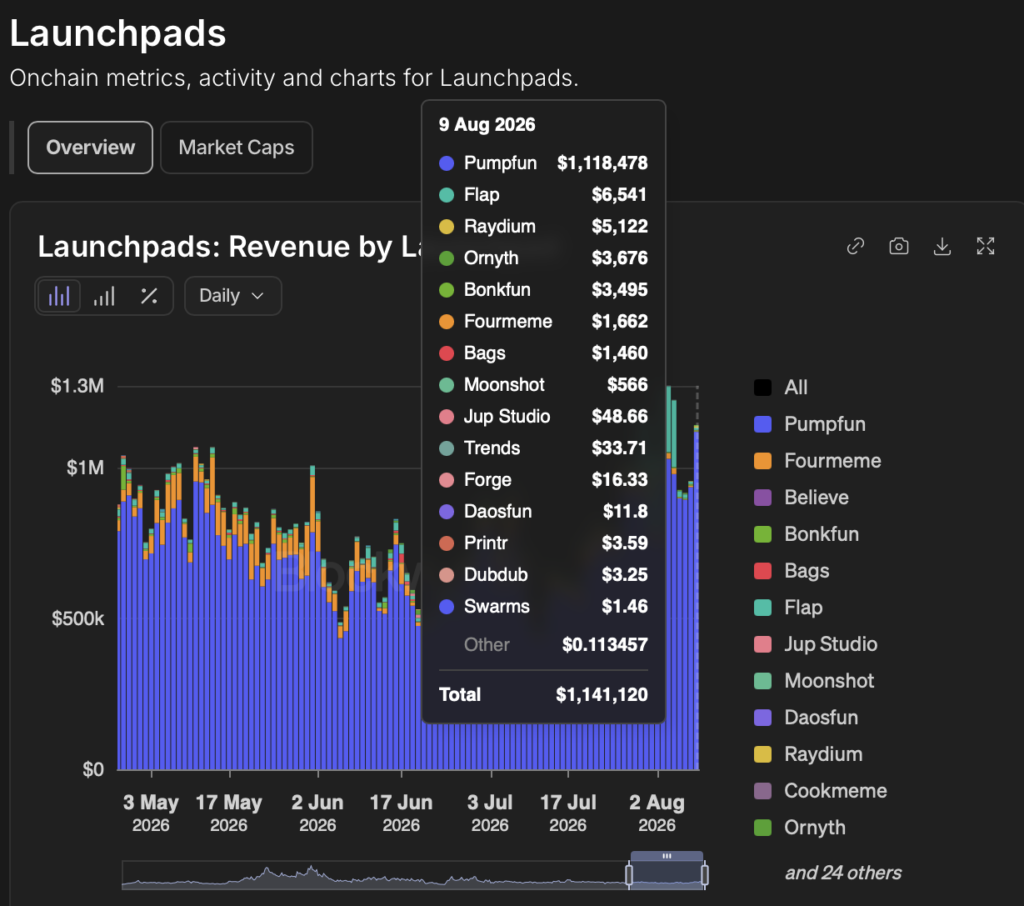
El 9 de agosto, Pump.fun obtuvo unos ingresos de 1.118.478 dólares. Al mismo tiempo, el resto de las plataformas de lanzamiento ganaron colectivamente 22.642 dólares. Por lo tanto, la plataforma de Solana se quedó con el 98% del total de 1.141.120 dólares que ganó toda la categoría ese día. Esto convierte la situación del mercado en la más desequilibrada desde abril de 2025, cuando había muchos menos proyectos.
Fuente: Blockworks

Los ingresos de Pump.fun, que alcanzaron los 1,1 millones de dólares en un día, también marcaron un máximo sin precedentes desde marzo, completando una recuperación que se había estado gestando durante varias semanas. El volumen de operaciones también siguió una tendencia similar. De los 649,61 millones de dólares vendidos ayer en todas las plataformas, 542,17 millones de dólares pasaron por Pump.fun.

En total, ese día se lanzaron 37.966 tokens en la plataforma Pump.fun, y 127 de ellos superaron una capitalización de mercado de 1 millón de dólares, lo que representa aproximadamente uno de cada 300.

Aparece Robinhood Chain, Solana sigue vendiendo todos los productos

Si observamos las cifras, la competencia parece bastante desigual. Flap ganó 6.541 dólares en el día, ocupando el segundo lugar después de Pump.fun. El lanzador de Raydium obtuvo 5.122 dólares, y BONKfun, considerado un competidor serio, especialmente en julio del año pasado, ganó 3.495 dólares.

Ha entrado en juego la red Robinhood Chain, y hay que vigilarla de cerca. El volumen de operaciones en las plataformas de esta red fue de 28,39 millones de dólares, aproximadamente el 4% del volumen diario total. Es loable, teniendo en cuenta que la red apenas lleva un mes desde su lanzamiento. Sin embargo, Solana sigue liderando con gran ventaja. Esta red representó 546,35 millones de dólares del volumen total diario de operaciones en las plataformas, frente a los 74,87 millones de dólares de BNB Chain, y casi cada dólar asociado a Solana puede rastrearse hasta una plataforma concreta.

El sector de los lanzadores existe desde hace más de dos años, y en ese tiempo han surgido nuevas redes y nuevos proyectos. De hecho, los datos actuales muestran que el dinero se ha vuelto a concentrar en un solo lugar.

De dónde vino realmente este volumen

Nada de esto sucedió de forma pasiva. El cambio de tendencia comenzó a finales de julio, cuando los pares de memecoins volvieron a alcanzar el 29% del volumen de operaciones al contado en los intercambios descentralizados de Solana, el nivel más alto desde agosto de 2025, y Pump.fun se convirtió en la plataforma principal que absorbía esta actividad. A esto le siguió una serie de cambios en productos e incentivos.

El 7 de agosto, Pump.fun lanzó una actualización de comercio social que añadía alertas de operaciones, operaciones sin comisiones e intercambios entre cadenas $USDC, acercando más el producto a una terminal de trading que a una fábrica de tokens.

¡El comercio social en la app Pumpfun ha alcanzado un nuevo nivel!

– Llamadas a tokens, alertando a CADA seguidor
– Operaciones sin comisiones
– Operaciones entre cadenas sin complicaciones con $USDC.

¡Aumenta tu número de seguidores ahora mismo 👇

— Pump.fun (@Pumpfun) 7 de agosto de 2026

La captación de usuarios también ha sido agresiva. FOMO es una plataforma de trading competidora en Solana, y Pump.fun ofreció inmediatamente a sus usuarios una bonificación por registro de 20.000 dólares, más 30.000 dólares mensuales por cambiarse de plataforma. Pagar por flujo de órdenes no es algo nuevo en criptomonedas, pero la escala de estos pagos en relación con los ingresos del sector es impresionante. Pump.fun gastó casi todos los ingresos mensuales de sus competidores solo para atraer a sus usuarios.

En cuanto a los tokens, el programa de recompra continúa en funcionamiento. La mitad de los ingresos de la plataforma sigue destinándose a la compra de PUMP, habiéndose recomprando tokens por valor de 3,73 millones de dólares en una sola semana. BOOST, que reinvierte la liquidez obtenida de las migraciones en nuevos lanzamientos, se promociona como el mecanismo de lanzamiento por defecto, en lugar de una opción oculta en la configuración.

Cada uno de estos factores es gradual por sí solo. En conjunto, a lo largo de varias semanas, explican por qué la brecha de volumen ha aumentado, en lugar de reducirse.

El 98% de un mercado mucho más pequeño

Para entender la cifra de dominio se necesita contexto. Con unos ingresos de 1,14 millones de dólares al día, los ingresos totales del sector de lanzadores son solo una fracción de lo que eran durante el pico de popularidad de las memecoins en 2024 y principios de 2025, cuando este segmento generaba regularmente entre 4 y 5,6 millones de dólares diarios.

Los ingresos de Pump.fun hoy no son muy diferentes de lo que sucedía de media en toda la industria hace 18 meses. Su cuota del 98% refleja tanto la reducción del número de competidores como el crecimiento. La categoría se ha reducido, y una plataforma ha absorbido la mayor parte del mercado restante.

Esta distinción es importante para cualquiera que interprete estas cifras como una señal de interés por parte de los inversores minoristas. La concentración no es lo mismo que la recuperación. Los lanzamientos de tokens siguen ocurriendo a gran escala, casi 38.000 al día, pero los ingresos que generan se han reducido drásticamente.

Trending Cryptos

Related Questions

Q¿Qué porcentaje de los ingresos diarios totales de los launchpads obtuvo Pump.fun el 9 de agosto, según el artículo?

AEl 9 de agosto, Pump.fun obtuvo el 98% de los ingresos totales de la categoría de launchpads, que fueron 1.141.120 dólares en total.

Q¿Cuál fue el volumen de transacciones que pasó por Pump.fun el día en que obtuvo ingresos récord?

AEl día en que Pump.fun obtuvo ingresos récord de 1.1 millones de dólares, un volumen de transacciones de 542.17 millones de dólares pasó por su plataforma.

QAdemás de los cambios en el producto, ¿qué estrategia agresiva utilizó Pump.fun para atraer usuarios de la plataforma competidora FOMO?

APump.fun ofreció un bono de registro de 20.000 dólares y 30.000 dólares mensuales por migrar a usuarios de la plataforma competidora FOMO.

QSegún el artículo, ¿en qué se diferencia la situación actual del mercado de launchpads de su período máximo en 2024-2025?

AAunque los lanzamientos de tokens siguen siendo numerosos (casi 38.000 por día), los ingresos totales del sector son solo una fracción de lo que eran durante el pico de 2024-2025, cuando se generaban entre 4 y 5.6 millones de dólares diarios.

Q¿Qué dos acciones clave realiza Pump.fun con sus ganancias y liquidez, según se menciona en el artículo?

APump.fun destina la mitad de sus ingresos a recomprar su token PUMP y promueve el mecanismo BOOST, que reinvierte la liquidez de las migraciones en nuevos lanzamientos, como opción por defecto.

Related Reads

Elon Musk Building Terafab: The Largest Chip Factory for AI, Robots, and Space Data Centers

Elon Musk's SpaceX and Tesla have launched the Terafab project to build a massive semiconductor facility in Grimes County, Texas. The plant, exceeding 9.3 million square meters, aims to integrate logic chip manufacturing, memory production, advanced packaging, and testing. The initial phase requires $16.8 billion in capital investment, with a long-term goal of producing over 1 terawatt of computing power annually. This capacity will support Tesla's Optimus robots and Cybercab autonomous vehicles, as well as SpaceX's orbital data centers. Texas Governor Greg Abbott confirmed the project's start in August 2026, highlighting 3,000 new jobs and a $30 million state grant. Elon Musk emphasized the strategic advantage of combining logic, memory, and packaging under one roof. Musk called the future complex the "largest and most valuable building on Earth," with an area roughly 50 times that of the Pentagon. Intel is the key technology partner, with plans to use its 14A process node for chip production. This partnership aims to diversify supply chains currently dominated by TSMC. The project aligns with the U.S. Pax Silica initiative to secure semiconductor supply chains. An AI analysis notes the project's scale and potential challenges, comparing it to delays seen in other U.S. megafab projects like Intel's Ohio facility. It questions whether Terafab can avoid similar pitfalls related to timelines, budgets, workforce, and supply chain stability. The facility's success could significantly shift the global semiconductor balance and strengthen the U.S. position in the tech race.

cryptonews.ru1h ago

Elon Musk Building Terafab: The Largest Chip Factory for AI, Robots, and Space Data Centers

cryptonews.ru1h ago

Elon Musk is Building Terafab: The Largest Chip Plant for AI, Robots, and Space Data Centers

Elon Musk's SpaceX and Tesla have launched the massive Terafab project to build a semiconductor plant in Grimes County, Texas. Spanning over 9.3 million square meters, the facility will integrate logic chip and memory production, advanced packaging, and testing. The initial phase requires $16.8 billion in capital investment, with a long-term goal of producing over 1 terawatt of computing power annually. This output is intended to supply Tesla's Optimus robots and Cybercab autonomous vehicles, as well as SpaceX's orbital data centers. Texas Governor Greg Abbott confirmed the project's start on August 6, 2026, highlighting the creation of 3,000 jobs and a $30 million grant from the Texas Enterprise Fund. Musk emphasized the strategic advantage of combining chip design, memory production, and packaging under one roof to accelerate hardware development. He stated the fully built complex would be "the largest and most valuable building on Earth," about 50 times larger than the Pentagon. An estimated 25% of production is earmarked for Tesla's robotics, with 75% for SpaceX's space-based AI systems. Earlier tax documents suggested a total project cost of up to $119 billion, but this has not been officially confirmed. Intel is the key technology partner, with plans to use its 14A process node for chip manufacturing. This partnership aims to diversify supply chains and reduce dependence on dominant foundries like TSMC. The initiative aligns with the broader U.S. Pax Silica program, which seeks to build secure international semiconductor supply chains with allied nations. An AI-driven analysis notes that megafab projects, such as Intel's delayed Ohio facility, often face schedule and budget overruns. While Terafab represents a significant step toward U.S. semiconductor self-sufficiency and could shift the global tech balance, its success will depend on factors like skilled labor availability, energy supply, and supply chain stability. The final outcome may not be clear until the late 2030s.

cryptonews.ru2h ago

Elon Musk is Building Terafab: The Largest Chip Plant for AI, Robots, and Space Data Centers

cryptonews.ru2h ago

Trading

Spot

Hot Articles

What is USDC(WORMHOLE)

USD Coin (Wormhole): A Comprehensive Overview Introduction In the rapidly evolving world of cryptocurrencies, USD Coin (Wormhole), referred to as $USDC(Wormhole), stands out as a pioneering solution within the DeFi (Decentralized Finance) landscape. Operating on several blockchain platforms, including Solana, USD Coin (Wormhole) is more than just a digital representation of the United States dollar. It embodies the innovative spirit of modern finance, enabling seamless cross-chain transactions and enhanced interoperability among diverse blockchain ecosystems through the advanced Wormhole protocol. What is USD Coin (Wormhole)? USD Coin (Wormhole) is a tokenized version of the US dollar designed to facilitate frictionless transactions across different blockchain networks. Its primary aim is to bolster liquidity and enhance the functionality of the DeFi ecosystem. By leveraging the Wormhole protocol, which establishes a robust cross-chain communication network, users can effortlessly transfer USDC tokens across various platforms. This cross-chain capability marks a significant advancement in cryptocurrency use, promoting a more interconnected and efficient ecosystem where assets can flow freely between different blockchains. The value proposition of USD Coin (Wormhole) lies not only in its stability, being pegged to the US dollar, but also in its ability to bridge gaps between disparate blockchain environments. This innovative approach fosters a greater level of participation among users and developers, paving the way for new and exciting applications within decentralized finance. Who is the creator of USD Coin (Wormhole)? The origins of USD Coin (Wormhole) are intricately tied to the Wormhole network, which was developed by Jump Crypto. While specific individual creators are not prominently documented, Jump Crypto is notable for its involvement in advancing blockchain technology and supporting its applications in finance. By creating the Wormhole network, Jump Crypto has played a vital role in promoting cross-chain asset transfers, enhancing the efficiency and diversity of cryptocurrency usage. Who are the investors of USD Coin (Wormhole)? The success of USD Coin (Wormhole) is supported by investments from several notable funds and organizations within the cryptocurrency realm. Key investors include: Coinbase Ventures: A prominent venture capital arm backed by one of the leading cryptocurrency exchanges in the industry, Coinbase Ventures provides essential capital and strategic support to promising blockchain projects. Arrington XRP Capital: Specializing in digital assets, Arrington XRP Capital recognizes the potential of innovative projects like USD Coin (Wormhole) and has invested accordingly to back its development. Jump Trading: As the parent organization of Jump Crypto, Jump Trading brings not only investment but a wealth of expertise in trading technology and market dynamics to bolster the Wormhole project. How Does USD Coin (Wormhole) Work? The operational framework of USD Coin (Wormhole) is intricately designed to facilitate effective cross-chain transactions, maximizing security and efficiency. Here’s a simplified overview of how it functions: Asset Locking: When a user wishes to transfer USDC from one blockchain to another, they first lock their tokens on the source blockchain. This process ensures that the assets are secure and are set to be either burned or moved later. Token Minting: After the tokens are locked, an equivalent amount of USDC is minted on the destination blockchain. This provides the user with access to their funds on a new platform, reflecting the flexibility that the Wormhole protocol enables. Cross-Chain Transfer: The Wormhole protocol efficiently facilitates the entire transfer process. It ensures that once the USDC is minted on the destination chain, the equivalent tokens are burned on the source chain. The result is a seamless transfer of value between two distinct blockchain environments. This cross-chain methodology ensures that transactions remain secure and transparent, significantly enhancing liquidity within the different DeFi ecosystems. Timeline of USD Coin (Wormhole) Understanding the evolution of USD Coin (Wormhole) provides vital context for its significance in the cryptocurrency arena. Here’s a timeline highlighting important milestones in the project’s history: 2021: The Wormhole project is launched, establishing a framework for cross-chain asset transfers and setting the stage for the development of USD Coin (Wormhole). 2022: The Wormhole network experiences a significant challenge with a security breach that results in a $325 million theft. However, the incident is later addressed and refunded by Jump Crypto, showcasing the project’s commitment to security and transparency. 2023: USD Coin (Wormhole) integrates with Circle’s Cross-Chain Transfer Protocol (CCTP), enhancing its capabilities for cross-chain transfers and further solidifying its place within the DeFi ecosystem. 2024: Ongoing development and expansion of the Wormhole network continue, aimed at increasing the utility and reach of USD Coin (Wormhole) as well as enhancing its operational framework. Key Features The success of USD Coin (Wormhole) can be attributed to several key features that differentiate it from other cryptocurrency offerings: Cross-Chain Interoperability At the core of USD Coin (Wormhole) is its ability to facilitate seamless transfers across multiple blockchain networks. This interoperability serves as a cornerstone for decentralized finance, allowing various platforms to interact with each other, thereby accelerating the evolution of financial services. Security Wormhole employs a well-designed Guardian Network comprised of node validators that ensure secure cross-chain transactions. This collective oversight minimizes the risk of fraud and provides users with confidence that their assets are protected during cross-chain transfers. Liquidity Enhancement By enabling USDC to circulate freely across different blockchains, USD Coin (Wormhole) enhances liquidity in the DeFi ecosystem. This increased liquidity can foster more efficient trading, contribute to better pricing strategies, and improve the overall market dynamics encompassing various digital assets. Conclusion USD Coin (Wormhole) is a pivotal innovation in the blockchain space, reinforcing the capabilities of decentralized finance (DeFi) and establishing a more connected financial ecosystem. With its robust framework for cross-chain transactions, security features, and strong backing from reputable investors, USD Coin (Wormhole) is positioned to play a key role in the future of cryptocurrency. As the digital finance landscape continues to evolve, USD Coin (Wormhole) not only embraces the future of interconnectivity among blockchain networks but also reaffirms the power of tokenization and blockchain technology in transforming how we perceive and utilize value in a digital world. By navigating the complexities of cross-chain functionality, it demonstrates a sophisticated approach to enabling financial inclusivity and innovation in the world of cryptocurrencies.

1.8k Total ViewsPublished 2024.04.01Updated 2024.12.03

What is USDC(WORMHOLE)

What is W$C

World$tateCoin ($W$C): A Comprehensive Exploration of the Emerging Cryptocurrency Project Introduction In the ever-evolving landscape of cryptocurrencies, World$tateCoin ($W$C) has emerged as a project that aims to harness the power of web3 technologies to create a distinctive digital ecosystem. As traditional models of online interaction undergo significant transformation, World$tateCoin seeks to establish itself in this budding third generation of the internet. This article will delve into the intricacies of World$tateCoin, providing an overview of the project, its objectives, and its potential impact on the web3 space. What is World$tateCoin ($W$C)? World$tateCoin ($W$C) is designed as a cryptocurrency that facilitates seamless transactions within a web3 environment. Aimed at creating a decentralized platform where users can interact with various web3 applications, $W$C intends to streamline user experience and enhance accessibility to digital services. While the project aspires to become an integral part of the web3 landscape, detailed insights into its specific objectives and use cases remain limited, raising questions regarding its potential role and utility in a rapidly advancing digital context. The essence of web3 revolves around decentralization and empowering users with greater control over their interactions online. World$tateCoin intends to align with these principles, although specific applications and functionalities of the currency are still under discussion within the community. Who is the Creator of World$tateCoin ($W$C)? In exploring the origins of World$tateCoin, information regarding its creator remains elusive. As of now, there is no publicly available data identifying the individuals or organizations behind the project. This obscurity may cast a shadow of uncertainty over the project’s credibility, but the commitment to innovation within the cryptocurrency framework could be a driving force for its adoption in the future. The lack of identifiable leadership may result in hurdles related to trust and transparency—elements that are crucial for establishing a strong community in the crypto space. Who are the Investors of World$tateCoin ($W$C)? Current research does not reveal any specific investors or backing organizations involved with World$tateCoin. It is not uncommon for emerging cryptocurrency projects to either attract discreet investments or operate in a minimalist financial structure during their initial phase. The ambiguity surrounding investment supports and funding methodologies could affect the project’s sustainability and growth prospects. When assessing new projects within the cryptocurrency domain, investors generally look for transparency regarding financial backing and support from established entities. The absence of this information might necessitate a cautious approach for potential users and stakeholders interested in the future of World$tateCoin. How Does World$tateCoin ($W$C) Work? The operational mechanics of World$tateCoin are grounded in the principles of decentralization, a hallmark of web3 technologies. By facilitating transactions directly between users without the intervention of intermediaries, $W$C is designed to enhance trust and efficiency. However, comprehensive documentation detailing the unique features and operational framework that distinguish World$tateCoin from other cryptocurrencies is markedly sparse. This lack of information complicates the understanding of how $W$C functions within the broader web3 ecosystem and what unique propositions it brings to users and developers alike. Nevertheless, the fundamental goal of allowing for decentralized transactions holds the promise of a more liberated financial landscape, should the project deliver on its aspirations of implementing robust mechanisms and user-friendly interfaces. Timeline of World$tateCoin ($W$C) Constructing a timeline that encapsulates the historical progression of World$tateCoin poses challenges due to an absence of significant documentation on key events and milestones. Nevertheless, an approximate sequence of hypothetical phases can be envisaged, constituting a path forward for the project: Initial Concept (Date Unknown): Conceptualization of the World$tateCoin framework in the broader context of web3 technologies. Development Phase (Date Unknown): Commencement of technical development and coding processes. Community Engagement (Date Unknown): Outreach to potential users and stakeholders to foster community interest in the project. Launch Target (Date Unknown): Announcing an expected launch date, contingent on the progress of development and testing phases. Due to the lack of substantiated dates and details surrounding these phases, stakeholders will need to remain vigilant and engaged with the project's communications for updates regarding its trajectory. Key Topics About World$tateCoin ($W$C) As the project unfolds, certain key subjects arise that embody the potential and aspirations of World$tateCoin: Decentralization: The core philosophy driving the project, aimed at fostering direct user interactions. Web3 Integration: The goal of mirroring web3 principles and enabling seamless user access to an array of digital services. Digital Currency: Positioned as a currency to facilitate internet-based transactions, World$tateCoin aims to inject additional liquidity into the web3 market. Challenge of Information Scarcity: The notable absence of detailed information regarding the project's foundations, creators, and operational methods, necessitating increased transparency from developers to build community trust. Conclusion World$tateCoin ($W$C) is positioned within an exciting yet uncertain terrain of cryptocurrency and web3 integration. While it aims to cultivate a decentralized environment, the limited availability of information regarding its creators, investors, and specific functionalities presents challenges for potential stakeholders and users. In the dynamic world of cryptocurrencies, transparency, engagement, and well-structured communication are vital for the success of projects such as World$tateCoin. As the landscape continues to evolve, stakeholders will be eager to see how the project can solidify its place within the web3 narrative and contribute to the ongoing transformation of the digital ecosystem.

1.5k Total ViewsPublished 2024.04.01Updated 2024.12.03

What is W$C

How to Buy W

Welcome to HTX.com! We've made purchasing Wormhole (W) simple and convenient. Follow our step-by-step guide to embark on your crypto journey.Step 1: Create Your HTX AccountUse your email or phone number to sign up for a free account on HTX. Experience a hassle-free registration journey and unlock all features.Get My AccountStep 2: Go to Buy Crypto and Choose Your Payment MethodCredit/Debit Card: Use your Visa or Mastercard to buy Wormhole (W) instantly.Balance: Use funds from your HTX account balance to trade seamlessly.Third Parties: We've added popular payment methods such as Google Pay and Apple Pay to enhance convenience.P2P: Trade directly with other users on HTX.Over-the-Counter (OTC): We offer tailor-made services and competitive exchange rates for traders.Step 3: Store Your Wormhole (W)After purchasing your Wormhole (W), store it in your HTX account. Alternatively, you can send it elsewhere via blockchain transfer or use it to trade other cryptocurrencies.Step 4: Trade Wormhole (W)Easily trade Wormhole (W) on HTX's spot market. Simply access your account, select your trading pair, execute your trades, and monitor in real-time. We offer a user-friendly experience for both beginners and seasoned traders.

6.7k Total ViewsPublished 2024.04.02Updated 2026.06.02

How to Buy W

Discussions

Welcome to the HTX Community. Here, you can stay informed about the latest platform developments and gain access to professional market insights. Users' opinions on the price of W (W) are presented below.

活动图片