Une stratégie transforme 1 690 BTC en un rachat de 108,6 millions de dollars de STRC

cointelegraphPublished on 2026-08-10Last updated on 2026-08-10

Abstract

La société Strategy, qui détient la plus grande trésorerie d'entreprise en Bitcoin, a poursuivi ses ventes hebdomadaires de BTC afin de racheter ses actions préférées STRC. Entre le 3 et le 9 août, elle a vendu 1 690 Bitcoins pour 108,6 millions de dollars, selon un dépôt auprès de la SEC. Les fonds ont été utilisés pour racheter 1,15 million d'actions STRC, une action privilégiée à dividende mensuel. Il s'agit de la quatrième vente de Bitcoin divulguée par Strategy en 2026, portant le total annuel à 6 948 BTC vendus. La société conserve toutefois un portefeuille de 840 447 BTC, achetés pour un prix moyen de 75 385 dollars par Bitcoin. La vente récente a été effectuée à un prix net moyen de 64 262 dollars par BTC. Strategy continue également de constituer sa réserve en dollars, qui s'élève désormais à 4,65 milliards de dollars, servant notamment de coussin pour les dividendes des actions privilégiées. Parallèlement, le cours de l'action STRC a rebondi, regagnant le niveau des 90 dollars après un repli en juin.

Strategy, qui détient le plus important trésor d'entreprise en Bitcoin, a vendu des BTC pour la deuxième semaine consécutive afin de racheter ses actions préférentielles STRC.

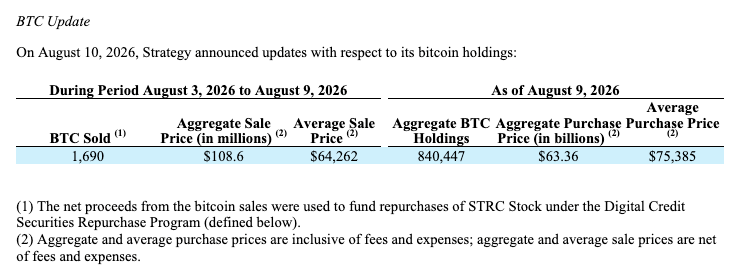
La société a vendu 1 690 Bitcoins pour 108,6 millions de dollars entre le 3 et le 9 août, selon un dépôt 8-K effectué lundi auprès de la Securities and Exchange Commission (SEC) américaine.

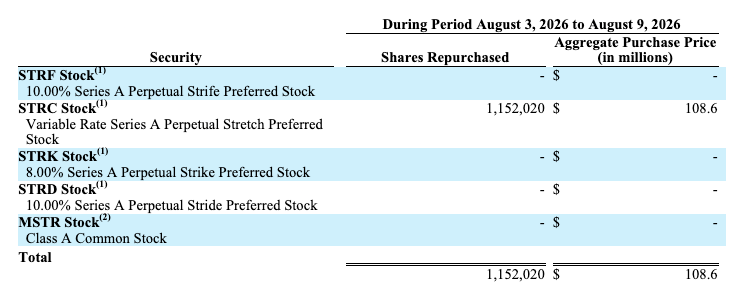
Strategy a utilisé le produit de la vente pour racheter 1,15 million d'actions de ses actions préférentielles STRC pour 108,6 millions de dollars. STRC est une action préférentielle à taux variable conçue pour verser des dividendes mensuels.

Cette transaction constitue la quatrième vente de Bitcoin déclarée par Strategy en 2026, portant le total de ses ventes de Bitcoin pour l'année à 6 948 BTC, tandis que l'entreprise détient toujours 840 447 BTC achetés pour un total de 63,36 milliards de dollars.

Le Bitcoin devient partie du moteur de financement

Strategy a vendu le dernier lot à un prix net moyen de 64 262 dollars par Bitcoin, tandis que la totalité de ses avoirs a été achetée à un prix d'acquisition moyen de 75 385 dollars par BTC, frais et dépenses inclus.

La vente précédente déclarée par Strategy concernait 1 638 BTC pour 104,73 millions de dollars entre le 27 juillet et le 2 août, où elle avait également utilisé le produit de la vente de Bitcoin pour financer des rachats de STRC.
Source : SEC

Le dernier dépôt montre que Strategy dispose encore de 785,2 millions de dollars dans le cadre de son programme de rachat de titres de crédit numérique, qui couvre ses actions préférentielles, tandis qu'un autre milliard de dollars reste disponible dans le cadre de son programme de rachat d'actions ordinaires de catégorie A.

Une réserve de 4,65 milliards de dollars amortit les dividendes préférentiels

Strategy a également continué à constituer sa réserve en dollars américains, faisant état d'un solde de 4,65 milliards de dollars au dimanche, contre environ 4 milliards dans la mise à jour hebdomadaire précédente.

La société a déclaré que 650 millions des 653,1 millions de dollars de produit net des ventes récentes d'actions MSTR étaient allées à la réserve, tandis que le dernier chiffre comprend également le produit attendu des ventes sur le marché (ATM) qui n'avaient pas encore été réglées.
Source : SEC

Les actions STRC ont également rebondi lors des rachats récents de Strategy, repassant au-dessus de 90 dollars le 3 août après un rebond de 24 % par rapport à leurs plus bas de juin.

Selon Yahoo Finance, STRC a progressé de 0,46 % à 95,45 dollars en négociation avant l'ouverture lundi, après avoir clôturé vendredi à 95 dollars, tandis que MSTR a gagné 0,25 % pour atteindre 100,26 dollars.

Magazine : Strategy est devenu un symbole de l'éclatement de la bulle Internet : l'histoire pourrait-elle se répéter ?


Trending Cryptos

Related Questions

QQuelle est la quantité de Bitcoin que Strategy a vendue entre le 3 et le 9 août, et quel était le montant total de la transaction ?

AStrategy a vendu 1 690 Bitcoin pour un montant total de 108,6 millions de dollars entre le 3 et le 9 août.

QQuel est l'objectif principal des ventes récentes de Bitcoin réalisées par Strategy ?

AL'objectif principal des ventes récentes de Bitcoin est d'utiliser les fonds pour racheter des actions privilégiées STRC de l'entreprise.

QÀ la suite des ventes de 2026, combien de Bitcoin Strategy détient-elle encore dans son trésor ?

AAprès les ventes de 2026, Strategy détient encore 840 447 Bitcoin dans son trésor.

QÀ quel prix moyen Strategy a-t-elle vendu le dernier lot de Bitcoin et quel est le prix d'achat moyen de l'ensemble de ses avoirs ?

AStrategy a vendu le dernier lot de Bitcoin à un prix net moyen de 64 262 dollars par Bitcoin. Le prix d'achat moyen de l'ensemble de ses avoirs est de 75 385 dollars par Bitcoin, frais et dépenses inclus.

QQuel est le solde de la réserve en dollars américains de Strategy, tel que rapporté dans l'article, et comment a-t-il évolué ?

ALe solde de la réserve en dollars américains de Strategy était de 4,65 milliards de dollars à la date de l'article, en augmentation par rapport aux environ 4 milliards de dollars de la mise à jour hebdomadaire précédente.

Related Reads

Elon Musk Building Terafab: The Largest Chip Factory for AI, Robots, and Space Data Centers

Elon Musk's SpaceX and Tesla have launched the Terafab project to build a massive semiconductor facility in Grimes County, Texas. The plant, exceeding 9.3 million square meters, aims to integrate logic chip manufacturing, memory production, advanced packaging, and testing. The initial phase requires $16.8 billion in capital investment, with a long-term goal of producing over 1 terawatt of computing power annually. This capacity will support Tesla's Optimus robots and Cybercab autonomous vehicles, as well as SpaceX's orbital data centers. Texas Governor Greg Abbott confirmed the project's start in August 2026, highlighting 3,000 new jobs and a $30 million state grant. Elon Musk emphasized the strategic advantage of combining logic, memory, and packaging under one roof. Musk called the future complex the "largest and most valuable building on Earth," with an area roughly 50 times that of the Pentagon. Intel is the key technology partner, with plans to use its 14A process node for chip production. This partnership aims to diversify supply chains currently dominated by TSMC. The project aligns with the U.S. Pax Silica initiative to secure semiconductor supply chains. An AI analysis notes the project's scale and potential challenges, comparing it to delays seen in other U.S. megafab projects like Intel's Ohio facility. It questions whether Terafab can avoid similar pitfalls related to timelines, budgets, workforce, and supply chain stability. The facility's success could significantly shift the global semiconductor balance and strengthen the U.S. position in the tech race.

cryptonews.ru2h ago

Elon Musk Building Terafab: The Largest Chip Factory for AI, Robots, and Space Data Centers

cryptonews.ru2h ago

Elon Musk is Building Terafab: The Largest Chip Plant for AI, Robots, and Space Data Centers

Elon Musk's SpaceX and Tesla have launched the massive Terafab project to build a semiconductor plant in Grimes County, Texas. Spanning over 9.3 million square meters, the facility will integrate logic chip and memory production, advanced packaging, and testing. The initial phase requires $16.8 billion in capital investment, with a long-term goal of producing over 1 terawatt of computing power annually. This output is intended to supply Tesla's Optimus robots and Cybercab autonomous vehicles, as well as SpaceX's orbital data centers. Texas Governor Greg Abbott confirmed the project's start on August 6, 2026, highlighting the creation of 3,000 jobs and a $30 million grant from the Texas Enterprise Fund. Musk emphasized the strategic advantage of combining chip design, memory production, and packaging under one roof to accelerate hardware development. He stated the fully built complex would be "the largest and most valuable building on Earth," about 50 times larger than the Pentagon. An estimated 25% of production is earmarked for Tesla's robotics, with 75% for SpaceX's space-based AI systems. Earlier tax documents suggested a total project cost of up to $119 billion, but this has not been officially confirmed. Intel is the key technology partner, with plans to use its 14A process node for chip manufacturing. This partnership aims to diversify supply chains and reduce dependence on dominant foundries like TSMC. The initiative aligns with the broader U.S. Pax Silica program, which seeks to build secure international semiconductor supply chains with allied nations. An AI-driven analysis notes that megafab projects, such as Intel's delayed Ohio facility, often face schedule and budget overruns. While Terafab represents a significant step toward U.S. semiconductor self-sufficiency and could shift the global tech balance, its success will depend on factors like skilled labor availability, energy supply, and supply chain stability. The final outcome may not be clear until the late 2030s.

cryptonews.ru3h ago

Elon Musk is Building Terafab: The Largest Chip Plant for AI, Robots, and Space Data Centers

cryptonews.ru3h ago

Trading

Spot

Hot Articles

What is $BITCOIN

DIGITAL GOLD ($BITCOIN): A Comprehensive Analysis Introduction to DIGITAL GOLD ($BITCOIN) DIGITAL GOLD ($BITCOIN) is a blockchain-based project operating on the Solana network, which aims to combine the characteristics of traditional precious metals with the innovation of decentralized technologies. While it shares a name with Bitcoin, often referred to as “digital gold” due to its perception as a store of value, DIGITAL GOLD is a separate token designed to create a unique ecosystem within the Web3 landscape. Its goal is to position itself as a viable alternative digital asset, although specifics regarding its applications and functionalities are still developing. What is DIGITAL GOLD ($BITCOIN)? DIGITAL GOLD ($BITCOIN) is a cryptocurrency token explicitly designed for use on the Solana blockchain. In contrast to Bitcoin, which provides a widely recognized value storage role, this token appears to focus on broader applications and characteristics. Notable aspects include: Blockchain Infrastructure: The token is built on the Solana blockchain, known for its capacity to handle high-speed and low-cost transactions. Supply Dynamics: DIGITAL GOLD has a maximum supply capped at 100 quadrillion tokens (100P $BITCOIN), although details regarding its circulating supply are currently undisclosed. Utility: While precise functionalities are not explicitly outlined, there are indications that the token could be utilized for various applications, potentially involving decentralized applications (dApps) or asset tokenization strategies. Who is the Creator of DIGITAL GOLD ($BITCOIN)? At present, the identity of the creators and development team behind DIGITAL GOLD ($BITCOIN) remains unknown. This situation is typical among many innovative projects within the blockchain space, particularly those aligning with decentralized finance and meme coin phenomena. While such anonymity may foster a community-driven culture, it intensifies concerns about governance and accountability. Who are the Investors of DIGITAL GOLD ($BITCOIN)? The available information indicates that DIGITAL GOLD ($BITCOIN) does not have any known institutional backers or prominent venture capital investments. The project seems to operate on a peer-to-peer model focused on community support and adoption rather than traditional funding routes. Its activity and liquidity are primarily situated on decentralized exchanges (DEXs), such as PumpSwap, rather than established centralized trading platforms, further highlighting its grassroots approach. How DIGITAL GOLD ($BITCOIN) Works The operational mechanics of DIGITAL GOLD ($BITCOIN) can be elaborated on based on its blockchain design and network attributes: Consensus Mechanism: By leveraging Solana’s unique proof-of-history (PoH) combined with a proof-of-stake (PoS) model, the project ensures efficient transaction validation contributing to the network's high performance. Tokenomics: While specific deflationary mechanisms have not been extensively detailed, the vast maximum token supply implies that it may cater to microtransactions or niche use cases that are still to be defined. Interoperability: There exists the potential for integration with Solana’s broader ecosystem, including various decentralized finance (DeFi) platforms. However, the details regarding specific integrations remain unspecified. Timeline of Key Events Here is a timeline that highlights significant milestones concerning DIGITAL GOLD ($BITCOIN): 2023: The initial deployment of the token occurs on the Solana blockchain, marked by its contract address. 2024: DIGITAL GOLD gains visibility as it becomes available for trading on decentralized exchanges like PumpSwap, allowing users to trade it against SOL. 2025: The project witnesses sporadic trading activity and potential interest in community-led engagements, although no noteworthy partnerships or technical advancements have been documented as of yet. Critical Analysis Strengths Scalability: The underlying Solana infrastructure supports high transaction volumes, which could enhance the utility of $BITCOIN in various transaction scenarios. Accessibility: The potential low trading price per token could attract retail investors, facilitating wider participation due to fractional ownership opportunities. Risks Lack of Transparency: The absence of publicly known backers, developers, or an audit process may yield skepticism regarding the project's sustainability and trustworthiness. Market Volatility: The trading activity is heavily reliant on speculative behavior, which can result in significant price volatility and uncertainty for investors. Conclusion DIGITAL GOLD ($BITCOIN) emerges as an intriguing yet ambiguous project within the rapidly evolving Solana ecosystem. While it attempts to leverage the “digital gold” narrative, its departure from Bitcoin's established role as a store of value underscores the need for a clearer differentiation of its intended utility and governance structure. Future acceptance and adoption will likely depend on addressing the current opacity and defining its operational and economic strategies more explicitly. Note: This report encompasses synthesised information available as of October 2023, and developments may have transpired beyond the research period.

1.9k Total ViewsPublished 2025.05.13Updated 2025.05.13

What is $BITCOIN

Discussions

Welcome to the HTX Community. Here, you can stay informed about the latest platform developments and gain access to professional market insights. Users' opinions on the price of BTC (BTC) are presented below.

活动图片