By: Lin Zhengying
At 4:30 AM on August 7, 2026, the 911 call center in Asuncion, the capital of Paraguay, received a call: a body was lying outside the upscale apartment building Jade Park in the Trinidad district.
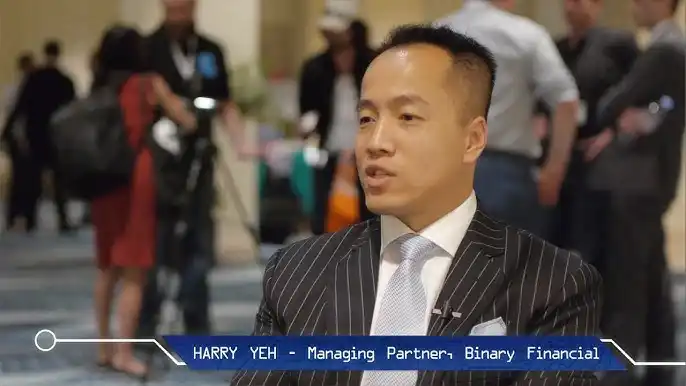
The scene that met the police was bizarre: the deceased was completely naked, covered with a black plastic bag, having apparently fallen from roughly the 100-meter-high 30th floor. The victim was quickly preliminarily identified as Harry Chun Tak Yeh, Chinese name Ye Junde, founder and managing partner of the cryptocurrency fund Quantum Fintech Group, a self-proclaimed Chinese-Canadian crypto investor managing over $2.4 billion in assets.
Investigators went up to the 30th floor and found the door to his apartment wide open, the interior ransacked, but completely empty.
He owned another apartment on the 27th floor of the same building, occupied by his 29-year-old Brazilian girlfriend, Isadora de Proenca Braganholo Carvalho. Questioned by prosecutors, she claimed to know nothing; the police have not publicly charged her with any wrongdoing.
After leading the investigation, prosecutor María del Carmen Palazón stated that accident, suicide, and homicide are all being considered as possibilities, pending the results of the autopsy.
$500 Entry
Harry Yeh's rise to wealth followed the most classic script in the crypto world.
Born in Hong Kong, he immigrated to Canada with his family as a child. He earned a bachelor's in Electrical Engineering from UC Berkeley and later an MBA from Stanford Graduate School of Business—at least, that's the resume he presented publicly.
Before entering the crypto space, he followed the standard Silicon Valley elite path: an engineer by background, he served as CTO and co-founder for several startups, ran a tech consulting firm, and worked with institutions generating revenues from $5 million to $200 million.
In 2013, when Bitcoin was hovering around $60, Yeh used $500 to buy his first BTC. That same year, he started his first fund with $250,000, founding the venture capital firm Binary Financial, which after several name changes became Quantum Fintech Group.
It was a pioneering era. Engaging in crypto OTC trading and managing hedge funds for high-net-worth clients, Yeh rode the entire curve of Bitcoin from $60 to tens of thousands of dollars. By 2023, he and his team claimed to manage a hedge fund and private investment network exceeding $2.4 billion in assets.
He began appearing frequently in the industry spotlight: discussing Bitcoin forks and ICOs on CNBC as early as 2017, appearing on Bloomberg's crypto show in 2022 calling Bitcoin "digital gold," and sharing stages with figures like Mark Cuban and Tether co-founder Craig Sellars. He also took over the production teams for The North American Bitcoin Conference (TNABC) and the Fantom Developer Conference, launching his own Quantum Miami conference, where the Mayor of Miami personally showed support.

Pinnacle Moment: Four Months, $2.5M to $1.6B
The most legendary "investment" of Yeh's career happened within the Fantom ecosystem.
Fantom was one of the hottest blockchains during the "DeFi Summer" of 2021, built by the so-called "DeFi Godfather," Andre Cronje. In September 2021, the algorithmic stablecoin project Tomb Finance on Fantom faced a crisis of trust due to a vulnerability event called "Gatekeeper" and was on the verge of collapse. Yeh stepped in to lead the team in his capacity as a member of the Fantom Foundation.
The next four months were a magical time for Tomb Finance: its Total Value Locked (TVL) skyrocketed from $2.5 million to a peak of $1.6 billion, an increase of nearly 80 times within two months, making it the most dazzling project in the Fantom ecosystem.
This victory cemented Yeh's status within the Fantom circle.
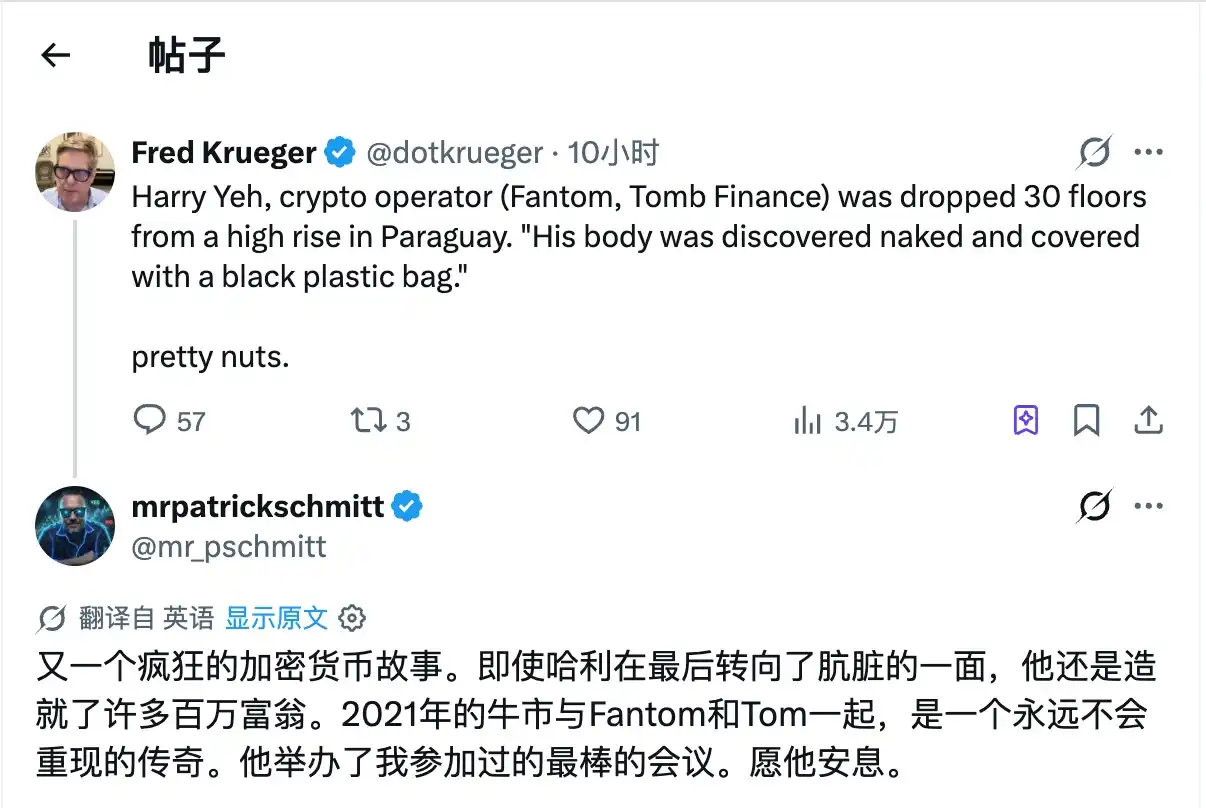
Someone on X reminisced: "Even though Harry turned to the dark side towards the end, he still created many millionaires. The 2021 bull run on Fantom and Tomb was a legendary time that will never be repeated. He hosted the best conference I ever attended. May he rest in peace."
His team subsequently incubated the LIF3 ecosystem, a blockchain focused on DeFi, and L3 Reserve, which issued the L3USD stablecoin asset. His personal website listed an investment portfolio densely centered around the Fantom ecosystem.
As recently as November 2024, he was still promoting LIF3: partnering with Web3 phone company Jambo to pre-install the Lif3 app on the $99 JamboPhone, claiming to bring crypto payments to users in over 120 countries.
At that time, his primary residence was Abu Dhabi, and he appeared on Dubai Crypto Oasis's "2024 Visionaries" list.
Why Die in Paraguay?
This is the most unsettling part of the entire story.
Why was a crypto magnate primarily residing in Abu Dhabi, with a professional footprint spanning Miami and Dubai, found in an apartment building in Asuncion, and why did he fall from a height completely naked?
Several details from the scene (open door, ransacked interior, naked victim) quickly led crypto community discussions to focus on one term: wrench attack.
This concept comes from an old saying in security circles: the strongest encryption can't withstand a $5 wrench. Attackers don't target code; they target the physical person, using violence or the threat of violence to force crypto holders to surrender wallet access, transfer funds, or private keys.
Just one day before Yeh's death, on August 6, blockchain analysis firm Chainalysis released a report: in the first half of 2026, 46 confirmed wrench attacks targeting crypto holders globally resulted in over $30 million stolen. At this rate, the year would break the 2025 record of $58 million.
Including attempted transfers and ransom amounts, the exposure so far this year is close to $107 million, with home invasions accounting for 37% of all wrench attacks, a new high for the year.
A crypto billionaire who publicly claimed to manage $2.4 billion, frequently appearing at conferences and on television, would be the ideal target for wrench attackers.
Of course, the possibilities of suicide and accident have not been ruled out.
The wealth rollercoaster of the crypto industry is enough to break anyone. Algorithmic stablecoin projects like Tomb Finance largely collapsed after the 2022 bear market, and the Fantom ecosystem also experienced its darkest moments with Andre Cronje's departure and evaporated TVL. How much of Yeh's self-proclaimed "$2.4 billion" in assets could withstand the bear market and proper auditing is unknown to the outside world.
A naked fall and a messy room could also point to a chaotic and lonely final night.
Currently, Paraguayan prosecutors have not released any evidence linking any party to the fall. The autopsy results will be key to unraveling the mystery.
Harry Yeh's life is a microcosm of the crypto industry's golden age: an engineer entering the field, placing a $500 bet, catching Bitcoin's steepest decade-long rise, creating a $1.6 billion myth in four months during the DeFi frenzy, hosting conferences, appearing on Bloomberg, and toasting with mayors.
But the safety lessons this industry teaches are all about asset security: cold wallets, multi-signature, hardware devices. As code becomes harder for hackers to crack, crime has shifted to the physical. In recent years, more and more crypto moguls have been targeted where they live long-term due to flaunting wealth.
In 2013, Bitcoin at $60 gave Harry Yeh everything; at 4:30 AM on August 7, 2026, the 100-meter height in Asuncion took it all back.
He once said in an interview: "The best investors know that great fortunes are born in bear markets." Only this time, he wouldn't live to see the next bull run.
(The factual information in this article is based on public reports; the individual's stated asset scale is according to their own claims. The case is still under investigation, and final conclusions are subject to autopsy and investigation results from Paraguayan judicial authorities.)