XDC Tech integra la plataforma de stablecoins de Bridge para llevar la liquidación de stablecoins on-chain al comercio con IA agencial

cointelegraphPublished on 2026-08-03Last updated on 2026-08-03

Abstract

XDC Tech, la rama institucional en EE. UU. de XDC Network, ha integrado la plataforma de infraestructura de stablecoins Bridge, una empresa de Stripe. Esta integración proporciona a los desarrolladores de XDC acceso directo a herramientas para convertir entre efectivo y stablecoins, cuentas virtuales y custodia multi-moneda, sin necesidad de construir una capa de cumplimiento normativo propio. El caso de uso principal son los pagos. Las empresas pueden aceptar dólares, euros y otras divisas fiduciarias a través de las cuentas virtuales de Bridge y recibir liquidación en stablecoins en XDC casi en tiempo real, eliminando bancos corresponsales y largas compensaciones. Esto ya funciona en finanzas comerciales y se extiende a activos tokenizados. La asociación es fundamental para el objetivo de XDC de ser la capa de liquidación para la economía agéntica, donde los agentes de IA autónomos realizan transacciones a velocidad de máquina. Bridge aporta: 1. Liquidación a velocidad de máquina para agentes autónomos. 2. Acceso regulado a canales fiduciarios en EE. UU., UE y Latinoamérica. 3. Cuentas virtuales que actúan como carteras nativas para agentes. 4. Custodia multi-moneda para comercio agéntico transfronterizo. 5. Soporte para finanzas comerciales y activos tokenizados dirigidos por agentes. 6. Cumplimiento normativo integrado (KYC/KYB) para pagos autónomos. La integración, disponible a través de los portales de desarrolladores de XDC y Bridge, combina la velocidad, bajo...

Nueva York, 3 de agosto de 2026 – XDC Tech, la rama institucional estadounidense de XDC Network, anunció una integración crítica con Bridge, la principal plataforma de infraestructura de stablecoins y una empresa de Stripe. La integración brinda a los desarrolladores que construyen en XDC acceso directo a las herramientas de Bridge para convertir entre efectivo y stablecoins, conocidas como on- y off-ramps, junto con cuentas virtuales y custodia multicurrency, sin que los desarrolladores tengan que construir esa capa de cumplimiento por sí mismos.
El caso de uso principal son los pagos. Las empresas pueden aceptar dólares, euros y otras monedas fiduciarias a través de las cuentas virtuales de Bridge y recibir la liquidación en stablecoins en XDC casi en tiempo real, eliminando a los bancos corresponsales y la compensación de varios días. Esto ya funciona en finanzas comerciales, donde exportadores e importadores en la plataforma de XDC liquidan facturas en stablecoins como USDC en lugar de esperar días por transferencias bancarias, y se extiende a activos tokenizados, donde los emisores pueden aceptar inversiones de compradores y procesar retiros en moneda regular a través de las mismas on- y off-ramps.

Bridge posee licencias en Estados Unidos, la UE y América Latina. La integración sitúa la red de finanzas comerciales de XDC dentro de ese sistema de pagos regulado, en un momento en que los bancos y las fintech siguen siendo selectivos sobre en qué redes blockchain construyen.

Cómo esto acelera el camino de XDC hacia la IA agencial y los pagos

La asociación con Bridge no es una integración aislada; es una pieza fundamental de la hoja de ruta de XDC para convertirse en la capa de liquidación para la economía agencial, donde los agentes de IA autónomos transan con otros agentes, empresas y humanos a velocidad de máquina. A continuación, se explica cómo cada capacidad entregada a través de Bridge se alinea directamente con el viaje de IA Agencial y pagos de XDC.

1. Liquidación a Velocidad de Máquina para Agentes Autónomos

Los agentes de IA que toman miles de microdecisiones por segundo no pueden esperar 2-3 días hábiles a que un banco corresponsal liquide una transferencia. XDC finaliza transacciones en ~2 segundos con tarifas inferiores a una centésima de centavo, y las on/off-ramps de Bridge traducen esa finalidad en dinero fiduciario real al instante. El resultado: un agente puede cotizar, negociar, pagar y conciliar dentro de una sola sesión de usuario, la línea base operativa que cualquier red creíble de comercio agencial necesita.

2. Vías de Dinero Fiduciario Reguladas

Los agentes autónomos solo son útiles si pueden pagar a proveedores reales y ser pagados por clientes reales en monedas reales. La huella licenciada de Bridge en Estados Unidos, la UE y América Latina brinda a los agentes basados en XDC acceso conforme a las vías de dinero fiduciario USD, EUR y LATAM desde el momento de su despliegue, sin necesidad de asociaciones bancarias personalizadas, solicitudes de transmisión de dinero ni construcciones jurisdicción por jurisdicción. Esto reduce el tiempo de llegada al mercado para cualquier producto agencial de años a semanas.

3. Cuentas Virtuales como Carteras Nativas de Agentes

Las cuentas virtuales de Bridge permiten que cada agente de IA, o cada flujo de trabajo que ejecuta un agente, tenga su propio endpoint IBAN/ACH dedicado que se liquida en stablecoins en XDC. Por lo tanto, los agentes pueden recibir dinero fiduciario de clientes, mantener valor en stablecoins para lógica programable y realizar pagos en dinero fiduciario a contrapartes, todo bajo una única identidad reconciliable. Este es el primitivo faltante que convierte a un "asistente" de IA en un actor económico real.

4. Custodia Multicurrency para el Comercio Agencial Transfronterizo

Un agente que orquesta una cadena de suministro global puede necesitar mantener saldos en USD, EUR y stablecoins simultáneamente. La custodia multicurrency de Bridge, conectada directamente al stack de desarrolladores de XDC, permite a los agentes cubrirse, consolidar y liquidar entre monedas de manera programática. Combinado con el cumplimiento ISO 20022 de XDC, los pagos iniciados por agentes llevan el mismo mensaje estructurado que SWIFT, SEPA y FedNow esperan, lo que significa que las transacciones de agentes pueden fluir hacia los sistemas ERP y de tesorería empresariales sin capas de traducción.

5. Finanzas Comerciales Agenciales y Activos Reales Tokenizados

XDC ya impulsa miles de millones en flujos de finanzas comerciales. Con Bridge adjunto, ahora se puede dar autoridad delegada a agentes de IA para confirmar facturas, liberar pagos contra hitos de envío y comprar/vender cuentas por cobrar tokenizadas, liquidando en USDC en XDC y convirtiendo a dinero fiduciario en cualquiera de los extremos. La misma vía admite la incorporación de inversores impulsada por agentes para activos tokenizados: dinero fiduciario entrante vía Bridge, tokens emitidos en XDC, redenciones de vuelta a dinero fiduciario bajo demanda.

6. Cumplimiento por Diseño para Pagos Autónomos

El mayor obstáculo para los pagos de agentes autónomos no es la tecnología, es el cumplimiento normativo. La integración hace que el KYC/KYB, la verificación de sanciones y la custodia regulada de Bridge sean heredadas por cada aplicación de XDC. Esto significa que los pagos iniciados por agentes son auditables, rastreables y defendibles ante un regulador desde el primer día, lo que separará las redes agenciales que escalan de las que son clausuradas.

"Cada capa de las finanzas se está reconstruyendo para un mundo donde el software, no solo las personas, inicia el pago. Esta asociación le da a nuestro ecosistema una infraestructura de stablecoins que ya cumple con ese listón. Es una parte de una construcción más amplia que aún no estamos listos para detallar, apuntando directamente a la economía agencial", dice Atul Khekade, Co-Fundador de XDC Network.

"Las redes que finalmente importarán más para la liquidación de stablecoins serán las construidas para la velocidad y la finalidad desde el primer día. La infraestructura de XDC es exactamente el tipo de base que este espacio necesita a medida que los volúmenes de stablecoins siguen aumentando", dice Mai Leduc Blount, Jefa de Producto en Bridge.

Según la compañía, XDC liquida más de 2.000 transacciones por segundo con tarifas inferiores a una centésima de centavo, finalizando transacciones en dos segundos. La alineación de XDC con el estándar de mensajería ISO 20022 está destinada a ayudarlo a conectarse con sistemas como SWIFT, SEPA y FedNow.

La integración estará disponible para desarrolladores y empresas que construyan sobre XDC, con documentación y acceso a sandbox disponibles a través del Portal de Desarrolladores de XDC en xdc.tech y a través de Bridge en bridge.xyz.

Acerca de XDC Tech

XDC Tech es la infraestructura institucional con sede en EE. UU. en XDC Network que abarca liquidaciones, pagos, comercio agencial, tokenización y finanzas comerciales.

Acerca de XDC Network XDC Network es una blockchain Layer-1 de código abierto compatible con EVM, construida para pagos, finanzas comerciales, Comercio Agencial y activos reales, que ofrece alto rendimiento, tarifas bajas y seguridad de grado empresarial, a la vez que cumple con ISO 20022 para admitir interoperabilidad con sistemas de mensajería financiera global y sistemas de pago de comercio agencial con IA. XDC Network sustenta un ecosistema creciente de soluciones reguladas de dinero digital, comercio y liquidación en todo el mundo.

Acerca de Bridge, una empresa de Stripe

Bridge es la principal plataforma de infraestructura de stablecoins para mover dinero globalmente. Las empresas usan Bridge para recibir, almacenar, convertir, emitir y gastar stablecoins fácilmente, permitiéndoles servir nuevos mercados y mover dinero más rápido y económico a través de las fronteras. Bridge fue adquirida por Stripe en febrero de 2025.

Contacto para medios

XDC Tech EE.UU.
media@xdc.tech

Trending Cryptos

Related Questions

Q¿Qué anunció XDC Tech en su asociación con Bridge y qué beneficios ofrece esta integración a los desarrolladores?

AXDC Tech anunció una integración crítica con Bridge, la principal plataforma de infraestructura de stablecoins. Esta integración ofrece a los desarrolladores que construyen en XDC acceso directo a las herramientas de Bridge para convertir entre efectivo y stablecoins (rampas de entrada y salida), junto con cuentas virtuales y custodia multi-moneda, sin necesidad de que los desarrolladores construyan esa capa de cumplimiento normativo por sí mismos.

Q¿Cuál es el caso de uso principal de esta integración y cómo mejora los procesos de pago en sectores como las finanzas comerciales?

AEl caso de uso principal es los pagos. Las empresas pueden aceptar dólares, euros y otras monedas fiduciarias a través de las cuentas virtuales de Bridge y recibir liquidación en stablecoins en XDC casi en tiempo real, eliminando a los bancos corresponsales y la compensación de varios días. Esto ya funciona en finanzas comerciales, donde exportadores e importadores en la plataforma de XDC liquidan facturas en stablecoins como USDC en lugar de esperar días por transferencias bancarias, y se extiende a activos tokenizados.

QSegún el artículo, ¿cómo acelera esta asociación la hoja de ruta de XDC hacia la 'economía agéntica'?

ALa asociación con Bridge es una pieza fundamental de la hoja de ruta de XDC para convertirse en la capa de liquidación para la economía agéntica. Acelera este viaje proporcionando: Liquidación a velocidad de máquina para agentes autónomos, acceso a vías fiduciarias reguladas, cuentas virtuales que funcionan como carteras nativas para agentes, custodia multi-moneda para comercio transfronterizo, capacidades para finanzas comerciales agénticas y activos tokenizados, y cumplimiento normativo integrado desde el diseño para pagos autónomos.

Q¿Qué ventajas específicas ofrece la infraestructura de Bridge para que los agentes de IA funcionen como actores económicos reales?

ABridge permite que cada agente de IA tenga su propio endpoint bancario dedicado (IBAN/ACH) a través de cuentas virtuales, que se liquidan en stablecoins en XDC. Esto permite a los agentes recibir dinero fiduciario de clientes, mantener valor en stablecoins para lógica programable y pagar en fiduciario a contrapartes, todo bajo una única identidad reconciliable. Esta es la primitiva faltante que convierte a un 'asistente' de IA en un actor económico real.

Q¿Cuáles son las capacidades técnicas clave de la Red XDC que la hacen adecuada para este rol, según se menciona en el comunicado?

ASegún la compañía, XDC finaliza transacciones en aproximadamente 2 segundos con tarifas inferiores a una centésima de centavo, y puede manejar más de 2000 transacciones por segundo. Su alineación con el estándar de mensajería ISO 20022 está diseñada para ayudarla a conectarse con sistemas como SWIFT, SEPA y FedNow, permitiendo que los pagos iniciados por agentes fluyan a sistemas empresariales ERP y de tesorería sin capas de traducción.

Related Reads

XRP Ledger Active Users Approach 200,000

The number of daily active users on the XRP Ledger is approaching 200,000, one of the highest levels in recent months. Despite XRP continuing to trade below key technical resistance, on-chain data shows accelerated network activity, suggesting growing ecosystem usage even as price momentum remains subdued. The increase to roughly 190,800 daily active users has been sustained through late July, marking a significant recovery from levels around 100,000 during the broader market correction. This rise indicates user return driven by sustained engagement rather than just speculative trading. Higher address activity typically reflects broader blockchain adoption and can boost transaction counts, payment volumes, and dApp liquidity—considered healthier indicators than price fluctuations. However, XRP's price has not mirrored this network improvement, currently trading near $1.07 and struggling to break resistance at $1.10. It remains below its 50-day and 100-day moving averages, with a recent attempt to break out of a symmetrical triangle losing momentum. The technical outlook remains mixed; while blockchain activity shows improving fundamentals, price action lacks confirmation of a broader recovery. A decisive break above the 200-day moving average near $1.21 is needed to strengthen the long-term technical outlook. Momentum indicators like the RSI, around 47, show a balanced forecast with reduced selling pressure. In conclusion, XRP Ledger user activity nears a yearly high despite the asset's price being below major technical barriers. Sustained user growth, coupled with a price recovery above key moving averages, could begin to align the technical structure with the strengthening on-chain fundamentals.

cryptonews.ru48m ago

XRP Ledger Active Users Approach 200,000

cryptonews.ru48m ago

ZEC Price Just Surpassed $490 — Here's What Fueled the Rally

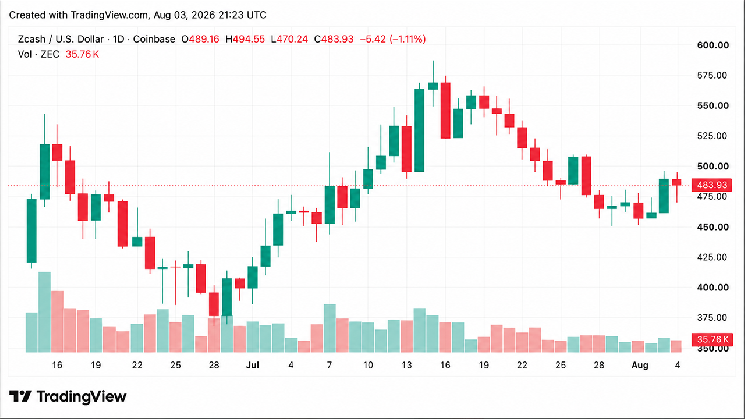
ZEC Surges Past $490, Key Drivers Behind the Rally On August 3, the privacy-focused cryptocurrency Zcash (ZEC) surged nearly 5%, climbing over $20 in a six-hour rally to a session high near $494. This move helped ZEC's market cap reclaim $8 billion, solidifying its position as the most valuable privacy coin and marking an almost 8% gain for the month. While benefiting from a broader market uptrend, ZEC's outperformance was driven by significant fundamental catalysts. The primary driver was the integration by privacy infrastructure project Nym of Zcash's new shielded pool, Ironwood. This enables direct, end-to-end private payments in ZEC for network services, a landmark development for privacy-first decentralized finance. The rally coincides with renewed industry focus on privacy as digital assets mature. Industry observers note privacy is becoming the "next frontier," evolving from Bitcoin's proof-of-concept to Ethereum's programmability and Solana's scalability. Commentary highlighted that true privacy, via zero-knowledge (ZK) technology which is now production-ready, was a foundational goal for early crypto pioneers. Further momentum came from Zcash's progress in decentralized governance, launching a retroactive grant funding (RetroPGF-like) program. This shifts treasury fund distribution from closed committees to direct coin holder voting, pioneering a privacy-native funding mechanism. ZEC's surge helped push the total market capitalization of privacy-focused coins above $30 billion. Other notable gainers included NEAR, ZK, and NOCK. However, losses in coins like ZANO, ZBT, and a significant drop in last week's leader COTI partially offset the sector's overall gains.

cryptonews.ru1h ago

ZEC Price Just Surpassed $490 — Here's What Fueled the Rally

cryptonews.ru1h ago

Trading

Spot

Hot Articles

What is SONIC

Sonic: Pioneering the Future of Gaming in Web3 Introduction to Sonic In the ever-evolving landscape of Web3, the gaming industry stands out as one of the most dynamic and promising sectors. At the forefront of this revolution is Sonic, a project designed to amplify the gaming ecosystem on the Solana blockchain. Leveraging cutting-edge technology, Sonic aims to deliver an unparalleled gaming experience by efficiently processing millions of requests per second, ensuring that players enjoy seamless gameplay while maintaining low transaction costs. This article delves into the intricate details of Sonic, exploring its creators, funding sources, operational mechanics, and the timeline of significant events that have shaped its journey. What is Sonic? Sonic is an innovative layer-2 network that operates atop the Solana blockchain, specifically tailored to enhance the existing Solana gaming ecosystem. It accomplishes this through a customised, VM-agnostic game engine paired with a HyperGrid interpreter, facilitating sovereign game economies that roll up back to the Solana platform. The primary goals of Sonic include: Enhanced Gaming Experiences: Sonic is committed to offering lightning-fast on-chain gameplay, allowing players and developers to engage with games at previously unattainable speeds. Atomic Interoperability: This feature enables transactions to be executed within Sonic without the need to redeploy Solana programmes and accounts. This makes the process more efficient and directly benefits from Solana Layer1 services and liquidity. Seamless Deployment: Sonic allows developers to write for Ethereum Virtual Machine (EVM) based systems and execute them on Solana’s SVM infrastructure. This interoperability is crucial for attracting a broader range of dApps and decentralised applications to the platform. Support for Developers: By offering native composable gaming primitives and extensible data types - dining within the Entity-Component-System (ECS) framework - game creators can craft intricate business logic with ease. Overall, Sonic's unique approach not only caters to players but also provides an accessible and low-cost environment for developers to innovate and thrive. Creator of Sonic The information regarding the creator of Sonic is somewhat ambiguous. However, it is known that Sonic's SVM is owned by the company Mirror World. The absence of detailed information about the individuals behind Sonic reflects a common trend in several Web3 projects, where collective efforts and partnerships often overshadow individual contributions. Investors of Sonic Sonic has garnered considerable attention and support from various investors within the crypto and gaming sectors. Notably, the project raised an impressive $12 million during its Series A funding round. The round was led by BITKRAFT Ventures, with other notable investors including Galaxy, Okx Ventures, Interactive, Big Brain Holdings, and Mirana. This financial backing signifies the confidence that investment foundations have in Sonic’s potential to revolutionise the Web3 gaming landscape, further validating its innovative approaches and technologies. How Does Sonic Work? Sonic utilises the HyperGrid framework, a sophisticated parallel processing mechanism that enhances its scalability and customisability. Here are the core features that set Sonic apart: Lightning Speed at Low Costs: Sonic offers one of the fastest on-chain gaming experiences compared to other Layer-1 solutions, powered by the scalability of Solana’s virtual machine (SVM). Atomic Interoperability: Sonic enables transaction execution without redeployment of Solana programmes and accounts, effectively streamlining the interaction between users and the blockchain. EVM Compatibility: Developers can effortlessly migrate decentralised applications from EVM chains to the Solana environment using Sonic’s HyperGrid interpreter, increasing the accessibility and integration of various dApps. Ecosystem Support for Developers: By exposing native composable gaming primitives, Sonic facilitates a sandbox-like environment where developers can experiment and implement business logic, greatly enhancing the overall development experience. Monetisation Infrastructure: Sonic natively supports growth and monetisation efforts, providing frameworks for traffic generation, payments, and settlements, thereby ensuring that gaming projects are not only viable but also sustainable financially. Timeline of Sonic The evolution of Sonic has been marked by several key milestones. Below is a brief timeline highlighting critical events in the project's history: 2022: The Sonic cryptocurrency was officially launched, marking the beginning of its journey in the Web3 gaming arena. 2024: June: Sonic SVM successfully raised $12 million in a Series A funding round. This investment allowed Sonic to further develop its platform and expand its offerings. August: The launch of the Sonic Odyssey testnet provided users with the first opportunity to engage with the platform, offering interactive activities such as collecting rings—a nod to gaming nostalgia. October: SonicX, an innovative crypto game integrated with Solana, made its debut on TikTok, capturing the attention of over 120,000 users within a short span. This integration illustrated Sonic’s commitment to reaching a broader, global audience and showcased the potential of blockchain gaming. Key Points Sonic SVM is a revolutionary layer-2 network on Solana explicitly designed to enhance the GameFi landscape, demonstrating great potential for future development. HyperGrid Framework empowers Sonic by introducing horizontal scaling capabilities, ensuring that the network can handle the demands of Web3 gaming. Integration with Social Platforms: The successful launch of SonicX on TikTok displays Sonic’s strategy to leverage social media platforms to engage users, exponentially increasing the exposure and reach of its projects. Investment Confidence: The substantial funding from BITKRAFT Ventures, among others, emphasizes the robust backing Sonic has, paving the way for its ambitious future. In conclusion, Sonic encapsulates the essence of Web3 gaming innovation, striking a balance between cutting-edge technology, developer-centric tools, and community engagement. As the project continues to evolve, it is poised to redefine the gaming landscape, making it a notable entity for gamers and developers alike. As Sonic moves forward, it will undoubtedly attract greater interest and participation, solidifying its place within the broader narrative of blockchain gaming.

2.2k Total ViewsPublished 2024.04.04Updated 2024.12.03

What is SONIC

What is $S$

Understanding SPERO: A Comprehensive Overview Introduction to SPERO As the landscape of innovation continues to evolve, the emergence of web3 technologies and cryptocurrency projects plays a pivotal role in shaping the digital future. One project that has garnered attention in this dynamic field is SPERO, denoted as SPERO,$$s$. This article aims to gather and present detailed information about SPERO, to help enthusiasts and investors understand its foundations, objectives, and innovations within the web3 and crypto domains. What is SPERO,$$s$? SPERO,$$s$ is a unique project within the crypto space that seeks to leverage the principles of decentralisation and blockchain technology to create an ecosystem that promotes engagement, utility, and financial inclusion. The project is tailored to facilitate peer-to-peer interactions in new ways, providing users with innovative financial solutions and services. At its core, SPERO,$$s$ aims to empower individuals by providing tools and platforms that enhance user experience in the cryptocurrency space. This includes enabling more flexible transaction methods, fostering community-driven initiatives, and creating pathways for financial opportunities through decentralised applications (dApps). The underlying vision of SPERO,$$s$ revolves around inclusiveness, aiming to bridge gaps within traditional finance while harnessing the benefits of blockchain technology. Who is the Creator of SPERO,$$s$? The identity of the creator of SPERO,$$s$ remains somewhat obscure, as there are limited publicly available resources providing detailed background information on its founder(s). This lack of transparency can stem from the project's commitment to decentralisation—an ethos that many web3 projects share, prioritising collective contributions over individual recognition. By centring discussions around the community and its collective goals, SPERO,$$s$ embodies the essence of empowerment without singling out specific individuals. As such, understanding the ethos and mission of SPERO remains more important than identifying a singular creator. Who are the Investors of SPERO,$$s$? SPERO,$$s$ is supported by a diverse array of investors ranging from venture capitalists to angel investors dedicated to fostering innovation in the crypto sector. The focus of these investors generally aligns with SPERO's mission—prioritising projects that promise societal technological advancement, financial inclusivity, and decentralised governance. These investor foundations are typically interested in projects that not only offer innovative products but also contribute positively to the blockchain community and its ecosystems. The backing from these investors reinforces SPERO,$$s$ as a noteworthy contender in the rapidly evolving domain of crypto projects. How Does SPERO,$$s$ Work? SPERO,$$s$ employs a multi-faceted framework that distinguishes it from conventional cryptocurrency projects. Here are some of the key features that underline its uniqueness and innovation: Decentralised Governance: SPERO,$$s$ integrates decentralised governance models, empowering users to participate actively in decision-making processes regarding the project’s future. This approach fosters a sense of ownership and accountability among community members. Token Utility: SPERO,$$s$ utilises its own cryptocurrency token, designed to serve various functions within the ecosystem. These tokens enable transactions, rewards, and the facilitation of services offered on the platform, enhancing overall engagement and utility. Layered Architecture: The technical architecture of SPERO,$$s$ supports modularity and scalability, allowing for seamless integration of additional features and applications as the project evolves. This adaptability is paramount for sustaining relevance in the ever-changing crypto landscape. Community Engagement: The project emphasises community-driven initiatives, employing mechanisms that incentivise collaboration and feedback. By nurturing a strong community, SPERO,$$s$ can better address user needs and adapt to market trends. Focus on Inclusion: By offering low transaction fees and user-friendly interfaces, SPERO,$$s$ aims to attract a diverse user base, including individuals who may not previously have engaged in the crypto space. This commitment to inclusion aligns with its overarching mission of empowerment through accessibility. Timeline of SPERO,$$s$ Understanding a project's history provides crucial insights into its development trajectory and milestones. Below is a suggested timeline mapping significant events in the evolution of SPERO,$$s$: Conceptualisation and Ideation Phase: The initial ideas forming the basis of SPERO,$$s$ were conceived, aligning closely with the principles of decentralisation and community focus within the blockchain industry. Launch of Project Whitepaper: Following the conceptual phase, a comprehensive whitepaper detailing the vision, goals, and technological infrastructure of SPERO,$$s$ was released to garner community interest and feedback. Community Building and Early Engagements: Active outreach efforts were made to build a community of early adopters and potential investors, facilitating discussions around the project’s goals and garnering support. Token Generation Event: SPERO,$$s$ conducted a token generation event (TGE) to distribute its native tokens to early supporters and establish initial liquidity within the ecosystem. Launch of Initial dApp: The first decentralised application (dApp) associated with SPERO,$$s$ went live, allowing users to engage with the platform's core functionalities. Ongoing Development and Partnerships: Continuous updates and enhancements to the project's offerings, including strategic partnerships with other players in the blockchain space, have shaped SPERO,$$s$ into a competitive and evolving player in the crypto market. Conclusion SPERO,$$s$ stands as a testament to the potential of web3 and cryptocurrency to revolutionise financial systems and empower individuals. With a commitment to decentralised governance, community engagement, and innovatively designed functionalities, it paves the way toward a more inclusive financial landscape. As with any investment in the rapidly evolving crypto space, potential investors and users are encouraged to research thoroughly and engage thoughtfully with the ongoing developments within SPERO,$$s$. The project showcases the innovative spirit of the crypto industry, inviting further exploration into its myriad possibilities. While the journey of SPERO,$$s$ is still unfolding, its foundational principles may indeed influence the future of how we interact with technology, finance, and each other in interconnected digital ecosystems.

295 Total ViewsPublished 2024.12.17Updated 2024.12.17

What is $S$

What is AGENT S

Agent S: The Future of Autonomous Interaction in Web3 Introduction In the ever-evolving landscape of Web3 and cryptocurrency, innovations are constantly redefining how individuals interact with digital platforms. One such pioneering project, Agent S, promises to revolutionise human-computer interaction through its open agentic framework. By paving the way for autonomous interactions, Agent S aims to simplify complex tasks, offering transformative applications in artificial intelligence (AI). This detailed exploration will delve into the project's intricacies, its unique features, and the implications for the cryptocurrency domain. What is Agent S? Agent S stands as a groundbreaking open agentic framework, specifically designed to tackle three fundamental challenges in the automation of computer tasks: Acquiring Domain-Specific Knowledge: The framework intelligently learns from various external knowledge sources and internal experiences. This dual approach empowers it to build a rich repository of domain-specific knowledge, enhancing its performance in task execution. Planning Over Long Task Horizons: Agent S employs experience-augmented hierarchical planning, a strategic approach that facilitates efficient breakdown and execution of intricate tasks. This feature significantly enhances its ability to manage multiple subtasks efficiently and effectively. Handling Dynamic, Non-Uniform Interfaces: The project introduces the Agent-Computer Interface (ACI), an innovative solution that enhances the interaction between agents and users. Utilizing Multimodal Large Language Models (MLLMs), Agent S can navigate and manipulate diverse graphical user interfaces seamlessly. Through these pioneering features, Agent S provides a robust framework that addresses the complexities involved in automating human interaction with machines, setting the stage for myriad applications in AI and beyond. Who is the Creator of Agent S? While the concept of Agent S is fundamentally innovative, specific information about its creator remains elusive. The creator is currently unknown, which highlights either the nascent stage of the project or the strategic choice to keep founding members under wraps. Regardless of anonymity, the focus remains on the framework's capabilities and potential. Who are the Investors of Agent S? As Agent S is relatively new in the cryptographic ecosystem, detailed information regarding its investors and financial backers is not explicitly documented. The lack of publicly available insights into the investment foundations or organisations supporting the project raises questions about its funding structure and development roadmap. Understanding the backing is crucial for gauging the project's sustainability and potential market impact. How Does Agent S Work? At the core of Agent S lies cutting-edge technology that enables it to function effectively in diverse settings. Its operational model is built around several key features: Human-like Computer Interaction: The framework offers advanced AI planning, striving to make interactions with computers more intuitive. By mimicking human behaviour in tasks execution, it promises to elevate user experiences. Narrative Memory: Employed to leverage high-level experiences, Agent S utilises narrative memory to keep track of task histories, thereby enhancing its decision-making processes. Episodic Memory: This feature provides users with step-by-step guidance, allowing the framework to offer contextual support as tasks unfold. Support for OpenACI: With the ability to run locally, Agent S allows users to maintain control over their interactions and workflows, aligning with the decentralised ethos of Web3. Easy Integration with External APIs: Its versatility and compatibility with various AI platforms ensure that Agent S can fit seamlessly into existing technological ecosystems, making it an appealing choice for developers and organisations. These functionalities collectively contribute to Agent S's unique position within the crypto space, as it automates complex, multi-step tasks with minimal human intervention. As the project evolves, its potential applications in Web3 could redefine how digital interactions unfold. Timeline of Agent S The development and milestones of Agent S can be encapsulated in a timeline that highlights its significant events: September 27, 2024: The concept of Agent S was launched in a comprehensive research paper titled “An Open Agentic Framework that Uses Computers Like a Human,” showcasing the groundwork for the project. October 10, 2024: The research paper was made publicly available on arXiv, offering an in-depth exploration of the framework and its performance evaluation based on the OSWorld benchmark. October 12, 2024: A video presentation was released, providing a visual insight into the capabilities and features of Agent S, further engaging potential users and investors. These markers in the timeline not only illustrate the progress of Agent S but also indicate its commitment to transparency and community engagement. Key Points About Agent S As the Agent S framework continues to evolve, several key attributes stand out, underscoring its innovative nature and potential: Innovative Framework: Designed to provide an intuitive use of computers akin to human interaction, Agent S brings a novel approach to task automation. Autonomous Interaction: The ability to interact autonomously with computers through GUI signifies a leap towards more intelligent and efficient computing solutions. Complex Task Automation: With its robust methodology, it can automate complex, multi-step tasks, making processes faster and less error-prone. Continuous Improvement: The learning mechanisms enable Agent S to improve from past experiences, continually enhancing its performance and efficacy. Versatility: Its adaptability across different operating environments like OSWorld and WindowsAgentArena ensures that it can serve a broad range of applications. As Agent S positions itself in the Web3 and crypto landscape, its potential to enhance interaction capabilities and automate processes signifies a significant advancement in AI technologies. Through its innovative framework, Agent S exemplifies the future of digital interactions, promising a more seamless and efficient experience for users across various industries. Conclusion Agent S represents a bold leap forward in the marriage of AI and Web3, with the capacity to redefine how we interact with technology. While still in its early stages, the possibilities for its application are vast and compelling. Through its comprehensive framework addressing critical challenges, Agent S aims to bring autonomous interactions to the forefront of the digital experience. As we move deeper into the realms of cryptocurrency and decentralisation, projects like Agent S will undoubtedly play a crucial role in shaping the future of technology and human-computer collaboration.

962 Total ViewsPublished 2025.01.14Updated 2025.01.14

What is AGENT S

Discussions

Welcome to the HTX Community. Here, you can stay informed about the latest platform developments and gain access to professional market insights. Users' opinions on the price of S (S) are presented below.

活动图片