DeepSeek V4 Official Version Arrives, New Capabilities Emerge, Value-for-Money King Enters the Fray

marsbitPublished on 2026-07-31Last updated on 2026-07-31

Abstract

On July 31st, DeepSeek officially launched the public API beta for its DeepSeek-V4-Flash model. A key highlight is its performance on multiple Agent benchmark tests, reportedly nearing or even surpassing the level of the V4-Pro preview version from three months ago. Notably, the Flash model achieves this with significantly smaller scale (130B active parameters vs. Pro's 490B), suggesting that post-training optimization and data quality may be as crucial as raw model size. DeepSeek emphasized that the V4-Flash-0731 uses the same model architecture and size as its preview version, with improvements attributed solely to "re-trained post-training." The update also marks the official debut of DeepSeek's self-developed Agent framework, "Harness." The move signals DeepSeek's strategic push to position its cost-effective Flash model as a competitive base for Agent applications—scenarios requiring autonomous planning, tool usage, and complex task execution—where inference speed and cost are critical. By natively supporting OpenAI's Responses API format and adapting for code-generation scenarios, DeepSeek aims not just to be a cheaper alternative but to establish its own ecosystem in the Agent era. This release follows DeepSeek's record-breaking ~$50 billion fundraising round roughly two months prior, underscoring market confidence in its technology and commercialization prospects. The company is reportedly preparing for another funding round at a valuation of approximately $71 bill...

On the afternoon of July 31st, Phoenix Net Technology discovered upon checking the DeepSeek official website that the DeepSeek-V4-Flash official version API has been launched for public beta testing. Unlike the previous hierarchical logic of “Pro strong, Flash weak”, this update signals a noteworthy shift—the performance of the Flash official version in multiple Agent benchmark tests has approached or even surpassed the level of the V4-Pro preview version from three months ago.
The official update log shows that the V4-Flash official version scored 82.7 points on Terminal Bench 2.1, 54.2 points on NL2Repo, 76.7 points on Cybergym, and 70.3 points on Toolathlon verified. In contrast, the V4-Pro preview version scored 67.9 points on Terminal Bench 2.0.
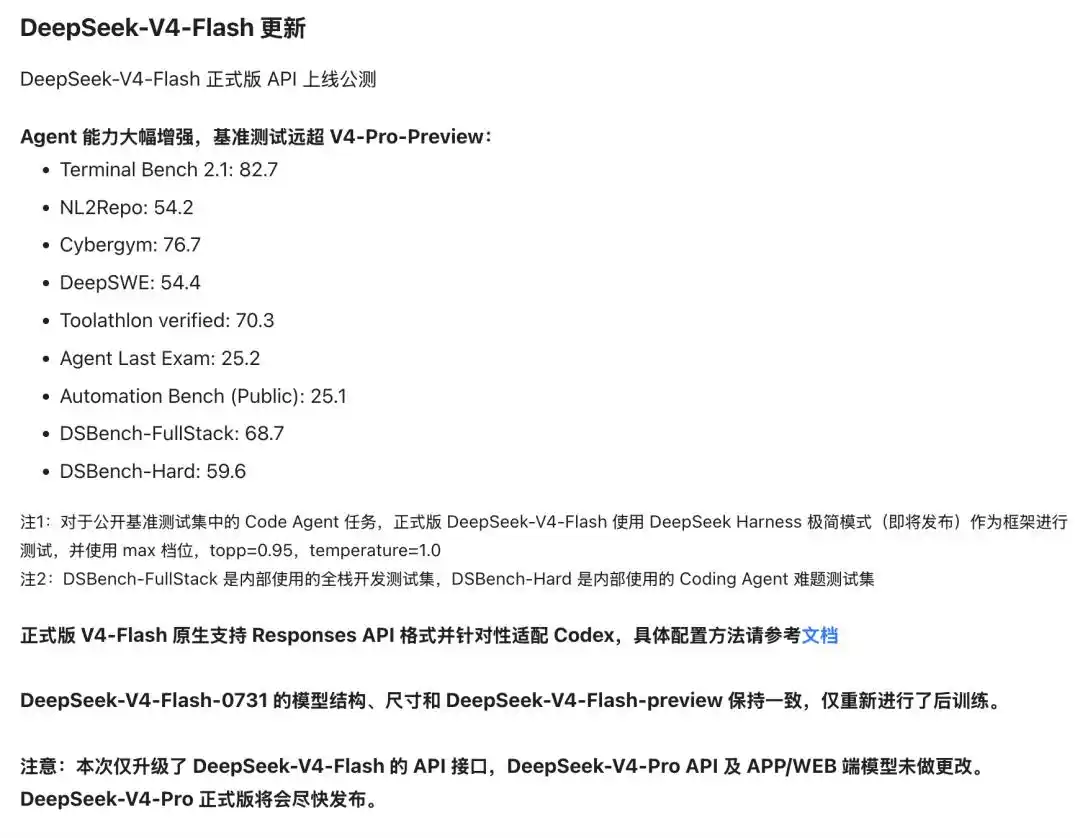
It is important to note that Terminal Bench 2.0 and 2.1 are not the same version of the test suite, so a direct comparison is not entirely fair. However, for a lightweight version with only 13 billion activation parameters to achieve such scores in Agent capabilities suggests that the optimization space in the post-training phase might offer greater leverage than simply scaling up parameters.

Additionally, DeepSeek also specifically noted that the current public beta is limited to the API, and the latest capabilities are not yet available on the App and web interface. The DeepSeek-V4-Pro official version will be released as soon as possible.

“Only Underwent Post-Training Again”

The DeepSeek official statement in the update log indicates, “The model architecture, size, and parameters of DeepSeek-V4-Flash-0731 remain consistent with DeepSeek-V4-Flash-preview; only post-training was conducted again.”

According to DeepSeek's official technical report, V4-Flash has 284 billion total parameters and 13 billion activation parameters; V4-Pro has 1.6 trillion total parameters and 49 billion activation parameters. The two differ by an order of magnitude in model scale. If Flash can bring its Agent capabilities close to Pro's level through post-training, it implies that for specific tasks, model scale is not the decisive factor—the weight of training methods and data quality is rising.

The official also specially noted that for the Code Agent tasks in the public benchmark tests, the DeepSeek Harness minimal mode was used as the framework for testing, with max setting, topp=0.95, temperature=1.0. This detail suggests that DeepSeek may have made targeted optimizations at the Agent framework level, not just improvements in the model itself.

This is also the first time DeepSeek's self-developed Harness has appeared under an official name. Previously, Liang Wenfeng compared the path to AGI to climbing stairs: language models are the first step, CoT (Chain-of-Thought) was addressed last year, this year's step is Agent, and the problem that must be solved after Agent is continuous learning—enabling models to accumulate experience over time like humans, rather than requiring the full context to be fed in every time to work. Beyond that lies the “singularity” of self-iteration and embodied intelligence. “AI currently lacks not taste or intuition, but the ability for continuous learning,” he said. “Investors look at Agent; we look at how to solve learning.”

Continuous learning sounds like a model-level proposition, but its engineering focal point lies precisely in the Harness. DeepSeek's Agent Harness team was formed in March this year. Leading it is Cui Tianyi, born in the 1990s, a Zhejiang University computer science graduate, holder of six ACM Asia Regional Competition gold medals, who previously worked for nine years at top quantitative firm Jane Street, joined DeepSeek in March this year, and subsequently aggressively recruited in May.

It is reported that DeepSeek plans to launch the Harness concurrently with the V4 official version release. Furthermore, as DeepSeek stated at the end of the log, “The DeepSeek-V4-Pro official version will be released as soon as possible.”

A Direct Confrontation at the Ecosystem Level

If large model competition in 2023 was about “competing on general capabilities” and 2024 was about “competing on long context,” then the keyword for 2026 is undoubtedly Agent.

Agent capability—the model's ability to autonomously plan, call tools, and execute complex tasks—is becoming the new yardstick for measuring large model strength. From Terminal Bench (terminal operations) and NL2Repo (code repository generation) to Cybergym (cybersecurity tasks) and SWE-bench (software engineering), a series of Agent benchmark tests are redefining what makes a good model.

Globally, the first tier of Agent capability is still dominated by closed-source giants. According to data from third-party evaluation platforms like benchlm.ai, GPT-5.6 Sol and the Claude Opus series rank at the top in most Agent benchmark tests. Among domestic players, GLM, Qwen, and others are also catching up quickly.

DeepSeek's significant boost to Flash's Agent capabilities this time has a clear strategic intent: to enter the vast market of Agent applications with a high-value, lightweight model.

After all, Agent scenarios are far more sensitive to inference speed and cost than pure dialogue scenarios. An Agent task requiring repeated tool calls and multi-step reasoning could cost several times or even tens of times more to run on a flagship model compared to Flash. If Flash's Agent capability reaches a level that is “sufficient or even good,” its cost-performance advantage will be highly disruptive.

The two internal test sets officially released also have clear targets. DSBench-FullStack (internal full-stack development test set) scored 68.7, and DSBench-Hard (internal Coding Agent difficult problem test set) scored 59.6. This indirectly confirms DeepSeek's positioning—to build Flash as the preferred foundation for developers and Agent applications.

A quiet ecosystem battle is also brewing. The official V4-Flash natively supports the Responses API format and is specifically adapted for Codex.

The Responses API is a new-generation API format strongly promoted by OpenAI. Compared to the traditional Chat Completions, it is more suitable for Agent scenarios—supporting more flexible tool calls, more complex multi-turn interactions, and finer-grained output control.

DeepSeek's native support for this format means developers can migrate Agent applications developed based on the OpenAI ecosystem to DeepSeek at a lower cost. This will be a direct confrontation between the two at the ecosystem level.

The adaptation for Codex targets the vertical scenario of code generation and software development. Codex is OpenAI's model for the code domain. DeepSeek's targeted adaptation is a direct challenge in OpenAI's traditional area of strength.

Viewed together, these moves indicate that DeepSeek's ambition is not just to be a “cheap alternative” but to establish its own niche in the Agent era.

After the 50 Billion RMB Financing: Time Window Under High Valuation

This update comes less than two months after DeepSeek completed its first round of external financing.

A little over a month ago, DeepSeek completed its first external financing round since its founding nearly three years ago, raising over 50 billion RMB, setting a single-round financing record in China's AI industry, with a post-money valuation of approximately $52 billion (about 350 billion RMB). Investors included industry giants like Tencent, CATL, JD.com, as well as several state-owned industrial funds.
In mid-July, DeepSeek intended to advance a new round of private financing with a pre-money valuation of about $71 billion (approximately 480 billion RMB), a roughly 37% increase from the $52 billion valuation after the first round. The interval from $52 billion to $71 billion was less than six weeks.

Behind the high valuation lies market recognition of DeepSeek's technical strength and bets on its commercialization prospects. However, high valuation also means high expectations and high pressure.

According to multiple media reports, DeepSeek founder Liang Wenfeng personally contributed approximately 20 billion RMB in the first financing round, maintaining firm control of the company through a special structure. This founder, who emerged from the quantitative firm Phantom, had insisted on self-funding for nearly three years previously. The shift from “no financing, no IPO” to actively embracing capital is itself a strong signal—DeepSeek is accelerating toward commercialization and an IPO.

The launch of the Flash official version can perhaps be seen as a technological realization by DeepSeek under the support of capital. But the real test lies ahead: Can the Pro official version arrive on schedule? Can the improvement in Agent capability translate into solid revenue? Under the pressure from giants like OpenAI and Anthropic, how will DeepSeek leverage its high-value route?

The curtain on the Agent war has just risen. DeepSeek, with a significant evolution of a lightweight model, poses a new question to the industry—when the dividends of post-training are fully exploited, when efficiency gains begin to offset the parameter gap, the competitive logic of large models may need to be rewritten.

This article is from the WeChat public account “Phoenix Net Technology,” author: Phoenix Net Technology


Trending Cryptos

Related Questions

QWhat key feature of DeepSeek-V4-Flash's official release is highlighted by the updated benchmark scores, and how does it compare to the V4-Pro preview?

AThe key feature is the significant enhancement of Agent capabilities. Although direct comparison is limited because Terminal Bench 2.0 and 2.1 are different versions, the article notes that the smaller V4-Flash model (with 130B activated parameters) achieved benchmark scores that approach or even surpass those of the much larger V4-Pro preview model (with 490B activated parameters) from three months prior, particularly in Agent-related tests. This suggests that post-training optimizations can be highly effective, challenging the notion that model size alone determines performance.

QAccording to the article, what does the release of the DeepSeek-V4-Flash official version represent in the broader AI model competition landscape?

AThe release represents a strategic move in the Agent-centric competition era of 2026. By boosting the Agent performance of its more cost-effective, lighter Flash model, DeepSeek aims to capture the growing market for Agent applications where inference speed and cost are critical. This positions it as a high-value, 'good enough' alternative to more expensive flagship models like GPT-5.6 Sol and Claude Opus, directly challenging OpenAI and others on their home turf, especially in tool-use and code generation scenarios.

QWhat role does the newly named DeepSeek Harness play, as mentioned by CEO Liang Wenfeng, in the path toward AGI?

ACEO Liang Wenfeng likens the path to AGI to climbing stairs. While 2023 focused on language models and 2024 on long-context, the current step is Agent capability. Beyond that, he identifies 'sustained learning'—the ability for models to accumulate experience like humans without needing full context every time—as the critical next challenge. The DeepSeek Harness, their self-developed Agent framework, is identified as the key engineering tool for enabling this crucial 'sustained learning' capability, making it central to their long-term AGI strategy.

QHow does the DeepSeek-V4-Flash's native support for the Responses API format and Codex adaptation impact its competitive position?

AIt represents a direct ecosystem-level challenge to OpenAI. Native support for OpenAI's Responses API format lowers the barrier for developers to migrate Agent applications built on OpenAI's ecosystem to DeepSeek's platform. Additionally, targeted adaptation for Codex, OpenAI's code-specific model, indicates a direct assault on OpenAI's traditional stronghold of code generation. These moves are part of a strategy for DeepSeek to establish its own ecosystem in the Agent era, moving beyond just being a cost-effective alternative to becoming a primary platform.

QWhat recent financial event for DeepSeek does the article connect to this technical release, and what pressures does it imply?

AThe article connects the V4-Flash release to DeepSeek's recent record-breaking fundraising of over 50 billion RMB (~$5.2 billion post-money valuation) and its subsequent plans for a new round at a valuation of approximately $71 billion. The high valuation reflects market confidence in its technology and commercialization potential but also creates significant pressure to deliver results. This technical release is seen as an initial 'delivery on the promise' following the capital influx. The true test will be whether improved Agent capabilities can translate into real revenue growth and if the upcoming V4-Pro official version can meet high expectations amidst intense competition.

Related Reads

UNI Doubles in Two Months Against the Trend: A 5-Year-Overdue Value Realization

Amidst a generally stagnant crypto market in June and July, UNI, the governance token of Uniswap, saw a significant surge, nearly doubling in price from around $2.3 to $4.6. This rally represents a delayed but significant value reassessment, triggered by the practical implementation of its long-debated "fee switch" mechanism. The key turning point was the on-chain execution of the UNIfication proposal in December 2025. It activated a protocol fee on select pools, directed Unichain sequencer revenue (net of costs) to a communal treasury, executed a one-time burn of 100 million UNI, and established a system where all protocol revenue flows into a "TokenJar" contract. This treasury has a single exit: purchasing and permanently burning UNI via a "Firepit" contract. Initially, the market reacted tepidly as the generated revenue and corresponding burn rate were modest. The narrative shifted dramatically in July 2025 with two major developments. First, the launch of Robinhood Chain, tailored for tokenized stocks, rapidly became a primary source of volume and fees for Uniswap, at one point contributing nearly half of its weekly fees. Second, governance votes successfully expanded the fee mechanism to v4 pools and initiated a temperature check for fees on Robinhood Chain. The activation of v4 fees caused the protocol's daily revenue earmarked for UNI burns to nearly triple. The core of UNI's recent price action is the transition from a pure governance token to a cash-flow asset with a permanent, protocol-funded buyer. Its effectiveness is amplified by UNI's mature and widely distributed supply, with no major impending unlocks to dilute the impact of the buybacks. The sustainability of this rally now hinges on whether the transaction volume, particularly on Robinhood Chain, persists after its initial gas subsidies expire, determining if this is a genuine value realization or a subsidy-fueled spike.

marsbit1h ago

UNI Doubles in Two Months Against the Trend: A 5-Year-Overdue Value Realization

marsbit1h ago

Breaking: Google Earth Urgently Pulls Back Nano Banana 2 Image Generation Feature!

Google Earth's newly launched "Create image" feature, powered by the Nano Banana 2 AI image generation model, was abruptly withdrawn shortly after its release due to being "played" by users. The feature allowed users to generate and overlay AI-created visuals directly onto real-world satellite and 3D maps in Google Earth. The tool enabled creative applications like historical recreations (e.g., visualizing ancient Pompeii), generating informational graphics for landmarks, and envisioning architectural projects or futuristic cityscapes on real terrain. It operated under "geospatial grounding," meaning the AI respected the underlying geography, topography, and perspective of the chosen map view. The model also integrated with Gemini to retrieve relevant factual information. However, upon release, users quickly tested its limits. A prominent example involved reimagining Philadelphia's historic Independence Hall as a post-apocalyptic ruin overrun by "happy" zombies, evil clowns, and giant alien mechs. This highlighted both the feature's playful potential and its risks regarding the generation of inappropriate or misleading content on realistic maps, leading to its swift temporary removal. Google stated it would re-release the feature after implementing "enhanced guardrails." Analysts note this move strategically leverages Google's vast proprietary geospatial data, positioning its AI not just for artistic generation but for spatially accurate world visualization—a unique advantage in the competitive AI image generation landscape.

marsbit3h ago

Breaking: Google Earth Urgently Pulls Back Nano Banana 2 Image Generation Feature!

marsbit3h ago

Altman Admits: Overestimated AI Snatching Jobs! Huang Renxun: The Unemployment Narrative Is Completely Backwards

Sam Altman has revised his earlier predictions about AI rapidly replacing jobs, admitting he overestimated the speed at which AI would eliminate entry-level white-collar roles. Speaking on the "Invest Like the Best" podcast, he stated that people do not truly want an AI CEO, as accountability and human connection remain critical. He found that individuals prefer interacting with people who can be held responsible for decisions. Similarly, NVIDIA's Jensen Huang argued that the narrative of AI destroying jobs is misguided. He distinguishes between tasks and jobs, noting that while AI can automate specific tasks, entire jobs—encompassing communication, judgment, coordination, and accountability—are not eliminated. He cited examples like radiologists and software engineers, where demand for these roles has increased as AI handles repetitive tasks, allowing for business expansion and the creation of more positions. Data from a University of Maryland and LinkUp study supports this, showing that U.S. job postings for new graduates have actually risen, countering the fear of vanishing entry-level roles. However, a significant shift is occurring: the traditional entry-level tasks that help newcomers gain experience are being automated, making initial career access more challenging. The key insight is that as AI takes over standardized tasks, the enduring value of human work shifts toward areas of responsibility, trust-building, and final decision-making—aspects that AI cannot replicate. The real "moat" for professionals lies in these irreplaceable human elements.

marsbit3h ago

Altman Admits: Overestimated AI Snatching Jobs! Huang Renxun: The Unemployment Narrative Is Completely Backwards

marsbit3h ago

Trading

Spot

Hot Articles

How to Buy T

Welcome to HTX.com! We've made purchasing Threshold Network Token (T) simple and convenient. Follow our step-by-step guide to embark on your crypto journey.Step 1: Create Your HTX AccountUse your email or phone number to sign up for a free account on HTX. Experience a hassle-free registration journey and unlock all features.Get My AccountStep 2: Go to Buy Crypto and Choose Your Payment MethodCredit/Debit Card: Use your Visa or Mastercard to buy Threshold Network Token (T) instantly.Balance: Use funds from your HTX account balance to trade seamlessly.Third Parties: We've added popular payment methods such as Google Pay and Apple Pay to enhance convenience.P2P: Trade directly with other users on HTX.Over-the-Counter (OTC): We offer tailor-made services and competitive exchange rates for traders.Step 3: Store Your Threshold Network Token (T)After purchasing your Threshold Network Token (T), store it in your HTX account. Alternatively, you can send it elsewhere via blockchain transfer or use it to trade other cryptocurrencies.Step 4: Trade Threshold Network Token (T)Easily trade Threshold Network Token (T) on HTX's spot market. Simply access your account, select your trading pair, execute your trades, and monitor in real-time. We offer a user-friendly experience for both beginners and seasoned traders.

12.7k Total ViewsPublished 2024.03.29Updated 2026.06.02

How to Buy T

Discussions

Welcome to the HTX Community. Here, you can stay informed about the latest platform developments and gain access to professional market insights. Users' opinions on the price of T (T) are presented below.

活动图片