Inesperado, GPT-5.6 reduce drásticamente sus precios desde hoy

marsbitPublished on 2026-07-31Last updated on 2026-07-31

Abstract

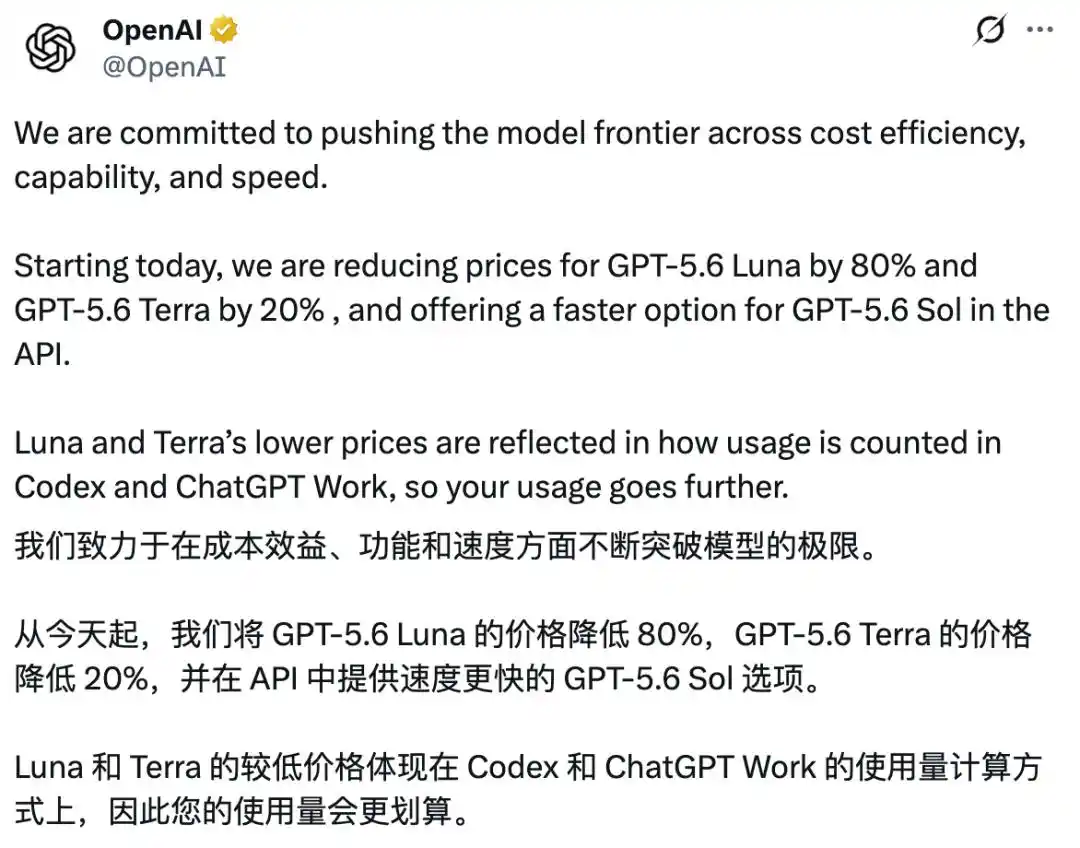
GPT-5.6 reduce dràsticament els seus preus. El model d'entrada, Luna, abaixa un 80%, fins a 0,2 USD per a entrades d'un milió de tokens. El model Terra també baixa un 20%. Mentrestant, el model insígnia, Sol, manté el preu però ofereix una nova opció "Fast mode" que duplica la velocitat. OpenAI assenyala que aquests ajustos són possibles gràcies a l'optimització interna de l'eficiència operativa, on el mateix GPT-5.6 Sol ha participat en la millora dels seus sistemes de producció. Aquesta reducció de costos facilita l'ús de models com Luna en tasques d'agent més complexes i freqüents, afavorint un major ús en fluxos de treball. Els canvis també s'aplicaran a altres productes com Codex i ChatGPT Work, reduint el cost de certes tasques automàtiques. OpenAI emfatitza que tot i l'automatització, el procés roman dirigit per humans.

El modelo básico Luna ha bajado de precio de forma drástica: el precio por millón de tokens de entrada ha bajado de 1 dólar a 0,2 dólares, y el de salida, de 6 dólares a 1,2 dólares.

Convertido a renminbi, esto equivale a que el precio de entrada pasa de unos 6,8 yuanes a 1,35 yuanes, y el de salida, de unos 40,6 yuanes a 8,1 yuanes.

El modelo Terra, posicionado como "principal para el trabajo diario", también se ha abaratado un 20%, y los precios de entrada y salida han bajado a 2 dólares y 12 dólares, respectivamente.

Convertido a renminbi, son aproximadamente 13,5 y 81,2 yuanes, respectivamente.

Solo el modelo insignia, Sol, mantiene su precio original, pero ha lanzado el Modo rápido, que alcanza una velocidad hasta 2,5 veces superior a la del modo estándar, ofreciendo aceleración sin aumento de precio.
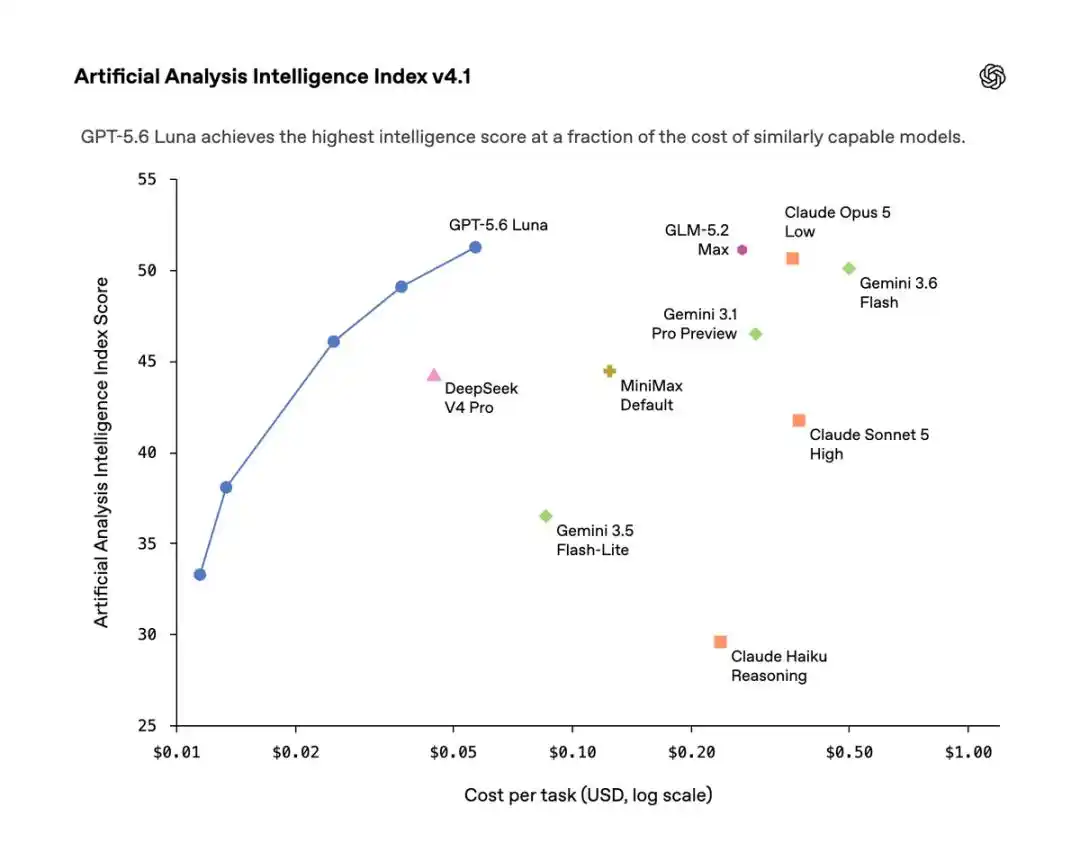
Después de que Codex restableciera agresivamente los usos, se ha organizado inmediatamente una bajada de precios, OpenAI... ¿a quién quieres agobiar?

La guerra de precios se ha vuelto directamente candente.

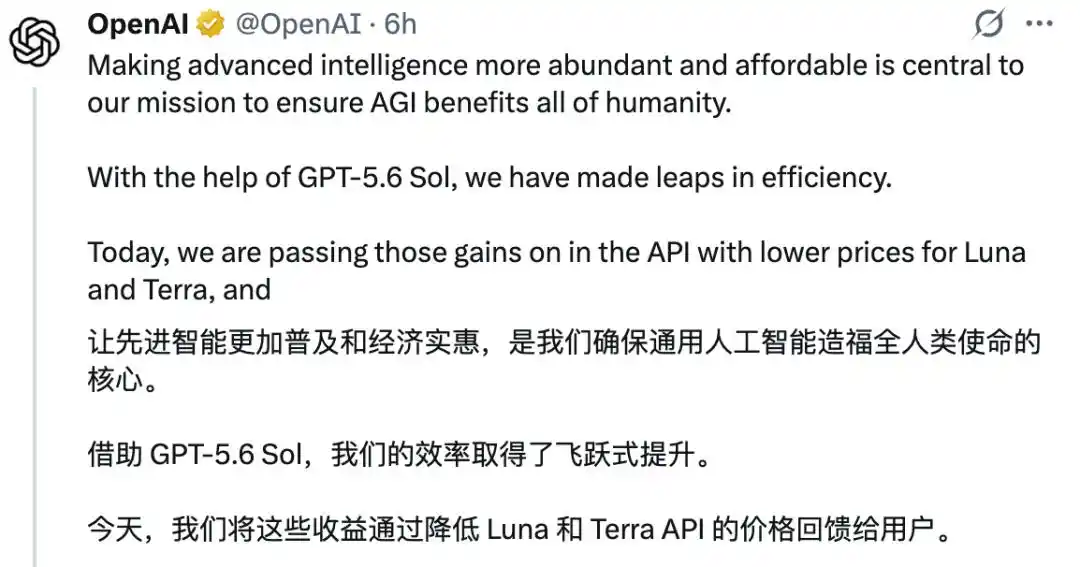
OpenAI ha afirmado que la bajada de precios se debe a que GPT-5.6 Sol se ha ayudado a sí mismo a ahorrar dinero.

GPT-5.6 Sol ha participado en su propia mejora, logrando un salto cualitativo en eficiencia, por lo que como regalo especial a usuarios nuevos y veteranos~

El truco de "pisarse el pie izquierdo con el derecho para elevarse", también lo has adoptado tú, OpenAI.

.

Dos modelos más baratos, uno más rápido

Actualmente, los precios de la API de los tres modelos de GPT-5.6 son:

GPT-5.6 Luna: 0,2 dólares por millón de tokens de entrada, 1,2 dólares por salida;

GPT-5.6 Terra: 2 dólares por millón de tokens de entrada, 12 dólares por salida;

GPT-5.6 Sol: 5 dólares por millón de tokens de entrada, 30 dólares por salida.
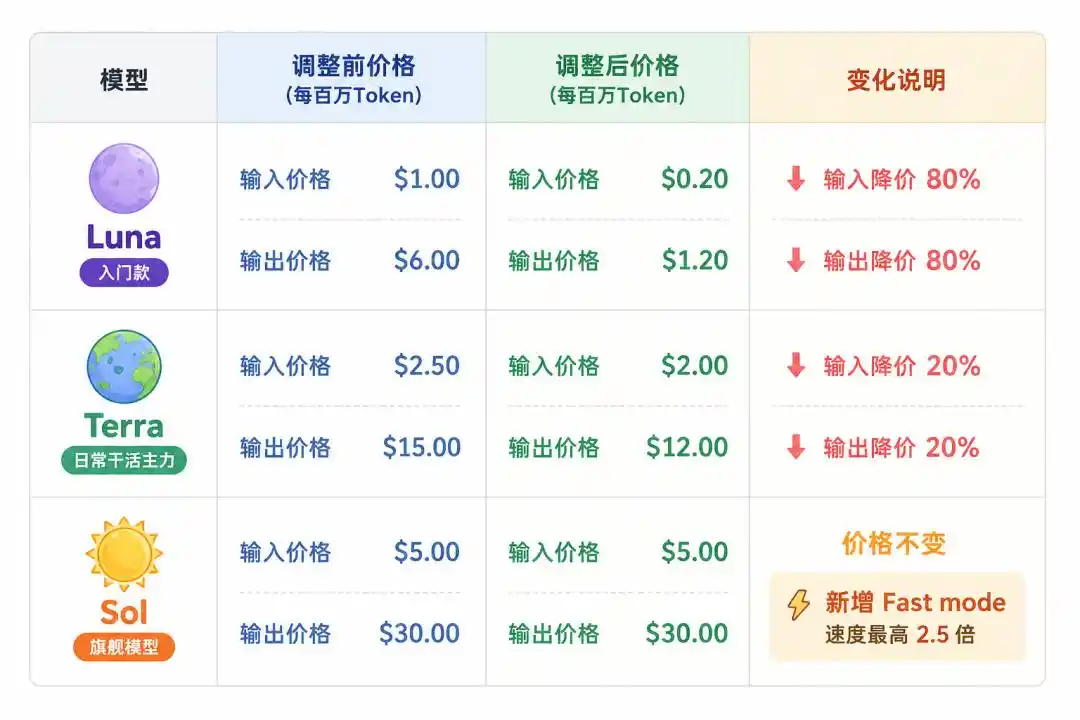
Tras la bajada de precios, Luna ha dado un auténtico salto al vacío.

Su precio de entrada ya es igual al de la generación anterior, GPT-5.4 nano, y su precio de salida es incluso 0,05 dólares más barato.

Pero las tareas de los dos modelos no son exactamente iguales: GPT-5.4 nano se centra principalmente en tareas sencillas y de alta frecuencia como clasificación, extracción de información y ordenación.

GPT-5.6 Luna, en cambio, está posicionado por OpenAI como un modelo orientado a cargas de trabajo sensibles a los costes, capaz de llamar a herramientas, manejar contextos largos y ejecutar flujos de trabajo de múltiples pasos.

En resumen, OpenAI está vendiendo el modelo que permite funcionar a los Agentes al precio de los antiguos modelos pequeños y sencillos.

Terra ha sido relativamente comedido, con una bajada del 20%.

Sol mantiene su precio original y añade el Modo rápido, que alcanza una velocidad hasta 2,5 veces superior a la del modo estándar, pero a un precio que es el doble, manteniendo el mismo nivel de inteligencia del modelo.

También sustituirá al anterior Procesamiento Prioritario. Las solicitudes API que usaban la etiqueta "priority" podrán cambiar automáticamente al Modo rápido.

Según la empresa, estos ajustes también se aplicarán a Codex y ChatGPT Work.

El precio de las suscripciones no bajará, ni aumentará la cantidad total de créditos de los usuarios, pero al llamar a Terra y Luna, el consumo de créditos se reducirá en consecuencia.

Con la misma cuota de suscripción, el modelo podrá hacer más tareas.

OpenAI también ha cambiado el modelo Auto-review en ChatGPT y Codex CLI de GPT-5.4 a GPT-5.6 Luna.

Auto-review se encarga de comprobar en segundo plano el código y los resultados de las modificaciones, una típica tarea de Agente de alta frecuencia.

Combinando la actualización del modelo y la bajada de precios de Luna, OpenAI estima que sus costes se reducirán a aproximadamente una décima parte de los anteriores.

Los modelos baratos ya no se encargan solo de los tradicionales "trabajos menores" como clasificación y extracción, sino que empiezan a entrar en eslabones que requieren juicio y llamadas a herramientas, como la revisión de código y la supervisión en segundo plano.

Actualmente, el posicionamiento de los tres modelos es:

Las tareas sensibles al presupuesto y de gran volumen de llamadas se asignan a Luna;

El trabajo diario normal se asigna a Terra;

Las tareas de alta dificultad siguen utilizando Sol;

Y si incluso la espera resulta demasiado lenta, se puede gastar el doble de dinero para adquirir velocidad.

GPT-5.6 empieza a participar en la reducción de sus propios costes

¿Por qué esta bajada de precios repentina?

OpenAI afirma que la razón es que GPT-5.6 Sol ha participado en la optimización de su propio sistema de producción.

Las mejoras de eficiencia que ha logrado se han convertido en números con descuento en la lista de precios.

En concreto, GPT-5.6 Sol ha reescrito y optimizado parte del núcleo (Kernel) GPU del entorno de producción, ha diseñado y ejecutado cientos de experimentos de generación de tokens, y ha participado en la supervisión del entrenamiento, interviniendo cuando surgían problemas.

Los resultados también son destacables: la optimización del núcleo GPU de producción ha reducido el coste del servicio integral de GPT-5.6 en un 20%; las mejoras en la decodificación especulativa han aumentado la eficiencia de generación de tokens en más de un 15%.
El núcleo (Kernel) GPU puede entenderse como el programa de bajo nivel que ejecuta las tareas de cálculo específicas del modelo en la GPU.

El modelo en sí no necesita cambiar; simplemente, si estos programas se escriben de manera más eficiente, la misma GPU podrá completar los cálculos más rápido, procesar más solicitudes y el coste por llamada también disminuirá.

La decodificación especulativa, por su parte, consiste en "adivinar" primero por lotes los tokens que podrían aparecer a continuación al generar una respuesta, y luego entregárselos al modelo principal para su verificación. Cuanto más precisa sea la suposición, menos pasos habrá que generar y esperar uno por uno.

Ambas optimizaciones no reducen la capacidad del modelo, pero permiten que el mismo modelo funcione más rápido y más barato.

Sin embargo, esto todavía no significa que GPT-5.6 se actualice por completo de forma autónoma.

OpenAI enfatiza específicamente que todo el proceso sigue estando dirigido por humanos.

El modelo puede escribir código, ejecutar experimentos y supervisar anomalías, pero cómo se definen los objetivos, si se pueden utilizar los resultados y si el código entra en el entorno de producción, sigue requiriendo "Human in the Loop" (Humano en el bucle).

Por último

Finalmente, hay un nuevo cambio.

Esta bajada de precios tiene un objetivo muy concreto: los flujos de trabajo de Agentes.

Luna, el modelo con mayor descuento, no es solo un modelo pequeño tradicional para hacer clasificaciones y extracciones.

Según el posicionamiento de OpenAI, puede llamar a herramientas y ejecutar tareas de múltiples pasos, orientándose principalmente a cargas de trabajo de alta frecuencia y sensibles a los costes.

Por lo tanto, la reducción del 80% en el precio de Luna también está rebajando el umbral para la ejecución prolongada de Agentes.

Hace posible que tareas como la revisión, verificación y supervisión, que antes no se podían ejecutar con frecuencia debido a su alto coste, se conviertan en pasos rutinarios dentro de los flujos de trabajo.

Combinado con la participación de GPT-5.6 en la optimización de su propio sistema de producción, aparece un nuevo ciclo:

El modelo participa en mejorar la eficiencia operativa, reduciendo los costes; al bajar los precios, el modelo entra en más flujos de trabajo de alta frecuencia; el aumento en la escala de llamadas impulsa, a su vez, la siguiente ronda de optimizaciones de eficiencia.

Esta rueda volante de bajada de precios de OpenAI ya empieza a tomar forma.

Con esta serie de movimientos, ahora la presión recae directamente en la Empresa A:

"Te toca a ti."

Enlaces de referencia:[1]https://x.com/OpenAI/status/2082878156483219672[2]https://x.com/sama/status/2082880720989532597

Este artículo procede del canal público de WeChat "量子位" (Quantum Bit), autor: Atención a la tecnología de vanguardia.


Trending Cryptos

Related Questions

Q¿Qué cambios de precio se anunciaron para los modelos GPT-5.6 Luna y Terra?

AEl modelo GPT-5.6 Luna redujo su precio en un 80%, pasando de 1 dólar a 0.2 dólares por millón de *tokens* de entrada y de 6 dólares a 1.2 dólares por millón de *tokens* de salida. El modelo GPT-5.6 Terra bajó un 20%, a 2 dólares por entrada y 12 dólares por salida por millón de *tokens*.

Q¿Qué novedad presentó el modelo GPT-5.6 Sol en lugar de una reducción de precio?

AEl modelo GPT-5.6 Sol mantuvo su precio original (5 dólares por entrada y 30 dólares por salida por millón de *tokens*), pero introdujo un nuevo 'Fast mode'. Este modo ofrece una velocidad hasta 2.5 veces mayor que el modo estándar, aunque cuesta el doble, sin cambios en la capacidad del modelo.

QSegún OpenAI, ¿cuál fue la razón principal para esta ronda de reducción de precios?

AOpenAI afirmó que la reducción de precios se debió a que el propio modelo GPT-5.6 Sol participó en la optimización de su sistema de producción. Específicamente, ayudó a reescribir y optimizar *kernels* de GPU y a mejorar la decodificación especulativa, lo que redujo los costos operativos y permitió transferir los ahorros a los usuarios.

Q¿Cómo beneficia la bajada de precio del modelo Luna al desarrollo de *Agents* o flujos de trabajo automatizados?

ALa drástica reducción del precio del modelo Luna (un 80%) disminuye significativamente el umbral de coste para ejecutar flujos de trabajo de *Agents* de forma continuada. Esto permite que tareas de alto volumen y sensibles al costo, como revisión de código, verificación y monitorización, que antes podían ser prohibitivas, se integren ahora como pasos rutinarios en procesos automatizados.

Q¿Qué ciclo o 'volante de inercia' (*flywheel*) destaca el artículo que OpenAI podría estar iniciando con estos cambios?

AEl artículo describe un ciclo emergente o 'volante de inercia de reducción de precios': el modelo ayuda a optimizar la eficiencia de su propio funcionamiento, lo que reduce costos; los precios más bajos permiten que el modelo se utilice en más flujos de trabajo de alta frecuencia; el aumento en la escala de uso genera más datos y oportunidades para impulsar la siguiente ronda de optimizaciones de eficiencia.

Related Reads

UNI Doubles in Two Months Against the Trend: A 5-Year-Overdue Value Realization

Amidst a generally stagnant crypto market in June and July, UNI, the governance token of Uniswap, saw a significant surge, nearly doubling in price from around $2.3 to $4.6. This rally represents a delayed but significant value reassessment, triggered by the practical implementation of its long-debated "fee switch" mechanism. The key turning point was the on-chain execution of the UNIfication proposal in December 2025. It activated a protocol fee on select pools, directed Unichain sequencer revenue (net of costs) to a communal treasury, executed a one-time burn of 100 million UNI, and established a system where all protocol revenue flows into a "TokenJar" contract. This treasury has a single exit: purchasing and permanently burning UNI via a "Firepit" contract. Initially, the market reacted tepidly as the generated revenue and corresponding burn rate were modest. The narrative shifted dramatically in July 2025 with two major developments. First, the launch of Robinhood Chain, tailored for tokenized stocks, rapidly became a primary source of volume and fees for Uniswap, at one point contributing nearly half of its weekly fees. Second, governance votes successfully expanded the fee mechanism to v4 pools and initiated a temperature check for fees on Robinhood Chain. The activation of v4 fees caused the protocol's daily revenue earmarked for UNI burns to nearly triple. The core of UNI's recent price action is the transition from a pure governance token to a cash-flow asset with a permanent, protocol-funded buyer. Its effectiveness is amplified by UNI's mature and widely distributed supply, with no major impending unlocks to dilute the impact of the buybacks. The sustainability of this rally now hinges on whether the transaction volume, particularly on Robinhood Chain, persists after its initial gas subsidies expire, determining if this is a genuine value realization or a subsidy-fueled spike.

marsbit1h ago

UNI Doubles in Two Months Against the Trend: A 5-Year-Overdue Value Realization

marsbit1h ago

Breaking: Google Earth Urgently Pulls Back Nano Banana 2 Image Generation Feature!

Google Earth's newly launched "Create image" feature, powered by the Nano Banana 2 AI image generation model, was abruptly withdrawn shortly after its release due to being "played" by users. The feature allowed users to generate and overlay AI-created visuals directly onto real-world satellite and 3D maps in Google Earth. The tool enabled creative applications like historical recreations (e.g., visualizing ancient Pompeii), generating informational graphics for landmarks, and envisioning architectural projects or futuristic cityscapes on real terrain. It operated under "geospatial grounding," meaning the AI respected the underlying geography, topography, and perspective of the chosen map view. The model also integrated with Gemini to retrieve relevant factual information. However, upon release, users quickly tested its limits. A prominent example involved reimagining Philadelphia's historic Independence Hall as a post-apocalyptic ruin overrun by "happy" zombies, evil clowns, and giant alien mechs. This highlighted both the feature's playful potential and its risks regarding the generation of inappropriate or misleading content on realistic maps, leading to its swift temporary removal. Google stated it would re-release the feature after implementing "enhanced guardrails." Analysts note this move strategically leverages Google's vast proprietary geospatial data, positioning its AI not just for artistic generation but for spatially accurate world visualization—a unique advantage in the competitive AI image generation landscape.

marsbit3h ago

Breaking: Google Earth Urgently Pulls Back Nano Banana 2 Image Generation Feature!

marsbit3h ago

Altman Admits: Overestimated AI Snatching Jobs! Huang Renxun: The Unemployment Narrative Is Completely Backwards

Sam Altman has revised his earlier predictions about AI rapidly replacing jobs, admitting he overestimated the speed at which AI would eliminate entry-level white-collar roles. Speaking on the "Invest Like the Best" podcast, he stated that people do not truly want an AI CEO, as accountability and human connection remain critical. He found that individuals prefer interacting with people who can be held responsible for decisions. Similarly, NVIDIA's Jensen Huang argued that the narrative of AI destroying jobs is misguided. He distinguishes between tasks and jobs, noting that while AI can automate specific tasks, entire jobs—encompassing communication, judgment, coordination, and accountability—are not eliminated. He cited examples like radiologists and software engineers, where demand for these roles has increased as AI handles repetitive tasks, allowing for business expansion and the creation of more positions. Data from a University of Maryland and LinkUp study supports this, showing that U.S. job postings for new graduates have actually risen, countering the fear of vanishing entry-level roles. However, a significant shift is occurring: the traditional entry-level tasks that help newcomers gain experience are being automated, making initial career access more challenging. The key insight is that as AI takes over standardized tasks, the enduring value of human work shifts toward areas of responsibility, trust-building, and final decision-making—aspects that AI cannot replicate. The real "moat" for professionals lies in these irreplaceable human elements.

marsbit3h ago

Altman Admits: Overestimated AI Snatching Jobs! Huang Renxun: The Unemployment Narrative Is Completely Backwards

marsbit3h ago

Trading

Spot

Hot Articles

How to Buy LUNA

Welcome to HTX.com! We've made purchasing Terra (LUNA) simple and convenient. Follow our step-by-step guide to embark on your crypto journey.Step 1: Create Your HTX AccountUse your email or phone number to sign up for a free account on HTX. Experience a hassle-free registration journey and unlock all features.Get My AccountStep 2: Go to Buy Crypto and Choose Your Payment MethodCredit/Debit Card: Use your Visa or Mastercard to buy Terra (LUNA) instantly.Balance: Use funds from your HTX account balance to trade seamlessly.Third Parties: We've added popular payment methods such as Google Pay and Apple Pay to enhance convenience.P2P: Trade directly with other users on HTX.Over-the-Counter (OTC): We offer tailor-made services and competitive exchange rates for traders.Step 3: Store Your Terra (LUNA)After purchasing your Terra (LUNA), store it in your HTX account. Alternatively, you can send it elsewhere via blockchain transfer or use it to trade other cryptocurrencies.Step 4: Trade Terra (LUNA)Easily trade Terra (LUNA) on HTX's spot market. Simply access your account, select your trading pair, execute your trades, and monitor in real-time. We offer a user-friendly experience for both beginners and seasoned traders.

5.3k Total ViewsPublished 2024.03.29Updated 2026.06.02

How to Buy LUNA

What is $LUNA

Luna28 ($$LUNA): A Moon-Inspired Crypto Venture Introduction In the ever-evolving world of cryptocurrencies, innovation is key. Luna28 stands out as a project that not only embraces technology but also intertwines it with the mystique of cosmic cycles. Inspired by the moon's 28-day cycle, Luna28 ($$LUNA) aims to create a unique and engaging experience for its community, merging the concepts of tokenomics and lunar-themed non-fungible tokens (NFTs). At its core, this project employs a distinctive token burn mechanism aligned with lunar and solar eclipses, setting a new precedent in the crypto space. What is Luna28? Luna28 is a token-based cryptocurrency project built on the Ethereum blockchain. It seeks to offer its users a blend of cosmic engagement through a series of innovative features. Key to its identity is the launch of lunar-themed NFTs which enhance community interaction while celebrating the moon's cultural significance. The project aims to create a deeper connection between its community members and the cosmos. This connection is facilitated through a carefully crafted ecosystem that leverages lunar themes, token burns, and dynamic activities associated with celestial events. The goal is not just about enhancing token value but fostering a sense of belonging and enjoyment within the community. Creator of Luna28 The details surrounding the creator of Luna28 remain largely unknown. This lack of information has led to an air of mystery around the project, further adding to its uniqueness. The anonymous nature of its creation reflects a broader trend within the crypto industry, where the focus is often on the project and its community rather than individual profiles. Investors of Luna28 Currently, there is no publicly available information regarding the specific investment foundations or organizations that support Luna28. This aspect may indicate a grassroots initiative where the community plays a vital role in the project's development and growth. The absence of prominent investors can sometimes create a more decentralized and independent project, allowing for organic community engagement and involvement. How Does Luna28 Work? One of the most compelling aspects of Luna28 is how it operates, particularly its unique features that set it apart from other cryptocurrency projects. 1. Lunar and Solar Eclipse Token Burns Luna28 incorporates a special token burn mechanism, which involves periodically burning a portion of its token supply during lunar and solar eclipses. This approach not only creates excitement around celestial events but also works on the fundamental principle of increasing scarcity. By reducing the overall token supply through burns, the remaining tokens have the potential for increased value, benefiting all holders. 2. Tokenomics The economic structure of Luna28 is crafted to ensure sustainability and growth. Each transaction incurs a 4.4% tax: 2% contributes to the Moon Cycle Fund, which is burned every 28 days during the full moon. The remaining 2.4% is earmarked for development and marketing, facilitating the project’s expansion and continuous improvement. This tax structure establishes a steady flow of funding while maintaining a deflationary approach that can enhance the token's value proposition. 3. 100% Burned Liquidity Security and trust are paramount in any cryptocurrency project. Luna28 addresses these concerns by locking its liquidity pool tokens in a burn wallet. This ensures that liquidity is permanently secured, fostering confidence within the community as they engage with the platform. 4. NFT Drops Further enhancing community engagement, Luna28 plans to release lunar-themed NFTs. These digital collectibles not only serve as a source of fun and creativity but also offer users unique assets tied to the larger lunar theme. The introduction of NFTs reflects a growing trend in the crypto space, blending traditional forms of artistic expression with innovative technology. 5. Hyper Deflationary Token Luna28 is classified as a hyper deflationary token, emphasizing its commitment to a declining token supply through systematic burns. This design encourages long-term holding, as community members anticipate potential value growth driven by scarcity. 6. First Buyer Incentive In a bid to promote active participation, Luna28 offers a unique first buyer incentive. After each celestial burn event, the first participant in the market is rewarded with 10% of the tokens burned during that event. This encourages immediate engagement and interest surrounding each significant celestial phenomenon. 7. Sustainable Tax Structure The project's tax model is specifically designed to encourage sustainable growth, balancing the need for ongoing project development with the goal of enhancing token value. This innovative tax structure serves the dual purpose of supporting the community's interests while maintaining a healthy ecosystem for the project. Timeline of Luna28 A well-charted timeline helps in understanding the progression and milestones of Luna28. Here’s a synopsis of important events in the project’s history: Stealth Launch: The project entered the crypto arena under a stealth launch, garnering significant community interest and posting a remarkable 1792% increase from its initial listing. This initial surge indicated strong community reception and a solid foundation for future growth. Token Burns: Committing to its unique approach, Luna28 plans to burn 28% of its token supply over a three-year period, timed specifically during lunar and solar eclipses. Community members eagerly await their opportunities to participate in these events. Community Involvement: Emphasizing transparency and the importance of community feedback, Luna28 plans to notify its users in advance about upcoming token burn events. This engagement approach encourages active participation, fostering a strong sense of community. Key Features Luna28's distinctive features bolster its appeal within the cryptocurrency sector: Hyper Deflationary Nature: The project's focus on hyper deflationary mechanics enables a strategic reduction in supply, aiming for enhanced value retention. Incentives for Early Engagement: The project rewards early participants with direct benefits, which cultivates a proactive community eager to contribute. Commitment to Community Development: The sustainable tax model not only ensures the project's growth but also actively involves the community in shaping its future direction. Conclusion Luna28 represents a unique fusion of technology, community engagement, and celestial inspiration in the cryptocurrency landscape. By integrating innovative mechanisms such as token burns during astrological events and creating engaging lunar-themed NFTs, the project distinguishes itself as a trailblazer within its niche. As a community-driven endeavor, Luna28 promises to deliver not just another cryptocurrency but an experience that marries elements of cosmic fascination with blockchain technology. With its innovative features and strong emphasis on community involvement, Luna28 has the potential to create a lasting impact in the world of digital currencies. The connection it forges between its users and the universe represents not only a creative endeavor but also a brilliantly calculated business strategy poised for growth. As we observe the evolution of Luna28, it is evident that it is more than just a token; it is a concept that encourages its community to look up at the cosmos and ponder their place within it, all while navigating the exciting world of cryptocurrency. The future for Luna28 looks bright and full of potential, eagerly awaiting its next lunar cycle.

1.2k Total ViewsPublished 2024.04.01Updated 2024.12.03

What is $LUNA

What is TERRA

Exploring the Terra Ecosystem: A Comprehensive Overview Introduction In the ever-evolving landscape of blockchain technology and cryptocurrency, the Terra Ecosystem has emerged as an ambitious project designed to facilitate a decentralized financial system. This innovative platform focuses on creating stable and scalable algorithmic stablecoins, aimed at driving the widespread adoption of cryptocurrencies. In this article, we will delve into the foundational aspects of the Terra Ecosystem, exploring its operational mechanisms, its creators, investors, notable components, and the timeline of its development. What is the Terra Ecosystem? Founded in 2018, the Terra Ecosystem is a layer-one blockchain designed to provide an efficient and reliable payment platform. The core mission of Terra is to create a preferred form of money that is not only decentralized but also practical for everyday use. At the heart of the ecosystem is its native algorithmic stablecoin, TerraUSD (UST), which is pegged to the US dollar using an innovative algorithmic mechanism. This unique approach addresses a common concern in the cryptocurrency space: the volatility that often accompanies digital assets. The Terra Ecosystem aims to enhance the usability of cryptocurrencies by creating an environment where digital currencies function similarly to traditional currencies. By being user-friendly and stable, Terra sets out to attract users outside of the crypto community, ultimately fostering mass adoption. The Creators of the Terra Ecosystem The Terra Ecosystem emerged under the guidance of its co-founders Daniel Shin and Do Kwon. Both individuals, with a wealth of experience in entrepreneurship and technology, launched Terraform Labs to spearhead this groundbreaking project. Daniel Shin, a prominent figure in the South Korean tech landscape, has co-founded multiple tech companies, while Do Kwon has an extensive background in computer science and engineering. Their partnership is pivotal in steering the development and growth trajectory of the Terra Ecosystem. Investors in the Terra Ecosystem While detailed information about specific investors remains limited, it is widely acknowledged that Terraform Labs has garnered substantial financial support from a variety of angel investors and venture capital firms. This backing provides the necessary resources for the ongoing development and expansion of the Terra Ecosystem. The emphasis on acquiring diversified investment sources reflects the strong belief in the project's potential within the cryptocurrency community. How Does the Terra Ecosystem Work? At the core of the Terra Ecosystem's functionality lies its innovative proof-of-stake (PoS) consensus mechanism. This allows holders of the LUNA token, the native currency of the ecosystem, to participate in the governance and operation of the network. The dual-token structure differentiates Terra from many other projects, with LUNA serving both as a stake for validators and as a governance token. The mechanism operates in a distinctive way, whereby the supply of LUNA backs the stablecoin UST. If the demand for UST increases, the algorithm automatically adjusts the supply of LUNA to maintain the stability of UST at its dollar peg. Users are enabled to exchange 1 UST for an equivalent value in LUNA, ensuring that fluctuations in demand do not affect the peg. This innovative approach enables the Terra Ecosystem to maintain price stability, one of its primary goals. Timeline of the Terra Ecosystem The development journey of the Terra Ecosystem has been marked by significant milestones: 2018: Establishment of Terraform Labs by Daniel Shin and Do Kwon, laying the groundwork for the Terra Ecosystem. April 2019: The initial release of the Terra blockchain, initiating its journey into the broader cryptocurrency landscape. 2021: Terra experiences remarkable growth as its total value locked (TVL) reaches new heights, positioning it as a dominant player in decentralized finance (DeFi). May 2022: A turbulent period arises as the Terra blockchain is temporarily halted following the collapse of UST and LUNA, leading to a significant impact on market perception and capitalization. January 2024: Terraform Labs files for bankruptcy, marking another critical event in the project's history, sparking discussions on the sustainability and future of the ecosystem. Key Components of the Terra Ecosystem A variety of features contribute to the unique functionality of the Terra Ecosystem: Core Functionality The Terra Ecosystem includes essential functionalities such as managing transaction fees, monitoring price fluctuations, and maintaining historical balances of transactions, all of which are crucial for ensuring user experience and operational integrity. Applications One of the flagship features of the Terra Ecosystem is its diverse array of applications. This includes: Anchor Protocol: A money market protocol that provides high stablecoin yields and tokenized stakes for users seeking to maximize returns on their investments. Mirroring Technology: Enabling users to create assets that mirror real-world assets and trades, allowing for broader use cases and applications. Chai: A payment platform designed to facilitate everyday transactions using Terra's stablecoin technology. Swaps and Exchanges The ecosystem provides functionality for seamless asset exchanges. Notable features include native swapping capabilities and platforms such as Terraswap, allowing users to exchange Terra assets efficiently while benefiting from competitive rates. Governance Governance plays a critical role in the decentralized nature of the Terra Ecosystem. Token holders use their LUNA tokens to propose changes or vote on proposals that affect the network, ensuring collective decision-making and community involvement in the ecosystem's evolution. Notable Projects in the Terra Ecosystem Beyond the core functionalities, the Terra Ecosystem is also home to notable projects that further augment its capabilities: Terraswap: This decentralized exchange (DEX) emerged to facilitate easy swapping of Terra assets, thus promoting a vibrant trading environment within the ecosystem. Astroport: Another DEX known for its high total value locked, Astroport enhances trading opportunities and liquidity provision for users. Loop Markets: This integrated exchange hub offers users a range of trading tools and services, significantly contributing to the user experience across the Terra platform. Conclusion The Terra Ecosystem stands as a significant player within the blockchain and cryptocurrency domains, aiming to create a stable and scalable financial platform designed for widespread cryptocurrency adoption. Although the ecosystem faced dramatic challenges, notably the collapse of its stablecoin UST and the LUNA token, it continues to adapt and evolve in the face of adversity. As the project navigates its future, it remains committed to its foundational vision of building practical products accessible to a broader audience, thereby reinforcing the potential of decentralized finance. The Terra Ecosystem, with its robust features and innovative approach, holds promise as it seeks to redefine the landscape of digital currency use, remaining a focal point for enthusiasts and investors alike in the ongoing evolution of blockchain technology.

1.6k Total ViewsPublished 2024.12.17Updated 2024.12.17

What is TERRA

Discussions

Welcome to the HTX Community. Here, you can stay informed about the latest platform developments and gain access to professional market insights. Users' opinions on the price of LUNA (LUNA) are presented below.

活动图片