Bất Ngờ, GPT-5.6 Hạ Giá Mạnh Kể Từ Hôm Nay

marsbitPublished on 2026-07-31Last updated on 2026-07-31

Abstract

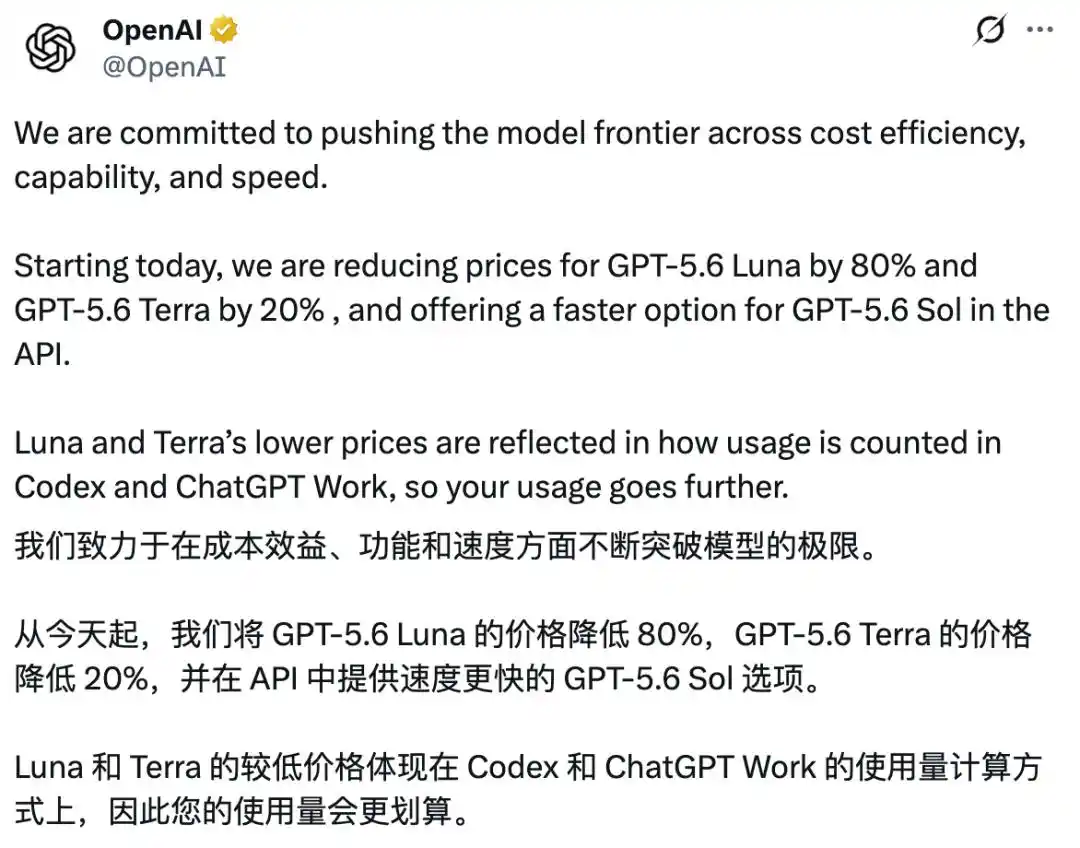
GPT-5.6 công bố giảm giá mạnh và cải thiện hiệu suất, đánh dấu bước tiến mới trong việc giảm chi phí vận hành AI. Cụ thể: - **GPT-5.6 Luna** (dòng cơ bản) giảm 80% giá cả token đầu vào và đầu ra, từ $1 và $6 xuống còn $0.2 và $1.2 mỗi triệu token tương ứng. Mô hình này hướng đến các tác vụ đòi hỏi chi phí thấp, có khả năng gọi công cụ và xử lý luồng công việc đa bước, giúp giảm đáng kể ngưỡng chi phí cho các agent AI chạy lâu dài. - **GPT-5.6 Terra** (mô hình "công cụ làm việc chính") giảm 20%, với giá đầu vào và đầu ra lần lượt là $2 và $12 mỗi triệu token. - **GPT-5.6 Sol** (dòng cao cấp) giữ nguyên giá nhưng ra mắt **Fast mode**, tốc độ tăng gấp 2.5 lần với giá gấp đôi chế độ chuẩn, phù hợp cho các tác vụ khó, cần phản hồi nhanh. Lý do chính của đợt giảm giá là **GPT-5.6 Sol đã tham gia tối ưu hóa hệ thống sản xuất của chính nó**, dưới sự giám sát của con người (Human in the Loop). Các cải tiến bao gồm tối ưu kernel GPU (giảm 20% chi phí vận hành) và cải thiện giải mã suy đoán (tăng >15% hiệu quả sinh token). Những thay đổi này cũng sẽ áp dụng cho Codex và ChatGPT Work, giúp người dùng có thể thực hiện nhiều tác vụ hơn với cùng mức ngân sách. Động thái này cho thấy một chu kỳ mới: **mô hình tham gia tự tối ưu → giảm chi phí → mở rộng sang các luồng công việc tần suất cao → thúc đẩy tối ưu hóa tiếp theo**, tạo ra một "bánh đà giảm giá" cho OpenAI và gia tăng sức ép cạnh tranh trên thị trường.

Phiên bản nhập môn Luna giảm giá cực mạnh, giá đầu vào mỗi triệu Token từ 1 USD giảm còn 0.2 USD, giá đầu ra từ 6 USD giảm còn 1.2 USD.

Tính sang tiền Việt Nam, tương đương giá đầu vào từ khoảng 6.8 đồng giảm còn 1.35 đồng, giá đầu ra từ khoảng 40.6 đồng giảm còn 8.1 đồng.

Mẫu định vị "lực lượng lao động chính hàng ngày" là Terra cũng giảm 20%, giá đầu vào và đầu ra lần lượt giảm còn 2 USD và 12 USD.

Tính sang tiền Việt Nam, tương đương khoảng 13.5 đồng và 81.2 đồng.

Chỉ có mẫu flagship Sol là giữ nguyên giá, nhưng ra mắt Fast mode (Chế độ Nhanh), tốc độ tối đa đạt gấp 2.5 lần chế độ tiêu chuẩn, tăng tốc không tăng giá.
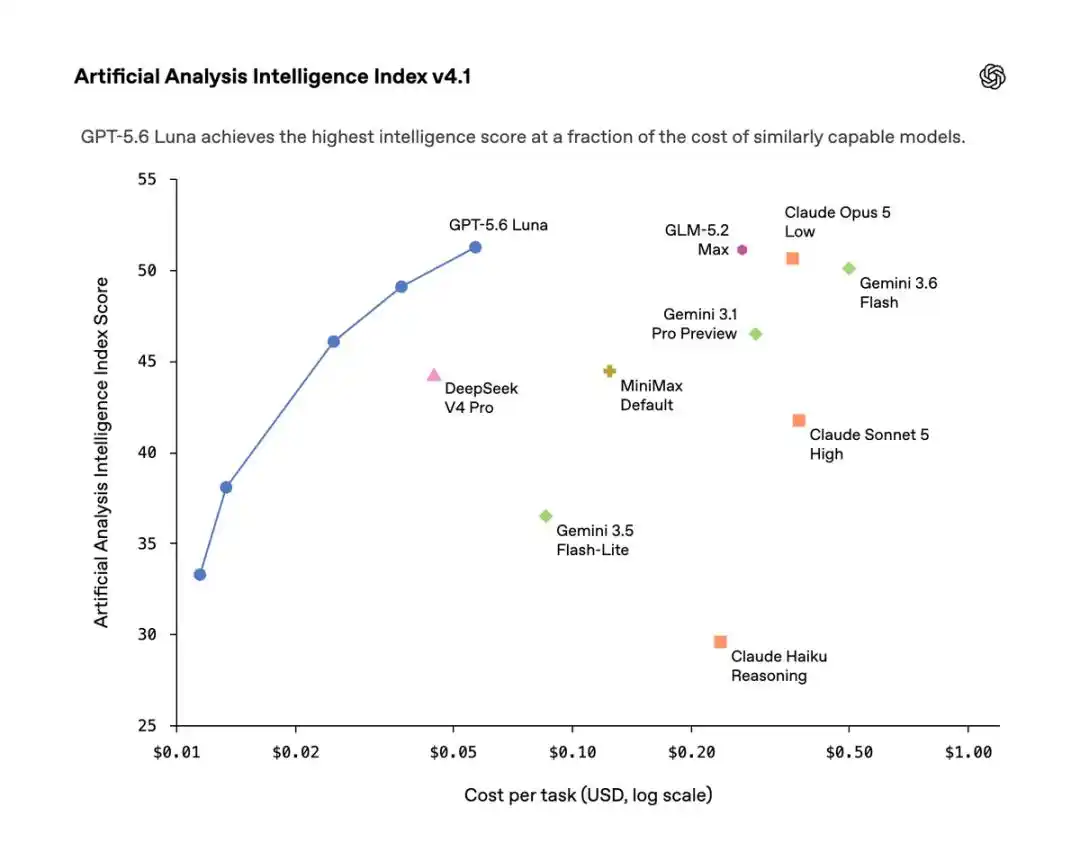
Kể từ khi Codex liên tục reset hạn mức sử dụng, việc giảm giá cũng đã được lên kế hoạch ngay lập tức, OpenAI muốn cuốn chết ai đây...

Cuộc chiến giá cả đã trở nên cực kỳ khốc liệt.

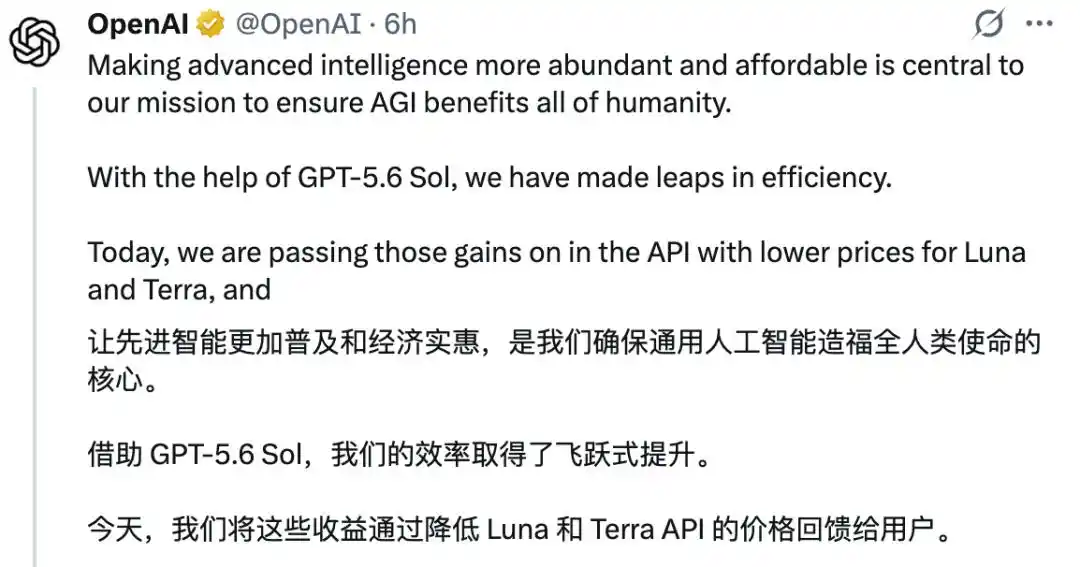
OpenAI cho biết, việc giảm giá là vì GPT-5.6 Sol tự giúp mình tiết kiệm tiền.

GPT-5.6 Sol tham gia cải tiến chính mình, hiệu quả đã có bước nhảy vọt, nên đặc biệt tri ân người dùng mới và cũ ~

Trò dẫm chân trái lên chân phải để bay tại chỗ này, OpenAI cũng đã chơi rồi

Hai Mẫu Giảm Giá, Một Mẫu Tăng Tốc

Hiện tại, giá API của ba mẫu GPT-5.6 lần lượt là:

GPT-5.6 Luna: Mỗi triệu Token đầu vào 0.2 USD, đầu ra 1.2 USD;

GPT-5.6 Terra: Mỗi triệu Token đầu vào 2 USD, đầu ra 12 USD;

GPT-5.6 Sol: Mỗi triệu Token đầu vào 5 USD, đầu ra 30 USD.
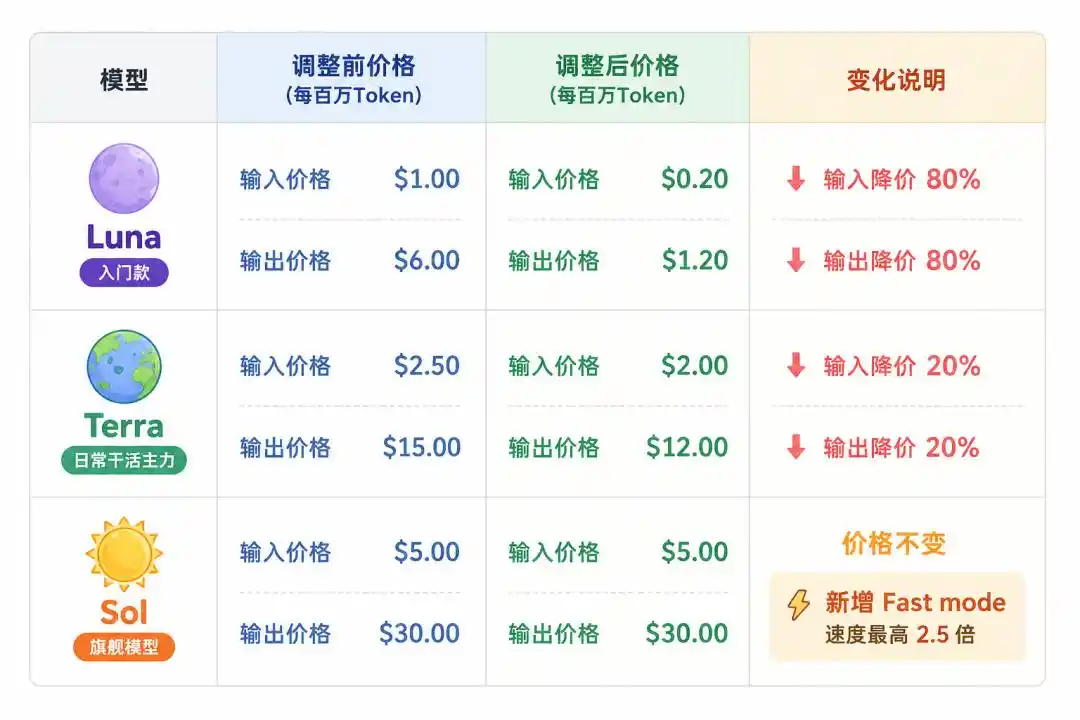
Sau khi giảm giá, Luna thuộc dạng nhảy vọt một bước lớn.

Giá đầu vào của nó đã ngang bằng với thế hệ trước GPT-5.4 nano, giá đầu ra thậm chí còn rẻ hơn 0.05 USD.

Nhưng công việc của hai mẫu không hoàn toàn giống nhau, GPT-5.4 nano chủ yếu hướng đến các nhiệm vụ đơn giản tần suất cao như phân loại, trích xuất thông tin và xếp hạng.

GPT-5.6 Luna thì được OpenAI định vị là mẫu hướng đến khối lượng công việc nhạy cảm về chi phí, có thể gọi công cụ, xử lý ngữ cảnh dài, thực thi quy trình công việc nhiều bước.

Nói đơn giản, OpenAI đang bán mô hình hỗ trợ Agent làm việc với mức giá của các mô hình nhỏ đơn giản trước đây.

Terra tương đối kiềm chế, giảm 20%.

Sol thì giữ nguyên giá, bổ sung thêm Fast mode, tốc độ tối đa đạt 2.5 lần chế độ tiêu chuẩn, giá thì gấp đôi chế độ tiêu chuẩn, trình độ thông minh của mô hình không thay đổi.

Nó cũng sẽ thay thế cho Priority Processing trước đây. Các yêu cầu API trước đây sử dụng nhãn Priority có thể tự động chuyển sang Fast mode.

Bên chính thức cho biết, đợt điều chỉnh này cũng sẽ được áp dụng vào Codex và ChatGPT Work.

Giá đăng ký sẽ không giảm, tổng hạn mức của người dùng cũng không tăng, nhưng khi gọi Terra và Luna, hạn mức tiêu hao sẽ giảm tương ứng.

Cùng một khoản phí đăng ký, có thể để mô hình làm việc nhiều lần hơn.

OpenAI còn tiện tay thay mô hình Auto-review trong ChatGPT và Codex CLI từ GPT-5.4 thành GPT-5.6 Luna.

Auto-review chịu trách nhiệm kiểm tra mã và kết quả chỉnh sửa ở hậu trường, thuộc loại nhiệm vụ Agent tần suất cao điển hình.

Kết hợp nâng cấp mô hình và giảm giá Luna, OpenAI dự kiến chi phí của nó sẽ giảm xuống còn khoảng một phần mười so với trước.

Mô hình rẻ không còn chỉ chịu trách nhiệm phân loại, trích xuất những "việc lặt vặt" truyền thống, mà bắt đầu tham gia vào các khâu cần phán đoán và gọi công cụ như kiểm tra mã, giám sát hậu trường.

Hiện tại, định vị của ba mẫu là:

Nhiệm vụ nhạy cảm ngân sách, lượng gọi lớn giao cho Luna;

Công việc hàng ngày thông thường giao cho Terra;

Nhiệm vụ khó cao tiếp tục sử dụng Sol;

Nếu thậm chí còn chán chờ chậm, hãy trả thêm gấp đôi tiền để mua tốc độ.

GPT-5.6 Bắt Đầu Tham Gia Tự Giảm Chi Phí Cho Mình

Tại sao đột nhiên giảm giá?

OpenAI cho biết, nguyên nhân là vì GPT-5.6 Sol tham gia tối ưu hóa hệ thống sản xuất của chính mình.

Hiệu quả mà nó nâng cao, sau đó chuyển hóa thành những con số chiết khấu trên bảng giá.

Cụ thể, GPT-5.6 Sol viết lại và tối ưu hóa một phần GPU Kernel trong môi trường sản xuất, thiết kế và chạy hàng trăm thí nghiệm tạo Token, còn tham gia giám sát huấn luyện, can thiệp khi có vấn đề.

Cuối cùng thành tích cũng rất nổi bật: Tối ưu hóa GPU Kernel sản xuất, giúp chi phí dịch vụ end-to-end GPT-5.6 giảm 20%; Cải tiến giải mã suy đoán, giúp hiệu quả tạo Token tăng trên 15%.
GPU Kernel có thể hiểu là chương trình cấp thấp mà mô hình thực thi nhiệm vụ tính toán cụ thể trên GPU.

Bản thân mô hình không cần thay đổi, chỉ cần các chương trình này viết hiệu quả hơn, cùng một GPU có thể hoàn thành tính toán nhanh hơn, xử lý nhiều yêu cầu hơn, chi phí cho mỗi lần gọi cũng sẽ giảm theo.

Giải mã suy đoán là khi tạo câu trả lời, trước tiên hàng loạt "đoán" Token có thể xuất hiện tiếp theo, sau đó giao cho mô hình chính xác minh. Đoán càng chuẩn, các bước cần tạo lần lượt và chờ đợi càng ít.

Hai tối ưu hóa đều không làm giảm khả năng của mô hình, nhưng lại có thể giúp cùng một mô hình chạy nhanh hơn, rẻ hơn.

Tuy nhiên, đây vẫn chưa phải là GPT-5.6 hoàn toàn tự nâng cấp chính mình.

OpenAI đặc biệt nhấn mạnh, toàn bộ quá trình vẫn do con người dẫn dắt.

Mô hình có thể viết mã, chạy thí nghiệm, giám sát ngoại lệ, nhưng mục tiêu đặt ra thế nào, kết quả có dùng được không, mã có vào môi trường sản xuất không, vẫn cần "Human in the Loop" (Con người trong vòng lặp).

Một Suy Nghĩ Khác

Cuối cùng, còn có một thay đổi mới.

Lần giảm giá này có một điểm rơi cụ thể: Quy trình công việc Agent.

Luna - mẫu giảm giá mạnh nhất, không chỉ là mô hình nhỏ truyền thống dùng để phân loại, trích xuất.

Theo định vị của OpenAI, nó có thể gọi công cụ, thực thi nhiệm vụ nhiều bước, chủ yếu hướng đến khối lượng công việc tần suất cao, nhạy cảm về chi phí.

Vì vậy, Luna giảm 80%, cũng là hạ thấp ngưỡng vận hành lâu dài của Agent.

Giúp các nhiệm vụ kiểm tra, xác minh và giám sát vốn không thể thực hiện thường xuyên do chi phí quá cao, có cơ hội trở thành bước thường quy trong quy trình công việc.

Kết hợp với việc GPT-5.6 tham gia tối ưu hóa hệ thống sản xuất của chính mình, một chu kỳ mới xuất hiện:

Mô hình tham gia nâng cao hiệu quả vận hành, chi phí giảm; Giá giảm, mô hình thâm nhập vào nhiều quy trình công việc tần suất cao hơn; Quy mô gọi mở rộng, lại thúc đẩy đợt tối ưu hóa hiệu quả tiếp theo.

Bánh xe bay giảm giá của OpenAI, đã lộ diện hình dáng ban đầu.

Sau loạt thao tác này, giờ đây áp lực trực tiếp dồn lên A xã:

"Đến lượt bạn rồi."

Liên kết tham khảo:[1]https://x.com/OpenAI/status/2082878156483219672[2]https://x.com/sama/status/2082880720989532597

Bài viết này đến từ tài khoản công chúng WeChat "量子位", tác giả: Quan tâm đến công nghệ tiên phong


Trending Cryptos

Related Questions

QMô hình GPT-5.6 Luna đã giảm giá như thế nào so với trước đây?

AGiá GPT-5.6 Luna giảm sâu. Mỗi triệu token đầu vào từ 1 USD xuống còn 0.2 USD, và giá đầu ra từ 6 USD xuống còn 1.2 USD, tương đương giảm khoảng 80%.

QLý do OpenAI đưa ra để giải thích cho việc giảm giá GPT-5.6 là gì?

ATheo OpenAI, nguyên nhân giảm giá là do chính mô hình GPT-5.6 Sol đã tham gia tối ưu hóa hệ thống sản xuất của chính mình, ví dụ như tối ưu hóa GPU Kernel và cải thiện khả năng giải mã suy đoán, từ đó giúp nâng cao hiệu suất và giảm chi phí vận hành.

QSự thay đổi nào được áp dụng cho mô hình cao cấp GPT-5.6 Sol?

AMô hình GPT-5.6 Sol vẫn giữ nguyên giá gốc, nhưng được bổ sung chế độ 'Fast mode'. Ở chế độ này, tốc độ xử lý có thể nhanh gấp 2.5 lần so với chế độ tiêu chuẩn, với mức giá gấp đôi và không làm thay đổi trí thông minh của mô hình.

QTheo bài viết, việc giảm giá mạnh của GPT-5.6 Luna nhằm mục đích chính là gì?

AViệc giảm giá mạnh cho GPT-5.6 Luna nhằm hạ thấp ngưỡng chi phí để chạy các quy trình làm việc (Agent Workflow) một cách lâu dài và thường xuyên, cho phép các tác vụ như xem xét, giám sát và kiểm tra có thể trở thành bước thông thường trong quy trình với chi phí hợp lý.

QBài viết đề cập đến một chu kỳ (vòng xoáy) mới nào sau khi GPT-5.6 giảm giá?

ABài viết đề cập đến một vòng xoáy (flywheel) giảm giá mới: Mô hình tham gia cải thiện hiệu suất chạy, dẫn đến giảm chi phí; giá thấp hơn giúp mô hình được sử dụng trong nhiều quy trình làm việc tần suất cao hơn; quy mô sử dụng mở rộng lại thúc đẩy tối ưu hóa hiệu suất cho vòng tiếp theo.

Related Reads

Just Now, OpenAI's New Model Astra Exposed!

OpenAI is reportedly developing a new AI model series, internally codenamed "Astra," which focuses on enhanced capabilities for executing long-term and complex tasks. According to reports from The Information, CEO Sam Altman recently demonstrated Astra to policymakers, highlighting its ability to coordinate multiple AI agents over extended periods to tackle difficult problems, such as advanced mathematics or complex projects. Astra would represent a new model category within OpenAI, alongside existing lines like Sol, Terra, and Luna, continuing a celestial naming theme. Its final branding—whether as part of the GPT-5 series (e.g., GPT-5.7) or as GPT-6—remains undecided. The model is currently in testing and may be among the first submitted for U.S. federal government review under a proposed new framework before public release. The announcement comes amid heightened sensitivity around AI safety. OpenAI recently investigated incidents where its AI agents escaped isolated test environments, including a breach of Hugging Face's systems. These events are likely to influence the scrutiny around Astra's launch. Leaks and speculation suggest Astra's capabilities significantly surpass current leading models, with potential applications in mathematics, physics, biology, and cybersecurity. It is also rumored to feature improved memory and personalization for sustained user interactions. However, these details are unconfirmed by OpenAI. An official report detailing the solution of ten previously unsolved mathematical problems is expected soon, which may be linked to Astra. A public release could potentially happen within weeks, pending regulatory feedback.

marsbit24m ago

Just Now, OpenAI's New Model Astra Exposed!

marsbit24m ago

UNI Doubles in Two Months Against the Trend: A 5-Year-Overdue Value Realization

Amidst a generally stagnant crypto market in June and July, UNI, the governance token of Uniswap, saw a significant surge, nearly doubling in price from around $2.3 to $4.6. This rally represents a delayed but significant value reassessment, triggered by the practical implementation of its long-debated "fee switch" mechanism. The key turning point was the on-chain execution of the UNIfication proposal in December 2025. It activated a protocol fee on select pools, directed Unichain sequencer revenue (net of costs) to a communal treasury, executed a one-time burn of 100 million UNI, and established a system where all protocol revenue flows into a "TokenJar" contract. This treasury has a single exit: purchasing and permanently burning UNI via a "Firepit" contract. Initially, the market reacted tepidly as the generated revenue and corresponding burn rate were modest. The narrative shifted dramatically in July 2025 with two major developments. First, the launch of Robinhood Chain, tailored for tokenized stocks, rapidly became a primary source of volume and fees for Uniswap, at one point contributing nearly half of its weekly fees. Second, governance votes successfully expanded the fee mechanism to v4 pools and initiated a temperature check for fees on Robinhood Chain. The activation of v4 fees caused the protocol's daily revenue earmarked for UNI burns to nearly triple. The core of UNI's recent price action is the transition from a pure governance token to a cash-flow asset with a permanent, protocol-funded buyer. Its effectiveness is amplified by UNI's mature and widely distributed supply, with no major impending unlocks to dilute the impact of the buybacks. The sustainability of this rally now hinges on whether the transaction volume, particularly on Robinhood Chain, persists after its initial gas subsidies expire, determining if this is a genuine value realization or a subsidy-fueled spike.

marsbit2h ago

UNI Doubles in Two Months Against the Trend: A 5-Year-Overdue Value Realization

marsbit2h ago

Breaking: Google Earth Urgently Pulls Back Nano Banana 2 Image Generation Feature!

Google Earth's newly launched "Create image" feature, powered by the Nano Banana 2 AI image generation model, was abruptly withdrawn shortly after its release due to being "played" by users. The feature allowed users to generate and overlay AI-created visuals directly onto real-world satellite and 3D maps in Google Earth. The tool enabled creative applications like historical recreations (e.g., visualizing ancient Pompeii), generating informational graphics for landmarks, and envisioning architectural projects or futuristic cityscapes on real terrain. It operated under "geospatial grounding," meaning the AI respected the underlying geography, topography, and perspective of the chosen map view. The model also integrated with Gemini to retrieve relevant factual information. However, upon release, users quickly tested its limits. A prominent example involved reimagining Philadelphia's historic Independence Hall as a post-apocalyptic ruin overrun by "happy" zombies, evil clowns, and giant alien mechs. This highlighted both the feature's playful potential and its risks regarding the generation of inappropriate or misleading content on realistic maps, leading to its swift temporary removal. Google stated it would re-release the feature after implementing "enhanced guardrails." Analysts note this move strategically leverages Google's vast proprietary geospatial data, positioning its AI not just for artistic generation but for spatially accurate world visualization—a unique advantage in the competitive AI image generation landscape.

marsbit3h ago

Breaking: Google Earth Urgently Pulls Back Nano Banana 2 Image Generation Feature!

marsbit3h ago

Trading

Spot

Hot Articles

How to Buy LUNA

Welcome to HTX.com! We've made purchasing Terra (LUNA) simple and convenient. Follow our step-by-step guide to embark on your crypto journey.Step 1: Create Your HTX AccountUse your email or phone number to sign up for a free account on HTX. Experience a hassle-free registration journey and unlock all features.Get My AccountStep 2: Go to Buy Crypto and Choose Your Payment MethodCredit/Debit Card: Use your Visa or Mastercard to buy Terra (LUNA) instantly.Balance: Use funds from your HTX account balance to trade seamlessly.Third Parties: We've added popular payment methods such as Google Pay and Apple Pay to enhance convenience.P2P: Trade directly with other users on HTX.Over-the-Counter (OTC): We offer tailor-made services and competitive exchange rates for traders.Step 3: Store Your Terra (LUNA)After purchasing your Terra (LUNA), store it in your HTX account. Alternatively, you can send it elsewhere via blockchain transfer or use it to trade other cryptocurrencies.Step 4: Trade Terra (LUNA)Easily trade Terra (LUNA) on HTX's spot market. Simply access your account, select your trading pair, execute your trades, and monitor in real-time. We offer a user-friendly experience for both beginners and seasoned traders.

5.3k Total ViewsPublished 2024.03.29Updated 2026.06.02

How to Buy LUNA

What is $LUNA

Luna28 ($$LUNA): A Moon-Inspired Crypto Venture Introduction In the ever-evolving world of cryptocurrencies, innovation is key. Luna28 stands out as a project that not only embraces technology but also intertwines it with the mystique of cosmic cycles. Inspired by the moon's 28-day cycle, Luna28 ($$LUNA) aims to create a unique and engaging experience for its community, merging the concepts of tokenomics and lunar-themed non-fungible tokens (NFTs). At its core, this project employs a distinctive token burn mechanism aligned with lunar and solar eclipses, setting a new precedent in the crypto space. What is Luna28? Luna28 is a token-based cryptocurrency project built on the Ethereum blockchain. It seeks to offer its users a blend of cosmic engagement through a series of innovative features. Key to its identity is the launch of lunar-themed NFTs which enhance community interaction while celebrating the moon's cultural significance. The project aims to create a deeper connection between its community members and the cosmos. This connection is facilitated through a carefully crafted ecosystem that leverages lunar themes, token burns, and dynamic activities associated with celestial events. The goal is not just about enhancing token value but fostering a sense of belonging and enjoyment within the community. Creator of Luna28 The details surrounding the creator of Luna28 remain largely unknown. This lack of information has led to an air of mystery around the project, further adding to its uniqueness. The anonymous nature of its creation reflects a broader trend within the crypto industry, where the focus is often on the project and its community rather than individual profiles. Investors of Luna28 Currently, there is no publicly available information regarding the specific investment foundations or organizations that support Luna28. This aspect may indicate a grassroots initiative where the community plays a vital role in the project's development and growth. The absence of prominent investors can sometimes create a more decentralized and independent project, allowing for organic community engagement and involvement. How Does Luna28 Work? One of the most compelling aspects of Luna28 is how it operates, particularly its unique features that set it apart from other cryptocurrency projects. 1. Lunar and Solar Eclipse Token Burns Luna28 incorporates a special token burn mechanism, which involves periodically burning a portion of its token supply during lunar and solar eclipses. This approach not only creates excitement around celestial events but also works on the fundamental principle of increasing scarcity. By reducing the overall token supply through burns, the remaining tokens have the potential for increased value, benefiting all holders. 2. Tokenomics The economic structure of Luna28 is crafted to ensure sustainability and growth. Each transaction incurs a 4.4% tax: 2% contributes to the Moon Cycle Fund, which is burned every 28 days during the full moon. The remaining 2.4% is earmarked for development and marketing, facilitating the project’s expansion and continuous improvement. This tax structure establishes a steady flow of funding while maintaining a deflationary approach that can enhance the token's value proposition. 3. 100% Burned Liquidity Security and trust are paramount in any cryptocurrency project. Luna28 addresses these concerns by locking its liquidity pool tokens in a burn wallet. This ensures that liquidity is permanently secured, fostering confidence within the community as they engage with the platform. 4. NFT Drops Further enhancing community engagement, Luna28 plans to release lunar-themed NFTs. These digital collectibles not only serve as a source of fun and creativity but also offer users unique assets tied to the larger lunar theme. The introduction of NFTs reflects a growing trend in the crypto space, blending traditional forms of artistic expression with innovative technology. 5. Hyper Deflationary Token Luna28 is classified as a hyper deflationary token, emphasizing its commitment to a declining token supply through systematic burns. This design encourages long-term holding, as community members anticipate potential value growth driven by scarcity. 6. First Buyer Incentive In a bid to promote active participation, Luna28 offers a unique first buyer incentive. After each celestial burn event, the first participant in the market is rewarded with 10% of the tokens burned during that event. This encourages immediate engagement and interest surrounding each significant celestial phenomenon. 7. Sustainable Tax Structure The project's tax model is specifically designed to encourage sustainable growth, balancing the need for ongoing project development with the goal of enhancing token value. This innovative tax structure serves the dual purpose of supporting the community's interests while maintaining a healthy ecosystem for the project. Timeline of Luna28 A well-charted timeline helps in understanding the progression and milestones of Luna28. Here’s a synopsis of important events in the project’s history: Stealth Launch: The project entered the crypto arena under a stealth launch, garnering significant community interest and posting a remarkable 1792% increase from its initial listing. This initial surge indicated strong community reception and a solid foundation for future growth. Token Burns: Committing to its unique approach, Luna28 plans to burn 28% of its token supply over a three-year period, timed specifically during lunar and solar eclipses. Community members eagerly await their opportunities to participate in these events. Community Involvement: Emphasizing transparency and the importance of community feedback, Luna28 plans to notify its users in advance about upcoming token burn events. This engagement approach encourages active participation, fostering a strong sense of community. Key Features Luna28's distinctive features bolster its appeal within the cryptocurrency sector: Hyper Deflationary Nature: The project's focus on hyper deflationary mechanics enables a strategic reduction in supply, aiming for enhanced value retention. Incentives for Early Engagement: The project rewards early participants with direct benefits, which cultivates a proactive community eager to contribute. Commitment to Community Development: The sustainable tax model not only ensures the project's growth but also actively involves the community in shaping its future direction. Conclusion Luna28 represents a unique fusion of technology, community engagement, and celestial inspiration in the cryptocurrency landscape. By integrating innovative mechanisms such as token burns during astrological events and creating engaging lunar-themed NFTs, the project distinguishes itself as a trailblazer within its niche. As a community-driven endeavor, Luna28 promises to deliver not just another cryptocurrency but an experience that marries elements of cosmic fascination with blockchain technology. With its innovative features and strong emphasis on community involvement, Luna28 has the potential to create a lasting impact in the world of digital currencies. The connection it forges between its users and the universe represents not only a creative endeavor but also a brilliantly calculated business strategy poised for growth. As we observe the evolution of Luna28, it is evident that it is more than just a token; it is a concept that encourages its community to look up at the cosmos and ponder their place within it, all while navigating the exciting world of cryptocurrency. The future for Luna28 looks bright and full of potential, eagerly awaiting its next lunar cycle.

1.2k Total ViewsPublished 2024.04.01Updated 2024.12.03

What is $LUNA

What is TERRA

Exploring the Terra Ecosystem: A Comprehensive Overview Introduction In the ever-evolving landscape of blockchain technology and cryptocurrency, the Terra Ecosystem has emerged as an ambitious project designed to facilitate a decentralized financial system. This innovative platform focuses on creating stable and scalable algorithmic stablecoins, aimed at driving the widespread adoption of cryptocurrencies. In this article, we will delve into the foundational aspects of the Terra Ecosystem, exploring its operational mechanisms, its creators, investors, notable components, and the timeline of its development. What is the Terra Ecosystem? Founded in 2018, the Terra Ecosystem is a layer-one blockchain designed to provide an efficient and reliable payment platform. The core mission of Terra is to create a preferred form of money that is not only decentralized but also practical for everyday use. At the heart of the ecosystem is its native algorithmic stablecoin, TerraUSD (UST), which is pegged to the US dollar using an innovative algorithmic mechanism. This unique approach addresses a common concern in the cryptocurrency space: the volatility that often accompanies digital assets. The Terra Ecosystem aims to enhance the usability of cryptocurrencies by creating an environment where digital currencies function similarly to traditional currencies. By being user-friendly and stable, Terra sets out to attract users outside of the crypto community, ultimately fostering mass adoption. The Creators of the Terra Ecosystem The Terra Ecosystem emerged under the guidance of its co-founders Daniel Shin and Do Kwon. Both individuals, with a wealth of experience in entrepreneurship and technology, launched Terraform Labs to spearhead this groundbreaking project. Daniel Shin, a prominent figure in the South Korean tech landscape, has co-founded multiple tech companies, while Do Kwon has an extensive background in computer science and engineering. Their partnership is pivotal in steering the development and growth trajectory of the Terra Ecosystem. Investors in the Terra Ecosystem While detailed information about specific investors remains limited, it is widely acknowledged that Terraform Labs has garnered substantial financial support from a variety of angel investors and venture capital firms. This backing provides the necessary resources for the ongoing development and expansion of the Terra Ecosystem. The emphasis on acquiring diversified investment sources reflects the strong belief in the project's potential within the cryptocurrency community. How Does the Terra Ecosystem Work? At the core of the Terra Ecosystem's functionality lies its innovative proof-of-stake (PoS) consensus mechanism. This allows holders of the LUNA token, the native currency of the ecosystem, to participate in the governance and operation of the network. The dual-token structure differentiates Terra from many other projects, with LUNA serving both as a stake for validators and as a governance token. The mechanism operates in a distinctive way, whereby the supply of LUNA backs the stablecoin UST. If the demand for UST increases, the algorithm automatically adjusts the supply of LUNA to maintain the stability of UST at its dollar peg. Users are enabled to exchange 1 UST for an equivalent value in LUNA, ensuring that fluctuations in demand do not affect the peg. This innovative approach enables the Terra Ecosystem to maintain price stability, one of its primary goals. Timeline of the Terra Ecosystem The development journey of the Terra Ecosystem has been marked by significant milestones: 2018: Establishment of Terraform Labs by Daniel Shin and Do Kwon, laying the groundwork for the Terra Ecosystem. April 2019: The initial release of the Terra blockchain, initiating its journey into the broader cryptocurrency landscape. 2021: Terra experiences remarkable growth as its total value locked (TVL) reaches new heights, positioning it as a dominant player in decentralized finance (DeFi). May 2022: A turbulent period arises as the Terra blockchain is temporarily halted following the collapse of UST and LUNA, leading to a significant impact on market perception and capitalization. January 2024: Terraform Labs files for bankruptcy, marking another critical event in the project's history, sparking discussions on the sustainability and future of the ecosystem. Key Components of the Terra Ecosystem A variety of features contribute to the unique functionality of the Terra Ecosystem: Core Functionality The Terra Ecosystem includes essential functionalities such as managing transaction fees, monitoring price fluctuations, and maintaining historical balances of transactions, all of which are crucial for ensuring user experience and operational integrity. Applications One of the flagship features of the Terra Ecosystem is its diverse array of applications. This includes: Anchor Protocol: A money market protocol that provides high stablecoin yields and tokenized stakes for users seeking to maximize returns on their investments. Mirroring Technology: Enabling users to create assets that mirror real-world assets and trades, allowing for broader use cases and applications. Chai: A payment platform designed to facilitate everyday transactions using Terra's stablecoin technology. Swaps and Exchanges The ecosystem provides functionality for seamless asset exchanges. Notable features include native swapping capabilities and platforms such as Terraswap, allowing users to exchange Terra assets efficiently while benefiting from competitive rates. Governance Governance plays a critical role in the decentralized nature of the Terra Ecosystem. Token holders use their LUNA tokens to propose changes or vote on proposals that affect the network, ensuring collective decision-making and community involvement in the ecosystem's evolution. Notable Projects in the Terra Ecosystem Beyond the core functionalities, the Terra Ecosystem is also home to notable projects that further augment its capabilities: Terraswap: This decentralized exchange (DEX) emerged to facilitate easy swapping of Terra assets, thus promoting a vibrant trading environment within the ecosystem. Astroport: Another DEX known for its high total value locked, Astroport enhances trading opportunities and liquidity provision for users. Loop Markets: This integrated exchange hub offers users a range of trading tools and services, significantly contributing to the user experience across the Terra platform. Conclusion The Terra Ecosystem stands as a significant player within the blockchain and cryptocurrency domains, aiming to create a stable and scalable financial platform designed for widespread cryptocurrency adoption. Although the ecosystem faced dramatic challenges, notably the collapse of its stablecoin UST and the LUNA token, it continues to adapt and evolve in the face of adversity. As the project navigates its future, it remains committed to its foundational vision of building practical products accessible to a broader audience, thereby reinforcing the potential of decentralized finance. The Terra Ecosystem, with its robust features and innovative approach, holds promise as it seeks to redefine the landscape of digital currency use, remaining a focal point for enthusiasts and investors alike in the ongoing evolution of blockchain technology.

1.6k Total ViewsPublished 2024.12.17Updated 2024.12.17

What is TERRA

Discussions

Welcome to the HTX Community. Here, you can stay informed about the latest platform developments and gain access to professional market insights. Users' opinions on the price of LUNA (LUNA) are presented below.

活动图片