Comprar acciones se convirtió en "comprar criptomonedas", bienvenidos de regreso a la familia nativa

marsbitPublished on 2026-07-30Last updated on 2026-07-30

Abstract

En julio de 2026, el índice surcoreano KOSPI cayó un 8.95%, desencadenando la séptima suspensión de ese año. Acciones emblemáticas como SK Hynix cayeron más de un 15%. Más de 120.000 cuentas con apalancamiento fueron liquidadas, afectando principalmente a jóvenes. Este escenario, típico de criptomercados, se repite ahora en bolsas globales como las de EE.UU. y Japón, donde las acciones tecnológicas muestran una volatilidad extrema, superando incluso a la de Bitcoin. Lo que impulsa este cambio es la "criptomonedización" del mercado bursátil. Antiguos traders de cripto migraron a acciones tecnológicas, llevando consigo su mentalidad de especulación: apostar por narrativas como la IA, usar apalancamiento masivo (como los ETF 2x en Corea del Sur) y seguir señales de redes sociales en lugar de fundamentales. Esto generó burbujas rápidas: acciones como SK Hynix perdieron la mitad de su valor en poco más de un mes, un colapso más veloz que el de Bitcoin. Paradójicamente, Bitcoin, con una volatilidad del ~42% en 2025, ahora parece un activo más estable comparado con ciertas acciones tecnológicas. El mercado está dominado por el "trading de narrativas": cualquier empresa vinculada a la IA ve su precio dispararse, independientemente de sus resultados reales. Este comportamiento, alimentado por las redes sociales y el apalancamiento fácil, marca una regresión hacia un mercado menos racional, donde la euforia colectiva y el riesgo extremo se han normalizado. Como lamentó un inversor: "...

Autor: Dou Wanle

13 de julio de 2026, Seúl.

El índice compuesto de Corea, KOSPI, cayó un 8.95% en un día, por séptima vez en el año que se activa el circuito de freno. SK Hynix, la "acción de la suerte nacional" para los coreanos, se desplomó un 15.37% en un día, una caída tan severa que no se había visto en casi dos décadas. Samsung Electronics también cayó más del 10%.

Más de 1.2 millones de cuentas con apalancamiento recibieron notificaciones de llamada de margen, los sistemas de los corredores cerraron automáticamente entre 320,000 y 460,000 cuentas, y lo más desgarrador es que el 62% de las personas que sufrieron liquidaciones forzadas eran jóvenes de 20 a 30 años. Algunos perdieron el pago inicial para su casa de bodas, otros pidieron préstamos para comprar acciones...

Un joven de poco más de 20 años en Busan, tras sufrir pérdidas por seguir la recomendación de un YouTuber de acciones, fue directamente con un cuchillo a apuñalar a ese creador de contenido.

Hace algún tiempo, estas palabras probablemente se habrían usado para describir escenas posteriores a una gran caída en el mundo de las criptomonedas. Hoy, se están repitiendo en los mercados de Corea, Estados Unidos y Japón, tras el retroceso de las acciones tecnológicas.

Las fuertes subidas y caídas son solo la apariencia. Lo que realmente ha cambiado es el método de valoración: la narrativa supera a la valoración, el apalancamiento amplifica las emociones, y las redes sociales llevan rápidamente el consenso a extremos.

Los mercados bursátiles globales, especialmente las acciones tecnológicas, se están volviendo cada vez más como el mundo de las criptomonedas.

Regreso a la familia nativa

"Bienvenidos de regreso a la familia nativa."

Tras la caída, los traders del mundo cripto que se pasaron a la bolsa escribían pequeños ensayos sobre sus pérdidas, y el comentario anterior se veía por todas partes en las secciones de comentarios.
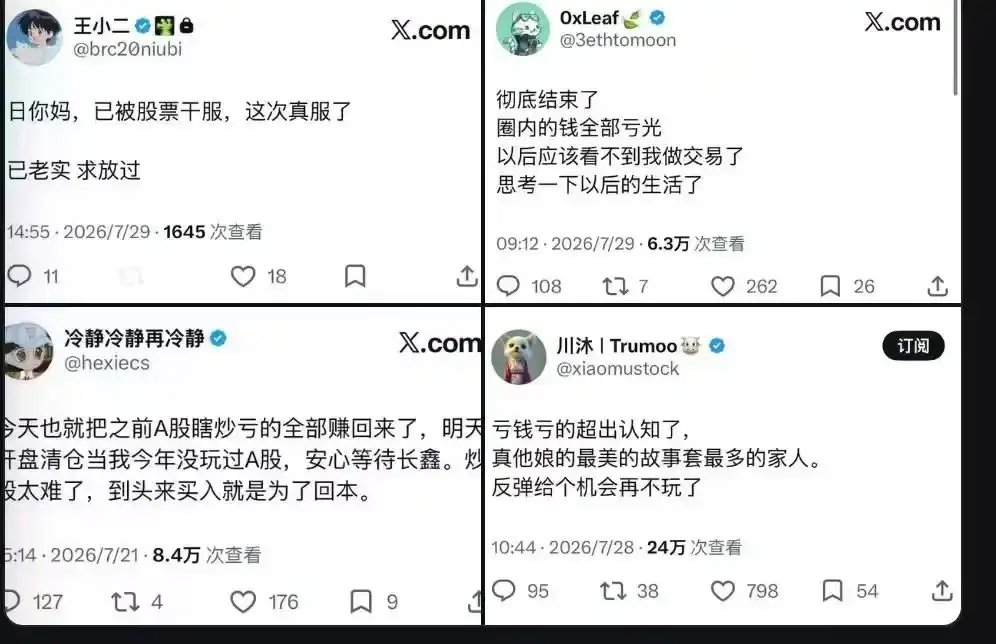
La llamada "familia nativa" se refiere a las criptomonedas. De la segunda mitad de 2025 a principios de 2026, se desarrolló en el mundo cripto un gran drama de "abandonar la familia nativa".

Un grupo de KOLs y jugadores veteranos con años de experiencia en el mercado de criptomonedas comenzaron a perder la confianza en el espacio. Bitcoin se movía lateralmente con volatilidad, el volumen de negociación era débil, los Meme coins cortaban cosecha tras cosecha, y muchos pensaron que "este círculo ya no tiene gracia", comenzando a dirigir su atención hacia las acciones estadounidenses.

Esta elección parecía bastante razonable.

Las acciones tienen ingresos, ganancias, informes financieros y la regulación de la SEC. En comparación con los proyectos cripto que carecen de flujo de caja y dependen completamente de la valoración por consenso, al menos las acciones estadounidenses parecían un activo más maduro y seguro.

Los traders del mundo cripto no solo se llevaron liquidez, sino que también transfirieron su método de trading.

En el mercado cripto, estaban acostumbrados a perseguir nuevas narrativas, buscar activos de alta elasticidad, usar apalancamiento y cambiar de posición rápidamente según el sentimiento en las redes sociales. Al entrar al mercado bursátil, este método apenas cambió, solo que el objeto de negociación pasó de ser tokens a ser IA, chips de memoria y ETF apalancados, logrando repetidamente grandes resultados.

Las acciones de memoria se convirtieron rápidamente en el nuevo consenso colectivo.

La lógica no era compleja: los servidores de IA necesitan más memoria de alto ancho de banda (HBM), hay escasez de oferta, los precios de la memoria suben, y Micron, Samsung Electronics y SK Hynix se convirtieron naturalmente en los "vendedores de palas" más directos. La frase del "Hermano Sun", "siempre falta memoria", caló hondo.

Muchos KOLs cripto se transformaron y comenzaron a hablar sobre acciones estadounidenses, el ciclo de la memoria, el gasto de capital en IA. Productos como el ETF 2x largo de SK Hynix también se consideraron herramientas de apuesta "más eficientes" que las acciones ordinarias.

Hasta que la tendencia cambió en julio.

Bitcoin se convirtió en un "activo de baja volatilidad"

¿Cuánto tiempo se necesita para caer a la mitad desde el pico?

Bitcoin tomó 268 días. La plata completó una corrección de magnitud similar en 169 días.

En comparación, SanDisk cayó aproximadamente un 55% en solo 36 días, y SK Hynix cayó aproximadamente un 53% en solo 34 días.

Para una "reducción a la mitad" similar, Bitcoin tomó casi nueve meses, mientras que las acciones de memoria tomaron poco más de un mes.
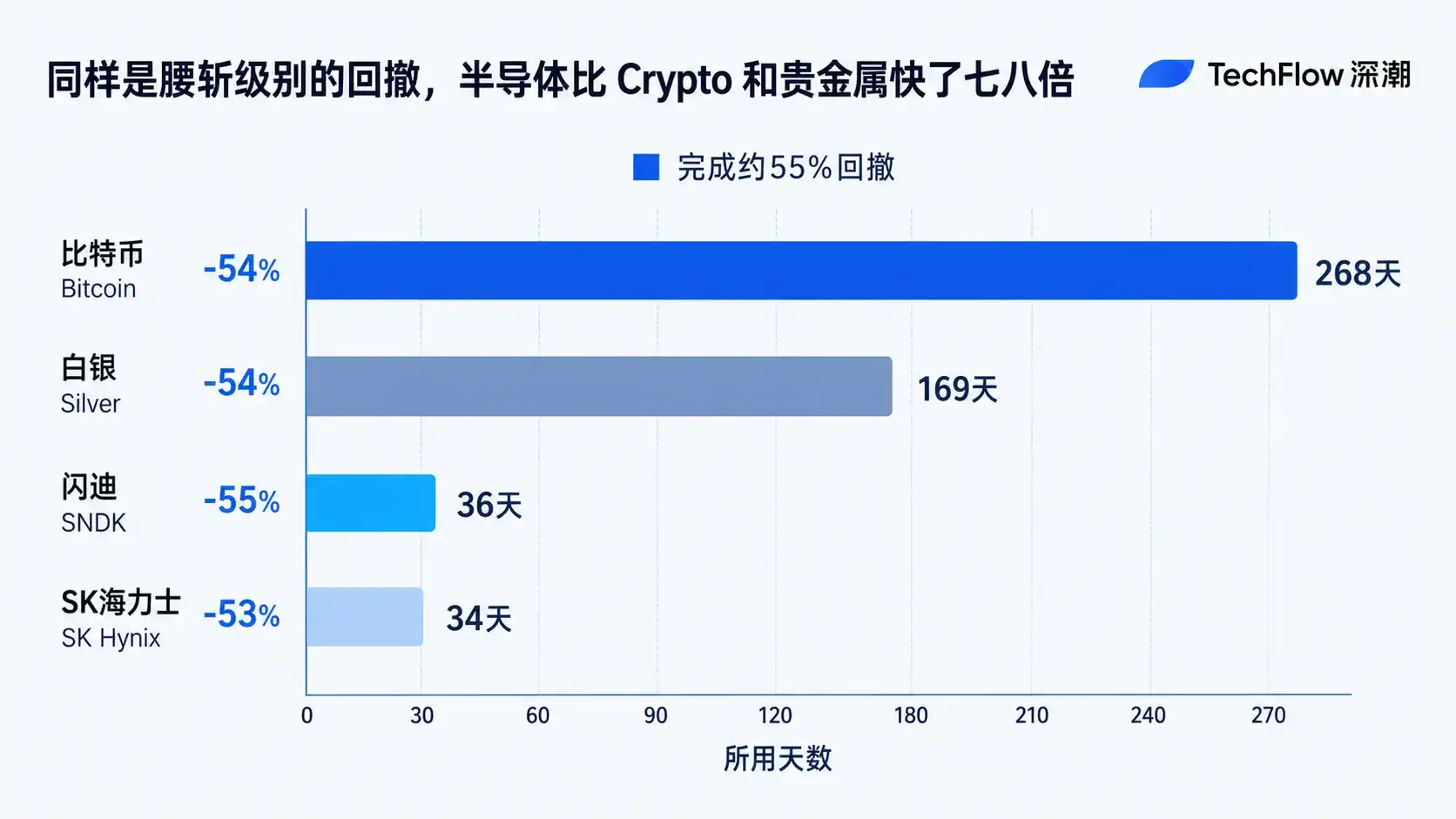
Esta es precisamente la peculiaridad de esta ronda de mercado: antes, los inversores temían que Bitcoin subiera o bajara drásticamente en pocos días, mientras que las acciones se ajustaban lentamente según ganancias y valoraciones; ahora, algunas acciones tecnológicas están completando el estallido completo de una burbuja en menos tiempo que las criptomonedas.

Muy contraintuitivo, en comparación con algunas acciones tecnológicas, Bitcoin se está volviendo relativamente estable.

Las estadísticas de Charles Schwab muestran que en 2025, la volatilidad histórica de Bitcoin fue de aproximadamente el 42%, con una reducción máxima de aproximadamente el 32%; en el mismo período, la volatilidad de Tesla fue de aproximadamente el 63% con una reducción máxima del 48%, y la volatilidad de Nvidia fue de aproximadamente el 50% con una reducción máxima del 37%.

Bitcoin sigue siendo un activo de alto riesgo, solo que algunas acciones tecnológicas grandes tienen una volatilidad aún mayor.

Bitwise incluso predijo en su perspectiva anual para 2026 que la volatilidad general de Bitcoin podría continuar siendo menor que la de Nvidia.

Así que la situación actual es bastante absurda: Bitcoin se parece cada vez más a una acción tecnológica, pero las acciones tecnológicas se parecen cada vez más a Bitcoin.

Cuando la narrativa se convierte en el ancla de valoración

En el mundo cripto hay un viejo dicho: especular con criptomonedas es especular con narrativas.

En 2026, las acciones tecnológicas globales están convirtiendo esta frase en realidad.

La IA, por supuesto, no es aire. Nvidia, Microsoft, Google y las grandes compañías de computación en la nube tienen ingresos reales y también están invirtiendo dinero real en construir centros de datos.

Pero desde "la IA realmente creará valor" hasta "cualquier empresa relacionada con la IA merece ser comprada a cualquier precio", hay un largo camino.

En el momento más caliente del mercado, este camino fue directamente omitido.

Servidores de IA, módulos ópticos, chips de memoria, centros de datos, equipos eléctricos e incluso empresas de energía nuclear: siempre que pudieran encajarse en la cadena de suministro de IA, sus precios podían subir rápidamente. Los negocios aún estaban en planificación, los pedidos aún no se materializaban, pero el mercado ya valoraba según el mejor resultado posible de varios años después.

La historia de Corea era "los semiconductores de IA están relacionados con el destino nacional". A medida que el KOSPI seguía alcanzando nuevos máximos, cada vez más familias comenzaron a abrir cuentas bursátiles para sus hijos menores de edad, dando acciones populares como Samsung Electronics y SK Hynix como regalos a largo plazo.

También apareció una concentración similar en el mercado A. En la primera mitad de 2026, la capitalización de mercado del sector TMT alcanzó los 41.78 billones de yuanes, representando aproximadamente el 31.45% de la capitalización total del mercado A; en algunos días de negociación, el volumen de negociación del sector tecnológico llegó a acercarse a la mitad del mercado total.

El mercado estadounidense, por su parte, ha estado valorando durante mucho tiempo en torno a unas pocas grandes compañías tecnológicas. Cuando el aumento del índice depende cada vez más de unas pocas empresas, cuando fondos, opciones y minoristas convergen en las mismas acciones, lo que parece una cartera de inversión diversificada en realidad está apostando por la misma historia de IA.

Esto se parece mucho al mundo cripto de antes. En 2021, Dogecoin subió no por un avance tecnológico, sino porque Elon Musk publicó un tuit. El fuerte aumento de las acciones tecnológicas en 2026 tampoco se debió a que todas las empresas tuvieran un estallido de ganancias, sino porque ChatGPT hizo creer a todos que "la IA lo reescribirá todo".

Que la narrativa pueda dominar el mercado tan rápidamente también se debe a cambios en los métodos de difusión.

En el pasado, la información sobre acciones provenía principalmente de informes financieros, informes de investigación y presentaciones institucionales. Hoy, cada vez más personas toman decisiones de inversión basadas en YouTube, X, videos cortos y comunidades de pago.

La compleja investigación de empresas se comprime en unas pocas frases: el tiempo probará el poder de cómputo y los módulos ópticos, el poder de cómputo de IA nunca será suficiente...

Los algoritmos de las redes sociales tampoco premian la prudencia; hacerse rico de la noche a la mañana siempre es la clave del tráfico: alguien duplicó su dinero de la noche a la mañana con opciones, un asalariado logró la libertad financiera apostando fuerte por acciones de memoria, alguien ganó en unos meses con ETF apalancados el salario de varios años.

El gráfico de velas es la mejor propaganda. Muchas amas de casa y señoras comenzaron a invertir sus ahorros privados, e incluso hubo quienes vendieron propiedades para comprar acciones, exactamente como hace unos años cuando un grupo de estudiantes abandonó la escuela para apostar todo al Web3...

Fiesta del apalancamiento

Lo más terrible del mundo cripto no es la volatilidad, sino la combinación mortal de apalancamiento y volatilidad. En 2026, los mercados bursátiles globales están replicando esto perfectamente.

El 27 de mayo de 2026, la bolsa de Corea aprobó la cotización de 16 ETF apalancados 2x con acciones individuales como subyacentes, vinculados precisamente a Samsung Electronics y SK Hynix.

Los minoristas enloquecieron. Desde la aprobación hasta mediados de julio, los minoristas coreanos compraron netos un total de 14 billones de wones (aproximadamente 640 mil millones de RMB) en ETF apalancados de acciones individuales. En el mismo período, los inversores extranjeros solo compraron alrededor de 2 billones de wones.

Estos ETF tenían varios diseños fatales.

Este tipo de productos reajusta su cartera diariamente. Cuanto más violenta sea la oscilación, más evidente será el deterioro del valor neto. Supongamos que una acción cae primero un 10% y luego sube un 11.1%, el precio puede volver al punto de partida; el producto apalancado 2x correspondiente caería primero un 20% y luego subiría un 22.2%, terminando aún con una pérdida de aproximadamente el 2.2%.

Durante una caída rápida, el problema es aún más grave.

Para mantener el apalancamiento objetivo, el producto necesita reducir pasivamente su exposición al riesgo después de una caída. Vender presiona aún más el precio del subyacente, y la caída de precios desencadena más reducciones de posición, stops de pérdida y presión sobre el margen.

Goldman Sachs señaló posteriormente que la "desapalancamiento rápido" de estos productos fue la causa principal de la volatilidad anómala intradía del KOSPI, y el 62% de las ventas netas institucionales provino de liquidaciones relacionadas con ETF.

Dos meses después, los reguladores coreanos suspendieron urgentemente la cotización de todos los nuevos ETF apalancados de acciones individuales, aumentando drásticamente el margen mínimo de 10 millones de wones a 30 millones de wones, y solo aceptando efectivo.

Pero era demasiado tarde: 2.3 billones de wones en montos de liquidación forzada, la riqueza de cientos de miles de familias se esfumó.

Incluso el mercado de acciones estadounidense, el más profundo del mundo, está experimentando las consecuencias del apalancamiento.

Un analista de JPMorgan señaló recientemente que el mercado de valores estadounidense aún tiene "espacio para desapalancarse" y necesita tres meses para volver a los niveles anteriores a abril.

La relación entre el tamaño de los ETF apalancados de acciones de chips de memoria y la capitalización de mercado de sus subyacentes es tres veces el promedio de todos los ETF de acciones. Incluso los ETF de índices de acciones apalancados en general tienen una relación elevada en comparación con su propio historial.

Una regresión

La "criptomonedización de la bolsa" no significa que las acciones sean ya exactamente iguales a las criptomonedas.

Detrás de las acciones aún hay empresas, activos, ingresos y flujos de caja, así como divulgación financiera, auditorías y regulación. Incluso cuando el sentimiento del mercado se desvanece, una empresa que realmente gana dinero todavía tiene un valor que puede calcularse.

Lo que realmente ha cambiado es la capa de negociación.

En el pasado, la gente compraba las ganancias futuras de una empresa; ahora, cada vez más personas están negociando la popularidad de un tema.

La criptomonedización de la bolsa es, en esencia, una revolución de desracionalización.

La bolsa tradicional mira el PER, el flujo de caja; la bolsa criptomonedizada mira la narrativa, la imaginación; la bolsa tradicional considera alta una volatilidad del 20%; en la bolsa criptomonedizada, una volatilidad intradía del 10% al 15% en acciones individuales se ha vuelto común.

La bolsa tradicional usa apalancamiento a través de préstamos de valores; la bolsa criptomonedizada, a través de ETF, derivados, estrategias cuantitativas; la información de la bolsa tradicional proviene de informes de investigación, estados financieros; la de la bolsa criptomonedizada, de Twitter, YouTubers, comunidades; la bolsa tradicional valora racionalmente a través de instituciones; en la bolsa criptomonedizada, las instituciones se minorizan, los cuantitativos compran en subidas y venden en bajadas...

Lo más ridículo es que, hoy Bitcoin se esfuerza por parecerse a una acción, a través de ETF, institucionalización y disminución de la volatilidad, siendo gradualmente aceptado por las finanzas tradicionales.

Este es un punto de cruce absurdo.

Los que pasaron del mundo cripto a la bolsa finalmente se dieron cuenta de que no habían abandonado su "familia nativa": es un mecanismo que se repite constantemente: historias grandiosas, posiciones congestionadas, apalancamiento fácil de obtener, y la creencia de cada uno de que puede salir antes que los demás.

La frase que un inversor minorista coreano escribió en un foro de trading merece ser recordada por todos: Quiero volver a los días antes de comprar acciones, y que me devuelvan mi dinero.

Pero el mercado nunca hace reembolsos.

Trending Cryptos

Related Questions

Q¿Por qué el artículo dice que el mercado de valores, especialmente el de las acciones tecnológicas, se está volviendo similar al criptomercado?

AEl artículo argumenta que el mercado de valores, en particular las acciones tecnológicas, está adoptando características del criptomercado, como la dependencia de narrativas en lugar de valoraciones fundamentales, el uso extensivo del apalancamiento, la volatilidad extrema y la rápida difusión de la información a través de las redes sociales. Ejemplos incluyen la caída abrupta de las acciones coreanas de chips de memoria y el papel de los ETF apalancados en amplificar las pérdidas.

Q¿Qué se entiende por 'familia nativa' (native family) en el contexto del artículo y por qué los comerciantes criptográficos regresan a ella?

AEn el contexto del artículo, la 'familia nativa' se refiere al mercado de criptomonedas. Los comerciantes que originalmente operaban en cripto y luego se trasladaron al mercado de valores están 'regresando a su familia nativa' en sentido figurado porque las tácticas de trading que usaban en cripto (narrativas, apalancamiento, volatilidad) ahora dominan esos mercados bursátiles. Su comentario 'Bienvenido de vuelta a la familia nativa' es una forma irónica de señalar que el entorno de riesgo que dejaron atrás ahora los persigue en la bolsa.

Q¿Según el artículo, cómo se compara actualmente la volatilidad de Bitcoin con la de algunas acciones tecnológicas importantes?

ADe manera contraria a la intuición, el artículo señala que, en comparación con ciertas acciones tecnológicas, Bitcoin se está volviendo un activo relativamente estable. Proporciona datos: en 2025, la volatilidad histórica de Bitcoin fue del 42% y su retroceso máximo del 32%, mientras que para Tesla fue del 63% y 48%, y para Nvidia del 50% y 37%. Además, acciones como SK Hynix tardaron solo 34 días en caer un 53%, mientras que un retroceso similar en Bitcoin tomó 268 días.

Q¿Qué papel desempeñaron los ETF apalancados sobre acciones individuales en el desplome del mercado coreano descrito en el artículo?

ALos ETF apalancados sobre acciones individuales (como los de 2x sobre Samsung y SK Hynix) jugaron un papel crucial y dañino en la caída del mercado coreano. Su diseño provoca una erosión de valor en mercados volátiles y, durante las caídas rápidas, requieren una 'desapalancamiento rápido', lo que fuerza ventas automáticas que deprimen aún más los precios, creando un círculo vicioso. La gran compra minorista de estos productos (14 billones de wones) amplificó masivamente las pérdidas y contribuyó significativamente a la volatilidad extrema y al colapso descrito.

Q¿Cuál es la principal diferencia que el artículo señala entre el 'mercado de valores tradicional' y el 'mercado de valores criptonizado'?

AEl artículo contrasta el 'mercado de valores tradicional', que valora las ganancias, los flujos de efectivo (PE, DCF), tiene una volatilidad moderada, información de informes financieros y un apalancamiento regulado, con el 'mercado de valores criptonizado'. Este último se basa en narrativas e imaginación, exhibe una volatilidad extrema (fluctuaciones diarias del 10-15%), emplea herramientas de apalancamiento complejas como ETF y derivados, obtiene información de redes sociales y youtubers, y muestra un comportamiento de 'instituciones minoristas' y trading cuantitativo oportunista.

Related Reads

a16z: From Companies to DAOs, DUNA May Become the Next Generation Organizational Form

This article, "From Companies to DAOs: How DUNA Could Become the Next Organizational Form," traces the 500-year evolution of business collaboration. It begins with medieval structures like the *commenda* and Florentine *compagnia*, which exposed partners to personal risk. The modern corporation, exemplified by the Dutch East India Company (VOC), was a revolutionary leap, enabling large-scale, capital-intensive ventures by offering limited liability and reducing coordination costs. However, corporations introduced new challenges like principal-agent problems and bureaucratic overhead. The piece argues that software and internet-native protocols are now reducing these traditional overheads. Decentralized Autonomous Organizations (DAOs) emerged as a new model for coordination without centralized management. Yet, DAOs face a significant legal vacuum: they lack legal recognition, leaving members exposed to unlimited personal liability, and their tokens are vulnerable to being classified as securities under unclear regulations (e.g., the Howey Test). This has forced projects into suboptimal workarounds like offshore foundations. The article identifies the Decentralized Unincorporated Nonprofit Association (DUNA) as a potential solution. Recently legalized in states like Wyoming, the DUNA provides a legal wrapper for decentralized networks. It grants key protections—legal personality, limited liability, and perpetual existence—to a group without imposing a traditional hierarchical management structure. This allows token-holder communities to govern, hold assets, and contract as a single legal entity, aligning with their decentralized nature. While DUNA doesn't solve all governance challenges or magically resolve securities law questions, it represents a crucial step. It fills the legal recognition gap, offering a native legal form for internet-scale, decentralized collaboration and extending the separation of personal risk from organizational venture into a new domain.

marsbit7m ago

a16z: From Companies to DAOs, DUNA May Become the Next Generation Organizational Form

marsbit7m ago

2026 Mid-Year Report On-Chain RWA: Tokenized Stock Market Cap Doubles in a Year, But 90% of Rights Are Hollow Shells

The 2026 Mid-Year Report on On-Chain RWA highlights a significant growth in tokenized stock market capitalization, which nearly doubled from $951 million in March to $1.89 billion by July. However, the report reveals a fundamental contradiction in this "layer 2.5" ecosystem: products with the strongest legal foundation (like regulated U.S. infrastructure) lack liquidity and distribution, while freely tradable offshored wrapper products often lack substantive ownership rights. The increase is driven largely by a few products (SECZ, FGRS, STRCx) and platforms (Ondo, xStocks, Securitize collectively hold over 85% share). While distributed value across networks like Ethereum, Solana, and BNB Chain has grown, the market remains fragmented. Products referencing the same underlying asset (e.g., Apple stock) are distinct legal liabilities with different intermediaries and jurisdictional rules, offering varying degrees of legal claim. The report cautions that headline numbers are misleading, as they reflect changes in distributed token value—driven by issuance, conversions, and price movements—not pure investor inflows. True "canonical shares" with legal ownership, wide wallet distribution, institutional liquidity, and independent on-chain price discovery do not yet exist at scale. Tokenized treasuries show stronger product-market fit, and ETFs may be easier to scale than single stocks. The core takeaway is a trade-off: legal certainty versus liquidity and composability.

marsbit56m ago

2026 Mid-Year Report On-Chain RWA: Tokenized Stock Market Cap Doubles in a Year, But 90% of Rights Are Hollow Shells

marsbit56m ago

Coldcard Hardware Wallet Hacked: 594 Bitcoin Withdrawn in 25 Minutes

The Coldcard hardware wallet has been compromised, with hackers stealing approximately 594.5 Bitcoin (~$40 million) from 500 addresses in just 25 minutes. The root cause was a critical software bug, undetected for five years, which disabled the device's secure chip for generating true random numbers. This led to the creation of private keys based on predictable data like the processor's serial number, drastically reducing cryptographic security. The attackers exploited this offline by brute-forcing possible seed phrases, finding active addresses on the public ledger, and signing transactions. Initially, Coinkite (Coldcard's maker) claimed only older models were at risk but later admitted all devices running the compromised firmware were vulnerable. CEO Rodolphe Novak (NVK) apologized but ruled out financial compensation for affected users. To secure funds, owners must urgently update their firmware to specific safe versions, generate a completely new seed phrase on the updated device, and transfer all assets to new addresses created with that new seed. While a BIP-39 passphrase can help, it does not replace this migration process. Other Coinkite products like TAPSIGNER were not affected. This incident underscores that even specialized hardware requires rigorous, independent code audits, especially for cryptographic functions. It parallels past failures, like a 2006 OpenSSL bug in Debian, and raises questions about whether automated code analysis can ever fully replace human scrutiny in critical security areas.

cryptonews.ru3h ago

Coldcard Hardware Wallet Hacked: 594 Bitcoin Withdrawn in 25 Minutes

cryptonews.ru3h ago

Trading

Spot

Hot Articles

What is LINON

Linde plc Tokenized Stock (Ondo): Revolutionizing Traditional Equity Access Through Blockchain Innovation The emergence of Linde plc Tokenized Stock (Ondo), represented by the ticker $LINON, signifies a monumental shift in the fusion of traditional financial structures and decentralized finance (DeFi). This innovative financial instrument showcases the tremendous potential of blockchain technology to democratize access to traditional equity markets while ensuring the security and regulatory compliance necessary for institutional-grade financial products. Through Ondo Finance's pioneering tokenization platform, $LINON provides a seamless pathway for global investors to engage with one of the world's leading industrial gas companies, Linde plc, creating a blockchain-native representation of the underlying equity. Introduction to Linde plc Tokenized Stock The landscape of financial markets is witnessing a groundbreaking transformation through the tokenization of real-world assets. Linde plc Tokenized Stock (Ondo) epitomizes this revolutionary approach by bridging the gap between conventional stock ownership and blockchain-enabled financial infrastructure. The $LINON token allows investors to gain exposure to one of the prominent industrial companies worldwide through decentralized technology. Operating within Ondo Finance's comprehensive ecosystem, $LINON symbolizes a practical application of tokenization technology that enhances accessibility, efficiency, and global connectivity in traditional financial markets. By leveraging blockchain infrastructure, this tokenized stock enables international investors to participate in U.S. equity markets, overcoming traditional barriers associated with cross-border investing. The significance of $LINON goes beyond technological innovation; it represents a fundamental shift in asset structuring, distribution, and trading in the digital age. This tokenized stock maintains all the economic benefits associated with traditional Linde plc shares while offering improved liquidity, programmable compliance features, and seamless integration with decentralized finance protocols. The development of $LINON indicates a growing acceptance of blockchain technology as a viable means for traditional finance, exemplifying how even well-established assets like Linde plc can integrate into blockchain systems. This approach preserves the core attributes that appeal to investors while introducing advanced capabilities that enhance the overall investment proposition. Project Overview and Objectives Linde plc Tokenized Stock (Ondo) encapsulates a strategic effort to democratize access to traditional equity markets through advanced blockchain technologies. The primary objective of $LINON is to provide approved global investors seamless access to the economic exposure associated with Linde plc shares, furthering an effort to create a more inclusive financial ecosystem. Beyond the digital representation of traditional assets, $LINON endeavors to eliminate barriers of geography and time zones that limit investor participation. Its design ensures that blockchain technology can elevate traditional investment vehicles without undermining the security or compliance requirements expected by investors. Key goals of the project include enhanced liquidity provision, programmable compliance mechanisms, and interoperability with other blockchain networks. Each $LINON token is fortified by actual Linde plc securities housed at U.S.-registered broker-dealers, allowing holders to reap economic advantages akin to traditional stockholders, such as dividend reinvestment. Furthermore, $LINON aims to establish new industry standards for institutional-grade tokenized securities, paving the way for traditional assets to embrace blockchain technology while remaining compliant with regulatory frameworks. By associating itself with a company as reputable as Linde plc, the project opens avenues for exploring tokenized equities catering to both conservative institutional players and daring retail investors. Project Creator and Development Team The vision for Linde plc Tokenized Stock (Ondo) comes from Nathan Allman, founder and CEO of Ondo Finance. His background in traditional finance coupled with expertise in blockchain technology positions him uniquely to navigate the complexities of asset tokenization. Allman's academic journey began at Brown University, focusing on Economics and Biology, equipping him with valuable analytical skills. His time at Goldman Sachs in the Digital Assets division strengthened his understanding of the interplay between financial institutions and emerging technologies, laying the groundwork for his later endeavors in alternative investment strategies. Under Allman's guidance, Ondo Finance has emerged as a leader in asset tokenization, launching $LINON as a flagship example of the company's larger mission towards revolutionizing traditional financial systems using blockchain technology. His commitment to leveraging blockchain for creating institutional-grade financial products has shaped the landscape of real-world asset tokenization. Investment and Funding Structure The growth of Ondo Finance, the platform powering Linde plc Tokenized Stock (Ondo), is bolstered by robust financial backing from prestigious venture capital firms and strategic investors. This strong investment foundation underpins the development of the key infrastructure essential for compliant tokenized securities like $LINON. In August 2021, Ondo Finance secured $4 million in seed funding led by a major venture capital firm, which enabled the company to commence platform development and establish the necessary regulatory processes for tokenizing real-world assets. This early investment cemented Ondo Finance's credibility within the industry. The Series A funding round followed, garnering $20 million with participation from renowned firms committed to transformative technology companies. This backing demonstrated substantial institutional confidence in Ondo Finance's vision, allowing it to hone its approach to asset tokenization through mechanisms that ensure compliance and accessibility. Noteworthy contributors, including institutional investors and experienced partners, have added significant value to Ondo Finance’s development efforts. Their involvement underscores the confidence across sectors in Ondo Finance's approach to bridging traditional finance with blockchain innovations. Technical Infrastructure and Innovation The technical architecture that underpins Linde plc Tokenized Stock (Ondo) represents a sophisticated melding of traditional finance systems and cutting-edge blockchain technology. The architecture's foundation is built on the Ethereum network, renowned for its security and programmability—both critical for intricate financial instruments. The $LINON tokenization process comprises creating a blockchain-native representation of Linde plc shares that preserves economic benefits while augmenting investor capabilities. Each token corresponds to actual shares held at U.S.-registered broker-dealers, creating a compliant custody structure that legitimizes the asset's existence and value. Automated compliance systems are integrated into the tokenization process, managing critical components such as know-your-customer (KYC) verification and anti-money laundering (AML) protocols. This incorporation of programmable compliance empowers $LINON to uphold regulatory standards essential for institutional proliferation. Cross-chain interoperability characterizes the advanced technical features of $LINON. While initially deployed on Ethereum, the framework is designed for expansion to other networks such as Solana and BNB Chain. This adaptability enhances liquidity and accessibility, allowing investors to select their preferred blockchain ecosystems. Historical Timeline and Development Crafting the history of Linde plc Tokenized Stock (Ondo) unfolds in parallel with the evolution of Ondo Finance's tokenization platform. The timeline's inception dates back to March 2021 when Nathan Allman laid the foundations for creating institutional-grade financial products on blockchain infrastructure. The initial funding round in August 2021 provided crucial resources for developing the platform and establishing partnerships necessary for effective tokenization. By January 2023, Ondo Finance launched its tokenized treasury products, establishing mechanisms that would facilitate future tokenized equities such as $LINON. A pivotal milestone arose in February 2025 when Ondo Chain—a Layer 1 blockchain designed specifically for asset tokenization—was introduced. This infrastructure enhances capabilities vital for institutional markets, demonstrating Ondo Finance's long-term commitment to tokenization. Subsequently, the launch of Ondo Global Markets in September 2025 marked the official debut of $LINON. This milestone showcased the successful transition from development to active trading, enabling investors around the world to access American financial markets seamlessly. Ongoing development plans include a targeted expansion of available tokenized assets to over 1,000 by the end of 2025, pointing to a bright future for Ondo Finance's ecosystem and its mission to broaden tokenized equity accessibility. Regulatory Compliance and Legal Framework The legal architecture governing Linde plc Tokenized Stock (Ondo) emphasizes a sophisticated approach to regulatory compliance, allowing tokenized securities to be implemented within a blockchain-based framework. The legal structure governing $LINON spans multiple jurisdictions while maintaining a robust legal footing. Compliance systems ensure that only eligible investors can access the token, enforced through automated verification that aligns with international regulations. This innovative regulatory technology promises real-time enforcement of complex requirements, considerably enhancing efficiency in operating within the regulatory landscape. The custody framework undergirding $LINON ensures that the underlying shares are securely held at U.S.-registered broker-dealers, complying with necessary regulations while delivering blockchain-driven access to investors. The token maintains its economic equivalency and security through this carefully structured custody arrangement. KYC and AML compliance systems are embedded within the smart contract architecture, ensuring integrity and adherence to regulatory practices while fostering transparency for investors. The jurisdictional restrictions mark a commitment to navigating the evolving landscape of international securities laws. Market Impact and Industry Significance The advent of Linde plc Tokenized Stock (Ondo) holds profound implications for the broader financial landscape, symbolizing a clear shift towards blockchain-enabled markets. $LINON serves as a proof-of-concept for integrating traditional companies into blockchain ecosystems, showcasing the potential benefits such as broader accessibility and improved efficiency. The market's response to $LINON indicates a growing acceptance of tokenization among institutional investors, contributing to the emergence of an expanding sector wherein traditional assets can be interconnected with blockchain innovations. The success of $LINON further solidifies market confidence, indicating an overarching shift towards recognizing asset tokenization as a transformative force in finance. Future Development and Expansion Plans The future trajectory for Linde plc Tokenized Stock (Ondo) centers around the expansion of the tokenization ecosystem and enhanced infrastructure supporting blockchain-enabled financial services. Plans for cross-chain integration usher in new opportunities for liquidity and flexibility within the investment framework, with existing capabilities poised for continuous enhancement. With the introduction of Ondo Chain, Ondo Finance aims to transition $LINON to an optimized blockchain environment specifically designed for asset tokenization. This new infrastructure heralds exciting prospects for the development of institutional-grade financial products, ensuring ongoing compatibility with contemporary investment strategies. Further integration with decentralized finance protocols signifies a commitment to empowering $LINON holders through advanced financial strategies. The anticipated expansion of available tokenized assets promises to broaden investor access, enhancing the utility and appeal of the platform. In alignment with ambitions for regulatory expansion, ongoing efforts to secure approvals for new jurisdictions will enhance investor access, further positioning $LINON at the forefront of the burgeoning tokenization market. Conclusion Linde plc Tokenized Stock (Ondo), as represented by the $LINON token, stands at the intersection of traditional finance and blockchain innovation. It embodies a transformative milestone in how financial assets are structured, distributed, and engaged within modern investment ecosystems. The technical sophistication behind $LINON, combined with its regulatory compliance framework, illustrates that asset tokenization can improve financial infrastructure rather than simply digitizing existing products. This pioneering effort not only enhances investor access to U.S. equity markets but also signifies an evolution of how traditional financial services can integrate blockchain technology. As the asset tokenization market grows exponentially, with prospects suggesting significant valuation increases, $LINON paves the way for a future where tokenized securities become standard fixtures in the financial landscape. The trajectory of $LINON will undoubtedly influence how traditional finance adapts to a transformed, blockchain-powered world.

3.9k Total ViewsPublished 2025.12.05Updated 2025.12.05

What is LINON

What is CRMON

Salesforce Tokenized Stock (Ondo): Revolutionising Traditional Equity Access Through Blockchain Innovation The emergence of Salesforce Tokenized Stock (CRMON) marks a pivotal advancement in integrating traditional financial markets with blockchain technology. This innovative approach offers investors unprecedented access to equity exposure through tokenisation. Developed by Ondo Finance, CRMON provides tokenholders with economic exposure equivalent to holding Salesforce stock (CRM) while automatically reinvesting dividends. This effectively bridges the gap between conventional equity markets and decentralised finance (DeFi). Introduction and Comprehensive Overview of Salesforce Tokenized Stock In recent years, the financial landscape has dramatically transformed due to blockchain technology, fundamentally altering how investors access and interact with traditional assets. The development of Salesforce Tokenized Stock (CRMON) is a prime example of this evolution, representing a sophisticated fusion of conventional equity markets with cutting-edge distributed ledger technology. CRMON is a tokenised version of Salesforce stock, emerging from the innovative work of Ondo Finance, a leading platform in the real-world asset tokenisation sector that positions itself as a bridge between traditional finance and decentralised systems. Designed to provide tokenholders with economic exposure that mirrors the performance of the underlying Salesforce stock, CRMON incorporates automatic dividend reinvestment mechanisms. This eliminates many traditional barriers associated with international equity investment, such as complex brokerage relationships, currency conversion challenges, and restricted trading hours. The tokenisation process reimagines stock ownership as a blockchain-native asset while maintaining its economic equivalence with the underlying security, offering enhanced portability and integration capabilities within decentralised finance ecosystems. CRMON transcends its individual utility as an investment instrument to represent a fundamental shift in how financial markets can operate in an increasingly digital world. By maintaining full backing through U.S.-registered broker-dealers and implementing robust compliance frameworks, CRMON demonstrates that tokenised securities can achieve the regulatory standards necessary for institutional adoption while delivering the technological advantages of blockchain infrastructure. Understanding Tokenized Real-World Assets and CRMON's Strategic Position Tokenised real-world assets signify one of the most significant innovations in modern finance, fundamentally reimagining how traditional securities are represented, traded, and utilised within digital ecosystems. CRMON operates as a tokenised equity instrument correlating directly with Salesforce stock while optimising accessibility and efficiency. This aligns with Ondo Finance's broader mission to democratise access to institutional-grade financial products through innovative tokenisation strategies. The tokenisation process guarantees complete economic equivalence with the underlying Salesforce equity. Each CRMON token represents a proportional claim on Salesforce stock held by qualified custodians, with dividend payments automatically reinvested to maintain continuous exposure to total return performance. This structure simplifies dividend management and ensures that tokenholders receive the full economic benefit of their equity exposure, encompassing both capital appreciation and income generation. Ondo Finance's strategy in tokenising Salesforce stock demonstrates its expertise in creating compliant, institutional-grade products that meet traditional financial markets' stringent requirements. The platform’s focus on merging regulatory compliance with blockchain benefits positions it at the forefront of decentralised finance, captivating both institutional and retail investors seeking blockchain-native solutions. The Technology and Innovation Framework Behind CRMON The technological infrastructure supporting CRMON integrates blockchain technology with traditional financial mechanisms, delivering institutional-grade security and compliance while maintaining the operational advantages of decentralised systems. Built on the Ethereum blockchain, CRMON utilises robust smart contract capabilities to ensure transparent, secure operations. The smart contract architecture incorporates layered security and compliance mechanisms, enabling automated compliance checks and real-time asset backing verification. Integration with oracle services maintains accurate pricing and dividend information, ensuring CRMON reflects the underlying Salesforce stock's accurate performance. This architecture delivers automated dividend reinvestments and other corporate actions, eliminating manual processing requirements and directly enhancing tokenholder benefits. Ondo Finance ensures CRMON's security structure includes daily third-party verification of holdings, independent collateral agents, and a multiple-layer custody system through partnerships with established financial institutions. This framework safeguards tokenholder interests against operational risks while providing robust asset backing. The user interface enhances integration capabilities, allowing seamless interaction between CRMON and various decentralised finance protocols, as well as cryptocurrency exchanges. This interoperability enables users to leverage their tokenised equity across multiple platforms, creating sophisticated investment strategies that marry traditional equity characteristics with blockchain-native innovation. Leadership and Corporate Structure of Ondo Finance The leadership team behind CRMON and Ondo Finance blends expertise from traditional finance and blockchain technology, presenting a robust combination of skills essential for successfully bridging conventional markets with decentralised finance. Nathan Allman, the founder and CEO, emerged from a distinguished financial background before establishing Ondo Finance in 2021. Allman's experience includes notable roles at major financial institutions, including significant contributions to developing cryptocurrency market services. His insights into regulatory compliance were paramount in developing products like CRMON that successfully unify traditional securities with blockchain technology. With a team of professionals boasting substantial experience in both conventional finance and blockchain sectors, Ondo Finance's leadership comprises diverse expertise that covers every aspect of tokenised asset development. Justin Schmidt serves as President and COO, contributing unique operational expertise, while Chris Tyrell brings essential compliance knowledge. Investment Landscape and Funding History The investment landscape surrounding Ondo Finance reflects significant institutional confidence in its mission to tokenise real-world assets. The company has raised substantial funds through various investment rounds, attracting leading venture capital firms and strategic investors that recognise the transformative potential of tokenised securities like CRMON. Notably, Ondo Finance completed a successful Series A funding round in 2022, led by well-known venture capital firms. This funding success validates Ondo Finance's innovative approach to creating compliant, institutional-grade tokenised products. In total, Ondo Finance has successfully secured substantial funding, raising significant capital for product development and market expansion, including a noteworthy token sale that reinforced its governance structure through the establishment of the ONDO token. The diverse composition of investors reflects broad market confidence in Ondo Finance's business model, demonstrating support from both traditional and blockchain-native organisations. Operational Mechanics and Technical Implementation The operational framework supporting CRMON exemplifies sophisticated integration of traditional financial mechanisms with blockchain technology. The technical implementation introduces multiple layers of security, compliance, and operational efficiency to meet institutional standards while enhancing accessibility. The tokenisation process begins by acquiring actual Salesforce stock through U.S.-registered broker-dealers, ensuring each CRMON token maintains direct correlation with the underlying equity performance. Smart contracts automate operational processes, including dividend reinvestment and corporate action processing, facilitating a streamlined user experience. The Minting and redemption processes allow authorised participants to manage CRMON tokens effectively. During U.S. trading hours, institutions can mint new tokens by depositing stablecoins that are used to purchase corresponding Salesforce equity. This structure maintains a tight correlation with underlying assets, enhancing liquidity and price discovery. Additionally, the infrastructure supports twenty-four-hour token transfer capabilities, providing CRMON holders with operations outside traditional market hours. This represents a significant advantage over conventional securities ownership, thus promoting integration with decentralised finance applications. Plans for cross-chain compatibility through partnerships signal further ambitions for CRMON's market reach. By expanding to other blockchain networks, Ondo Finance aims to enhance accessibility and user engagement with tokenised equity products. Timeline and Historical Development of Tokenized Equity Innovation The timeline of CRMON's development and Ondo Finance's broader tokenised capabilities demonstrates a systematic innovation process beginning with the company's founding in 2021. 2021: Ondo Finance is founded by Nathan Allman and co-founders, launching initial products focused on structured vault offerings on the Ethereum blockchain. 2022: The company completes substantial funding rounds—both equity and token sales—totaling significant capital and launching initial tokenised U.S. Treasury products. 2023-2024: Ondo Finance experiences substantial growth, establishing partnerships with major financial institutions while expanding its product offerings beyond fixed-income securities. February 2025: Ondo Global Markets is announced, marking the transition into equity tokenisation with plans for accessing over one hundred U.S. stocks and ETFs. September 2025: The official launch of Ondo Global Markets includes CRMON alongside other tokenised equity offerings, marking a significant evolution in Ondo Finance's product ecosystem. This timeline highlights the organisation's rapid growth and its capability to adapt its technological and compliance frameworks to accommodate different asset classes effectively while maintaining security and regulatory integrity. Regulatory Framework and Compliance Approach Ondo Finance's regulatory framework showcases a sophisticated compliance strategy, essential for achieving institutional adoption in the tokenised securities market. The company's strong partnerships with U.S.-registered broker-dealers promote adherence to Securities and Exchange Commission regulations and apply robust investor protections. Acquisitions, such as Oasis Pro—a registered broker-dealer—significantly enhance Ondo Finance's compliance capabilities, ensuring thorough alignment with existing regulatory structures. The company employs independent verification procedures that foster transparency, aiming for a solid performance standards reputation. Furthermore, Ondo Finance's commitment extends to international regulatory compliance, ensuring token access remains restricted to eligible investors while adhering to pertinent cross-border securities regulations. Comprehensive attention to tax implications and reporting requirements fortifies the security and compliance landscape of CRMON, ensuring that investor obligations remain manageable. Future Prospects and Market Positioning The forward-looking landscape for CRMON and Ondo Finance illustrates substantial growth opportunities driven by institutional adoption of blockchain technology and escalating demand for efficient alternatives to conventional securities ownership. Market projections indicate the tokenised asset sector could value multiple trillion dollars by 2030. With plans to scale CRMON offerings significantly and integrate it with a dedicated blockchain infrastructure—Ondo Chain—Ondo Finance aims to elevate its institutional-grade tokenised asset operations. Additionally, the development of strategic partnerships enhances distribution capabilities while establishing the company's credibility in the financial market. Furthermore, the integration of tokenised equity with decentralised finance protocols offers new potential for innovative financial products and strategies previously impossible with traditional securities. These factors underscore CRMON's positioning to effectively capture increased market share and deliver innovative solutions for international investment exposure. Conclusion Salesforce Tokenized Stock (CRMON) symbolises a transformative development within financial markets, successfully bridging traditional equity ownership with blockchain technology to create unprecedented accessibility for global investors. Through Ondo Finance's sophisticated tokenisation framework, CRMON provides complete economic exposure to Salesforce equity performance while enhancing operational advantages that exceed traditional ownership. The launch of CRMON reflects the broader evolution of financial markets towards blockchain infrastructures that maintain regulatory compliance while delivering increased efficiency. Ondo Finance's extensive approach to regulatory adherence, institutional-grade security, and technological innovation solidifies CRMON as a model for future tokenised securities, delivering access previously unattainable in conventional brokerage structures. As the tokenised asset sector continues to develop, CRMON is well-positioned to address historical inefficiencies in capital markets while providing investors with innovative solutions for accessing traditional securities. The outlook for CRMON looks exceptionally promising, supported by ambitious expansion plans, technological innovations, and strategic partnerships, thereby representing a pioneering model of modern financial infrastructure evolving through blockchain integration.

4.0k Total ViewsPublished 2025.12.05Updated 2025.12.05

What is CRMON

What is SHOPON

Shopify Tokenized Stock (Ondo): A Comprehensive Analysis of Real-World Asset Tokenization in Web3 This article delves into the Shopify Tokenized Stock (Ondo), recognised by its ticker symbol $SHOPON, exploring its implications at the intersection of traditional finance and blockchain technology. As a part of Ondo Finance's tokenized securities platform, Shopify’s tokenized stock exemplifies advancements in democratizing access to global capital markets through innovative digital assets. Introduction and Overview of Shopify Tokenized Stock (Ondo) Shopify Tokenized Stock (Ondo), or $SHOPON, portrays a pivotal innovation in the realm of tokenized securities, allowing investors to gain economic exposure akin to directly owning shares of Shopify Inc. This token, developed under the umbrella of Ondo Finance, not only provides investors with the ability to hold digital representations of the company’s stock but also integrates features such as automatic reinvestment of dividends. This advancement represents a substantial shift in the landscape of decentralized finance (DeFi), linking conventional equity markets with blockchain solutions designed to enhance accessibility, transparency, and liquidity. By eliminating geographical barriers and enabling 24/7 trading capabilities, $SHOPON is positioned as a bridge connecting traditional financial instruments and the emerging Web3 ecosystem. What is Shopify Tokenized Stock (Ondo), $SHOPON? The $SHOPON token serves as a digital manifestation of Shopify Inc.'s shares, engineered to provide a direct correlation to the underlying asset's performance. Through the utilization of blockchain technology, the token gives holders a mechanism to participate in the economic benefits associated with equity ownership, including capital appreciation and dividend distribution. The unique aspect of $SHOPON lies in its automatic dividend reinvestment mechanism, which allows returns to compound without necessitating active management by the investor. This feature inherently enhances its attractiveness as an investment vehicle, particularly for individuals seeking passive income growth alongside exposure to high-performing equities. The tokenization process is facilitated by the custody of actual Shopify shares through regulated intermediaries, ensuring that every $SHOPON token is verifiably backed by real equity. This structure empowers investors with the dual advantages of both traditional financial characteristics and the innovative benefits tied to blockchain technology. Who is the Creator of Shopify Tokenized Stock (Ondo)? The creator of Shopify Tokenized Stock (Ondo), Nathan Allman, is an experienced figure in the finance sector, formerly associated with Goldman Sachs. His rich background includes significant expertise in digital asset development, bridging the gap between traditional finance and cryptocurrencies. Allman’s educational journey, marked by studies at Brown University, provided him with a deep understanding of economics and biology, equipping him with analytical skills that inform his strategic vision. In 2021, he founded Ondo Finance, committing to developing tokenized securities that meet institutional-grade standards while leveraging blockchain's transformative capabilities. Under Allman's leadership, Ondo Finance has focused on creating compliant and innovative financial products that empower a diverse investor base. Who are the Investors of Shopify Tokenized Stock (Ondo)? The investment landscape surrounding Shopify Tokenized Stock (Ondo) is notably robust, underpinned by significant institutional support. Primarily, Pantera Capital stands out as a strategic partner through the Ondo Catalyst initiative, a $250 million commitment aimed at accelerating the development of on-chain capital markets. This partnership not only signifies institutional confidence in the potential of tokenized assets but also reinforces Ondo Finance's operational capabilities and market positioning. The funding pathways have included earlier rounds that amassed millions in seed funding and further structural investments, solidifying relationships with both venture capital firms and private investors. Moreover, the financial framework is complemented by strategic partnerships with established financial institutions and technology companies, enhancing Ondo’s infrastructure and operational expertise. How Does Shopify Tokenized Stock (Ondo), $SHOPON Work? At the core of $SHOPON's operational framework is a sophisticated system integrating traditional finance mechanisms with blockchain technology. The custody of actual Shopify shares ensures that token holders retain authentic economic exposure, safeguarding their investments in line with recognized legal structures. The smart contracts employed in managing $SHOPON handle various functions, including automatic dividend reinvestment and ownership transfer, offering instant settlement and increased liquidity, marking a significant departure from conventional trading systems plagued by multi-day settlement delays. By providing interoperability with other decentralized finance applications, $SHOPON empowers holders with potentially lucrative opportunities for advanced investment strategies, including lending and automated market making. This complex integration presents a unique value proposition, catering to both traditional and crypto-native investors. The innovative structure of $SHOPON also allows for real-time settlements and transactions documented on the blockchain, delivering unparalleled transparency and security—a major advancement over standard equity trading practices. Timeline of Shopify Tokenized Stock (Ondo) March 2021: Nathan Allman establishes Ondo Finance, initially focusing on decentralized finance yield optimization. August 2021: Completion of a $4 million seed funding round led by Pantera Capital. January 2023: Launch of initial tokenized treasury security products, laying the groundwork for future equity tokenization. July 2025: Announcement of the Ondo Catalyst initiative, a strategic investment program valued at $250 million, aimed at propelling the development of tokenization in capital markets. September 3, 2025: Launch of Ondo Global Markets featuring over 100 tokenized U.S. stocks and ETFs, including $SHOPON. Technical Implementation and Blockchain Infrastructure Shopify Tokenized Stock (Ondo) operates on a technical architectural framework that marries blockchain protocols with traditional financial custody arrangements. The ecosystem leverages Ethereum's smart contract capabilities, providing seamless transaction management while ensuring compliance with regulatory standards through established financial custodians. Central to this architecture are security measures and transparent transaction records that affirm the legitimacy of each tokenholder's economic stake. With automated features managed by intricate smart contracts, $SHOPON not only streamlines ownership transfers but also allows for the tactical reinvestment of dividends—a hallmark of modern investment strategies. Moreover, the incorporation of LayerZero technology facilitates cross-chain interoperability, making $SHOPON accessible across multiple blockchain environments while preserving its functional robustness. This forward-thinking technical design positions $SHOPON as an adaptable asset within the larger DeFi milieu. Regulatory Framework and Compliance Architecture $SHOPON's regulatory framework is built upon the meticulous navigation of existing financial regulations that govern securities. The custody arrangements for the underlying Shopify shares are managed by U.S.-regulated broker-dealers, ensuring compliance and protection for investors. By maintaining a separation between the blockchain tokenization process and traditional custody, $SHOPON adheres to legal requirements while offering innovative functionalities that challenge conventional constraints. This dual-layered compliance approach enhances investor confidence and underscores Ondo Finance's commitment to regulatory integrity. Notably, the availability of $SHOPON is tailored to international investors from regions such as Asia-Pacific, Europe, and Africa, as regulatory parameters in the U.S. and U.K. present challenges in accessing tokenized securities. Market Access and Global Distribution Strategy The distribution strategy of $SHOPON is keenly designed to optimize global access while conforming to regulatory standards. The platform aims to establish comprehensive coverage for eligible investors across multiple regions, effectively dismantling traditional barriers through the implementation of blockchain technology. Integration with various cryptocurrency wallets and exchanges also promotes user-friendliness and accessibility, establishing a streamlined experience for investors to manage their holdings. Moreover, the 24/7 trading capabilities afforded by the tokenized model allow participants to react promptly to market shifts, fundamentally transforming how global equities are accessed and traded. Technology Integration and Cross-Chain Functionality The remarkable technological underpinnings of $SHOPON propagate its multi-chain functionality, set to expand its reach beyond Ethereum to networks such as Solana and BNB Chain. Such cross-chain capabilities allow users flexibility when navigating between blockchains, concurrently leveraging distinct network attributes to optimize their trading experience. LayerZero serves as the backbone for ensuring decentralized transfers between networks while providing the requisite security and speed, quintessential for maintaining investor trust. This comprehensive interoperability illustrates $SHOPON's commitment to being a versatile, user-centric asset in the evolving investment landscape. Ecosystem Integration and DeFi Compatibility Incorporating $SHOPON into broader DeFi protocols signifies its potential beyond traditional stock ownership. Token holders can leverage their holdings for various sophisticated strategies and applications, enhancing investment returns and liquidity management. By establishing a presence in lending protocols and automated trading systems, $SHOPON effectively democratizes access to advanced financial strategies previously limited to institutional investors. Such integration contributes to a more competitive and dynamic financial landscape, where individual investors can capitalize on tools typically reserved for larger entities. Risk Management and Security Framework Security remains paramount in the operational infrastructure of $SHOPON. The tokenization framework employs multiple layers of protection—beginning with regulated custody of the underlying Shopify shares. The operational protocols establish rigorous auditing, key management, and transaction monitoring standards, thus safeguarding against potential vulnerabilities. Moreover, meticulous adherence to evolving regulatory requirements provides an extra layer of security, fortifying investor protections and institutional compliance. Market Impact and Industry Implications The introduction of Shopify Tokenized Stock (Ondo) heralds a transformative shift in how financial markets operate, emphasizing the potential of tokenized securities to reshape traditional investment paradigms. The successful integration of $SHOPON encapsulates the efficiencies inherent in blockchain technology and opens avenues for new user demographics previously barred from extensive market participation. The impact extends beyond the immediate benefits to token holders, indicating broader trends that may challenge the status quo of investment services, particularly in addressing geographic restrictions and operational costs typically associated with traditional brokerage platforms. Undeniably, $SHOPON encapsulates the potential for traditional institutions to innovate further, leveraging the increasing demand for seamless blockchain access to complement existing financial infrastructure. Future Development Roadmap and Strategic Vision As Ondo Finance looks forward, the trajectory of $SHOPON rests on ambitious goals aimed at broadening the spectrum of available tokenized assets significantly. Over the next few years, plans are in place to expand to more than 1,000 tokenized securities, further enhancing market participation and investment options for individuals worldwide. Continued integration with traditional financial actors, development of specialized institutional products, and enhancements in automated trading capabilities will ensure that $SHOPON maintains its position at the forefront of financial innovation. Regulatory collaboration will also remain a focal point, establishing a framework that not only supports the compliance requirements but also promotes a healthy environment for tokenized asset proliferation. Conclusion and Market Significance In summary, Shopify Tokenized Stock (Ondo), represented by the ticker $SHOPON, is more than merely a tokenized equity offering; it embodies the innovation possible when traditional finance collides with modern blockchain applications. With a robust technical architecture, a commitment to compliance, and a clear strategic vision, $SHOPON exemplifies the potential for tokenized assets to enhance liquidity, accessibility, and functionality in capital markets. As the global investment landscape evolves, the transformative implications of $SHOPON extend beyond individual investors to revolutionize how financial instruments are perceived, traded, and utilized within both traditional and decentralized frameworks.

4.0k Total ViewsPublished 2025.12.05Updated 2025.12.05

What is SHOPON

Discussions

Welcome to the HTX Community. Here, you can stay informed about the latest platform developments and gain access to professional market insights. Users' opinions on the price of HOME (HOME) are presented below.

活动图片