Une fois que les investissements en R&D ont rattrapé ceux des États-Unis, la concurrence sino-américaine sur les puces dépend-elle encore uniquement de l'argent ?

marsbitPublished on 2026-07-30Last updated on 2026-07-30

Abstract

Selon le dernier rapport de la Semiconductor Industry Association (SIA), les investissements chinois en R&D auraient rattrapé voire légèrement dépassé ceux des États-Unis en 2024, en termes de parité de pouvoir d'achat (PPA). Cette comparaison indique que la Chine mobilise désormais une quantité de ressources similaire pour la recherche, mais les chiffres doivent être nuancés. En taux de change du marché, les investissements américains restent bien supérieurs. La structure des dépenses diffère significativement. La Chine consacre plus de 80 % de son budget R&D au « développement expérimental », c'est-à-dire à l'ingénierie, à l'industrialisation et à l'amélioration des technologies existantes. En comparaison, les États-Unis allouent environ 15 % de leurs fonds à la recherche fondamentale, soit le double de la part chinoise (environ 7 %). Cela reflète des écosystèmes distincts : un système américain reposant sur des universités et des laboratoires nationaux pour l'exploration à long terme, et un système chinois où les entreprises, plus tournées vers le marché, jouent un rôle moteur. Dans le secteur spécifique des semi-conducteurs, l'écart reste marqué. Les entreprises américaines ont investi 76,8 milliards de dollars en R&D en 2025, bénéficiant de revenus élevés et d'un cycle vertueux où les profits financent l'innovation future. Les entreprises chinoises, bien qu'augmentant leurs dépenses, partent souvent d'une base de revenus plus faible, ce qui limite le montant absolu dis...

Le dernier rapport annuel de la Semiconductor Industry Association (SIA) américaine contient un graphique particulièrement susceptible de susciter des émotions.
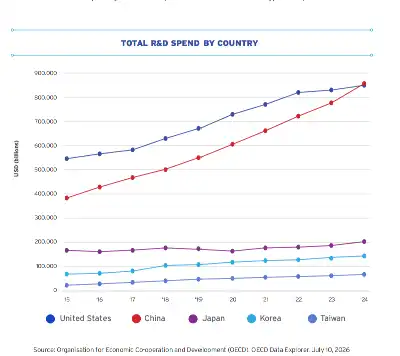
De 2015 à 2024, les investissements en R&D de la Chine ont constamment augmenté, la courbe rattrapant et même dépassant légèrement celle des États-Unis en 2024. Sur cette base, la SIA alerte les décideurs politiques américains : les investissements en R&D des entreprises et du gouvernement chinois ont dépassé ceux des États-Unis, en particulier dans les phases avancées de développement, et les États-Unis doivent réaugmenter leurs investissements. Le rapport souligne également que les dépenses de R&D des entreprises américaines de semi-conducteurs ont atteint 76,8 milliards de dollars en 2025, soit une augmentation de 10,3 % par rapport à l'année précédente.
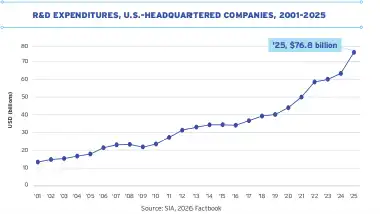
Le rattrapage des investissements en R&D de la Chine par rapport aux États-Unis est un changement qu'il faut prendre au sérieux. Cependant, cela démontre la capacité de la Chine à mobiliser des ressources de R&D à l'échelle mondiale la plus importante, cela n'équivaut pas à un nivellement dans tous les domaines technologiques, et ne permet certainement pas de conclure directement que les semi-conducteurs chinois sont entrés dans une phase de leadership global.

L'argent reste important. Mais lorsque les investissements atteignent ce niveau, la concurrence commence à passer de "avoir ou non de l'argent" à "où investir l'argent, qui le dépense, comment le transformer, et la capacité à supporter de longues périodes sans résultats".

"Dépasser les États-Unis", il faut d'abord voir avec quelle règle on mesure

La SIA cite des données de l'Organisation de coopération et de développement économiques (OCDE).

Dans des statistiques publiées en mars 2026, l'OCDE indique qu'en parité de pouvoir d'achat (PPA), les investissements totaux en R&D de la Chine en 2024 ont atteint environ 8600 milliards de dollars, rattrapant et dépassant légèrement ceux des États-Unis en prix constants de 2020. En prix de 2024, les investissements en R&D de la Chine et des États-Unis dépassent tous deux les 1000 milliards de dollars.

La logique de la parité de pouvoir d'achat n'est pas compliquée. Une même somme d'argent peut payer les salaires d'ingénieurs, les loyers de laboratoires et certains services de recherche en plus grande quantité en Chine qu'aux États-Unis. Comparer avec la PPA se rapproche davantage de la quantité réelle de ressources de R&D mobilisées par les deux pays.

Mais l'OCDE rappelle également que les PPA existantes sont principalement conçues pour comparer le PIB et ne sont pas calculées spécifiquement pour les activités de R&D. Selon l'année de base de la PPA utilisée, les investissements en R&D de la Chine en 2024 pourraient représenter 90% à 95% de ceux des États-Unis, ou être légèrement supérieurs ; si l'on convertit directement au taux de change du marché, les investissements en R&D de la Chine ne représentent qu'environ la moitié de ceux des États-Unis.

Ainsi, "les investissements en R&D de la Chine dépassent ceux des États-Unis" n'est pas une erreur, mais une affirmation qui doit être utilisée avec des précisions.

Une formulation plus prudente serait : en termes de parité de pouvoir d'achat, les investissements en R&D de la Chine ont atteint une ampleur comparable à celle des États-Unis ; en taux de change du marché, les États-Unis restent nettement en tête.

Les deux méthodes de calcul ne répondent pas non plus à la même question.

La PPA est plus adaptée pour observer quelles ressources de R&D internes la Chine a mobilisées ; le taux de change du marché reflète mieux la capacité à acheter des équipements internationaux, de la propriété intellectuelle étrangère, des talents mondiaux et des services techniques transfrontaliers. Pour une industrie comme les semi-conducteurs, hautement internationale et dépendante d'équipements et de logiciels coûteux, aucune des deux mesures ne peut être négligée. L'argent de la Chine a été principalement dépensé dans le développement expérimental

En 2024, les dépenses totales de R&D en Chine ont atteint 3 632,68 milliards de yuans, soit une augmentation de 8,9 % par rapport à l'année précédente, représentant 2,69 % du PIB. Parmi celles-ci, les entreprises ont investi 2 821,16 milliards de yuans, soit 77,7 % des dépenses nationales de R&D. En 2025, les investissements en R&D de la Chine ont encore augmenté pour atteindre 3 926,2 milliards de yuans, la part du PIB passant à 2,80 %.

Cette structure donne facilement l'impression que les investissements en R&D chinois sont principalement tirés par les entreprises, et donc déjà hautement marchands.

Cette affirmation est globalement vraie, mais incomplète.

En 2024, sur les dépenses totales de R&D de la Chine, la recherche fondamentale représentait 250,09 milliards de yuans, soit 6,88 % ; la recherche appliquée 430,55 milliards de yuans, soit 11,9 % ; et le développement expérimental 2 952,04 milliards de yuans, soit 81,2 %. Le développement expérimental consiste à utiliser les connaissances scientifiques et l'expérience d'ingénierie existantes pour développer de nouveaux produits, de nouveaux procédés, ou améliorer des produits et procédés existants.

En 2025, les fonds consacrés à la recherche fondamentale en Chine sont passés à 277,8 milliards de yuans, représentant 7,08 % du total, soit une augmentation de 89,4 % par rapport à 2020. Les investissements en recherche fondamentale s'accélèrent, mais dans la structure globale, les ressources de R&D chinoises restent clairement orientées vers le développement technique et les applications industrielles.

Ce n'est pas une faiblesse intrinsèque.

L'industrie des semi-conducteurs n'est pas une industrie uniquement poussée par des articles scientifiques. Le réglage des procédés, l'amélioration du rendement, la modification des équipements, la validation des matériaux, l'itération des produits et l'adaptation aux clients relèvent tous du développement expérimental. De nombreuses technologies peuvent mettre des années, voire plus, à passer du stade "réalisable en laboratoire" à "stable sur une ligne de production".

La capacité de la Chine à développer rapidement une capacité de production à grande échelle dans des domaines tels que les équipements photovoltaïques, les batteries, les systèmes de communication, l'électronique grand public et certaines étapes de la fabrication de semi-conducteurs ces dernières années est étroitement liée à cette structure d'investissement axée sur le développement technique et l'industrialisation.

Mais cela signifie aussi que les avantages de la Chine se manifestent davantage dans la transformation des technologies existantes en produits, la réduction des coûts et l'expansion des capacités. Les percées à long terme concernant de nouveaux matériaux, de nouvelles architectures de dispositifs, des algorithmes fondamentaux et des outils de base nécessitent encore une accumulation plus solide en recherche fondamentale.

Le NCSES, sous l'égide de la National Science Foundation américaine, estime que les investissements en R&D des États-Unis en 2024 s'élevaient à environ 9 930 milliards de dollars.

D'après les dernières données complètes par catégorie disponibles pour 2023, sur les 9 370 milliards de dollars de dépenses de R&D américaines, la recherche fondamentale représentait environ 1 380 milliards de dollars, soit 15 % ; la recherche appliquée environ 1 740 milliards de dollars, soit 19 % ; et le développement expérimental environ 6 250 milliards de dollars, soit 67 %. Le NCSES indique que de 2021 à 2024, la part du développement expérimental aux États-Unis est restée globalement autour de 67 %.

Les États-Unis dépensent également la majeure partie de leur argent dans le développement de produits et de technologies, ce n'est pas une bande de professeurs d'université assis dans des laboratoires qui s'occupent de l'innovation nationale. Mais leur part de recherche fondamentale est environ le double de celle de la Chine.

L'écart entre 15 % et environ 7 % ne reflète pas seulement des choix budgétaires, mais aussi le résultat d'une division du travail de longue date entre les systèmes de recherche des deux pays.

Les États-Unis disposent d'un vaste réseau d'universités de recherche, de laboratoires nationaux, de programmes de recherche fédéraux et d'instituts de recherche d'entreprises. Les universités et le système de recherche public explorent de nombreuses orientations sans retombées commerciales évidentes à court terme, et les entreprises transforment ces résultats en produits. Au cours de l'année fiscale 2024, les dépenses de R&D des universités américaines ont atteint 118 milliards de dollars, dont 55 % provenaient du gouvernement fédéral.

En Chine, les entreprises assument une proportion plus élevée des activités de R&D. Bien sûr, les entreprises sont plus proches du marché, mais la R&D des entreprises est naturellement contrainte par les revenus, les bénéfices et les cycles de produit. Il n'est pas réaliste de demander à une entreprise en situation de concurrence féroce d'investir à long terme dans des projets fondamentaux qui ne verraient pas de commandes avant dix ans.

C'est pourquoi la recherche fondamentale ne peut pas simplement être laissée au marché.

Les investissements en R&D dans les semi-conducteurs diffèrent grandement entre la Chine et les États-Unis

Les investissements nationaux totaux en R&D couvrent la médecine, l'agriculture, l'énergie, l'aérospatiale, les logiciels, la défense et de nombreuses recherches en sciences sociales. Ils ne peuvent qu'indiquer les ressources de recherche globales d'un pays, et ne sont pas directement équivalents aux investissements dans les semi-conducteurs.

En se concentrant véritablement sur l'industrie des puces, les différences sont encore plus marquées.

Le rapport de la SIA montre que les dépenses de R&D des entreprises de semi-conducteurs dont le siège est aux États-Unis ont atteint 76,8 milliards de dollars en 2025, soit une augmentation de 10,3 % par rapport à 2024. Selon la méthodologie du classement de la R&D industrielle de l'UE citée dans le rapport, les dépenses de R&D des entreprises américaines de semi-conducteurs représentent environ 15 % de leur chiffre d'affaires, contre 14,6 % en Europe, 10,6 % en Corée du Sud, 10 % en Chine, 8,5 % au Japon et 8,1 % à Taïwan.
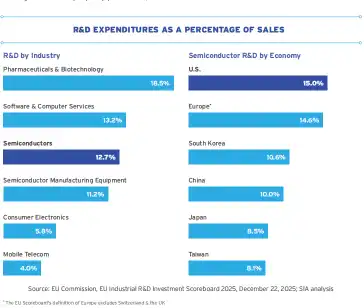
Il faut également faire attention aux limites statistiques. Ce ratio provient d'un échantillon d'entreprises et de l'analyse de la SIA, ce n'est pas un recensement complet de toutes les entreprises de semi-conducteurs de chaque économie. Mais cela montre au moins que non seulement les entreprises américaines de puces ont un chiffre d'affaires absolu important, mais elles sont également prêtes à consacrer une part relativement élevée de leurs revenus à la technologie de la génération suivante.

Les ventes mondiales des entreprises américaines de semi-conducteurs en 2025 s'élevaient à 4 250 milliards de dollars, soit 53,4 % des ventes mondiales. Une large part de marché génère des revenus élevés, ces revenus élevés soutiennent des investissements en R&D importants, et les résultats de la R&D aident les entreprises à maintenir leurs primes de prix.

C'est l'aspect le plus difficile à reproduire de l'industrie américaine des semi-conducteurs.

Il ne s'agit pas simplement d'investir plus de fonds dans la recherche, mais de disposer d'entreprises mondiales comme Nvidia, Broadcom, Qualcomm, AMD, Applied Materials, Lam Research, KLA, Synopsys et Cadence, qui ont formé des boucles commerciales fermées dans la conception de puces, les équipements, les EDA et les logiciels système.

La R&D d'entreprise ne s'arrête pas à la dépense d'un budget. Les résultats de la R&D se transforment en produits, les produits pénètrent le marché mondial, et les bénéfices sont ensuite réinvestis dans la R&D de la génération suivante. Une fois établi, ce cycle est souvent plus efficace qu'une simple dépendance à un financement externe.

Le problème de l'industrie chinoise des semi-conducteurs n'est pas non plus simplement un manque d'investissement total.

Sur la même période, les entreprises chinoises de conception de puces, d'équipements de fabrication, de matériaux et de fabrication de plaquettes augmentent également leurs dépenses de R&D, mais de nombreuses entreprises ont encore un chiffre d'affaires limité. Le ratio des investissements en R&D par rapport au chiffre d'affaires peut ne pas être faible, mais le montant absolu est difficile à comparer avec celui des leaders internationaux. Certaines entreprises doivent simultanément combler des lacunes en matière de produits, de procédés, de logiciels et de validation client, ce qui disperse des fonds limités dans plusieurs directions.

Le fait qu'une entreprise consacre 30 % de ses revenus à la R&D ne signifie pas nécessairement qu'elle a plus d'argent qu'un leader international qui en consacre 15 %. Le ratio représente la volonté d'investir, le montant absolu détermine si de nombreux projets peuvent être menés à bien.

Les investissements en R&D augmentent rapidement, alors pourquoi certaines technologies restent-elles difficiles à rattraper ?

La particularité de la technologie des semi-conducteurs est qu'il ne s'agit pas d'une course où une répartition égale des ressources permet d'avancer régulièrement.

Une chaîne de fabrication avancée implique des matériaux, des équipements, des composants, des procédés, des EDA, de la propriété intellectuelle, de la conception, de l'emballage et des tests. Atteindre 90 points dans la grande majorité des maillons ne peut pas compenser un maillon critique à 50 points.

S'il manque un élément optique clé à un équipement de photolithographie, les performances de la machine entière ne peuvent pas s'améliorer ; la validation en laboratoire d'un équipement de gravure ne signifie pas qu'il peut fonctionner en continu dans une usine de plaquettes ; un logiciel de conception capable de traiter une puce simple ne signifie pas qu'il peut supporter une conception complexe de centaines de milliards de transistors ; le succès de la fabrication d'une puce ne garantit pas que les clients souhaitent lui confier leur prochain produit.

Cela rend le taux de conversion de la R&D dans les semi-conducteurs difficile à mesurer par le nombre d'articles, le nombre de brevets ou même le montant des dépenses de R&D.

Des indicateurs plus concrets sont les suivants : l'équipement peut-il être intégré aux lignes de production des clients, et quel est son temps moyen de bon fonctionnement ; les matériaux peuvent-ils passer une validation à long terme, et quelle est la cohérence des lots ; le rendement des procédés peut-il être continuellement amélioré ; les outils EDA peuvent-ils supporter de vrais projets de grande envergure ; les puces peuvent-elles être produites en masse, et continuer à recevoir des commandes de clients pour les prochains produits.

Ces indicateurs ne se prêtent pas facilement à figurer en première page d'un dossier de demande de financement, mais ce sont eux qui déterminent si les investissements en R&D finissent par se transformer en capacité industrielle.

Le puissant système de fabrication et le vaste marché de la Chine offrent dans ce processus des avantages uniques. Les nouveaux équipements et matériaux peuvent trouver plus rapidement des scénarios d'essai, et les entreprises de puces ont l'occasion d'itérer dans les communications, l'automobile, l'industrie, l'électronique grand public et les centres de données.

Mais un grand marché n'apporte pas automatiquement une validation de haute qualité.

Si un client n'est disposé à tester qu'une fois sous la contrainte de politiques, puis revient au fournisseur d'origine pour le produit suivant, la boucle de R&D ne s'est toujours pas fermée. Une substitution nationale réellement efficace ne consiste pas en ce qu'un produit a été acheté, mais en ce que ses performances, son coût et son service conduisent les clients à l'acheter à plusieurs reprises.

Recherche fondamentale et industrialisation ne devraient pas être placées aux deux extrémités d'une balance

Lorsqu'on discute de la structure de la R&D en Chine, on tombe facilement dans le piège suivant : la part de la recherche fondamentale est faible, donc il faudrait prélever davantage d'argent du développement technique pour le transférer vers la recherche fondamentale.

Les choses ne sont pas si simples.

L'industrie chinoise des semi-conducteurs a encore de nombreux problèmes techniques à résoudre. La stabilité des équipements, la pureté des matériaux, les marges de procédé, la dissipation thermique des emballages, l'écosystème logiciel des puces et les services clients nécessitent tous des investissements continus. Affaiblir les investissements dans l'industrialisation ne générera pas automatiquement des innovations fondamentales, et pourrait même laisser les avancées technologiques déjà réalisées au stade du prototype.

Une orientation plus raisonnable n'est pas de choisir entre l'un ou l'autre, mais de relier les deux extrémités.

La recherche fondamentale a besoin de financements à long terme plus stables, en particulier dans les domaines liés aux capacités fondamentales des semi-conducteurs comme les matériaux, la physique, la chimie, les mathématiques et l'architecture des systèmes informatiques. Pour ce type de projets, on ne peut pas évaluer les revenus industriels tous les trois ans, ni exiger que chaque article scientifique corresponde immédiatement à une ligne de produits.

L'industrialisation nécessite quant à elle de meilleures plateformes de pré-production, des conditions de test publiques et des mécanismes de validation client. Les technologies développées par les universités et les institutions de recherche, si elles ne sont pas reprises par des équipes d'ingénierie et si les usines de plaquettes et les fabricants d'équipements ne participent pas à leur validation, auront du mal à franchir la distance entre le laboratoire et la production de masse.

La recherche dans le domaine des semi-conducteurs en Chine ne manque pas de projets ni de résultats annoncés. Ce qui manque vraiment, c'est un mécanisme capable de travailler continuellement sur une technologie pendant dix ans, de traverser plusieurs échecs, et de la perfectionner jusqu'à ce que les clients soient prêts à l'utiliser.

Une fois les investissements en R&D entrés dans le premier groupe mondial, les questions d'efficacité deviendront de plus en plus saillantes

Lorsque les investissements annuels en R&D d'un pays ne sont que de quelques centaines de milliards de yuans, augmenter le budget peut en soi résoudre de nombreux problèmes.

Lorsque les investissements approchent les 4 000 milliards de yuans, la situation change. Les nouveaux fonds restent utiles, mais l'amélioration marginale apportée par chaque yuan investi commence à dépendre davantage de l'allocation des ressources.

Les constructions répétées de laboratoires et de parcs industriels entre régions consomment des fonds ; les entreprises, pour obtenir un soutien, choisissent de lancer trop de lignes de produits simultanément, ce qui consomme des fonds ; le manque de plateformes d'équipements partagés et de pré-production conduit chaque équipe à acheter en double, ce qui consomme également des fonds.

L'industrie des semi-conducteurs nécessite particulièrement une concentration des ressources.

Certaines directions nécessitent l'exploration parallèle de plusieurs voies technologiques, on ne peut pas miser sur une seule réponse ; mais la compétition entre plusieurs voies n'équivaut pas à ce que des dizaines de régions construisent des projets similaires. Dans les domaines des équipements et des matériaux, qui nécessitent des investissements importants, ont des cycles longs et peu de clients, une dispersion excessive peut laisser chaque équipe en manque d'argent, de personnel et de vrais clients.

La tâche plus difficile pour la politique de R&D à l'étape suivante n'est pas de continuer à prouver que "nous investissons aussi", mais de permettre l'élimination des projets inefficaces, de retirer les fonds des orientations infructueuses, et en même temps de fournir un soutien à long terme aux équipes qui font de réels progrès.

C'est beaucoup plus difficile que d'annoncer un nouveau montant d'investissement.

La concurrence sur les puces implique bien sûr les investissements financiers, mais aussi la planification scientifique et les capacités organisationnelles

Le rattrapage des investissements en R&D de la Chine par rapport aux États-Unis montre d'abord que l'augmentation continue des investissements technologiques au cours des dix dernières années a produit un effet d'échelle. La Chine n'est plus une économie qui s'appuie sur une fabrication à bas coût pour recevoir une diffusion technologique, mais est devenue l'une des plus grandes économies en termes de ressources de R&D investies dans le monde.

Ce changement ne doit pas être minimisé.

L'importante main-d'œuvre d'ingénieurs, la chaîne de fabrication complète et l'augmentation continue des dépenses de R&D des entreprises ont effectivement amélioré la capacité de la Chine à résoudre des problèmes industriels complexes. Les progrès réalisés par la Chine dans certains domaines des équipements de semi-conducteurs, des matériaux, de l'emballage, de la mémoire et des procédés matures ne sont pas non plus le résultat d'une politique unique, mais le fruit d'accumulations d'investissements à long terme.

Mais le fait que les dépenses de R&D dépassent celles d'un certain pays ne déclenche pas automatiquement un bouton menant à la supériorité technologique.

La concurrence dans les semi-conducteurs implique l'argent, mais aussi l'accumulation de science fondamentale, la densité des talents, la taille du chiffre d'affaires des entreprises, la validation client, le marché mondial et la coordination industrielle. Plus important encore, elle teste la capacité à supporter une incertitude sur une plus longue durée.

Le développement technique peut fixer des objectifs trimestriels, mais la recherche fondamentale n'a souvent pas de fin claire. Un équipement peut être accepté, mais le rendement et la stabilité nécessitent encore des années de travail. Une entreprise peut obtenir un premier client grâce à des politiques, mais le deuxième client doit être gagné par le produit lui-même.

La Chine a résolu la question de "avoir ou non la capacité d'investir massivement". Ce qui déterminera véritablement l'écart ensuite, c'est la capacité de cet argent à traverser les articles, les projets et les prototypes, pour finalement se matérialiser dans les produits, les lignes de production et les commandes clients.

Cet article provient du compte WeChat public : TechSugar , auteur : Tan Xin

Trending Cryptos

Related Questions

QQu'est-ce que le rapport de la SIA indique sur les investissements en R&D entre la Chine et les États-Unis ?

ALe rapport de la Semiconductor Industry Association indique que, de 2015 à 2024, les investissements en R&D de la Chine ont augmenté régulièrement. En 2024, la courbe a rejoint, voire légèrement dépassé, celle des États-Unis en utilisant le critère de la parité de pouvoir d'achat (PPA). Cependant, les entreprises américaines de semi-conducteurs ont augmenté leurs dépenses de R&D de 10,3 % en 2025, pour atteindre 76,8 milliards de dollars.

QQuelle est la différence structurelle majeure entre les investissements en R&D de la Chine et ceux des États-Unis, selon l'article ?

AL'article souligne une différence structurelle majeure : en 2024, 81,2 % des investissements en R&D chinois étaient consacrés au développement expérimental (nouveaux produits, procédés), tandis que seulement environ 7 % étaient alloués à la recherche fondamentale. Aux États-Unis, en 2023, la recherche fondamentale représentait environ 15 % des dépenses de R&D, soit plus du double de la part chinoise.

QQuels sont les facteurs qui rendent la compétition dans les semi-conducteurs plus complexe qu'une simple course aux investissements financiers ?

ALa compétition dans les semi-conducteurs va au-delà de l'argent. Elle dépend aussi de l'accumulation de science fondamentale, de la densité des talents, de la taille des revenus des entreprises, de la validation par les clients, de l'accès au marché mondial et de la synergie industrielle. L'article souligne également l'importance de la capacité à supporter des périodes d'incertitude prolongées et à transformer efficacement la R&D en produits et commandes clients fiables.

QPourquoi l'article suggère-t-il que l'efficacité des investissements en R&D devient un enjeu crucial pour la Chine ?

AAvec des investissements annuels en R&D approchant les 4 000 milliards de yuans, les améliorations marginales dépendent désormais davantage de l'allocation efficace des ressources que de l'augmentation du budget. L'article pointe du doigt des problèmes potentiels tels que les constructions de laboratoires et de parcs industriels redondants entre les régions, la dispersion des ressources sur trop de projets, et le manque de plates-formes de test partagées. L'enjeu est donc de savoir désallouer les fonds des projets inefficaces et de soutenir à long terme les équipes prometteuses.

QQuelle est la position de l'article concernant le débat entre recherche fondamentale et ingénierie dans l'industrie des semi-conducteurs en Chine ?

AL'article affirme qu'il ne s'agit pas de choisir entre recherche fondamentale et ingénierie, mais de les connecter. Il recommande un financement à long terme stable pour la recherche fondamentale dans des domaines clés, sans exigence de résultats industriels immédiats. Parallèlement, il préconise de renforcer les capacités d'ingénierie via de meilleures plates-formes de prototypage, de test public et de validation client, afin que les technologies puissent franchir le fossé entre le laboratoire et la production de masse.

Related Reads

Has Bitcoin Bottomed, or Is a 'Shakeout' Approaching? What's the Situation with XRP?

Cryptocurrency analytics platform Santiment shared key insights on Bitcoin and altcoin markets, highlighting significant signals from on-chain data. Analysis shows Bitcoin's 365-day MVRV ratio has fallen to -26%, indicating substantial losses for long-term holders, a level historically associated with market bottom formations and long-term buying opportunities. While short-term MVRV is near breakeven, suggesting no clear directional signal, the annual perspective points to a bottom before bullish cycles. On-chain data reveals divergent behavior: large wallets (10-10,000 BTC) have been accumulating, adding ~18,500 BTC in 10 days, while smaller retail investors continue buying dips. Analysts caution that high retail demand can sometimes create a risk of a final market shakeout or correction. The altcoin market shows a mixed picture. Ethereum's 365-day MVRV is around -33%, but recent monthly gains combined with overly optimistic social sentiment pose a short-term correction risk. XRP is in oversold territory with 30-day and 365-day MVRVs at -57.5% and -45.5% respectively, signaling potential for a strong mid-to-long term rebound. Social activity and optimism are rising for Solana, while investor sentiment remains calmer towards Cardano. Future direction for Bitcoin and altcoins depends not only on on-chain metrics but also on macroeconomic and regulatory developments. The Federal Reserve's interest rate decision and upcoming policy rulings are increasing market volatility expectations, while uncertainty around the U.S. Congressional clarity process continues to pressure pricing. *This is not investment advice.

cryptonews.ru17m ago

Has Bitcoin Bottomed, or Is a 'Shakeout' Approaching? What's the Situation with XRP?

cryptonews.ru17m ago

Bank of Korea Reveals Results of Tokenized Deposit Testing

The Bank of Korea has announced the results of its pilot test for tokenized deposits. Involving 28 central banks and international financial organizations, the project saw participation from major South Korean banks including KB Kookmin Bank, NH NongHyup Bank, Shinhan Bank, Woori Bank, and Hana Bank. Transactions, from payment orders to final settlement, were completed in real time, averaging just 80 seconds. The test involved 30 transactions across 17 different scenarios—such as corporate and interbank transfers—and was conducted in six currencies, including the Korean won, US dollar, and euro, with a total transaction value reaching approximately $995,000. The central bank reported that the platform operated stably throughout, despite being only partially connected to the existing banking infrastructure. Settlements using tokenized deposits were executed seamlessly, quickly, and transparently. An internal transfer of 20 million won (about $13,890) between NH NongHyup Bank and Shinhan Bank was also successfully processed via the Project Agora platform, which involved connecting to the Bank of Korea's CBDC test platform, Project Hangang. Additionally, KB Kookmin Bank and Japan's MUFG Bank tested cross-border payments using these deposit tokens—digital certificates issued by commercial banks within the pilot, not directly by the central bank. The Bank of Korea plans to continue testing payments with tokenized deposits. This follows last year's pledge by South Korean authorities to tighten regulations for won-based stablecoins, which will require approval from both the central bank and the Financial Services Commission.

cryptonews.ru2h ago

Bank of Korea Reveals Results of Tokenized Deposit Testing

cryptonews.ru2h ago

Trading

Spot

Hot Articles

What is LINON

Linde plc Tokenized Stock (Ondo): Revolutionizing Traditional Equity Access Through Blockchain Innovation The emergence of Linde plc Tokenized Stock (Ondo), represented by the ticker $LINON, signifies a monumental shift in the fusion of traditional financial structures and decentralized finance (DeFi). This innovative financial instrument showcases the tremendous potential of blockchain technology to democratize access to traditional equity markets while ensuring the security and regulatory compliance necessary for institutional-grade financial products. Through Ondo Finance's pioneering tokenization platform, $LINON provides a seamless pathway for global investors to engage with one of the world's leading industrial gas companies, Linde plc, creating a blockchain-native representation of the underlying equity. Introduction to Linde plc Tokenized Stock The landscape of financial markets is witnessing a groundbreaking transformation through the tokenization of real-world assets. Linde plc Tokenized Stock (Ondo) epitomizes this revolutionary approach by bridging the gap between conventional stock ownership and blockchain-enabled financial infrastructure. The $LINON token allows investors to gain exposure to one of the prominent industrial companies worldwide through decentralized technology. Operating within Ondo Finance's comprehensive ecosystem, $LINON symbolizes a practical application of tokenization technology that enhances accessibility, efficiency, and global connectivity in traditional financial markets. By leveraging blockchain infrastructure, this tokenized stock enables international investors to participate in U.S. equity markets, overcoming traditional barriers associated with cross-border investing. The significance of $LINON goes beyond technological innovation; it represents a fundamental shift in asset structuring, distribution, and trading in the digital age. This tokenized stock maintains all the economic benefits associated with traditional Linde plc shares while offering improved liquidity, programmable compliance features, and seamless integration with decentralized finance protocols. The development of $LINON indicates a growing acceptance of blockchain technology as a viable means for traditional finance, exemplifying how even well-established assets like Linde plc can integrate into blockchain systems. This approach preserves the core attributes that appeal to investors while introducing advanced capabilities that enhance the overall investment proposition. Project Overview and Objectives Linde plc Tokenized Stock (Ondo) encapsulates a strategic effort to democratize access to traditional equity markets through advanced blockchain technologies. The primary objective of $LINON is to provide approved global investors seamless access to the economic exposure associated with Linde plc shares, furthering an effort to create a more inclusive financial ecosystem. Beyond the digital representation of traditional assets, $LINON endeavors to eliminate barriers of geography and time zones that limit investor participation. Its design ensures that blockchain technology can elevate traditional investment vehicles without undermining the security or compliance requirements expected by investors. Key goals of the project include enhanced liquidity provision, programmable compliance mechanisms, and interoperability with other blockchain networks. Each $LINON token is fortified by actual Linde plc securities housed at U.S.-registered broker-dealers, allowing holders to reap economic advantages akin to traditional stockholders, such as dividend reinvestment. Furthermore, $LINON aims to establish new industry standards for institutional-grade tokenized securities, paving the way for traditional assets to embrace blockchain technology while remaining compliant with regulatory frameworks. By associating itself with a company as reputable as Linde plc, the project opens avenues for exploring tokenized equities catering to both conservative institutional players and daring retail investors. Project Creator and Development Team The vision for Linde plc Tokenized Stock (Ondo) comes from Nathan Allman, founder and CEO of Ondo Finance. His background in traditional finance coupled with expertise in blockchain technology positions him uniquely to navigate the complexities of asset tokenization. Allman's academic journey began at Brown University, focusing on Economics and Biology, equipping him with valuable analytical skills. His time at Goldman Sachs in the Digital Assets division strengthened his understanding of the interplay between financial institutions and emerging technologies, laying the groundwork for his later endeavors in alternative investment strategies. Under Allman's guidance, Ondo Finance has emerged as a leader in asset tokenization, launching $LINON as a flagship example of the company's larger mission towards revolutionizing traditional financial systems using blockchain technology. His commitment to leveraging blockchain for creating institutional-grade financial products has shaped the landscape of real-world asset tokenization. Investment and Funding Structure The growth of Ondo Finance, the platform powering Linde plc Tokenized Stock (Ondo), is bolstered by robust financial backing from prestigious venture capital firms and strategic investors. This strong investment foundation underpins the development of the key infrastructure essential for compliant tokenized securities like $LINON. In August 2021, Ondo Finance secured $4 million in seed funding led by a major venture capital firm, which enabled the company to commence platform development and establish the necessary regulatory processes for tokenizing real-world assets. This early investment cemented Ondo Finance's credibility within the industry. The Series A funding round followed, garnering $20 million with participation from renowned firms committed to transformative technology companies. This backing demonstrated substantial institutional confidence in Ondo Finance's vision, allowing it to hone its approach to asset tokenization through mechanisms that ensure compliance and accessibility. Noteworthy contributors, including institutional investors and experienced partners, have added significant value to Ondo Finance’s development efforts. Their involvement underscores the confidence across sectors in Ondo Finance's approach to bridging traditional finance with blockchain innovations. Technical Infrastructure and Innovation The technical architecture that underpins Linde plc Tokenized Stock (Ondo) represents a sophisticated melding of traditional finance systems and cutting-edge blockchain technology. The architecture's foundation is built on the Ethereum network, renowned for its security and programmability—both critical for intricate financial instruments. The $LINON tokenization process comprises creating a blockchain-native representation of Linde plc shares that preserves economic benefits while augmenting investor capabilities. Each token corresponds to actual shares held at U.S.-registered broker-dealers, creating a compliant custody structure that legitimizes the asset's existence and value. Automated compliance systems are integrated into the tokenization process, managing critical components such as know-your-customer (KYC) verification and anti-money laundering (AML) protocols. This incorporation of programmable compliance empowers $LINON to uphold regulatory standards essential for institutional proliferation. Cross-chain interoperability characterizes the advanced technical features of $LINON. While initially deployed on Ethereum, the framework is designed for expansion to other networks such as Solana and BNB Chain. This adaptability enhances liquidity and accessibility, allowing investors to select their preferred blockchain ecosystems. Historical Timeline and Development Crafting the history of Linde plc Tokenized Stock (Ondo) unfolds in parallel with the evolution of Ondo Finance's tokenization platform. The timeline's inception dates back to March 2021 when Nathan Allman laid the foundations for creating institutional-grade financial products on blockchain infrastructure. The initial funding round in August 2021 provided crucial resources for developing the platform and establishing partnerships necessary for effective tokenization. By January 2023, Ondo Finance launched its tokenized treasury products, establishing mechanisms that would facilitate future tokenized equities such as $LINON. A pivotal milestone arose in February 2025 when Ondo Chain—a Layer 1 blockchain designed specifically for asset tokenization—was introduced. This infrastructure enhances capabilities vital for institutional markets, demonstrating Ondo Finance's long-term commitment to tokenization. Subsequently, the launch of Ondo Global Markets in September 2025 marked the official debut of $LINON. This milestone showcased the successful transition from development to active trading, enabling investors around the world to access American financial markets seamlessly. Ongoing development plans include a targeted expansion of available tokenized assets to over 1,000 by the end of 2025, pointing to a bright future for Ondo Finance's ecosystem and its mission to broaden tokenized equity accessibility. Regulatory Compliance and Legal Framework The legal architecture governing Linde plc Tokenized Stock (Ondo) emphasizes a sophisticated approach to regulatory compliance, allowing tokenized securities to be implemented within a blockchain-based framework. The legal structure governing $LINON spans multiple jurisdictions while maintaining a robust legal footing. Compliance systems ensure that only eligible investors can access the token, enforced through automated verification that aligns with international regulations. This innovative regulatory technology promises real-time enforcement of complex requirements, considerably enhancing efficiency in operating within the regulatory landscape. The custody framework undergirding $LINON ensures that the underlying shares are securely held at U.S.-registered broker-dealers, complying with necessary regulations while delivering blockchain-driven access to investors. The token maintains its economic equivalency and security through this carefully structured custody arrangement. KYC and AML compliance systems are embedded within the smart contract architecture, ensuring integrity and adherence to regulatory practices while fostering transparency for investors. The jurisdictional restrictions mark a commitment to navigating the evolving landscape of international securities laws. Market Impact and Industry Significance The advent of Linde plc Tokenized Stock (Ondo) holds profound implications for the broader financial landscape, symbolizing a clear shift towards blockchain-enabled markets. $LINON serves as a proof-of-concept for integrating traditional companies into blockchain ecosystems, showcasing the potential benefits such as broader accessibility and improved efficiency. The market's response to $LINON indicates a growing acceptance of tokenization among institutional investors, contributing to the emergence of an expanding sector wherein traditional assets can be interconnected with blockchain innovations. The success of $LINON further solidifies market confidence, indicating an overarching shift towards recognizing asset tokenization as a transformative force in finance. Future Development and Expansion Plans The future trajectory for Linde plc Tokenized Stock (Ondo) centers around the expansion of the tokenization ecosystem and enhanced infrastructure supporting blockchain-enabled financial services. Plans for cross-chain integration usher in new opportunities for liquidity and flexibility within the investment framework, with existing capabilities poised for continuous enhancement. With the introduction of Ondo Chain, Ondo Finance aims to transition $LINON to an optimized blockchain environment specifically designed for asset tokenization. This new infrastructure heralds exciting prospects for the development of institutional-grade financial products, ensuring ongoing compatibility with contemporary investment strategies. Further integration with decentralized finance protocols signifies a commitment to empowering $LINON holders through advanced financial strategies. The anticipated expansion of available tokenized assets promises to broaden investor access, enhancing the utility and appeal of the platform. In alignment with ambitions for regulatory expansion, ongoing efforts to secure approvals for new jurisdictions will enhance investor access, further positioning $LINON at the forefront of the burgeoning tokenization market. Conclusion Linde plc Tokenized Stock (Ondo), as represented by the $LINON token, stands at the intersection of traditional finance and blockchain innovation. It embodies a transformative milestone in how financial assets are structured, distributed, and engaged within modern investment ecosystems. The technical sophistication behind $LINON, combined with its regulatory compliance framework, illustrates that asset tokenization can improve financial infrastructure rather than simply digitizing existing products. This pioneering effort not only enhances investor access to U.S. equity markets but also signifies an evolution of how traditional financial services can integrate blockchain technology. As the asset tokenization market grows exponentially, with prospects suggesting significant valuation increases, $LINON paves the way for a future where tokenized securities become standard fixtures in the financial landscape. The trajectory of $LINON will undoubtedly influence how traditional finance adapts to a transformed, blockchain-powered world.

3.9k Total ViewsPublished 2025.12.05Updated 2025.12.05

What is LINON

What is CRMON

Salesforce Tokenized Stock (Ondo): Revolutionising Traditional Equity Access Through Blockchain Innovation The emergence of Salesforce Tokenized Stock (CRMON) marks a pivotal advancement in integrating traditional financial markets with blockchain technology. This innovative approach offers investors unprecedented access to equity exposure through tokenisation. Developed by Ondo Finance, CRMON provides tokenholders with economic exposure equivalent to holding Salesforce stock (CRM) while automatically reinvesting dividends. This effectively bridges the gap between conventional equity markets and decentralised finance (DeFi). Introduction and Comprehensive Overview of Salesforce Tokenized Stock In recent years, the financial landscape has dramatically transformed due to blockchain technology, fundamentally altering how investors access and interact with traditional assets. The development of Salesforce Tokenized Stock (CRMON) is a prime example of this evolution, representing a sophisticated fusion of conventional equity markets with cutting-edge distributed ledger technology. CRMON is a tokenised version of Salesforce stock, emerging from the innovative work of Ondo Finance, a leading platform in the real-world asset tokenisation sector that positions itself as a bridge between traditional finance and decentralised systems. Designed to provide tokenholders with economic exposure that mirrors the performance of the underlying Salesforce stock, CRMON incorporates automatic dividend reinvestment mechanisms. This eliminates many traditional barriers associated with international equity investment, such as complex brokerage relationships, currency conversion challenges, and restricted trading hours. The tokenisation process reimagines stock ownership as a blockchain-native asset while maintaining its economic equivalence with the underlying security, offering enhanced portability and integration capabilities within decentralised finance ecosystems. CRMON transcends its individual utility as an investment instrument to represent a fundamental shift in how financial markets can operate in an increasingly digital world. By maintaining full backing through U.S.-registered broker-dealers and implementing robust compliance frameworks, CRMON demonstrates that tokenised securities can achieve the regulatory standards necessary for institutional adoption while delivering the technological advantages of blockchain infrastructure. Understanding Tokenized Real-World Assets and CRMON's Strategic Position Tokenised real-world assets signify one of the most significant innovations in modern finance, fundamentally reimagining how traditional securities are represented, traded, and utilised within digital ecosystems. CRMON operates as a tokenised equity instrument correlating directly with Salesforce stock while optimising accessibility and efficiency. This aligns with Ondo Finance's broader mission to democratise access to institutional-grade financial products through innovative tokenisation strategies. The tokenisation process guarantees complete economic equivalence with the underlying Salesforce equity. Each CRMON token represents a proportional claim on Salesforce stock held by qualified custodians, with dividend payments automatically reinvested to maintain continuous exposure to total return performance. This structure simplifies dividend management and ensures that tokenholders receive the full economic benefit of their equity exposure, encompassing both capital appreciation and income generation. Ondo Finance's strategy in tokenising Salesforce stock demonstrates its expertise in creating compliant, institutional-grade products that meet traditional financial markets' stringent requirements. The platform’s focus on merging regulatory compliance with blockchain benefits positions it at the forefront of decentralised finance, captivating both institutional and retail investors seeking blockchain-native solutions. The Technology and Innovation Framework Behind CRMON The technological infrastructure supporting CRMON integrates blockchain technology with traditional financial mechanisms, delivering institutional-grade security and compliance while maintaining the operational advantages of decentralised systems. Built on the Ethereum blockchain, CRMON utilises robust smart contract capabilities to ensure transparent, secure operations. The smart contract architecture incorporates layered security and compliance mechanisms, enabling automated compliance checks and real-time asset backing verification. Integration with oracle services maintains accurate pricing and dividend information, ensuring CRMON reflects the underlying Salesforce stock's accurate performance. This architecture delivers automated dividend reinvestments and other corporate actions, eliminating manual processing requirements and directly enhancing tokenholder benefits. Ondo Finance ensures CRMON's security structure includes daily third-party verification of holdings, independent collateral agents, and a multiple-layer custody system through partnerships with established financial institutions. This framework safeguards tokenholder interests against operational risks while providing robust asset backing. The user interface enhances integration capabilities, allowing seamless interaction between CRMON and various decentralised finance protocols, as well as cryptocurrency exchanges. This interoperability enables users to leverage their tokenised equity across multiple platforms, creating sophisticated investment strategies that marry traditional equity characteristics with blockchain-native innovation. Leadership and Corporate Structure of Ondo Finance The leadership team behind CRMON and Ondo Finance blends expertise from traditional finance and blockchain technology, presenting a robust combination of skills essential for successfully bridging conventional markets with decentralised finance. Nathan Allman, the founder and CEO, emerged from a distinguished financial background before establishing Ondo Finance in 2021. Allman's experience includes notable roles at major financial institutions, including significant contributions to developing cryptocurrency market services. His insights into regulatory compliance were paramount in developing products like CRMON that successfully unify traditional securities with blockchain technology. With a team of professionals boasting substantial experience in both conventional finance and blockchain sectors, Ondo Finance's leadership comprises diverse expertise that covers every aspect of tokenised asset development. Justin Schmidt serves as President and COO, contributing unique operational expertise, while Chris Tyrell brings essential compliance knowledge. Investment Landscape and Funding History The investment landscape surrounding Ondo Finance reflects significant institutional confidence in its mission to tokenise real-world assets. The company has raised substantial funds through various investment rounds, attracting leading venture capital firms and strategic investors that recognise the transformative potential of tokenised securities like CRMON. Notably, Ondo Finance completed a successful Series A funding round in 2022, led by well-known venture capital firms. This funding success validates Ondo Finance's innovative approach to creating compliant, institutional-grade tokenised products. In total, Ondo Finance has successfully secured substantial funding, raising significant capital for product development and market expansion, including a noteworthy token sale that reinforced its governance structure through the establishment of the ONDO token. The diverse composition of investors reflects broad market confidence in Ondo Finance's business model, demonstrating support from both traditional and blockchain-native organisations. Operational Mechanics and Technical Implementation The operational framework supporting CRMON exemplifies sophisticated integration of traditional financial mechanisms with blockchain technology. The technical implementation introduces multiple layers of security, compliance, and operational efficiency to meet institutional standards while enhancing accessibility. The tokenisation process begins by acquiring actual Salesforce stock through U.S.-registered broker-dealers, ensuring each CRMON token maintains direct correlation with the underlying equity performance. Smart contracts automate operational processes, including dividend reinvestment and corporate action processing, facilitating a streamlined user experience. The Minting and redemption processes allow authorised participants to manage CRMON tokens effectively. During U.S. trading hours, institutions can mint new tokens by depositing stablecoins that are used to purchase corresponding Salesforce equity. This structure maintains a tight correlation with underlying assets, enhancing liquidity and price discovery. Additionally, the infrastructure supports twenty-four-hour token transfer capabilities, providing CRMON holders with operations outside traditional market hours. This represents a significant advantage over conventional securities ownership, thus promoting integration with decentralised finance applications. Plans for cross-chain compatibility through partnerships signal further ambitions for CRMON's market reach. By expanding to other blockchain networks, Ondo Finance aims to enhance accessibility and user engagement with tokenised equity products. Timeline and Historical Development of Tokenized Equity Innovation The timeline of CRMON's development and Ondo Finance's broader tokenised capabilities demonstrates a systematic innovation process beginning with the company's founding in 2021. 2021: Ondo Finance is founded by Nathan Allman and co-founders, launching initial products focused on structured vault offerings on the Ethereum blockchain. 2022: The company completes substantial funding rounds—both equity and token sales—totaling significant capital and launching initial tokenised U.S. Treasury products. 2023-2024: Ondo Finance experiences substantial growth, establishing partnerships with major financial institutions while expanding its product offerings beyond fixed-income securities. February 2025: Ondo Global Markets is announced, marking the transition into equity tokenisation with plans for accessing over one hundred U.S. stocks and ETFs. September 2025: The official launch of Ondo Global Markets includes CRMON alongside other tokenised equity offerings, marking a significant evolution in Ondo Finance's product ecosystem. This timeline highlights the organisation's rapid growth and its capability to adapt its technological and compliance frameworks to accommodate different asset classes effectively while maintaining security and regulatory integrity. Regulatory Framework and Compliance Approach Ondo Finance's regulatory framework showcases a sophisticated compliance strategy, essential for achieving institutional adoption in the tokenised securities market. The company's strong partnerships with U.S.-registered broker-dealers promote adherence to Securities and Exchange Commission regulations and apply robust investor protections. Acquisitions, such as Oasis Pro—a registered broker-dealer—significantly enhance Ondo Finance's compliance capabilities, ensuring thorough alignment with existing regulatory structures. The company employs independent verification procedures that foster transparency, aiming for a solid performance standards reputation. Furthermore, Ondo Finance's commitment extends to international regulatory compliance, ensuring token access remains restricted to eligible investors while adhering to pertinent cross-border securities regulations. Comprehensive attention to tax implications and reporting requirements fortifies the security and compliance landscape of CRMON, ensuring that investor obligations remain manageable. Future Prospects and Market Positioning The forward-looking landscape for CRMON and Ondo Finance illustrates substantial growth opportunities driven by institutional adoption of blockchain technology and escalating demand for efficient alternatives to conventional securities ownership. Market projections indicate the tokenised asset sector could value multiple trillion dollars by 2030. With plans to scale CRMON offerings significantly and integrate it with a dedicated blockchain infrastructure—Ondo Chain—Ondo Finance aims to elevate its institutional-grade tokenised asset operations. Additionally, the development of strategic partnerships enhances distribution capabilities while establishing the company's credibility in the financial market. Furthermore, the integration of tokenised equity with decentralised finance protocols offers new potential for innovative financial products and strategies previously impossible with traditional securities. These factors underscore CRMON's positioning to effectively capture increased market share and deliver innovative solutions for international investment exposure. Conclusion Salesforce Tokenized Stock (CRMON) symbolises a transformative development within financial markets, successfully bridging traditional equity ownership with blockchain technology to create unprecedented accessibility for global investors. Through Ondo Finance's sophisticated tokenisation framework, CRMON provides complete economic exposure to Salesforce equity performance while enhancing operational advantages that exceed traditional ownership. The launch of CRMON reflects the broader evolution of financial markets towards blockchain infrastructures that maintain regulatory compliance while delivering increased efficiency. Ondo Finance's extensive approach to regulatory adherence, institutional-grade security, and technological innovation solidifies CRMON as a model for future tokenised securities, delivering access previously unattainable in conventional brokerage structures. As the tokenised asset sector continues to develop, CRMON is well-positioned to address historical inefficiencies in capital markets while providing investors with innovative solutions for accessing traditional securities. The outlook for CRMON looks exceptionally promising, supported by ambitious expansion plans, technological innovations, and strategic partnerships, thereby representing a pioneering model of modern financial infrastructure evolving through blockchain integration.

3.9k Total ViewsPublished 2025.12.05Updated 2025.12.05

What is CRMON

What is SHOPON

Shopify Tokenized Stock (Ondo): A Comprehensive Analysis of Real-World Asset Tokenization in Web3 This article delves into the Shopify Tokenized Stock (Ondo), recognised by its ticker symbol $SHOPON, exploring its implications at the intersection of traditional finance and blockchain technology. As a part of Ondo Finance's tokenized securities platform, Shopify’s tokenized stock exemplifies advancements in democratizing access to global capital markets through innovative digital assets. Introduction and Overview of Shopify Tokenized Stock (Ondo) Shopify Tokenized Stock (Ondo), or $SHOPON, portrays a pivotal innovation in the realm of tokenized securities, allowing investors to gain economic exposure akin to directly owning shares of Shopify Inc. This token, developed under the umbrella of Ondo Finance, not only provides investors with the ability to hold digital representations of the company’s stock but also integrates features such as automatic reinvestment of dividends. This advancement represents a substantial shift in the landscape of decentralized finance (DeFi), linking conventional equity markets with blockchain solutions designed to enhance accessibility, transparency, and liquidity. By eliminating geographical barriers and enabling 24/7 trading capabilities, $SHOPON is positioned as a bridge connecting traditional financial instruments and the emerging Web3 ecosystem. What is Shopify Tokenized Stock (Ondo), $SHOPON? The $SHOPON token serves as a digital manifestation of Shopify Inc.'s shares, engineered to provide a direct correlation to the underlying asset's performance. Through the utilization of blockchain technology, the token gives holders a mechanism to participate in the economic benefits associated with equity ownership, including capital appreciation and dividend distribution. The unique aspect of $SHOPON lies in its automatic dividend reinvestment mechanism, which allows returns to compound without necessitating active management by the investor. This feature inherently enhances its attractiveness as an investment vehicle, particularly for individuals seeking passive income growth alongside exposure to high-performing equities. The tokenization process is facilitated by the custody of actual Shopify shares through regulated intermediaries, ensuring that every $SHOPON token is verifiably backed by real equity. This structure empowers investors with the dual advantages of both traditional financial characteristics and the innovative benefits tied to blockchain technology. Who is the Creator of Shopify Tokenized Stock (Ondo)? The creator of Shopify Tokenized Stock (Ondo), Nathan Allman, is an experienced figure in the finance sector, formerly associated with Goldman Sachs. His rich background includes significant expertise in digital asset development, bridging the gap between traditional finance and cryptocurrencies. Allman’s educational journey, marked by studies at Brown University, provided him with a deep understanding of economics and biology, equipping him with analytical skills that inform his strategic vision. In 2021, he founded Ondo Finance, committing to developing tokenized securities that meet institutional-grade standards while leveraging blockchain's transformative capabilities. Under Allman's leadership, Ondo Finance has focused on creating compliant and innovative financial products that empower a diverse investor base. Who are the Investors of Shopify Tokenized Stock (Ondo)? The investment landscape surrounding Shopify Tokenized Stock (Ondo) is notably robust, underpinned by significant institutional support. Primarily, Pantera Capital stands out as a strategic partner through the Ondo Catalyst initiative, a $250 million commitment aimed at accelerating the development of on-chain capital markets. This partnership not only signifies institutional confidence in the potential of tokenized assets but also reinforces Ondo Finance's operational capabilities and market positioning. The funding pathways have included earlier rounds that amassed millions in seed funding and further structural investments, solidifying relationships with both venture capital firms and private investors. Moreover, the financial framework is complemented by strategic partnerships with established financial institutions and technology companies, enhancing Ondo’s infrastructure and operational expertise. How Does Shopify Tokenized Stock (Ondo), $SHOPON Work? At the core of $SHOPON's operational framework is a sophisticated system integrating traditional finance mechanisms with blockchain technology. The custody of actual Shopify shares ensures that token holders retain authentic economic exposure, safeguarding their investments in line with recognized legal structures. The smart contracts employed in managing $SHOPON handle various functions, including automatic dividend reinvestment and ownership transfer, offering instant settlement and increased liquidity, marking a significant departure from conventional trading systems plagued by multi-day settlement delays. By providing interoperability with other decentralized finance applications, $SHOPON empowers holders with potentially lucrative opportunities for advanced investment strategies, including lending and automated market making. This complex integration presents a unique value proposition, catering to both traditional and crypto-native investors. The innovative structure of $SHOPON also allows for real-time settlements and transactions documented on the blockchain, delivering unparalleled transparency and security—a major advancement over standard equity trading practices. Timeline of Shopify Tokenized Stock (Ondo) March 2021: Nathan Allman establishes Ondo Finance, initially focusing on decentralized finance yield optimization. August 2021: Completion of a $4 million seed funding round led by Pantera Capital. January 2023: Launch of initial tokenized treasury security products, laying the groundwork for future equity tokenization. July 2025: Announcement of the Ondo Catalyst initiative, a strategic investment program valued at $250 million, aimed at propelling the development of tokenization in capital markets. September 3, 2025: Launch of Ondo Global Markets featuring over 100 tokenized U.S. stocks and ETFs, including $SHOPON. Technical Implementation and Blockchain Infrastructure Shopify Tokenized Stock (Ondo) operates on a technical architectural framework that marries blockchain protocols with traditional financial custody arrangements. The ecosystem leverages Ethereum's smart contract capabilities, providing seamless transaction management while ensuring compliance with regulatory standards through established financial custodians. Central to this architecture are security measures and transparent transaction records that affirm the legitimacy of each tokenholder's economic stake. With automated features managed by intricate smart contracts, $SHOPON not only streamlines ownership transfers but also allows for the tactical reinvestment of dividends—a hallmark of modern investment strategies. Moreover, the incorporation of LayerZero technology facilitates cross-chain interoperability, making $SHOPON accessible across multiple blockchain environments while preserving its functional robustness. This forward-thinking technical design positions $SHOPON as an adaptable asset within the larger DeFi milieu. Regulatory Framework and Compliance Architecture $SHOPON's regulatory framework is built upon the meticulous navigation of existing financial regulations that govern securities. The custody arrangements for the underlying Shopify shares are managed by U.S.-regulated broker-dealers, ensuring compliance and protection for investors. By maintaining a separation between the blockchain tokenization process and traditional custody, $SHOPON adheres to legal requirements while offering innovative functionalities that challenge conventional constraints. This dual-layered compliance approach enhances investor confidence and underscores Ondo Finance's commitment to regulatory integrity. Notably, the availability of $SHOPON is tailored to international investors from regions such as Asia-Pacific, Europe, and Africa, as regulatory parameters in the U.S. and U.K. present challenges in accessing tokenized securities. Market Access and Global Distribution Strategy The distribution strategy of $SHOPON is keenly designed to optimize global access while conforming to regulatory standards. The platform aims to establish comprehensive coverage for eligible investors across multiple regions, effectively dismantling traditional barriers through the implementation of blockchain technology. Integration with various cryptocurrency wallets and exchanges also promotes user-friendliness and accessibility, establishing a streamlined experience for investors to manage their holdings. Moreover, the 24/7 trading capabilities afforded by the tokenized model allow participants to react promptly to market shifts, fundamentally transforming how global equities are accessed and traded. Technology Integration and Cross-Chain Functionality The remarkable technological underpinnings of $SHOPON propagate its multi-chain functionality, set to expand its reach beyond Ethereum to networks such as Solana and BNB Chain. Such cross-chain capabilities allow users flexibility when navigating between blockchains, concurrently leveraging distinct network attributes to optimize their trading experience. LayerZero serves as the backbone for ensuring decentralized transfers between networks while providing the requisite security and speed, quintessential for maintaining investor trust. This comprehensive interoperability illustrates $SHOPON's commitment to being a versatile, user-centric asset in the evolving investment landscape. Ecosystem Integration and DeFi Compatibility Incorporating $SHOPON into broader DeFi protocols signifies its potential beyond traditional stock ownership. Token holders can leverage their holdings for various sophisticated strategies and applications, enhancing investment returns and liquidity management. By establishing a presence in lending protocols and automated trading systems, $SHOPON effectively democratizes access to advanced financial strategies previously limited to institutional investors. Such integration contributes to a more competitive and dynamic financial landscape, where individual investors can capitalize on tools typically reserved for larger entities. Risk Management and Security Framework Security remains paramount in the operational infrastructure of $SHOPON. The tokenization framework employs multiple layers of protection—beginning with regulated custody of the underlying Shopify shares. The operational protocols establish rigorous auditing, key management, and transaction monitoring standards, thus safeguarding against potential vulnerabilities. Moreover, meticulous adherence to evolving regulatory requirements provides an extra layer of security, fortifying investor protections and institutional compliance. Market Impact and Industry Implications The introduction of Shopify Tokenized Stock (Ondo) heralds a transformative shift in how financial markets operate, emphasizing the potential of tokenized securities to reshape traditional investment paradigms. The successful integration of $SHOPON encapsulates the efficiencies inherent in blockchain technology and opens avenues for new user demographics previously barred from extensive market participation. The impact extends beyond the immediate benefits to token holders, indicating broader trends that may challenge the status quo of investment services, particularly in addressing geographic restrictions and operational costs typically associated with traditional brokerage platforms. Undeniably, $SHOPON encapsulates the potential for traditional institutions to innovate further, leveraging the increasing demand for seamless blockchain access to complement existing financial infrastructure. Future Development Roadmap and Strategic Vision As Ondo Finance looks forward, the trajectory of $SHOPON rests on ambitious goals aimed at broadening the spectrum of available tokenized assets significantly. Over the next few years, plans are in place to expand to more than 1,000 tokenized securities, further enhancing market participation and investment options for individuals worldwide. Continued integration with traditional financial actors, development of specialized institutional products, and enhancements in automated trading capabilities will ensure that $SHOPON maintains its position at the forefront of financial innovation. Regulatory collaboration will also remain a focal point, establishing a framework that not only supports the compliance requirements but also promotes a healthy environment for tokenized asset proliferation. Conclusion and Market Significance In summary, Shopify Tokenized Stock (Ondo), represented by the ticker $SHOPON, is more than merely a tokenized equity offering; it embodies the innovation possible when traditional finance collides with modern blockchain applications. With a robust technical architecture, a commitment to compliance, and a clear strategic vision, $SHOPON exemplifies the potential for tokenized assets to enhance liquidity, accessibility, and functionality in capital markets. As the global investment landscape evolves, the transformative implications of $SHOPON extend beyond individual investors to revolutionize how financial instruments are perceived, traded, and utilized within both traditional and decentralized frameworks.

3.9k Total ViewsPublished 2025.12.05Updated 2025.12.05

What is SHOPON

Discussions

Welcome to the HTX Community. Here, you can stay informed about the latest platform developments and gain access to professional market insights. Users' opinions on the price of CHIP (CHIP) are presented below.

活动图片