Quand 8 millions d’ETH commencent à « déménager » : l’ère post-Pectra, le Staking connaît-il un bouleversement structurel ?

marsbitPublished on 2026-07-29Last updated on 2026-07-29

Abstract

Lido entame une migration majeure de plus de 8 millions d'ETH (environ 160 milliards de dollars) vers une nouvelle architecture de validateurs introduite par la mise à niveau Pectra d'Ethereum. Cette mise à niveau, via l'EIP-7251, permet aux validateurs de type "0x02" d'avoir un solde effectif maximum de 2048 ETH (contre 32 ETH auparavant) et de réinvestir automatiquement leurs récompenses directement sur la Beacon Chain, d'où le nom de "validateurs à intérêts composés". L'opération de Lido consistera à fusionner environ 265 000 validateurs traditionnels ("0x01") en un nombre réduit de validateurs "0x02" à solde élevé. Cela réduira le nombre total de validateurs sur le réseau d'environ un tiers, simplifiant ainsi la maintenance opérationnelle et les coûts pour les grands opérateurs comme Lido. Bien que les gains en taux de rendement annuel (APR) soient modestes (environ 4,7% d'amélioration relative pour les petits validateurs), la valeur principale réside dans l'efficacité opérationnelle. Pour les petits stakeurs, le nouveau système facilite le réinvestissement des récompenses. Pour les grands services de staking, il permet de gérer plus d'ETH avec moins de validateurs. Cette évolution, accompagnée par Lido de l'introduction d'une garantie en ETH pour ses opérateurs de nœuds, signale un changement structurel dans l'écosystème du staking Ethereum. L'accent se déplace de la simple recherche de rendement vers une gestion plus sophistiquée du capital, de la liquidité et des ri...

Une grosse actualité, passée relativement inaperçue ces derniers temps, est que Lido est en train de « déménager » plus de 8 millions d’ETH (environ 16 milliards de dollars).

Il ne s’agit évidemment pas de transférer ces fonds de Lido vers un nouveau protocole, mais plutôt de migrer progressivement les centaines de milliers de validateurs traditionnels qui sous-tendent le stETH vers la nouvelle architecture de validateurs introduite après la mise à niveau Pectra.

Selon le plan de Lido, plus de 265 000 validateurs utilisant l’ancienne clé de retrait (withdrawal credential) 0x01 seront progressivement fusionnés en un nombre réduit de validateurs 0x02 avec des soldes plus élevés. Une fois la migration terminée, le nombre total de validateurs sur le réseau Ethereum devrait passer d’environ 880 000 à environ 628 000, soit une baisse de près d’un tiers. Le nombre de messages de preuve (attestations) à diffuser par époque (Epoch) pourrait également diminuer d’environ 29 %.

Cela ne réduira pas directement les frais de Gas payés par les utilisateurs ordinaires, n’accélérera pas soudainement la confirmation des transactions, et même, pour réaliser cette migration, Lido estime que la perte de récompense temporaire liée à la migration équivaut à environ 0,28 % des récompenses annuelles de staking du protocole.

Alors, si l’amélioration du rendement est limitée et que la migration elle-même a un coût, pourquoi Lido s’emploie-t-il toujours à pousser ce « déménagement » à l’échelle de dizaines de milliards de dollars ?

La réponse se cache dans un changement important apporté par la mise à niveau Pectra de mai 2025 : les validateurs à intérêts composés.
I. Lido « déménage » 8 millions d’ETH, mais que déménage-t-il exactement ?

Le 7 mai 2025, la mise à niveau Pectra a été officiellement déployée sur le réseau principal d’Ethereum.

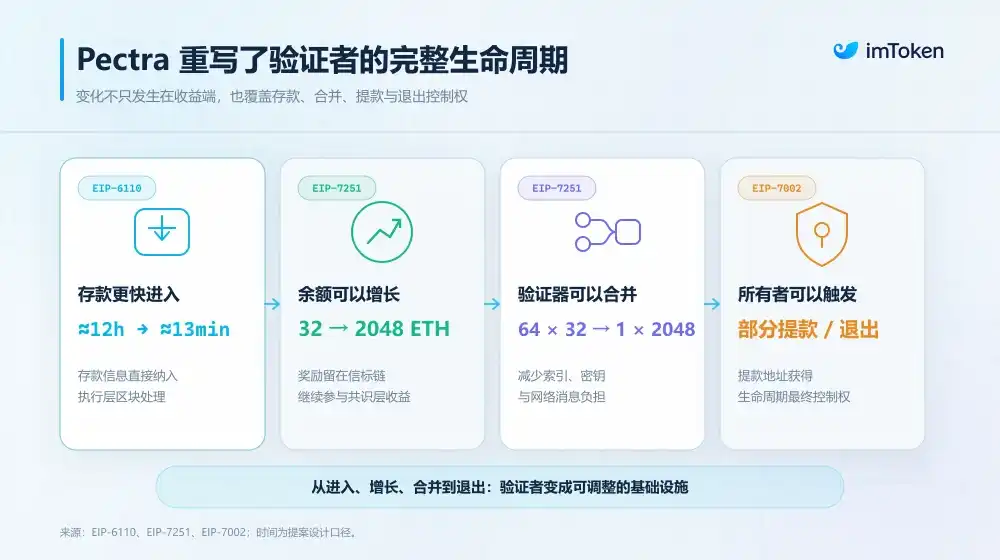
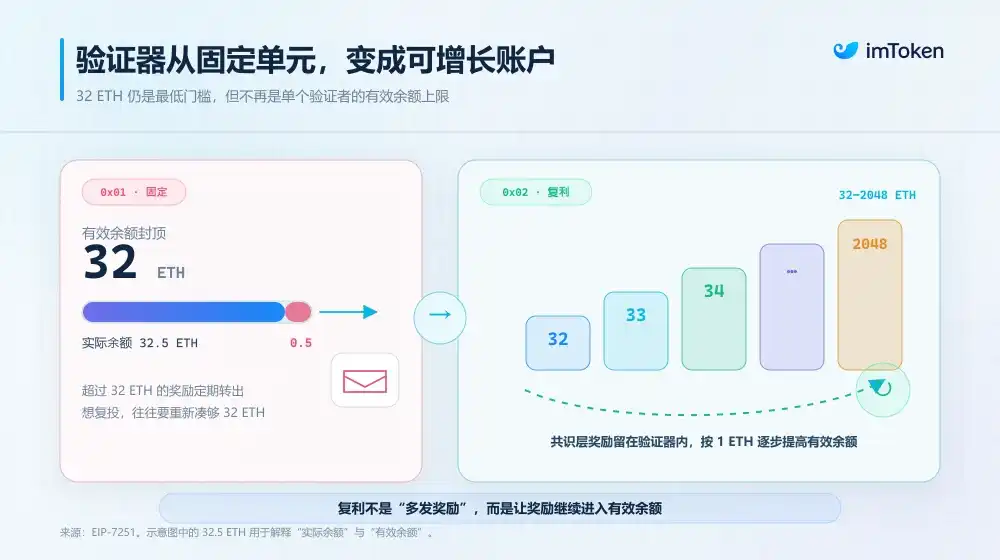
L’EIP-7251 a notamment augmenté le solde effectif maximum d’un validateur individuel de 32 ETH à 2048 ETH, et a introduit la clé de retrait (withdrawal credential) commençant par « 0x02 ». Les validateurs utilisant cette nouvelle clé peuvent conserver les récompenses obtenues sur la couche de consensus (consensus layer) dans leur solde sur la Beacon Chain, augmentant progressivement leur solde effectif et générant de nouveaux revenus – d’où le nom de « validateurs à intérêts composés ».

En surface, cela se contente d’intégrer le « réinvestissement automatique des récompenses » dans le protocole, mais le changement plus profond est qu’il brise la structure fixe de 32 ETH qui caractérisait depuis longtemps les validateurs Ethereum.

Comme on le sait, la limite supérieure du solde effectif d’un validateur Ethereum a toujours été fixée à 32 ETH. Qu’il atteigne ensuite 33 ETH ou plus, le solde effectif réellement pris en compte pour le calcul des récompenses de consensus reste plafonné à 32 ETH. La partie dépassant cette limite n’augmente pas son poids de validation et est périodiquement transférée vers l’adresse de retrait sur la couche d’exécution.

Ainsi, pour les stakers individuels ne gérant qu’un ou quelques validateurs, s’ils veulent que leurs récompenses continuent à participer au staking natif, ils doivent rassembler les récompenses dispersées de différents validateurs jusqu’à atteindre à nouveau 32 ETH. Le seuil de réinvestissement est élevé, et les petits soldes restent en dehors du système de staking après avoir été transférés vers l’adresse de retrait.

Parallèlement, pour Lido, les grandes plateformes d’échange et les prestataires de services de staking professionnels, bien qu’ils puissent regrouper les récompenses éparses générées par un grand nombre d’utilisateurs pour constituer plus rapidement de nouveaux lots de 32 ETH, ils font face à un autre coût : chaque fois qu’ils ajoutent 32 ETH, ils doivent généralement créer et maintenir un nouveau validateur.

Or, avec la croissance continue du montant total mis en jeu (staking) sur Ethereum, le nombre de validateurs ne cesse de gonfler, entraînant une augmentation des coûts opérationnels liés à l’indexation, aux clés, aux signatures et aux messages de preuve.
L’EIP-7251 introduit par Pectra vise précisément à changer cette structure.

Dans le nouveau mode 0x02, le seuil minimum pour lancer un validateur reste de 32 ETH, mais le solde effectif maximum d’un validateur individuel est porté à 2048 ETH. Cela signifie que les récompenses ne doivent plus obligatoirement être automatiquement transférées, mais peuvent rester dans le validateur, continuant à augmenter le solde effectif et à générer de nouveaux revenus.

Parallèlement, plusieurs validateurs existants peuvent être fusionnés. Par exemple, 2048 ETH répartis sur 64 validateurs peuvent être consolidés en un seul validateur à solde élevé. Le poids total du staking ne change pas, mais le nombre de validateurs, de clés et de messages réseau à gérer diminue considérablement (pour en savoir plus : « Après un an, « Lean Ethereum » repart : quel bilan Ethereum veut-il présenter ? »).

Au final, les fonds ne quittent pas Ethereum, la sécurité économique fournie n’est pas réduite, mais la charge opérationnelle baisse fortement.

Ce que Lido est en train de promouvoir, c’est précisément cette fusion.

À strictement parler, le terme « intérêts composés » dans « validateur à intérêts composés » n’explique en réalité que la moitié de sa valeur. L’autre moitié de sa valeur réside dans le fait que les validateurs peuvent enfin passer d’une multitude de petites unités standardisées de 32 ETH à une infrastructure recombinée, plus rationalisée et mieux adaptée à une exploitation à grande échelle.
II. Quelle amélioration du rendement cela peut-il apporter ?

Il est intéressant de noter que, du seul point de vue du rendement, l’amélioration apportée par les intérêts composés n’est pas uniformément répartie.

En théorie, qu’il s’agisse de stakers individuels ou de grandes institutions, le passage au 0x02 permet de réduire les soldes inactifs et de faire participer les récompenses plus directement au staking ultérieur. Cependant, comme les différents participants avaient initialement des capacités de gestion des fonds différentes, le gain marginal apporté par la mise à niveau n’est pas le même.

L’article de recherche publié en juin 2026, « When Staking Rewards Compound: Measuring the Impact of Ethereum's Pectra Upgrade », compare les performances de rendement des validateurs 0x01 et 0x02.

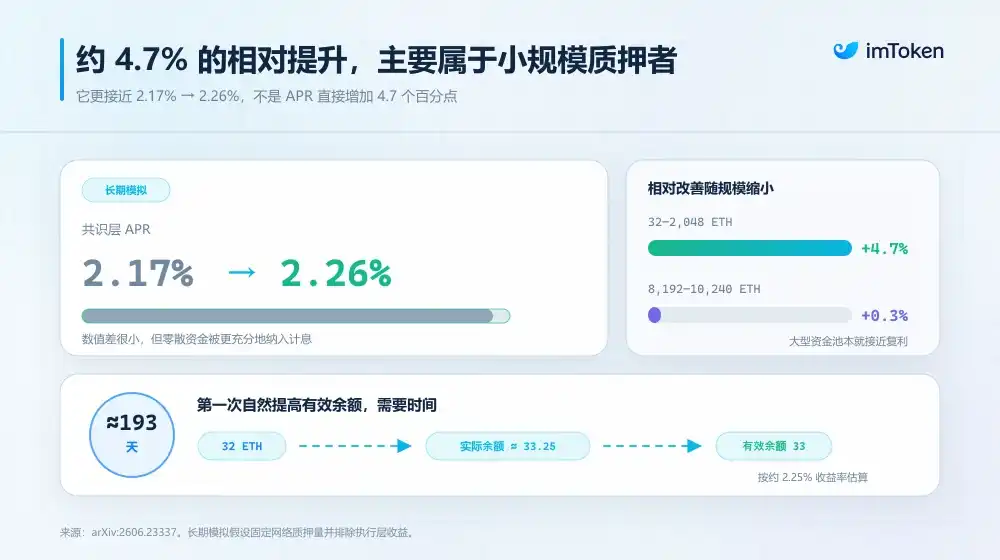
Les résultats de simulation montrent que, dans la fourchette de soldes de 32 ETH à 2048 ETH, le TAEG (APR) moyen sur la couche de consensus des validateurs 0x01 est d’environ 2,17 %, tandis que celui des validateurs 0x02 est d’environ 2,26 %. L’amélioration relative pour ces derniers est d’environ 4,7 %. Cependant, lorsque l’enjeu atteint 8192 ETH à 10240 ETH, l’écart relatif entre les deux se réduit à environ 0,3 %.

Il est particulièrement important de noter ici que les « environ 4,7 % » mentionnés dans l’article ne signifient pas une augmentation directe de 4,7 points de pourcentage du TAEG. Il s’agit d’une amélioration relative d’environ 4,7 % par rapport au TAEG de base de la couche de consensus, qui se situe autour de 2 % à 3 %.

La raison pour laquelle l’amélioration est plus marquée pour les petits stakers n’est pas qu’ils bénéficient d’un revenu exclusif, mais plutôt qu’auparavant, il leur était plus difficile d’effectuer un réinvestissement.

Par exemple, un utilisateur qui ne possède qu’un seul validateur de 32 ETH verra ses récompenses automatiquement transférées vers son adresse de retrait. Il devra ensuite accumuler pendant longtemps, ou combiner avec d’autres fonds, pour rassembler à nouveau 32 ETH et lancer un nouveau validateur. De plus, les montants inférieurs à 32 ETH restent dispersés sur différentes adresses, ce qui réduit naturellement la volonté de les regrouper.

En revanche, le validateur 0x02 permet à ces fonds de continuer à augmenter le solde effectif au sein du même validateur, réduisant ainsi les fonds inactifs constitués par les « montants inférieurs à 32 ETH ». En fin de compte, ce qui manquait aux petits stakers, ce n’était pas seulement la volonté de réinvestir, mais aussi la capacité à réinjecter les ETH épars dans le staking natif.

Les grands prestataires de services de staking peuvent également bénéficier des intérêts composés natifs. Cependant, ils avaient déjà une plus grande capacité de regroupement de fonds, pouvant rassembler rapidement de nouveaux lots de 32 ETH pour lancer de nouveaux validateurs. Du point de vue de l’ensemble du pool de liquidités, ils pouvaient déjà obtenir un effet de configuration des fonds proche des intérêts composés.

Ainsi, plus l’enjeu est important, plus la proportion de soldes épars par rapport au total des fonds est faible, et plus l’amélioration marginale apportée par le 0x02 est naturellement réduite.
Cela ne signifie pas pour autant que le 0x02 est sans importance pour les grandes institutions.

Au contraire, le problème central auquel les grandes institutions sont confrontées évolue de « comment faire en sorte que les récompenses continuent à générer des revenus » vers « comment gérer plus d’ETH avec moins de validateurs ».

Pour elles, la valeur du 0x02 se manifeste davantage sous deux aspects : d’une part, les récompenses peuvent rester dans le validateur pour continuer à bénéficier des intérêts composés, réduisant ainsi les opérations fréquentes de regroupement, de nouveaux dépôts et de création de validateurs ; d’autre part, les nombreux validateurs 32 ETH existants peuvent être fusionnés, réduisant significativement les coûts de gestion des nœuds, des clés et des messages de la couche de consensus.

Bien sûr, ce changement implique aussi de nouveaux arbitrages.

Les validateurs traditionnels 0x01 transfèrent automatiquement les récompenses dépassant 32 ETH vers l’adresse de retrait, sans nécessiter d’opération active sur la chaîne. Le mode 0x02 conserve par défaut les récompenses dans le validateur. Si les grands prestataires de services doivent satisfaire aux retraits des utilisateurs ou gérer la liquidité, ils doivent initier activement des retraits partiels et repenser leurs mécanismes de comptabilité, de distribution des récompenses et de tampon de liquidité.

Ainsi, pour les petits stakers, la valeur la plus directe du 0x02 est de réduire le seuil de réinvestissement et de diminuer les fonds inactifs. Pour les grandes institutions, bien que l’amélioration du taux de rendement soit moindre, les gains en termes de fusion de validateurs et d’efficacité de l’infrastructure sont en réalité plus importants.

Les deux parties bénéficient du même mécanisme, mais les sources de bénéfices et leurs priorités ne sont pas identiques.

III. Changements et continuité dans l’écosystème du Staking Ethereum

Par conséquent, si l’on se place uniquement du point de vue du TAEG, on s’aperçoit que la migration de Lido ne représente pas une affaire particulièrement alléchante.

Après tout, l’amélioration du rendement obtenue par les grands prestataires de services grâce aux intérêts composés pourrait être inférieure à 1 %, la migration entraîne une perte temporaire de récompenses, et les systèmes existants de comptabilité, de retrait et de gestion de la liquidité doivent être adaptés en conséquence.

Pourtant, Lido a décidé de pousser cette mise à niveau de l’architecture centrale, la plus importante depuis la V2 en 2023. C’est parce que lorsque le protocole gère plus de 8 millions d’ETH, le nombre de validateurs lui-même devient un coût.

Surtout depuis la mise à niveau Pectra, un validateur de 2048 ETH peut supporter un poids de staking équivalent à 64 validateurs traditionnels. Cela signifie qu’il est possible de gérer plus de capitaux avec moins de validateurs, de manière plus efficace.

En réalité, la mise à niveau de Lido ne se limite pas à la fusion de validateurs.

Après la migration vers le Curated Module v2, ses opérateurs de nœuds professionnels doivent désormais, pour la première fois, verrouiller des ETH en guise de garantie. En cas d’interruption de service, de slashing, de mauvaise attribution des récompenses ou d’autres problèmes imputables, cette garantie peut être utilisée pour couvrir les pertes.

Auparavant, les opérateurs de nœuds sélectionnés de Lido dépendaient principalement de leurs performances passées et de leur réputation pour gagner la confiance. Désormais, la réputation demeure, mais elle est complétée par une contrainte de capital réel. Les 34 opérateurs de nœuds sélectionnés actuels devraient tous migrer vers CMv2, et aucun n’a choisi de se retirer en raison de l’exigence de garantie.

Ce changement est peut-être plus digne d’attention que les intérêts composés eux-mêmes. Il signifie que les critères de concurrence dans le Staking après Pectra sont en train de connaître une transformation structurelle majeure. À l’avenir, les différences entre les services de staking pourraient davantage se manifester dans la façon d’améliorer l’utilisation efficace des fonds, de gérer les retraits et la liquidité, de répartir les risques des validateurs, et de trouver un équilibre entre contrôle des actifs, complexité opérationnelle et rendement.
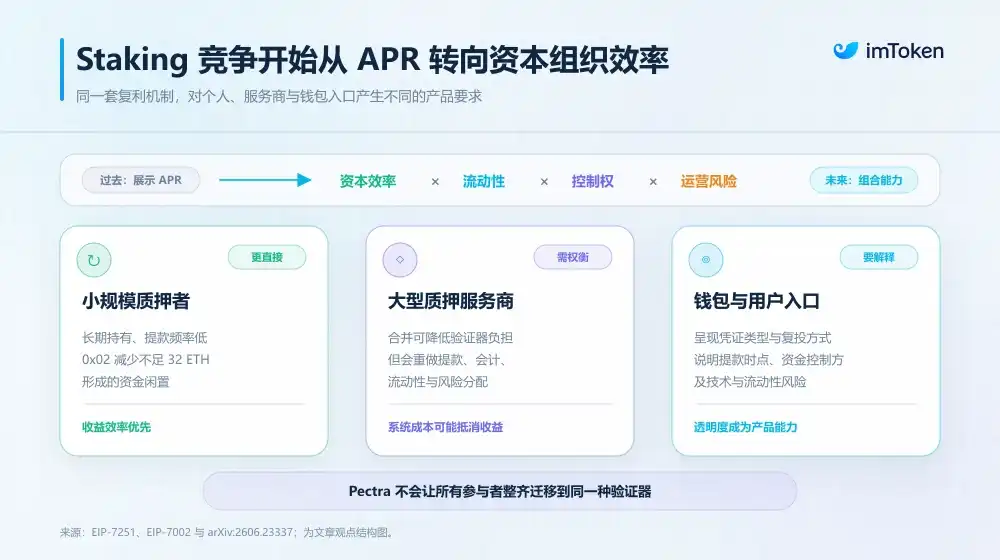
Pour les portails utilisateurs comme les portefeuilles, la valeur ne réside plus seulement à afficher un chiffre de rendement à l’utilisateur. Il est également nécessaire d’aider l’utilisateur à comprendre les parcours des fonds et les structures de risque sous-jacentes aux différentes méthodes de staking. Prenons l’exemple d’imToken Stake :

  • Actuellement, les utilisateurs peuvent accéder directement à la fonction de staking depuis la page de leurs actifs ETH, et choisir le service correspondant en fonction de l’ampleur de leurs fonds et de leurs besoins. Pour les utilisateurs souhaitant participer avec de petits montants, ils peuvent effectuer l’opération via le service de staking intégré dans le portefeuille.
  • Pour les utilisateurs détenant plus de 32 ETH et souhaitant conserver le contrôle de leurs actifs, ils peuvent également opter pour une solution de validateurs non-custodiale, participant ainsi au Staking natif d’Ethereum tout en évitant de maintenir eux-mêmes des nœuds.

Avec la diffusion progressive des validateurs à intérêts composés, le contenu que ces portails doivent présenter va également s’accroître : par exemple, les récompenses sont-elles automatiquement réinvesties, quand peuvent-elles être retirées, quel type de clé de retrait le validateur utilise-t-il, qui contrôle les fonds, et quels sont les risques techniques et de liquidité supportés par les différentes solutions.

Cela signifie aussi que le portefeuille ne se connecte plus seulement à une page de rendement du Staking, mais à un ensemble de services de validation qui ne cessent de se différencier.

Pour conclure

Dans l’ensemble, de The Merge à la mise à niveau Shanghai, puis à la mise à niveau Pectra, Ethereum comble progressivement le cycle de vie du Staking.

The Merge a fait des validateurs le cœur de la sécurité du réseau, la mise à niveau Shanghai a résolu la question de la sortie des fonds engagés, et la mise à niveau Pectra commence à optimiser davantage la manière dont les fonds entrent, s’accumulent et se réorganisent.

Bien sûr, les validateurs à intérêts composés n’apporteront pas à tous les participants la même amélioration de rendement :

  • Pour les petits stakers, ils peuvent réduire les soldes inactifs, permettant aux ETH détenus à long terme de participer plus pleinement au consensus.
  • Pour les grandes institutions, leur valeur la plus importante n’est peut-être pas d’augmenter le TAEG, mais de réduire le nombre de validateurs et d’alléger la charge opérationnelle.

Par conséquent, la migration vers les validateurs 0x02 sera inévitablement progressive. Les différents participants, en fonction de l’ampleur de leurs fonds, de leurs besoins de liquidité et de leur structure opérationnelle, choisiront de conserver leurs validateurs existants ou de passer progressivement au mode à intérêts composés.

Mais la manière dont Ethereum organise le capital engagé dans le staking est déjà en train de subir une transformation structurelle majeure, étape par étape. Surtout maintenant que les validateurs ne sont plus figés à 32 ETH, l’écosystème du Staking commence aussi à évoluer, passant de produits de rendement standardisés vers une concurrence plus segmentée en matière de gestion des fonds et d’infrastructure.

C’est aussi un changement de paradigme dans le Staking Ethereum, digne d’un suivi à long terme.

Trending Cryptos

Related Questions

QQuel est le principal changement apporté par la mise à niveau Pectra (EIP-7251) concernant les validateurs Ethereum ?

ALa mise à niveau Pectra, via l'EIP-7251, augmente le solde effectif maximum d'un validateur individuel de 32 ETH à 2048 ETH et introduit des informations d'identification de retrait commençant par '0x02'. Cela permet aux validateurs de conserver leurs récompenses sur la chaîne de balises, augmentant progressivement leur solde effectif et générant de nouveaux revenus - d'où le terme 'validateurs à intérêts composés'.

QPourquoi Lido entreprend-il la migration massive de 800 000 ETH vers la nouvelle architecture de validateurs, malgré un gain de rendement limité ?

ALido entreprend cette migration principalement pour réduire les coûts opérationnels à long terme. En consolidant des milliers de validateurs traditionnels (0x01) en un nombre moindre de validateurs à solde élevé (0x02), ils réduisent considérablement le nombre de validateurs, de clés et de messages de consensus à gérer. Cette rationalisation de l'infrastructure est cruciale pour gérer efficacement des capitaux à grande échelle, même si l'amélioration du TAEG est marginale pour les grands opérateurs.

QQuel groupe de participants au staking bénéficie le plus de l'amélioration relative du rendement avec les validateurs 0x02, et pourquoi ?

ALes petits stakeurs (avec un seul validateur de 32 ETH, par exemple) bénéficient de la plus forte amélioration relative du rendement. En effet, auparavant, leurs récompenses étaient automatiquement versées sur une adresse de retrait, et il leur était difficile de réunir à nouveau 32 ETH pour un nouveau validateur. Le mode 0x02 élimine ce seuil en permettant aux récompenses de s'accumuler directement dans le solde effectif du validateur existant, réduisant ainsi les fonds dormants.

QQuel changement important, au-delà des intérêts composés, Lido introduit-il avec son Curated Module v2 pour ses opérateurs de nœuds ?

AAvec le Curated Module v2, Lido introduit une exigence de caution en ETH pour ses opérateurs de nœuds sélectionnés. Cette caution sert de garantie financière pour couvrir d'éventuelles pertes en cas de panne opérationnelle, de slashing (confisquation) ou d'erreur dans la distribution des récompenses. Cela ajoute une contrainte de capital réel à la confiance basée sur la réputation, renforçant la sécurité et l'alignement des intérêts.

QComment l'article décrit-il l'évolution globale de l'écosystème du Staking Ethereum après Pectra ?

AL'article décrit une transformation structurelle majeure. L'écosystème passe de produits de rendement standardisés (basés sur des validateurs fixes de 32 ETH) à une concurrence plus nuancée centrée sur la gestion des capitaux et l'infrastructure. Les différences entre services se manifesteront dans l'efficacité d'utilisation des fonds, la gestion des liquidités et des retraits, l'allocation des risques des validateurs, et l'équilibre entre contrôle des actifs, complexité opérationnelle et rendement.

Related Reads

Once-Popular Web3 Enters Wave of Layoffs

The once-hot Web3 industry is experiencing a severe wave of layoffs. While many companies attribute job cuts to AI-driven restructuring, the primary reason is often financial pressure. The Web3 sector, at the intersection of tech and finance, has been hit particularly hard. Employees at major cryptocurrency exchanges report sudden, impersonal layoffs—often with system access revoked overnight—and minimal or no severance. Common tactics include setting impossible performance targets or terminating employees for minor policy violations. The working atmosphere has become toxic, marked by intense monitoring, excessive meetings, and management obsessed with control and internal politics rather than product innovation. The industry's core business model is collapsing. Exchange revenue from trading fees and listing charges has plummeted due to a decline in quality projects and retail investor exodus. Events like the massive forced liquidation on October 10th further shattered confidence. Competition from on-chain derivatives platforms and prediction markets is intensifying the downturn. As layoffs continue, displaced workers struggle to find new opportunities. Many transition to the AI sector, but face significant bias from traditional finance and even some AI firms, which view crypto industry experience with suspicion. The current downturn appears more structural than cyclical, driven by unsustainable practices, internal strife, and a failure to innovate, raising questions about the industry's future trajectory.

marsbit5m ago

Once-Popular Web3 Enters Wave of Layoffs

marsbit5m ago

Sales Drop 26% But Prices Rise? Xiaomi's Dilemma

Xiaomi, facing a significant 26.3% year-on-year decline in global smartphone shipments in Q2 2026, has implemented its third price hike of the year. On August 2nd, prices were raised for nine models, including the flagship Mi 17 series (up 400-500 yuan) and Redmi K90/Turbo 5 series (up 300 yuan). This move completes a pattern where cost pressure, originating from surging memory chip prices, has climbed from entry-level to mid-range and now flagship products. The primary driver is a severe supply squeeze on consumer-grade DRAM and NAND flash memory, as major manufacturers like Samsung shift advanced capacity to more profitable HBM for AI applications. According to Xiaomi President Lu Weibing, memory prices for the same configuration have skyrocketed nearly fourfold since Q1 2025, adding roughly 1500 yuan to the cost of a mainstream 12GB+512GB phone. IDC estimates consumer memory costs have risen nearly 300% year-on-year. While the price increases hurt demand and contributed to the sales slump, Xiaomi's strategy of reducing entry-level models and upgrading its product mix also played a role. Domestically, its market share in China fell to 12% (5th place), while leaders Huawei and Apple saw shipments grow over 24%. To mitigate future risks, Xiaomi is accelerating its in-house "Surge" chip development and optimizing memory configurations across its lineup. Xiaomi is not alone; major brands like OPPO, vivo, and Apple have already raised prices in 2026, with industry insiders predicting another round of increases (200-800 yuan) in the second half. A full-scale industry-wide涨价 cycle is underway, forcing both manufacturers and consumers to recalibrate their strategies and purchasing decisions amid sustained cost pressures.

marsbit16m ago

Sales Drop 26% But Prices Rise? Xiaomi's Dilemma

marsbit16m ago

Three Consecutive Quarters of Decline: The Crypto Market is Experiencing Its Longest Ebb Since 2022

The cryptocurrency market experienced its third consecutive quarterly decline in Q2 2026, marking its longest downturn since 2022, according to a CoinGecko report. The total market capitalization fell 12.6% to $2.1 trillion, a retreat of roughly 52% from its October 2025 peak. Multiple indicators signal an orderly capital exit from the sector. For the first time since Q3 2023, the total stablecoin market cap shrank (-1.6% to $305.1B), indicating funds are leaving the ecosystem entirely, not just rotating to safer crypto assets. Trading volumes on centralized exchanges dropped 27.9%, while DeFi's Total Value Locked (TVL) plummeted 23.4%. Both Bitcoin (-14.2%) and Ethereum (-25.4%) underperformed traditional risk assets like equities in Q2, breaking from previous correlative narratives. Ethereum saw its first-ever three-quarter losing streak, with its market share falling to around 10%. A few areas saw growth. Prediction market volumes surged 48.7%, largely driven by sports betting. Hyperliquid's HYPE token entered the top 10 by market cap, and tokenized collectibles platforms grew, though primarily via gamified mechanics. Despite a ~9.8% Bitcoin rebound in July, historical trends suggest caution for August. The market, now ~49% below its 2025 high, is undergoing a measured retreat. Its recovery hinges on future Federal Reserve policy and the industry's ability to develop sustainable revenue streams beyond speculation.

marsbit30m ago

Three Consecutive Quarters of Decline: The Crypto Market is Experiencing Its Longest Ebb Since 2022

marsbit30m ago

Trading

Spot

Hot Articles

What is LINON

Linde plc Tokenized Stock (Ondo): Revolutionizing Traditional Equity Access Through Blockchain Innovation The emergence of Linde plc Tokenized Stock (Ondo), represented by the ticker $LINON, signifies a monumental shift in the fusion of traditional financial structures and decentralized finance (DeFi). This innovative financial instrument showcases the tremendous potential of blockchain technology to democratize access to traditional equity markets while ensuring the security and regulatory compliance necessary for institutional-grade financial products. Through Ondo Finance's pioneering tokenization platform, $LINON provides a seamless pathway for global investors to engage with one of the world's leading industrial gas companies, Linde plc, creating a blockchain-native representation of the underlying equity. Introduction to Linde plc Tokenized Stock The landscape of financial markets is witnessing a groundbreaking transformation through the tokenization of real-world assets. Linde plc Tokenized Stock (Ondo) epitomizes this revolutionary approach by bridging the gap between conventional stock ownership and blockchain-enabled financial infrastructure. The $LINON token allows investors to gain exposure to one of the prominent industrial companies worldwide through decentralized technology. Operating within Ondo Finance's comprehensive ecosystem, $LINON symbolizes a practical application of tokenization technology that enhances accessibility, efficiency, and global connectivity in traditional financial markets. By leveraging blockchain infrastructure, this tokenized stock enables international investors to participate in U.S. equity markets, overcoming traditional barriers associated with cross-border investing. The significance of $LINON goes beyond technological innovation; it represents a fundamental shift in asset structuring, distribution, and trading in the digital age. This tokenized stock maintains all the economic benefits associated with traditional Linde plc shares while offering improved liquidity, programmable compliance features, and seamless integration with decentralized finance protocols. The development of $LINON indicates a growing acceptance of blockchain technology as a viable means for traditional finance, exemplifying how even well-established assets like Linde plc can integrate into blockchain systems. This approach preserves the core attributes that appeal to investors while introducing advanced capabilities that enhance the overall investment proposition. Project Overview and Objectives Linde plc Tokenized Stock (Ondo) encapsulates a strategic effort to democratize access to traditional equity markets through advanced blockchain technologies. The primary objective of $LINON is to provide approved global investors seamless access to the economic exposure associated with Linde plc shares, furthering an effort to create a more inclusive financial ecosystem. Beyond the digital representation of traditional assets, $LINON endeavors to eliminate barriers of geography and time zones that limit investor participation. Its design ensures that blockchain technology can elevate traditional investment vehicles without undermining the security or compliance requirements expected by investors. Key goals of the project include enhanced liquidity provision, programmable compliance mechanisms, and interoperability with other blockchain networks. Each $LINON token is fortified by actual Linde plc securities housed at U.S.-registered broker-dealers, allowing holders to reap economic advantages akin to traditional stockholders, such as dividend reinvestment. Furthermore, $LINON aims to establish new industry standards for institutional-grade tokenized securities, paving the way for traditional assets to embrace blockchain technology while remaining compliant with regulatory frameworks. By associating itself with a company as reputable as Linde plc, the project opens avenues for exploring tokenized equities catering to both conservative institutional players and daring retail investors. Project Creator and Development Team The vision for Linde plc Tokenized Stock (Ondo) comes from Nathan Allman, founder and CEO of Ondo Finance. His background in traditional finance coupled with expertise in blockchain technology positions him uniquely to navigate the complexities of asset tokenization. Allman's academic journey began at Brown University, focusing on Economics and Biology, equipping him with valuable analytical skills. His time at Goldman Sachs in the Digital Assets division strengthened his understanding of the interplay between financial institutions and emerging technologies, laying the groundwork for his later endeavors in alternative investment strategies. Under Allman's guidance, Ondo Finance has emerged as a leader in asset tokenization, launching $LINON as a flagship example of the company's larger mission towards revolutionizing traditional financial systems using blockchain technology. His commitment to leveraging blockchain for creating institutional-grade financial products has shaped the landscape of real-world asset tokenization. Investment and Funding Structure The growth of Ondo Finance, the platform powering Linde plc Tokenized Stock (Ondo), is bolstered by robust financial backing from prestigious venture capital firms and strategic investors. This strong investment foundation underpins the development of the key infrastructure essential for compliant tokenized securities like $LINON. In August 2021, Ondo Finance secured $4 million in seed funding led by a major venture capital firm, which enabled the company to commence platform development and establish the necessary regulatory processes for tokenizing real-world assets. This early investment cemented Ondo Finance's credibility within the industry. The Series A funding round followed, garnering $20 million with participation from renowned firms committed to transformative technology companies. This backing demonstrated substantial institutional confidence in Ondo Finance's vision, allowing it to hone its approach to asset tokenization through mechanisms that ensure compliance and accessibility. Noteworthy contributors, including institutional investors and experienced partners, have added significant value to Ondo Finance’s development efforts. Their involvement underscores the confidence across sectors in Ondo Finance's approach to bridging traditional finance with blockchain innovations. Technical Infrastructure and Innovation The technical architecture that underpins Linde plc Tokenized Stock (Ondo) represents a sophisticated melding of traditional finance systems and cutting-edge blockchain technology. The architecture's foundation is built on the Ethereum network, renowned for its security and programmability—both critical for intricate financial instruments. The $LINON tokenization process comprises creating a blockchain-native representation of Linde plc shares that preserves economic benefits while augmenting investor capabilities. Each token corresponds to actual shares held at U.S.-registered broker-dealers, creating a compliant custody structure that legitimizes the asset's existence and value. Automated compliance systems are integrated into the tokenization process, managing critical components such as know-your-customer (KYC) verification and anti-money laundering (AML) protocols. This incorporation of programmable compliance empowers $LINON to uphold regulatory standards essential for institutional proliferation. Cross-chain interoperability characterizes the advanced technical features of $LINON. While initially deployed on Ethereum, the framework is designed for expansion to other networks such as Solana and BNB Chain. This adaptability enhances liquidity and accessibility, allowing investors to select their preferred blockchain ecosystems. Historical Timeline and Development Crafting the history of Linde plc Tokenized Stock (Ondo) unfolds in parallel with the evolution of Ondo Finance's tokenization platform. The timeline's inception dates back to March 2021 when Nathan Allman laid the foundations for creating institutional-grade financial products on blockchain infrastructure. The initial funding round in August 2021 provided crucial resources for developing the platform and establishing partnerships necessary for effective tokenization. By January 2023, Ondo Finance launched its tokenized treasury products, establishing mechanisms that would facilitate future tokenized equities such as $LINON. A pivotal milestone arose in February 2025 when Ondo Chain—a Layer 1 blockchain designed specifically for asset tokenization—was introduced. This infrastructure enhances capabilities vital for institutional markets, demonstrating Ondo Finance's long-term commitment to tokenization. Subsequently, the launch of Ondo Global Markets in September 2025 marked the official debut of $LINON. This milestone showcased the successful transition from development to active trading, enabling investors around the world to access American financial markets seamlessly. Ongoing development plans include a targeted expansion of available tokenized assets to over 1,000 by the end of 2025, pointing to a bright future for Ondo Finance's ecosystem and its mission to broaden tokenized equity accessibility. Regulatory Compliance and Legal Framework The legal architecture governing Linde plc Tokenized Stock (Ondo) emphasizes a sophisticated approach to regulatory compliance, allowing tokenized securities to be implemented within a blockchain-based framework. The legal structure governing $LINON spans multiple jurisdictions while maintaining a robust legal footing. Compliance systems ensure that only eligible investors can access the token, enforced through automated verification that aligns with international regulations. This innovative regulatory technology promises real-time enforcement of complex requirements, considerably enhancing efficiency in operating within the regulatory landscape. The custody framework undergirding $LINON ensures that the underlying shares are securely held at U.S.-registered broker-dealers, complying with necessary regulations while delivering blockchain-driven access to investors. The token maintains its economic equivalency and security through this carefully structured custody arrangement. KYC and AML compliance systems are embedded within the smart contract architecture, ensuring integrity and adherence to regulatory practices while fostering transparency for investors. The jurisdictional restrictions mark a commitment to navigating the evolving landscape of international securities laws. Market Impact and Industry Significance The advent of Linde plc Tokenized Stock (Ondo) holds profound implications for the broader financial landscape, symbolizing a clear shift towards blockchain-enabled markets. $LINON serves as a proof-of-concept for integrating traditional companies into blockchain ecosystems, showcasing the potential benefits such as broader accessibility and improved efficiency. The market's response to $LINON indicates a growing acceptance of tokenization among institutional investors, contributing to the emergence of an expanding sector wherein traditional assets can be interconnected with blockchain innovations. The success of $LINON further solidifies market confidence, indicating an overarching shift towards recognizing asset tokenization as a transformative force in finance. Future Development and Expansion Plans The future trajectory for Linde plc Tokenized Stock (Ondo) centers around the expansion of the tokenization ecosystem and enhanced infrastructure supporting blockchain-enabled financial services. Plans for cross-chain integration usher in new opportunities for liquidity and flexibility within the investment framework, with existing capabilities poised for continuous enhancement. With the introduction of Ondo Chain, Ondo Finance aims to transition $LINON to an optimized blockchain environment specifically designed for asset tokenization. This new infrastructure heralds exciting prospects for the development of institutional-grade financial products, ensuring ongoing compatibility with contemporary investment strategies. Further integration with decentralized finance protocols signifies a commitment to empowering $LINON holders through advanced financial strategies. The anticipated expansion of available tokenized assets promises to broaden investor access, enhancing the utility and appeal of the platform. In alignment with ambitions for regulatory expansion, ongoing efforts to secure approvals for new jurisdictions will enhance investor access, further positioning $LINON at the forefront of the burgeoning tokenization market. Conclusion Linde plc Tokenized Stock (Ondo), as represented by the $LINON token, stands at the intersection of traditional finance and blockchain innovation. It embodies a transformative milestone in how financial assets are structured, distributed, and engaged within modern investment ecosystems. The technical sophistication behind $LINON, combined with its regulatory compliance framework, illustrates that asset tokenization can improve financial infrastructure rather than simply digitizing existing products. This pioneering effort not only enhances investor access to U.S. equity markets but also signifies an evolution of how traditional financial services can integrate blockchain technology. As the asset tokenization market grows exponentially, with prospects suggesting significant valuation increases, $LINON paves the way for a future where tokenized securities become standard fixtures in the financial landscape. The trajectory of $LINON will undoubtedly influence how traditional finance adapts to a transformed, blockchain-powered world.

4.0k Total ViewsPublished 2025.12.05Updated 2025.12.05

What is LINON

What is CRMON

Salesforce Tokenized Stock (Ondo): Revolutionising Traditional Equity Access Through Blockchain Innovation The emergence of Salesforce Tokenized Stock (CRMON) marks a pivotal advancement in integrating traditional financial markets with blockchain technology. This innovative approach offers investors unprecedented access to equity exposure through tokenisation. Developed by Ondo Finance, CRMON provides tokenholders with economic exposure equivalent to holding Salesforce stock (CRM) while automatically reinvesting dividends. This effectively bridges the gap between conventional equity markets and decentralised finance (DeFi). Introduction and Comprehensive Overview of Salesforce Tokenized Stock In recent years, the financial landscape has dramatically transformed due to blockchain technology, fundamentally altering how investors access and interact with traditional assets. The development of Salesforce Tokenized Stock (CRMON) is a prime example of this evolution, representing a sophisticated fusion of conventional equity markets with cutting-edge distributed ledger technology. CRMON is a tokenised version of Salesforce stock, emerging from the innovative work of Ondo Finance, a leading platform in the real-world asset tokenisation sector that positions itself as a bridge between traditional finance and decentralised systems. Designed to provide tokenholders with economic exposure that mirrors the performance of the underlying Salesforce stock, CRMON incorporates automatic dividend reinvestment mechanisms. This eliminates many traditional barriers associated with international equity investment, such as complex brokerage relationships, currency conversion challenges, and restricted trading hours. The tokenisation process reimagines stock ownership as a blockchain-native asset while maintaining its economic equivalence with the underlying security, offering enhanced portability and integration capabilities within decentralised finance ecosystems. CRMON transcends its individual utility as an investment instrument to represent a fundamental shift in how financial markets can operate in an increasingly digital world. By maintaining full backing through U.S.-registered broker-dealers and implementing robust compliance frameworks, CRMON demonstrates that tokenised securities can achieve the regulatory standards necessary for institutional adoption while delivering the technological advantages of blockchain infrastructure. Understanding Tokenized Real-World Assets and CRMON's Strategic Position Tokenised real-world assets signify one of the most significant innovations in modern finance, fundamentally reimagining how traditional securities are represented, traded, and utilised within digital ecosystems. CRMON operates as a tokenised equity instrument correlating directly with Salesforce stock while optimising accessibility and efficiency. This aligns with Ondo Finance's broader mission to democratise access to institutional-grade financial products through innovative tokenisation strategies. The tokenisation process guarantees complete economic equivalence with the underlying Salesforce equity. Each CRMON token represents a proportional claim on Salesforce stock held by qualified custodians, with dividend payments automatically reinvested to maintain continuous exposure to total return performance. This structure simplifies dividend management and ensures that tokenholders receive the full economic benefit of their equity exposure, encompassing both capital appreciation and income generation. Ondo Finance's strategy in tokenising Salesforce stock demonstrates its expertise in creating compliant, institutional-grade products that meet traditional financial markets' stringent requirements. The platform’s focus on merging regulatory compliance with blockchain benefits positions it at the forefront of decentralised finance, captivating both institutional and retail investors seeking blockchain-native solutions. The Technology and Innovation Framework Behind CRMON The technological infrastructure supporting CRMON integrates blockchain technology with traditional financial mechanisms, delivering institutional-grade security and compliance while maintaining the operational advantages of decentralised systems. Built on the Ethereum blockchain, CRMON utilises robust smart contract capabilities to ensure transparent, secure operations. The smart contract architecture incorporates layered security and compliance mechanisms, enabling automated compliance checks and real-time asset backing verification. Integration with oracle services maintains accurate pricing and dividend information, ensuring CRMON reflects the underlying Salesforce stock's accurate performance. This architecture delivers automated dividend reinvestments and other corporate actions, eliminating manual processing requirements and directly enhancing tokenholder benefits. Ondo Finance ensures CRMON's security structure includes daily third-party verification of holdings, independent collateral agents, and a multiple-layer custody system through partnerships with established financial institutions. This framework safeguards tokenholder interests against operational risks while providing robust asset backing. The user interface enhances integration capabilities, allowing seamless interaction between CRMON and various decentralised finance protocols, as well as cryptocurrency exchanges. This interoperability enables users to leverage their tokenised equity across multiple platforms, creating sophisticated investment strategies that marry traditional equity characteristics with blockchain-native innovation. Leadership and Corporate Structure of Ondo Finance The leadership team behind CRMON and Ondo Finance blends expertise from traditional finance and blockchain technology, presenting a robust combination of skills essential for successfully bridging conventional markets with decentralised finance. Nathan Allman, the founder and CEO, emerged from a distinguished financial background before establishing Ondo Finance in 2021. Allman's experience includes notable roles at major financial institutions, including significant contributions to developing cryptocurrency market services. His insights into regulatory compliance were paramount in developing products like CRMON that successfully unify traditional securities with blockchain technology. With a team of professionals boasting substantial experience in both conventional finance and blockchain sectors, Ondo Finance's leadership comprises diverse expertise that covers every aspect of tokenised asset development. Justin Schmidt serves as President and COO, contributing unique operational expertise, while Chris Tyrell brings essential compliance knowledge. Investment Landscape and Funding History The investment landscape surrounding Ondo Finance reflects significant institutional confidence in its mission to tokenise real-world assets. The company has raised substantial funds through various investment rounds, attracting leading venture capital firms and strategic investors that recognise the transformative potential of tokenised securities like CRMON. Notably, Ondo Finance completed a successful Series A funding round in 2022, led by well-known venture capital firms. This funding success validates Ondo Finance's innovative approach to creating compliant, institutional-grade tokenised products. In total, Ondo Finance has successfully secured substantial funding, raising significant capital for product development and market expansion, including a noteworthy token sale that reinforced its governance structure through the establishment of the ONDO token. The diverse composition of investors reflects broad market confidence in Ondo Finance's business model, demonstrating support from both traditional and blockchain-native organisations. Operational Mechanics and Technical Implementation The operational framework supporting CRMON exemplifies sophisticated integration of traditional financial mechanisms with blockchain technology. The technical implementation introduces multiple layers of security, compliance, and operational efficiency to meet institutional standards while enhancing accessibility. The tokenisation process begins by acquiring actual Salesforce stock through U.S.-registered broker-dealers, ensuring each CRMON token maintains direct correlation with the underlying equity performance. Smart contracts automate operational processes, including dividend reinvestment and corporate action processing, facilitating a streamlined user experience. The Minting and redemption processes allow authorised participants to manage CRMON tokens effectively. During U.S. trading hours, institutions can mint new tokens by depositing stablecoins that are used to purchase corresponding Salesforce equity. This structure maintains a tight correlation with underlying assets, enhancing liquidity and price discovery. Additionally, the infrastructure supports twenty-four-hour token transfer capabilities, providing CRMON holders with operations outside traditional market hours. This represents a significant advantage over conventional securities ownership, thus promoting integration with decentralised finance applications. Plans for cross-chain compatibility through partnerships signal further ambitions for CRMON's market reach. By expanding to other blockchain networks, Ondo Finance aims to enhance accessibility and user engagement with tokenised equity products. Timeline and Historical Development of Tokenized Equity Innovation The timeline of CRMON's development and Ondo Finance's broader tokenised capabilities demonstrates a systematic innovation process beginning with the company's founding in 2021. 2021: Ondo Finance is founded by Nathan Allman and co-founders, launching initial products focused on structured vault offerings on the Ethereum blockchain. 2022: The company completes substantial funding rounds—both equity and token sales—totaling significant capital and launching initial tokenised U.S. Treasury products. 2023-2024: Ondo Finance experiences substantial growth, establishing partnerships with major financial institutions while expanding its product offerings beyond fixed-income securities. February 2025: Ondo Global Markets is announced, marking the transition into equity tokenisation with plans for accessing over one hundred U.S. stocks and ETFs. September 2025: The official launch of Ondo Global Markets includes CRMON alongside other tokenised equity offerings, marking a significant evolution in Ondo Finance's product ecosystem. This timeline highlights the organisation's rapid growth and its capability to adapt its technological and compliance frameworks to accommodate different asset classes effectively while maintaining security and regulatory integrity. Regulatory Framework and Compliance Approach Ondo Finance's regulatory framework showcases a sophisticated compliance strategy, essential for achieving institutional adoption in the tokenised securities market. The company's strong partnerships with U.S.-registered broker-dealers promote adherence to Securities and Exchange Commission regulations and apply robust investor protections. Acquisitions, such as Oasis Pro—a registered broker-dealer—significantly enhance Ondo Finance's compliance capabilities, ensuring thorough alignment with existing regulatory structures. The company employs independent verification procedures that foster transparency, aiming for a solid performance standards reputation. Furthermore, Ondo Finance's commitment extends to international regulatory compliance, ensuring token access remains restricted to eligible investors while adhering to pertinent cross-border securities regulations. Comprehensive attention to tax implications and reporting requirements fortifies the security and compliance landscape of CRMON, ensuring that investor obligations remain manageable. Future Prospects and Market Positioning The forward-looking landscape for CRMON and Ondo Finance illustrates substantial growth opportunities driven by institutional adoption of blockchain technology and escalating demand for efficient alternatives to conventional securities ownership. Market projections indicate the tokenised asset sector could value multiple trillion dollars by 2030. With plans to scale CRMON offerings significantly and integrate it with a dedicated blockchain infrastructure—Ondo Chain—Ondo Finance aims to elevate its institutional-grade tokenised asset operations. Additionally, the development of strategic partnerships enhances distribution capabilities while establishing the company's credibility in the financial market. Furthermore, the integration of tokenised equity with decentralised finance protocols offers new potential for innovative financial products and strategies previously impossible with traditional securities. These factors underscore CRMON's positioning to effectively capture increased market share and deliver innovative solutions for international investment exposure. Conclusion Salesforce Tokenized Stock (CRMON) symbolises a transformative development within financial markets, successfully bridging traditional equity ownership with blockchain technology to create unprecedented accessibility for global investors. Through Ondo Finance's sophisticated tokenisation framework, CRMON provides complete economic exposure to Salesforce equity performance while enhancing operational advantages that exceed traditional ownership. The launch of CRMON reflects the broader evolution of financial markets towards blockchain infrastructures that maintain regulatory compliance while delivering increased efficiency. Ondo Finance's extensive approach to regulatory adherence, institutional-grade security, and technological innovation solidifies CRMON as a model for future tokenised securities, delivering access previously unattainable in conventional brokerage structures. As the tokenised asset sector continues to develop, CRMON is well-positioned to address historical inefficiencies in capital markets while providing investors with innovative solutions for accessing traditional securities. The outlook for CRMON looks exceptionally promising, supported by ambitious expansion plans, technological innovations, and strategic partnerships, thereby representing a pioneering model of modern financial infrastructure evolving through blockchain integration.

4.1k Total ViewsPublished 2025.12.05Updated 2025.12.05

What is CRMON

What is SHOPON

Shopify Tokenized Stock (Ondo): A Comprehensive Analysis of Real-World Asset Tokenization in Web3 This article delves into the Shopify Tokenized Stock (Ondo), recognised by its ticker symbol $SHOPON, exploring its implications at the intersection of traditional finance and blockchain technology. As a part of Ondo Finance's tokenized securities platform, Shopify’s tokenized stock exemplifies advancements in democratizing access to global capital markets through innovative digital assets. Introduction and Overview of Shopify Tokenized Stock (Ondo) Shopify Tokenized Stock (Ondo), or $SHOPON, portrays a pivotal innovation in the realm of tokenized securities, allowing investors to gain economic exposure akin to directly owning shares of Shopify Inc. This token, developed under the umbrella of Ondo Finance, not only provides investors with the ability to hold digital representations of the company’s stock but also integrates features such as automatic reinvestment of dividends. This advancement represents a substantial shift in the landscape of decentralized finance (DeFi), linking conventional equity markets with blockchain solutions designed to enhance accessibility, transparency, and liquidity. By eliminating geographical barriers and enabling 24/7 trading capabilities, $SHOPON is positioned as a bridge connecting traditional financial instruments and the emerging Web3 ecosystem. What is Shopify Tokenized Stock (Ondo), $SHOPON? The $SHOPON token serves as a digital manifestation of Shopify Inc.'s shares, engineered to provide a direct correlation to the underlying asset's performance. Through the utilization of blockchain technology, the token gives holders a mechanism to participate in the economic benefits associated with equity ownership, including capital appreciation and dividend distribution. The unique aspect of $SHOPON lies in its automatic dividend reinvestment mechanism, which allows returns to compound without necessitating active management by the investor. This feature inherently enhances its attractiveness as an investment vehicle, particularly for individuals seeking passive income growth alongside exposure to high-performing equities. The tokenization process is facilitated by the custody of actual Shopify shares through regulated intermediaries, ensuring that every $SHOPON token is verifiably backed by real equity. This structure empowers investors with the dual advantages of both traditional financial characteristics and the innovative benefits tied to blockchain technology. Who is the Creator of Shopify Tokenized Stock (Ondo)? The creator of Shopify Tokenized Stock (Ondo), Nathan Allman, is an experienced figure in the finance sector, formerly associated with Goldman Sachs. His rich background includes significant expertise in digital asset development, bridging the gap between traditional finance and cryptocurrencies. Allman’s educational journey, marked by studies at Brown University, provided him with a deep understanding of economics and biology, equipping him with analytical skills that inform his strategic vision. In 2021, he founded Ondo Finance, committing to developing tokenized securities that meet institutional-grade standards while leveraging blockchain's transformative capabilities. Under Allman's leadership, Ondo Finance has focused on creating compliant and innovative financial products that empower a diverse investor base. Who are the Investors of Shopify Tokenized Stock (Ondo)? The investment landscape surrounding Shopify Tokenized Stock (Ondo) is notably robust, underpinned by significant institutional support. Primarily, Pantera Capital stands out as a strategic partner through the Ondo Catalyst initiative, a $250 million commitment aimed at accelerating the development of on-chain capital markets. This partnership not only signifies institutional confidence in the potential of tokenized assets but also reinforces Ondo Finance's operational capabilities and market positioning. The funding pathways have included earlier rounds that amassed millions in seed funding and further structural investments, solidifying relationships with both venture capital firms and private investors. Moreover, the financial framework is complemented by strategic partnerships with established financial institutions and technology companies, enhancing Ondo’s infrastructure and operational expertise. How Does Shopify Tokenized Stock (Ondo), $SHOPON Work? At the core of $SHOPON's operational framework is a sophisticated system integrating traditional finance mechanisms with blockchain technology. The custody of actual Shopify shares ensures that token holders retain authentic economic exposure, safeguarding their investments in line with recognized legal structures. The smart contracts employed in managing $SHOPON handle various functions, including automatic dividend reinvestment and ownership transfer, offering instant settlement and increased liquidity, marking a significant departure from conventional trading systems plagued by multi-day settlement delays. By providing interoperability with other decentralized finance applications, $SHOPON empowers holders with potentially lucrative opportunities for advanced investment strategies, including lending and automated market making. This complex integration presents a unique value proposition, catering to both traditional and crypto-native investors. The innovative structure of $SHOPON also allows for real-time settlements and transactions documented on the blockchain, delivering unparalleled transparency and security—a major advancement over standard equity trading practices. Timeline of Shopify Tokenized Stock (Ondo) March 2021: Nathan Allman establishes Ondo Finance, initially focusing on decentralized finance yield optimization. August 2021: Completion of a $4 million seed funding round led by Pantera Capital. January 2023: Launch of initial tokenized treasury security products, laying the groundwork for future equity tokenization. July 2025: Announcement of the Ondo Catalyst initiative, a strategic investment program valued at $250 million, aimed at propelling the development of tokenization in capital markets. September 3, 2025: Launch of Ondo Global Markets featuring over 100 tokenized U.S. stocks and ETFs, including $SHOPON. Technical Implementation and Blockchain Infrastructure Shopify Tokenized Stock (Ondo) operates on a technical architectural framework that marries blockchain protocols with traditional financial custody arrangements. The ecosystem leverages Ethereum's smart contract capabilities, providing seamless transaction management while ensuring compliance with regulatory standards through established financial custodians. Central to this architecture are security measures and transparent transaction records that affirm the legitimacy of each tokenholder's economic stake. With automated features managed by intricate smart contracts, $SHOPON not only streamlines ownership transfers but also allows for the tactical reinvestment of dividends—a hallmark of modern investment strategies. Moreover, the incorporation of LayerZero technology facilitates cross-chain interoperability, making $SHOPON accessible across multiple blockchain environments while preserving its functional robustness. This forward-thinking technical design positions $SHOPON as an adaptable asset within the larger DeFi milieu. Regulatory Framework and Compliance Architecture $SHOPON's regulatory framework is built upon the meticulous navigation of existing financial regulations that govern securities. The custody arrangements for the underlying Shopify shares are managed by U.S.-regulated broker-dealers, ensuring compliance and protection for investors. By maintaining a separation between the blockchain tokenization process and traditional custody, $SHOPON adheres to legal requirements while offering innovative functionalities that challenge conventional constraints. This dual-layered compliance approach enhances investor confidence and underscores Ondo Finance's commitment to regulatory integrity. Notably, the availability of $SHOPON is tailored to international investors from regions such as Asia-Pacific, Europe, and Africa, as regulatory parameters in the U.S. and U.K. present challenges in accessing tokenized securities. Market Access and Global Distribution Strategy The distribution strategy of $SHOPON is keenly designed to optimize global access while conforming to regulatory standards. The platform aims to establish comprehensive coverage for eligible investors across multiple regions, effectively dismantling traditional barriers through the implementation of blockchain technology. Integration with various cryptocurrency wallets and exchanges also promotes user-friendliness and accessibility, establishing a streamlined experience for investors to manage their holdings. Moreover, the 24/7 trading capabilities afforded by the tokenized model allow participants to react promptly to market shifts, fundamentally transforming how global equities are accessed and traded. Technology Integration and Cross-Chain Functionality The remarkable technological underpinnings of $SHOPON propagate its multi-chain functionality, set to expand its reach beyond Ethereum to networks such as Solana and BNB Chain. Such cross-chain capabilities allow users flexibility when navigating between blockchains, concurrently leveraging distinct network attributes to optimize their trading experience. LayerZero serves as the backbone for ensuring decentralized transfers between networks while providing the requisite security and speed, quintessential for maintaining investor trust. This comprehensive interoperability illustrates $SHOPON's commitment to being a versatile, user-centric asset in the evolving investment landscape. Ecosystem Integration and DeFi Compatibility Incorporating $SHOPON into broader DeFi protocols signifies its potential beyond traditional stock ownership. Token holders can leverage their holdings for various sophisticated strategies and applications, enhancing investment returns and liquidity management. By establishing a presence in lending protocols and automated trading systems, $SHOPON effectively democratizes access to advanced financial strategies previously limited to institutional investors. Such integration contributes to a more competitive and dynamic financial landscape, where individual investors can capitalize on tools typically reserved for larger entities. Risk Management and Security Framework Security remains paramount in the operational infrastructure of $SHOPON. The tokenization framework employs multiple layers of protection—beginning with regulated custody of the underlying Shopify shares. The operational protocols establish rigorous auditing, key management, and transaction monitoring standards, thus safeguarding against potential vulnerabilities. Moreover, meticulous adherence to evolving regulatory requirements provides an extra layer of security, fortifying investor protections and institutional compliance. Market Impact and Industry Implications The introduction of Shopify Tokenized Stock (Ondo) heralds a transformative shift in how financial markets operate, emphasizing the potential of tokenized securities to reshape traditional investment paradigms. The successful integration of $SHOPON encapsulates the efficiencies inherent in blockchain technology and opens avenues for new user demographics previously barred from extensive market participation. The impact extends beyond the immediate benefits to token holders, indicating broader trends that may challenge the status quo of investment services, particularly in addressing geographic restrictions and operational costs typically associated with traditional brokerage platforms. Undeniably, $SHOPON encapsulates the potential for traditional institutions to innovate further, leveraging the increasing demand for seamless blockchain access to complement existing financial infrastructure. Future Development Roadmap and Strategic Vision As Ondo Finance looks forward, the trajectory of $SHOPON rests on ambitious goals aimed at broadening the spectrum of available tokenized assets significantly. Over the next few years, plans are in place to expand to more than 1,000 tokenized securities, further enhancing market participation and investment options for individuals worldwide. Continued integration with traditional financial actors, development of specialized institutional products, and enhancements in automated trading capabilities will ensure that $SHOPON maintains its position at the forefront of financial innovation. Regulatory collaboration will also remain a focal point, establishing a framework that not only supports the compliance requirements but also promotes a healthy environment for tokenized asset proliferation. Conclusion and Market Significance In summary, Shopify Tokenized Stock (Ondo), represented by the ticker $SHOPON, is more than merely a tokenized equity offering; it embodies the innovation possible when traditional finance collides with modern blockchain applications. With a robust technical architecture, a commitment to compliance, and a clear strategic vision, $SHOPON exemplifies the potential for tokenized assets to enhance liquidity, accessibility, and functionality in capital markets. As the global investment landscape evolves, the transformative implications of $SHOPON extend beyond individual investors to revolutionize how financial instruments are perceived, traded, and utilized within both traditional and decentralized frameworks.

4.1k Total ViewsPublished 2025.12.05Updated 2025.12.05

What is SHOPON

Discussions

Welcome to the HTX Community. Here, you can stay informed about the latest platform developments and gain access to professional market insights. Users' opinions on the price of ERA (ERA) are presented below.

活动图片