La société TradeXYZ dédommagera les traders après l'effondrement des actions SK Hynix qui a conduit à des liquidations d'actifs de 57 millions de dollars

cryptonews.ruPublished on 2026-07-29Last updated on 2026-07-29

Abstract

La société TradeXYZ a annoncé qu'elle indemniserait les traders pour les pertes subies lors de la négociation d'actions de la société de semi-conducteurs SK Hynix (SKHX). Une chute abrupte du titre en pré-marché a déclenché des liquidations massives sur le marché décentralisé. Le titre SK Hynix, très actif sur TradeXYZ, a chuté de 1127,9 $ à 917,25 $ pendant la session asiatique. Cette anomalie de prix, causée par l'exécution d'un unique ordre de vente au plancher journalier sur la bourse sud-coréenne NXT, a été captée par les oracles de TradeXYZ. Sur la plateforme HIP-3, le prix des contrats à terme perpétuels a chuté de 17,9% en quelques minutes, entraînant la liquidation de positions longues pour environ 57 millions de dollars, affectant 960 comptes de traders. TradeXYZ a précisé que son système d'oracle fonctionnait correctement et n'était pas à l'origine de l'incident. L'échange a promis de couvrir les pertes liées à cette anomalie et dévoilera sous peu les critères d'indemnisation. Par ailleurs, l'activité sur SKHX reste intense, avec un intérêt ouvert de 493 millions de dollars sur HIP-3. Certains grands investisseurs adoptent désormais des positions courtes sur SK Hynix, reflétant un sentiment baissier sur le secteur des semi-conducteurs, une stratégie également observée sur des titres comme Nvidia.

La société TradeXYZ a annoncé qu'elle dédommagera les traders pour les pertes subies lors de la négociation d'actions de la société de semi-conducteurs SK Hynix (SKHX). Le marché décentralisé a provoqué des liquidations suite à une chute automatique des actions SK Hynix en pré-marché.

La société sud-coréenne SK Hynix (Nasdaq:SKHY), spécialisée dans la production de semi-conducteurs, figure parmi les contrats à terme les plus activement négociés sur TradeXYZ. Actuellement, l'indice principal KOSPI n'est pas disponible, mais les traders de la blockchain ont rapidement réagi au potentiel de mouvements directionnels de SK Hynix. Les actions reflètent également le sentiment général concernant le marché des sociétés de semi-conducteurs.
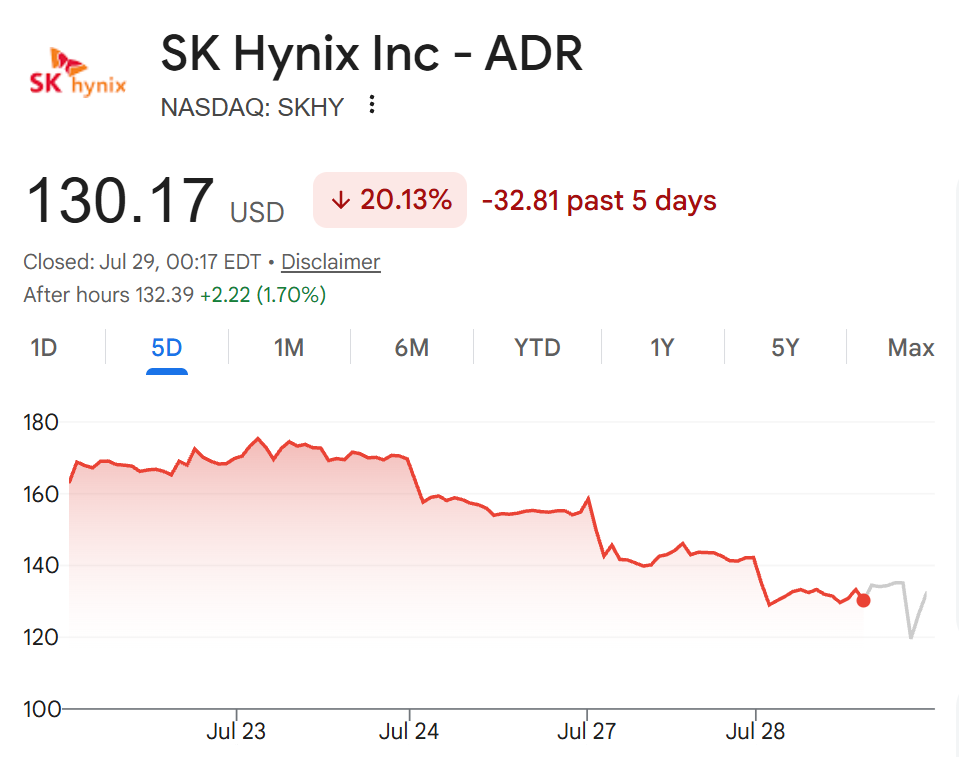
Les actions SK Hynix sont dans une tendance baissière, devenant une plateforme active pour les positions directionnelles avec effet de levier sur la plateforme Hyperliquid. | Source : Google Finance

Alors que le marché sud-coréen entrait dans une nouvelle correction, HIP-3 est l'une des plateformes où les traders peuvent parier sur la baisse et ouvrir immédiatement une position courte sur les actions SK Hynix.

À ce jour, le volume total des échanges sur le marché SKHX sur TradeXYZ a dépassé 20,9 milliards de dollars. Cela a entraîné un impact disproportionné, car les fluctuations brutales de l'indice ont provoqué des liquidations de positions longues.
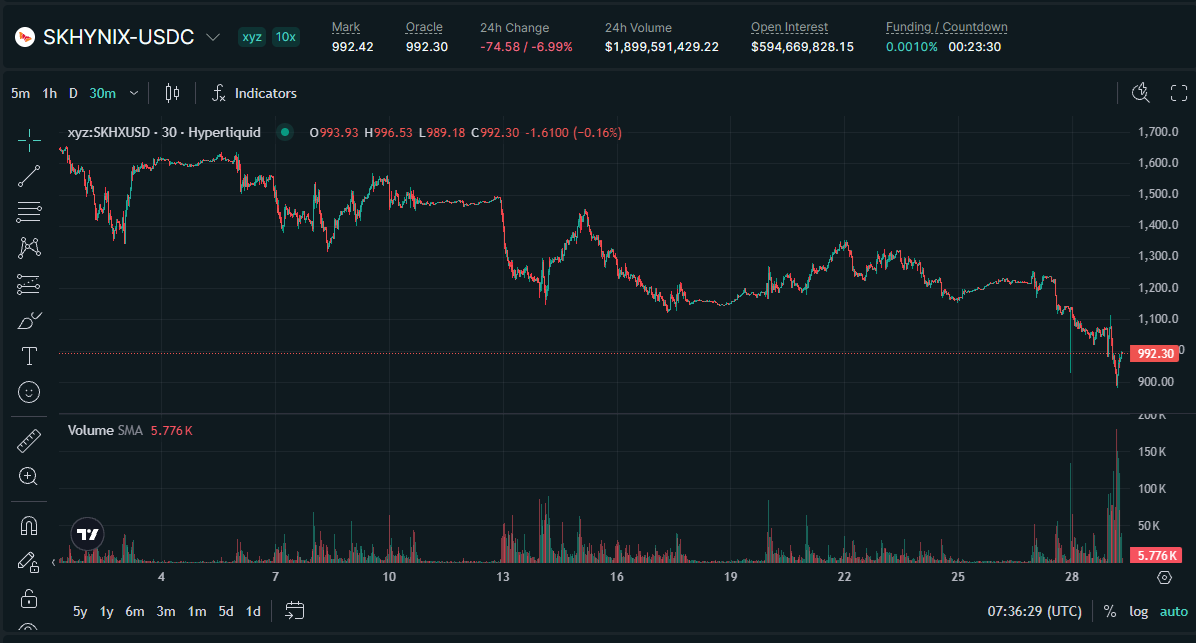
Pour SKHX, ce fut l'un des jours les plus actifs sur HIP-3, car le contrat a attiré des positions directionnelles fortes. | Source : Hyperliquid

Sur la bourse HIP-3 au 29 juillet, SKHX était le deuxième contrat à terme perpétuel le plus actif. L'intérêt ouvert sur le contrat a atteint 493 millions de dollars, et le volume des échanges sur les dernières 24 heures était de 589 millions de dollars. La journée passée a été l'une des plus actives pour le trading de SKHX en juillet.

Sur la bourse de contrats à terme perpétuels Lighter, on a également observé un prix anormalement bas, tombé à 839 dollars, mais ensuite la mèche de la bougie a disparu, et le marché affiche le statut « délisté ».

Pourquoi y a-t-il eu une vague de liquidations sur TradeXYZ ?

La société TradeXYZ a expliqué que les actions SK Hynix sont passées de 1 127,9 $ à 917,25 $ pendant les heures de trading asiatiques. TradeXYZ utilise des oracles pour accéder aux prix externes, et dans ce cas, l'oracle a fonctionné. Selon le développeur, le système d'oracle a fonctionné correctement, et les liquidations n'ont pas été causées par d'autres erreurs de la part de la bourse.

La bourse a promis de couvrir les pertes liées à l'anomalie de prix et dévoilera dans les prochains jours les critères pour obtenir une compensation.

Sur la bourse sud-coréenne NXT, SKHX, le prix a montré une anomalie de 29 % inférieure au prix de clôture du jour précédent. Le prix était effectivement faussé mais a été accepté par les oracles de TradeXYZ. Le prix des contrats à terme perpétuels sur HIP-3 a chuté de 17,9 % en quelques minutes, entraînant la liquidation de positions longues d'une valeur d'environ 57 millions de dollars pour 960 comptes de traders.

L'anomalie de prix est survenue à cause d'un ordre unique exécuté à 8h00 heure locale sud-coréenne, lorsqu'une seule action a été vendue à la limite basse journalière. À l'ouverture des marchés, un faible nombre d'ordres d'achat signifiait que cette vente d'une seule action a déterminé le premier prix de référence, qui a ensuite été distribué aux oracles pour le trading décentralisé.

Au cours des fluctuations de prix, la liquidité de TradeXYZ a absorbé environ 11 points de pourcentage, mais cela n'a pas pu sauver toutes les positions longues avec effet de levier.

Les grands investisseurs ont recommencé à vendre à découvert les SKHX

Le principal attrait de SKHX réside dans le potentiel de mouvements directionnels et la possibilité d'ouvrir des positions courtes alors que la croissance du secteur des semi-conducteurs ralentit.

Les positions sur SKHX sur le contrat comptent 108 grandes positions, ce qui en fait l'une des meilleures options sur la plateforme HIP-3. Parmi celles-ci, 48 sont des positions longues sur SKHX. La plus grande position est évaluée à 47,35 millions de dollars, et le profit non réalisé dépasse les 10 millions de dollars.

Ce même grand joueur ouvre également des positions courtes sur les actions Nvidia (Nasdaq:NVDA), ce qui reflète l'attitude générale concernant le trading des semi-conducteurs.


Trending Cryptos

Related Questions

QQuelle société s'engage à compenser les pertes des traders suite à l'effondrement des actions SK Hynix ?

ALa société TradeXYZ a annoncé qu'elle compensera les pertes des traders liées à la chute des actions SK Hynix.

QQuel a été le montant total des actifs liquidés en raison de la chute des actions SK Hynix sur TradeXYZ ?

ALa chute rapide des prix a entraîné la liquidation de positions longues pour un montant d'environ 57 millions de dollars.

QQuelle est la cause principale identifiée par TradeXYZ pour la vague de liquidations ?

ATradeXYZ a expliqué que l'anomalie de prix est survenue à cause d'un ordre unique exécuté à la bourse NXT en Corée du Sud, où une seule action vendue à la limite basse quotidienne a fixé un prix de référence erroné, repris par les oracles.

QSur quelle plateforme de trading décentralisée (DEX) l'activité sur les contrats SKHX a-t-elle été particulièrement élevée ?

AL'activité a été particulièrement élevée sur la plateforme HIP-3, où le contrat SKHX était le deuxième contrat perpétuel le plus actif.

QQuelle autre action majeure du secteur des semi-conducteurs un grand investisseur vendait-il à découvert, selon l'article ?

ASelon l'article, le même grand investisseur qui détenait une position importante sur SKHX ouvrait également des positions courtes sur les actions de Nvidia (Nasdaq : NVDA).

Related Reads

UNI Doubles in Two Months Against the Trend: A 5-Year-Overdue Value Realization

Amidst a generally stagnant crypto market in June and July, UNI, the governance token of Uniswap, saw a significant surge, nearly doubling in price from around $2.3 to $4.6. This rally represents a delayed but significant value reassessment, triggered by the practical implementation of its long-debated "fee switch" mechanism. The key turning point was the on-chain execution of the UNIfication proposal in December 2025. It activated a protocol fee on select pools, directed Unichain sequencer revenue (net of costs) to a communal treasury, executed a one-time burn of 100 million UNI, and established a system where all protocol revenue flows into a "TokenJar" contract. This treasury has a single exit: purchasing and permanently burning UNI via a "Firepit" contract. Initially, the market reacted tepidly as the generated revenue and corresponding burn rate were modest. The narrative shifted dramatically in July 2025 with two major developments. First, the launch of Robinhood Chain, tailored for tokenized stocks, rapidly became a primary source of volume and fees for Uniswap, at one point contributing nearly half of its weekly fees. Second, governance votes successfully expanded the fee mechanism to v4 pools and initiated a temperature check for fees on Robinhood Chain. The activation of v4 fees caused the protocol's daily revenue earmarked for UNI burns to nearly triple. The core of UNI's recent price action is the transition from a pure governance token to a cash-flow asset with a permanent, protocol-funded buyer. Its effectiveness is amplified by UNI's mature and widely distributed supply, with no major impending unlocks to dilute the impact of the buybacks. The sustainability of this rally now hinges on whether the transaction volume, particularly on Robinhood Chain, persists after its initial gas subsidies expire, determining if this is a genuine value realization or a subsidy-fueled spike.

marsbit53m ago

UNI Doubles in Two Months Against the Trend: A 5-Year-Overdue Value Realization

marsbit53m ago

Breaking: Google Earth Urgently Pulls Back Nano Banana 2 Image Generation Feature!

Google Earth's newly launched "Create image" feature, powered by the Nano Banana 2 AI image generation model, was abruptly withdrawn shortly after its release due to being "played" by users. The feature allowed users to generate and overlay AI-created visuals directly onto real-world satellite and 3D maps in Google Earth. The tool enabled creative applications like historical recreations (e.g., visualizing ancient Pompeii), generating informational graphics for landmarks, and envisioning architectural projects or futuristic cityscapes on real terrain. It operated under "geospatial grounding," meaning the AI respected the underlying geography, topography, and perspective of the chosen map view. The model also integrated with Gemini to retrieve relevant factual information. However, upon release, users quickly tested its limits. A prominent example involved reimagining Philadelphia's historic Independence Hall as a post-apocalyptic ruin overrun by "happy" zombies, evil clowns, and giant alien mechs. This highlighted both the feature's playful potential and its risks regarding the generation of inappropriate or misleading content on realistic maps, leading to its swift temporary removal. Google stated it would re-release the feature after implementing "enhanced guardrails." Analysts note this move strategically leverages Google's vast proprietary geospatial data, positioning its AI not just for artistic generation but for spatially accurate world visualization—a unique advantage in the competitive AI image generation landscape.

marsbit2h ago

Breaking: Google Earth Urgently Pulls Back Nano Banana 2 Image Generation Feature!

marsbit2h ago

Altman Admits: Overestimated AI Snatching Jobs! Huang Renxun: The Unemployment Narrative Is Completely Backwards

Sam Altman has revised his earlier predictions about AI rapidly replacing jobs, admitting he overestimated the speed at which AI would eliminate entry-level white-collar roles. Speaking on the "Invest Like the Best" podcast, he stated that people do not truly want an AI CEO, as accountability and human connection remain critical. He found that individuals prefer interacting with people who can be held responsible for decisions. Similarly, NVIDIA's Jensen Huang argued that the narrative of AI destroying jobs is misguided. He distinguishes between tasks and jobs, noting that while AI can automate specific tasks, entire jobs—encompassing communication, judgment, coordination, and accountability—are not eliminated. He cited examples like radiologists and software engineers, where demand for these roles has increased as AI handles repetitive tasks, allowing for business expansion and the creation of more positions. Data from a University of Maryland and LinkUp study supports this, showing that U.S. job postings for new graduates have actually risen, countering the fear of vanishing entry-level roles. However, a significant shift is occurring: the traditional entry-level tasks that help newcomers gain experience are being automated, making initial career access more challenging. The key insight is that as AI takes over standardized tasks, the enduring value of human work shifts toward areas of responsibility, trust-building, and final decision-making—aspects that AI cannot replicate. The real "moat" for professionals lies in these irreplaceable human elements.

marsbit2h ago

Altman Admits: Overestimated AI Snatching Jobs! Huang Renxun: The Unemployment Narrative Is Completely Backwards

marsbit2h ago

Trading

Spot

Hot Articles

What is USDC(WORMHOLE)

USD Coin (Wormhole): A Comprehensive Overview Introduction In the rapidly evolving world of cryptocurrencies, USD Coin (Wormhole), referred to as $USDC(Wormhole), stands out as a pioneering solution within the DeFi (Decentralized Finance) landscape. Operating on several blockchain platforms, including Solana, USD Coin (Wormhole) is more than just a digital representation of the United States dollar. It embodies the innovative spirit of modern finance, enabling seamless cross-chain transactions and enhanced interoperability among diverse blockchain ecosystems through the advanced Wormhole protocol. What is USD Coin (Wormhole)? USD Coin (Wormhole) is a tokenized version of the US dollar designed to facilitate frictionless transactions across different blockchain networks. Its primary aim is to bolster liquidity and enhance the functionality of the DeFi ecosystem. By leveraging the Wormhole protocol, which establishes a robust cross-chain communication network, users can effortlessly transfer USDC tokens across various platforms. This cross-chain capability marks a significant advancement in cryptocurrency use, promoting a more interconnected and efficient ecosystem where assets can flow freely between different blockchains. The value proposition of USD Coin (Wormhole) lies not only in its stability, being pegged to the US dollar, but also in its ability to bridge gaps between disparate blockchain environments. This innovative approach fosters a greater level of participation among users and developers, paving the way for new and exciting applications within decentralized finance. Who is the creator of USD Coin (Wormhole)? The origins of USD Coin (Wormhole) are intricately tied to the Wormhole network, which was developed by Jump Crypto. While specific individual creators are not prominently documented, Jump Crypto is notable for its involvement in advancing blockchain technology and supporting its applications in finance. By creating the Wormhole network, Jump Crypto has played a vital role in promoting cross-chain asset transfers, enhancing the efficiency and diversity of cryptocurrency usage. Who are the investors of USD Coin (Wormhole)? The success of USD Coin (Wormhole) is supported by investments from several notable funds and organizations within the cryptocurrency realm. Key investors include: Coinbase Ventures: A prominent venture capital arm backed by one of the leading cryptocurrency exchanges in the industry, Coinbase Ventures provides essential capital and strategic support to promising blockchain projects. Arrington XRP Capital: Specializing in digital assets, Arrington XRP Capital recognizes the potential of innovative projects like USD Coin (Wormhole) and has invested accordingly to back its development. Jump Trading: As the parent organization of Jump Crypto, Jump Trading brings not only investment but a wealth of expertise in trading technology and market dynamics to bolster the Wormhole project. How Does USD Coin (Wormhole) Work? The operational framework of USD Coin (Wormhole) is intricately designed to facilitate effective cross-chain transactions, maximizing security and efficiency. Here’s a simplified overview of how it functions: Asset Locking: When a user wishes to transfer USDC from one blockchain to another, they first lock their tokens on the source blockchain. This process ensures that the assets are secure and are set to be either burned or moved later. Token Minting: After the tokens are locked, an equivalent amount of USDC is minted on the destination blockchain. This provides the user with access to their funds on a new platform, reflecting the flexibility that the Wormhole protocol enables. Cross-Chain Transfer: The Wormhole protocol efficiently facilitates the entire transfer process. It ensures that once the USDC is minted on the destination chain, the equivalent tokens are burned on the source chain. The result is a seamless transfer of value between two distinct blockchain environments. This cross-chain methodology ensures that transactions remain secure and transparent, significantly enhancing liquidity within the different DeFi ecosystems. Timeline of USD Coin (Wormhole) Understanding the evolution of USD Coin (Wormhole) provides vital context for its significance in the cryptocurrency arena. Here’s a timeline highlighting important milestones in the project’s history: 2021: The Wormhole project is launched, establishing a framework for cross-chain asset transfers and setting the stage for the development of USD Coin (Wormhole). 2022: The Wormhole network experiences a significant challenge with a security breach that results in a $325 million theft. However, the incident is later addressed and refunded by Jump Crypto, showcasing the project’s commitment to security and transparency. 2023: USD Coin (Wormhole) integrates with Circle’s Cross-Chain Transfer Protocol (CCTP), enhancing its capabilities for cross-chain transfers and further solidifying its place within the DeFi ecosystem. 2024: Ongoing development and expansion of the Wormhole network continue, aimed at increasing the utility and reach of USD Coin (Wormhole) as well as enhancing its operational framework. Key Features The success of USD Coin (Wormhole) can be attributed to several key features that differentiate it from other cryptocurrency offerings: Cross-Chain Interoperability At the core of USD Coin (Wormhole) is its ability to facilitate seamless transfers across multiple blockchain networks. This interoperability serves as a cornerstone for decentralized finance, allowing various platforms to interact with each other, thereby accelerating the evolution of financial services. Security Wormhole employs a well-designed Guardian Network comprised of node validators that ensure secure cross-chain transactions. This collective oversight minimizes the risk of fraud and provides users with confidence that their assets are protected during cross-chain transfers. Liquidity Enhancement By enabling USDC to circulate freely across different blockchains, USD Coin (Wormhole) enhances liquidity in the DeFi ecosystem. This increased liquidity can foster more efficient trading, contribute to better pricing strategies, and improve the overall market dynamics encompassing various digital assets. Conclusion USD Coin (Wormhole) is a pivotal innovation in the blockchain space, reinforcing the capabilities of decentralized finance (DeFi) and establishing a more connected financial ecosystem. With its robust framework for cross-chain transactions, security features, and strong backing from reputable investors, USD Coin (Wormhole) is positioned to play a key role in the future of cryptocurrency. As the digital finance landscape continues to evolve, USD Coin (Wormhole) not only embraces the future of interconnectivity among blockchain networks but also reaffirms the power of tokenization and blockchain technology in transforming how we perceive and utilize value in a digital world. By navigating the complexities of cross-chain functionality, it demonstrates a sophisticated approach to enabling financial inclusivity and innovation in the world of cryptocurrencies.

1.6k Total ViewsPublished 2024.04.01Updated 2024.12.03

What is USDC(WORMHOLE)

What is W$C

World$tateCoin ($W$C): A Comprehensive Exploration of the Emerging Cryptocurrency Project Introduction In the ever-evolving landscape of cryptocurrencies, World$tateCoin ($W$C) has emerged as a project that aims to harness the power of web3 technologies to create a distinctive digital ecosystem. As traditional models of online interaction undergo significant transformation, World$tateCoin seeks to establish itself in this budding third generation of the internet. This article will delve into the intricacies of World$tateCoin, providing an overview of the project, its objectives, and its potential impact on the web3 space. What is World$tateCoin ($W$C)? World$tateCoin ($W$C) is designed as a cryptocurrency that facilitates seamless transactions within a web3 environment. Aimed at creating a decentralized platform where users can interact with various web3 applications, $W$C intends to streamline user experience and enhance accessibility to digital services. While the project aspires to become an integral part of the web3 landscape, detailed insights into its specific objectives and use cases remain limited, raising questions regarding its potential role and utility in a rapidly advancing digital context. The essence of web3 revolves around decentralization and empowering users with greater control over their interactions online. World$tateCoin intends to align with these principles, although specific applications and functionalities of the currency are still under discussion within the community. Who is the Creator of World$tateCoin ($W$C)? In exploring the origins of World$tateCoin, information regarding its creator remains elusive. As of now, there is no publicly available data identifying the individuals or organizations behind the project. This obscurity may cast a shadow of uncertainty over the project’s credibility, but the commitment to innovation within the cryptocurrency framework could be a driving force for its adoption in the future. The lack of identifiable leadership may result in hurdles related to trust and transparency—elements that are crucial for establishing a strong community in the crypto space. Who are the Investors of World$tateCoin ($W$C)? Current research does not reveal any specific investors or backing organizations involved with World$tateCoin. It is not uncommon for emerging cryptocurrency projects to either attract discreet investments or operate in a minimalist financial structure during their initial phase. The ambiguity surrounding investment supports and funding methodologies could affect the project’s sustainability and growth prospects. When assessing new projects within the cryptocurrency domain, investors generally look for transparency regarding financial backing and support from established entities. The absence of this information might necessitate a cautious approach for potential users and stakeholders interested in the future of World$tateCoin. How Does World$tateCoin ($W$C) Work? The operational mechanics of World$tateCoin are grounded in the principles of decentralization, a hallmark of web3 technologies. By facilitating transactions directly between users without the intervention of intermediaries, $W$C is designed to enhance trust and efficiency. However, comprehensive documentation detailing the unique features and operational framework that distinguish World$tateCoin from other cryptocurrencies is markedly sparse. This lack of information complicates the understanding of how $W$C functions within the broader web3 ecosystem and what unique propositions it brings to users and developers alike. Nevertheless, the fundamental goal of allowing for decentralized transactions holds the promise of a more liberated financial landscape, should the project deliver on its aspirations of implementing robust mechanisms and user-friendly interfaces. Timeline of World$tateCoin ($W$C) Constructing a timeline that encapsulates the historical progression of World$tateCoin poses challenges due to an absence of significant documentation on key events and milestones. Nevertheless, an approximate sequence of hypothetical phases can be envisaged, constituting a path forward for the project: Initial Concept (Date Unknown): Conceptualization of the World$tateCoin framework in the broader context of web3 technologies. Development Phase (Date Unknown): Commencement of technical development and coding processes. Community Engagement (Date Unknown): Outreach to potential users and stakeholders to foster community interest in the project. Launch Target (Date Unknown): Announcing an expected launch date, contingent on the progress of development and testing phases. Due to the lack of substantiated dates and details surrounding these phases, stakeholders will need to remain vigilant and engaged with the project's communications for updates regarding its trajectory. Key Topics About World$tateCoin ($W$C) As the project unfolds, certain key subjects arise that embody the potential and aspirations of World$tateCoin: Decentralization: The core philosophy driving the project, aimed at fostering direct user interactions. Web3 Integration: The goal of mirroring web3 principles and enabling seamless user access to an array of digital services. Digital Currency: Positioned as a currency to facilitate internet-based transactions, World$tateCoin aims to inject additional liquidity into the web3 market. Challenge of Information Scarcity: The notable absence of detailed information regarding the project's foundations, creators, and operational methods, necessitating increased transparency from developers to build community trust. Conclusion World$tateCoin ($W$C) is positioned within an exciting yet uncertain terrain of cryptocurrency and web3 integration. While it aims to cultivate a decentralized environment, the limited availability of information regarding its creators, investors, and specific functionalities presents challenges for potential stakeholders and users. In the dynamic world of cryptocurrencies, transparency, engagement, and well-structured communication are vital for the success of projects such as World$tateCoin. As the landscape continues to evolve, stakeholders will be eager to see how the project can solidify its place within the web3 narrative and contribute to the ongoing transformation of the digital ecosystem.

1.3k Total ViewsPublished 2024.04.01Updated 2024.12.03

What is W$C

How to Buy W

Welcome to HTX.com! We've made purchasing Wormhole (W) simple and convenient. Follow our step-by-step guide to embark on your crypto journey.Step 1: Create Your HTX AccountUse your email or phone number to sign up for a free account on HTX. Experience a hassle-free registration journey and unlock all features.Get My AccountStep 2: Go to Buy Crypto and Choose Your Payment MethodCredit/Debit Card: Use your Visa or Mastercard to buy Wormhole (W) instantly.Balance: Use funds from your HTX account balance to trade seamlessly.Third Parties: We've added popular payment methods such as Google Pay and Apple Pay to enhance convenience.P2P: Trade directly with other users on HTX.Over-the-Counter (OTC): We offer tailor-made services and competitive exchange rates for traders.Step 3: Store Your Wormhole (W)After purchasing your Wormhole (W), store it in your HTX account. Alternatively, you can send it elsewhere via blockchain transfer or use it to trade other cryptocurrencies.Step 4: Trade Wormhole (W)Easily trade Wormhole (W) on HTX's spot market. Simply access your account, select your trading pair, execute your trades, and monitor in real-time. We offer a user-friendly experience for both beginners and seasoned traders.

6.5k Total ViewsPublished 2024.04.02Updated 2026.06.02

How to Buy W

Discussions

Welcome to the HTX Community. Here, you can stay informed about the latest platform developments and gain access to professional market insights. Users' opinions on the price of W (W) are presented below.

活动图片